
Car Subwoofer Manufacturer: Two Rules, One Question
 ·
Updated October 16, 2026
·
11 min read
A car subwoofer is simple to describe and almost impossible to regulate, because it is two things at once. There is a speaker, which is plastic, paper, rubber and metal, and there is an amplifier, which is electronics. One of those is touched by a safety standard about fire and the other by a radio rule about interference — and both of those rules turn on the same question, which is not how the product is built but where it is used. In 245,845 federal recall records, the word subwoofer appears once.

1. What a Subwoofer Is Made Of, and the Four Things That Decide It
Open a car subwoofer and the parts are countable: a basket, a magnet and a voice coil, a cone, a surround, a spider, a set of terminals, an enclosure, a grille or trim ring, and — if it is a powered box — a circuit board with a power supply on it.
Which of those parts matter depends on which rule you are looking at, and the two rules do not look at the same list.
| Part | What it decides | Which rule sees it |
|---|---|---|
| The enclosure and trim | How the vehicle interior behaves in a fire | The interior-materials standard, if it is in the cabin |
| The grille and ring | The same thing, and they sit closest to the cabin air | The same standard, and this is the part that usually decides it |
| The circuit board | How much electrical noise the box makes | The radio rules, unless the exemption applies |
| The magnet and coil | Output, heat and how much the driver weighs | Nothing, until the mounting fails |
| The terminals and wiring | Whether a short can reach the amplifier | Nothing, and this is what both recalls in the file were about |
What this guide covers
- What a subwoofer is made of
- One rule for the plastic: the thirteen millimetres
- What the burn test actually does
- One rule for the electronics: the exemption
- The catch in the exemption
- One record in 245,845
- Both subwoofer recalls were fires
- The aftermarket amplifier recall
- What the radio recalls show
- What the file does not measure
- Five questions a subwoofer quote should answer
- Six checks before you order
- Frequently asked questions
2. One Rule for the Plastic: the Thirteen Millimetres
The rule that reaches the plastic in a subwoofer is 49 CFR 571.302, Federal Motor Vehicle Safety Standard 302, Flammability of interior materials. Its scope sentence is one line long and it contains the word that matters.
“This standard specifies burn resistance requirements for materials used in the occupant compartments of motor vehicles.”
The occupant compartment. The standard defines the space it is protecting as the occupant compartment air space, meaning the space inside the occupant compartment that normally contains refreshable air. Then it draws the line that decides whether your enclosure is covered:
“Any portion of a single or composite material which is within 13 mm of the occupant compartment air space shall meet the requirements of S4.3.”
Thirteen millimetres. Not the panel, not the assembly — any portion of any material within 13 mm of the cabin air. A grille cloth, a trim ring, the carpet on the front face of an enclosure, a plastic baffle: if it sits inside that band, its burn rate is a regulated figure.
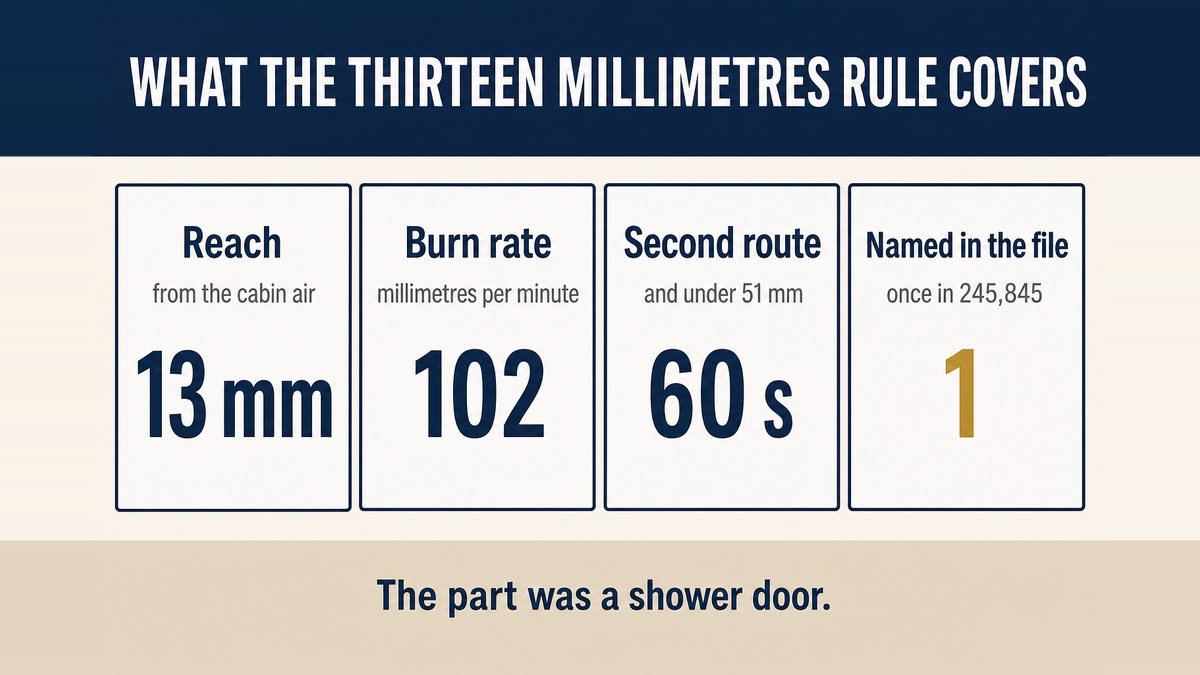
The requirement itself has two routes to a pass, which is unusual and worth knowing:
- The rate route. The material shall not burn, nor transmit a flame front across its surface, at a rate of more than 102 mm per minute.
- The early-stop route. If a material stops burning before it has burned for 60 seconds from the start of timing, and has not burned more than 51 mm from the point where timing started, it is treated as meeting the burn-rate requirement.
There is also a testing rule that decides how many samples a supplier has to run. Material that does not adhere to other material at every point of contact is tested separately. Material that adheres at every point of contact is tested as a composite with what it is bonded to. So a grille cloth glued to a plastic frame across its whole face is not a cloth sample and not a frame sample; it is one composite specimen, and it has to pass as one.
And then the counterweight: the standard applies to passenger cars, multipurpose passenger vehicles, trucks and buses. A subwoofer mounted in the boot of a saloon is outside the occupant compartment, so the standard does not reach it. The same product, with its grille and trim ring showing in a hatchback cabin or under a seat, is inside. The answer depends on the drawing, not on the part number.
3. What the Burn Test Actually Does
The test has more numbers in it than most buying teams expect, and they are the reason a factory cannot simply say “it passes 302”.
- The specimen is a rectangle 102 mm wide by 356 mm long wherever possible. Its thickness is the thickness of the material as used in the vehicle, except that material thicker than 13 mm is cut down to 13 mm, measured from the surface closest to the cabin air.
- The orientation is fixed: the specimen is cut in the direction that gives the most adverse result, and mounted so that the surface closest to the cabin air faces downward.
- The conditioning is 24 hours at 21 °C and 50 per cent relative humidity, and the test is run under those conditions.
- The chamber is a metal cabinet 381 mm long, 203 mm deep and 356 mm high, with a 13 mm clearance around the top and ten 19 mm holes in the base.
- The flame comes from a burner with a 10 mm tube, adjusted to a 38 mm flame with the tube vertical and the air inlet closed, and the specimen is exposed to it for 15 seconds.
- The timing starts when the flame from the burning specimen reaches a point 38 mm from the open end, and the burn rate is calculated as 60 × (distance ÷ time).
Two consequences follow for a supplier conversation. First, the specimen size means the material has to exist in a flat sheet large enough to cut a 102 by 356 mm rectangle; a small moulded ring cannot be tested as it stands, and a surrogate route has to be discussed. Second, the direction matters, and the most adverse direction is the one that must be used — so a laminate that passes one way and fails the other way is a failing material.
4. One Rule for the Electronics: the Exemption
If the box is powered, it contains a circuit board with a switching supply on it. In the United States, unintentional radiators are governed by 47 CFR 15.103, which opens with a list of devices that are exempt. The first entry is the one that matters here, and it is one sentence long.
“A digital device utilized exclusively in any transportation vehicle including motor vehicles and aircraft.”
Exclusively. The exemption is not for a device that happens to be used in a car. It is for a device that is used in nothing else. A subwoofer amplifier built only for vehicle electrical systems, sold only for that purpose, has a route out of the technical standards and the equipment authorisation. A dual-purpose amplifier, or a power supply that can be fed from a mains adaptor, or a box with a wall socket on the back for bench use, has given that route up.
The preamble to the section also defines what the exemption is worth, and then removes most of the comfort from it. An exempted device is subject only to the general conditions of operation of the two general sections, and is exempt from the specific technical standards and other requirements of the part. The operator has to stop using it if the Commission finds it is causing harmful interference, and may not resume until the cause is fixed. And the section adds a sentence that a supplier should read carefully, because it is the difference between an exemption and a free pass:
“Although not mandatory, it is strongly recommended that the manufacturer of an exempted device endeavor to have the device meet the specific technical standards in this part.”
In other words, the exemption removes the paperwork, not the physics. A car subwoofer that interferes with the vehicle’s own radio reception is a customer complaint whether or not it is exempt, and an exempted device can be ordered off the air on a finding of interference.
5. The Catch in the Exemption
The exemption is written for a device. A powered subwoofer is not a device. It is several, and the same section says what happens when that is the case.
“Responsible parties should note that equipment containing more than one device is not exempt from the technical standards in this part unless all of the devices in the equipment meet the criteria for exemption. If only one of the included devices qualifies for exemption, the remainder of the equipment must comply with any applicable regulations. If a device performs more than one function and all of those functions do not meet the criteria for exemption, the device does not qualify for inclusion under the exemptions.”
Read that as a checklist rather than a rule. A powered box with a switching power supply, a digital signal processor, a Bluetooth receiver and a class D output stage contains at least four things that can be looked at separately. If the Bluetooth receiver is a radio that needs its own authorisation, or if the power supply is built to accept a mains adaptor, the box is not exempt as a whole, and the question moves from the exemption to the ordinary route.
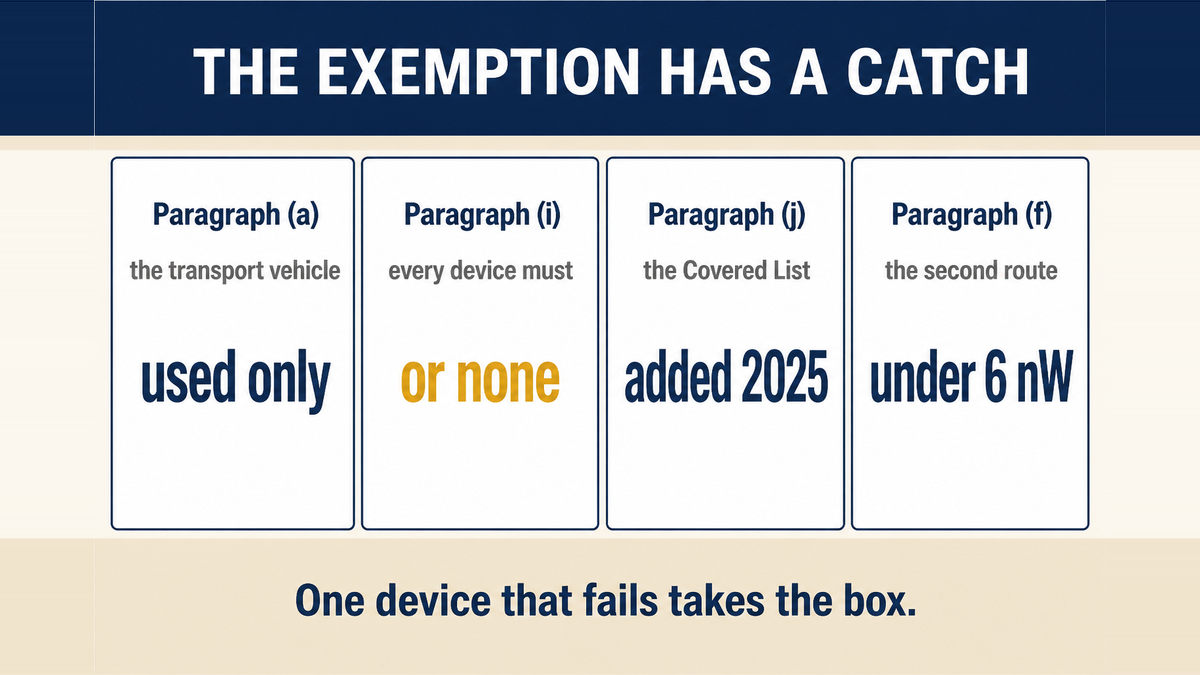
There is one more entry on that list, and it is the newest and the most consequential for an importer. The section now opens with a condition that overrides the rest: the rules governing certification apply to any equipment produced by any entity identified on the Covered List, established under a separate section of the same chapter. That condition was added by a Federal Register amendment in August 2025. The practical effect is that an exemption which used to turn purely on what the product does can now also turn on who made it — which means the manufacturer’s name on the file is itself part of the diligence.
6. One Record in 245,845
Method first. The federal recall file holds 245,845 records and no header row, so every field of every record is scanned rather than trusting a column map. Controls: brake appears in 28,639 records and air bag in 16,162.
Then search for the product, and the result is the smallest in this series so far. The word subwoofer, checked on a word boundary, appears in one record. The word woofer in two. And tweeter appears in none.
Around the edges of the product the counts are larger, and each one tells you what the file thinks a car audio system is made of. Speaker appears in 162 records, amplifier in 260, stereo in 23, head unit in 219. The taxonomy for the radio is EQUIPMENT:ELECTRICAL:RADIO/TAPE DECK/CD ETC. — a name assembled when a car radio still had a tape deck in it, and still in use for the largest audio campaign in the file.
Two absences are worth noting before the campaigns. The phrase “burn rate”, the core number of the interior-materials standard, appears in no record at all. And FMVSS 302 is named by number in exactly one campaign out of 245,845 — a motorhome whose shower door did not meet the standard. The rule that governs the plastic in a subwoofer has been cited once, and never for audio equipment.
7. Both Subwoofer Recalls Were Fires
Now to the campaigns, and there is a symmetry in them that is worth pausing on. Both are in the trunk, both begin with a short circuit, both end at the amplifier, and neither is about sound.
- Toyota, campaign 15V047000, 51,495 Avalons from 2011 to 2012: the sub-woofer speaker located in the trunk could experience an intermittent electrical short, which could damage the integrated circuit in the audio amplifier. In some cases the damaged circuit could then allow a constant electrical current flow to the sub-woofer. The consequence in the record is a fire risk from overheating. The remedy was to replace the audio system amplifier and to install a protective cover around the sub-woofer.
- Subaru, campaign 17V625000, 9,178 WRX and WRX STI cars from 2015: vehicles with a factory-installed subwoofer in the trunk, where items carried in the trunk could push the subwoofer wiring against the subwoofer metal frame, causing an electrical short. The short could damage the subwoofer amplifier and overheat the subwoofer. The remedy was to inspect the wire, fit a wire retainer clip, and replace the subwoofer where needed.
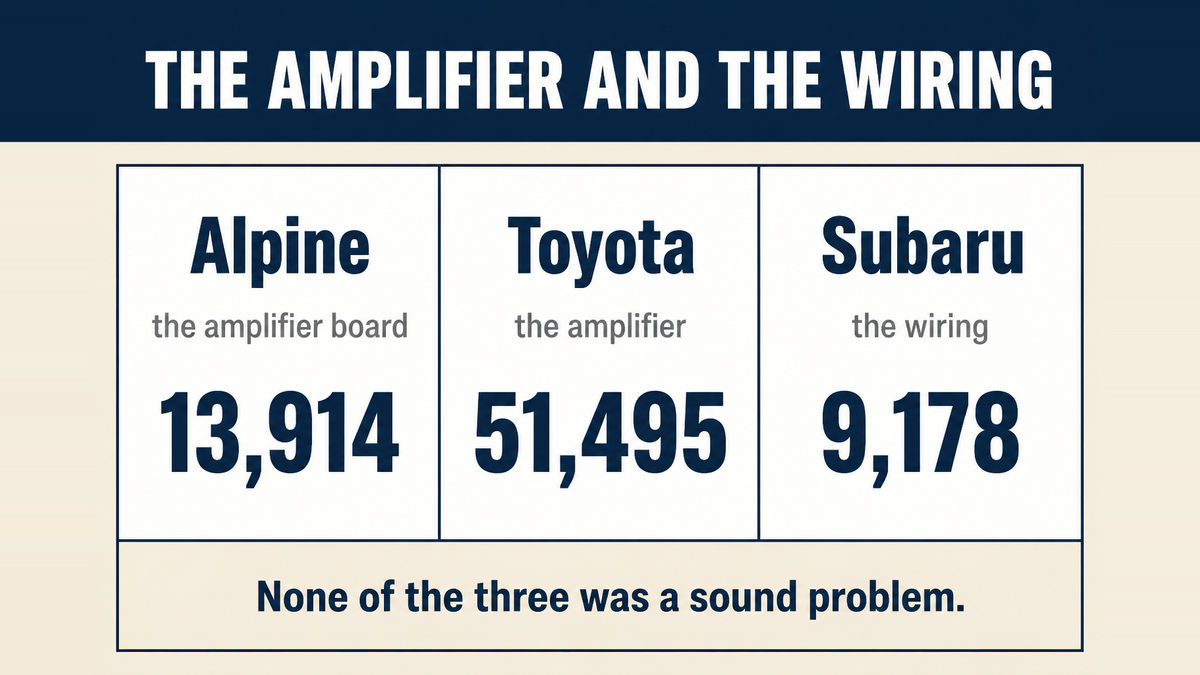
Three lessons sit in those two paragraphs, and they are all about parts that appear nowhere on a subwoofer specification sheet.
The first is that the failure lives in the wiring and the amplifier, not in the driver. A subwoofer driver is a coil in a magnetic gap; it fails by sounding wrong. A subwoofer that burns fails because something upstream of it kept sending current it could not shed.
The second is that both remedies were packaging fixes — a protective cover, a retainer clip. Neither car maker changed the driver or the enclosure. If you are sourcing a powered box, the question that would have prevented both campaigns is not about the speaker at all: what physically stops the wiring from touching the frame, and what stops a short from reaching the board?
The third is the location. Both of these units were in the trunk, which is the one place FMVSS 302 does not reach. The single safety standard that could have caught them never applied, and the one that did apply was about wiring and current. That is the whole shape of this product in one pair of recalls.
8. The Aftermarket Amplifier Recall
One amplifier campaign in the file was filed by an amplifier company rather than a car maker, and it is the closest thing to a pure audio-product recall.
Alpine, campaign 15E069000, 13,914 audio amplifiers across three models — PDR-F50, PDR-M65 and PDR-V75 — made between 1 December 2013 and 1 July 2015. The cause is described in six words that a buyer can act on: “due to a manufacturing error, the power circuit board (PCB) may develop an abnormal hot spot.” The stated risk is a vehicle fire. The remedy was to replace the amplifier.
Two details in that filing are worth copying into your own paperwork. The first is that the fault is a manufacturing error rather than a design error, which means it came and went within a production window. A recall defined by a window is only actionable if the boards carry a way to identify themselves, so lot and date marking on the board is a safety feature, not a manufacturing convenience. The second is that the quantities are small — 13,914 units against a driver product that ships in hundreds of thousands — and the consequence is still a fire. Low volume is not low risk on a part that carries current.
The component field for that campaign is EQUIPMENT:ELECTRICAL, the same shelf the jump starters and the GPS tracker landed on. An aftermarket amplifier is filed as equipment, by the company whose name is on it, with model year 9999.
9. What the Radio Recalls Show
The largest campaigns in the audio group are not about amplification at all, and they deserve a section of their own because they change what a speaker is in a modern vehicle.
- Chrysler, campaign 15V461000, 1,416,903 vehicles across Ram trucks, Chrysler, Dodge and Jeep models: the fitted radios had software vulnerabilities that could allow third-party access to networked vehicle control systems, and exploiting them could allow unauthorised remote modification and control. The remedy was a software update, mailed on a USB drive or downloaded by the owner. This is the largest audio-related campaign in the file and it is a computer security case.
- General Motors, campaign 16V257000, 317,572 Sonics, Traxes and Sparks: the radio could fail to give the audible warning chime when the key was left in the ignition, so the vehicles do not meet FMVSS 114, Theft Protection. The remedy was a radio software update.
- Tesla, campaign 22V235000, 594,894 vehicles: the Boombox function could play sound through the external speaker while the vehicle was moving, obscuring the Pedestrian Warning System, so the vehicles do not meet FMVSS 141, Minimum Sound Requirements for Hybrid and Electric Vehicles. The remedy was an over-the-air update that disables the function in Drive, Neutral and Reverse.
- Mazda, campaign 23V553000, 17,600 CX-90s: the software in the approaching-vehicle sound system amplifier could be missing, producing inaccurate external warning sounds. The remedy was an update to that amplifier’s software.
- Toyota, campaign 26V203000, 73,528 Corolla Cross Hybrids from 2023 to 2025: the vehicles may not make adequate external warning sounds when reversing. Filed in March 2026, and again this is FMVSS 141.
Three of the five turn on the same standard, and it is worth naming what that standard does. FMVSS 141 requires a quiet vehicle to make a sound, so that a pedestrian can hear it coming. That makes the speaker a safety device, and it makes the amplifier that drives it a safety device as well — one of the Mazda remedies is literally to update the amplifier’s software. The pedestrian alert speaker is not the subwoofer, but it is the same component family and often the same supplier, and the recalls show which of the two is now carrying a legal duty.
The fourth campaign is stranger still. A radio that fails to chime because a key was left in the ignition is a failure of FMVSS 114. So in this file a car radio has been recalled for a security vulnerability, for failing a theft-protection standard and for making the wrong kind of noise — and no audio product in 245,845 records has ever been recalled for failing the flammability standard that actually covers its materials.
10. What the File Does Not Measure
One last set of counts is worth putting on the table, because it says which numbers are safety numbers and which are sales numbers.
| Term | Records | What it means |
|---|---|---|
speaker | 162 | Present, but mostly as a pedestrian alert device |
amplifier | 260 | Present, and this is where the fires are |
head unit | 219 | Present, as the radio |
enclosure | 122 | Present, and mostly in the caravan and trailer world |
watt | 85 | Almost absent |
ohm | 4 | Effectively absent |
tweeter | 0 | Absent |
burn rate | 0 | Absent, and this is the regulated figure |
The three numbers a subwoofer is sold on — power handling, impedance and sensitivity — are barely in the file, and the regulated number, burn rate, is not in it at all. That is not a contradiction; it is the difference between two documents. A specification sheet records what a product is meant to do. A recall file records what went wrong with it. Power handling and impedance almost never cause a recall, which is why a buying team can spend a week on them and still miss the two things that do: where the wiring runs, and which way the current goes when it should not.
11. Five Questions a Subwoofer Quote Should Answer
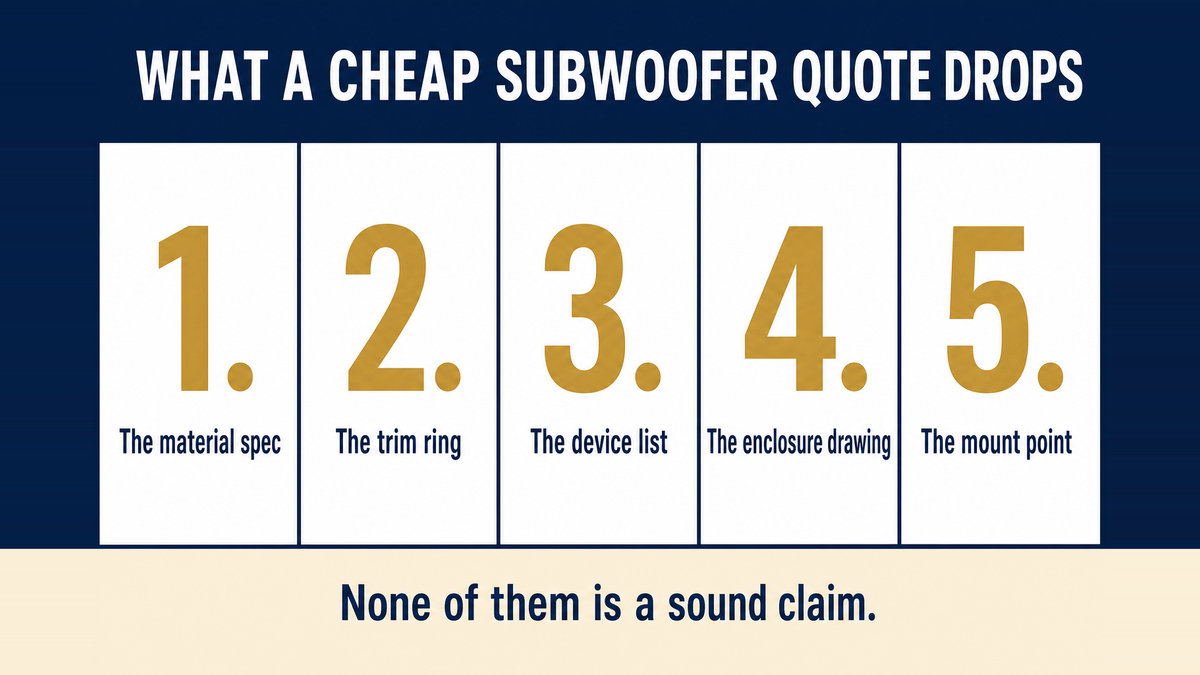
A subwoofer quote usually carries a size, a power figure, an impedance and a price. Four numbers, none of which appears in the recall file with any weight. Here are the five that do.
- Where will the grille and the trim ring sit, and is any material inside the band? Ask for the mounting drawing with the cabin air line marked on it. If any portion of any material is within 13 mm of the cabin air space, its burn rate is a regulated figure and it needs a test on the composite as bonded.
- Can you give me a burn test on the composite, cut in the most adverse direction? Material that does not adhere at every point of contact is tested separately; material that does is tested as a composite. The specimen is a 102 by 356 mm rectangle, oriented with the cabin-facing surface downward.
- Is the amplifier used exclusively in a vehicle, and is every device inside the box within that? The exemption applies to a digital device used exclusively in a transport vehicle, and equipment with more than one device is exempt only if all of them qualify. A Bluetooth receiver or a mains adaptor can quietly move the whole box onto the ordinary route.
- What are the board lot dates, and how are they marked? The one aftermarket amplifier recall in the file was a manufacturing error inside a production window. A window you cannot identify is a window you cannot contain.
- What stops the wiring touching anything metallic, and what protects the amplifier from a short? Both subwoofer campaigns in the file began with a short and ended at the amplifier, and both were fixed with a cover and a clip rather than with a better speaker.
12. Six Checks Before You Order
- The material specification, with the burn test attached rather than promised, and with the test done on the material as it is used in the vehicle.
- The 13 millimetre measurement on the drawing, taken from the cabin air line to the nearest portion of any material, including the grille cloth, the ring and the carpet.
- The specimen feasibility — whether a flat 102 by 356 mm specimen can be cut from the material in the form you are buying it, and if not, what surrogate route the factory proposes.
- The device list inside a powered box, worked through against the exemption paragraph by paragraph, before anything is tooled.
- The board lot control and the wire routing drawing, because that is where the two fires in the file came from.
- The mount and the enclosure material, checked against where the box is going to sit, because in the cabin the material rule applies and in the trunk it does not.
That list is what a factory audit turns into questions and a pre-shipment check turns into photographs. On a subwoofer the two checks are unusually cheap, because the difficult parts of the product — the driver and the magnet — are not where the risk is. The risk is in a 13 millimetre band of material and a wire that has to stay away from a frame.
Then there is the matter of the word. Your customer calls it a subwoofer, and the catalogue calls it a driver sensitivity figure. FMVSS 302 calls it interior material, and reaches it or not depending on a 13 millimetre band. The radio rules call it a digital device, and exempt it or not depending on what else is in the box. And the recall file, across a quarter of a million records, calls it almost nothing at all. Which of those four descriptions you are ordering against decides which document you need, and it is decided long before the price.
Frequently Asked Questions
Is there a safety standard for car subwoofers?
Not one written for subwoofers. If any part of the product is inside the occupant compartment, 49 CFR 571.302 governs the burn behaviour of the materials, and it reaches any portion of any material within 13 mm of the occupant compartment air space. If the product is powered, 47 CFR 15.103 decides whether its electronics are exempt from the radio interference rules. Beyond those two, a subwoofer is a performance product, which is why the recall file has so little in it.
What is the 13 millimetre rule?
It is the reach of the interior materials standard. Portions of a vehicle occupant compartment — trim panels, floor coverings, headlining and other interior materials — have to meet a burn requirement, and the standard specifies that any portion of a single or composite material within 13 mm of the occupant compartment air space is covered. So a grille cloth or a trim ring that sits just inside the cabin line is a regulated material, and the same part buried deeper behind trim may not be.
Does a powered subwoofer need FCC approval?
It may be exempt, and the test is narrower than most suppliers assume. A digital device used exclusively in a transportation vehicle, including a motor vehicle, is on the exempted list. Exclusively is the operative word: a box built only for vehicle electrical systems qualifies, and a box that can also run from a mains adaptor, or whose power supply is dual purpose, does not. The exemption is also not a free pass — an exempted device is still subject to the general conditions of operation and can be ordered off the air on a finding of harmful interference.
What does the exemption not cover in a multi-device box?
Equipment containing more than one device is exempt only if every one of the devices meets the criteria. If just one of them qualifies, the rest of the equipment still has to meet the applicable rules, and a device that performs more than one function does not qualify unless all of those functions do. A powered subwoofer with a switching supply, a digital signal processor and a Bluetooth receiver therefore needs to be looked at as several devices rather than as one product. There is also a newer condition on the same section, added by amendment in August 2025, that makes the certification rules apply to equipment from any entity on the Covered List.
Do subwoofers actually get recalled?
Twice, in this file, and both were fires rather than sound complaints. Toyota recalled 51,495 Avalons because a sub-woofer in the trunk could short intermittently and damage the amplifier circuit, which could then feed a constant current to the driver; the remedy was an amplifier and a protective cover. Subaru recalled 9,178 WRX cars because items in the trunk could push the subwoofer wiring against its metal frame, with the same result; the remedy was a wire retainer clip. Both units were in the trunk, where the interior materials standard does not reach.
What is FMVSS 141, and why does it involve a speaker?
It is the minimum sound standard for hybrid and electric vehicles, and it exists so that a pedestrian can hear a quiet vehicle approaching. Because that sound comes from a speaker and an amplifier, both become safety devices for the purposes of the standard. Three campaigns in the file turned on it: Tesla recalled 594,894 vehicles because a function could play sound through the external speaker and obscure the warning, Mazda recalled 17,600 because software could be missing from a warning-sound amplifier, and Toyota recalled 73,528 Corolla Cross Hybrids in March 2026 because the reverse warning might not be adequate.
A subwoofer is a material, a mechanism and a piece of electronics in one box, and each of the three is judged somewhere different. The rule that reaches its plastic turns on a 13 millimetre band. The rule that reaches its electronics turns on whether the box is used exclusively in a vehicle and whether every device inside it qualifies.
And the only two subwoofer recalls in a quarter of a million records were fires that started in a wire and ended at an amplifier. Ask for the mounting drawing with the cabin line on it, ask for the burn test on the composite, ask for the device list, and ask what stops the wiring touching the frame.
Resin, Additive, and the Rate They Produce
We return the resin and additive in the moulding, the burn rate measured on a coupon, and whether the electronics exemption still reaches you.
Get My Material Sheet
Questions & Comments
We read every one and reply within 24 hoursA car subwoofer is an enclosure, a driver and a load on the electrical system, each judged separately. Send the box drawing and the vehicle, and we will check impedance, mounting depth and the fuse.