
Wiper Blades Wholesale: The Part the Clause Never Names
 ·
Updated October 22, 2026
·
12 min read
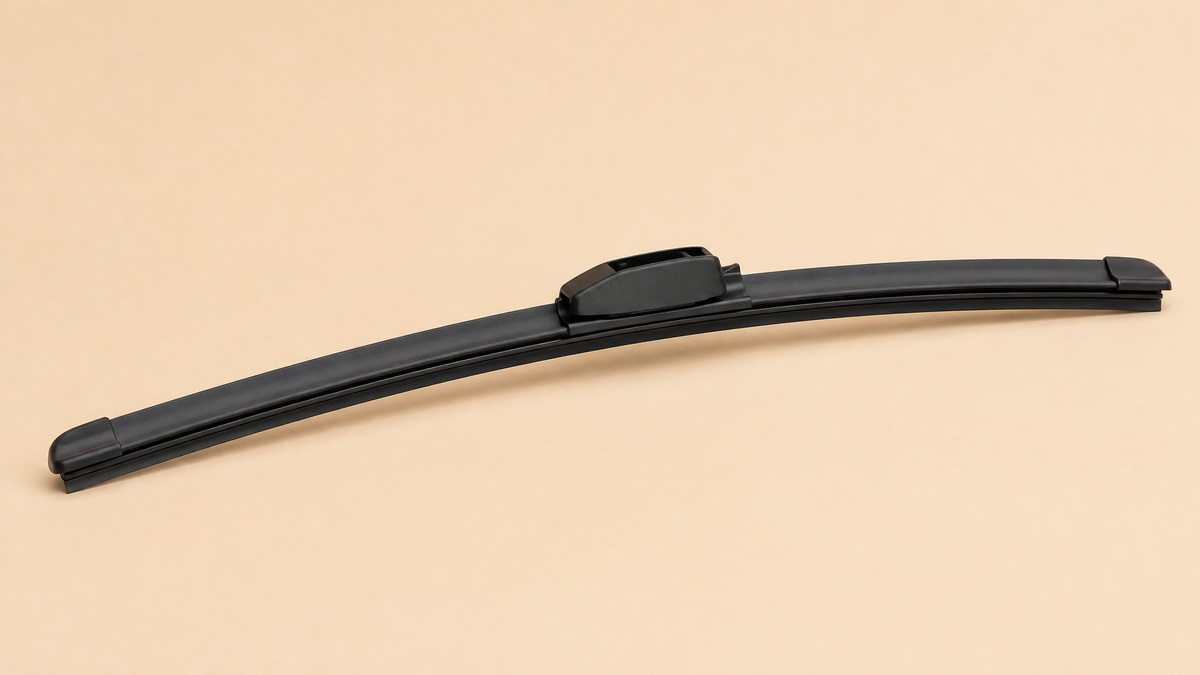
A wiper blade is the cheapest part on a service counter and the only one whose job is written into a federal standard that never says its name. The standard sets its requirements on the vehicle's wiping and washing system: at least two speeds, a floor of 45 cycles per minute for one of them, and a wet test that has to clear 80, 94 and 99 per cent of three measured areas of the windshield. Read the clause closely and you find that not one of those numbers is addressed to the blade in the carton. This article reads FMVSS 104 clause by clause, works out what a replacement blade can and cannot be asked to carry, and sets out the six lines a wholesale order document should state before a container leaves.
1. The Standard That Never Says the Word Blade
Start with what the clause covers, because the answer is narrower than the product range. The section opens with a scope sentence and an application sentence, and both of them are about vehicles:
“S1. Scope. This standard specifies requirements for windshield wiping and washing systems. S2. Application. This standard applies to passenger cars, multipurpose passenger vehicles, trucks, and buses.” — 49 CFR § 571.104
Two systems, four vehicle classes, and no part. The next requirement paragraph keeps the same shape: each vehicle shall have a power-driven windshield wiping system that meets the frequency and wiped-area requirements. The subject of the sentence is the vehicle. The blade is what that system holds against the glass.
That is not a drafting accident, and it is not a gap that leaves the blade outside the law either. Two definitions in the statute settle the position. The first says what equipment is:
“(8) motor vehicle equipment means — (A) any system, part, or component of a motor vehicle as originally manufactured; (B) any similar part or component manufactured or sold for replacement or improvement of a system, part, or component, or as an accessory or addition to a motor vehicle …” — 49 U.S.C. § 30102(a)(8)
So a blade made for replacement is equipment in the statutory sense. The second definition says who counts as its maker, and it is the sentence most often missed in a sourcing conversation:
“(6) manufacturer means a person — (A) manufacturing or assembling motor vehicles or motor vehicle equipment; or (B) importing motor vehicles or motor vehicle equipment for resale.” — 49 U.S.C. § 30102(a)(6)
Put the three clauses together and the position of your carton becomes clear. A wiper blade is equipment. It is equipment that no federal standard names, because the wiping standard writes its duties on the vehicle. And the party importing it for resale is the manufacturer in the eye of the statute, with the prohibition that follows from that name: nobody may import or sell equipment covered by an applicable standard unless it complies and is covered by a certification.
The practical reading is worth saying plainly, because suppliers get it wrong in both directions. A blade cannot be described as DOT approved, because there is no approval step for it and no standard of its own to pass. At the same time, a blade is not outside the framework: it is replacement equipment for a system that has to meet a standard, and the party putting it on the market carries the responsibility that comes with the word manufacturer.
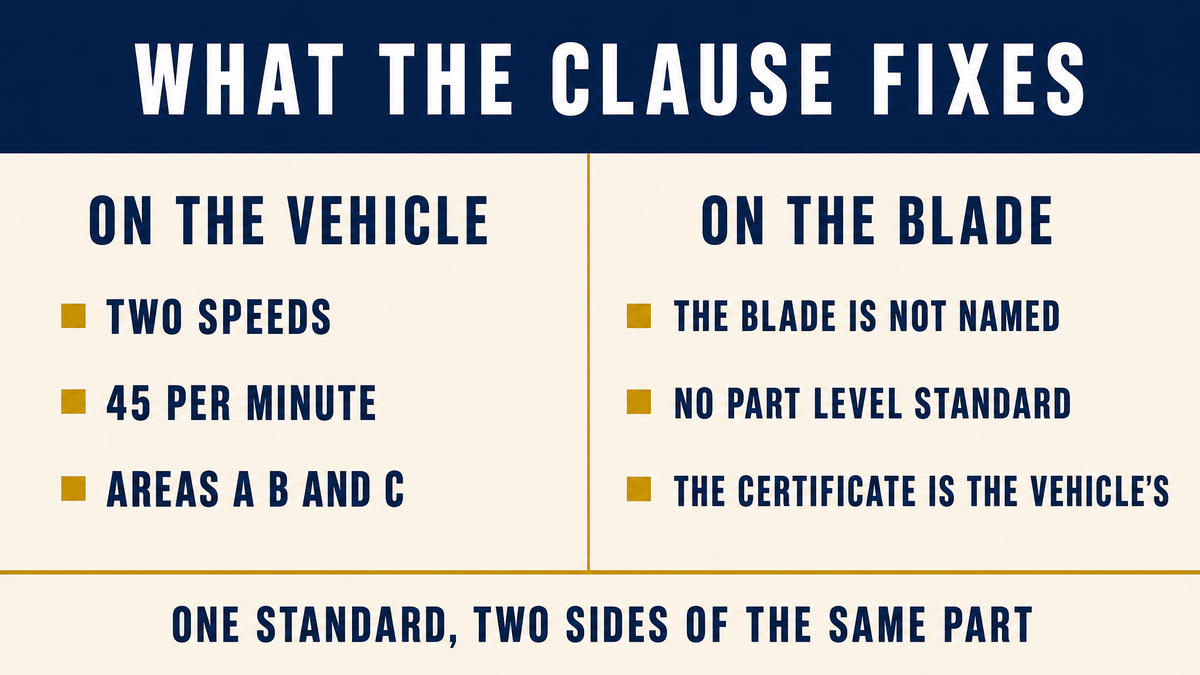
There is a second reason the clause is worth reading this way, and it changes what a buyer should ask for. When a requirement is written on a system, the party who certifies it is the vehicle maker, and the evidence lives with the vehicle. What a blade supplier can offer instead is not a certificate for the blade. It is a statement about the vehicle the blade was designed against, and the two facts that make that statement checkable are the length and the interface. Both belong in the order, and both are covered below.
2. What the Clause Actually Measures
The frequency requirements are three sentences, and they are unusually tight for a part that costs so little. The first sets the count of speeds, and the second sets a floor that has to hold whatever the engine is doing:
“S4.1.1.1 Each windshield wiping system shall have at least two frequencies or speeds. S4.1.1.2 One frequency or speed shall be at least 45 cycles per minute regardless of engine load and engine speed.” — 49 CFR § 571.104
The third sentence adds the relationship between the two speeds, and it is the one that decides whether a system has two real speeds or one speed and a decoration. The highest speed and one lower speed must differ by at least 15 cycles per minute, and that lower speed must itself be at least 20 cycles per minute, again with no dependence on engine load or engine speed.
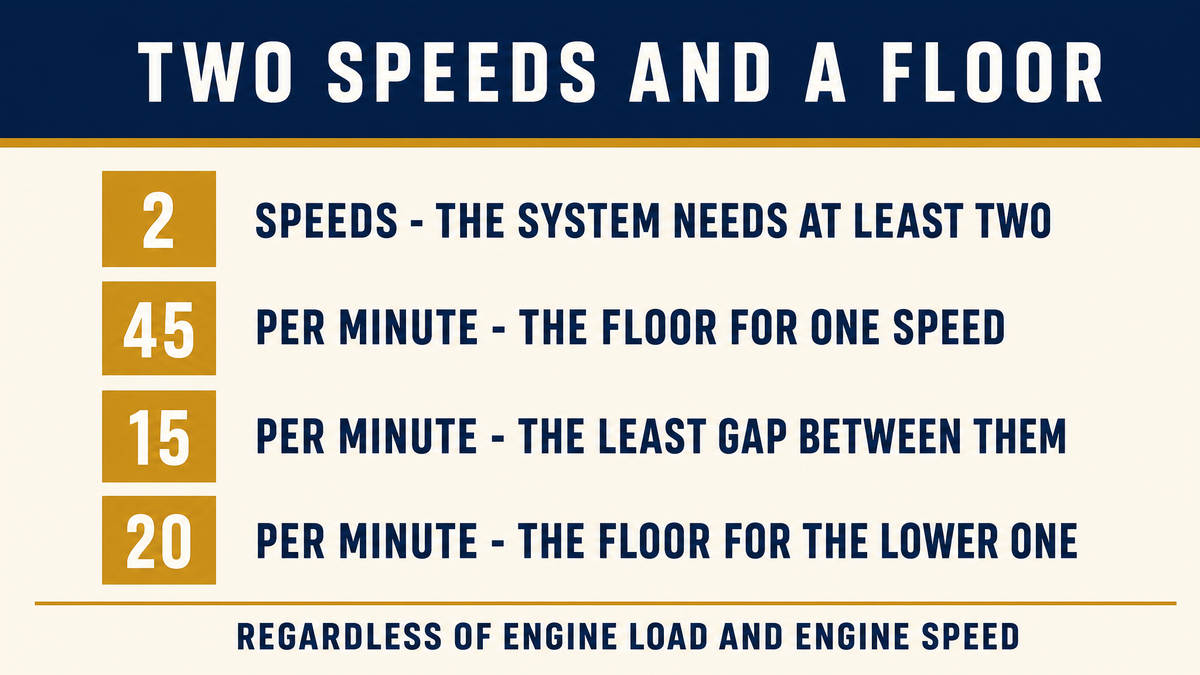
Two things follow that matter on a quotation. First, the numbers are about the system, so a blade change cannot move them and a blade claim should not pretend to. A supplier who says a blade improves the wipe speed is describing something the clause did not put in the blade's hands. Second, the phrase regardless of engine load and engine speed is the part worth remembering, because it is what separates a tested system from a system that works in a car park.
Those two paragraphs may be shown to be met by testing under sections 4.1.1 and 4.1.2 of SAE Recommended Practice J903a (1966), which the clause incorporates by reference. That reference is the hinge of the whole standard. The performance test is not written out in the regulation; it sits in a 1966 recommended practice, and the regulation adopts it by name. When a supplier speaks about testing to the standard, the useful question is which document the test followed and which vehicle the system was on.
The washing half of the system has its own clause, and it is written in a way that is worth reading once. A passenger car's washing system must meet SAE Recommended Practice J942 (1965), with one sentence of that practice deleted and replaced. The deleted words point at a wipe pattern defined in J903; the substituted words point at the areas established under standard 104 itself. For multipurpose passenger vehicles, trucks and buses, the substitution is different again: the manufacturer's own designed pattern takes the place of the reference. So the washer is regulated by reference to the wiper, and on the heavier classes it is regulated against nothing outside the maker's own drawing.
That last point is the first place a buyer sees the shape of this category. On a passenger car, the washer and the wiper share one measured geometry. On a truck or a bus, the same clause hands the pattern back to the manufacturer, and the only external check left is the vehicle maker's own statement. If you are quoting blades into more than one vehicle class, the paperwork that supports the claim is not the same paperwork in each class.
3. Three Areas and a 25 Millimetre Border
The wiped-area paragraph is where the standard stops being about a switch and starts being about geometry. It runs the test wet, under SAE J903a, and then asks for a percentage of three named areas. The same paragraph also draws a boundary around the whole exercise:
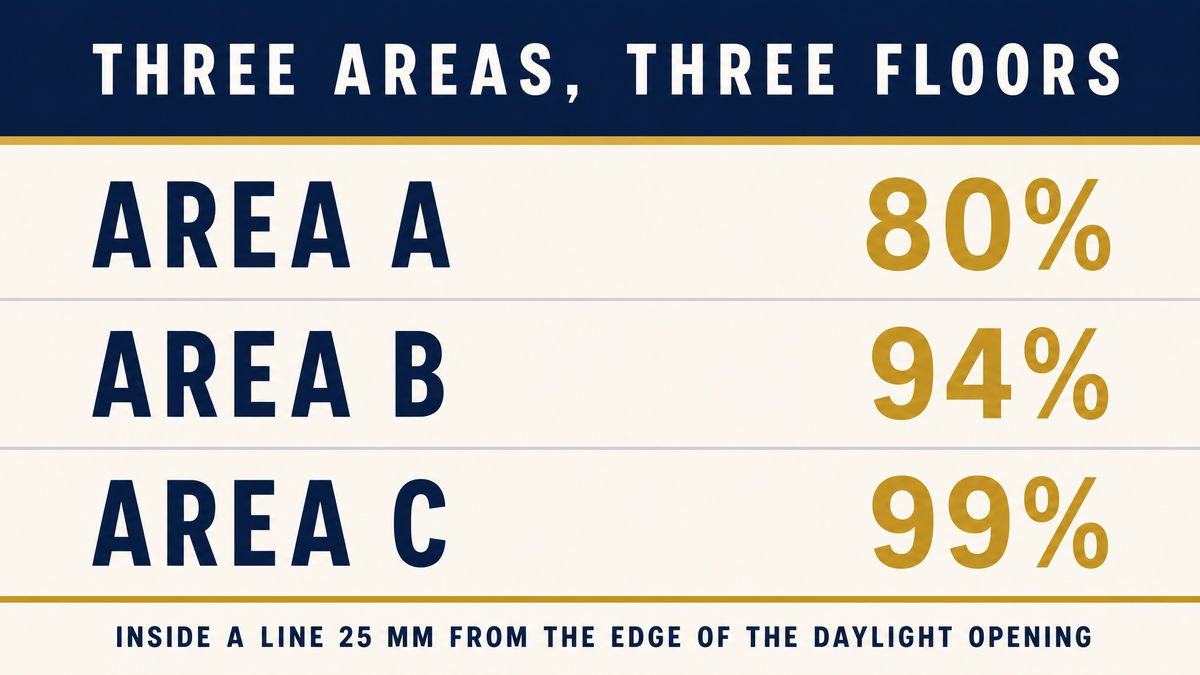
“S4.1.2 Wiped area. When tested wet in accordance with SAE Recommended Practice J903a (1966) … each passenger car windshield wiping system shall wipe the percentage of Areas A, B, and C of the windshield … that (1) is specified in column 2 of the applicable table following subparagraph S4.1.2.1 and (2) is within the area bounded by a perimeter line on the glazing surface 25 millimeters from the edge of the daylight opening.” — 49 CFR § 571.104
Two things in that sentence are worth more than the rest of the clause to a buyer. The first is that the measurement is wet, which is the condition the product exists for. The second is the 25 millimetre line, because it defines the region in which wiping is counted: coverage outside that line is not scored, and coverage inside it is.
The percentage is the same in every table in the clause, and it is the number to carry in your head: Area A 80 per cent, Area B 94 per cent, Area C 99 per cent. What changes between the tables is not the percentage but the angles that fix where the areas sit, and the tables are keyed to the vehicle's overall width.
S4.1.2.1 establishes Areas A, B and C as shown in Figures 1 and 2 of SAE J903a, using the angles in columns 3 to 6 of Table I, II, III or IV, as applicable. Each row of each table gives four angles in degrees — left, right, up and down — and the four tables carry four different width bands, from passenger cars of less than 1520 millimetres in overall width up to cars of 1730 or more.
Areas A, B and C: the floors, and how far the angles move
| Area | Minimum percent to be wiped | Left angle, across the four tables | Right angle, across the four tables |
|---|---|---|---|
| A | 80 | 16° to 18° | 49° to 56° |
| B | 94 | 13° to 14° | 46° to 53° |
| C | 99 | 7° to 10° | 15° in all four |
Read the table as a buyer and one line stands out: the smallest area carries the loosest floor and the largest area carries the tightest one. Area C has to be cleared at 99 per cent, which leaves one per cent of a bounded region unwiped, and that region is the one the angles of the widest table stretch out furthest. The up and down angles move as well — from 7 to 10 degrees up in Area A, from 4 to 5 in Area B, from 3 to 5 in Area C — while the down angle for Area A stays at 5 degrees in every table.
The definitions section is what makes those numbers repeatable, and it is worth one pass because three of the terms are the ones a supplier will not know. The daylight opening is the maximum unobstructed opening through the glazing surface, taken from the SAE drawing standards. The glazing surface reference line is the line where the glazing meets a horizontal plane 635 millimetres above the seating reference point. And overall width is the maximum overall body width dimension, identified in the same standards as W116. The angles in the tables are read against those references, which is why the same physical blade pattern can satisfy the clause on one body and miss it on another.
For a sourcing conversation, the useful consequence is small and practical. The clause gives four numbers per area per width band, and the width band is a fact about the vehicle, not about the blade. So the question to put to a supplier is not whether the blade clears the windshield. It is which width band the vehicle list behind the part number belongs to, and whether the swept arc on that body still clears the percentages above.
4. Where a Replacement Blade Meets a Certified System
Here is the position of the aftermarket in one sentence: the certificate belongs to the vehicle, the blade is the part the driver changes, and the numbers above are the only bridge between the two. Everything that a buyer can usefully demand sits on that bridge.
Start with what the numbers are measured against. A wet test produces a covered region, that region is scored inside a border, and the score was established with the system the vehicle was built with. Change the blade and you have changed the part that makes contact with the glass, while the requirements stay where they were written. The three floors do not move for the replacement part, and neither does the border.
That gives a clear split between what a blade can affect and what it cannot.
A blade can move coverage. The percentages are a measure of what the strip of rubber clears inside the areas, so the two ends of the arc, the pressure along the strip and the way the strip tracks a curved glass all show up in that number. A blade that lifts at one end or leaves a band behind is a percentage lost inside a region the clause scores.
A blade cannot move the frequency or the wash. Those requirements are written on the system, and a supplier who offers a blade as an upgrade to a slow wiper is selling something the clause never placed in the part. The same applies to the washer: the pattern it has to deliver is tied to the areas of the wiping standard on a passenger car, and to the maker's own designed pattern on the heavier classes.
There is one further asymmetry that a buyer should know before agreeing a specification. The words a workshop uses for a failing blade — the judder, the smear, the chatter of a strip that will not lie flat — do not appear anywhere in the clause, and they do not appear in the federal record either, as the next section shows. So the faults that a driver complains about are the ones with no measured number attached to them, while the faults the clause cares about are the ones that show up as a percentage.
What that leaves is a test the buyer can actually run, and it does not need a lab. Fit the blade to the vehicle the order names, wet the glass, and watch where the strip stops clearing inside the areas the clause establishes. If the ends lift, or a band remains through the middle of Area A, the blade has moved a score that the system was certified against. A supplier who cannot describe the arc of a blade on a named body is describing a length, not a fitment.
5. The Fitment List Is the Specification
Because the standard never names the blade, the blade's own specification has to come from somewhere else, and in this category it comes from three facts that travel together: the length, the interface to the arm, and the list of vehicles the part is made for. Everything else in a wiper quotation is a description of those three.
Begin with the interface, because it is the part a buyer can see. The arm belongs to the vehicle and stays there; the blade carries the mounting point that mates with it. That makes the blade a part defined by somebody else's fitting, in the same way the wheel of the previous article in this series was defined by a listing that belonged to the tyre maker. The difference is that here the other party is the vehicle, and the document that names the fitting is the fitment list.
This is also why the word universal is the weakest claim in the category. A universal blade does not remove the matching work; it moves it to the person fitting the part. On a wholesale order that person is the buyer's own customer, and the failures that follow land there too. A supplier who can map the part number onto a vehicle list is doing work that a universal claim defers.
The length is the second fact, and it is a geometry decision rather than a preference. The clause scores coverage inside a border drawn 25 millimetres in from the daylight opening, and the arc is what produces that coverage. A strip that is short leaves the outer part of the arc dirty, and the driver sees that first at the ends of the sweep. Push the same blade onto a larger body and the geometry changes again, which is why a length that clears one vehicle can miss another for reasons that have nothing to do with the rubber.
The vehicle list is the third fact, and it is the one that carries the liability. A blade order without a vehicle list is an order for a length and a connector, and the buyer is quietly accepting the matching risk. Three questions make the list checkable before a tool or an order document exists:
- Which arm does the part number fit, and what is the mounting point on the blade called in your catalogue? A named interface and a named arm is a specification. A description of how it snaps on is not.
- What is the length in millimetres, measured on the production piece? Inches and millimetres both appear in this trade, and a length step quoted in one unit is often rounded in the other.
- On which vehicles is it the maker's listed application, and where is that list published? The answer has to be a document the buyer can open, not a sentence in an email.
There is a further reason the vehicle list matters more here than in most of this category. Remember the substitution the standard makes for the heavier classes: on a passenger car the washer pattern is tied back to the areas of standard 104, but on multipurpose passenger vehicles, trucks and buses the clause hands the pattern to the manufacturer's own design. Above the passenger car, the external reference thins out, and the maker's own statement carries more of the weight. A buyer selling into fleet or commercial vehicles is therefore buying a fitment list as much as a blade.
One last point belongs here, because it comes up in supplier vetting. A blade is replacement equipment, and the party importing it for resale is the manufacturer in the statutory sense. So the useful question about a supplier is not whether the factory has a wiper certificate, since no standard exists for the blade alone. It is whether the factory can state, in writing, which vehicle list it builds to, what the interface is, and who stands behind the material claim — the kind of statement a factory audit can only confirm after somebody has written it down.
6. What the Record Says
Method first. The federal recall file holds 245,845 records and has no header row, so every field is scanned rather than trusting a column map. Controls: brake appears in 28,639 records and air bag in 16,162. Twenty-five terms are counted, each with its own pattern, and four of them come back at zero.
| Term | Records | Campaigns |
|---|---|---|
wiper | 1,286 | 128 |
wipers | 2,547 | 91 |
blade | 132 | 23 |
blades | 61 | 14 |
refill | 13 | 2 |
wipe | 8 | 2 |
windshield | 4,427 | 235 |
windscreen | 126 | 7 |
washer | 2,340 | 231 |
nozzle | 3,657 | 51 |
linkage | 845 | 100 |
motor | 99,676 | 5,199 |
arm | 4,612 | 429 |
switch | 7,151 | 553 |
park | 6,080 | 458 |
rubber | 3,360 | 170 |
silicone | 59 | 7 |
beam | 1,310 | 136 |
clip | 958 | 132 |
hook | 331 | 38 |
streak | 6 | 1 |
chatter | 0 | 0 |
judder | 0 | 0 |
smear | 0 | 0 |
squeegee | 0 | 0 |
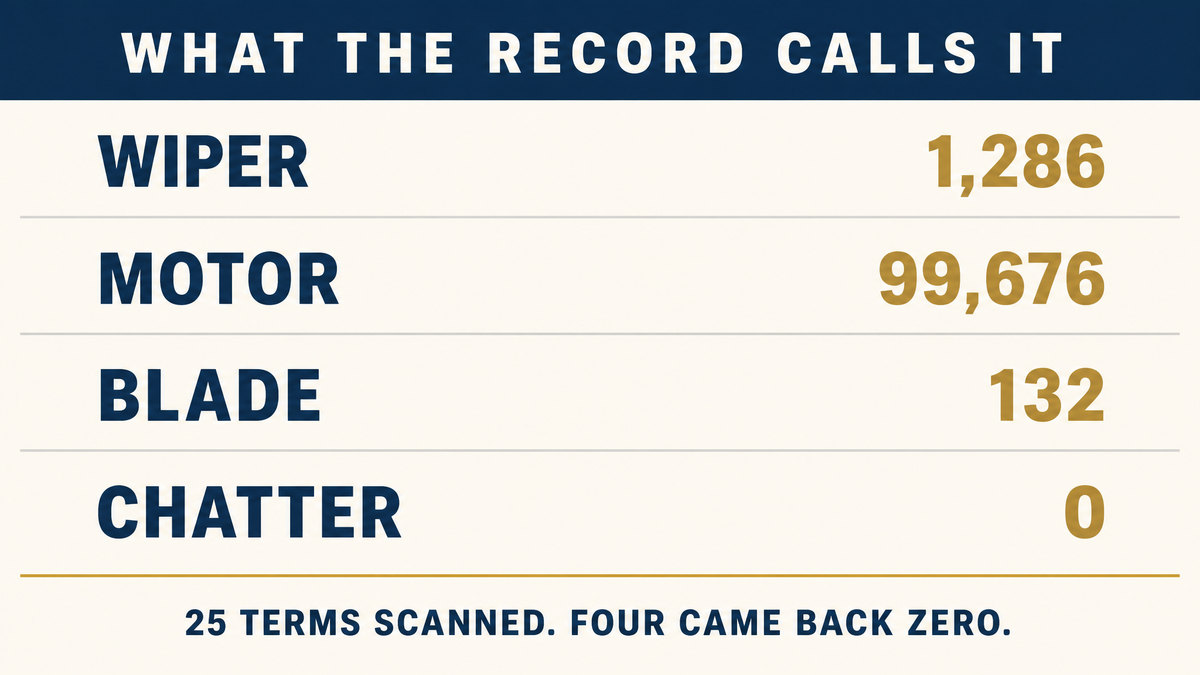
The system is in the file. The blade is barely in it. The component headings tell that story without any counting of prose. Campaigns filed under VISIBILITY/WIPER number 345. Then come the driven parts: the windshield wiper and washer heading carrying LINKAGES at 329 campaigns, the same heading carrying MOTOR at 262, the plain wiper and washer heading at 221, and the one carrying SWITCH/WIRING at 15. The rear window versions exist and are small: 7, 5 and 4 campaigns for linkages, motor and the plain heading. What those headings describe is the equipment that drives the blade, not the blade.
The five largest wiper campaigns are all motors or linkages under those headings: a GMC Terrain campaign at 681,509 units under the motor heading, a Ford Expedition campaign at 652,996 under linkages, a Lincoln Corsair campaign at 604,533 under the motor heading, a Subaru Outback campaign at 592,647, and a Ford F-150 campaign at 483,082. The largest single row in the whole wiper set is a Honda Accord Hybrid campaign at 737,233 units, filed under a heading for power window devices, so there the word sits in the text and not in the heading.
The category word is shared with a car key. blade reaches only 132 records across 23 campaigns, and the biggest of them are not wiper campaigns at all: a Chevrolet Camaro campaign at 464,712 units and a Pontiac G8 campaign at 47,043, both filed under a heading for the ignition system, and then an ignition key campaign at 10,740. The wiper rows in the same set are far smaller: a Ford Transit Connect campaign at 16,330, a Tiffin Zephyr at 10,351 and a Lucid Air at 5,523. In this file a blade is most often the flat part of a key, and the shop word for a failing wiper strip appears nowhere at all.
Four zeros, and they are the four words for the fault. chatter, judder, smear and squeegee return nothing across a quarter of a million records, while the general word streak appears six times in a single campaign. The broad words drown everything else: motor at 99,676 records across 5,199 campaigns is the largest term in the table and it is mostly motors of other kinds, from restraint control units to anti-lock brake pumps. arm at 4,612 records is mostly suspension arms, and park at 6,080 is mostly a gear position or a lamp.
The spelling split is the largest recorded in this series. windshield appears in 4,427 records and windscreen in 126, a ratio of roughly 35 to 1. That is the same American-English behaviour recorded at rows 41 to 44 with the fibre spelling, the ceramic wording, the odour and mould pairs and the tyre spellings — and here it points at a decision rather than a curiosity. A part sold into the United States market is bought under the word windshield, and a catalogue written around windscreen is written for a different market.
The finding. The record carries the system that drives the blade and the glass the blade works on, and none of the blade itself. It counts motors, linkages, switches and washer hardware, and it has no row for the word a driver uses when the strip stops working. That is the same conclusion the clause pointed at from the other side: a blade has no standard of its own, so its quality is settled where the vehicle was certified, and the fitment list, not a recall row, is where a buyer can check it.
7. Five Questions a Wiper Quote Should Answer
A wiper quotation usually carries a length, a colour, a quantity and a price. None of those four settles the thing the buyer is exposed to, which is whether the part fits the arm on the vehicle and clears the areas the standard measures. Five questions cover it, and all five can be answered before the first carton is packed.
- Which arm does this part number fit, and what does your catalogue call the mounting point? The interface belongs to the vehicle and the blade carries the matching point, so a named arm and a named mounting point is the specification. A description of how the part clips on is not.
- What is the length in millimetres, measured on a production piece? Ask for the number on the finished part rather than on the drawing, and ask for the inch step as well, because the two units are rounded differently in most catalogues.
- Which published application list does the part sit on, and which width band do those vehicles fall into? The wiped-area angles in the clause are keyed to overall width, so the band is a fact about the vehicle, and a supplier quoting one blade across several bands should be able to say so.
- Has the blade been run wet on a named body, and where does the arc still leave a band? This is the only question that speaks to the floors of 80, 94 and 99 per cent, and it is answerable with a wet windshield, a named vehicle and a pair of eyes.
- Is the customer's vehicle a passenger car or one of the heavier classes? On a passenger car the washer pattern is tied to the areas of the standard, and on multipurpose passenger vehicles, trucks and buses the same clause hands the pattern back to the maker's own design. The paperwork behind the claim is not the same in the two cases.
8. Six Lines to Put in the Order
Everything above collapses into six lines that belong in the order document rather than in a message thread. Each one is a fact a buyer can check when the container is opened, which is the test any specification line should pass.
| Line | What to write | Why it is on the list |
|---|---|---|
| 1 | The arm and the mounting point, named as the supplier names them in the catalogue | The interface belongs to the vehicle, not to the blade |
| 2 | The length in millimetres, measured on a production piece, with the inch step | Length decides the arc, and the arc decides coverage |
| 3 | The vehicle list the part number is built for, and the width band those vehicles fall into | The clause keys its areas to twice-measured body geometry |
| 4 | The wet check on a named body, and who performed it | The floors of 80, 94 and 99 per cent are measured wet |
| 5 | The material of the strip, and the party who stands behind that statement | The blade is replacement equipment, so the claim travels with the seller |
| 6 | The market and wording the carton is written for | The record shows one spelling dominating a market by 35 to 1 |
Three of the six lines are geometry and three are paperwork, which is the opposite split from the wheel article earlier in this series. There, the measurements were the easy part and the decisions carried the risk. Here the hard part is the fitment, and the paperwork is what makes the fitment checkable by somebody who is not standing in the factory.com/export-packaging-quality-control-checklist-guide/" target="_blank" rel="noopener">the packing and pre-shipment checks are where the lines above either hold or fall, and how the volumetric basis decides the freight is worth fixing at the same time, because a blade set packs light and a carton count is not a volume.
Frequently Asked Questions
Are wiper blades DOT approved?
There is no approval step for a blade, and no federal standard names one. The wiping standard writes its requirements on the vehicle's windshield wiping and washing system, and its requirements are met by the vehicle. A blade made for replacement is motor vehicle equipment under the statute, which is why the duty to comply and to certify falls on the party putting it on the market rather than on an agency approving the part.
Does FMVSS 104 apply to a wiper blade?
Not to the blade on its own. The section states requirements for windshield wiping and washing systems and applies them to passenger cars, multipurpose passenger vehicles, trucks and buses. The blade is the part that makes contact with the glass, and it has no clause of its own in the section.
What do the numbers 80, 94 and 99 per cent mean?
They are the minimum percentages of Areas A, B and C that a passenger car's wiping system has to clear in a wet test. The areas are established by a set of four angles — left, right, up and down — given in four tables that are keyed to the vehicle's overall width. The percentages are the same in all four tables; the angles are not.
Why does the measurement stop 25 millimetres from the edge?
The clause scores wiping inside the area bounded by a perimeter line 25 millimetres in from the edge of the daylight opening. Coverage outside that line is not counted, and coverage inside it is. It is the reason two people can look at the same windshield and describe different results.
Does a longer blade wipe more of the windshield?
It changes the arc rather than the score. The requirement counts coverage inside a border, so a strip that reaches past the border adds nothing to the number and can change the load on the arm at each end. The useful question is not whether the blade is longer, but whether the arc on that body still clears the areas the clause establishes.
What does a speed of 45 cycles per minute have to do with a blade?
Nothing directly. It is a requirement on the vehicle's wiping system, with a second sentence setting the gap between the top speed and the one below it at least 15 cycles per minute and the lower speed at least 20. Those three numbers are settled on the vehicle, and a blade supplier cannot move them.
The wiper standard is written about a swept area, not about a blade. FMVSS 104 sets what the windshield has to look like after a set number of cycles and never uses the word blade, which is why a supplier can be asked for a certificate that does not exist.
The honest answer is that the part is judged by the vehicle it is fitted to. So the order carries the vehicle list, the arm type and the length, and the test that decides the sale happens on a windshield rather than in a laboratory.
The Fitment List Is the Specification
We return the three areas the clause defines, the clearance at the border, and the fitment list that stands in for a blade standard.
Build My Fitment List
Questions & Comments
We read every one and reply within 24 hoursWiper blades are judged on a windshield rather than on a bench, which is why certificate requests stall. Send the model list and the arm types, and we will build the fitment table.