
Window Visor Manufacturer: The Window You Fit It To
 ·
Updated October 16, 2026
·
10 min read
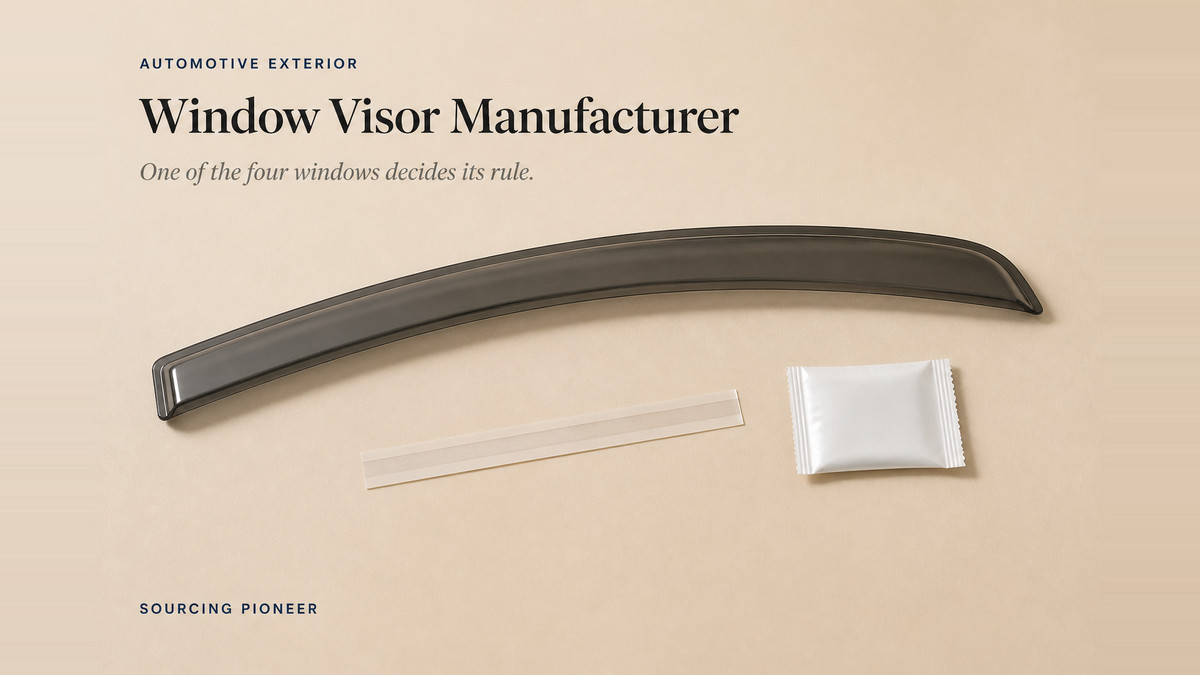
A window visor is a small part with an unusually clean legal shape, because the rule that reaches it is decided by which window it is fitted to. In California the prohibition on things that reduce a driver’s view through a side window is written into the same section that exempts side windows behind the driver — so the front pair of a four-piece kit and the rear pair are governed by two different paragraphs of one page of law. The same sections then set the numbers a manufacturer has to hit if the product is transparent: 88 percent visible light transmittance for the material, meeting FMVSS 205 including the 70 percent minimum and AS-14 abrasion resistance, and a certificate that names the material’s manufacturer by full name and street address. That last item is a sourcing requirement dressed as a paperwork requirement, and it is the one most often missed.
1. What the Product Is: A Frame Part, Not a Window
A window visor sits on the vehicle, not in it, and not on the glass. That single fact decides which rules look at it.
| Part | Where it sits | What it decides |
|---|---|---|
| The deflector body | Above the door window, on the frame and the door top | Whether the driver’s view through the side window is changed at all |
| The material | Smoked acrylic, polycarbonate, or a tinted sheet | Whether the transparent-material rules apply, and which light-transmittance figure is quoted |
| The tape or the clip | Between the deflector and the frame | Whether the part stays on at speed, which is the failure every other article in this segment keeps meeting |
| The window it is cut for | Front door, rear door, or a quarter panel | Which paragraph of the law applies |
The fourth row is the one this article is about. A visor set is normally sold as four pieces — a front pair and a rear pair — and one quotation sometimes covers both. But the front pair and the rear pair are not the same product in law, and the difference is not in the material or the shape. It is in the position.
What this guide covers
- What the product is: a frame part, not a window
- California: the side window is written into the prohibition
- The rear side window is out, and the front is not
- The transparent-material route: four numbers and a certificate
- The federal truck rule, and where its prohibition stops
- What the record says
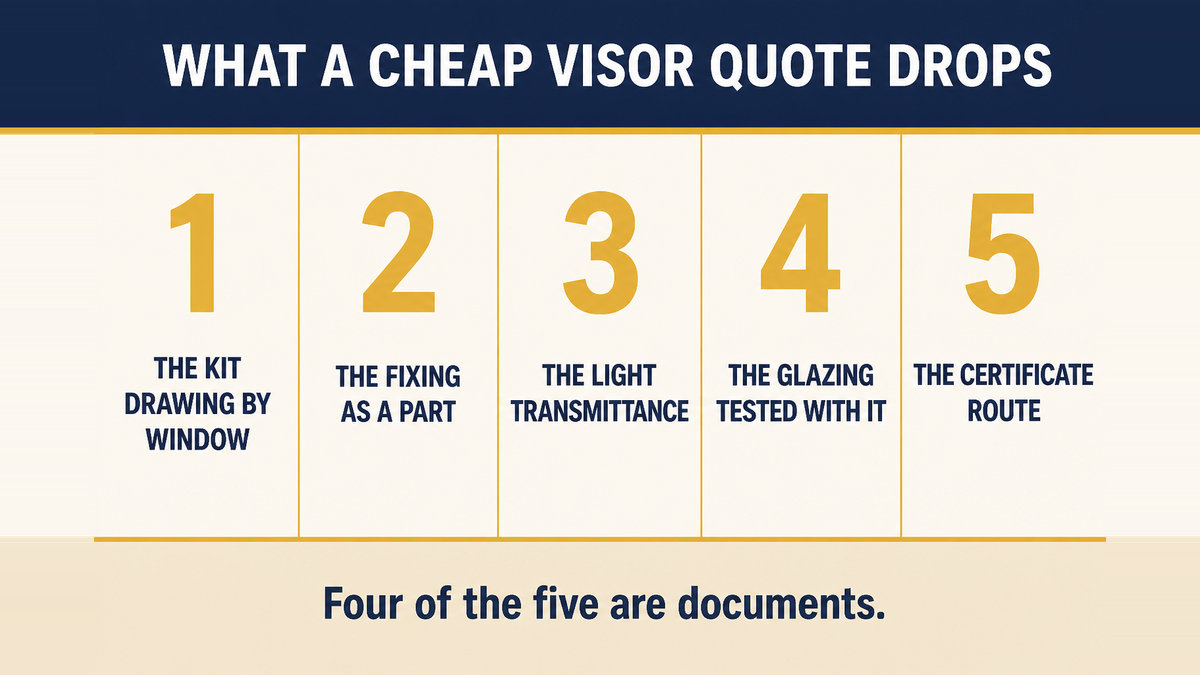
- Five questions a window visor quote should answer
- Six checks before you order
- Frequently asked questions
2. California: The Side Window Is Written Into the Prohibition
The section that governs this is Vehicle Code 26708, and its second paragraph is the one a visor has to answer.
“A person shall not drive any motor vehicle with any object or material placed, displayed, installed, affixed, or applied in or upon the vehicle that obstructs or reduces the driver’s clear view through the windshield or side windows.” — Vehicle Code 26708(a)(2)
Read that against the product. The clause does not ask whether the object touches the glass; it asks whether the object reduces the driver’s clear view through the windshield or side windows. A deflector mounted above a door window changes what the driver sees through the top of that window, which puts it inside the sentence. This is the same structure this series met at article 35 with windscreen-mounted phone holders, but with a different window and a different consequence: there, the exemption was a pair of squares cut out of a ban; here, there is an exemption for a whole class of windows.
3. The Rear Side Window Is Out, and the Front Is Not
The exception list in the same section contains one line that settles half of a four-piece kit.
“This section does not apply to any of the following: … (4) Side windows that are to the rear of the driver.” — Vehicle Code 26708(b)
That is a whole-window exemption, not a treatment of objects on the window. It means the prohibition in paragraph (a) does not reach the side windows behind the driver at all, and a deflector fitted to a rear door window is therefore outside the section entirely — not because the part is special, but because the window is out of scope. For a supplier the practical result is that a rear piece can be supplied in any material and any tint, and a front piece cannot, and the reason has nothing to do with the moulding.
The next entry in the list is the one that has to be read carefully, because it looks like it covers the product and probably does not.
“(2) Adjustable nontransparent sunvisors that are mounted forward of the side windows and are not attached to the glass.” — Vehicle Code 26708(b)
Two of the three conditions in that paragraph describe a window deflector exactly: it is mounted forward of the side window, and on a tape-on or clip-in fitting it is not attached to the glass. But the noun does not match. The paragraph names an adjustable, nontransparent sun visor, which is the interior visor that folds down against the windscreen, and a moulded acrylic deflector is neither adjustable at the mounting nor nontransparent. So the exemption that reads most like this product is not the exemption that covers it, and a supplier who has been quoting paragraph (2) as the reason a front piece is lawful has been quoting the wrong line.
What is left is the transparent-material route, which is where the product actually lands if the material is clear or lightly smoked. The section deals with it in two separate subdivisions, and the one that matters for a door window is the one written for the front side windows.
4. The Transparent-Material Route: Four Numbers and a Certificate
This is the operative paragraph for a clear or smoked deflector on a front door window, and it is written as a list of conditions rather than a permission.
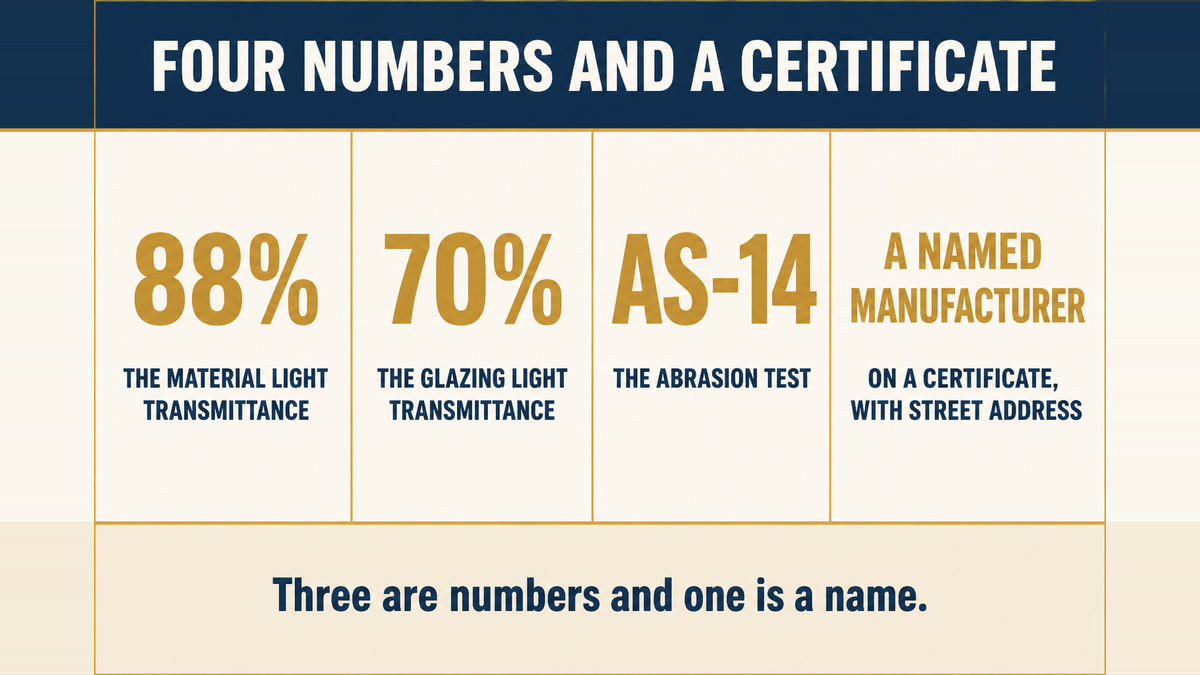
“Notwithstanding subdivision (a), clear, colorless, and transparent material may be installed, affixed, or applied to the front side windows, located to the immediate left and right of the front seat if the following conditions are met: (1) The material has a minimum visible light transmittance of 88 percent. (2) The window glazing with the material applied meets all requirements of Federal Motor Vehicle Safety Standard No. 205 (49 C.F.R. 571.205), including the specified minimum light transmittance of 70 percent and the abrasion resistance of AS–14 glazing, as specified in that federal standard. (3) The material is designed and manufactured to enhance the ability of the existing window glass to block the sun’s harmful ultraviolet A rays.” — Vehicle Code 26708(d)
Three conditions, and each of them is a thing a supplier can either state or not state. The 88 percent figure is a property of the material. The 70 percent figure and the AS-14 abrasion requirement are properties of the glazing with the material applied — a combined assembly, not a film spec, which is why a supplier answering with a film datasheet alone has not answered the condition. And the third is the only one that is about purpose rather than performance: the material has to be designed and manufactured to improve the glass’s ultraviolet A blocking, which is a statement about design intent that a mill can make and a trading company usually cannot.
The fourth condition is the one that turns a technical question into a sourcing one.
“(4) The driver has in their possession, or within the vehicle, a certificate signed by the installing company certifying that the windows with the material installed meet the requirements of this subdivision and the certificate identifies the installing company and the material’s manufacturer by full name and street address, or, if the material was installed by the vehicle owner, a certificate signed by the material’s manufacturer … and the certificate identifies the material’s manufacturer by full name and street address.” — Vehicle Code 26708(d)
Two names and two street addresses have to appear on a document the driver keeps in the vehicle: the installer’s and the material’s manufacturer’s. This is the clause that decides whether a factory is willing to be named on the product it sells. A trading company can write its own name on that certificate. It cannot honestly write a mill’s name and street address unless the mill has agreed to stand behind the material and has told the trading company what those details are. So the certificate is not a paperwork task that follows the order; it is a question to settle while the supplier is still being chosen.
The subdivision ends with a duty rather than a condition, and it is worth a line of its own: “If the material described in this subdivision tears or bubbles, or is otherwise worn to prohibit clear vision, it shall be removed or replaced.” Applied to a moulded acrylic deflector rather than a film, that sentence reads as an instruction to replace the part when the surface clouds, crazes or crazes through scratching — which is exactly what happens to a cheap acrylic visor after a few summers. The state writes the end of the product’s service life into the same paragraph that authorises it.
5. The Federal Truck Rule, and Where Its Prohibition Stops
The federal motor carrier rules look at the same product and reach a narrower conclusion, in a way that is easy to miss because the section is titled as a general prohibition.
First, the tinting provision, which is generous and specific:
“Coloring or tinting of windshields and the windows to the immediate right and left of the driver is allowed, provided the parallel luminous transmittance through the colored or tinted glazing is not less than 70 percent of the light at normal incidence … The transmittance restriction does not apply to other windows on the commercial motor vehicle.” — 49 CFR 393.60(d)
One figure, one pair of windows, and an express statement that every other window is out of the restriction. That is the same shape of rule as the California rear-window exemption, arrived at from a different direction.
Now the prohibition, which is where the article’s most useful negative sits.
“(e) Prohibition on obstructions to the driver’s field of view — (1) Devices mounted on the interior of the windshield. (i) Antennas, and similar devices must not be mounted more than 152 mm (6 inches) below the upper edge of the windshield … (2) Decals and stickers mounted on the windshield. … may be placed at the bottom or sides of the windshield provided such decals or stickers do not extend more than 115 mm (4½ inches) from the bottom …” — 49 CFR 393.60(e)
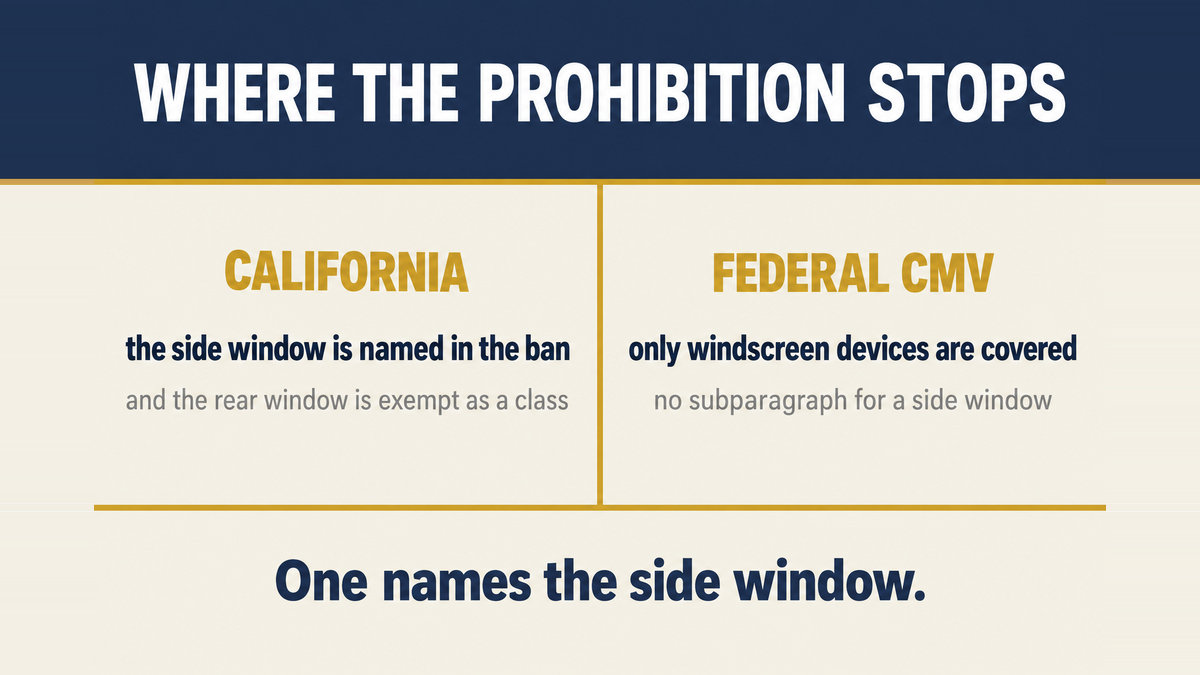
The heading is broad and the subparagraphs are not. There are two of them, and between them they cover devices mounted on the interior of the windshield, and decals and stickers on the windshield. There is no subparagraph for side windows, and none for anything mounted on a door frame or a window surround. So a federal field-of-view prohibition that on its face sounds like it would reach a window deflector has no rule inside it for one. That is the opposite of the California position, where the side window is named in the prohibition itself, and it is the second reason a supplier cannot write one mounting instruction for both markets.
Two further details in the same section are worth having on file because they show how the vehicle side of this is judged. The windscreen condition requirement keeps a 51 mm (2 inch) border at the top and a 25 mm (1 inch) border at each side outside the clean area, and it tolerates a single crack and any damaged area coverable by a 19 mm (¾ inch) disc if not closer than 76 mm (3 inches) to another similar area. And glazing itself must meet FMVSS 205 and be marked in accordance with FMVSS 205 S6 — the same standard the California paragraph points at, which is the one thread that runs through every regime in this article.
The federal rule has also been amended recently enough to matter: the current text of 393.60 carries amendments of 17 May 2018, 7 March 2022, 6 May 2022 and 9 May 2022, so a supplier summary written before 2022 should not be relied on for the device-mounting measurements.
6. What the Record Says
Method first. The federal recall file holds 245,845 records and has no header row, so every field is scanned rather than trusting a column map. Controls: brake appears in 28,639 records and air bag in 16,162. Every term is counted with its own pattern, because a combined search that lists a short word before a longer phrase containing it will consume the text and report the longer phrase as zero.
| Term | Records | Campaigns |
|---|---|---|
window visor | 0 | 0 |
window visors | 0 | 0 |
window deflector | 0 | 0 |
rain guard | 0 | 0 |
weather shield | 0 | 0 |
visor | 107 | 16 |
sun visor | 106 | 15 |
deflector | 160 | 19 |
deflectors | 41 | 5 |
tape | 864 | 71 |
side window | 368 | 17 |
glazing | 1,778 | 27 |
tinted | 21 | 3 |
obstruct | 245 | 18 |
field of view | 19 | 2 |
molding | 111 | 15 |
garnish | 27 | 3 |
trim | 1,076 | 121 |
adhesive | 1,723 | 239 |
detach | 14,411 | 1,100 |
road hazard | 6,247 | 618 |
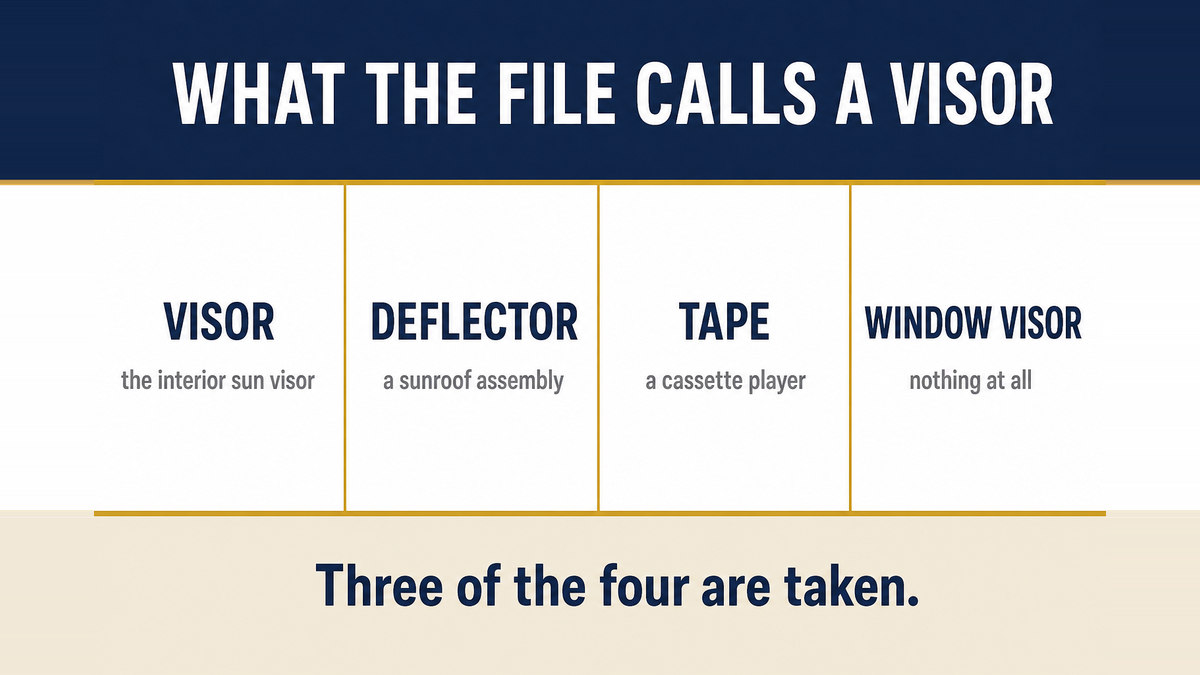
Five zeros, and they are the product’s five retail names. Window visor, window visors, window deflector, rain guard and weather shield do not appear anywhere in 245,845 records. The file does hold one of the trade’s other words, and the reading is worth a line of its own: visor appears 107 times across 16 campaigns, and the part it names is the interior sun visor — a Dodge Durango wiring campaign at 653,562 units, a Mitsubishi Eclipse Spyder passenger air bag inflator at 443,442, a Durango interior lighting campaign at 389,252, and a Ford Ranger campaign 26V238000 whose component path is STRUCTURE:INTERIOR PANELS:SUN VISOR. Two of the six largest are EQUIPMENT:OTHER:LABELS campaigns, which is the label-peeling family this series met in the previous article. So visor in this file means the cardboard flap above the driver’s head, and deflector is worse: its 160 records across 19 campaigns are sunroof assemblies, bumper grille shutters, axle parts and brake parts — a Ford F-150 sun and moon roof assembly at 174,853 units, a GMC Sierra active shutter at 70,768, a Hyundai Sonata sunroof at 62,811. The nearest thing in the file to an on-vehicle air deflector is a sunroof, which is a different part on a different panel.
The tape that holds a visor on is a cassette player in this file. tape appears 864 times across 71 campaigns, and the two largest records are a Ram 5500 campaign whose component path is EQUIPMENT:ELECTRICAL:RADIO/TAPE DECK/CD at 1,416,903 units and a Ford F-150 seat belt pretensioner campaign at 1,619,112. Double-sided acrylic foam tape, the fixing on most of these parts, has no presence in the record at all.
And the file does write about side windows, without ever writing about something fitted to one. side window appears 368 times across 17 campaigns, and every campaign in the sample is one of three things: the mechanism, the structure, or an air bag named after the window. The mechanism is a Chevrolet Express VISIBILITY:POWER WINDOW DEVICES AND CONTROLS campaign at 207,483 units. The structure is a Mercedes GLE 400 E body campaign at 161,000, an AMG GLS63 at 70,225, an IC Bus CESB at 22,730 and a Blue Bird All American at 363. The air bag is a Mercedes E550 AIR BAGS:SIDE/WINDOW campaign at 499 units. Not one of the 17 is about an object attached to a side window.
The glazing itself is well represented, which sharpens the point. glazing appears 1,778 times across 27 campaigns, and the component families behind it are VISIBILITY:WINDSHIELD and VISIBILITY:GLASS, SIDE/REAR — a Ford Explorer windshield campaign at 56,841, a Vitro rear window glass campaign at 47,366, a Nissan Sentra windshield at 41,797, an MCI 102DL3 side and rear glass campaign at 15,454, a Lippert bus window at 8,630. So the file has a full vocabulary for the glass and for the mechanism that moves it, and none for a part that sits on the frame above it.
The most precise finding is in the two smallest rows. field of view appears in 19 records across 2 campaigns, and both are MCI motor coaches with a windshield wiper motor fault — a J4500 at 1,261 units and a J4500C at 144. obstruct appears in 245 records across 18 campaigns, and the largest of them are hood latches: a Honda Ridgeline at 724,826 units, a Chevrolet Colorado at 118,800, a Lamborghini Urus at 2,133, a McLaren GT at 1,012, alongside two Porsche Taycan campaigns for a sensing system and a rear seat belt anchorage. So when this record describes a visibility problem it describes a wiper that stopped, or a latch that became obstructed — equipment that failed. It does not describe a view that was reduced by something on the vehicle, which is the exact thing the California section is written about.
One more row belongs beside that. tinted appears in only 21 records across 3 campaigns, and all three are Ford glass-bonding campaigns — an F-450 windshield at 79,017 units and two Mustang Mach E campaigns at 17,692 and 13,544. In this file tinted is a property of a piece of glass, never a treatment applied to one.
7. Five Questions a Window Visor Quote Should Answer
A visor quote usually carries a material, a colour, a thickness in millimetres, a set of pieces and a price. None of those answers which paragraph of the law applies. These five do.
- Which window is each piece cut for? Front pair and rear pair are governed by different paragraphs, because the rear side windows are exempt from the prohibition as a class. A kit drawing that does not distinguish them cannot be checked against the law at all.
- Does the fixing touch the glass? The exemption that reads most like this product turns partly on being mounted forward of the side window and not attached to the glass. A tape-on frame fitting and a clip-in channel fitting are not the same answer.
- What is the visible light transmittance of the material, and who measured it? The transparent-material paragraph opens with a minimum of 88 percent, which is a property of the material and should arrive as a figure with a test behind it rather than a shade name.
- Has the material been assessed on the glazing rather than on its own? The next condition is about the window glazing with the material applied meeting FMVSS 205 including the 70 percent minimum and AS-14 abrasion resistance — a combined assembly, so a film datasheet alone does not answer it.
- Whose name and street address will appear on the certificate? The paragraph names the installing company and the material’s manufacturer. A trading company cannot supply the second honestly unless the mill has agreed to be named.
8. Six Checks Before You Order
- The kit drawing labelled by window, front and rear separated, so the two paragraphs can be checked against the right pair of pieces.
- The fixing specified as a part — tape grade, clip type, and whether the fitting touches the glass — because that is the condition the closest exemption turns on and it is also the part that decides whether the visor stays on.
- The light transmittance figure with the test behind it, on the production material rather than a master sample.
- The glazing-and-material combination assessed together, with the FMVSS 205 requirement and the AS-14 abrasion requirement named in the report rather than assumed.
- The certificate route agreed in writing before the order: who installs, whose name and street address go on the document, and whether the mill will be named as the manufacturer.
- A replacement note for the customer, because the same paragraph that authorises clear material also requires it to be removed or replaced once it is worn past clear vision. A part sold with no service life note will be fitted and forgotten.
Items two and five are the ones a factory audit settles, because each is a name or a grade rather than an opinion. Item six is the one a pre-shipment inspection should photograph, since a service life note lives on the insert and nobody reads the insert unless somebody checks it. And a four-piece set is awkward to pack rather than heavy, so the freight on it turns on volume rather than weight — the same volumetric basis that decides most large, light automotive accessories.
For a window visor the answer is decided by the window rather than by the visor, and one state writes that window into its code. California writes the side window into its prohibition — no object may reduce the driver’s clear view through the windshield or side windows — and then exempts side windows behind the driver as a class, so the front pair and the rear pair of one kit stand on different paragraphs. The exemption that reads most like this product, for sunvisors mounted forward of the side windows and not attached to the glass, describes the mounting and names the wrong noun. What is left is the transparent-material route, with its 88 percent material figure, its FMVSS 205 / 70 percent / AS-14 combination requirement on the glazing, its duty to improve ultraviolet A blocking, and a certificate naming the material’s manufacturer by full name and street address — which is a sourcing question wearing paperwork as a disguise.
The federal truck rule then reaches the opposite conclusion, because its field-of-view prohibition has subparagraphs for interior windscreen devices and windscreen decals and none for a side window. And the record, which holds 1,778 records about glazing and 368 about side windows, has not one campaign for anything fitted to a window: its only two field of view campaigns are wiper motors, and its obstruct records are mostly hood latches. So settle the window each piece is cut for, the transmittance figure, the combined glazing assessment and the name on the certificate before the tool is cut.
Frequently Asked Questions
Does a window deflector affect the driver’s view?
In California the prohibition is written about the object, not about the glass: no person shall drive with any object or material placed, displayed, installed, affixed or applied in or upon the vehicle that obstructs or reduces the driver’s clear view through the windshield or side windows. A deflector mounted above a door window changes what the driver sees through the top of that window, which places it inside that sentence. The clause does not ask whether the object touches the glass.
Does the same rule apply to the rear side windows?
No, and the difference is a whole-window exemption rather than a rule about objects. The exception list in the same section states that the section does not apply to side windows that are to the rear of the driver. A deflector fitted to a rear door window is therefore outside the section entirely, because the window is out of scope rather than because the part is special. A rear piece and a front piece of the same kit are governed by different paragraphs.
What is the 88 percent light transmittance rule?
It is the first condition in the paragraph that allows clear, colorless and transparent material on the front side windows. The material must have a minimum visible light transmittance of 88 percent. The next condition is separate and stricter in kind: the window glazing with the material applied must meet all requirements of Federal Motor Vehicle Safety Standard No. 205, including the specified minimum light transmittance of 70 percent and the abrasion resistance of AS–14 glazing. That second figure is a property of the glazing in combination with the material, not of the film or sheet alone.
Who signs the certificate for a clear or tinted side window?
The paragraph requires the driver to have in their possession, or within the vehicle, a certificate signed by the installing company certifying that the windows with the material installed meet the requirements, and identifies the installing company and the material’s manufacturer by full name and street address. If the material was installed by the vehicle owner, the certificate is signed by the material’s manufacturer instead. Two names and two street addresses, one of which is the manufacturer’s.
Do the federal truck rules cover window deflectors?
The tinting provision reaches further than the prohibition does. Coloring or tinting is allowed on the windshield and on the windows to the immediate right and left of the driver provided the parallel luminous transmittance is not less than 70 percent, and the section states that the transmittance restriction does not apply to other windows. The prohibition section is headed as a prohibition on obstructions to the driver’s field of view, but its subparagraphs cover only devices mounted on the interior of the windshield and decals and stickers on the windshield. There is no subparagraph for a side window.
What happens when a clear deflector clouds or scratches?
The paragraph that authorises clear material on the front side windows ends with a duty rather than a condition: if the material tears or bubbles, or is otherwise worn to prohibit clear vision, it shall be removed or replaced. Applied to a moulded acrylic deflector rather than a film, that reads as an instruction to replace the part once the surface clouds or crazes. The state writes the end of the product’s service life into the same paragraph that permits it.
Four Numbers and the Material Route
We return the transmittance figure, the material route it opens, and the truck rule that changes the permitted position.
Note My Transmittance
Questions & Comments
We read every one and reply within 24 hoursA window visor is decided by the window aperture rather than by the visor itself. Send the vehicle and the set, and we will measure coverage against the state limit and specify the tape.