

Dropshipping Legal Requirements: Who Bears What at Each Stage
 ·
Updated October 14, 2026
·
16 min read
Search for the legal requirements of running a dropshipping store and you will find lists of things to do, and the lists are mostly accurate. What they leave out is the part that makes them usable, which is who the obligation sits on. A duty attached to no party cannot be checked against anything, and the reason the omission matters in this business is that a direct-ship seller occupies several roles at once without intending to. Goods crossing a border create an importer, and the importer is a role rather than a company, so a seller can be standing in it before the question has been asked. This guide sets out four stages, names the party for each obligation, and pulls the whole thing into one list at the end.
1. Why Lists of Legal Requirements Go Wrong
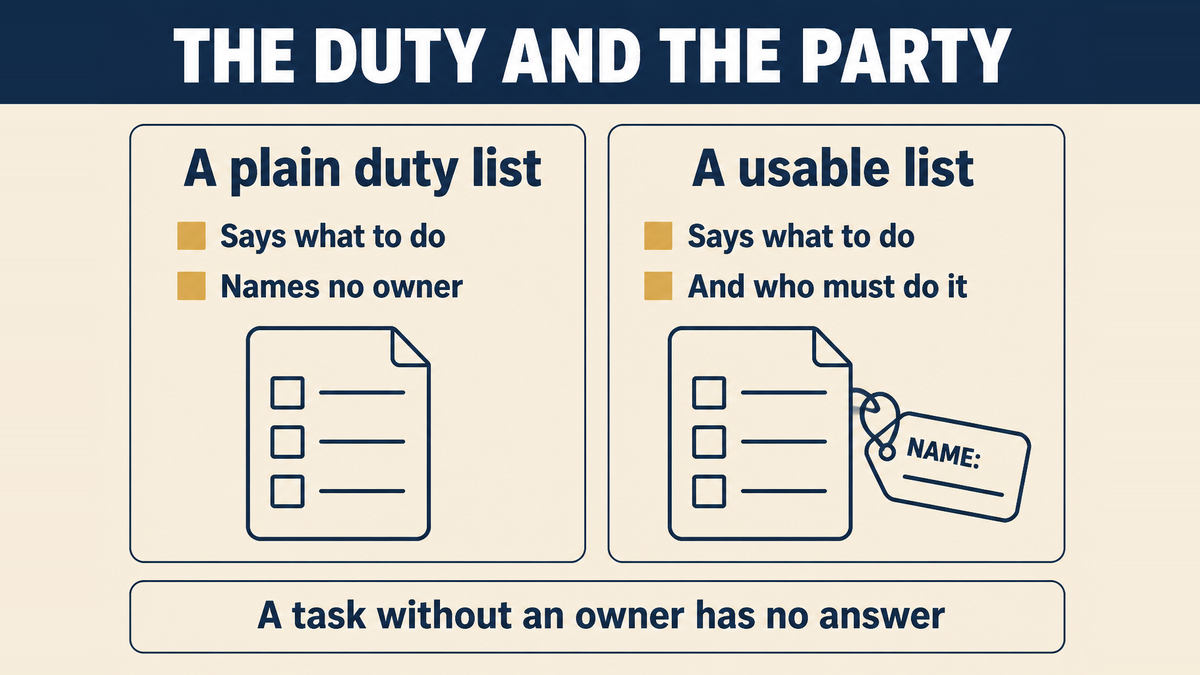
The standard list answers one question and silently skips the next. It tells you that imported goods must be marked with their country of origin, that certain products must be tested before sale, and that a shipping promise has a deadline attached. All of that is true. What it does not say is who has to see that each of those things happens, and without that second half there is nothing to check, because there is no role to check it against.
This is not a technicality in a business where the goods never pass through the seller's hands. A direct-ship seller who buys from a factory, arranges for the goods to reach a customer in another country and takes the money in between is doing several jobs at the same time. The list treats every job as belonging to the same anonymous person it calls the seller, and the rules do not. They attach obligations to particular roles, and a seller who has not worked out which roles they occupy cannot tell which lines of the list are theirs.
The reason this is worth fixing before anything else is that the roles are decided by paperwork rather than by intention. Something as ordinary as the name on a consignment note, or whether an entry is made in the seller's name or a supplier's, decides which party the rules are addressing. That is a better thing to know than any single duty, because it tells you which duties are worth reading in full.
| What a duty list gives you | What makes it usable |
|---|---|
| A task, with no owner | The role the obligation attaches to |
| A rule that applies to everyone | The point at which it becomes yours |
| A general warning | The document that decides the answer |
What this guide covers
2. Stage One: Who Is the Importer
The first role is the one a direct-ship seller most often occupies without noticing, and the rules define it in a way that is worth reading carefully, because the definition settles who pays the duty. It is set out among the general definitions that govern the customs regulations:
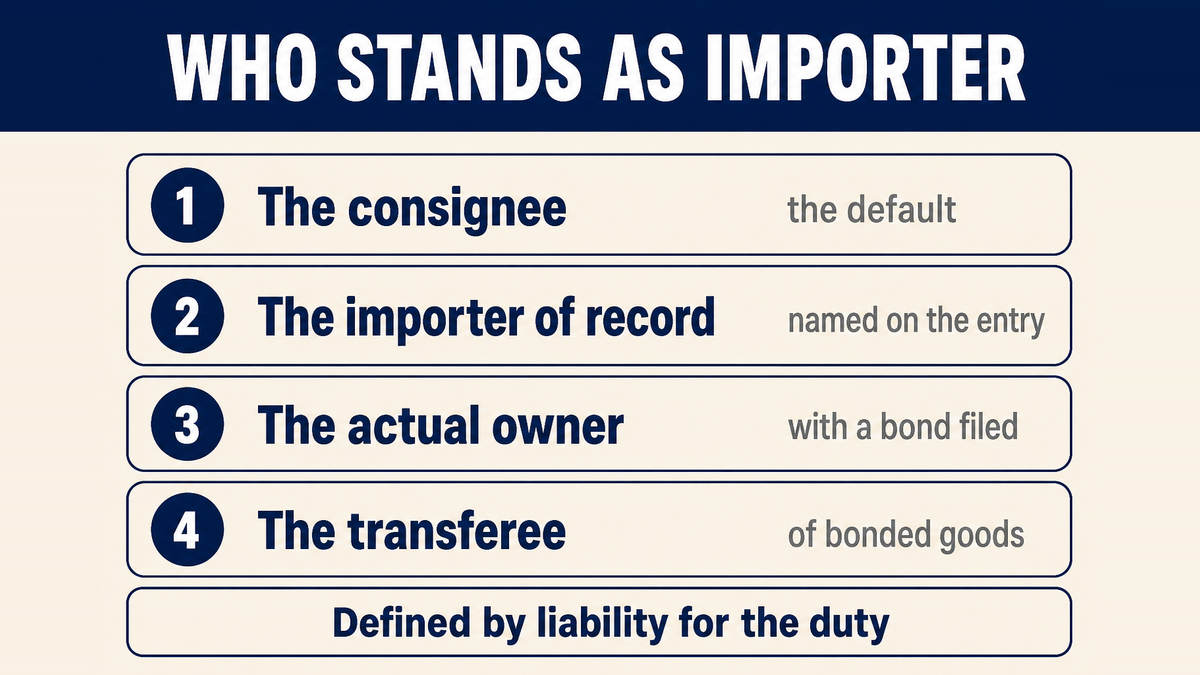
“Importer” means the person primarily liable for the payment of any duties on the merchandise, or an authorized agent acting on his behalf. The importer may be: (1) The consignee, or (2) The importer of record, or (3) The actual owner of the merchandise, if an actual owner's declaration and superseding bond has been filed in accordance with § 141.20 of this chapter, or (4) The transferee of the merchandise, if the right to withdraw merchandise in a bonded warehouse has been transferred in accordance with subpart C of part 144 of this chapter.
U.S. Customs and Border Protection, 19 CFR 101.1, definitions (read 14 October 2026)
Two features of that definition decide the question for a small seller. The first is that the importer is identified as the party “primarily liable for the payment of any duties”, so the role is defined by the money rather than by who arranged the transport. The second is that the first listed candidate is simply the consignee, which is the party the goods are consigned to. Where a shipment is consigned to the seller, the seller is the importer under this definition, and the fact that a factory or an agent organised the freight does not change it. Arguing that the supplier handles the shipping is an argument about who arranged a service, and the definition is asking a different question.
The route to the actual owner is worth noticing as well, because it is the nearest thing to an escape and it is conditional. The owner of the goods can be the importer, but only where an owner's declaration and superseding bond has been filed. Filing is a step rather than a status, so a seller who has never filed one is not the actual owner for this purpose even if they plainly own the goods. The practical reading is that the default outcome is the consignee, and the alternatives are arrangements somebody has to put in place deliberately.
The same subject is continued in the statute that governs making an entry, which adds a standard of behaviour to the role. It provides that one of the parties qualifying as importer of record, in person or through an authorised agent, shall, using reasonable care, make entry by filing the documentation or information needed for the goods to be released. The phrase doing the work is “reasonable care”, and what it means in practice is that the importer is expected to take steps rather than to rely on somebody else's word. That expectation is the reason the rest of this page is about documents, and the machinery of entry itself is set out in what a customs broker actually does, while the money side of the same role is covered in what a seller really owes.
What reasonable care asks for in practice is modest and specific. It means asking the questions a person in that role would ask, keeping the answers, and being able to show the steps taken: the consignment details, the classification used, the value declared, and any advice relied on. It is not a demand for expertise, and it is not satisfied by a general statement that a supplier handles everything. The reason it is worth naming is that the standard describes behaviour rather than outcome, so a seller who took the right steps and made an error is in a different position from one who took no steps at all.
3. Stage Two: What the Goods Have to Say
The second stage is about the article itself, and the obligation is that an imported article of foreign origin must indicate where it came from. The standard form of the rule requires the English name of the country of origin to be marked in a conspicuous place, as legibly, indelibly and permanently as the nature of the article will permit, at the time of importation. The reason it belongs at stage two rather than later is that the party who carries it is the importer established in stage one, which means the seller who is standing as consignee is the one responsible for the mark rather than the factory that made the item.
The phrase that decides how hard this is turns out to be the qualification inside the sentence. The mark has to be as permanent as the nature of the article permits, so the duty is fixed while the method is set by the item. A flat matte surface takes a printed mark without difficulty. A curved, glossy, mesh or loose-fill surface does not, and a small item may offer no usable surface at all. That makes this a product decision as much as a paperwork one, and it is worth settling before a listing exists rather than after a first shipment, which is the argument set out in what private label actually requires.
The check is cheap and it has a definite answer. Ask the supplier for a photograph of the marking on a finished unit. A photograph of the bare product does not answer the question, however good the product looks, and the difference between the two is the difference between an arrangement that exists and one that is being assumed. Where goods are inspected before they leave, the marking belongs on the inspection list, which is one of the things a pre-shipment inspection should cover.
4. Stage Three: What the Product Has to Be Able to Do
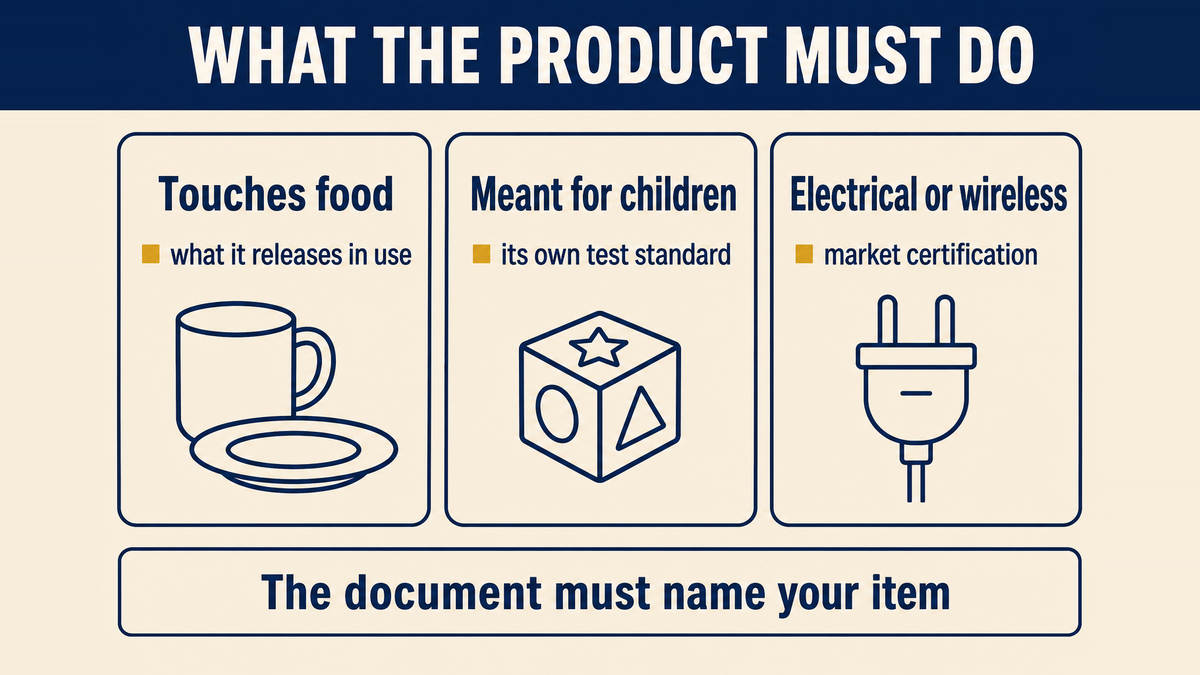
The third stage is different in kind, because its obligations attach to the item rather than to a person. Some products may not be offered for sale until a test exists, and the test cannot be replaced by a promise about the product. What that means for the question of who bears it is slightly indirect: the testing is done by somebody else, but the party who has to be able to produce the document when it is asked for is the seller, because the seller is who the buyer deals with and who a platform holds responsible.
Three groups of products come up repeatedly in a sourcing business, and each has its own set of rules rather than a shared one. Articles that come into contact with food are tested for what they release when used, which is a different question from whether they look well made; the framework is covered in food contact testing for kitchenware and tableware. Items intended for children carry their own test standards and their own documentation, set out in how toy safety testing works in practice. Electrical and wireless goods add a third set, which is covered in what electrical goods need before they can be listed.
Where this stage most often fails for a small seller is not the absence of a document but the presence of the wrong one. A test belongs to the item it was run on and to the party named on it, so a report for a similar product, or for a related material, does not answer the question for the item being listed. The practical test is narrow: does the item described in the document match the item being sold, down to the model and the material. Answering it requires a written specification, because without one there is no way to see whether the product has changed since the document was issued, and a change made quietly by a factory is exactly the situation the document was supposed to protect against. The usual forms those assurances take are catalogued in what the common lines from suppliers really mean.
5. Stage Four: What You Promise the Buyer
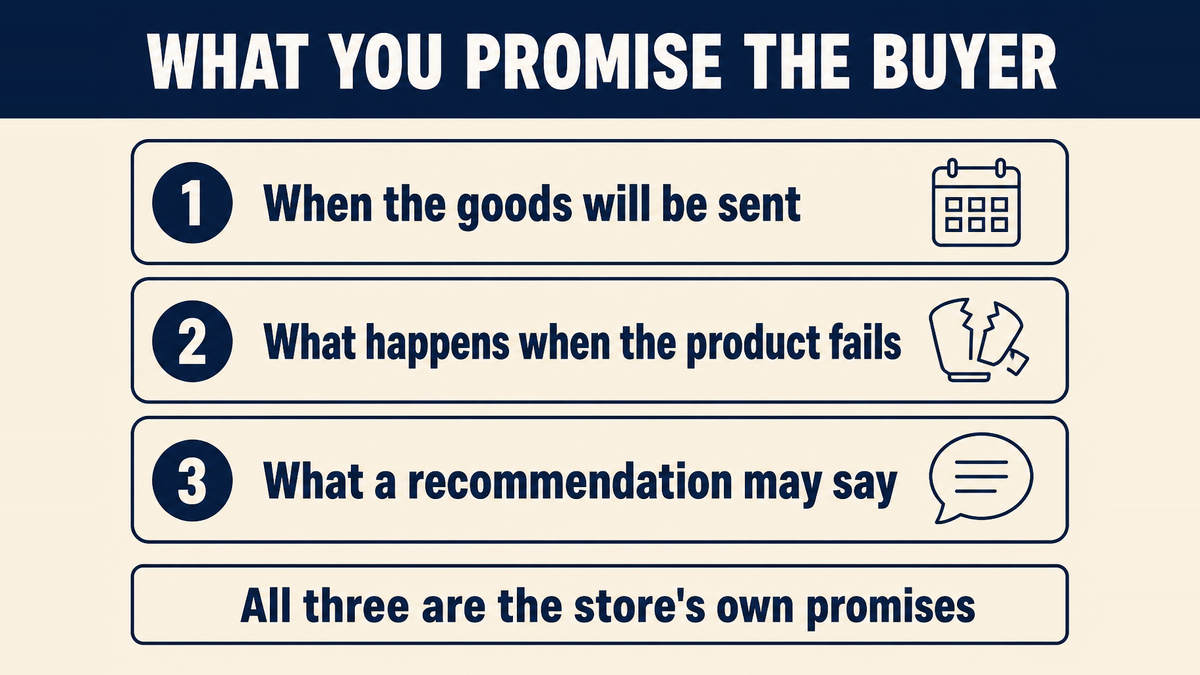
The last stage is made of obligations the store creates for itself, which is why it is both the easiest to control and the easiest to forget. A store makes three promises on its own account, and each of them is made by the seller rather than by anybody upstream, because a factory does not promise anything to your customer.
The first is about time. An offer carries a statement about when goods will be sent, whether that statement is a formal policy, a line on a product page, a note at checkout or an estimate shown by a platform, and the statement becomes the deadline. Where nothing at all is said, the rule supplies one rather than leaving a gap, and the obligation that follows is to be able to ship inside whatever applies. Failure has a procedure attached rather than being a matter for apology, and the handling side of a delay is covered in how to handle a complaint directly.
The second is about what happens when the product fails. A buyer whose device or garment stops working will bring the claim to the store that sold it, and whether the store can pass the claim upstream depends on a detail that is settled by wording rather than by intention: the protection for a party who only distributes is attached to the document naming somebody else as the party giving the warranty. A store that publishes warranty terms in its own voice has made its own promise, and the arithmetic of the round trip that follows is set out in what a return actually costs.
The third is about what may be said in a recommendation, and it belongs here because the store is the party that arranges the recommendation. A connection between the person recommending and the party selling can require disclosure, and the rules treat something that costs the seller nothing, such as a free or discounted product, as a connection of that kind. The practical consequence is that the first rung of any collaboration already carries an obligation, and a store that plans only its budget discovers that later than it should.
Read together, the three promises explain why this stage cannot be delegated. A supplier can make goods, test them and ship them, and none of that touches what the store has said to a buyer about timing, about failure or about who recommended the product. Those statements are the store's own, which is why they belong in the same list as the import duty rather than in a separate section called customer service.
There is an order inside this stage as well, and it is worth following because the three promises interact. Decide the shipping term before writing the listing, since the term constrains what can honestly be offered. Decide the warranty posture before publishing any warranty text, since the wording decides which party is answerable. And settle the disclosure wording before the first collaboration rather than after it, since the obligation arrives with the first parcel that is given away. Each of those decisions takes minutes, and each one removes a class of argument that is expensive to have later.
6. The One List, With the Party for Each Line
The four stages reduce to one table, and the useful column is the third one, because that is the column a duty list normally omits. Once the party is named, the question of whether an obligation applies stops being a matter of opinion and becomes a question about a document.
| Stage | The obligation | The party who bears it | What settles the answer |
|---|---|---|---|
| Import | Duties paid, entry made using reasonable care | The importer, by default the consignee | The consignment note and the entry |
| Marking | Country of origin shown, as permanently as the article allows | The importer, so often the seller | A photograph of a finished unit |
| Product | A test exists before the item is offered | The seller, who must be able to produce it | A report naming the exact item |
| Promise | Ship inside the stated term; honour the warranty; disclose the connection | The seller, always | The published term and the wording |
The pattern in the third column is the answer to the question this page opened with. Three of the four stages default to the seller, and they default to the seller regardless of how the goods were sourced, because the obligations are attached to the roles the seller happens to be occupying. Only the first is capable of being moved to another party, and moving it takes a filing rather than an understanding between two businesses.
Mismatches between what a seller believes and what a document says are worth looking for directly, because they are the failure this page is about. The two worth checking first are the consignment details, which decide stage one, and the name and item on the test report, which decide stage three. Where the consignment is not in the seller's name and the seller nevertheless pays the duty, the arrangement and the paperwork are telling different stories, and the fix is a filing rather than an understanding. Where the report names a different item, the fix is a written specification rather than another conversation.
That leaves the practical conclusion narrower than a duty list suggests and more useful. The work is not to memorise a set of rules, it is to establish which roles the store is standing in and to keep the documents that show it. A consignment note settles stage one, a photograph settles stage two, a report naming the item settles stage three, and a written term settles stage four. None of those is expensive, and all of them are things a store either has or does not.
7. Frequently Asked Questions
Is dropshipping legal?
The arrangement itself is not a regulated activity, so there is no permission to obtain before starting. What is regulated is what you sell, where you ship it and what you promise, and those obligations attach to roles rather than to the business model. The reason the question feels difficult is that a direct-ship seller occupies several of those roles at once without having chosen them individually.
Do I need a business licence to dropship?
That is a question about the jurisdiction you operate from rather than about dropshipping, and it sits outside the customs and consumer rules discussed here. What this page can say is that the obligations people usually have in mind when they ask are not licences at all. They are duties attached to roles, and the role that catches most small sellers is the importer, which is defined by liability for the duty rather than by any registration.
Who pays import duty on a dropshipped order?
The rules define the importer as the person primarily liable for the payment of any duties, and the first candidate listed is the consignee. Where goods are consigned to the seller, the seller is the importer on that wording, and the fact that a supplier arranged the freight does not change it. The other routes, such as the actual owner, require a declaration and a bond to have been filed rather than being available by default.
Does my supplier's certification cover me?
Only if the document describes the item you are selling and names the party it applies to. A test belongs to the item it was run on, so a report for a similar product or a related material does not answer the question for your listing. The check that makes this answerable is a written specification, because without one you cannot tell whether the product has changed since the document was issued.
What happens if I do not mark the country of origin?
The obligation falls on the importer rather than on the factory, so a seller standing in that role is the party responsible for seeing it done. The reason it is worth settling early is that the standard is expressed relative to the article, requiring a mark as permanent as the nature of the item permits, which makes it a product decision. A photograph of the mark on a finished unit is the cheapest way to know where you stand.
Four Stages, Your Duties at Each
We return the duty that attaches at each stage, the records proving it was met, and the promise that outlives the sale.
Map My Four Stages
Questions & Comments
We read every one and reply within 24 hoursTrying to work out who the importer is on your shipments, unsure whether a test report your supplier sent describes the item you are selling, or wondering what your own delivery estimate commits you to? Tell us how your goods move and in whose name, and our team will help you work out which roles you are standing in.