
Dropshipping for Beginners: What the Two Promises Cost
 ·
Updated October 13, 2026
·
15 min read
Almost every beginner guide opens the same way. You do not need a warehouse. You do not need to buy stock. There is nothing to lose if it does not work. Both halves of that are worth taking seriously, because one is largely true and the other is not, and the difference between them decides whether your first store survives its first bad month. There is also a rule underneath the whole model that almost none of these guides mention at all.

The Two Promises, Rewritten Honestly
| What you are told | What is actually true |
|---|---|
| You never hold inventory. | True, and useful. You also never see the stock you are selling, so you cannot plan around a shortage. |
| There is no financial risk. | False. You carry the returns, the disputes and the customs position, on goods you never handle. |
| You can start with almost nothing. | True for the store. The real early cost is the testing, not the website. |
What this guide covers
1. What Are You Actually Being Sold?
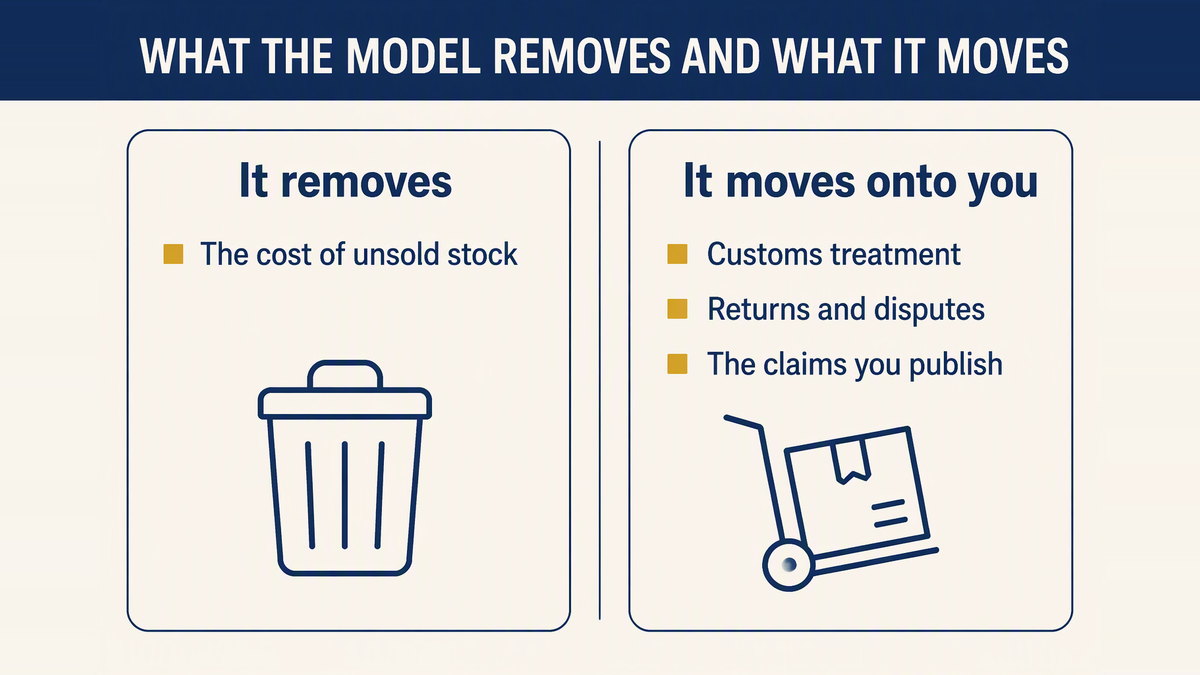
You are being sold the removal of one specific cost, and it is worth naming it precisely because the general version is misleading. The cost that gets removed is the cost of finding out. In a normal retail business you buy the goods first and discover whether anyone wants them afterwards, and if the answer is no you own the mistake. In this model you find out first, because nothing is bought until an order arrives.
That is a real advantage for a beginner, and it is the honest reason the model suits someone starting out. The mistake is letting it expand into something larger. The absence of stock is not the absence of risk. It is a shift in where the risk sits, from goods that might not sell to a set of obligations that arrive whether or not you are ready for them.
Those obligations are the subject of this guide. They fall into two groups. One is customs, which almost nobody explains to beginners and which has changed recently. The other is the money a customer can take back after you have already paid for the goods. Neither shows up in the tutorials.
2. The Rule the Whole Model Rests On
Per-order shipping from China only makes sense because of a specific customs exemption, and it is worth reading in its own words rather than in summary, because the wording carries the conditions.
Subject to the conditions in § 10.153, and subject to the provisions of paragraph (b) of this section, the port director shall pass free of duty and tax any shipment of merchandise, as defined in § 101.1 of this chapter, imported by one person on one day having a fair retail value, as evidenced by an oral declaration or the bill of lading (or other document filed as the entry) or manifest listing each bill of lading, in the country of shipment not exceeding $800, unless he has reason to believe that the shipment is one of several lots covered by a single order or contract and that it was sent separately for the express purpose of securing free entry therefor or of avoiding compliance with any pertinent law or regulation.
19 CFR 10.151(a), Importations not over $800
Three conditions sit inside that sentence, and beginners usually know only the first. The shipment must not exceed $800 in fair retail value. It must be imported by one person on one day, which means the limit is a daily allowance rather than a per-order one. And the exemption does not apply if the shipment looks like one part of a larger order that was split up specifically to get under the limit — so a bulk order divided into parcels does not qualify, and the wording says so directly.
That much is the version most people have heard. The paragraph that follows is the one that changes the picture.
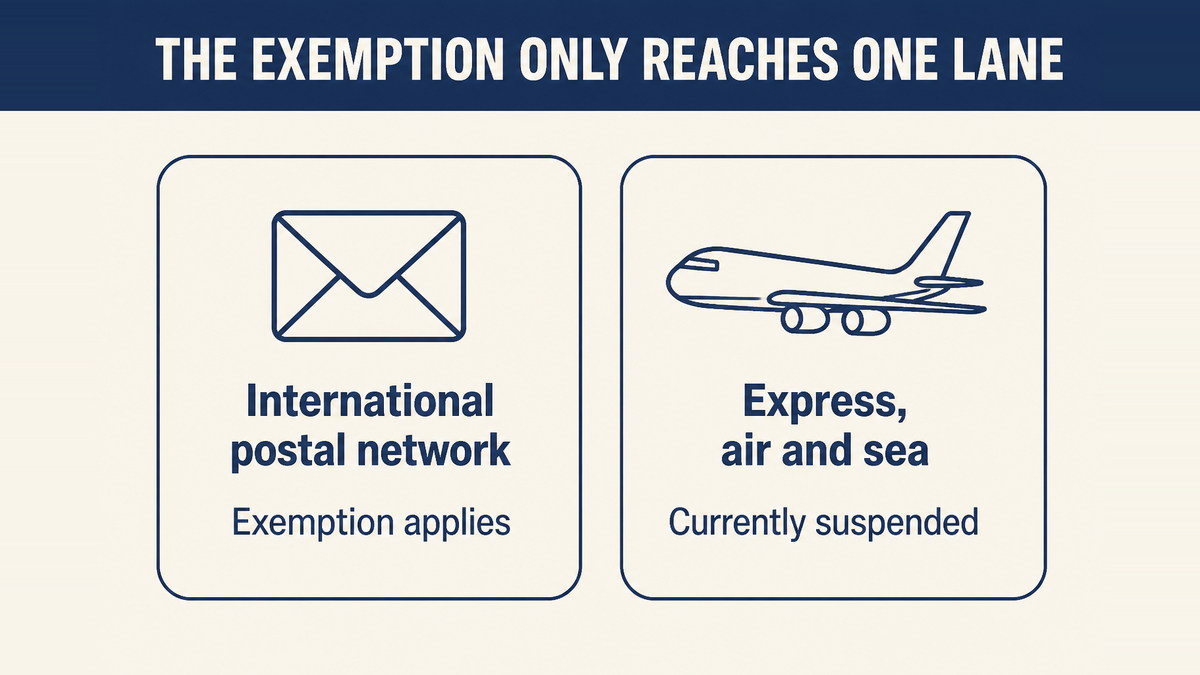
The exemption provided in paragraph (a) of this section is suspended for merchandise arriving via all modes other than through the international postal network until such time as CBP determines that the application of the exemption is no longer inconsistent with the purpose of 19 U.S.C. 1321(a), no longer jeopardizes the revenue, and no longer facilitates unlawful importations.
19 CFR 10.151(b), same section, as amended by CBP Dec. 26-12, 91 FR 37800
Read that plainly and it says the exemption does not currently apply to merchandise arriving by any route other than the international postal network. A parcel sent on a commercial express service is not arriving through the postal network, so it does not come in under the exemption on the strength of its value alone.
This is the single most useful thing a beginner can know, and it is the thing the guides leave out. The choice between a postal line and a commercial express line is not only a choice about speed and tracking. It is a choice about which customs treatment the parcel arrives under, and the cost difference between those two treatments can be larger than the difference in transit time. Anyone telling you that everything under $800 arrives duty free is describing a rule that currently only reaches one lane.
3. What Changes When That Rule Does Not Apply?
Duty becomes a real line in your arithmetic rather than a rounding error, and somebody has to pay it. That somebody is decided by the delivery terms on your shipment, and the two terms beginners meet most often are close enough in name to be confused with each other.
The distinction is short. One term means the seller delivers the goods to the named place with duty already paid. The other means the goods are delivered to the named place and the buyer handles the duty. Which one is written on your shipping agreement decides whether a customs bill arrives at your customer's door or at yours, and a bill that arrives at your customer's door after they have paid for the product is one of the fastest ways to lose them.
The term itself is worth checking rather than assuming, and our guide to whether delivered duty paid is worth it works through both sides of that choice for a first order. The beginner version is simpler than the guide: decide which side of the shipment pays duty, write it into the agreement, and then make sure the number that reaches your customer matches the number you advertised. Our guide to what an order really costs from unit price to landed cost shows how to build that figure up so it does not surprise you later.
4. What Do You Carry Without Touching the Goods?
Three things, and none of them is affected by the fact that the parcel left a factory you have never visited. They arrive on your side of the table because your customer paid you, not the supplier.
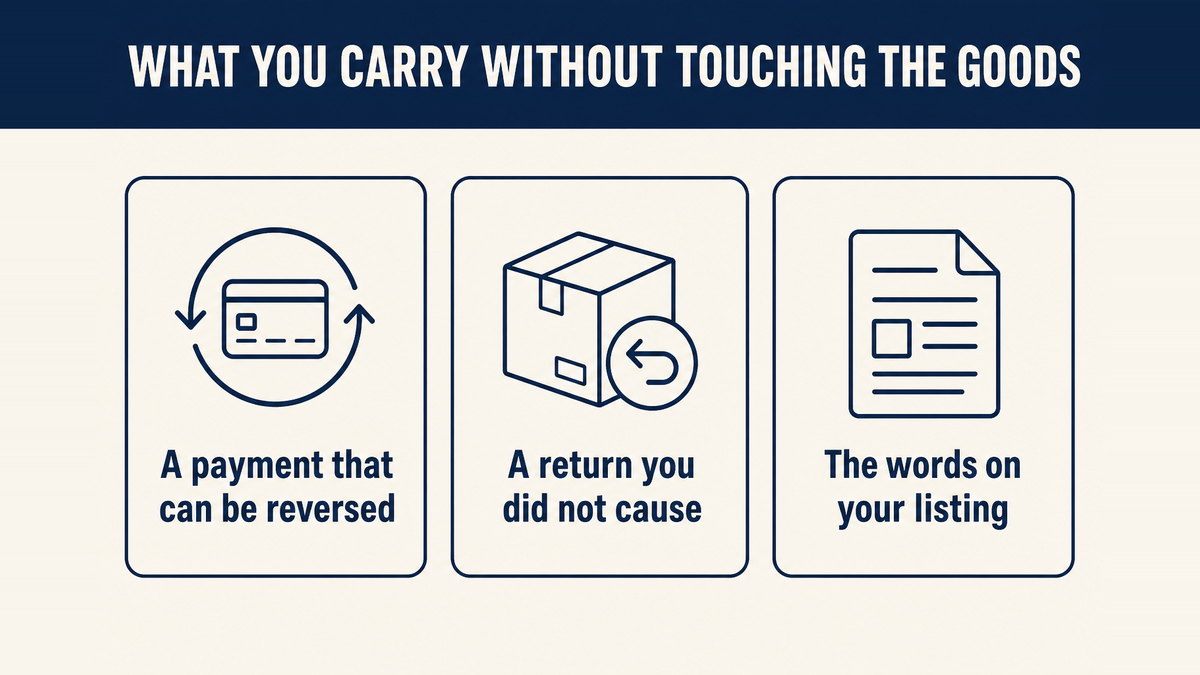
- A payment that can be reversed
- The money can leave your account after you have already paid for the goods, and the rule that allows it is written down in plain language.
- A return you did not cause
- If the parcel arrives late, damaged or wrong, the customer comes back to you. Your own claim against the supplier is a separate, slower process.
- The words on your listing
- Whatever you publish about the product is your statement, not the supplier's, even when you copied it from their page without reading it closely.
Take the first one, because it is the one beginners are least prepared for. It is often described as a chargeback, which makes it sound like a bank procedure happening somewhere else. It is better understood as a defined right, and the definition is worth reading.
Billing error means: … (3) A reflection on or with a periodic statement of an extension of credit for property or services not accepted by the consumer or the consumer's designee, or not delivered to the consumer or the consumer's designee as agreed.
12 CFR 1026.13(a)(3), Billing error resolution
Goods that were not delivered as agreed count as a billing error, in those words, in the rule. So a customer whose parcel arrives three weeks late, or arrives as the wrong item, has grounds to dispute the charge, and the dispute is between them and their card issuer. Your position is that you have already paid a supplier in another country for goods you no longer expect to be paid for. That gap is the actual risk of this model, and it is narrower than the risk of holding stock, but it is not nothing.
The practical defence is unglamorous. Keep the tracking number attached to the order rather than in a separate file, agree a delivery window with the supplier that you can actually meet, and resolve the dispute before it becomes one. The cost does not vanish when a parcel goes wrong, it moves: your remedy runs against the supplier rather than the customer, and our guide to rework, scrap and compensation after a failed inspection covers how that claim is put together.
The third item on that list is the one that quietly costs beginners the most, because it is invisible until it matters. The product description on your store is your claim, and copying a supplier's page wholesale means you have adopted their wording as your own — including any sentence about what the product does, what it is made of, or what standard it meets. Read the copy before you publish it, and cut any line you cannot support. Our notes on what common supplier claims actually mean are useful here, because the phrases that cause trouble are usually the ordinary ones.
5. The First 90 Days, in the Order That Matters
The sequence below is ordered by what protects you first, not by what feels most exciting. Notice that the store appears third and the advertising appears last, which is the opposite of how most beginner content is arranged.
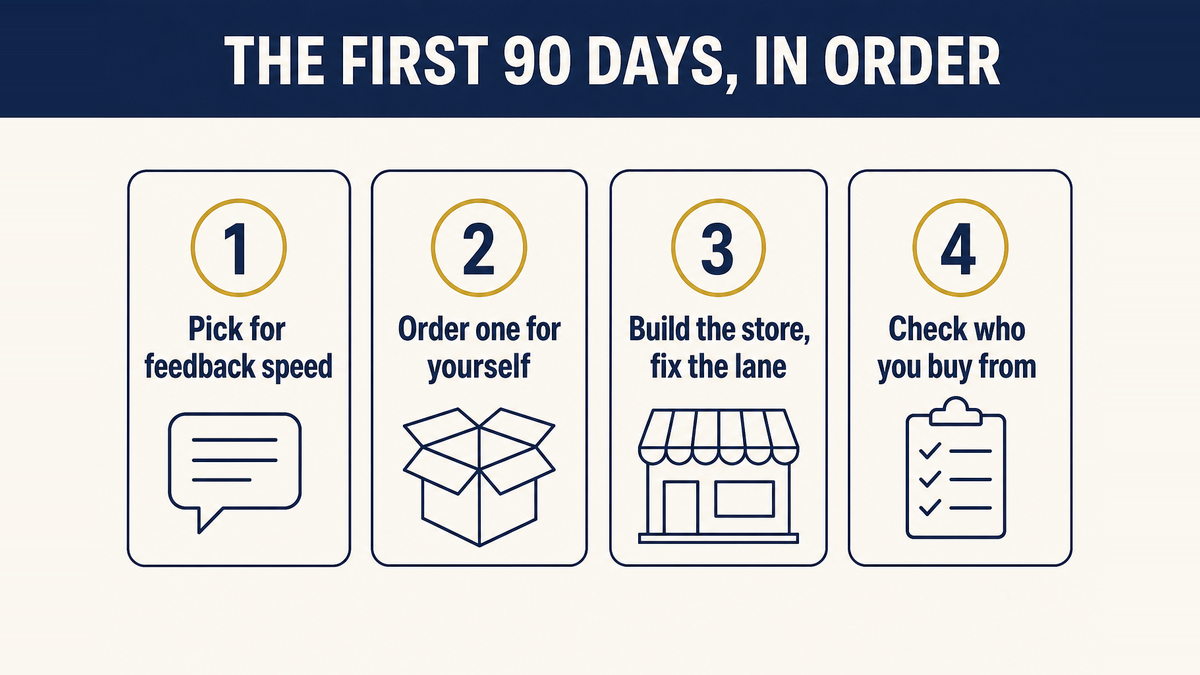
- Step one: pick a product you can get a verdict on quickly
- The first product does not need the best margin on the list. It needs to produce an answer in weeks rather than months, which means something simple, light and unlikely to come back. Our guide to choosing a product that actually sells sets out the criteria in full, and our notes on what product research tools measure and what they miss explain why a high score in a tool is not the same as a verdict.com/trending-products-for-dropshipping/" target="_blank" rel="noopener">reading a trend before it turns is the matching piece.
- Step two: order one for yourself before you list it
- This is the step beginners skip, and skipping it is the most common reason a first store fails quietly. You are checking three things that no listing photo will tell you: how long it actually takes to arrive, what the packaging looks like when it reaches a real address, and whether the product matches its own description. The cost is one unit and a few weeks. Our guide to placing a first order without losing money walks through the mechanics.
- Step three: build the store, and decide the shipping lane before you advertise
- The store is a weekend of work. The decision that needs more care is the lane, for the reason in section two: it sets the customs treatment of every order you will ever send. Settle it before you spend on traffic, because changing it later means repricing everything.
- Step four: check who you are actually buying from
- A price that looks too good is usually a trading company rather than a factory, which is not automatically a problem, but it changes what you can ask for and what you can negotiate. Our guide to telling a factory from a trading company before you order covers the tells, and checking the company before the goods covers the paperwork.
Two things worth knowing before you start, because both reduce the cost of the first ninety days. First, the whole point of the model is that you can be wrong cheaply, so treat the first product as a test rather than a bet and keep the order small enough that a bad answer costs you a week rather than a season. Second, once a product does start selling, the arithmetic changes, and the question moves from what each order really costs you to land to what it would cost to store and send from stock. Those are the two pieces to read next, in that order.
6. Frequently Asked Questions
Is dropshipping still worth starting in 2026?
It can be, but not for the reason it is usually sold on. The model removes the need to buy stock before you sell it, which lowers the cost of finding out whether a product works. It does not remove the cost of being wrong.
Do I need to pay import duty on dropshipping orders?
It depends on how the parcel arrives. Under the customs regulations the exemption for shipments not over $800 is currently suspended for merchandise arriving by any mode other than the international postal network, so a parcel sent on a commercial express line does not automatically arrive free of duty.
What is the $800 de minimis rule?
It is the exemption for a shipment of merchandise with a fair retail value not exceeding $800, imported by one person on one day. It applies to a single shipment, so one order cannot be split across several parcels to slide under the limit.
Why does the shipping line I choose matter so much?
Because it is a customs decision as much as a speed decision. Since the exemption is suspended outside the international postal network, the mode you choose helps decide whether duty is payable at all, and that can be a larger number than the difference in transit time.
Can a customer take their money back after I have paid my supplier?
Yes. Under the billing error rules, a charge for property or services not delivered to the consumer as agreed counts as a billing error, so a customer can dispute a charge after you have already paid for the goods. That is exposure you carry even though you never touched them.
What You Carry Without Touching the Goods
We return the duties you hold as seller of record, the records to keep from day one, and the two promises that get expensive when broken.
List What I Carry
Questions & Comments
We read every one and reply within 24 hoursStarting your first store, unsure which shipping lane your product can travel on, or trying to work out whether duty will arrive at your door or your customer's? Post the product, the destination country and the parcel weight, and our team will help you check the lane before you spend anything on traffic.