
Dropshipping Product Research in 2026: What the Tools Measure and What They Miss
 ·
Updated October 12, 2026
·
16 min read
Product research answers one question well: is anybody interested in this? It cannot answer the questions that decide whether you make money, because those depend on numbers that belong to you rather than to the market. Your landed cost, your return rate and your ability to reorder are not visible from outside, which is why two stores can research the same product correctly and end up with opposite results.
What Research Can and Cannot Tell You
| The question | What research gives you | Where the real answer lives |
|---|---|---|
| Is there demand? | A good answer. This is what tools are built to measure. | The marketplace, read over ordinary weeks. |
| What will it cost landed? | An estimate that ignores your route, your volume and your classification. | A quote from a supplier who will name the factory. |
| How often does it come back? | Nothing useful. | Your own orders, after you have sold some. |
| Can I reorder it? | Nothing at all. | The supplier's production reality and minimum order. |
What this guide covers
1. What Does Product Research Actually Answer?
It answers whether demand exists and roughly how strong it is. That is a genuinely useful question, and it is the one a tool is built for, because attention leaves traces that can be counted: searches, adverts, marketplace rank, social mentions.
What it does not answer is whether serving that demand would be profitable for you. Profit is a subtraction, and the numbers being subtracted are private: what your supplier charges, what freight and duty cost on your route, how often the item comes back, and what it costs you to handle a return. None of that is visible from outside the store.
This is why the same product report can produce a winner and a loser. The report is not wrong in either case. It is answering a question that stops one step before the decision, and the buyer who treats it as the decision is the one who is surprised.
It helps to separate two things that get called the same name. Market research describes a category: how many people want this kind of product, what they pay, and who already serves them. Product research, the thing a tool actually does, narrows that down to whether one specific item has enough attention to be worth selling. Neither one is a business case, because a business case needs costs, and cost is the one input no market can supply on your behalf.
So the honest way to use the output is as a shortlist. A tool is very good at taking four hundred possible products and handing you twelve that people are actively looking for. Twelve is a useful number to take to a supplier, and it is a dangerous number to take to a bank, because the same report that named those twelve says nothing about whether any of them can be bought at a price that leaves anything behind.
2. What Can a Tool See, and What Can It Not?
A tool can see attention and cannot see cost. Everything it reports is inferred from signals that are visible outside a store, and everything that decides your margin happens inside one.
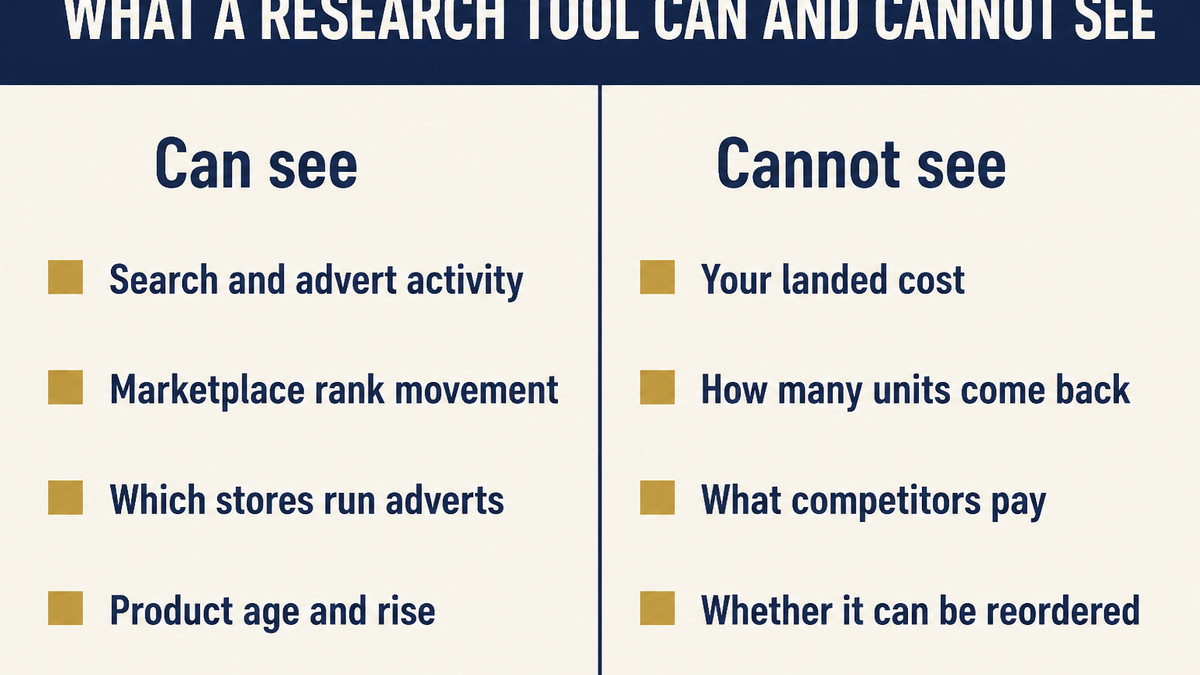
| A tool can see | Why it is reliable | A tool cannot see |
|---|---|---|
| Search and advert activity | It is public and it repeats if demand is real. | Your landed cost per unit on your own route. |
| Marketplace rank movement | Rank is published and changes daily. | How many of those sales turn into returns. |
| Which stores run adverts | Adverts are visible to anyone. | What those stores actually pay for the goods. |
| Product age and rise | Listing history is public. | Whether the factory will still make it next quarter. |
The practical rule that follows is simple. Use a tool to cut a long list down to a short one, then answer the second half of the questions with a supplier and with your own first orders. A tool is a filter, not a verdict.
3. What Are the Three Data Traps?
Three mistakes show up again and again, and all three come from reading a number as something it is not: a spike read as a trend, an estimate read as a measurement, and saturation read from the wrong signal.
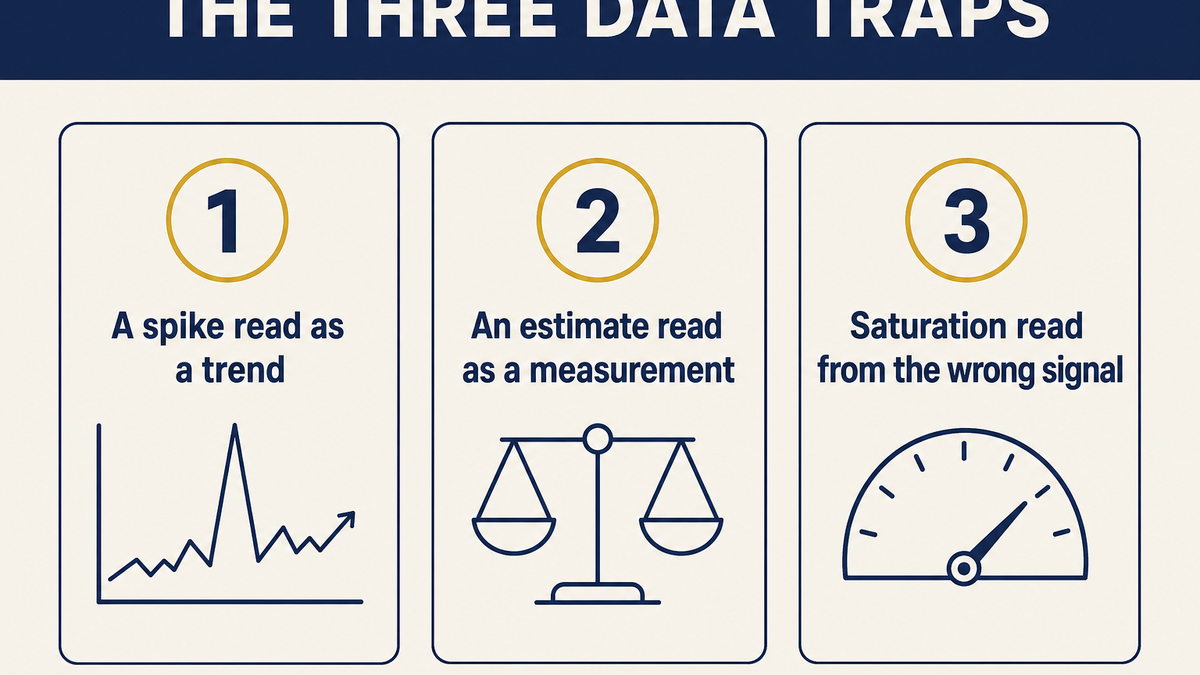
- A spike read as a trend
- A sharp rise is exciting and usually short. The useful shape is a line that holds after its first drop, because that is the demand that will still be there when your stock lands. Ask how the product behaved in the weeks before the rise, not only at the top.
- An estimate read as a measurement
- A competitor's sales figure is inferred from outside signals, not reported by the store, which makes it good for ranking products against each other and useless as the basis of a budget. Treat it as a direction and replace it with your own numbers as soon as you have any.
- Saturation read from the wrong signal
- The number of stores selling a product says less than what they compete on. If a page competes on price alone, the product has been turned into a commodity. If it competes on bundles, delivery time or a specific use case, there is still room for a store that does one of those better.
4. How Do You Research Without Paying for a Tool?
Read the marketplace directly, in the order that answers the most useful question first: is the demand steady, how hard is this to compete on, and what should be changed about the product. All three are free, and all three are more specific to your situation than a shared score.
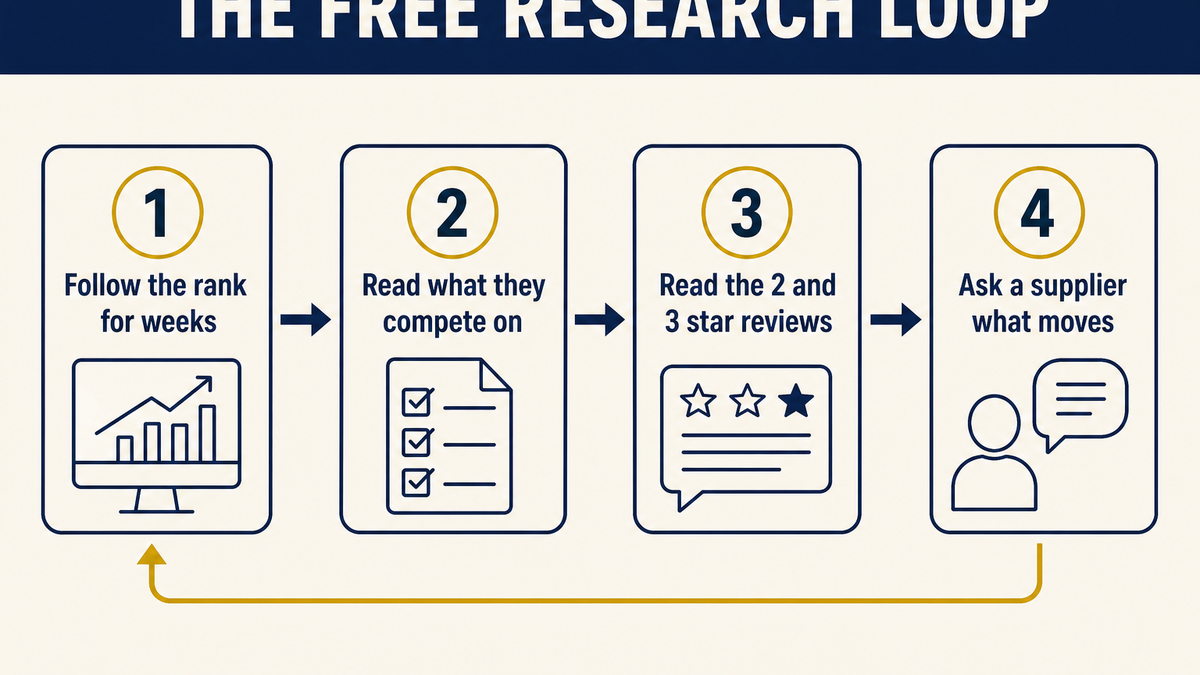
- Follow the rank over weeks, not days. A product that climbs and then holds is showing you demand that survives without your help. A product that peaks and falls has already had its moment, and you would be buying the tail of it.
- Read what the first page competes on. Price means the product is finished. Bundles, delivery time and a narrow use case mean there is still something to be better at, and that something is your opening.
- Read the two and three star reviews. The strongest research finding available for free is a complaint you can fix at the factory, because it proves demand and hands you the improvement in the same sentence.
- Ask a supplier what buyers request. A partner who handles sourcing requests daily sees demand before it becomes a keyword, and that is a forward-looking signal no historical dataset can match.
Write the answer down in one sentence before you go further: this product has steady demand, the competition is on price or on something else, and the change I would make is this. If you cannot write that sentence, you do not have a research finding yet, you have a bookmark.
5. The Question No Tool Asks: Can You Source It?
Whether you can buy it again, at the same specification, at a price that still leaves a margin. Research is silent on all three, and those three decide whether a good product turns into a business or into one lucky month.
This is not a hypothetical gap. It is the most common way a well-researched product fails: the demand was real, the first order was good, and then the second order arrived with a different material, a longer lead time or a higher price, and the margin that made the product worth selling quietly disappeared.
The supply half of research is done differently from the demand half, and it takes one conversation rather than a subscription. You ask who makes the item, then you ask the questions a reseller cannot answer and a factory can: how long the production takes, what the smallest sensible order is, which parts of the specification are fixed and which are open to substitution, and what documentation travels with the goods. A supplier who answers all four without needing to check anything has run the product before. One who promises to find out, on every question, has not.
This is also the cheapest research you will ever do, because it costs a message. The expensive version is skipping it, ordering stock on the strength of a demand chart, and discovering the supply answer only when the second order arrives and the numbers no longer work.
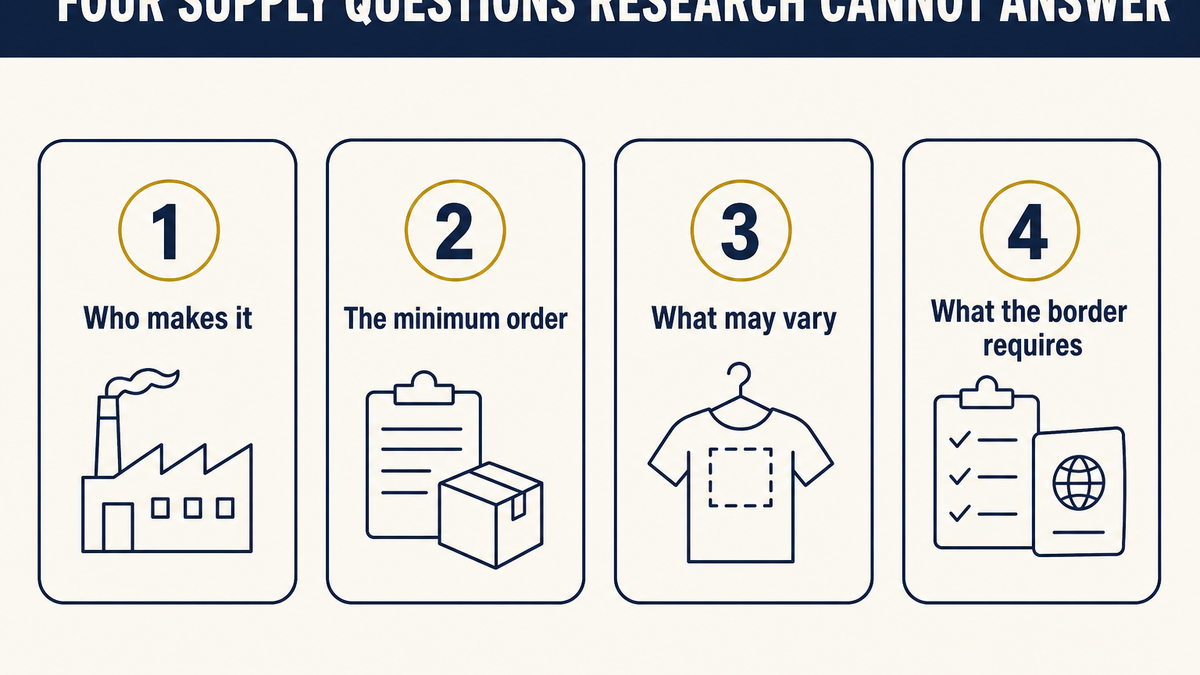
- Who makes it, and will they keep making it
- A listing is not a factory. Ask who produces the item and whether the production is ongoing, because a product sourced from a one-off consignment cannot be reordered when it sells well.
- What the minimum order is at each stage
- Stock, your branding on stock, and a custom specification have three different minimums. Knowing the three tells you how far you can scale before you must commit money you would rather keep liquid.
- What is allowed to vary between runs
- Materials get substituted and colours drift. A supplier who names what may vary, and within what range, is a supplier who has run the item more than once and expects to run it again.
- What the border requires
- Certification, labelling or a restricted-material check. Anything that must be cleared before the product can legally be sold in the destination country belongs in the research, not in the discovery stage after the first order. Check the duty you would pay on the USITC Harmonized Tariff Schedule, and note that low-value parcels into the United States lost their duty-free treatment for goods of China and Hong Kong, as the Federal Register notice implementing Executive Order 14256 records.
6. What Does a Research Checklist That Includes Supply Look Like?
Two passes, demand first and supply second, and you stop at the first pass that fails. Running them in this order means you only spend supplier time on products that already have demand behind them.
- Demand pass. Is the rank steady over weeks, and does the product appear in more than one place at once?
- Competition pass. What does the first page compete on, and which of those things can you do better?
- Change pass. What would you fix about the product, and can it be fixed at the factory rather than in the description?
- Supply pass. Who makes it, at what minimum, with what allowed variation, and what must be cleared for the border?
- Cost pass. What is left of the selling price after the landed cost, the shipping, the fee and a share of returns?
- Test pass. Can you sell it per order for a few weeks before committing to stock?
7. What Do You Do With the Answer?
Test it in the smallest way that produces information: sell it per order, set a date for the verdict, and read the returns rather than the return rate. Research tells you which products deserve that test. It does not replace it.
Two things make the test worth trusting. Have the goods checked before they ship, so a good result is a fact about the product rather than about the sample you were sent, using an independent quality inspection. And work with a partner who can source per order and hold a small buffer while you learn, which is what a private sourcing agent in China is for. If the test succeeds and the product deserves to become a normal line rather than an experiment, the timing and the risks are covered in our guide to moving from dropshipping to wholesale, and the landed cost side is set out in our dropshipping from China guide.
8. Frequently Asked Questions
Do I need a paid product research tool for dropshipping?
No, but you should understand what one replaces. A tool speeds up the first question, whether demand exists, and does nothing for the questions that decide profit: what the product costs landed, how often it comes back, and whether you can reorder it. Free methods answer those as well as paid ones do.
Why do research tools show products that do not work?
Because they measure attention rather than profit. A tool can see that a product is being advertised or searched for, but it cannot see your landed cost, your return rate, or whether the factory will still make it next quarter. Those three decide whether demand is worth serving.
What is the biggest mistake in product research?
Treating an estimate as a measurement. A competitor's sales figures are inferred from outside signals rather than reported by the store, so they are useful for ranking products and useless as a budget. Plan with your own costs, not a tool's estimate of somebody else's.
How do I research a product for free?
Read the marketplace instead of a dashboard. Sales rank movement shows whether demand is steady, the make-up of the search results shows how hard the product is to compete on, and the two and three star reviews of the closest product tell you what to fix and what to charge for.
How do I know if a product is too saturated?
Look at what the stores are competing on. If the whole first page competes on price, the product has already been turned into a commodity. If they compete on bundles, delivery time or a specific use case, there is still room for a store that does one of those better.
Three Data Traps, Named and Measured
We return the three traps with a worked example from your own list, the free signals replacing a paid tool, and the sourcing question.
Expose My Traps
Questions & Comments
We read every one and reply within 24 hoursTorn between two products your research flagged, unsure whether a sales estimate is worth trusting, or stuck because a product passed every check except the cost of getting it landed? Post the product, the numbers you have and the ones you cannot get, and our team will help you finish the second half of the research.