
Dropshipping Baby Products: The Age Line and What Cannot Be Sold
 ·
Updated October 14, 2026
·
15 min read
Baby products look like a good category for a direct-ship store: steady demand, buyers who do not argue about price, and a product that has to be replaced as the child grows. The reason so many sellers try it and stop is not competition. It is that this category is divided by age lines, and the lines do not govern how you label the item, they govern whether the item may be sold at all. Below one of the lines, a hazard that would be a labelling question in any other category classifies the product as a banned hazardous substance. Above the other, a testing and certification regime attaches to the product rather than to the seller. This guide sets out where the lines are, what decides which side an item falls on, and what a direct-ship model therefore cannot carry.
1. The Age Line Decides the Product, Not the Label
In most categories the safety rules operate as conditions attached to a product: meet them and the item may be sold, miss them and it has to be fixed or withdrawn. This category works differently, because the rules are built around age. An item intended for a very young child is subject to requirements that do not apply to the same item aimed at an older one, and the practical effect is that a design decision and a marketing decision can each move a product across a line into a stricter regime, or out of one entirely.
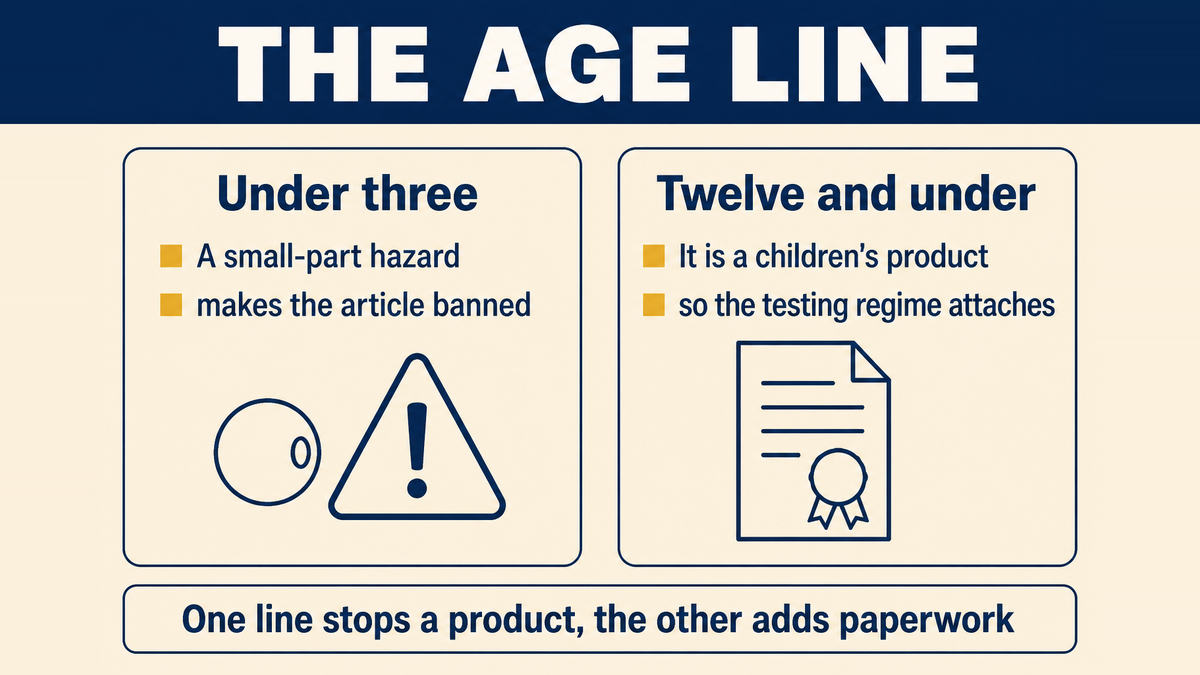
The lower line sits at three years of age and it is the more serious of the two. Its subject is small parts, and the consequence of failing it is not a warning label or a corrected listing. An article intended for a child under three that presents a choking, aspiration or ingestion hazard because of small parts is classified as a banned hazardous substance, which is a different kind of problem from a labelling defect. No amount of packaging, wording or disclosure resolves it, because what is banned is the article.
The upper line sits at twelve years of age, and it determines whether the item is a children's product at all. That question matters because the certification regime described later attaches to children's products specifically, so an item on one side of the line carries a testing and documentation obligation that the same item on the other side does not. The two lines are sometimes confused because both are expressed as ages, and they do different work: one can stop a product existing, and the other decides which paperwork surrounds it.
| Line | What it governs | Consequence of failing it |
|---|---|---|
| Under three | Small parts and choking hazards | The article is a banned hazardous substance |
| Twelve and under | Whether it is a children's product | The testing and certification regime attaches |
What this guide covers
2. What Makes an Item a Children's Product
The question of whether an item is a children's product reads like a matter of common sense and is actually decided by statute, with a list of factors that includes the seller's own conduct. The definition is set out in one sentence followed by four considerations:
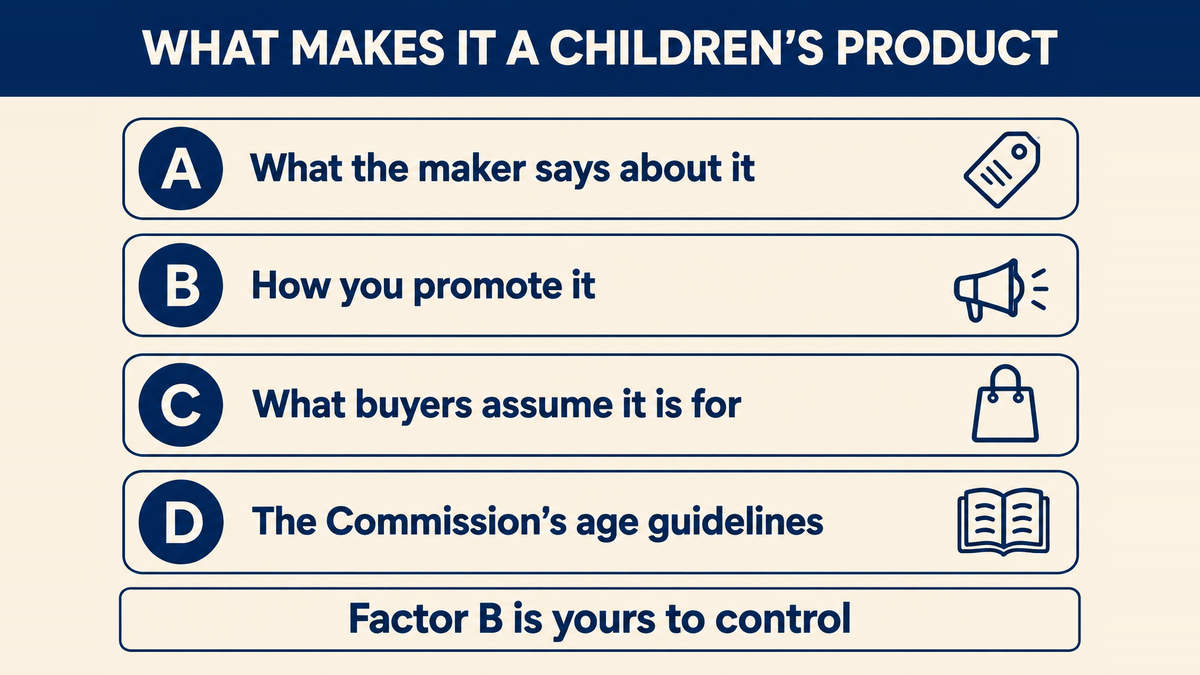
The term “children's product” means a consumer product designed or intended primarily for children 12 years of age or younger. In determining whether a consumer product is primarily intended for a child 12 years of age or younger, the following factors shall be considered: (A) A statement by a manufacturer about the intended use of such product, including a label on such product if such statement is reasonable. (B) Whether the product is represented in its packaging, display, promotion, or advertising as appropriate for use by children 12 years of age or younger. (C) Whether the product is commonly recognized by consumers as being intended for use by a child 12 years of age or younger. (D) The Age Determination Guidelines issued by the Commission staff in September 2002, and any successor to such guidelines.
15 U.S.C. § 2052(a)(2), via U.S. Government Publishing Office (read 14 October 2026)
Factor (B) is the one that catches sellers who did not intend to be in this category at all. Whether a product is promoted as appropriate for a young child is part of the test, and promotion is something the seller controls. An item that is genuinely a desk accessory, a novelty gift or a piece of home decor can be presented in a way that places it inside the children's product regime, and once it is inside, the testing and certification obligations attach to it. The reverse also happens: a seller who discovers the obligations and wants to leave the category cannot do it by editing the paperwork alone, because the presentation is what the factor looks at.
Factor (A) puts weight on a statement by the manufacturer about intended use, including a label, which means a factory's own packaging can decide the question before the seller has any say. A supplier who labels a product as suitable for a small child has made it a children's product for everyone who resells it, and that is worth checking on the artwork rather than assuming from the item's appearance. Factor (C) then adds what buyers generally understand the product to be, which is the reason an item sold with a picture of a toddler on the packaging cannot easily be treated as adult goods afterwards.
Factor (D) is what keeps borderline cases from being decided by opinion, and it is worth knowing that it exists. The Commission's staff publishes age determination guidelines, and the factors refer to them, which means a product that could plausibly be for a four-year-old or a seven-year-old is not resolved by the seller's view or by the supplier's. The guidelines are a published document rather than a private judgement, so where an item sits close to a line, the answer is available before the listing is written rather than after a question is raised.
The useful conclusion is that the category a product belongs to is not settled by the seller's intention, and it is not settled by the product's material or price. It is settled by a combination of the factory's labelling, the store's presentation and what buyers recognise, which means the question can be answered before listing simply by reading the packaging artwork and the product page with those three things in mind.
3. The Rule That Bans Rather Than Labels
The lower age line is enforced by a rule whose opening sentence explains why it is different in kind from a labelling requirement. The regulation describes its own purpose in plain terms, and the phrase to notice is the classification rather than the penalty.
Section 1500.18(a)(9) of this chapter classifies as a banned hazardous substance any toy or other article intended for use by children under 3 years of age that presents a choking, aspiration, or ingestion hazard because of small parts. This part 1501 describes certain articles that are subject to § 1500.18(a)(9); lists certain articles that are specifically exempted; and provides a test method for determining whether an article is a banned hazardous substance.
Consumer Product Safety Commission, 16 CFR 1501.1, Purpose (read 14 October 2026)
Two consequences follow from the wording. The first is that the classification applies to an article, not to a listing. An item that presents the hazard is a banned hazardous substance regardless of how carefully the store describes it, which means the usual remedies, such as adding a warning, changing the recommended age in the copy, or attaching a notice to the parcel, do not address it. Advertising an item as unsuitable for small children does not make it suitable for sale if it remains an article intended for use by children under three.
The second is that the question has an objective answer rather than being a matter of judgement. The regulation provides a test method for deciding whether a part is small, and the well-known version of that test is a cylinder representing the throat of a young child: a component that fits entirely inside it is a small part for these purposes. That is why the category has such a distinctive set of failures. A rattle whose end cap can be worked loose, a soft toy with a squeaker a child can pull out, a teether with a bead that can be separated, a set of keys on a ring where the ring is removable: each of these is the same problem wearing different clothes, and each is a design issue rather than a packaging one.
For a seller working through a supplier, this changes the useful question from "is this safe" to "what happens if a part comes off, and has anyone tested whether a part can come off at all". The first question invites an assurance, and an assurance is not evidence. The second produces either a test result for the item or a conversation that reveals there is not one, and the same reasoning applies to the toy category generally, where the testing standards are set out in how toy safety testing works in practice.
4. What the Certification Regime Requires
Inside the upper age line sits a set of requirements about testing and paperwork, and they are gathered in one part of the rules whose title states its subject. The part is divided so that the obligations read as a work programme rather than a single duty, and the contents list is the clearest summary available:
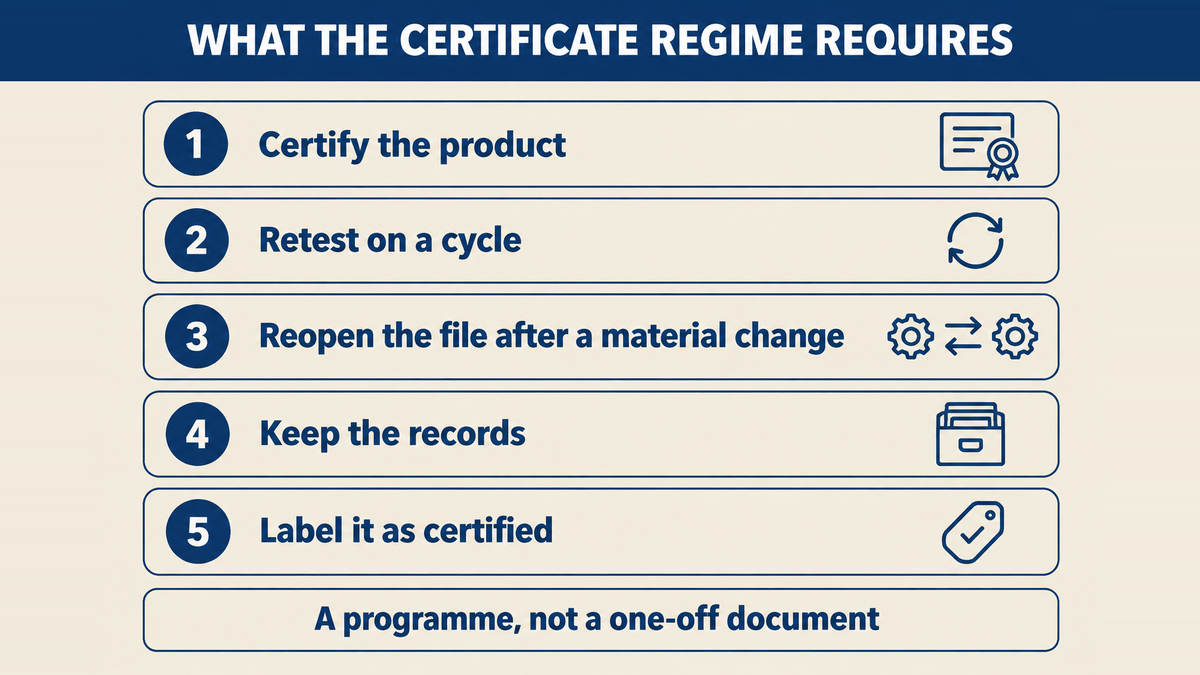
Part 1107 — Testing and Labeling Pertaining to Product Certification. Subpart A General Provisions: § 1107.1 Purpose, § 1107.2 Definitions. Subpart C Certification of Children's Products: § 1107.20 General requirements, § 1107.21 Periodic testing, § 1107.23 Material change, § 1107.24 Undue influence, § 1107.26 Recordkeeping. Subpart D Consumer Product Labeling Program: § 1107.30 Labeling consumer products to indicate that the certification requirements of section 14 of the CPSA have been met.
Consumer Product Safety Commission, 16 CFR Part 1107, contents (read 14 October 2026)
Read as a list, the shape of the obligation becomes visible. There is a general requirement to certify, which is where a certificate for the product comes from. There is periodic testing, which means the testing repeats on a cycle rather than being done once and filed. There is a provision addressed to a material change, which is the clause that matters most to anyone buying from a factory, because a change to the product after testing reopens the question. There is a provision concerning influence over the testing body, a recordkeeping duty, and finally a labelling provision describing how a product indicates that the certification requirements have been met.
Where a direct-ship seller runs into difficulty is at the intersection of two of those. A material change is precisely what a factory can make without telling a buyer, whether to reduce cost or to work around a material shortage, and the appearance of the item often does not change. And the recordkeeping duty means the answer to a question about a product is a document rather than a memory, which is the reason a store that has never held a specification in writing has nothing to produce when one is asked for. The general problem of assurances that do not survive contact with a specification is covered in what the usual assurances really mean, and the practice of checking goods against what was agreed is set out in what a pre-shipment inspection covers.
5. Which Items a Direct-Ship Model Cannot Carry
The reason this category is harder for a direct-ship store than for a retailer is not the rules themselves. It is the sequence. A retailer takes goods into a warehouse where somebody can open a carton and look at a unit before it is offered for sale. A direct-ship store never handles the product at all, so whatever the factory packed is what reaches the child, and the first inspection of the item may be the one performed by the person who bought it.
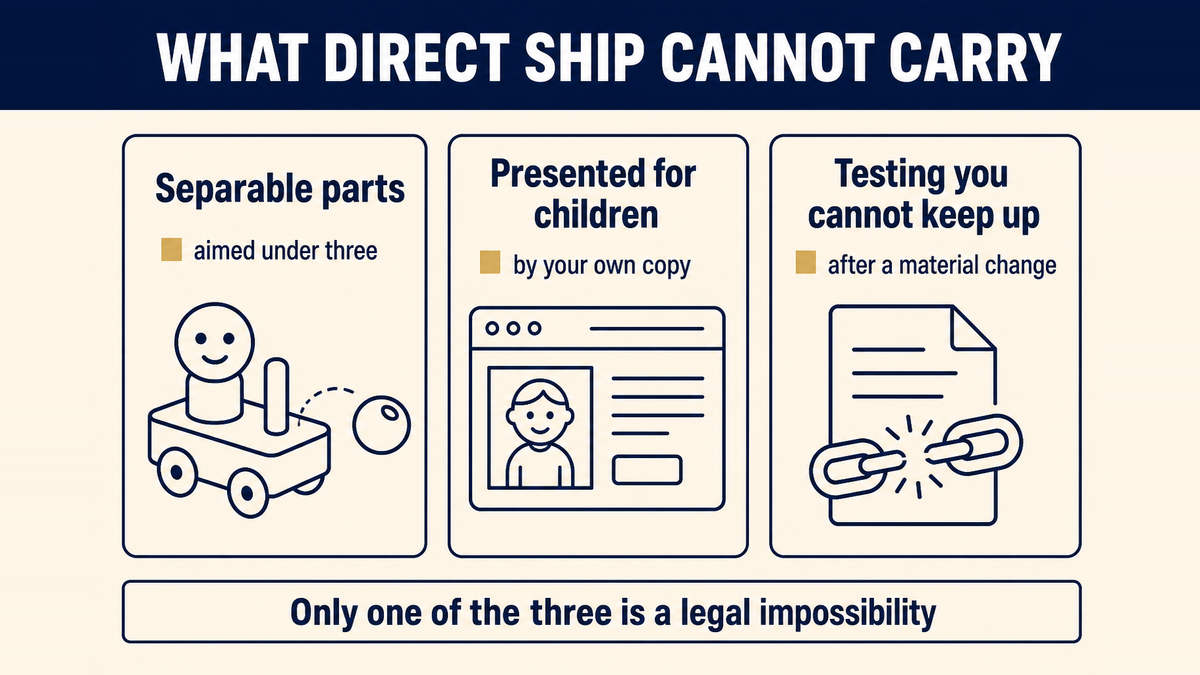
That sequence rules out a recognisable set of items. Anything intended for a child under three that contains a component which can be separated is the first group, and it is wider than it sounds: a rattle with a pressed-in end cap, a teether threaded with beads, a soft toy with a squeaker, a plush animal with glued-on eyes, a cloth book with a plastic ring. Any of these can present the hazard, and the classification that follows applies to the article rather than to the listing, so there is nothing to correct after the fact.
The second group is the one sellers do not see coming, and it consists of products that were never meant to be children's products but have been described as suitable for a young child. Factor (B) of the statutory test looks at how a product is presented in packaging, display, promotion and advertising, and a seller writing "great for toddlers" into a listing has answered the question in a way that brings the whole certification regime down on the item. The same applies in reverse to an item whose factory packaging shows a small child, because that packaging is part of what the product says about itself.
What makes the first group so costly when it goes wrong is the timing. An item that should not have been sold has already been delivered by the time anyone finds out, so the position is not a listing that can be corrected but a household holding an article that is classified as banned. Refunding the order does not retrieve the product, and the useful actions become a withdrawal of the item from sale, a decision about what to tell the buyers who already have one, and a conversation with a person who is by definition thinking about their child rather than about a supplier. The operational side of that conversation is how a complaint is handled directly, and the arithmetic of putting it right is what a return actually costs.
A third group fails for a different reason: the obligations cannot be sustained rather than being impossible to meet. Periodic testing means the testing repeats, and the recordkeeping duty means the paperwork has to exist and be kept. A store that cannot name the exact specification of the item it is selling, and cannot get a factory to agree to tell it before a specification changes, has no way to run that cycle. The items are not forbidden. The arrangement is simply one where a direct-ship seller cannot keep the obligation up, which over a season produces the same result as a category that was never workable.
6. How to Check an Item Before You List It
The checks that answer these questions are reading and asking rather than spending, which is why they are worth doing before a product is chosen rather than after it is selling. Four of them cover most of the ground, and each one has a definite output rather than a general reassurance.
| Check | What it answers | Who does it |
|---|---|---|
| Read the factory's artwork | What age the packaging claims | You, from a photograph |
| Read your own listing | What age your promotion claims | You, before publishing |
| Ask for the test on the exact item | Whether a result exists for this product | The supplier, in writing |
| Write the specification down | Whether a future change would be visible | Both sides, once |
The first two checks are the ones that decide which regime applies, and they are worth doing with a specific question in mind: does anything here, in artwork or in copy, describe the item as suitable for a child of twelve or younger. A yes to that question means the item is a children's product and the certification rules apply to it. A yes combined with an item that is small or has separable parts, aimed at a child under three, is the situation where the small parts rule is worth checking before anything else happens.
The third check is where a store usually discovers that what it holds is a document for a similar product rather than for this one. A report belongs to the item it was run on and to the party named on it, so the test to apply is whether the item described in the document is the item being listed, down to the model and the material. The fourth check is the one that protects everything else, because a written specification is the only thing that makes a factory's later change visible. Without it, a substitution of material or component happens silently and the paperwork quietly stops describing the product.
None of this makes the category unusable, and it is worth being clear about that. The items that clear all four checks are unglamorous and easy to overlook: things for older children, things with no separable components, textiles rather than assembled mechanisms, and products whose packaging already says who they are for. The decision is simply made earlier and on different grounds than a sales ranking suggests, and that is the whole content of this page.
7. Frequently Asked Questions
Are baby products a good dropshipping niche?
The demand is steady and the constraints are unusually strict, which is why so many sellers try the category and stop. Two age lines shape it. Below three years, an article with small-part hazards is classified as a banned hazardous substance rather than a product needing a better label, and at twelve years and under the testing and certification regime attaches. The workable products are the ones that sit clear of both.
Can I sell baby products without testing them?
Not if the item is a children's product, because the certification regime attaches to the product rather than to the seller. The test to apply before listing is whether anything in the packaging artwork or your own promotion describes the item as suitable for a child of twelve or younger. If the answer is yes, the testing and documentation obligations are in scope regardless of who assembled the goods.
What makes a toy a choking hazard?
The rule provides a test method for deciding whether a part is small, and the familiar version is a cylinder representing the throat of a young child: a component that fits entirely inside it counts as a small part. In practice this is a design question rather than a labelling one, because the failures are separable components such as a pressed-in cap, a bead, a squeaker, or an eye that can be pulled off.
Do I need a children's product certificate?
If the item is a children's product, the certification requirements apply, and the part of the rules that covers them is organised as a programme rather than a single document: a general requirement to certify, testing that repeats on a cycle, a provision addressing a material change to the product, controls on influence over the testing body, recordkeeping, and labelling. A direct-ship seller runs into difficulty mainly with the material change and recordkeeping provisions.
What if my supplier already has certificates?
Ask which item the document describes before relying on it, because a result belongs to the item it was run on and to the party named on it. A certificate for a similar product, or for a related material, does not answer the question for the item being listed. The check that makes this answerable is a written specification, since it is what allows you to see whether the product has changed since the document was issued.
A Decision Table per SKU, Not per Category
Each line carries its age band, the test that band implies, and a drop flag, so nothing is delisted on opinion.
Table My SKUs
Questions & Comments
We read every one and reply within 24 hoursTrying to work out which side of the age lines a product falls on, unsure whether a certificate your supplier sent covers the item you are actually listing, or wondering whether a small separable component rules an item out entirely? Send us the product and the packaging artwork, and our team will help you read both against the rules before the listing goes live.