
Bluetooth Speaker Manufacturer: Sourcing From China
 ·
Updated October 12, 2026
·
19 min read
A Bluetooth speaker is a driver, a board and a battery inside a box, and on this product the box is what decides whether any of it sounds good. Two quotations for speakers that look identical in a photograph can differ by more than double, and the gap is usually in the enclosure — how much sealed air is inside it, how well it holds that air, and how stiff its walls are. There is a second thing that makes this category unusual. If you advertise a power output in watts, the figure is governed by a rule, and the rule tells you how it has to be measured, labelled and displayed — and it does not let the importer point at the factory when it is wrong. This guide covers the seven parts you are buying, why the enclosure matters more than the driver, which wattage figure you can legally print, what changes when the battery sits inside the product, how the price is built, what goes wrong, how to check a manufacturer, and where a cheap quotation gets its money back.

What to Pin Down First, by What You Are Making
| If you are making | Pin this down first | Because |
|---|---|---|
| A desk speaker where sound quality is the selling point | The internal air volume and the seal, before the driver | The sealed air inside the box works as a spring against the driver. Change the volume or let the seal leak and the bass changes, whatever driver you paid for. |
| A speaker sold on how loud it is | The rated power output, measured and labelled the way the rule requires | A wattage figure is a regulated claim rather than a description. The number you print has conditions attached, and the obligation sits with the importer. |
| An outdoor or waterproof speaker | The joint and its gasket, before the water rating | The rating is produced by the seal rather than by the plastic, so a rating ordered after the tool is cut is a rating you cannot reach. |
| Anything with a battery inside the housing | The transport marking for batteries packed in equipment | A battery inside a device and a battery shipped loose are marked differently and are not the same shipment, even when the cell is identical. |
| A small speaker with deep bass | The passive radiator and the cavity it works against | Small boxes cannot move much air. A passive radiator is how the low end is recovered, and it only works if it matches the volume behind it. |
| A quotation that looks cheap | The driver grade, the battery in watt-hours, and the gasket | Three lines that are invisible in a photograph and easy to reduce without changing the outside of the product at all. |
What Are You Actually Buying? Seven Parts, and One of Them Is the Box
Seven, and the imbalance in this list is the whole story of the category. Six of them are bought-in components made by specialist companies. The seventh is the part the speaker factory makes itself — and it happens to be the one that decides the acoustic result.
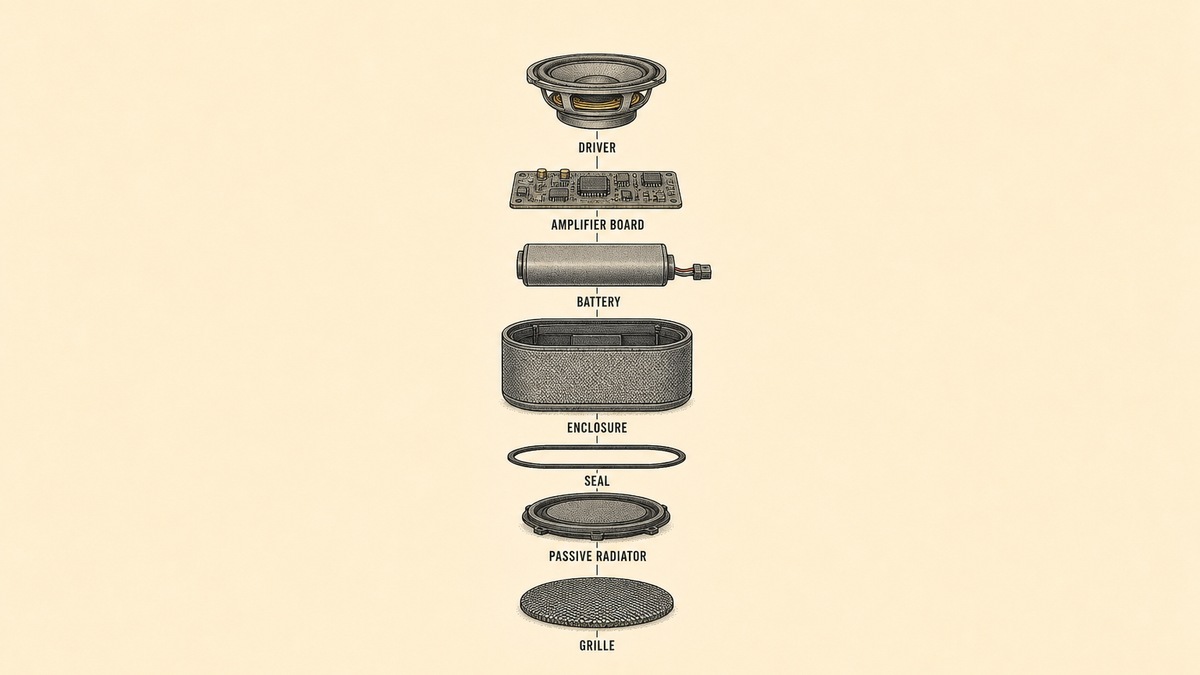
The driver is the part buyers ask about and the part the factory usually buys in. It is specified by size and impedance, and within one size there are grades that differ in cost and in how they sound. Because it is bought in, it is also the easiest line to swap quietly between the sample and the production run, so it belongs in the specification by name.
The amplifier board is where the wattage figure comes from, and it is bought in as well. It carries the Bluetooth radio, the amplifier and the protection circuits. Two boards with the same output rating can differ in efficiency, in how they behave when they clip, and in how much heat they throw into a sealed plastic box with nowhere for that heat to go.
The battery is the third bought-in part and, on a portable speaker, the one that sets the product's working life, because in most designs the customer cannot replace it. That is a different situation from a product with a user-replaceable cell: here the grade you choose is the grade the product will still have in three years, and the end of the battery is the end of the speaker.
The enclosure is the part the factory makes, and it is doing three jobs at once. It holds the parts, it seals the air the driver works against, and it has to be stiff enough that the driver does not move it instead of the air. A box that flexes is a box that absorbs the energy you paid a driver for. Because the walls, the bosses and the ribs are all set by the cavity, none of this can be changed after the tool is cut — which is the same reason every plastic enclosure project is a tooling project rather than a part number, as set out in how a plastic enclosure is actually specified.
The seal is a thin gasket or a moulded lip sitting in the joint between the front panel and the body, and it is the cheapest part in the speaker and the one that decides whether the other six sound right. A gasket costs almost nothing and a leaking joint costs you the bass.
The passive radiator is a driver with no motor, fitted into the box so that it moves with the air pressure the real driver creates. It is how a small speaker produces low notes it has no room to produce directly, and it works only when matched to the air volume behind it. A radiator chosen for price rather than for the cavity it sits in either does nothing or buzzes.
The grille is the last part and it is not decoration. It protects the driver and blocks a little air, and a grille with a small open area or a thick section can take back a noticeable share of what the driver produces. Like any protective part, it is part of the product rather than an accessory to it.
Why Does the Enclosure Decide More Than the Driver Does?
Because the air inside the box is a spring, and springs are made by dimensions rather than by brands. A sealed speaker is a system: the driver pushes air, the air pushes back, and the amount of push-back is set by the volume of air trapped behind the driver and by how completely the box holds it. Change the volume and you change the tuning. Let the box leak and you lose the spring.
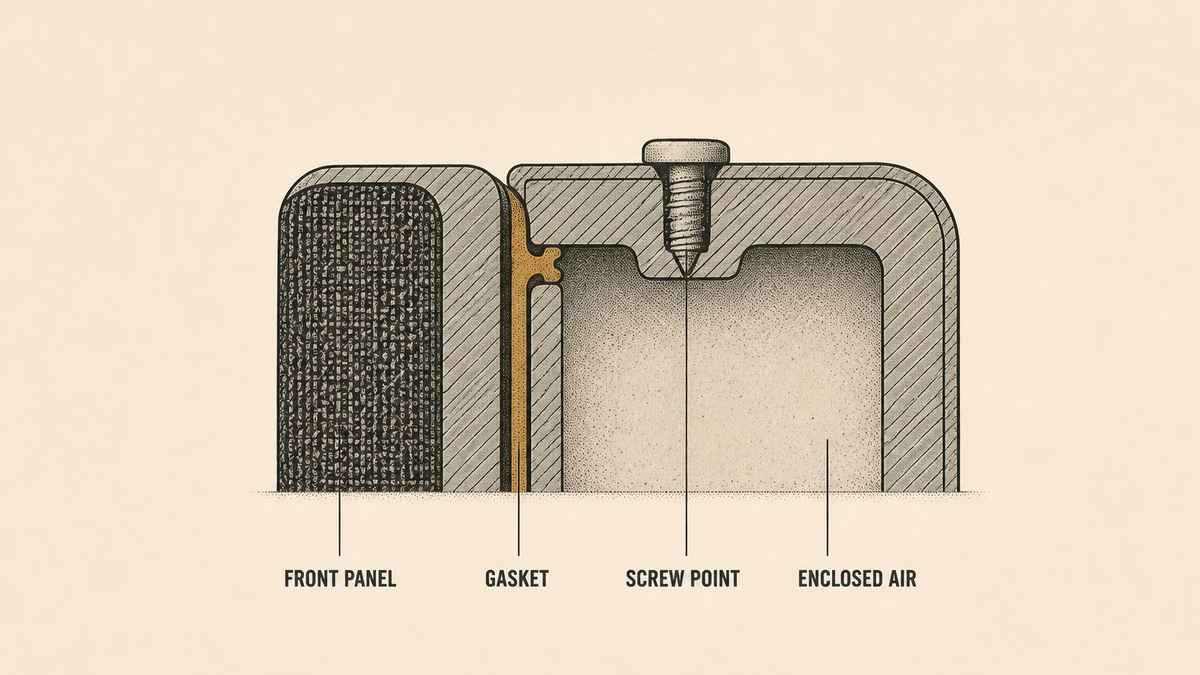
A leak is silent, and that is what makes it expensive. A joint that leaks does not hiss, does not drip and cannot be seen in a photograph. What it does is cancel part of the low-frequency movement before it becomes sound, so the symptom is a speaker that is slightly thin rather than obviously broken. Because the symptom is mild and gradual, a leaking design can pass every inspection you run and still generate reviews about weak bass.
The gasket has a compression range, and both ends of it fail. An elastomer seals best when it is squeezed by a defined amount, and both ends fail: too little and it does not close the gap, too much and it takes a permanent set so the box leaks after the first time somebody opens it. The squeeze is set by the groove depth and the standoff between the two faces, so it is a tooling dimension rather than a gasket dimension, and it has to be agreed between the moulder and whoever makes the gasket. A gasket is a moulded rubber component with its own material and hardness questions, and here it is doing an acoustic job.
The walls are part of the acoustic system. A thin panel that flexes in time with the driver is a panel stealing energy, and it usually does it at one frequency, which is why a boxy resonance can appear on one note rather than across the range. Stiffness comes from section depth far more cheaply than from wall thickness, so ribs are the normal answer — and the ribs have their own trap, because a rib that is too thick produces a sink mark on the visible face. Wall, boss and rib thickness are one family of decisions, all fixed in the tool, and covered in the enclosure guide linked above.
Ports and passive radiators are two answers to one problem. A small box cannot move much air, so the low end is recovered either by a tuned port, which is a hole with a length, or by a passive radiator, which is a moving disc. The port is cheaper and needs room to be a tube; the radiator takes less space and costs more, and it can be tuned closer to the driver's needs. Whichever you choose, the tuning is a dimension paired with a volume, so it is decided on the drawing rather than chosen from a catalogue.
And there is a test you can run with one finger. Press gently on the driver cone of a finished sealed unit, with the speaker switched off, and then release. A properly sealed box pushes back and returns slowly, because you are compressing the air inside it. A box with a leaky joint feels soft and springs back almost immediately. Ten seconds with one finger tells you more about the seal than a page of specifications, and it is the first thing worth doing when a production sample arrives. A low-frequency sweep at moderate volume, listening at the joint for a buzz, is the second — a gasket that is not seated properly often announces itself before it starts leaking.
How Do You Write a Bluetooth Speaker Specification?
Eight lines, and four of them are ones buyers leave out because the supplier did not ask for them. Adjectives are what a quotation is usually written in; every line below is a number or a named test, which is what makes two quotations comparable at all.
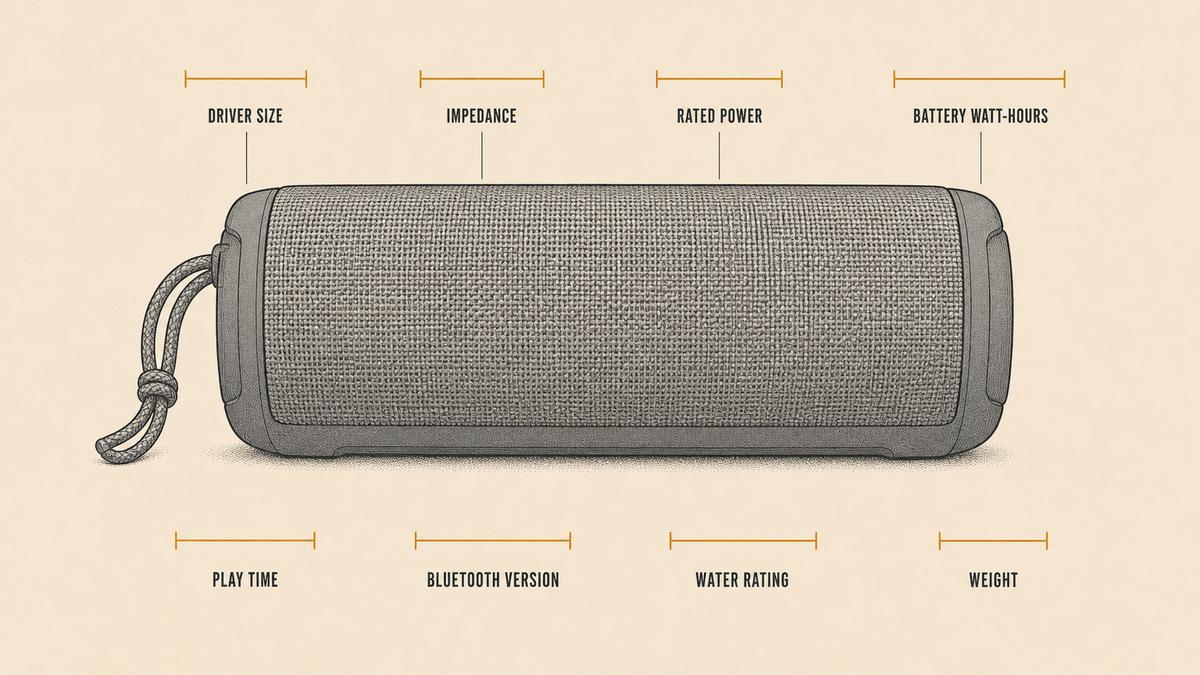
The driver, by size, impedance and grade. Size and impedance tell the factory which part to reach for; the grade is what tells them which version of it. Name the grade, because a bought-in driver is the easiest line in the whole product to change between the sample you approved and the run you receive.
The rated power output, on the terms the rule sets. Not a peak figure and not a marketing figure, and the next section explains why this line has conditions attached to it that no other line does.
The battery capacity in watt-hours. Capacity quoted only in milliamp-hours hides the voltage, and watt-hours are the figure the transport rules use and the figure a customer can eventually check. Ask for it as a number.
Play time at a stated volume. A play-time claim without a volume attached is not a specification, because the number changes completely with how loud the speaker is asked to be. Write it as a figure at a named level, and test the sample at that level rather than at a comfortable desk volume.
The Bluetooth version and the codecs. The version is the easy part; the codec list is the part that decides whether the speaker does anything better than the cheapest one on the shelf. Ask for both, and ask what happens to the audio path when a second device is connected.
The water rating, with the level named and the joint described. Write the level rather than the word water-resistant, and ask how the joint reaches it — gasket, lip or labyrinth. A rating is produced by the seal, so a rating written after the tool was cut is a rating the box cannot deliver.
The enclosure: material, wall, internal air volume and tuning. This is the line that decides the sound and the one most likely to be missing. Ask for the internal air volume behind the driver, whether the box is sealed or ported, and if it is tuned, what the tuning is paired with. These are dimensions, and they belong on the drawing rather than in an email.
Weight and dimensions, as figures. On a portable product the weight is a feature the customer feels every time they pick it up, and a line on your freight invoice. It is also what a cheap build quietly changes when a lighter battery or thinner wall turns up.
Which Wattage Figure Can You Legally Put on the Box?
The rated one, measured under the conditions the rule sets, labelled the way the rule requires — and this is the only line in the specification where the answer is written down by a regulator rather than agreed between you and a supplier. The rule is the FTC's amplifier rule, 16 CFR Part 432, the FTC rule on power output claims for amplifiers used in home entertainment products, and a supplier who has never heard of it is a supplier who has never sold a powered speaker into the United States under their own name.
When it applies. The part applies whenever a power output, a power band or frequency response, or a distortion characteristic is represented — expressly or by implication — in connection with the advertising, sale or offering for sale of sound power amplification equipment manufactured or sold for home entertainment purposes. The rule's own examples include self-powered speakers for computers, multimedia systems and sound systems. If your listing carries a wattage figure for a powered speaker, you are in the territory it describes — but confirm the scope against the rule itself for your product, because the wording is what decides.
What it requires you to disclose. Where such a representation is made, the manufacturer's rated power output has to be disclosed, measured under the rule's standard test conditions, shown clearly and in a way that stands out, and more prominently than any other representation permitted under the part. It has to be labelled “FTC Power Output Rating”, and the rule says this disclosure must not be made by a footnote, an asterisk or a similar notation. That rules out the most common way a real number is buried under a big one.
What “rated power” means, and why the big number is not it. The standard test conditions define rated power as the minimum sine wave continuous average power output, in watts, per channel where the equipment amplifies two or more channels. That is a specific, continuous, measured figure — not a peak, a maximum, a burst or a marketing number, which are exactly the figures a cheap supplier will offer because they are larger.
Can you print the other figure too? Yes, under conditions. Other operating characteristics and specifications may be disclosed, but any other power output has to be rated by the manufacturer, expressed in minimum watts per channel, and labelled clearly and prominently “This rating was not tested under the FTC standard” — again without a footnote or asterisk. The rule then sets a checkable design constraint: disclosures under this optional section must be less prominent, and any disclosure that is bold-faced or more than two-thirds the height of the required one is not less prominent. A large unlabelled number above a small labelled one is therefore not a grey area.
And nothing may be claimed that the customer cannot get. A separate section prohibits representing or disclosing performance characteristics that are not obtainable when the equipment is operated by the consumer in the usual and normal manner without the use of extraneous aids. A figure that only appears on a bench with an artificial load is a figure the rule does not allow. Violating the part is treated as an unfair trade practice under the Federal Trade Commission Act.
Then the part that decides who fixes it. Another section deals with liability, and its wording is specific about foreign-made goods: where the manufacturer, or in the case of foreign made products the importer or domestic sales representative, furnishes the required information, other sellers who rely on that written representation are not liable for transmitting it if they hold a written certification of its accuracy. Read that as a sourcing instruction: the chain only protects a seller who holds a written certification, so the wattage figure on your listing should reach you as a documented number from an identifiable party, not as a line in a spreadsheet.
Two things this is not. It is not a European requirement either: the electronics route into the EU is about safety, electromagnetic compatibility and restricted substances rather than how a power figure is advertised, and it is a separate piece of work on a separate schedule, covered in CE marking and RoHS testing for electronics. And it is not a licence to skip measuring. The most useful thing you can ask a supplier for on this line is a rated power output with the test conditions behind it, because a supplier who can supply both has a bench and a procedure, and one who can supply only a number has a brochure.
What Changes When the Battery Is Inside the Product?
The marking changes, and so does what the customer can do about it later. Batteries travel under a dangerous goods regime, and the regime distinguishes a battery shipped loose from a battery packed inside a device — which means a speaker with a built-in cell and a carton of spare cells are not the same shipment, even when the cell is identical.
The number on the mark depends on the case. In the lithium battery section of the transport rules, 49 CFR 173.185, the mark has to indicate the UN number, and the rule sets out one number for cells and batteries shipped on their own — with lithium metal cells marked UN3090 and lithium ion cells marked UN3480 — and continues to the different case where the cells or batteries are contained in, or packed with, equipment. Ask your forwarder which case your shipment falls into and what the mark must say, because a supplier labelling a built-in battery as if it were a loose one is a supplier guessing.
The rest of the battery work is already covered next door. The per-battery ceiling that decides whether a customer can carry the product onto a plane, the test summary that has to exist before a cell may be offered for transport and the list of things that summary must contain, and the packaging requirements that stop terminals shorting, are all set out in detail in our guide to the cell, capacity and shipping rules for power banks, and they apply to this product in the same way. What is different here is worth its own paragraph.
The battery is usually not replaceable, so it sets the product's life. On a speaker the cell is normally built into a sealed housing, and when it fades the customer replaces the speaker rather than the battery. That turns a battery grade from a cost line into a durability decision: the difference between one cell grade and another is the difference between a product that is still working in year three and a complaint about a speaker that will not hold a charge. Ask for the cell grade by name, not only the capacity.
And a sealed box full of electronics has nowhere to put its heat. This is the engineering point that is specific to this product. The amplifier board generates heat, the battery dislikes heat, and a portable speaker is usually a closed plastic shell with no fan and no vents — because vents would break the acoustic seal. So ask what temperature the board reaches inside the closed box at sustained high volume, and where the battery sits relative to it. A design that puts the cell against the amplifier ages the cell faster than the customer expects, and it is invisible on a specification sheet.
How Is the Price Built?
Eight lines, and the two that buyers spend the most time arguing about are not the two that decide the price. The driver and the battery dominate the unit cost, the tooling dominates a first order, and the housing and the gasket are where the sound is quietly made or lost.
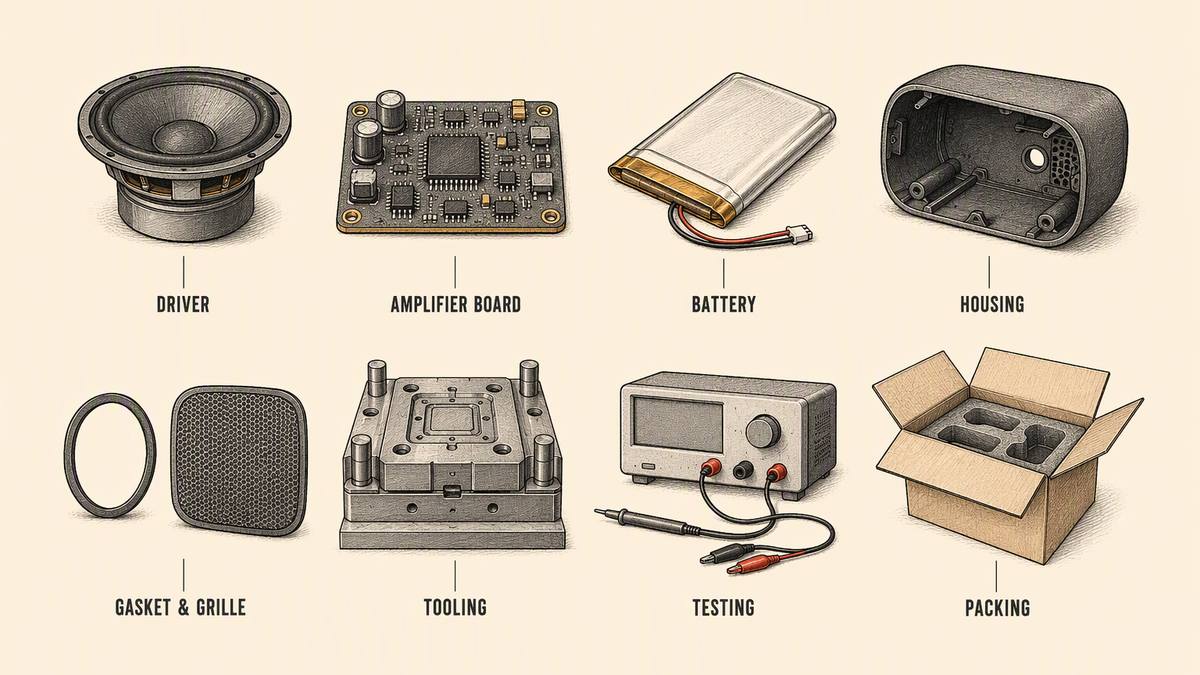
The driver. Bought in, priced by size and grade, and the largest single line on most units. Two speakers with the same driver size can cost very differently because of the grade behind it, which is why the grade belongs in the specification by name.
The amplifier board. Bought in, and priced by how much of it there is: the radio, the amplifier, the protection circuits and the charging circuit. Cheap boards save on protection and on efficiency, and efficiency is what decides part of the play time you are promising.
The battery. Bought in, priced by capacity in watt-hours and by cell grade. Because the cell is not replaceable by the customer, this is the line where a small saving becomes a durability complaint rather than a cost saving.
The housing. Moulded, priced by material weight and cycle time, and shaped by the cavity. Every decision that makes the box stiff enough and sealed enough was made when the tool was cut, so this line is where the acoustic system is paid for or lost.
The gasket and the grille. Cheap per unit and consequential. The gasket is a moulded rubber part with its own material and hardness, and the grille is a part whose open area and thickness decide how much of the driver's output survives the front of the box.
The tooling. A one-off, and on a first order usually the largest single number on the invoice. It does not scale with quantity, which is why a cheaper unit price and a cheaper first order are often two different quotations — and why the ownership and transferability of the tool matters more than its price.
The testing. Priced per model rather than per unit. Safety and electromagnetic testing are charged once per model, so a second colour is cheap and a second board or amplifier rating is not.
The packing. The retail box, the cable, the manual and the insert. On a speaker the retail box is often the brand's largest visible asset, and an accessory cable that cannot carry the product's output turns a good speaker into a slow-charging complaint.
Two notes belong to the order. Ask for the setup and tooling costs as separate figures, because that is the only way a first order and a repeat order can be compared. And ask which lines are per unit and which are per model, because three speakers sharing one housing carry one tool and three test bills.
What Goes Wrong?
Four failures, and only one of them is visible from outside the box. The other three are inside a sealed housing, which is why they survive inspection and arrive as reviews.
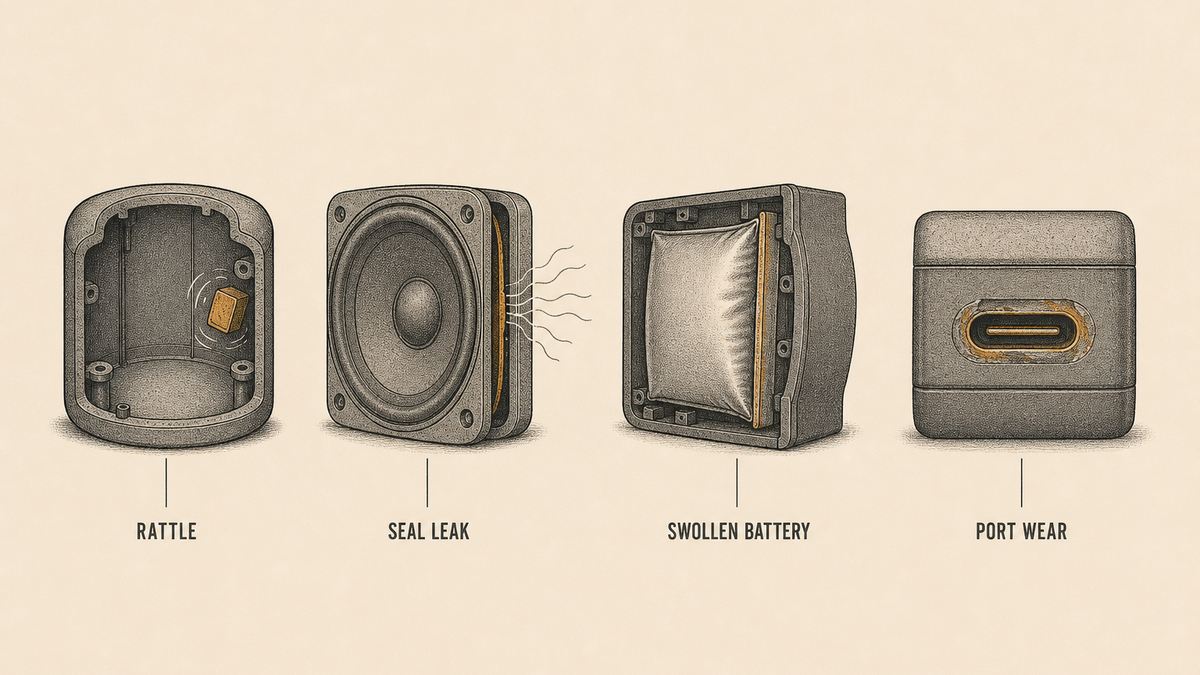
A rattle or a buzz. Something inside has come loose: a wire against the back of the driver, a gasket not fully seated, a screw not tightened, or a passive radiator touching its surround. What makes it hard to catch is that it usually appears only at volume, when the moving parts travel far enough to touch. A quiet desk test will not find it; a low-frequency sweep at high volume will, which is why the sweep belongs in the inspection rather than in a review.
A leaking joint, and the bass that goes with it. The seal fails, the enclosed air stops behaving as a spring, and the low end thins out. Because air escapes rather than anything breaking, there is no hiss and no visible damage, and the symptom is mild enough that it is often blamed on the driver or on the amplifier. It is the failure that the one-finger test on the cone exists to catch, and it is the reason the gasket is a specification item rather than a bought-in detail.
A swollen battery. A pouch cell that has been over-discharged, overheated or simply worked hard for years will bulge, and in a sealed box the bulge has nowhere to go except into a panel. The failure becomes visible as a gap along a seam or a panel that no longer sits flat, and by then the product is finished. Two design decisions decide how soon it happens: the cell grade, and how far the cell sits from the amplifier board's heat.
A worn charging socket. The connector is a mechanical part with a life measured in insertions, and a cheap socket wears oval so that the cable has to be held at an angle. It is the commonest end-of-life complaint on a portable product, it is entirely predictable from the socket that was specified, and it is invisible on arrival because a new socket feels fine.
The fifth failure does not break anything and is the hardest of all to trace. It is a speaker that drops its connection, or that stutters when the phone is in a pocket two metres away. The Bluetooth antenna is a piece of metal on the board or on a film inside the housing, and what sits next to it changes how it works. A battery placed over the antenna, a metal plate in the grille, or more plastic between the radio and the outside than the design assumed will all cut the range, and none of it appears on a specification sheet. The only way to find it is to pair two units and walk away from them.
How Do You Check a Manufacturer Before You Commit?
Start with the question that reveals the shape of the company: which of these parts do you make, and who makes the rest? A speaker factory normally moulds the housing and assembles the product, and buys the driver, the board and the battery. A supplier who can name all three knows what is inside their own product; one who claims to make everything has told you less. The general method is in telling a bluetooth speaker maker from a reseller.
Ask for the rated power output and the conditions behind it. A number with a test method attached is the answer you want; a number on its own is a brochure. Ask which figure it is, how it was measured, and whether your listing will carry the required label.
Ask for the battery documentation. The test summary that has to exist for a cell to be offered for transport, the watt-hour figure, the level the mark has to carry for your shipment, and the cell grade by name. The list of what that summary must contain, and the packaging rules that go with it, are set out in full in the power bank guide linked earlier in this article.
Ask for the acoustic dimensions, as numbers. The internal air volume behind the driver, whether the box is sealed or tuned, what the tuning is paired with, and how the joint is sealed. A supplier who can answer has designed the product; one who answers with the driver's size has assembled it.
Then test the sample with your hands and your ears. Press the cone gently with the unit switched off and feel whether the box pushes back. Run a low-frequency sweep at volume and listen at the joint for a buzz. Play it at the loudest setting and listen for distortion rather than volume. Run the battery down at the volume you intend to advertise and time it. Pair two units and walk away. Weigh the unit against the specification.
Inspect before it ships. What to check is the driver grade against the specification, the rated power label if the retail box carries one, the battery marking, the seal at the joint, the socket, the cable's current rating and the weight.Have the first order checked against your own list rather than against a general impression, and take the number of cartons to open from the sampling table.If the housing is a new tooling, the first samples from that tool deserve their own agreed check against the drawing rather than a general inspection.
And settle the market paperwork before the retail box is printed. If the product is going to Europe, the safety, electromagnetic and substance requirements are a separate workstream from everything above, and they do not replace any of it. Printing a retail box before the market requirements are settled is how a good product ends up in a warehouse with a label nobody can fix.
Where Does a Cheap Quotation Get Its Money Back?
A cheap speaker quotation is usually a real price for a lower-grade driver, a cheaper board, a lighter cell and a thinner gasket, and the customer hears the result rather than seeing it. Eight lines go missing.
- The driver grade. The same size and impedance from a cheaper tier. It is bought in, so nothing outside the speaker changes, and the difference is exactly what the customer is buying the product for.
- The amplifier board. Less protection and lower efficiency. Protection shows up as a product that fails after a difficult charge cycle; efficiency shows up as play time that does not match the claim you published.
- The battery grade. The same capacity in watt-hours from a lower cell grade. Because the cell is sealed in and not replaceable by the customer, this saving is repaid as a product that fades early, with no way for the customer to fix it.
- The gasket. A thinner or harder gasket, or a moulded lip instead of a separate seal. It is the cheapest part in the product and it decides the bass, so the saving is a percentage of nothing and the cost is the whole low end.
- The wall and the ribs. A thinner housing that flexes. The energy the driver puts into a flexing panel is energy the customer never hears, and the resonance it produces tends to appear on one note rather than everywhere.
- The passive radiator or the port. A radiator chosen from stock rather than matched to the cavity, or a port with the wrong length. The low notes come back thinner or the box buzzes at one frequency.
- The charging socket and the accessory cable. A lighter socket that wears oval, and a cable rated below the product's output so that fast charging never happens. Both are invisible until use, and the cable is the one the customer blames the speaker for.
- The testing. Safety and electromagnetic testing skipped, or done on a single prototype rather than per model. The saving is real, it is charged once per model, and the bill for skipping it arrives at a border rather than at a factory.
Close those eight lines on the enquiry rather than in a complaint: the driver by size, impedance and grade, the rated power output with its test conditions, the board's protection and efficiency, the battery by watt-hours and grade with its documentation, the internal air volume and tuning, the gasket by material and hardness, the housing material and wall with the rib plan, the socket by grade, the cable's current rating, and which tests are run per model.
One closing point. A speaker is judged by a sense rather than by a measurement your customer can easily make, which makes it easy to sell badly and hard to complain about precisely. The two decisions worth the most attention are the ones hardest to photograph: how much sealed air is inside the box, and how much of the number on the front of it you are allowed to print.
Frequently Asked Questions
What is the difference between RMS and peak power on a Bluetooth speaker?
One is a measured continuous figure; the other is a larger number with no continuous meaning. Under the FTC's amplifier rule, 16 CFR Part 432, the rated power output must be measured as the minimum sine wave continuous average power output under the rule's standard test conditions, shown more prominently than any other representation, and labelled “FTC Power Output Rating” without a footnote or asterisk. A larger figure may also be shown, but only expressed in minimum watts per channel and labelled “This rating was not tested under the FTC standard”.
Can I ship Bluetooth speakers from China?
Yes, and the battery inside changes how. Lithium cells travel under a dangerous goods regime that distinguishes cells shipped on their own from cells contained in, or packed with, equipment, and the UN number on the mark differs between those cases, as set out in 49 CFR 173.185. So a finished speaker is not classified like a shipment of loose cells, even when the cell is identical. Ask your forwarder which case applies and what the mark must say, then work through the wider rules — the test summary, the packaging and the per-battery air ceiling — on our power bank guide.
Why does my speaker lose bass at high volume?
Two likely reasons, and they sound similar. The first is a leaking joint: if the seal between the front panel and the body is not holding, the enclosed air stops working as a spring and the low end thins out progressively. Check it with the unit switched off by pressing the cone gently and feeling whether the box pushes back. The second is deliberate: most designs limit the low-frequency output as volume rises, to stop the driver travelling further than it can. That is a design choice rather than a fault, and the honest response is to know at what volume it starts and to write your claims around the level the product actually holds.
What is a passive radiator, and do I need one?
It is a driver with no motor, mounted so that the air pressure the real driver creates moves it, and it adds low-frequency output from a small enclosure. You need one, or a tuned port, if the product is small and bass is part of the selling point. The catch is that it works only when matched to the air volume and the driver, so it is a dimension paired with your cavity rather than a part chosen from a list. A radiator picked for price either contributes almost nothing or produces a buzz you will spend weeks tracing.
Why does my speaker buzz or rattle at high volume?
Because something inside moves further at high volume, and that is when a loose part starts to touch. The usual suspects are a wire resting against the back of the driver, a gasket that is not fully seated in its groove, a screw that was not tightened on the line, or a passive radiator meeting its surround. The reason this reaches customers rather than staying in the factory is that a quiet desk test does not reproduce it. Run a low-frequency sweep at the loudest setting during inspection — it takes a minute and it finds the majority of these before the container is loaded.
How much does it cost to develop a custom Bluetooth speaker?
There is no useful single figure, because a first order is three kinds of cost added together. Tooling for the housing is a one-off and usually the largest number on a first invoice, and you should ask for it separately so you can compare it with a repeat order. The per-model costs are the safety and electromagnetic testing, which do not scale with quantity. The per-unit cost is dominated by the driver and the battery. Ask for all three separately, then ask which parts are bought in and which the supplier makes.
Send the sealed air volume and the rated power — not just the driver size
Tell us what the speaker has to sound like and where it will be sold, and then the lines that decide whether it does: the driver by size, impedance and grade, the rated power output with its test conditions and how it will be labelled on your listing, the board's protection and efficiency, the battery by watt-hours and grade with its transport documentation, the internal air volume and whether the box is sealed, ported or fitted with a passive radiator, the gasket by material and hardness, the housing material and wall with the rib plan, the socket by grade, the cable's current rating, which tests run per model, and the market you are shipping into. Those answers settle the box, the seal and the claim before a price means anything. We will come back with the factories whose acoustic design, driver supply and battery sourcing match your product, the specification written as figures rather than adjectives, the tooling, testing and unit costs shown separately so quotations become comparable, a sampling plan built around pressing the cone and sweeping at volume rather than photographing a unit, and a clear statement of which supplier owns which failure on what you are buying.
Request a Bluetooth Speaker Sourcing Quote
Questions & Comments
We read every one and reply within 24 hoursWorking through Bluetooth speaker quotations that all quote the same driver size? Post the internal air volume, the rated power figure with its test conditions, and the cell grade, and we can usually say which lines are missing from them. If units have already arrived with weak bass, a buzz at high volume, a swollen cell or a loose charging socket, describe what you heard or saw and roughly when it appeared, because the symptom usually says whether it was the seal, the assembly, the cell or the socket.