
Timing Belt Manufacturer: One Tooth Is the Only Rule
 ·
Updated October 22, 2026
·
13 min read
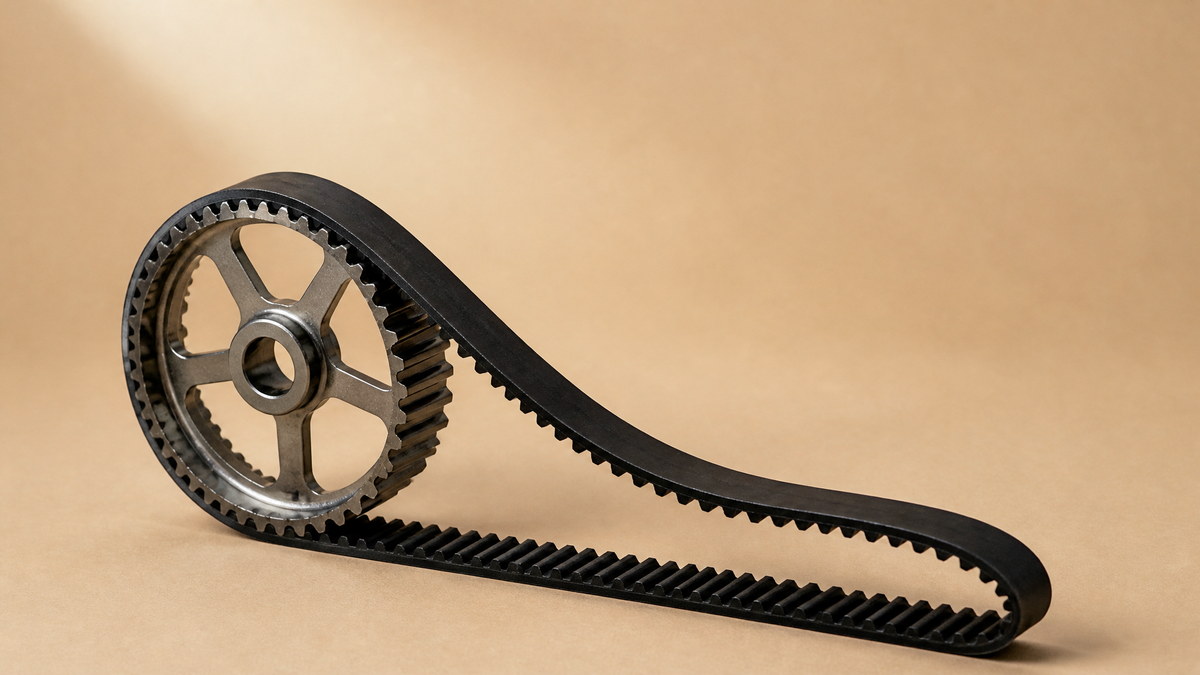
Search the Code of Federal Regulations for the phrase timing belt and you get six passages, every one of them in the same section, and not one of them about the belt. They are about a fault code. The rule says that on an engine with variable valve timing and a belt or a chain, the diagnostic system must detect a misalignment of one or more teeth between the camshaft and the crankshaft. That is the entire federal footprint of a part that can destroy an engine: a detection point, expressed in teeth.
1. The Only Federal Sentence About a Timing Belt
The section is 40 CFR 86.010-18, and it belongs to the on-board diagnostic rules rather than to any product standard. Its subject is the monitoring strategy a vehicle manufacturer has to build. The sentence that concerns this article sits inside a paragraph about camshaft and crankshaft alignment: the system must check the alignment between the two, and then, in the next clause, the case that matters here.
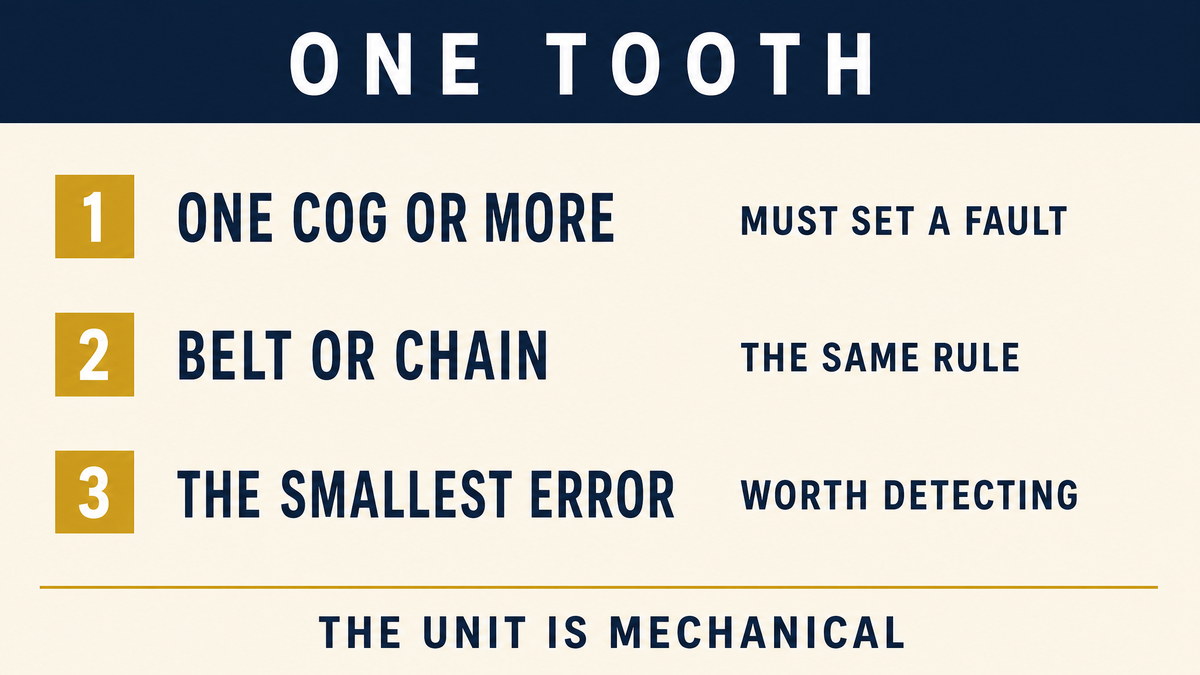
For engines equipped with variable valve timing and a timing belt or chain, the system must detect a malfunction if the alignment between the camshaft and crankshaft is off by one or more cam or crank sprocket cogs — the example the text gives is a belt or chain that has slipped by one or more teeth. There is an escape clause: if a manufacturer can show that a single-tooth misalignment cannot produce a measurable emissions increase under any reasonable driving condition, the cut-off moves to the smallest number of teeth that does.
That is the whole of it. Six matches in the entire code, all in one section, and all of them describing what a car must be able to notice rather than what a factory must be able to make. The rule is addressed to whoever calibrates the engine, not to whoever moulds the belt.
Two details in that sentence are worth keeping. The cut-off is one tooth, which means the regulation treats a single cog of error as the smallest unit worth detecting — a strong statement about what precision the part is expected to hold over its life. And the rule covers belt or chain, which tells you the regulator was writing about the alignment, not about the material.
2. A Diagnostic Is Not a Specification
Because the only mention is diagnostic, the rest of the map is empty, and it is worth being precise about how empty.
No product standard. There is no section of the vehicle standards that names a timing belt, sets a tensile figure, a heat-ageing limit or a tooth-profile tolerance. No marking duty. Nothing requires the belt to carry a name, a number or a date code; the printing on a belt is the maker's own. No category in the aftermarket parts subpart. Part 85 Subpart V lists emission-related parts with named parameters — converters, spark plugs, coils — and a search for belt across that subpart returns nothing at all.
So the part that can bend eight valves in a second has less federal text behind it than a tyre's sidewall lettering. That is not a scandal; it is a consequence of where the harm lands. A belt failure is not a crash and not an emissions event at the moment it happens — it is an engine failure, and the law does not regulate engine durability.
The practical result is the same as the fuel pump and the water pump, and it lands harder here because of the consequence. Nothing tells you what a timing belt must do, so the specification is yours, and the only external document you can lean on is the vehicle manufacturer's maintenance schedule, which is not law and has no enforcement behind it.
3. The Tooth Is the Unit
If the only rule is expressed in teeth, then the tooth is the unit a buyer should specify in, and the whole article follows from that. A timing belt is not a rubber part that happens to be toothed. It is a positioning device, and every property that matters is a property of how precisely it holds a position.
The profile and the pitch. Round, trapezoidal and curvilinear profiles engage a sprocket differently, and the pitch — the distance from one tooth centre to the next — decides the radius at which the belt runs. Change the pitch and the cam timing shifts by a fixed angle for every tooth in mesh. The tooth count. It fixes the length, and on a used engine it has to match the original exactly, because the tensioner's travel is designed around it.
The cord. Glass, aramid and steel cords are three different answers to one question: how much does the pitch change under load and heat? A cord that stretches by a fraction of a per cent is a belt whose timing drifts, and the drift is what the diagnostic rule is written to catch. The width and the backing. Torque capacity and resistance to oil and heat, which decide whether the belt reaches its interval at all.
That is why the specification has to be written in millimetres and degrees rather than in adjectives. A supplier who says the belt is "high strength" has said nothing you can hold them to; a supplier who names the profile, the pitch, the tooth count, the cord material and the tensile figure has described a part that either holds one tooth or does not.
4. The Two Documents You Actually Rely On
With no federal text to stand on, a buyer leans on two things that are documents in the ordinary sense, and it is worth being clear about what each one can and cannot do.
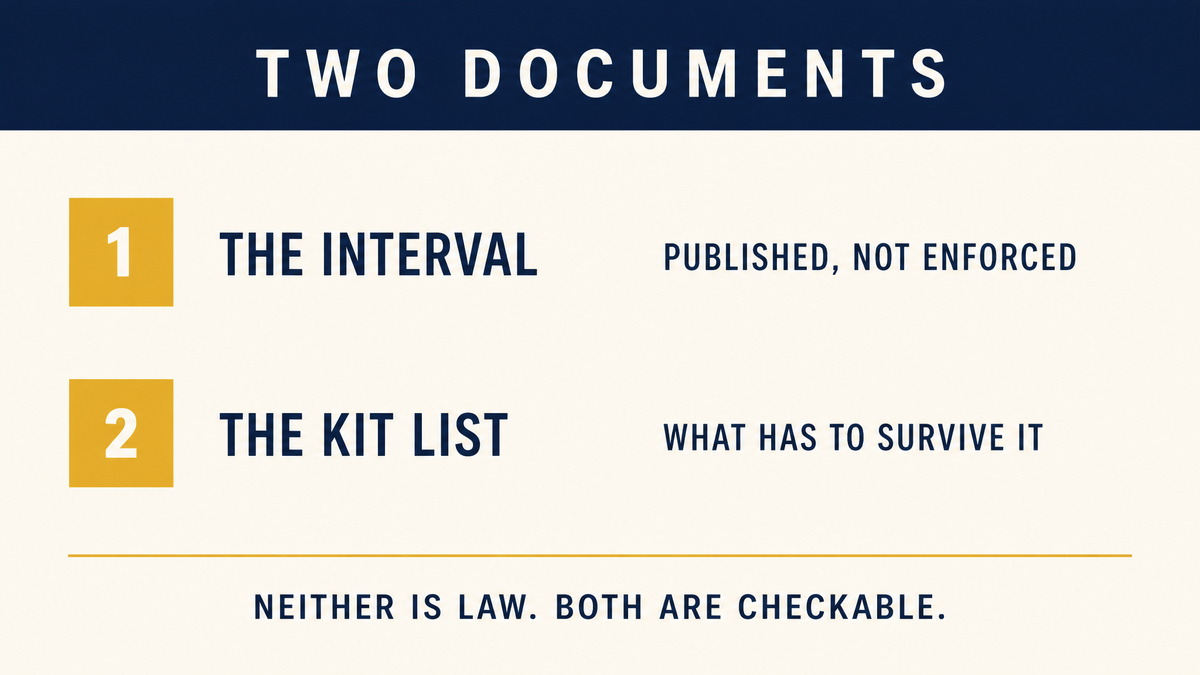
The maintenance interval. The vehicle manufacturer publishes a replacement interval in the service schedule, and in a belt-driven engine that interval is the closest thing to a service life the part has. It is not law. No agency enforces it, no recall follows from missing it, and two vehicles with the same engine can carry different figures. What it does do is set the number your customer will judge the part against, which makes it a commercial fact even when it is not a legal one.
The kit list. The second document is the one most buyers underrate: the contents of the box. A timing job has a labour cost that dwarfs the belt, and every component that has to be reached again later carries that labour a second time. Which is why the aftermarket sells a kit — belt, tensioner, idler pulley and, on many engines, the water pump and the front seal — and why the specification that matters commercially is the kit list rather than the belt alone.
Put those two together and the buyer's job becomes concrete. The interval tells you what the part must survive. The kit list tells you what has to survive with it. Neither is a regulation, and both are checkable in a way that "good quality" is not.
5. What a Failure Actually Costs
The reason this category deserves a specification at all is the shape of the downside, and it is worth stating plainly because it is what separates a timing belt from every other part in this series.
On an interference engine — the majority of modern four-stroke designs — the valves and the pistons occupy the same space at different moments of the cycle. The belt is what keeps them apart. If it slips far enough or breaks, a piston meets a valve, and the result is bent valves, a damaged head, sometimes a holed piston. The repair is an engine job, not a belt job.
Now compare the numbers. The belt is a small fraction of the cost of the job that replaces it, and the job is a small fraction of the cost of the failure. A part priced in tens of dollars sits upstream of a repair priced in thousands, and the ratio between them is the largest in this entire series — far beyond the fuel pump, which strands a driver, and beyond the water pump, which overheats an engine on a gauge the driver can see.
That asymmetry is the argument for the next two sections. When the downside is a factor of a hundred, the specification should be written around the downside rather than around the unit price, and the two-price technique stops being a negotiating tactic and becomes the only rational way to buy.
6. Where the Price Difference Comes From
Two kits for the same engine, one at half the price, differ in five places. On a belt the differences are small in appearance and large in life, which is exactly why they survive in a market that compares photographs.
The compound. HNBR and neoprene are not the same material at eighty degrees in oil mist, and the difference shows up as cracking at the root of the tooth long after the warranty has run out. The tooth facing. A nylon fabric on the tooth face reduces friction against the sprocket; a cheaper belt runs bare rubber, wears the profile and changes the pitch it was specified to hold.
The cord. The single most expensive line in the belt and the one that decides whether the timing drifts over the interval. The tensioner. A bearing, a grease fill and a seal that has to survive the same heat cycle as the belt; it is the component most likely to fail first in a cheap kit. The idler and the water pump. Whether the kit includes them, and whether the pump's seal is the one that survives contact with the coolant the vehicle actually uses.
Two prices, then, and the second one has to name the compound, the cord, the tensioner bearing and the kit contents. On a belt the gap per kit is small and the gap per failure is not, which is the cleanest case for the technique in this series.
7. What the Word "Belt" Actually Counts
Method first, unchanged. The federal recall file holds 245,845 records across 15,305 campaigns, has no header row, and every field is scanned. Controls: brake 28,639, air bag 16,162. Twenty-five terms were counted.
| Term or heading | Figure | What it belongs to |
|---|---|---|
SEAT BELTS | 1,833 campaigns | the restraint system, not a drive belt |
SEAT BELTS:REAR/OTHER:RETRACTOR | 1,748 | the same system, one level down |
BELTS AND ASSOCIATED | 1,122 | the accessory drive, and mostly the tensioner |
belt | 14,327 records / 808 campaigns | a word owned by two unrelated systems |
timing | 271 / 28 | the part this article is about |
tensioner | 195 / 28 | mostly seat belt pretensioners |
sprocket | 89 / 8 | the thing the tooth engages |
tooth | 9 / 3 | the unit the federal rule is written in |
teeth | 81 / 19 | the same unit, plural |
snapped | 0 | what a belt does when it fails |
squeal | 0 | what a slipping belt sounds like |
chirp | 0 | the other sound it makes |
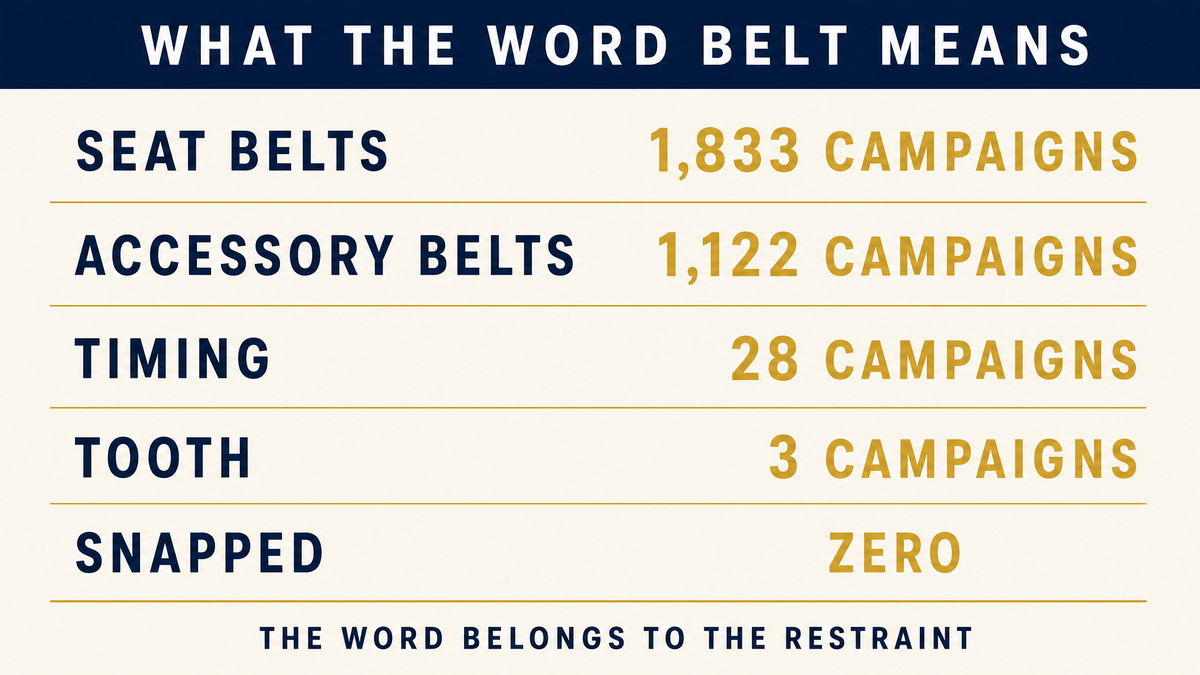
The word is not the part's. belt appears in 14,327 records, and the largest headings underneath it are seat belts — 1,833 campaigns, with the rear retractor alone at 1,748. A search for "belt recall" in this file returns a restraint system, not a drive belt. Anyone benchmarking a timing belt on the strength of that word is measuring the wrong part, which is the same trap the converter row found with torque and the fuel pump row found with pump.
The part's own number is small. timing appears in 271 records across 28 campaigns. Four of those campaigns are large — a BMW filing at 157,796 vehicles, another at 156,137, a Lexus at 101,584 — which is what a belt-driven engine failure looks like when it reaches the regulator: rare, and expensive enough to report.
Three zeros, and all three are the failure. snapped, squeal and chirp return nothing. Those are the three words for what a belt does when it is about to fail or has failed, and a file of a quarter of a million rows does not contain one of them. What it contains instead is engine, valve at 8,247 and piston at 553 — the damage, described after the fact.
The finding. This row closes the pattern the last three established. The code mentions the part once, in a diagnostic clause, in the unit of a tooth. The record mentions the part's word mostly on behalf of the seat belt, and when it does record the real thing it records the wreckage rather than the cause. Between a detection point and an engine rebuild there is no document at all — which is why the specification in section 3 is the only thing standing in the gap.
8. Seven Questions a Timing Belt Quote Should Answer
A quotation in this category is usually a price per kit and a photograph. The seven questions below turn it into a part that can be held to something.
- Which engine, and is it interference? The answer decides how much the specification is worth. On a free-running engine a mistake costs a recovery; on an interference engine it costs a head.
- Profile, pitch and tooth count? Against the original part number, not against a fitment list. A one-tooth error in the count is the same magnitude of error the diagnostic rule exists to detect.
- Which cord, and what is the tensile figure? The line that decides whether the pitch holds over the interval, and the first thing removed to reach a price.
- Which compound, and is the tooth face fabric-backed? HNBR against neoprene, and nylon against bare rubber. Both are cheap to name and expensive to omit.
- What is in the box? Belt, tensioner, idler, water pump, front seal — named, not "and associated parts". The kit list is the commercial specification.
- Which tensioner bearing and what grease fill? The component most likely to fail before the belt, and the one a cheap kit substitutes silently.
- What does the better-specified kit cost? Named compound, cord, bearing and contents, priced beside the quoted one. On a belt the gap per kit is small; the gap per failure is not.
9. Six Lines to Put in the Order
Six lines, and the first one is a part number rather than a size, because on this part the geometry is the product.
- The original part number, tooth count and pitch. Three things that have to match, stated together, so that a substitution cannot pass as an equivalent.
- Profile and width. The engagement and the torque capacity, in millimetres and in a named profile.
- Cord material and tensile figure. The property that decides whether the timing holds to the interval, named as a material and a number.
- Compound and tooth facing. HNBR or better, with a fabric face, stated on the drawing rather than in a brochure.
- Kit contents, item by item. Including the tensioner bearing type and the grease fill, because those are what the second labour charge is spent on.
- Two prices. As quoted, and with every line above named. The difference is the design cost, isolated from labour and freight.
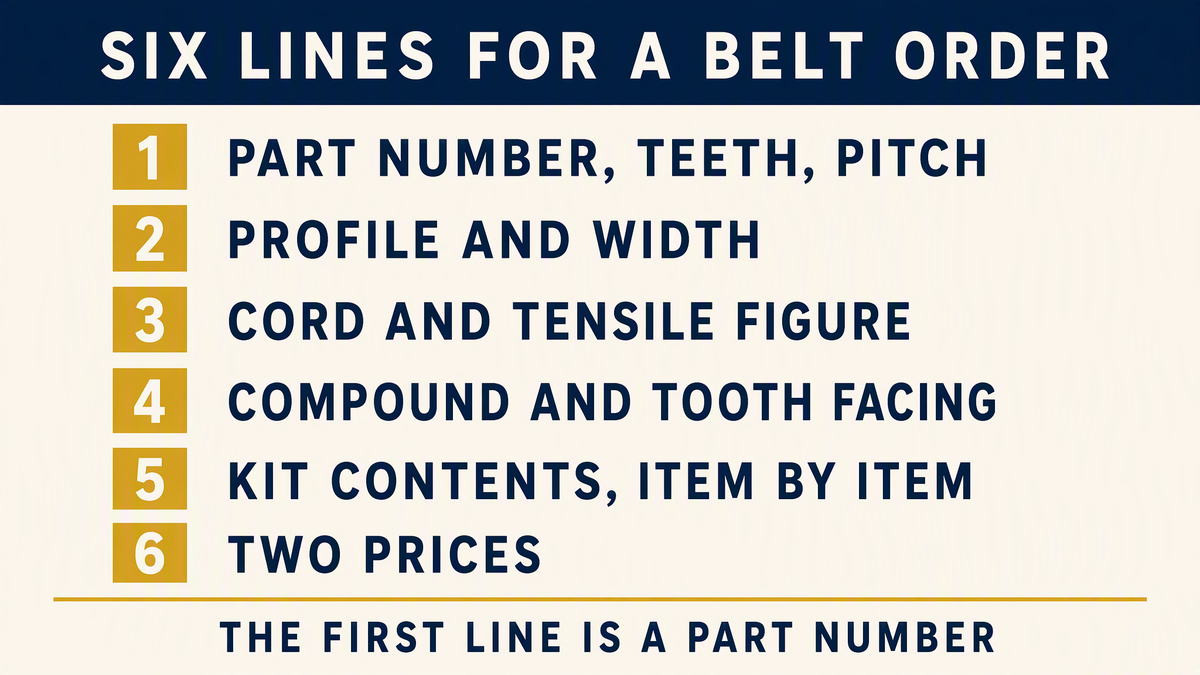
The fifth line is the one buyers skip and the one that decides whether the job is done once. A belt replaced on its own, with the original tensioner left in place, is a specification that stops at the cheapest component. Since the labour is the cost, the kit list is not an upsell — it is the only way the interval means anything.
Two of the six sit outside the belt. A tensile figure is only evidence if somebody reads it against the drawing, and how an audit reads a laboratory report is where a claimed number becomes a fact. The other is the carton: a belt that arrives kinked or stored against a sharp edge has taken a set before it is fitted, and the pre-shipment checklist is where that is settled — with how the packed volume decides the freight worth pricing at the same moment, because a kit is bulky for its weight and the carton is a large share of the landed cost.
Frequently Asked Questions
Is there a federal standard for timing belts?
No. The phrase appears six times in the Code of Federal Regulations, all of them in 40 CFR 86.010-18, and every one is about a diagnostic requirement rather than a product specification. There is no performance standard, no marking duty and no category for a belt in the aftermarket parts subpart. The belt's only federal footprint is a rule telling the car to notice a one-tooth slip.
What does "one tooth" mean in practice?
The rule requires the diagnostic system to detect a camshaft-to-crankshaft misalignment of one or more sprocket cogs. In practice a tooth is a fixed angle on a given sprocket, and one tooth on the cam sprocket is a larger crank angle than one tooth on the crank sprocket, because the cam turns at half speed. That is why the regulation names the cogs rather than degrees: the cut-off is mechanical, and the same error is measurable on any engine.
Does the rule cover chains as well as belts?
Yes. The sentence reads "a timing belt or chain", and the example it gives is a belt or chain that has slipped by one or more teeth. The regulator was writing about alignment, not about material, which is also why the clause is no help at all to somebody choosing between the two.
How often should a timing belt be changed?
At the interval the vehicle manufacturer publishes in the service schedule, not at a figure in federal law. There is no legal interval, and two vehicles with the same engine can carry different figures. What the interval does is set the number your customer will judge the part against, so it belongs in the specification as a design target even though no agency enforces it.
Why sell a kit instead of the belt on its own?
Because the labour, not the belt, is the cost of the job. A tensioner or an idler that fails at half the interval means the same labour again, and on many engines the water pump sits behind the same cover. The kit list is therefore the commercial specification: belt, tensioner, idler, and on some engines the pump and the front seal, all named rather than implied.
What kills a belt before its interval?
Oil and heat first, then a seized tensioner or idler that overheats the belt from the back, then incorrect tension at installation. The record shows the aftermath rather than the cause: engine, valve at 8,247 records and piston at 553, while snapped, squeal and chirp return zero between them. None of the three words for the failure itself appear in a quarter of a million rows.
A timing belt is a timing device with rubber around it, and the rule that reaches it is written for the diagnostic system rather than the belt. The monitor compares camshaft and crankshaft signals, and its cut-off is a single tooth.
One tooth is not a tolerance a buyer can see on a sample. It is a spec that lives in the tooth profile, the cord and the tensioner, which is why the belt and the kit have to be specified together or the number is meaningless.
The Two Papers Your Buyer Will Ask For
A cross-reference naming the engine code each belt covers, plus the tensioner setting the same paper states.
Build My Cross-Reference
Questions & Comments
We read every one and reply within 24 hoursA timing belt is judged by a monitor that counts teeth, and one tooth is the whole measure. Send the engine code and the kit list, and we will check them against each other.