

Camshaft Manufacturers: A Profile Change, and the Track That Needs Testing
 ·
Updated October 15, 2026
·
12 min read
The parts in this series have mostly been defined by what they do not touch. A camshaft is the opposite: it is the component that decides when the engine breathes, and changing it changes the engine's emissions by design rather than by accident. That single fact places it, in one state, on a different procedural track from the parts before it in this series. California sorts aftermarket parts into those that can be assessed against written criteria and those for which emission testing may be required — and a camshaft is not on the short list. The part also has a manufacturing fact that matters just as much for a buyer: the hardened layer on a lobe is thin, and regrinding can remove it.
1. What a Camshaft Is, and What a Lobe Has to Be
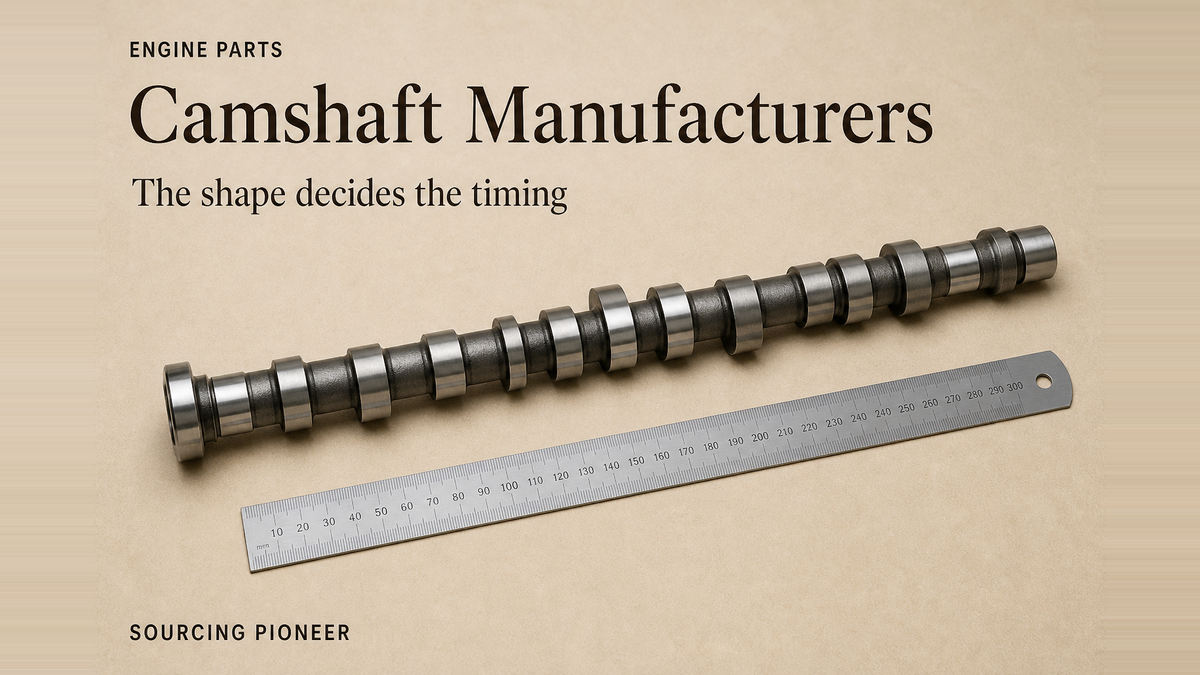
A camshaft is a shaft carrying a sequence of lobes, each of which opens one valve and lets it close again as it rotates. Between the lobes are journals that run in bearings, and at one end there is usually a drive for the distributor, a pump or a sensor.
The shape of a lobe sets three things at once: how far the valve opens, how long it stays open, and when in the cycle it opens. Those three numbers are the engine's breathing, so a lobe profile is not a shape preference — it is a timing specification that the vehicle's emissions calibration was built around.
A lobe also has to survive one of the hardest contacts in the engine. The cam rubs against a follower, a bucket or a rocker under high load and with only the oil film between them, and it does so several thousand times a minute for the life of the engine. That is why lobes are not simply cut from the same material as the rest of the shaft. Cast camshafts are made so the lobe surface itself is hard, often by chilling the casting at the lobe, and steel camshafts have their lobes hardened afterwards. Either way, the hardness lives in a shallow layer at the surface of the lobe — and that layer is the whole point of the part.
| The element | What it decides | What a vague quote hides |
|---|---|---|
| The lobe profile | Valve lift, duration and timing | Which profile, and what it was designed for |
| The lobe's hardened layer | Whether the lobe wears or survives | Hardness and the depth of the layer |
| Billet or cast | How the lobe gets its hardness | Which route, and whether it was re-hardened |
| The journals | Whether the shaft runs straight and true | Dimensions and runout |
| The end drive | Whether the accessory or sensor works | Whether it was cut true to the shaft |
What this guide covers
- What a camshaft is, and what a lobe has to be
- The inspection standard does not look at it
- California splits aftermarket parts in two
- A camshaft is not on the short list
- Regrinding removes the layer that matters
- What a cheap camshaft quote leaves out
- What to check on a sample
- Where the unit price comes from
- Frequently asked questions
2. The Inspection Standard Does Not Look at It
As with the rest of the engine, no federal inspection provision reaches a camshaft. The in-use inspection standard is organised as one section per system, covering brakes, brake power unit, steering, suspension, tyres and wheel assemblies. There is no engine section, so a camshaft carries no figure, marking or test that an inspection is directed to check.
So the part is left to the engine it is fitted to and to the regime that governs what may be sold for it — which, for this component, is the more interesting half of the story.
3. California Splits Aftermarket Parts in Two
The state that runs a formal exemption programme sorts the parts it receives into categories, and then — more usefully for a buyer — into two application tracks. The categories are listed as a numbered set:
Category I Consolidation of Existing Executive Orders … Category II Air Intake Kits or Modifications … Category III Engine Control Module (ECM) Programmers and/or ECM Signal Modifications … Category IV Fuel Tanks or Fuel Tank Modifications … Category V Intercooler Kits … Category VI Supercharger and Turbocharger Kits or Modifications … Category VII Pre-Catalyst Exhaust Components … Category VIII Other Categorized Parts … Category IX Add-On or Modified Part(s) Not Covered by Categories II through VIII
California Air Resources Board, Manufacturers of Aftermarket Parts (read 15 October 2026)
Two of those categories exist to catch what the others do not, and one application form is the one that matters here. The agency describes the two tracks in its own words, and the difference between them is the whole point of this article:
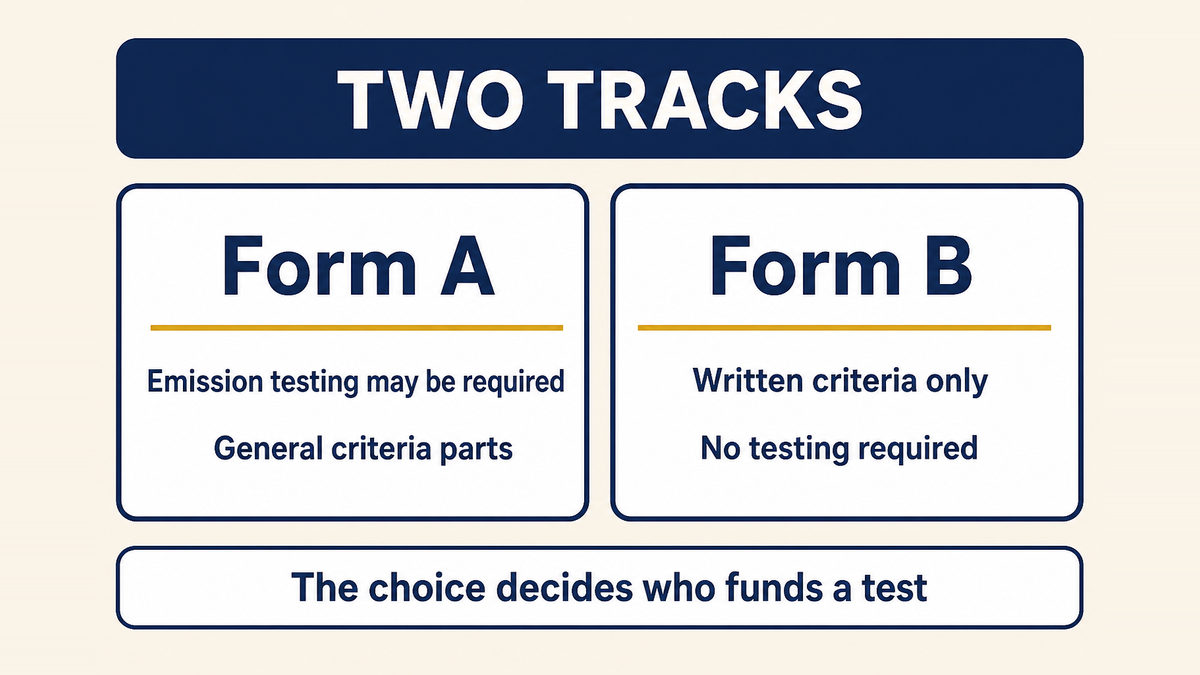
Form A General Criteria Parts Application: this must be filled out for those add-on and modified parts for which vehicle or engine emission testing may be required to determine their impact on emissions. Form B Compliance Criteria Parts Application: this must be filled out for those parts for which explicit criteria are satisfied in writing, and which do not require vehicle or engine emission testing to obtain the VC 27156 exemption.
California Air Resources Board, Manufacturers of Aftermarket Parts (read 15 October 2026)
Form A, or Form B. One route asks for written criteria and produces an exemption without testing. The other contemplates testing the part on a vehicle or an engine before the exemption can be granted. Which route a product takes is therefore not a detail of administration — it decides whether a supplier can get to market on paperwork or has to fund a test programme.
4. A Camshaft Is Not on the Short List
The short list is published, and it is short. The agency names exactly which parts can go down the criteria route:
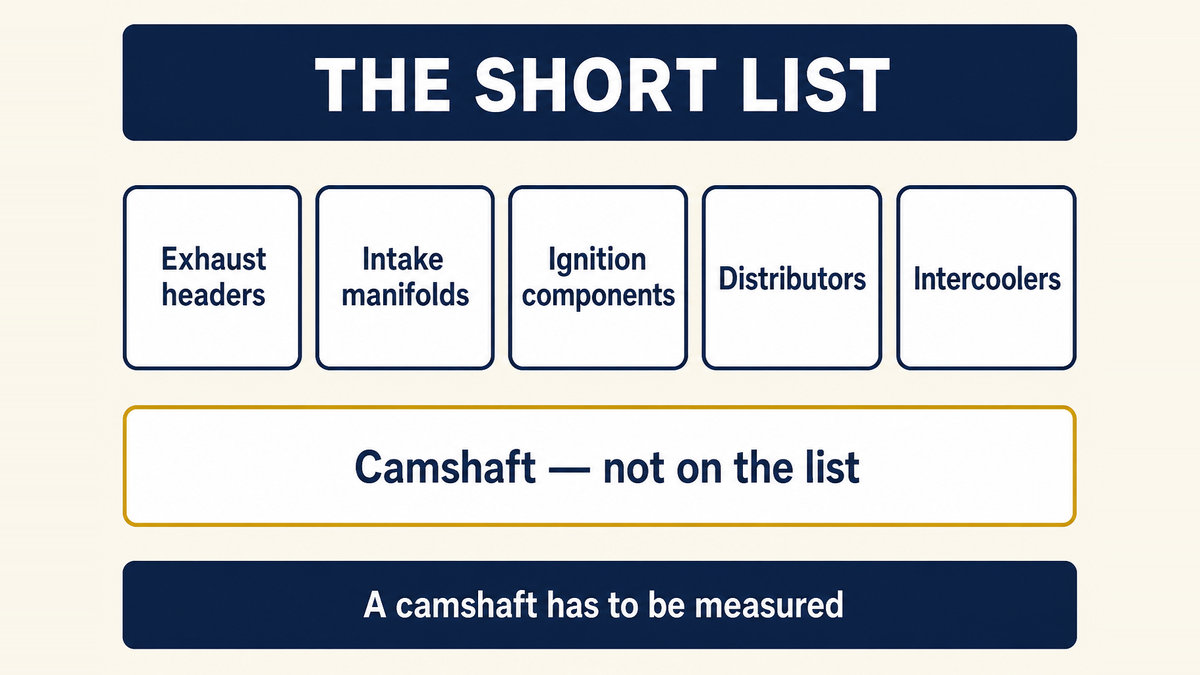
Parts eligible for compliance criteria evaluation are exhaust headers for non-feedback controlled catalyst-equipped vehicles, intake manifolds for non-EGR vehicles only, ignition system components (excluding distributors), ignition distributors, and intercoolers.
California Air Resources Board, Manufacturers of Aftermarket Parts (read 15 October 2026)
Read that list as a buyer and the position of a camshaft is clear. Manifolds, ignition parts, distributors and intercoolers are on it. A camshaft is not. It therefore belongs on the track where vehicle or engine emission testing may be required — because the profile change it represents is exactly the kind of change that has to be measured rather than reasoned about.
Two consequences follow, and they are the most commercially useful things in this article.
The distinction is not between a standard part and a performance part. It is between a replacement that reproduces the original profile and a change of profile. A camshaft ground to the vehicle's original specification is serving an engine whose emissions were certified with that profile, which is a different proposition from a camshaft selected to alter the engine's breathing. The catalogue entry should make it possible to tell which one is being sold.
The cost of the wrong track is a test programme. A supplier who has not established where their product sits will discover it when an application asks for test results, and testing is a cost measured in vehicles, laboratory time and calendar months rather than in paperwork. For a buyer, that is a reason to ask the question at the sampling stage rather than after the range is built.
5. Regrinding Removes the Layer That Matters
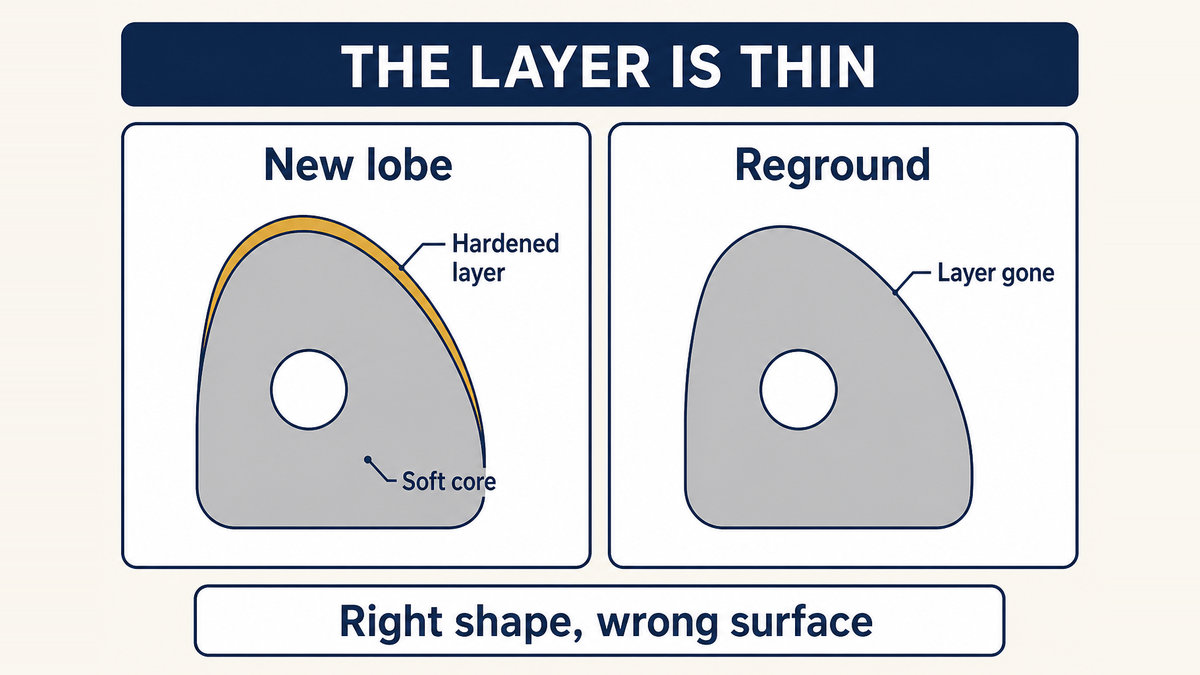
The manufacturing fact that decides whether a camshaft is fit for an engine is thinner than a sheet of paper. A lobe's hardness is not uniform through the metal; it exists in a shallow hardened layer at the rubbing surface, whether that was produced by chilling the casting at the lobe or by hardening the lobe afterwards.
That creates a specific hazard for buyers in this category, and it is one worth stating plainly: a worn camshaft can be reground, and regrinding cuts metal off the lobe. Take enough off the base circle to restore the profile and the hardened layer is gone, leaving a lobe with the right shape and the wrong surface. Unless the shaft is re-hardened after grinding — which is a separate process with its own cost, and one a quotation will either mention or not — the part will wear at a rate that has nothing to do with how accurately it was ground.
The consequence for a specification is direct. A camshaft quotation should state whether the part is new or reground, and if reground, whether it has been re-hardened. Those two words are the difference between two very different products sharing one part number, and they are exactly the kind of distinction that a low quotation will leave out.
The same logic applies to the choice between a cast and a machined-from-solid camshaft. The two routes produce lobes by different means, and the specification that matters — what the lobe's surface hardness is and how deep it goes — has to be stated either way. A supplier who cannot state it has not described the part.
6. What a Cheap Camshaft Quote Leaves Out
A camshaft is a machined bar whose cost is mostly in processes, and the processes are invisible in a photograph. Five places a low quote tends to come from:
The lobe's hardness and the depth of it. Not a general claim that the lobes are hardened, but the figure and how deep it runs. This is the property that decides whether the part lasts, and it is the first thing given up when a camshaft is reground without being treated again.
The profile's provenance. Which specification the lobes were ground to, and whether it reproduces the vehicle's original or replaces it. On this component that is not a performance detail; it is the difference between the two application tracks described above.
The journal dimensions and runout. A camshaft runs in bearings along its whole length, so straightness and journal sizing decide whether it turns freely. Runout is measurable and belongs in the quotation rather than in a general claim of quality.
The end drive. The gear or slot that drives a pump, distributor or sensor has to be cut true to the shaft, not merely fitted to it, because everything it drives inherits any error in that relationship.
The new-or-reground answer. A single word that changes the product's expected life, and the item most likely to be absent from a quotation that leads on price.

7. What to Check on a Sample
A camshaft is a measured part with one property that has to be tested rather than eyeballed. Six checks cover the ground.
- Lobe lift measured on every lobe, against the profile the part is claimed to be. A single lobe out of specification is enough to misfire that cylinder.
- Lobe surface hardness, and where it was measured. This is the property that decides wear, and it cannot be judged by appearance.
- Journal diameters and runout, measured along the full length rather than at one point.
- Straightness, since a shaft that is bent cannot be corrected by bearings.
- The end drive, checked for concentricity with the shaft and for the dimensions of whatever it drives.
- Whether the part is new or reground, and if reground, the record showing it was re-hardened afterwards.
On the factory side the usual visit checks apply — who casts or supplies the blanks, whether hardening and grinding are done in-house, and who signs off the first article. Our sequence is in the factory audit checklist, and the machining side is covered in metal stamping and machined parts. Where a supplier also holds a social or ethical audit, the scheme behind the certificate is worth reading — see social audit schemes compared.
8. Where the Unit Price Comes From
A camshaft's price is built from the blank — a casting or a bar of steel — the machining of lobes and journals, the hardening process, the final grinding, and the packaging. The blank and the machining set the base cost; hardening and grinding are where the part's life is decided and where a supplier can save without changing how the part looks. The packaging is the smallest line and the one that decides whether a long slender part arrives straight.
Weight is moderate for a solid steel part, so a camshaft moves largely on mass, with the length making it awkward to pack — the method is set out in how volume decides what a shipment is charged.
A quotation worth comparing therefore names the profile specification, the blank type, the lobe hardness and its depth, the journal dimensions and runout limits, the end drive specification, and whether the part is new or reground. How the goods are described for entry is the subject of how an HTS code is assigned, and the origin paperwork behind it is set out in the certificate of origin guide.
9. Frequently Asked Questions
Does a camshaft fall under any federal inspection standard?
No. The in-use inspection standard is organised as one section per system and covers brakes, brake power unit, steering, suspension, tyres and wheel assemblies, with no engine section. A camshaft therefore carries no figure, marking or test that a federal inspection is directed to check.
Why is a camshaft treated differently from other replacement parts?
Because a lobe profile sets valve lift, duration and timing, so a change of profile changes how the engine breathes. In the state programme that sorts aftermarket parts, the parts eligible for assessment against written criteria without emission testing are named in a short list — exhaust headers, intake manifolds in certain cases, ignition system components, distributors and intercoolers. A camshaft is not on that list.
What does the two-track system mean in practice?
One application route is for parts for which explicit criteria can be satisfied in writing and which do not require vehicle or engine emission testing to obtain an exemption. The other is for parts for which such testing may be required to determine their impact on emissions. For a supplier, the second route means a test programme rather than a paperwork exercise, which is a cost measured in vehicles, laboratory time and months.
Is a reground camshaft acceptable?
Only if it is described as such and re-hardened. A lobe's hardness exists in a shallow layer at its surface, and regrinding removes metal from the lobe to restore the profile. Without re-hardening afterwards, the part can have the correct shape and an unhardened rubbing surface, which wears at a rate unrelated to how accurately it was ground. Whether a part is new or reground is therefore a specification item.
What should a camshaft quotation contain?
The profile specification, the blank type, the lobe surface hardness and the depth of the hardened layer, the journal dimensions and runout limits, the end drive specification, and a clear statement of whether the part is new or reground and whether it was re-hardened. Whether the profile reproduces the vehicle's original or replaces it also belongs in the description.
Lobe Lift and Base Circle on One Card
We return lift and base circle at every lobe, with whether the core was re-hardened and the batch it came from.
Measure My Lobes
Questions & Comments
We read every one and reply within 24 hoursTrying to get a supplier to state whether a camshaft is new or reground, working out whether a regrind was re-hardened afterwards, or checking where a change of lobe profile leaves you in the exemption system? Send us the engine and the market, and our team will put the specification in writing.