
Timing Chain Kit Manufacturers: The Weakest Member
 ·
Updated October 15, 2026
·
13 min read
This is the first part in the series that is not a part. A timing kit is a group of components that have to work together: a chain or a belt, a tensioner, guides, sprockets, and on many engines a water pump as well. That changes what the public record shows, and it changes the question a buyer should ask. Search the federal recall file and the remarkable thing is how little of it is about the chain. The two campaigns that name a timing chain are both about a bolt losing its torque, and the two that name a timing belt are both about a neighbour. The kit's weakest member is almost never the part the kit is named after.
1. A Kit Is a Set Because the Engine Opens Once
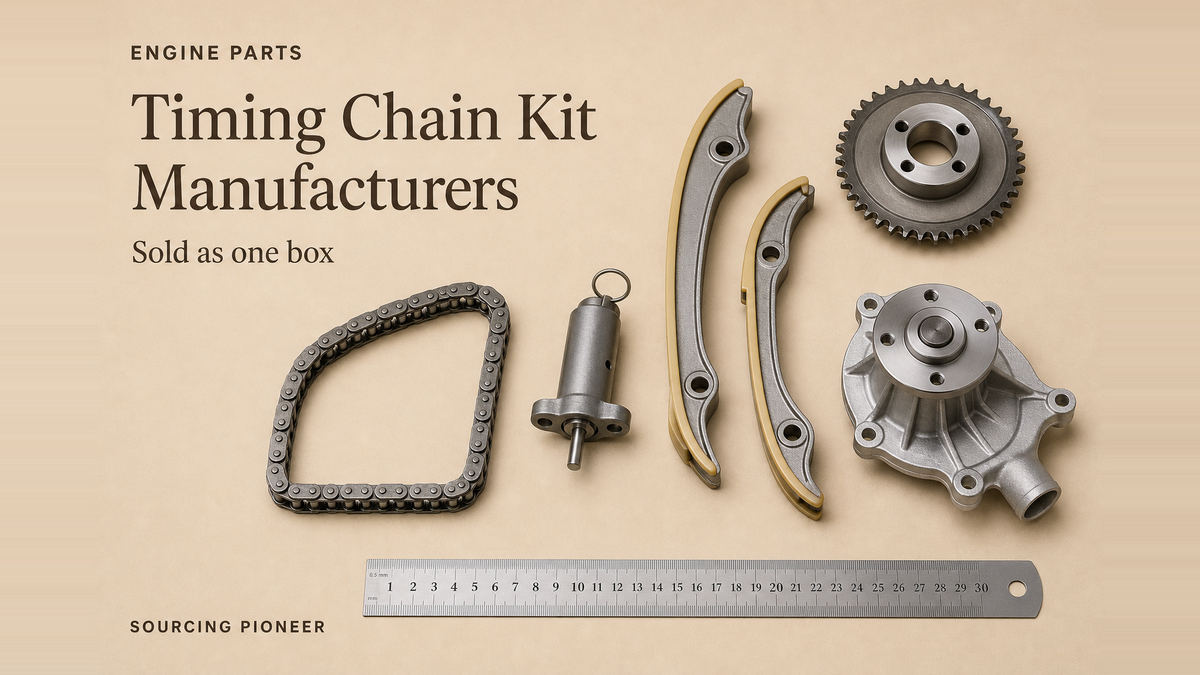
A timing chain does not work on its own. It runs around sprockets, it is held under tension by a tensioner, it is kept in line by guides, and on a great many engines it also drives a water pump. Those parts wear against each other, and they all sit behind the same cover.
That is why the trade sells them together, and it is why the rest of this article is about everything except the chain. A chain is a length of hardened steel links running in oil. It is not a delicate object. What fails around it is the tensioner that holds it, the guides that keep it straight, the sprockets that drive it, and the fasteners that hold those parts in place.
So a timing kit is not a chain with accessories. It is a group of parts whose quality is set by the weakest member in the box — and the buyer is the one who decides what goes in the box.
| The element | What it decides | What a vague quote hides |
|---|---|---|
| The chain or belt | Whether the drive lasts the service interval | Link or tooth quality, and whether the grade is OEM-equivalent |
| The tensioner | Whether the chain stays tight as it wears | Hydraulic or mechanical, and how it behaves as it ages |
| The guides | Whether the chain runs straight | The material, and whether the wear surface is a separate strip |
| The sprockets and gears | Whether the chain wears evenly | Hardness, and whether a worn sprocket is included at all |
| The water pump, where driven | Whether the kit's neighbour survives | Whether the pump is in the kit, and its bearing and seal |
| The fasteners and seals | Whether the kit can be fitted once | Bolt grade, torque figures, and whether new bolts are supplied |
What this guide covers
- A kit is a set because the engine opens once
- The inspection standard has no engine section
- What the federal record calls this part
- The two chain campaigns are both about a bolt
- The two belt campaigns are both about a neighbour
- "Chain guide" in the same vehicle means something else
- What belongs in the kit, and who says so
- What a cheap timing kit quote drops
- Six checks and where the price comes from
- Frequently asked questions
2. The Inspection Standard Has No Engine Section
Nothing in the in-use inspection standard covers engine timing. The standard is built as one section per system, and it deals with brakes, brake power unit, steering, suspension, tyres and wheel assemblies. There is no engine section, so a timing kit has no federal figure to be checked against, and no federal list of what it must contain.
What is left to work from is the record of what actually fails, and the engine each kit is designed for.
3. What the Federal Record Calls This Part
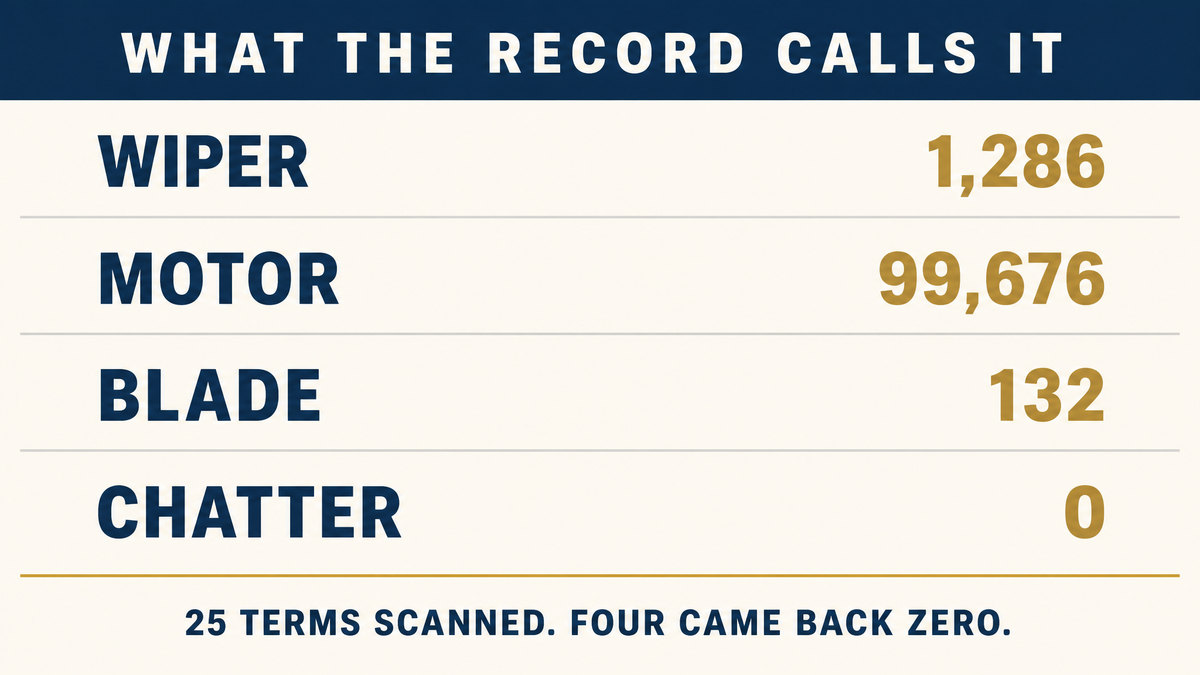
Search the same federal recall file used for the previous three articles and the words behave very differently from one another.
- Timing chain appears in just 8 records, belonging to 2 campaigns — the lowest count of any part in this series.
- Timing belt appears in 59 records, in 2 campaigns.
- Chain guide appears in 144 records, in 2 campaigns — both of them transmissions rather than engines, as the next section but one explains.
- Tensioner appears in 2,094 records across 134 campaigns. Of those 2,094, 1,983 are seat belts, 34 are drive or accessory belt tensioners, 75 fall outside those groups, and exactly 2 records in the whole file name a timing tensioner.
That last line is the most useful number in this article. A tensioner, in the federal record, is almost always a seat belt pretensioner — a different device, in a different system, doing a different job. 94.7 per cent of the records the word turns up are seat belts. A buyer or a supplier who sizes this market from a keyword tool, or from a raw record count, will be wrong by a factor of about a thousand.
So the words are not interchangeable, and the parts are not either. The two parts of this kit that matter most — the chain and the tensioner — are also the two hardest to search for by name.
4. The Two Chain Campaigns Are Both About a Bolt
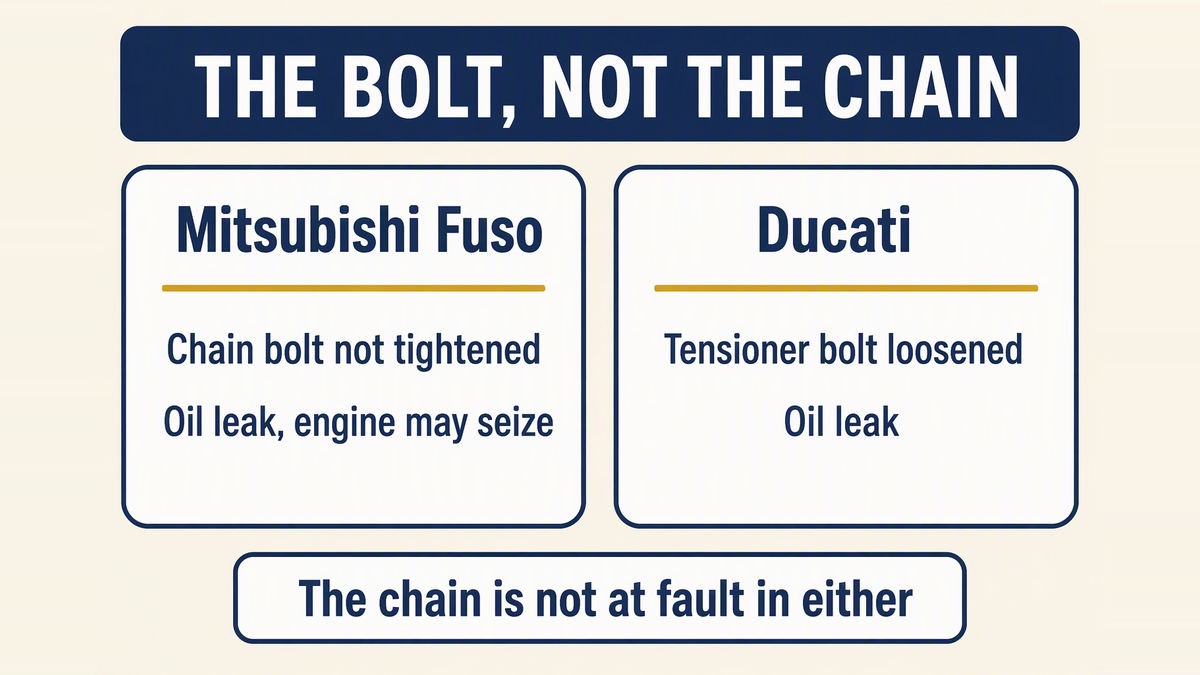
Only two campaigns in the file mention a timing chain. Neither of them is about a chain.
Mitsubishi Fuso, campaign 15V195000, filed 1 April 2015, 25 trucks. The record states that the lower engine timing chain bolt "may have been insufficiently tightened during assembly". The consequence is that a bolt that was not tightened properly may let engine oil leak, and the engine may then seize. The remedy was to tighten the bolt to the correct torque.
Ducati, campaign 18V854000, filed 6 December 2018, 1,502 motorcycles. The timing chain tensioner may loosen over time, letting oil leak from the bottom of the tensioner adjustment bolt. The remedy was to tighten the tensioner bolts.
Put the two side by side and they say the same thing twice. In the only two places where the federal record names a timing chain, the failure was a fastener losing its torque. Not a chain stretching out of limits, not a guide worn through, not a tensioner failing internally. A joint.
That is the same conclusion the cylinder head record produced in the previous article, and it leads to the same practical demand. A kit's paperwork has to state the bolt grade and the torque figures, and on engines where the fasteners are torque-to-yield it has to say whether new bolts are supplied or the old ones reused.
5. The Two Belt Campaigns Are Both About a Neighbour
Belts appear more often than chains, and the two campaigns that name them are about the parts around the belt.
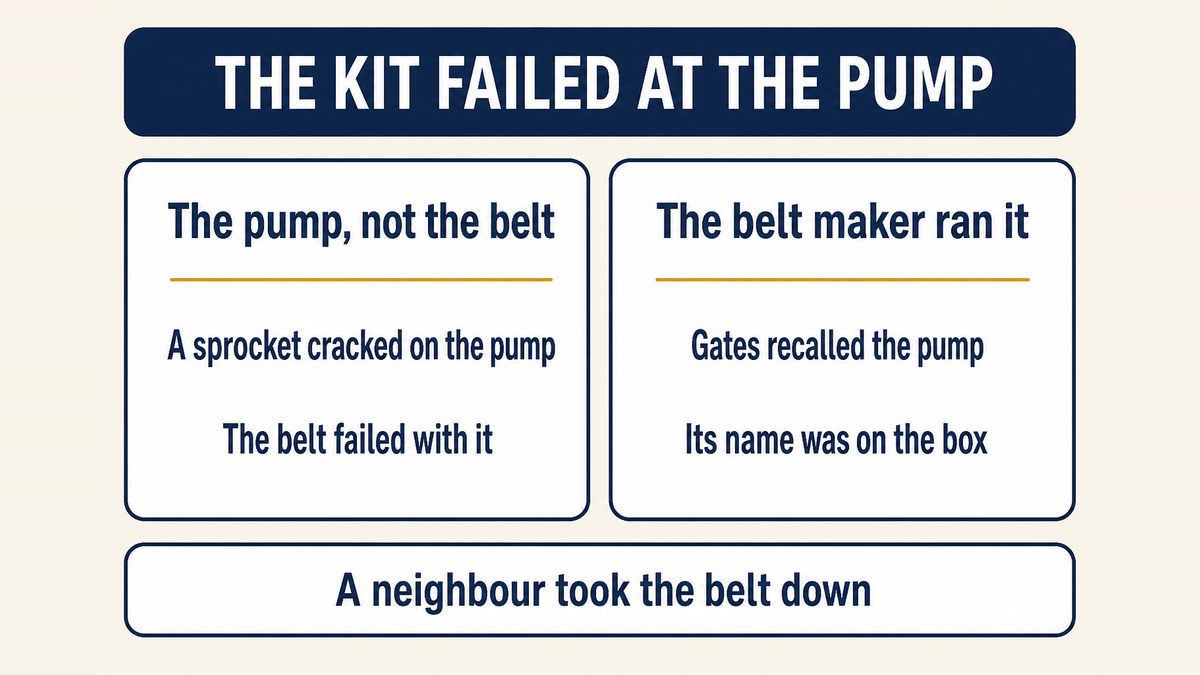
The first is unusual in a way worth spelling out. Campaign 14E007000, filed on 12 March 2014, was submitted by Gates — a belt manufacturer — and it covers service replacement parts rather than vehicles. The problem was not in the belt. In the affected water pumps, the record says, "the pulley or sprocket that turns the timing belt may develop microfractures causing the timing belt to fail". The consequence is that a failed timing belt can shut the engine down. The remedy was to replace the water pump.
Read that as a lesson about kits and it is hard to improve on. The kit's most dangerous member was not the belt. A sprocket on a pump, driving the belt, developed cracks, and the failure travelled from the pump into the belt. And the campaign had to be run by the belt manufacturer, because that name was on the box.
The second is Honda's campaign 19V298000, filed on 12 April 2019 and covering 93,946 vehicles. Here the belt itself is the subject: the timing belt teeth may separate from the belt, and a separated belt stalls the engine. The remedy went beyond the part — dealers were told to inspect the vehicle, replace the affected timing belt, and then have the engine inspected and any damaged components replaced.
So the belt cases add a second rule to the chain cases. The chain campaigns are about fasteners. The belt campaigns are about the parts around the belt — and about what the belt takes with it on the way out.
6. "Chain Guide" in the Same Vehicle Means Something Else
One more entry belongs here, because it is the clearest case in this series of a term that misleads a buyer.
Chain guide appears in 144 records across two campaigns — Subaru's 21V955000 and 22V485000. Both concern a continuously variable transmission. A programming error in the transmission control unit, the records state, may allow the clutch to engage before the drive chain is completely clamped. The drive chain may then slip and break, and the vehicle loses power. Part of the remedy was to look at the chain guide.
On a Subaru, a chain guide is a transmission part. The phrase carries no information about which chain, or which system, it belongs to — and neither does the word tensioner. For a buyer this is not a curiosity. It is the reason to specify a kit by the engine it fits rather than by a part name, and to insist that the supplier describes the application rather than the label.
7. What Belongs in the Kit, and Who Says So
No standard defines what a timing kit must contain. Nothing in the federal inspection standard covers engine timing, and no rule in the record sets a parts list for a kit. The contents are decided by whoever assembles the kit — which means, in practice, the buyer has to decide them rather than accept them.
The nearest thing to a rule comes from an unexpected direction. The federal rule on rebuilding an engine requires the work to be recorded in a list of "the parts and components you used", kept for at least two years. It is the only federal document in this series that asks for a bill of materials — and a timing kit is, functionally, a bill of materials. That is a reasonable shape for the document a buyer should ask for.
Practically it comes down to four questions. Which engine, exactly — a kit that covers a range of engines is usually built to the cheapest one in the range. Which parts are included: chain or belt, tensioner, guides, sprockets, the water pump where the engine drives one, seals and gaskets, bolts. Which grade: OEM-equivalent or lower, and stated in writing rather than on the packaging. And whether the box contains one maker's system or parts from several, because a mixed kit is where a compatibility claim gets thin.
The Gates campaign above is the argument for the last of those. A pump and a belt that were never designed as a pair produced a failure that neither manufacturer intended and only one of them had to answer for.
8. What a Cheap Timing Kit Quote Drops
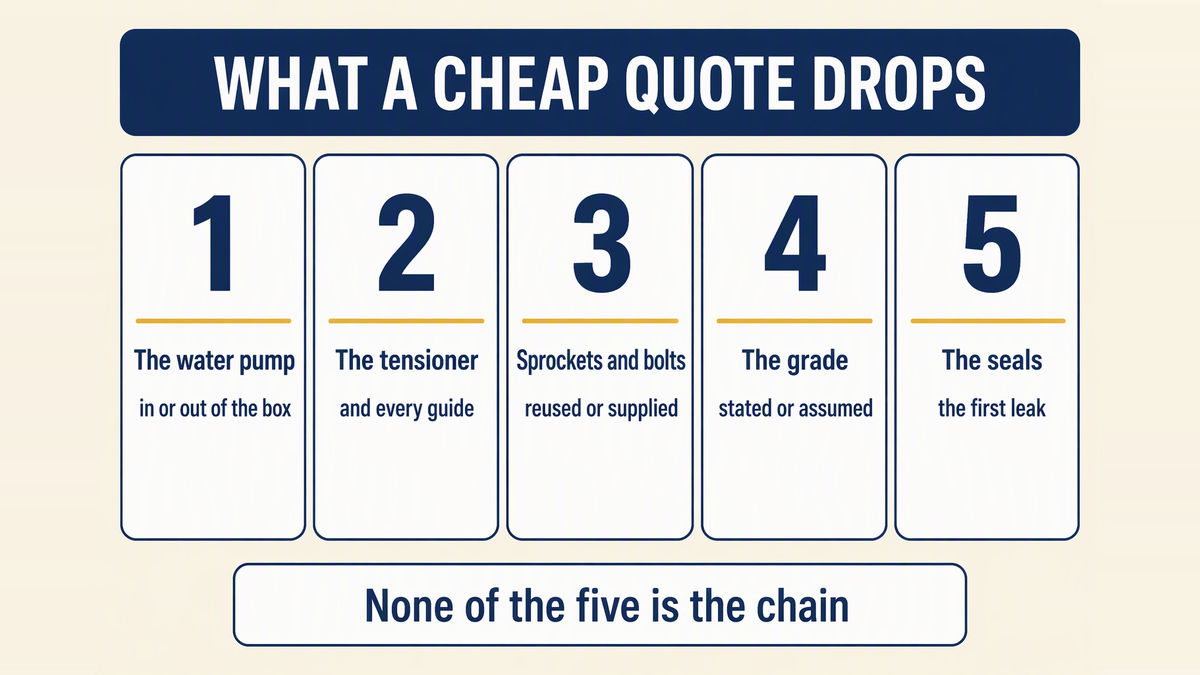
A kit's cost sits in the parts it is easiest to leave out of the box. Five places a low quotation comes from:
The water pump. Where the engine drives its pump with the timing belt or chain, the pump is behind the same cover and is part of the same job. Leaving it out does not remove the risk; it moves it to a second visit, and the Gates campaign is exactly what happens when a pump and a belt disagree.
The tensioner and the guides. The chain is the visible part and the cheapest to make. The tensioner and the guides are where the mechanism's life actually sits, and they are the parts a buyer cannot judge by looking at them.
The sprockets and the bolts. A kit that expects a worn sprocket to be reused and the old bolts to go back in has saved money on precisely the two items the chain campaigns above are about.
The grade. OEM-equivalent or otherwise, stated in the quotation rather than only on the box.
The seals and gaskets. The cover has to come off and go back on. This is the cheapest line in the quotation and the first place the job leaks.
9. Six Checks and Where the Price Comes From
Six checks cover a timing kit before it is ordered.
- The chain or belt grade, named by its maker and matched to the engine, not to the range.
- The tensioner, its type and its behaviour, and whether the kit supplies a new unit or a seal kit for the old one.
- The guides — how many the engine needs, and how many are in the box.
- The sprockets: how many, made of what, and whether a worn sprocket is expected to be reused.
- The water pump, where the engine drives one, including its bearing and seal.
- The fasteners and seals: bolt grade, torque figures, and whether new bolts are supplied.
On the factory side the questions are about who makes what: whether the chain comes from the same maker as the tensioner, whether the kit is assembled by the component maker or by a packager, and who signs off the first article. Our sequence is in the factory audit checklist, and the machining side is covered in metal stamping and machined parts. Where a supplier also holds a social or ethical audit, the scheme behind the certificate is worth reading — see social audit schemes compared.
A kit's price is built from the chain or belt, the tensioner, the guides, the sprockets, the pump where there is one, the seals and the packing. The chain sets the base cost, because it is the largest single item and the easiest to compare. The tensioner, the guides and the pump carry the rest — and they are where two quotations for the same engine will differ.
A kit is compact but it is steel and it is heavy for its size, so it moves on mass rather than on volume — the method is set out in how volume decides what a shipment is charged. How the goods are described for entry is the subject of how an HTS code is assigned, and the origin paperwork behind it is set out in the certificate of origin guide.
10. Frequently Asked Questions
Does a timing chain or belt fall under any federal inspection standard?
No. The in-use inspection standard is organised as one section per system and covers brakes, brake power unit, steering, suspension, tyres and wheel assemblies, with no engine section. Nothing in it covers engine timing, so a timing kit carries no federal figure to be checked against and no federal list of what it must contain.
What does the federal record show about timing chains?
Very little, and what it shows is not about chains. The term appears in 8 records belonging to 2 campaigns, and both concern a fastener losing its torque — a lower timing chain bolt on a Mitsubishi Fuso truck, and a tensioner adjustment bolt on a Ducati. Timing belt appears in 59 records in 2 campaigns, one of which was a water pump whose sprocket cracked and took the belt with it, and the other a Honda campaign where belt teeth separated on 93,946 vehicles. The word tensioner appears in 2,094 records, but 1,983 of those are seat belts and only 2 records in the whole file name a timing tensioner.
What should a timing kit contain?
No standard defines it, so the list is the buyer's to set and it depends on the engine. The usual members are the chain or belt, the tensioner, every guide the engine uses, the sprockets, the water pump where the engine drives it with the belt or chain, the seals and gaskets, and new bolts where the engine uses torque-to-yield fasteners. Ask for that list in writing, by application.
Is a kit that covers several engines a problem?
Not automatically, but it is worth a question. A kit built to fit a range of engines is usually built to the cheapest engine in the range, and the grade and the parts list may not be the same for every application it claims to cover. Ask which engine the kit was designed against, and whether the parts are identical across the range.
Why does a timing belt kit often include a water pump?
Because on engines where the pump is driven by the timing belt, the pump sits behind the same cover and belongs to the same job. The 2014 Gates campaign shows what happens when the two are not designed as a pair: a pulley or sprocket on the water pump developed microfractures, the timing belt failed as a result, and the belt manufacturer had to run the recall for a part it did not make.
Which Part in the Kit Fails First
We return the contents list with torque-to-yield fasteners marked, the tensioner specification, and the member the campaigns point at.
Name My Weakest Member
Questions & Comments
We read every one and reply within 24 hoursA timing chain kit is bought as a set and judged by the weakest part in it. Send the engine code and the kit list, and we will check the chain, the tensioner and the guides together.