
Seat Belt Manufacturer: The Label Has Three Fields
 ·
Updated October 22, 2026
·
13 min read
Every other part in this series carries a number you can look up. A seat belt carries three pieces of text you have to read: the year, the model, and a name. The interesting one is the second, because 49 CFR 571.209 defines it, and the definition is not what a sales sheet means by the word.
A model, in the standard's words, is a single combination of webbing having a specific type of fiber weave and construction, and hardware having a specific design. Colours may vary inside one model. Weave may not. That one sentence decides whether a supplier who changes yarn between lots has shipped the same product or a different one, and it is the sentence a factory is least likely to have on its drawing.
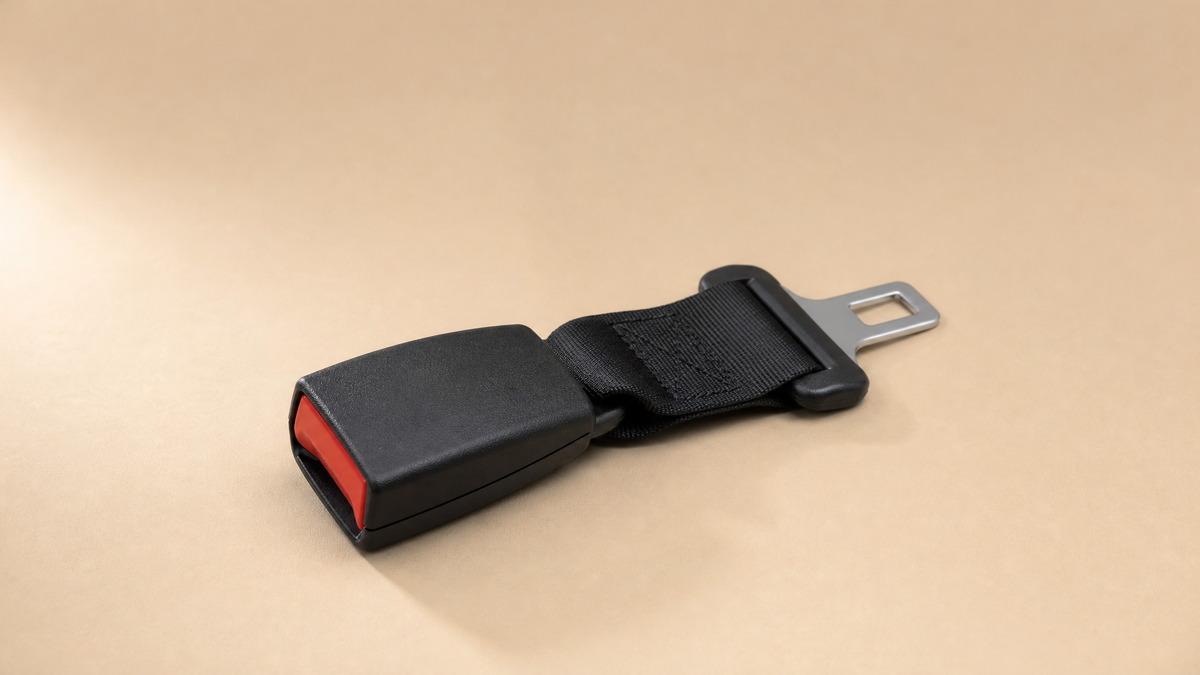
1. Three Fields, and Only One Is Free Text
S4.1(j) is short. Each seat belt assembly must be permanently and legibly marked or labelled with the year of manufacture, the model, and the name or trademark of the manufacturer or distributor — or of the importer, if the assembly was manufactured outside the United States. Three fields, no fourth, and no option to put them on the carton instead.
Two of the three are facts the factory already knows. The year is a date. The name is either the factory's own trademark or the distributor's, or, for an imported assembly, the importer's. That last clause is the one that matters to a trading company: the name on the label is the party the regulation points at, and if the goods crossed a border, the importer is an explicitly permitted answer.
The second field is the one that is not free text. Model is defined in the same paragraph, and the definition is a construction recipe rather than a marketing name:
- a single combination of webbing and hardware — not a family, not a platform, not a range;
- the webbing identified by fibre type, weave and construction;
- the hardware identified by design;
- colour permitted to vary within a model, provided each colour still meets the webbing requirements.
Read as a specification, that is unusually strict for a label. A supplier who switches from one yarn supplier to another without changing the weave has changed the fibre, and therefore the model. A supplier who changes the buckle from a stamped body to a cast one has changed the design, and therefore the model. Neither change is a quality problem. Both are labelling problems, and the label is what the buyer, the inspector and the recall system read.
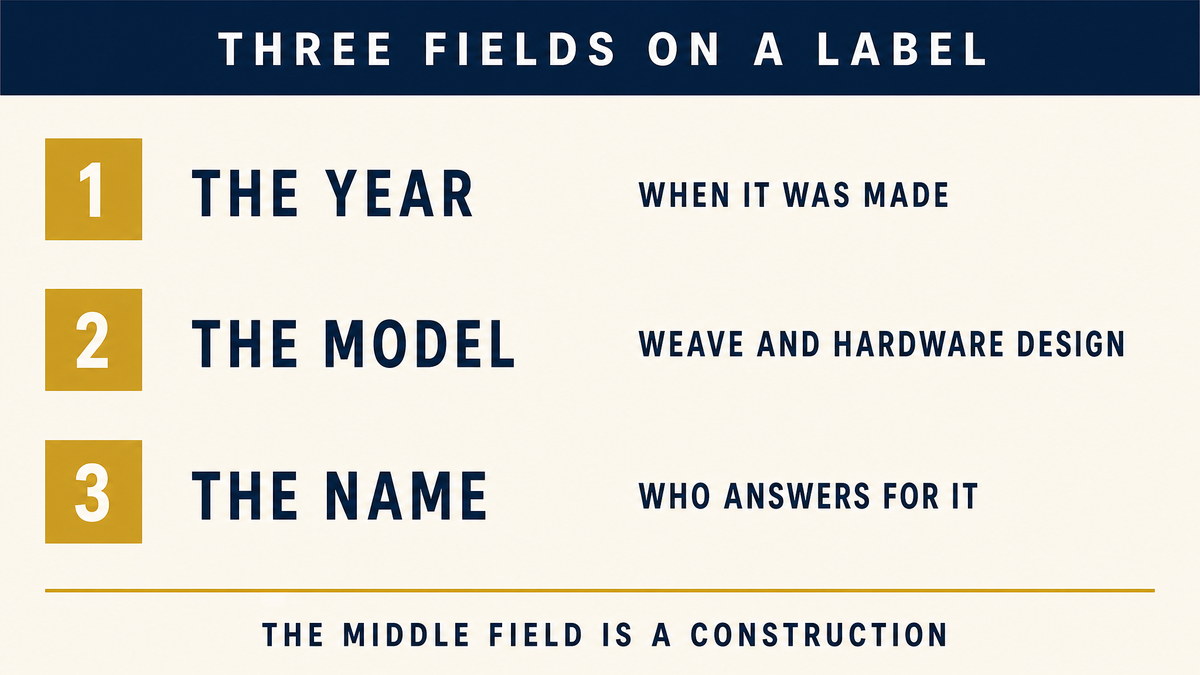
2. Why the Model Field Is the Buyer's Problem
In practice the model field is where a catalogue and a certificate stop agreeing. Three patterns recur.
The colour trap. Buyers often ask for a model in two colours for two markets, and the standard allows it — but only if the second colour passes the same webbing tests. A dye change is not automatically free. If the second colour is a different yarn lot with a different finish, the tests have to be run again, and the record should show it.
The yarn substitution. Fibre type is part of the model, so a move from one polyester to another is a model change even when the strength is identical. The commercial pressure to substitute is constant; the labelling consequence is that the part sold as model X is no longer model X. A buyer comparing two quotations that both say “model X” may be comparing two different constructions wearing the same name.
The importer's name. The label may carry the importer's name instead of the factory's, and that is legal. It also means the name on the webbing is not evidence of who wove it. If the buyer wants traceability to the mill, it has to be asked for separately, because the regulation does not require it.
None of this is a regulatory lecture. It is a purchasing instruction: the model field is the only place on a seat belt where a construction is written down, and it is worth requiring the drawing that defines it.
3. Six Numbers, Four of Them Percentages
S4.2 is the reason a seat belt is easier to specify than almost anything else in this series. It gives a width, three breaking strengths, three elongations, and three retained-strength floors after ageing. Every one is a number a buyer can put in an order.
| Property | Requirement | Test |
|---|---|---|
| Width | not less than 46 mm | except portions that never touch a 95th-percentile male |
| Breaking strength | Type 1 26,689 N; Type 2 pelvic 22,241 N; upper torso 17,793 N | S5.1(b) |
| Elongation at 11,120 N | Type 1 20%; Type 2 pelvic 30%; upper torso 40% | S5.1(c) |
| After abrasion | at least 75% of the listed strength | S5.1(d) or S5.3(c) |
| After carbon-arc light | at least 60%, and colour retention not below No. 2 on the AATCC Grey Scale | S5.1(e) |
| After micro-organisms | at least 85% | S5.1(f) |
Two things about that table are worth more than the numbers. First, the retained-strength floors are percentages of the assembly's own starting strength, not fixed values — so a stronger webbing has to survive the same proportional loss. Second, the elongation limits are what separate a comfortable belt from a hard one: 20 per cent at 11,120 N for a lap belt and 40 per cent for an upper torso section is a deliberate difference, and a supplier quoting a single elongation figure for a whole assembly has not understood the table.
The standard also fixes the webbing's ends: they must be protected or treated against raveling, and a metal-to-metal buckle used to adjust length must not let the webbing pull out at maximum adjustment. Those are the two failures that show up in service before anything else, and they are requirements, not recommendations.
4. What the Hardware Has to Be
The rest of S4.1 is a parts list disguised as prose. Four clauses decide whether an assembly can be installed and released, and each of them is checkable on a drawing.
Bolts. Where an anchorage does not take nuts, plates and washers, the assembly must carry 7/16-20 UNF-2A or 1/2-13 UNC-2A attachment bolts, or equivalent metric hardware, and the design must keep those bolts from working loose in service. That is a thread specification, not a strength grade, and it is the first thing a buyer can check against a quotation without any test equipment.
Reinforcing plates. For universal floor installations the plate or washer is specified down to the millimetre: steel, free of burrs and sharp edges on the edges that sit against the vehicle, at least 1.5 mm thick, at least 2,580 mm² in projected area, with at least 15 mm from any edge to the edge of the bolt hole, and every corner rounded to a radius of not less than 6 mm or cut so that no angle is below 135° and no side is shorter than 6 mm.
Release. The buckle has to be reachable, and the assembly has to come off easily and quickly. The standard's mechanical expression of that is narrow: with the release mechanism latched, the buckle may have only one opening at the tongue end. One opening is a design constraint, not a preference, and it rules out a class of buckles that look convenient and invite an accidental release.
Edges. Any hardware that touches a person, clothing or webbing must be free of burrs and sharp edges. On a webbing that is abraded 25 per cent of its strength away before it fails the test, an edge is a service-life decision.
The adjustment clause closes the loop. A Type 1 or Type 2 assembly must fit occupants from a 5th-percentile adult female to a 95th-percentile adult male, and the standard writes those two people out in numbers: 46.3 kg and 97.5 kg, sitting heights of 785 mm and 965 mm, hip breadths of 325 mm and 419 mm. A belt sized to a European average and sold into a market with a different distribution is a design decision the standard already anticipated, and the answer is adjustment range, not a longer webbing.
5. The Sheet in the Box Is Part of the Product
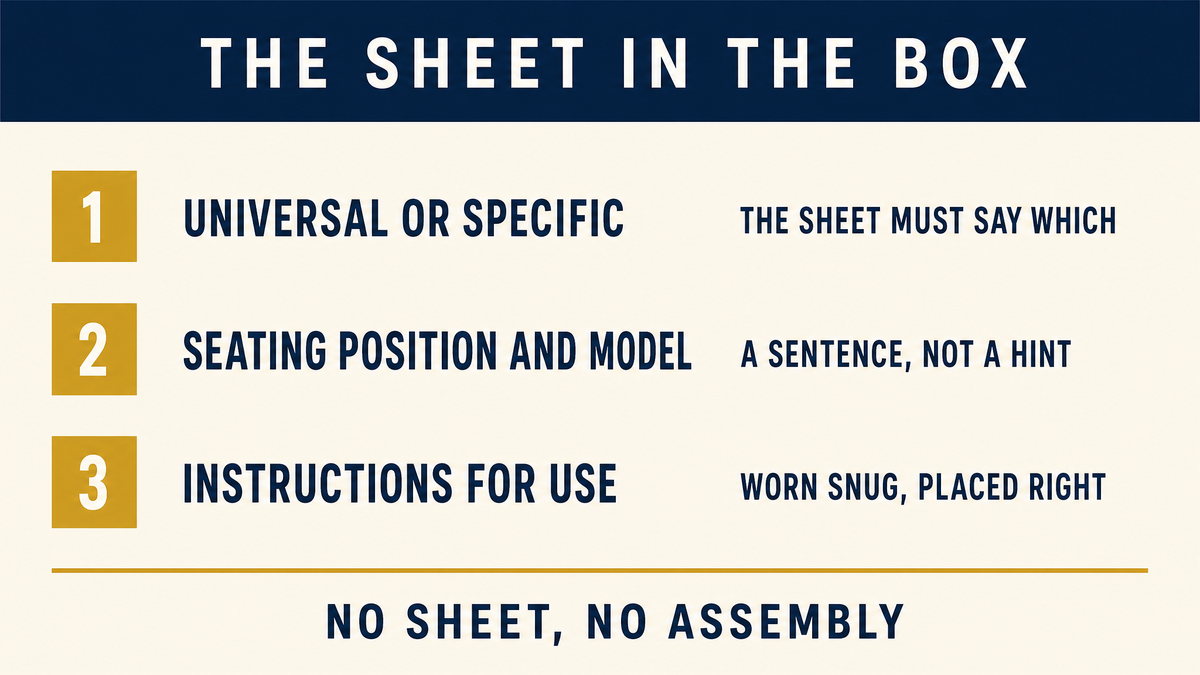
S4.1(k) requires an instruction sheet with every assembly that is not installed by a vehicle manufacturer, and it does two things that a trading company usually misses.
First, the sheet must say whether the assembly is for universal installation or for installation only in specifically stated vehicles, and it must carry at least the items listed in SAE Recommended Practice J800c (1973), which the standard incorporates by reference. Second, if the assembly is vehicle-specific, either the assembly or the sheet must carry a sentence naming the seating position and the vehicle:
This seat belt assembly is for use only in [seating position] in [make and model].
Read that as a shipping instruction. A container of assemblies sold as universal, with a sheet that names three vehicles, is a container that contradicts itself. What else has to be in the box, and what a packaging checklist should catch before the container is sealed, is a separate discipline. And a container with no sheet at all is an assembly that does not meet S4.1(k), whatever the webbing did in the tensile machine.
S4.1(l) adds a second document: written instructions for use, stressing that the belt is worn snugly and located properly on the body. That is the clause that makes a seat belt the only part in this series whose packaging has to teach the occupant something.
6. Where the Price Difference Comes From
Two assemblies at the same strength and half the price differ in five places, and the first two are invisible once the belt is in the car. That is the argument for a factory audit that asks for the model drawing rather than a certificate.
The yarn and the weave. Fibre type is part of the model, so this is not a cosmetic substitution. A denser weave with the same rated strength resists abrasion better, and abrasion is the test with the harshest floor: 75 per cent of the original strength after rubbing.
The dye. Colour may vary inside a model, but every colour has to pass the same six tests. A second colour bought from a different finisher is a second test programme, and the price of that programme is usually the difference between two quotations. Seat belts are bulky and light, so the freight also moves on volume: a CBM calculation belongs next to the unit price.
The buckle. Metal-to-metal and push-button buckles are different hardware designs, which means different models, not variants of one. A quotation that offers both under one model number is telling you something about how carefully the label was drafted.
The retractor. Automatic-locking, emergency-locking and non-locking retractors are three defined devices with different behaviour. An emergency-locking retractor has to lock on vehicle acceleration or on webbing movement, and the mechanism that does it is the part that fails first in the field.
The stitching and the ends. The ends must be treated against raveling, and the loop that carries the load is a stitched or folded construction that no clause specifies in detail. It is where a cheap assembly differs most, and it is the reason to ask for a sample pull test rather than a certificate.
7. What the Record Counts, and Why This One Is Different
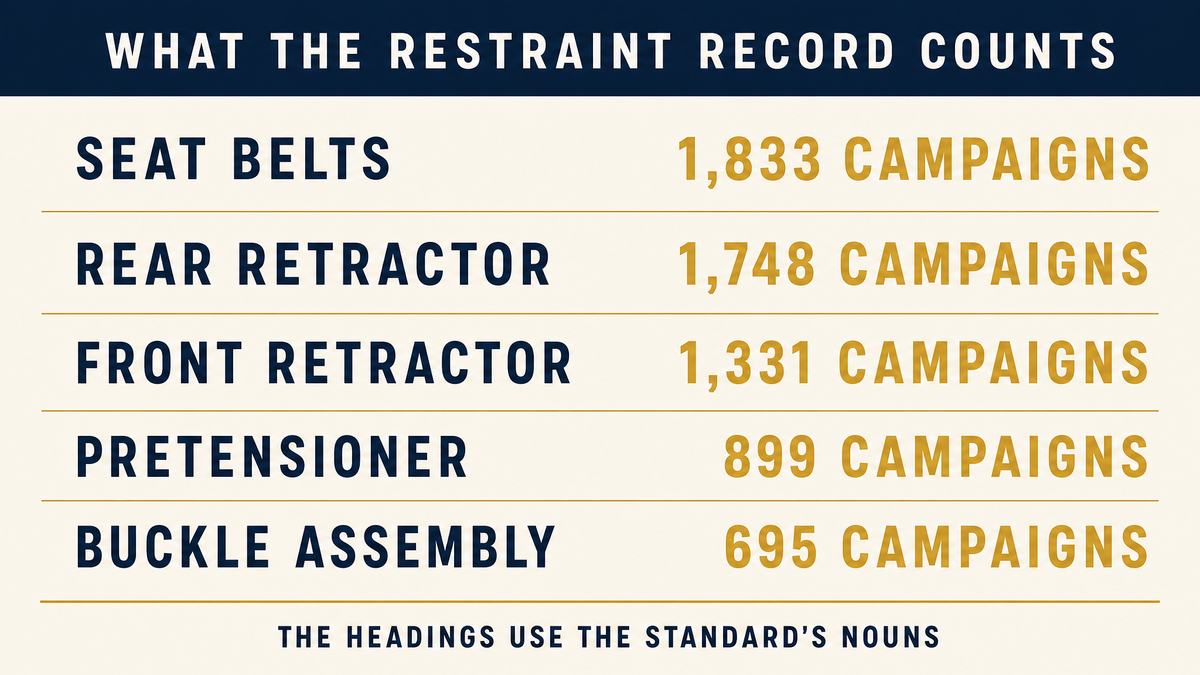
Method unchanged. The federal recall file holds 245,845 records across 15,305 campaigns, no header row, every field scanned, twenty-five terms each with its own pattern. Controls: brake 28,639, air bag 16,162.
This is the second family in seventeen rows with no empty term at all: all twenty-five returned records and campaigns. More interesting is what the headings say. The record's component taxonomy is built from the standard's own nouns:
| Heading | Campaigns | The word comes from |
|---|---|---|
| SEAT BELTS | 1,833 | the part |
| SEAT BELTS:REAR/OTHER:RETRACTOR | 1,748 | S3 definition, retractor |
| SEAT BELTS:FRONT:RETRACTOR | 1,331 | same |
| SEAT BELTS:PRETENSIONER | 899 | S3, load-limiter family |
| SEAT BELTS:FRONT:BUCKLE ASSEMBLY | 695 | S3 definition, buckle |
| SEAT BELTS:FRONT:ANCHORAGE | 490 | S4.1(f) attachment hardware |
| SEAT BELTS:CRITICAL FASTENERS | 293 | the bolts in S4.1(f) |
That is not true of any other part in this series. A water pump had no heading at all, a converter had ten campaigns, and the headlamp's record used one word for the assembly and nothing for its parts. Here the field reports in the regulation's vocabulary — webbing, retractor, buckle assembly, anchorage, fasteners — because the regulation defined those nouns before the field ever reported on them.
The term counts say the same thing from the other side: webbing 410 records and 46 campaigns, buckle 1,828 and 170, retractor 3,959 and 124, harness 7,691 and 595. The largest single campaign in the scan is a pretensioner recall covering 3,640,162 vehicles, and the second is another at 1,619,112: these are not boutique failures.
8. Seven Questions a Seat Belt Quote Should Answer
A quotation in this category arrives as a photo, a vehicle list and a price per set. The seven questions below turn it into a part with a construction behind it.
- What is the model, and what drawing defines it? Not the sales name. Fibre type, weave and construction for the webbing, and the hardware design, written down. If the drawing does not exist, the model number is a label without a referent.
- Which type is it? Type 1 lap, Type 2 lap and torso, or a Type 2a shoulder belt intended only with a lap belt. The type sets the strength and elongation figures that apply.
- Strength and elongation, section by section? A Type 2 assembly carries two different webbing requirements, 22,241 N at 30 per cent for the pelvic section and 17,793 N at 40 per cent for the upper torso. One figure for the whole assembly is the wrong answer.
- What survived the ageing tests? Abrasion, carbon-arc light and micro-organisms, with the retained percentage against the starting strength: 75, 60 and 85 per cent are the floors.
- Which retractor? Automatic-locking, emergency-locking or non-locking. Each is a defined device, and the definition decides how the assembly behaves when the car is parked on a slope.
- Does the carton carry the sheet, and what does it say? Universal or vehicle-specific, with the sentence naming the seating position and the model if it is specific.
- Two prices, quoted and specified. The gap between them is the subject of the next section.
9. Six Lines to Put in the Order
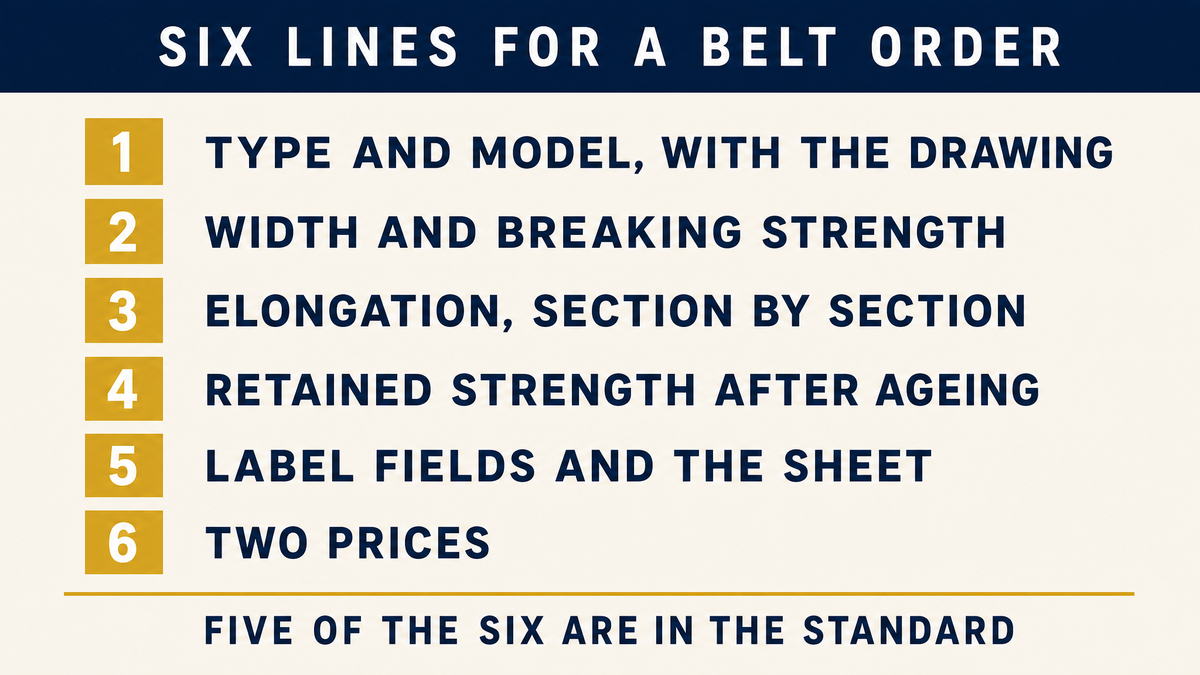
Six lines, all of them checkable without a laboratory, and five of them taken directly from the standard.
- Type and model, with the defining drawing attached.
- Width not less than 46 mm, and the breaking strength that applies to each section.
- Elongation at 11,120 N, stated separately for pelvic and upper torso webbing.
- The three retained-strength results — after abrasion, after light, after micro-organisms.
- The three label fields and the instruction sheet, with the sheet's universal-or-specific sentence quoted.
- Two prices: as quoted, and with the six items above named.
A seat belt is bought by the metre and sold by a label. 571.209 fixes the web width, three breaking strengths that depend on the assembly, and elongation limits that decide how far a body travels before it is held.
None of those figures is visible on a roll of webbing. They live in a test report, which is why the second field on the label matters more than the first: it names the assembly the numbers belong to.
The Sheet That Must Be Inside the Carton
Installation limits, service life and six hardware values, laid out in the order the standard lists them.
Lay Out My SheetFrequently Asked Questions
Does DOT approve a seat belt?
No. The standard sets requirements and the manufacturer certifies that the assembly meets them; the label is the record of that claim. What the label must carry is fixed by S4.1(j): year of manufacture, model, and the name or trademark of the manufacturer, the distributor, or the importer if the assembly was made outside the United States.
What exactly is a “model”?
The standard defines it as a single combination of webbing with a specific fibre type, weave and construction, and hardware with a specific design. Colour may vary within one model, but each colour still has to meet the webbing requirements. A yarn change or a buckle redesign is a new model, even when nothing else changes.
Can the label carry the importer's name instead of the factory's?
Yes, and the standard says so explicitly for assemblies manufactured outside the United States. The consequence is that the name on the webbing is not evidence of who wove it. If traceability to the mill matters, it has to be asked for separately.
How strong does the webbing have to be?
Breaking strength is set by type: 26,689 N for a Type 1 assembly, 22,241 N for the pelvic webbing of a Type 2, and 17,793 N for its upper torso webbing. Elongation at 11,120 N is capped at 20, 30 and 40 per cent in that order.
Why does the width matter if the strength passes?
Because width is what spreads the load over the body. The standard sets a floor of 46 mm, with an exception only for portions that never touch a 95th-percentile adult male in any adjustment position. A narrower belt can pass a tensile test and still concentrate force.
Can I offer the same model in a second colour?
Yes, provided both colours meet the webbing requirements. Colour is expressly allowed to vary inside a model; the fibre, weave and construction are not. A second colour from a different finisher is a second test programme, and the quotation should show it.
Questions & Comments
We read every one and reply within 24 hoursSeat belt figures live in a test report, and the report names an assembly rather than a roll of webbing. Send the drawing, and we will match every figure to its configuration.