
Paint Protection Film Manufacturer: A Film Over a Lens
 ·
Updated October 16, 2026
·
11 min read
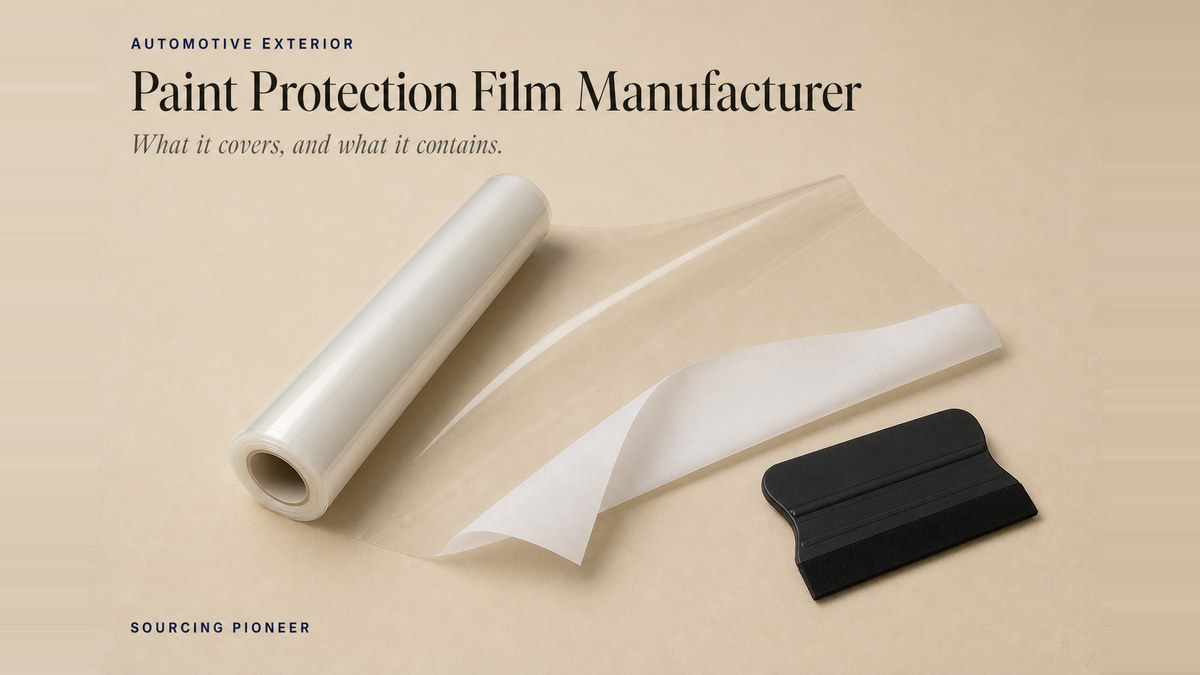
A paint protection film is a transparent sheet that goes on a car and stays there. On a body panel it is a coating the buyer chose; in front of a headlamp it is a feature in front of a lens, and the federal lighting standard has a sentence about exactly that. The clause is not written about film and does not mention it. It says that a headlamp “must not have any styling ornament or other feature, such as a translucent cover or grill, in front of the lens”. That is one of the two regimes this article covers, and it is the one that decides whether the lamp-shaped pieces in your kit can be sold for the lamps they are cut for. The second regime is not about cars at all: if the film carries a fluoropolymer topcoat, the sheet is a PFAS-containing article, and the importer of it sits inside a federal one-time reporting rule whose most recent amendment is dated 13 April 2026.
1. What the Product Is: A Film, an Adhesive and a Topcoat
A paint protection film comes off a roll as three layers, and the buyer only ever sees one of them.
| Layer | What it is | What it decides |
|---|---|---|
| The topcoat | A thin clear layer, often a fluoropolymer, that gives the surface its slip and its stain resistance | Whether the sheet can carry a stain-resistance claim — and, if it is fluoropolymer, whether the article contains a PFAS |
| The base film | A thermoplastic urethane sheet, usually 150 to 200 micrometres thick | Impact resistance, stretch, and whether the film can be wrapped round a curve |
| The adhesive | A pressure-sensitive layer that may be repositionable or slide-on | Whether the sheet can be re-lifted during fitting, and what it leaves behind |
| The release liner | The carrier sheet that is thrown away | Handling in the workshop and nothing else |
Every quotation a buyer receives will describe the base film. Almost none of them will describe the topcoat chemistry in a way that answers the second question in this article, because the topcoat is the part of the construction a supplier is most reluctant to put in writing. That reluctance is reasonable commercially and expensive legally, for a reason set out in section 4: a rule written for importers starts from the position that you know there is a PFAS in the article but may not know which one.
What this guide covers
- What the product is: a film, an adhesive and a topcoat
- The rule for putting anything in front of a lamp
- The second regime is not about cars
- What the article-importer rule actually asks for
- What the record says: thirteen zeros
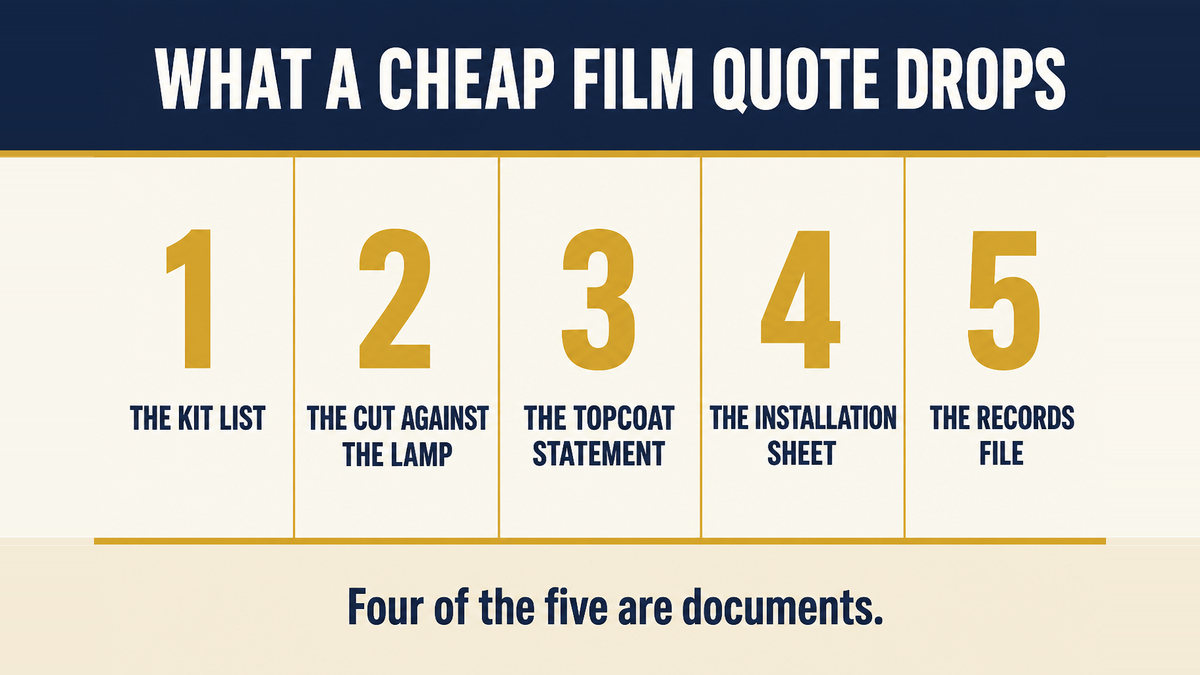
- Five questions a film quote should answer
- Six checks before you order
- Frequently asked questions
2. The Rule for Putting Anything in Front of a Lamp
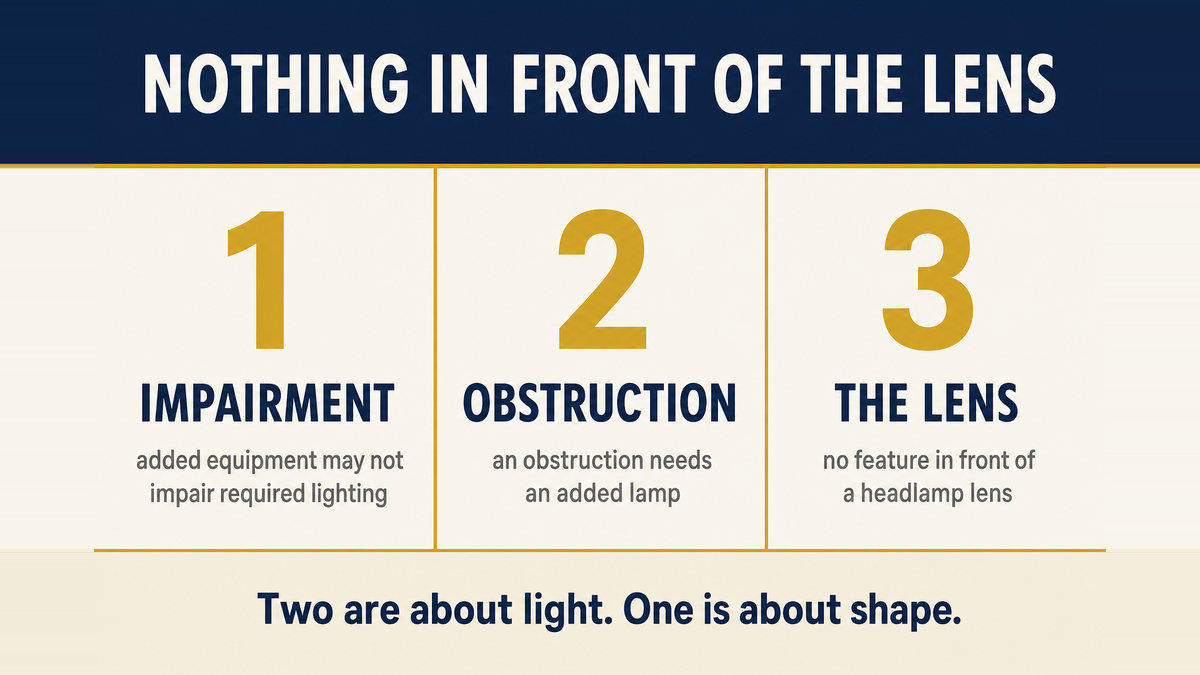
The lighting standard is FMVSS 108. Its impairment section opens with a prohibition on adding equipment, then deals with obstruction, then deals with the headlamp specifically.
“No additional lamp, reflective device, or other motor vehicle equipment is permitted to be installed that impairs the effectiveness of lighting equipment required by this standard.” — FMVSS 108, paragraph S6.2.1
“If any required lamp or reflective device is obstructed by motor vehicle equipment (e.g., mirrors, snow plows, wrecker booms, backhoes, winches, etc.) including dealer installed equipment, and cannot meet the applicable photometry and visibility requirements, the vehicle must be equipped with an additional lamp or device of the same type which meet all applicable requirements of this standard, including photometry and visibility.” — FMVSS 108, paragraph S6.2.2
Those two are written about impairment and can be argued about with a photometer. The third one cannot.
“Headlamp obstructions. When activated in the steady burning state, headlamps (excluding headlamps mounted on motorcycles) must not have any styling ornament or other feature, such as a translucent cover or grill, in front of the lens.” — FMVSS 108, paragraph S6.2.3.1
Read that clause against the product. A film applied over a headlamp is a layer sitting in front of the lens. The clause does not ask how much light it blocks, does not set a transmission figure, and does not provide a test to pass. It names the category — styling ornament or other feature — and gives one example, a translucent cover, which is the closest thing in the sentence to a clear sheet. Whether a clear protective film falls inside the words “other feature” is not something this article settles, and a supplier should not settle it either. What a supplier can do is stop being surprised by it, because the clause sits in the standard that already governs the lamps the film is being cut for.
The marking rules give the same question a second edge. Paragraph S6.5.1 requires that “the lens of each original equipment and replacement headlamp … must be marked with the symbol ‘DOT’ either horizontally or vertically to indicate certification under 49 U.S.C. 30115”, and S6.5.1.2 says that for every other lamp or reflective device in the standard’s Table I the same symbol “may be marked … which constitutes a certification that it conforms to the requirements of this standard”. Both markings sit on the lens. A film that covers the lens covers the mark, and the mark is the evidence the lamp is what it claims to be.
What this means for a kit that includes lamp pieces
A modern paint protection film kit is not one sheet for a bonnet. It is a set: bumper, bonnet leading edge, mirrors, door cups, door edges, boot lip, A-pillars, sill plates, and in most kits a pair of headlamp pieces and sometimes fog lamp pieces. The lamp-shaped pieces are the smallest in the kit and they are the ones with a specific clause pointed at them, plus a certification mark underneath them.
The practical consequence is not that a lamp piece is unlawful. It is that a lamp piece is the part of the kit where a supplier needs a decision rather than a specification. Three answers are defensible and they are all different products: cut the kit without lamp pieces; cut the lamp pieces and state clearly on the kit and the listing that they are for track or off-road use; or cut the pieces and supply them with a written position that explains what the standard says and leaves the choice with the buyer. What is not defensible is shipping lamp pieces with no instruction at all, because the customer will fit them to a road car and will not know that a sentence exists about it.
3. The Second Regime Is Not About Cars
The other rule that reaches a paint protection film has nothing to do with vehicles. It is about chemistry, and it applies to the sheet as an imported article rather than as a car part. The rule is 40 CFR Part 705, Reporting and Recordkeeping Requirements for Certain Per- and Polyfluoroalkyl Substances, with the source note 88 FR 70548, October 11, 2023 and the authority 15 U.S.C. 2607(a)(7) — section 8(a)(7) of the Toxic Substances Control Act.
Three sentences set out the reach of it, and the third is the one that decides whether a film is in scope.
“This part specifies reporting and recordkeeping procedures for manufacturers (including importers) of per- and polyfluoroalkyl substances (hereafter referred to as PFAS) under section 8(a)(7) of the Toxic Substances Control Act (TSCA).” — § 705.1(a)
“The requirements of this part apply to all chemical substances and mixtures containing a chemical substance (including articles) that are a PFAS …” — § 705.5
So articles are expressly inside the rule, not outside it. What counts as an article is defined in the same part, and the definition is a test a film passes on its face:
“Article means a manufactured item which: (1) Is formed to a specific shape or design during manufacture; (2) Has end use function(s) depending in whole or in part upon its shape or design during end use; and (3) Has either no change of chemical composition during its end use or only those changes of composition which have no commercial purpose separate from that of the article …” — § 705.3
A film is cut to a shape, it works because of that shape, and it does not change chemically while it is on a car. On the face of the definition it is an article. And an article is only in scope if it contains a PFAS — which is a question about the topcoat, not about the urethane base film, and a question the buyer is usually the last person to be able to answer.
Two limits are worth stating before the reporting detail, because they keep the section honest. The rule is conditional: no PFAS, no duty. And it is a reporting and recordkeeping rule rather than a prohibition — it does not ban a fluoropolymer topcoat, it requires a one-time submission and the records to back it. A supplier who has been treating this as a ban has been worried about the wrong thing; a supplier who has been ignoring it has missed a filing.
4. What the Article-Importer Rule Actually Asks For
This is the part of the regime that a China-sourced film order runs straight into, because it was written for the exact situation an importer of a coated film is in.
“Article reporting. Any importer of an article which contains a chemical substance that is a PFAS … has the option to submit information to EPA using a streamlined reporting form for that PFAS in the imported article, for each year since January 1, 2011, in which the PFAS was imported in an article. Information must be submitted to the extent the submitter knows or can reasonably ascertain. In the event that actual data is not known to or reasonably ascertainable by the submitter, then reasonable estimates may be submitted.” — § 705.18(a)
Now read the identity rule underneath it, because it is the single most useful sentence in this article for a buyer whose supplier will not disclose a formulation.
“If the specific chemical identity of the PFAS imported in an article is not known to or reasonably ascertainable to the submitter (e.g., if the chemical identity is claimed as confidential business information by the submitter’s supplier, or if the submitter knows they have a PFAS but is unable to ascertain its specific chemical identity), the submitter may provide a generic name or description of the PFAS.” — § 705.18(a)(2)(ii)
That sentence describes the commercial reality of importing coated film almost word for word: the buyer knows there is a fluoropolymer in the topcoat, the mill treats the identity of it as confidential, and the buyer cannot name it. The rule does not require the impossible. It allows a generic name or description, and it allows reasonable estimates where actual data is not known or reasonably ascertainable.
Who is caught, and for how long, is set out in two more places. § 705.10 covers persons who have “manufactured for commercial purposes a chemical substance identified in § 705.5 at any period from January 1, 2011, through the end of the last calendar year prior to November 13, 2023”. The scope paragraph adds the enforcement position: “TSCA section 15(3) makes it unlawful for any person to fail or refuse to submit information required under this part”, and it states that a person who breaks TSCA section 15 “is liable to the United States for a civil penalty and may be criminally prosecuted”.
Two practical notes complete the picture, and both are things a buyer should ask about rather than assume. First, the reporting window is a look-back — years since 2011 — and not a forward-looking obligation, so a product change made today does not erase the earlier years. Second — and this is the one to raise with the supplier rather than decide alone — the part has been amended several times since it was published, with amendments on 13 November 2023, 5 September 2024, 4 November 2024, 13 May 2025 and 13 April 2026, so any summary of it taken from an older article or a supplier’s email should be checked against the current text rather than trusted.
5. What the Record Says: Thirteen Zeros
Method first. The federal recall file holds 245,845 records and has no header row, so every field is scanned rather than trusting a column map. Controls: brake appears in 28,639 records and air bag in 16,162. Every term is counted with its own pattern, because a combined search that lists a short word before a longer phrase containing it will consume the text and report the longer phrase as zero.
| Term | Records | Campaigns |
|---|---|---|
paint protection film | 0 | 0 |
ppf | 0 | 0 |
clear bra | 0 | 0 |
protection film | 0 | 0 |
clear coat | 0 | 0 |
top coat | 0 | 0 |
laminate | 0 | 0 |
peeling | 0 | 0 |
yellowing | 0 | 0 |
chipped | 0 | 0 |
gravel | 0 | 0 |
candela | 0 | 0 |
lumens | 0 | 0 |
film | 63 | 9 |
wrap | 28 | 7 |
vinyl | 227 | 7 |
peel | 145 | 13 |
delaminate | 65 | 8 |
delamination | 24 | 4 |
blister | 11 | 5 |
adhesive | 1,723 | 239 |
conspicuity | 245 | 22 |
reflective | 6,520 | 548 |
headlamp | 553 | 81 |
taillamp | 5 | 2 |
photometric | 3 | 2 |
Thirteen zeros, and they fall into four groups. Four are the product’s own names: paint protection film, ppf, clear bra, protection film. Three are the words for how it is built: clear coat, top coat, laminate. Four are the words for how it fails: peeling, yellowing, chipped, gravel. And two are the units of light: candela and lumens. A supplier reading that list should notice that the file has no word for the product, no word for its construction, no word for any of the four things a customer complains about, and none of the units that the lighting standard is written in.
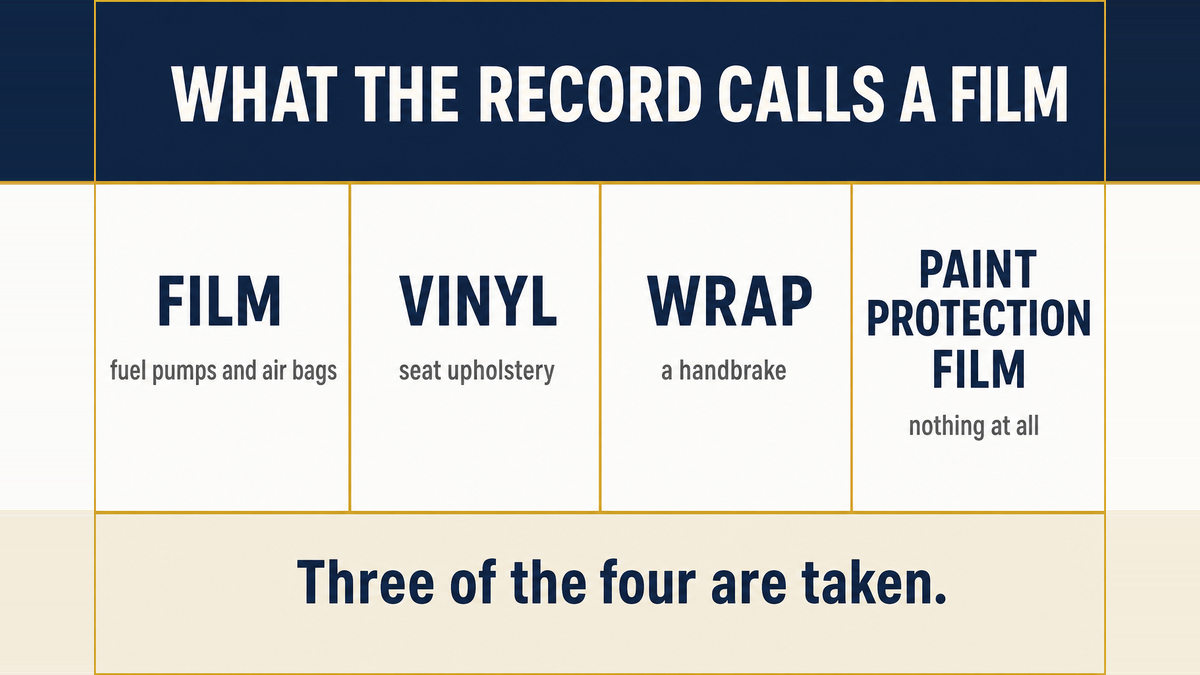
The words that are present belong to other things. film appears 63 times across 9 campaigns, and every campaign in the sample is an air bag, a fuel pump or an engine oil fault — a Hyundai curtain air bag at 568,576 units, an Audi Q5 fuel pump at 240,487, three Porsche fuel pumps, a Ram 3500 oil fault. The record’s film is a layer inside a component, not a sheet on a surface. vinyl appears 227 times across 7 campaigns and the largest is a Syntec seat campaign at 1,156,972 units, followed by a Thomas Built school bus seat campaign and a Ford Ranger child seat latch campaign: in this file vinyl is seat upholstery. And wrap appears 28 times across 7 campaigns, the largest being a Ford F-150 parking brake campaign at 870,701 units. The trade’s three words for this product — film, vinyl, wrap — are all occupied by a seat, a fuel pump and a handbrake.
Two present words are worth following, because they show the record does write about the two things this article is about. delaminate appears in 65 records across 8 campaigns, and one of them sits under EXTERIOR LIGHTING:HEADLIGHTS. The Acura RLX campaign 14V792000, 9,751 vehicles, is worth reading in full because it is the exact mirror of the product in this article:
“An aluminum film applied to the inner reflector of the headlight may experience adhesion issues causing the film to delaminate. Thus, these vehicles fail to comply with the requirements of Federal Motor Vehicle Safety Standard (FMVSS) No. 108, ‘Lamps, reflective devices, and associated equipment.’ … Delamination of the aluminum film may diminish output of the headlight, increasing the risk of a vehicle crash.”
The remedy was to replace both headlights free of charge. Read the anatomy of that record against your own product. The failing part is a film. It is bonded to a headlamp. The failure mode is adhesion loss and delamination. The consequence is stated as reduced light output. And the legal effect is a failure to comply with FMVSS 108 — the same standard whose impairment and obstruction clauses are quoted in section 2. The one difference that matters is position: Honda’s film is on the reflector inside the lamp, where the manufacturer owns it and can replace the lamp; an applied paint protection film is on the lens outside it, where it is the customer’s and the remedy is not available to the seller.
The second word is the marking one. peel appears in 145 records across 13 campaigns and the largest is a Ford Expedition centre console at 548,463 units — trim coming away. But the campaign to read is a label one: Chevrolet Camaro 13V463000, 18,941 vehicles, filed under EQUIPMENT:OTHER:LABELS, where “the required air bag warning label on the sun visor may peel off” and the vehicles therefore “fail to comply to Federal Motor Vehicle Safety Standard No. 208”. Note which standard that is: not the lighting standard, but a standard about occupant protection, breached because a marking came away. The record treats a detached label as a safety failure in its own right, which is the same logic that makes a film over a DOT mark a question worth asking rather than a detail worth ignoring.
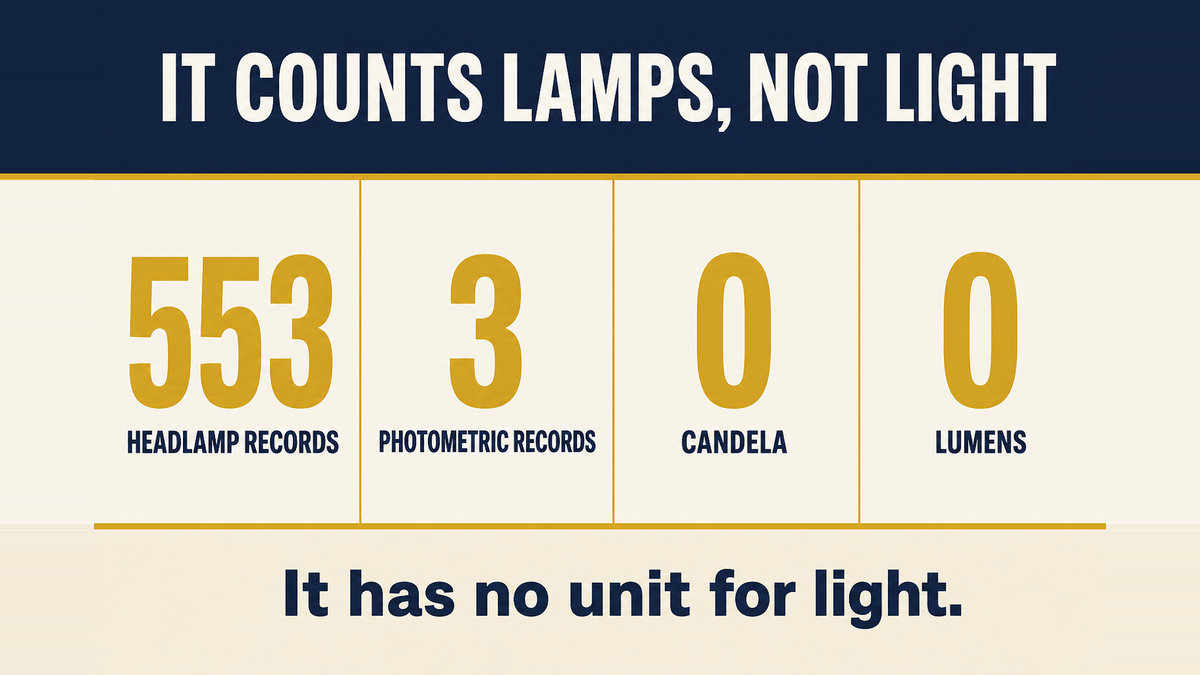
And the file counts lamps, not light. headlamp appears 553 times across 81 campaigns. photometric appears 3 times in 2 campaigns. taillamp appears 5 times in 2. candela is zero and lumens is zero. A standard that is written in photometric terms has left almost no trace of those terms in the record of what actually went wrong, which is a fair reflection of how lighting faults surface: as a glare complaint, an aiming failure or a lamp that will not come on, not as a number on a test sheet.
6. Five Questions a Paint Protection Film Quote Should Answer
A film quote usually carries a thickness in microns, a warranty length in years, a roll width, a finish and a price per square metre. None of those answers either of the two questions this article raises. These five do.
- Does the kit include pieces for the headlamps or the fog lamps, and what does the kit say they are for? This is the item that decides whether the standard’s headlamp clause is engaged at all, and it is a product-structure question rather than a materials question.
- Is the film cut with clearance around any DOT mark on the lamp, or does it cover the lens completely? A piece that leaves the mark readable is a different product from one that covers it, and the difference costs nothing to specify.
- Does the topcoat contain a fluoropolymer, and will the mill state that in writing? The answer drives the PFAS question, and the rule anticipates that the honest answer may be a description rather than a chemical name.
- What will the mill put in writing about the topcoat chemistry? Under the reporting rule a generic name or description is permitted where the specific identity is not known or reasonably ascertainable, so a supplier does not need the mill’s full formulation to answer — but the request has to be made before the order, not after.
- Which years has this exact construction been supplied, and to which market? The reporting obligation looks back to 2011 rather than forward, so the history of the product is part of the answer.
7. Six Checks Before You Order
- The kit list, with the lamp pieces named or absent. A kit drawing that shows a headlamp piece is a kit that has taken a position, whether or not anyone wrote it down.
- The cut file measured against the lamp, not against a photograph. The mark position on the lens and the clearance around it are dimensionable, and they belong on the drawing.
- A written statement from the mill on the topcoat. Fluoropolymer present, absent, or not disclosed — any of the three is usable, and silence is the one answer that is not.
- The installation sheet and the kit label, in the customer’s language, saying what each piece is for and where the lamp pieces may be fitted. On a related product this series has already found the same gap: a mat sold without a retention instruction is a mat fitted loose.
- The material sheet for the base film — thickness, stretch and adhesive type — because those decide whether the sheet can be wrapped round a mirror housing without lifting at the edge, which is the actual failure a customer will report.
- A records file for the construction, kept from the first order rather than started when a question arrives. The reporting rule is a look-back, so the cheapest time to begin keeping the paperwork is before the first shipment.
Item one and item four are on site questions, so they sit inside a factory audit. Item four is also the one a pre-shipment inspection should photograph, because the instruction sheet is decided by whoever builds the carton and is the last thing anyone looks at. And because a film is sold by area and ships as a roll, the freight on it turns on volume rather than weight — the same volumetric basis that decides most large, light automotive accessories.
A paint protection film sits under two regimes at once, one at each end of the vehicle. The lighting standard governs the end that touches a lamp: a headlamp must not have any styling ornament or other feature, such as a translucent cover or grill, in front of the lens, added equipment must not impair required lighting, and the DOT mark that certifies a lamp sits on the very surface a film would cover. The record contains an exact mirror of that problem — an aluminium film on a headlamp reflector at Acura, whose adhesion failed, whose delamination reduced light output, and whose legal effect was a failure to comply with FMVSS 108 — with the one difference that Honda owned the lamp and could replace it.
The chemistry regime governs the other end: a fluoropolymer topcoat makes the sheet a PFAS-containing article, articles are expressly in scope, an importer of such an article has a streamlined reporting route, and the rule explicitly allows a generic name or description where the supplier treats the identity as confidential. So settle the kit list and the lamp pieces before the cut file is made, and get the topcoat statement from the mill before the first order rather than the hundredth.
Frequently Asked Questions
Can a paint protection film be applied over a headlamp?
The standard does not answer that question by name, and this article does not settle it. FMVSS 108 says that a headlamp, when activated in the steady burning state, must not have any styling ornament or other feature, such as a translucent cover or grill, in front of the lens. A film applied over a lens sits in front of it. Whether a clear protective film falls inside the words other feature is a legal question, and the practical point for a supplier is that the kit list — whether lamp pieces are included — is a product decision that engages the clause.
Does a film over a lamp affect the DOT marking?
The marking sits on the lens. The standard requires the lens of each original equipment and replacement headlamp to be marked with the symbol DOT to indicate certification, and it provides that for every other lamp or reflective device in its Table I a DOT mark constitutes a certification that the item conforms. A film covering the lens covers the mark, and the record treats marking failures seriously in their own right: a Chevrolet Camaro campaign recalled 18,941 vehicles because an air bag warning label on the sun visor could peel off, which was a failure to comply with FMVSS 208.
What is 40 CFR Part 705?
It is the EPA’s reporting and recordkeeping rule for certain per- and polyfluoroalkyl substances under section 8(a)(7) of the Toxic Substances Control Act, with a source note of 88 FR 70548 dated 11 October 2023 and authority at 15 U.S.C. 2607(a)(7). Its scope paragraph covers manufacturers including importers of PFAS, and it states that the requirements apply to all chemical substances and mixtures containing a chemical substance, including articles, that are a PFAS.
Is a paint protection film an article under the PFAS reporting rule?
It is only in scope if it contains a PFAS, so the answer has two parts. On the definition, an article is a manufactured item formed to a specific shape or design during manufacture, whose end use function depends in whole or in part on that shape or design, and which has no change of chemical composition during use or only changes with no separate commercial purpose. A film cut to a shape and working because of that shape meets that description on its face. The open question is the chemistry, which turns on the topcoat rather than the urethane base film.
What if the supplier will not disclose the topcoat chemistry?
The rule anticipates exactly that. Where the specific chemical identity of a PFAS imported in an article is not known to or reasonably ascertainable to the submitter, including where the identity is claimed as confidential business information by the submitter’s supplier, or where the submitter knows there is a PFAS but cannot work out its identity, the submitter may provide a generic name or description of the PFAS. Information must be submitted to the extent known or reasonably ascertainable, and where actual data is not known or reasonably ascertainable, reasonable estimates may be submitted.
Which years does the PFAS reporting cover?
It is a look-back rather than a forward-looking duty. The persons covered are those who manufactured for commercial purposes a reportable substance at any period from 1 January 2011 through the end of the last calendar year prior to 13 November 2023, and the article reporting option applies for each year since 1 January 2011 in which the PFAS was imported in an article. Because the part has been amended several times since it was published — including in November 2023, September 2024, November 2024, May 2025 and April 2026 — any summary taken from an older source should be checked against the current text.
What the Article-Importer Rule Asks of You
We return the importer duty for the film, the lamp-surface restriction, and the thirteen zeros the record holds for this product.
Note My Importer Duty
Questions & Comments
We read every one and reply within 24 hoursPaint protection film is judged at two ends of the car: the lens it covers and the paint it protects. Send the kit drawing and the film specification, and we will check both regimes.