
Jump Starter Manufacturer: Two Products in One Box
 ·
Updated October 16, 2026
·
12 min read
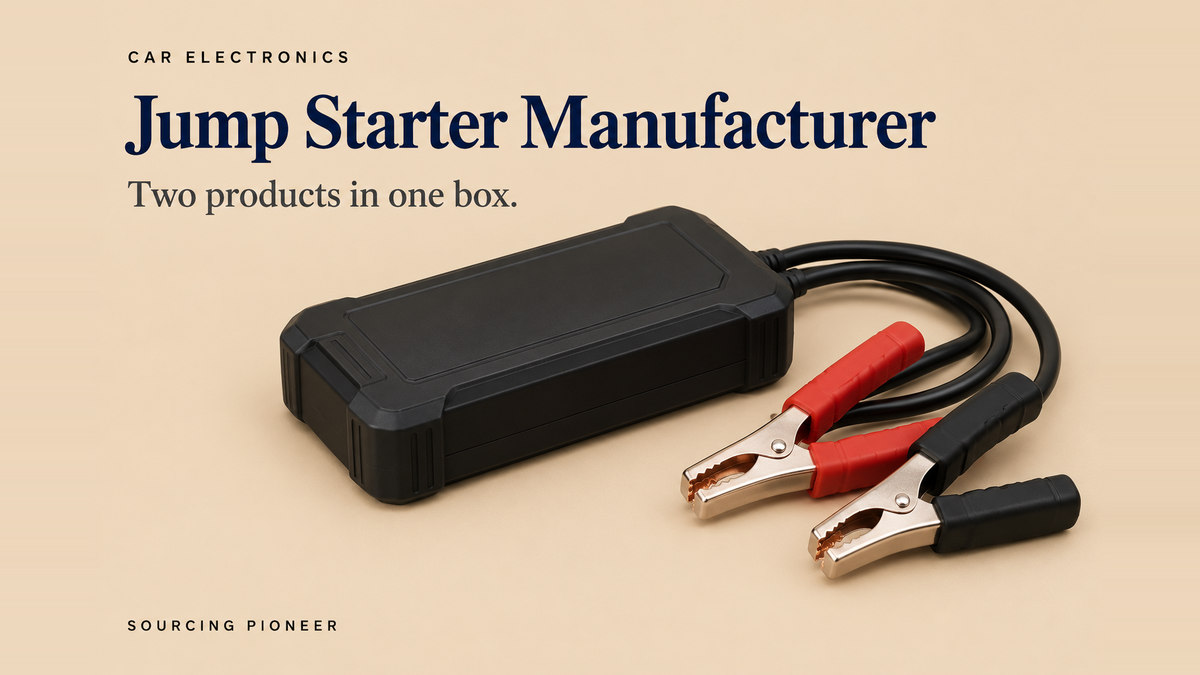
A jump starter is two products sold as one. There is a lithium-ion battery pack, and there is a cable assembly with two clamps on the end. The battery half is governed by one of the most carefully written test programmes in transport law. The cable half is governed by almost nothing. In the federal recall file, four jump starters appear across 245,845 records, and three of the four were fires — two of which began in the cable or at the plug, not in the cells.
1. What a Jump Starter Is Made Of, and Where the Two Halves Meet
Open a portable jump starter and you find a pouch or cylindrical cell pack, a small circuit board that manages charging and output, a set of sockets for charging, and a pair of heavy cables ending in clamps. That is the whole product. The price is decided by the cells; the safety record is decided by the joints.
The two halves meet at exactly three places, and each one is a place where something can go wrong:
| The joint | What it decides | What a vague quote hides |
|---|---|---|
| The board and the cells | Whether the pack can be over-charged, over-discharged or shorted safely | The protection design, and whether it changed after testing |
| The board and the output | How much current reaches the clamps, and for how long | The rated output current, and whether the cable can carry it |
| The cable and the clamps | Whether the cable survives a long crank without melting | The conductor size, the insulation rating and the clamp spring |
| Where the clamps land | Whether the polarity is right when the buyer is in a hurry | How reverse connection is handled, and how the product marks its terminals |
| The charging port | Whether the pack can be charged at the wrong temperature | The charging window, and whether the board refuses to charge outside it |
What this guide covers
- What a jump starter is made of
- Four entries in the record, three of them fires
- What the transport rules call it, and the 100 Wh line
- What the UN 38.3 series actually tests
- What makes a pack a new type
- The test summary: ten things it has to carry
- The two marks that have to be on the product
- The cable, the clamps and the polarity problem
- The charging window
- What the vehicle side adds
- The charger next door
- Six checks and where the price comes from
- Frequently asked questions
2. Four Entries in the Record, Three of Them Fires
Method first, so the numbers can be repeated. The federal file holds 245,845 records with no header row, so every field of every record is scanned rather than trusting a column map. Controls: brake appears in 28,639 records and air bag in 16,162.
Against that, the phrase “jump start” appears in 94 records. Narrow it to records that name the product itself and there are four campaigns, covering 23,565 units between them. All four were filed under an E number, which means equipment rather than a vehicle, and all four name model year 9999 — the convention for an item with no vehicle attached.
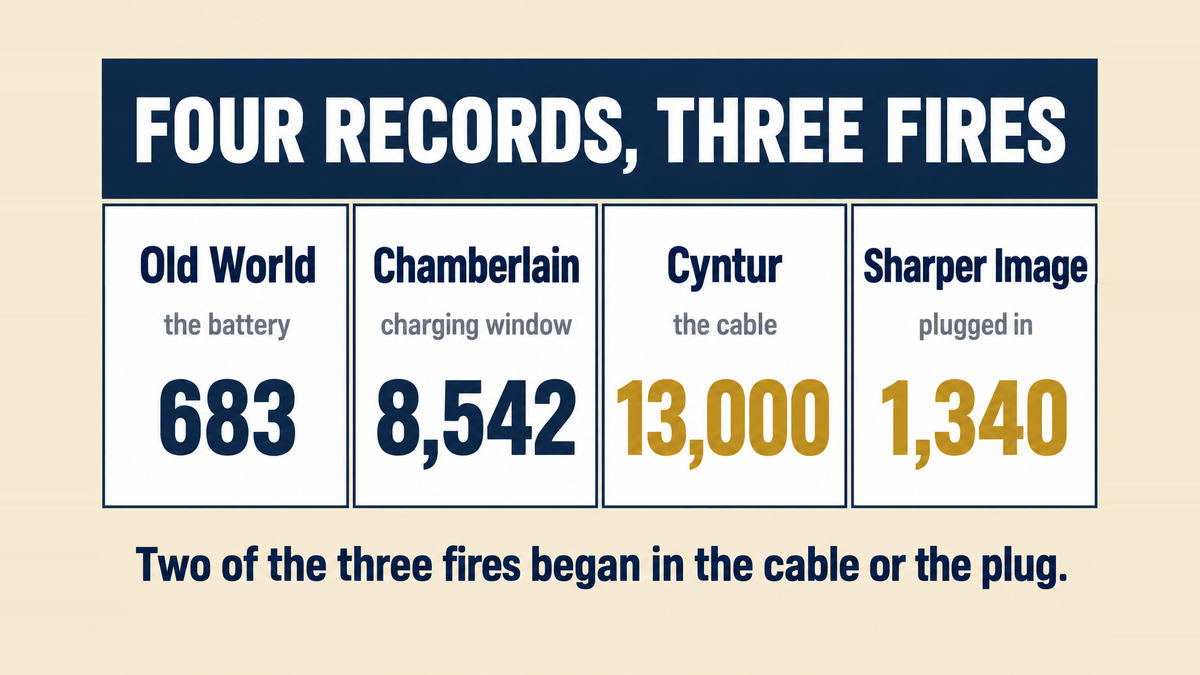
Read what failed in each one, because the pattern is the whole point of this article.
- Old World Industries, campaign 15E075000, 683 units of the Peak PKC0LS: the pack “contains a lithium battery that may overheat.” This is the only one of the four that is purely a cell problem.
- Chamberlain, campaign 15E079000, 8,542 units of the CA1000: the unit “can be charged when the internal battery is either too hot or too cold for charging, possibly resulting in the unit overheating.” Nothing was wrong with the cells — the charging logic was missing a temperature window.
- Battery-Biz, campaign 16E021000, 13,000 units of the Cyntur CTJSLI: “due to faulty design of the cable assembly, the jumpstarter may overheat and catch fire.” The agency’s wording for the sequence is blunter still: over-cranking causes the cable to melt, and the pack to overheat and catch fire. The remedy was a replacement cable, not a replacement pack.
- Sharper Image, campaign 17E047000, 1,340 units of part number 204966, offered with three outputs at 12, 16 and 19 volts: the units “may catch fire when they are plugged in.” That is the charging port, not the cranking path.
Two other phrases settle how invisible this product is in the system. “Booster pack” appears in none of the 245,845 records. “Booster cable” appears in none. “Power bank” appears in none. A product that sells in the millions is written down, when it is written down at all, as a lithium battery in a device.
3. What the Transport Rules Call It, and the 100 Wh Line
Because the product contains lithium cells, the rule that governs it is 49 CFR 173.185, Lithium cells and batteries. The first paragraph is the one that decides everything else, and it does not describe a jump starter at all:
“Each lithium cell or battery must be of the type proven to meet the criteria in part III, sub-section 38.3 of the UN Manual of Tests and Criteria… Lithium cells and batteries are subject to these tests regardless of whether the cells used to construct the battery are of a tested type.”
That last sentence is worth reading twice. A pack built from cells that each passed their own tests is still not a tested pack. The assembly is what has to be proven, because the assembly is what changes the behaviour.
The next thing to settle is size, because size decides which rulebook applies. A lithium-ion battery of 100 Wh or less, or a cell of 20 Wh or less, may travel under the lighter set of conditions in paragraph (c), which come with their own marking. Above that line the full packaging rules apply. There is a middle route for road and rail only, where the figures rise to 60 Wh for a cell and 300 Wh for a battery provided the outer box carries the words “LITHIUM BATTERIES — FORBIDDEN FOR TRANSPORT ABOARD AIRCRAFT AND VESSEL”.
So the first question to a supplier is not about cells. It is: what is the watt-hour rating of the finished pack, and which of those three routes is this shipment taking?
4. What the UN 38.3 Series Actually Tests
Sub-section 38.3 of the UN Manual of Tests and Criteria sets eight tests, and which of them apply depends on what you are shipping. All cell types take T.1 to T.6 and T.8. Non-rechargeable batteries take T.1 to T.5. Rechargeable batteries take T.1 to T.5 and T.7. A jump starter pack is a rechargeable battery, so its line is the third one.
Which edition a report cites matters, and it is worth looking for that line. The eighth revised edition took in the amendments adopted in 2022, and a further set adopted in December 2024 changed sub-section 38.3 again, including the definition of rupture. A test summary written against Rev. 7 and one written against Rev. 8 are both summaries, and they do not say the same thing.
The numbers inside those tests are the part a buying team can use, because they are what a factory has to reproduce.
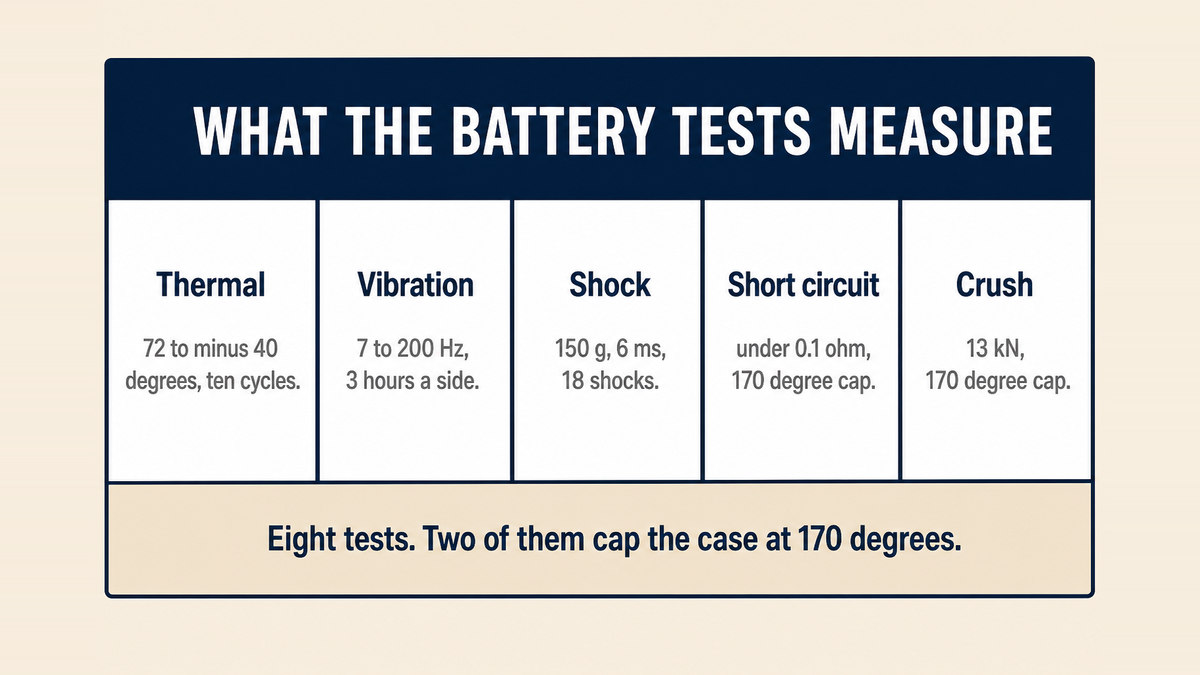
- T.1, altitude — low pressure for a set period, then a check that the open-circuit voltage is still at least 90 per cent of what it was before.
- T.2, thermal — at least six hours at 72 °C, then at least six hours at minus 40 °C, with no more than thirty minutes between the extremes, repeated for ten complete cycles, then twenty-four hours at room temperature.
- T.3, vibration — a sweep from 7 Hz to 200 Hz and back, taking fifteen minutes, repeated twelve times for three hours in each of three directions at right angles, one of them straight at the terminal face. For cells and small batteries the peak acceleration reaches 8 g.
- T.4, shock — a half-sine pulse of 150 g for six milliseconds for small batteries, delivered three times forwards and three times backwards in each of three directions: eighteen shocks in total.
- T.5, external short circuit — warmed to 57 °C, then shorted through a total external resistance of less than 0.1 ohm. The case temperature must not exceed 170 °C, with no rupture and no fire during the test or in the six hours after it.
- T.6, impact and crush — pressed until one of three things happens: the force reaches 13 kN, or the voltage drops by 100 mV, or the cell is deformed by 50 per cent of its thickness. Same 170 °C cap, and the sample is watched for six hours afterwards.
- T.7, overcharge — charged at twice the maker’s stated maximum continuous current for twenty-four hours, to at least 22 volts where the recommended charge voltage is 18 volts or less. No fire during the test and none within seven days afterwards.
- T.8, forced discharge — forced to discharge into a 12 volt supply at the maker’s stated maximum discharge current, for a period equal to the rated capacity divided by that current. Same seven-day no-fire condition.
One detail in the wording is easy to miss and matters for a claim about a design. Tests T.1 to T.4 require no leakage, no venting, no disassembly, no rupture and no fire. Tests T.5 to T.8 require only no disassembly and no fire, plus the temperature cap. So venting is a defined event, and it is a failure in the first half of the series while being tolerated in the second. A factory that says “it just vents” has told you which tests it was reading.
5. What Makes a Pack a New Type
This is the section to keep. A test report covers a type, and the manual defines a type as “a particular electrochemical system and physical design.” Change the design and the report no longer covers what you are shipping. The manual lists what counts as a change for a rechargeable pack: a change in watt-hour rating of more than 20 per cent, or an increase in voltage of more than 20 per cent.
Then it goes further, and this is the part a sourcing conversation usually gets wrong.
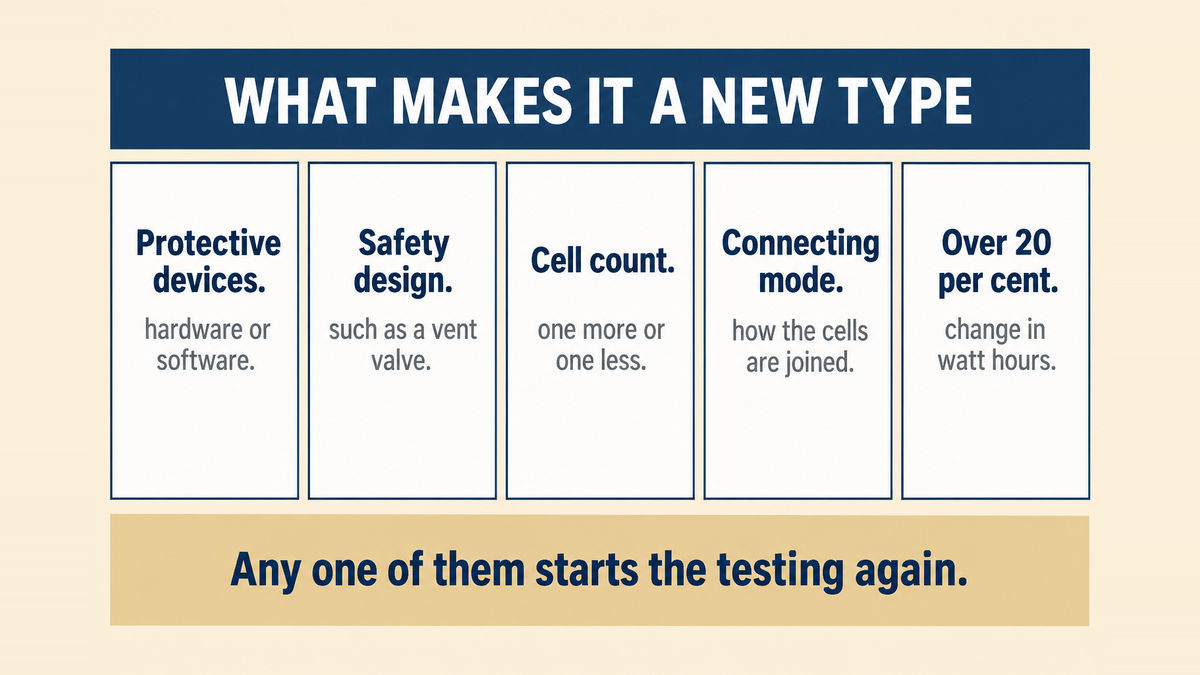
A change of protective devices, including hardware and software, counts. A change of safety design such as a venting valve counts. A change in the number of cells counts. A change in the way the cells are connected counts. And for shock testing at a peak below 50 g, a change in mass counts too.
Put those five together and the implication for a buyer is uncomfortable but simple. Almost every request that makes a jump starter cheaper or more attractive is one of them. Take one cell out. Swap the protection board for a cheaper one. Move from a 3-cell series to a parallel arrangement. Add a USB-C output that changes how the board behaves. Add a firmware feature so the pack stays awake longer. Any of those means the pack has to be tested again, and the test summary you were shown at the sample stage no longer describes the goods on the pallet.
The manual also says what to do when a type fails: the fault that caused the failure has to be put right before that type is tested again. There is no route in which a failed pack becomes a passed pack by asking again.
6. The Test Summary: Ten Things It Has to Carry
Here is the practical gift in the whole rule. Since 1 January 2008, every maker of lithium cells or batteries and every distributor that handles them afterwards has had to make a test summary available, and the rule names the ten things it must contain:
- The name of the cell, battery or product manufacturer.
- The maker’s contact details, including address, telephone, email and website.
- The name of the test laboratory, with the same four contact details.
- A unique test report identification number.
- The date of the test report.
- A description that includes whether it is lithium ion or lithium metal, the mass, the watt-hour rating or lithium content, a physical description, and the model number of the cell, battery or product.
- A list of the tests carried out and the result of each, as pass or fail.
- A reference to the assembled-battery testing requirements, where they apply.
- The revised edition of the UN Manual that was used, and any amendments to it.
- The name and title of a responsible person, as an indication that the information is valid.
Item 7 is the one that gives a test summary its value: it is not a certificate, it is a list, and you can read which tests were run. Item 9 dates the whole thing, because the Manual is revised and a summary built on an old edition says so. And item 10 is why a test summary is a document with a person behind it.
The United States Department of Transportation publishes a guide to this requirement, revised in July 2024, at phmsa.dot.gov, and it notes that the requirement took effect on 1 January 2022 and was revised on 10 May 2024. Ask for the test summary and you are asking for something a supplier already has to be able to produce.
7. The Two Marks That Have to Be on the Product
Once the pack is tested, two marks do the travelling for it, and both are written into the same section of the rule.
The first is on the case. Since 10 May 2024, every lithium-ion battery has had to be marked with its watt-hour rating on the outside case. For a jump starter this is the number a customs officer, an airline or a customer will look for first, because it is the number that decides which route the shipment may take.
The second is on the box. A package of lithium-ion cells or batteries carries the lithium battery mark, showing UN3480 for cells and batteries on their own, or UN3481 where they are contained in, or packed with, equipment. A jump starter is a battery inside a device, so its mark reads UN3481. The mark is a rectangle or square with hatched edging, not less than 100 mm by 100 mm, with hatching at least 5 mm wide, symbols and letters in black on white or another contrasting colour, and hatching in red. Where a package is too small for the full square, a 100 mm by 70 mm version is allowed.
Three smaller conditions come with it, and they are the ones that cause arguments at the airport. Where packages go into an overpack, the mark must either show through or be reproduced on the outside, and the overpack itself must carry the word OVERPACK in letters at least 12 mm high. A package of cells or batteries must survive a 1.2 metre drop in any orientation without damage, without the contents shifting into contact with each other, and without anything coming out. And where the older wording is still in use, a package must take a load equal to identical packages stacked to three metres for 24 hours.
There is also a date to know if a supplier is shipping an older print run. The version of the mark that was in effect on 9 May 2024 may continue to be used until 31 December 2026. A carton printed with the earlier artwork is not automatically wrong — but the window closes at the end of 2026, and a long print run bought in 2026 will outlive it.
8. The Cable, the Clamps and the Polarity Problem
Half of the fires in the recall set happened in the part of the product that carries no test at all.
The Cyntur case is the clearest example. The recalled part, as the record puts it, was the cable assembly: a faulty design meant that over-cranking melted the cable and took the pack with it. The remedy was a replacement cable with new safety features — not a new battery. A test summary for the cells would have said nothing about it.
A cable is a rated part. It has a conductor size, an insulation material with a temperature class, a length, and a pair of clamps with springs that have to hold on to a battery post while a starter motor draws several hundred amps. Ask for those four things in writing and you are asking about the only part of a jump starter that has burned twice.
The other direction of failure is the human one, and the record has a case for it too. Chrysler’s campaign 17V433000, covering 12,989 Jeep Compass vehicles, was recalled because the User’s Guide had the polarity of the battery terminals reversed in the graphic. A customer following the manual could connect jumper cables the wrong way round and be hurt. The remedy was to print new guides. No part of the car changed.
Two lessons sit side by side there. The product has to tolerate a careless connection, because buyers are careless at the roadside. And the instructions have to be right, because in the United States the manual is a part of the product that can be recalled on its own.
9. The Charging Window
The second failure class has nothing to do with cranking. Chamberlain’s campaign 15E079000, 8,542 units, describes a pack that could be charged when the internal battery was either too hot or too cold for charging, with overheating as the result. The Sharper Image units failed on the same path from the other end: they could catch fire when plugged in.
This is the gap that the test series does not close. Test T.2 drives a pack through ten cycles between 72 °C and minus 40 °C, and then looks for leakage, venting, rupture and fire. It proves the pack can survive those temperatures in storage. It says nothing about whether the charging circuit knows to refuse a charge when the pack is hot, cold, or already full.
A pack that passes T.2 has shown it can sit in a hot and cold place. It has not shown that it will decline to charge there.
So the question to put to a supplier is not “does it have temperature protection” but “at what temperatures, in both directions, does the board refuse to charge, and what does the light do when it refuses?” The second half of that question matters commercially, because the most common support complaint about a jump starter is a unit that appears dead when it has simply decided not to charge.
10. What the Vehicle Side Adds
Two of the campaigns in the file are about the car’s own provision for being jumped, and they are useful context for anyone selling into fleets.
Navistar’s campaign 10V107000, 29,460 International trucks, is about an optional jump start stud. Corrosion at the base of the stud could cause an electrical short between the stud and the battery box. A later Navistar campaign covered a longer list of models with the same provision and replaced the component with an upgraded version. The lesson is that a jump-start terminal on a truck is a designed part with its own corrosion history.
General Motors’ 14V253000, 19,225 Cadillac CTS cars, is stranger. If the vehicle was switched off with the wipers left on, the wipers then became restricted, and the battery went flat and needed a jump start, the wipers would be inoperative after the jump. The remedy was a new front wiper module. Nobody in that story did anything wrong; the car simply could not cope with the sequence.
Both cases point the same way. When a fleet buyer asks about jump starters, the answer that wins is usually about the vehicle they are fitting it to, not about the pack.
11. The Charger Next Door
One step away from the jump starter is the charging product, and the record shows where that goes wrong — which is worth reading here because the fix turns out to be the same part every time.
- Audi, campaign 23V842000, 93,196 vehicles: on the industrial 220/240 volt plug at the 100 per cent setting, some home outlets could not carry the current, overheating the outlet or the cable. Owners were told to stop using that cable, and the remedy was a new cable with an incorporated temperature sensor.
- Porsche, campaign 23V841000, 41,345 vehicles, for the same fault and the same fix.
- EVject, campaign 24E081000, 8,900 charging adapters, recalled because they were made without internal thermal protection.
- BMW, campaign 18V652000, 3,501 vehicles, where capacitors inside a portable charging cord could fail and give a shock or start a fire.
Every one of those remedies is a protection device. A temperature sensor, a thermal cut-out, a better capacitor. And that closes the loop with section 5, because a change of protective devices including hardware and software is one of the five changes that makes a lithium pack a new type. The fix for a safety problem and the reason a test report expires are the same event. That is the single most useful thing to understand about this product family: improvement and retesting are not two tasks, they are one.
12. Six Checks and Where the Price Comes From
A jump starter quote usually arrives as a capacity in milliamp-hours, a peak current in amps, and a price. The number that decides the paperwork — watt hours — is often missing, and the document that proves the pack is shippable is usually missing with it.
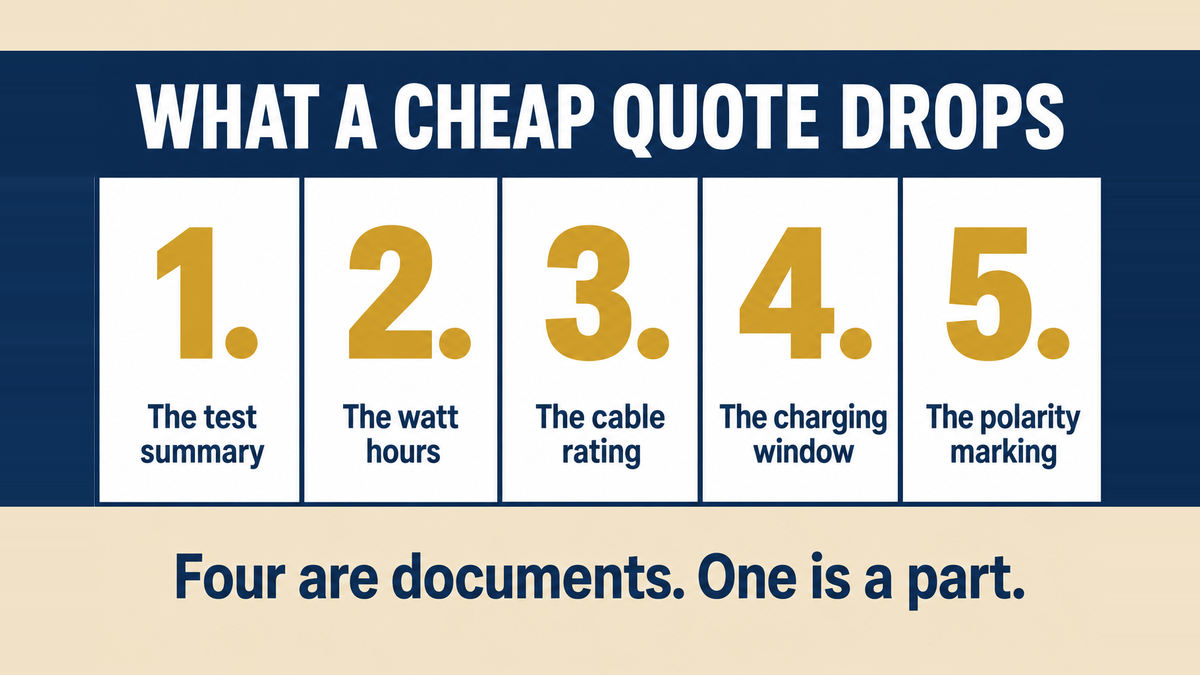
Six questions carry most of the value, and all six can be answered on paper before a deposit:
- What is the watt-hour rating of the finished pack? That one number decides whether the lighter shipping route is open, and it is the mark that now has to appear on the case.
- Can you send the UN 38.3 test summary? Then read it against the ten items in section 6. A summary with no test list and no responsible person is not a summary.
- Which tests were run on this exact configuration, and has anything changed since? A different protection board, a different valve, one more or one fewer cell, or a different way of connecting them all start a new type.
- What is the cable rated for, and what does the pack do when the clamps are reversed? The cable is the part that failed in the largest of the four recalls.
- Between which temperatures will the board refuse to charge? Both ends of the range, and what the indicator shows.
- What is printed on the case and on the carton? The watt-hour mark on the product, and the lithium battery mark with the right UN number on the box.
Those are the questions a factory audit puts to a supplier in person, and they can all be asked on paper first. The paperwork is also worth pricing properly: a packaging check before shipment costs far less than a container held at a port because the lithium battery mark is the wrong size or the mark on the case is missing.
Then there is the matter of the name. Your customer calls it a jump starter. The transport rule calls it a rechargeable lithium-ion battery contained in equipment, which is why the box says UN3481. The recall record calls it equipment, files it under an E number, and gives it model year 9999. The test summary is the only document that describes all three at once — which is why it is the first thing to ask for and the most common thing to be missing.
Frequently Asked Questions
Is a jump starter a hazardous material when it ships?
Yes. It contains lithium-ion cells, so it is regulated as dangerous goods. Because the pack is contained in a device, the lithium battery mark shows UN3481. Where the pack is shipped on its own as a spare, the mark shows UN3480. The size rules decide which set of packaging conditions applies: a lithium-ion battery of 100 watt hours or less, or a cell of 20 watt hours or less, may travel under the lighter conditions, with a separate road and rail route running to 300 watt hours for a battery if the box carries the words forbidding transport aboard aircraft and vessel.
Which UN 38.3 tests does a jump starter pack need?
It is a rechargeable battery, so its series is T.1 to T.5 plus T.7. Cells take T.1 to T.6 plus T.8, and non-rechargeable batteries take T.1 to T.5. A component cell that is not shipped separately from the battery it belongs to needs only T.6 and T.8. The important point for a buyer is that a pack assembled from cells that each passed their own tests is still not a tested pack, because the assembly is a type of its own.
What is the 100 watt hour line, and why does it matter?
It is the size at which the lighter shipping conditions end. A lithium-ion battery of 100 watt hours or less, or a cell of 20 watt hours or less, may use those conditions, which come with their own marking requirements. Above that, the full packaging rules apply. There is a middle route for road and rail only, which raises the figures to 60 watt hours for a cell and 300 watt hours for a battery, on condition that the outer package is marked with words forbidding transport aboard aircraft and vessel.
What has to be printed on the product itself?
Since 10 May 2024, every lithium-ion battery must be marked with its watt-hour rating on the outside case. That is the marking a customs officer or an airline will look for. The lithium battery mark belongs on the package rather than the product, and must be at least 100 mm by 100 mm with hatching at least 5 mm wide, in black on a contrasting background with red hatching. A smaller 100 mm by 70 mm version is allowed where the package is too small for the full square.
What is a lithium battery test summary, and who has to provide it?
It is a document that must be made available for every lithium cell or battery made on or after 1 January 2008, by the manufacturer and by every distributor handling it afterwards. It has to carry ten items: the maker’s name and contact details, the test laboratory’s name and contact details, a unique test report number, the report date, a description including chemistry, mass, watt-hour rating and model number, a list of the tests run with pass or fail for each, a reference to assembled-battery testing where it applies, the edition of the UN Manual used, and the name and title of a responsible person. In practice it is the only document that tells you which tests were done on the configuration you are buying.
Why do jump starters catch fire if they passed testing?
Because the test series covers the cells and the pack, and the fires did not all start there. Of the four jump starters in the federal recall file, three were fires. One was a cable assembly whose design let over-cranking melt the cable and take the pack with it, and one caught fire when it was plugged in, which is the charging port rather than the cranking path. A third could be charged when the battery was too hot or too cold, which is a fault in the charging logic. Test T.2 proves a pack survives 72 and minus 40 degrees in storage; it does not prove the board will refuse to charge there. The cable, the plug and the charging window carry no test series of their own.
In a jump starter the paperwork is worth more than the specification sheet, because the pack is a battery first and an accessory second. The pack has one of the most detailed test programmes in transport law behind it, and the cable has nothing; the recall record shows exactly where that gap has been paid for.
Ask for the test summary, read which tests it lists, check the watt-hour mark on the case, and ask what the cable is rated for.
A Dossier the Forwarder Can Accept
Test summary, pack rating and declaration page, collated in the order a carrier asks for them at booking.
Collate My Dossier
Questions & Comments
We read every one and reply within 24 hoursA jump starter is a battery in a case with a clamp on it, and the battery rules come first. Send the capacity and the market, and we will check the UN test summary, the clamp rating and the cable gauge.