
Car Cover Factory: The Label Rule You Can Switch On
 ·
Updated October 16, 2026
·
11 min read
This article covers two kinds of cover, and the difference between them decides everything. A pickup bed cover is a cover you drive with. A car cover is a cover you drive without. The federal recall file holds nine campaigns and 328,498 units of the first kind, and in every single one the failure is the same: the cover comes loose at speed, leaves the vehicle and becomes a road hazard. The remedy is always a tether, a strap or more hardware. For the second kind the file holds nothing at all — car cover appears in zero of 245,845 records — because a cover that sits on a parked vehicle can never detach at speed. Which is why the rule that actually reaches this product is not a vehicle rule at all. It is a 1958 textile labelling law, it applies to a list of products that does not include a car cover, and the only thing that puts a car cover inside it is a sentence your own marketing writes.
1. What the Product Is: The Cover You Drive Without
A car cover is a textile article sized to a vehicle. It has four parts that matter commercially, and only one of them is the fabric.
| Part | What it decides | What the buyer asks about it |
|---|---|---|
| The face fabric | Breathability and water resistance | The fibre, and the weight per square metre |
| The coating or laminate | Whether water stays out, and whether the cover breathes | How much weight it adds to the base cloth |
| The closure — elastic hem, grommet, strap, buckle | Whether the cover stays on in wind | Elastic tension, grommet size, strap length |
| The label | What the product must tell the customer | Almost nothing, in most quotations |
The fourth row is the one this article is about, and it is the one that is almost never quoted. Ask three factories for a price on a cover and you will get three fabric specifications, three coating weights and three closure descriptions. Ask any of them what the label has to say and the answer is usually that the customer supplies it. That answer is defensible, and it hides the entire rulebook, because the duty to label sits with whoever is marketing the product, and it can be created by a single sentence on a carton.
What this guide covers
- What the product is: the cover you drive without
- The record’s covers are the other kind
- Every one of them fails the same way
- Two zeros, and a word that is occupied
- The label law: a list, and everything outside it
- The switch: one fiber claim turns the duty on
- The second way out: what the coating weighs
- What the label must carry when the switch is on
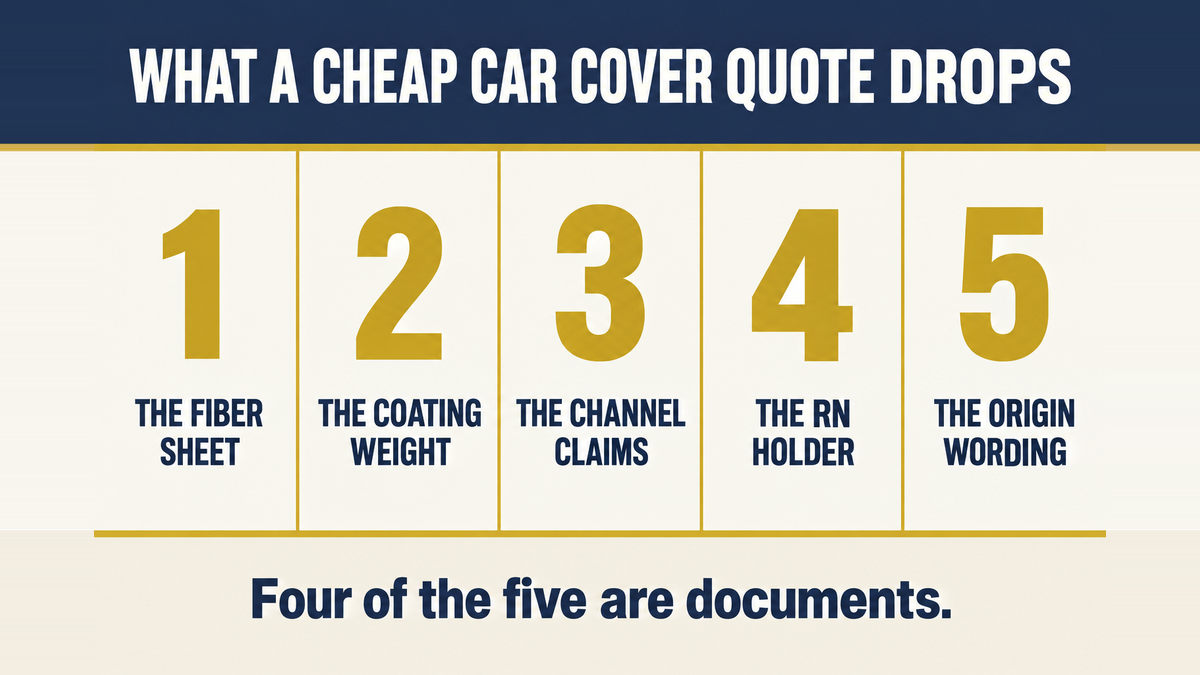
- Five questions a car cover quote should answer
- Six checks before you order
- Frequently asked questions
2. The Record’s Covers Are the Other Kind
The federal recall file has a great deal to say about covers, and none of it is about your product. Nine campaigns account for 328,498 units of tonneau and bed covers, and they sit in two different parts of the taxonomy — several are EQUIPMENT campaigns filed against the accessory, and one is a STRUCTURE:BODY campaign filed against the truck.
| Campaign | Subject | Units | Filed as |
|---|---|---|---|
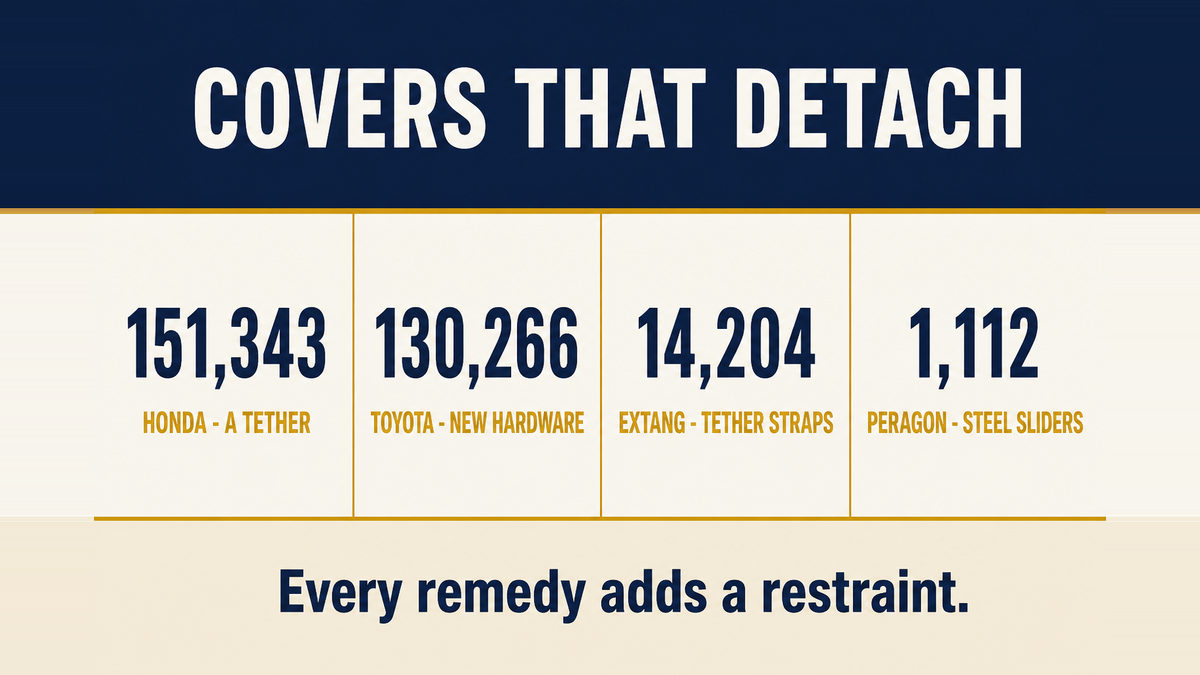
| 20E068000 | Honda Genuine Accessory tonneau cover, part 08Z07-T6Z-100F, 2017–2020 Ridgeline | 151,343 | EQUIPMENT |
| 23V142000 | Toyota genuine accessory tonneau cover, 2022–2023 Tundra | 130,266 | STRUCTURE:BODY |
| 20E024000 | Rugged Liners tri-fold tonneau cover | 14,876 | EQUIPMENT |
| 13E066000 | Extang Encore hard-panel tri-fold cover | 14,204 | EQUIPMENT |
| 19E066000 | Advantage tri-fold tonneau cover | 7,173 | EQUIPMENT |
| 19E018000 | DiamondBack HD cover | 6,816 | EQUIPMENT |
| 24E107000 | DiamondBack Switchback cover | 1,472 | EQUIPMENT |
| 22E029000 | Rugged Liners tri-fold tonneau cover | 1,236 | EQUIPMENT |
| 25E043000 | Peragon Tectonic hard three-panel bed cover | 1,112 | EQUIPMENT |
The reason this table belongs in an article about car covers is the shape of it. Every one of the nine is a cover that stays on the vehicle while the vehicle moves, which means every one of them can leave the vehicle while the vehicle is moving. Your product cannot, because it is fitted to a parked car and removed before the car is driven. That single mechanical difference is why one product has a recall history running to six figures and the other has a recall history of zero.
It is also why the file’s cover vocabulary appears at all. tonneau cover appears in 19 records across 6 campaigns, bed cover in 4 records in 1 campaign, and tonneau alone in 26 records across 9 campaigns. Every one of those records is a pickup bed cover.
3. Every One of Them Fails the Same Way
Four campaign texts are enough to establish the pattern, and they are worth quoting because the wording repeats almost exactly.
“If the tonneau cover is not properly secured in the open or closed position, wind resistance may cause the cover to flip and buckle. If this occurs, the hinges between the center and rear panel may deform, possibly allowing the rear panel to separate from the vehicle. … A separated panel may become a road hazard.” — campaign 20E068000, Honda, 151,343 units
“The tonneau cover attachment joints may come loose and allow the cover to detach. … A tonneau cover that detaches while driving can become a road hazard.” — campaign 23V142000, Toyota, 130,266 units
“The subject covers have a front panel that may become unsecured while driving, allowing wind to lift and separate the covers from the truck beds.” — campaign 13E066000, Extang, 14,204 units
“The bed cover’s plastic slides may become damaged and allow the cover to detach during transit.” — campaign 25E043000, Peragon, 1,112 units
Now read the four remedies together, because this is the part a supplier can use.
- Honda installed tethers on every cover and applied warning labels, and issued an updated accessory user’s information manual.
- Toyota installed new hardware — bolts, spacers, washers, nuts, rubber washers and cotter pins — and replaced any cover whose mounting holes had torn or split too far to take the new hardware.
- Extang installed tether straps to secure the front panel.
- Peragon supplied carriage brackets, rail brackets, cab latch pins and steel sliders.
Four makers, four mechanisms — wind lift, loose joints, an unsecured panel, damaged slides — and four remedies that are all the same idea: add a restraint. Not one remedy involved changing the material, the panel or the fabric. Every one of them added a part whose only job is to keep the cover attached.
That is the design lesson to carry across to your own product even though yours never moves. A cover’s failure mode is that it stops being attached. On a moving vehicle that is a road hazard. On a parked vehicle it is a cover on the ground and a scratched roof — and the parts that decide it are the same three: the elastic hem, the grommet and the strap.
4. Two Zeros, and a Word That Is Occupied
Method first. The federal recall file holds 245,845 records and has no header row, so every field is scanned rather than trusting a column map. Controls: brake appears in 28,639 records and air bag in 16,162. Every term is counted with its own pattern, because a combined search that lists a short word before a longer phrase containing it will consume the text and report the longer phrase as zero.
| Term | Records | Campaigns |
|---|---|---|
car cover | 0 | 0 |
car covers | 0 | 0 |
care label | 0 | 0 |
tonneau cover | 19 | 6 |
bed cover | 4 | 1 |
tonneau | 26 | 9 |
cover | 4,299 | 341 |
covers | 717 | 66 |
storage | 1,458 | 247 |
fiber | 15 | 6 |
elastic | 5 | 1 |
grommet | 53 | 15 |
strap | 565 | 93 |
tether | 745 | 47 |
moisture | 1,646 | 92 |
condensation | 293 | 33 |
corrosion | 3,294 | 342 |
scratch | 18 | 1 |
detach | 14,411 | 1,100 |
road hazard | 6,247 | 618 |
Two zeros. car cover and car covers do not appear anywhere in 245,845 records. Neither does care label. That second zero is the one that matters, because it means the file has no vocabulary for the labelling of a textile product at all — which is a fair reflection of what the file is for, and a warning about what it cannot tell you.
The big word is the wrong word. cover appears 4,299 times across 341 campaigns, and the largest of those campaigns are an ignition switch campaign (5,877,718 units), a child seat harness buckle campaign (1,910,102), and a battery campaign on the RAV4 (1,853,568). In all of them, cover is a small part of something else — a switch cover, a buckle cover, a terminal cover. It is the same control this series has used throughout: a word that appears thousands of times and identifies nothing.
One word is occupied. storage appears 1,458 times in 247 campaigns, and the largest campaigns by units are all fuel systems. The record’s storage is a fuel tank — an evaporative emissions campaign at 1,282,596 units, a tank assembly campaign at 1,100,000, an auxiliary tank at 411,205, a fuel gauge at 340,000. A supplier writing “storage cover” in a brief is using a word that in this file means a petrol tank twelve hundred times over.
The rest of the vocabulary is present and belongs to the vehicle. corrosion appears 3,294 times across 342 campaigns, moisture 1,646 times across 92, condensation 293 times across 33. Those are the three words a car cover is sold against, and in this file every one of them describes the vehicle’s own parts failing — a brake line, a wiring harness, a lamp housing. And the two large controls for the detaching covers above sit at detach 14,411 records across 1,100 campaigns and road hazard 6,247 across 618, which is the file’s way of saying that a part coming off a moving vehicle is one of the most common things it records.
5. The Label Law: A List, and Everything Outside It
The rule that reaches a car cover is 16 CFR Part 303, the rules under the Textile Fiber Products Identification Act, whose source note reads 24 FR 4480, June 2, 1959. Its general requirement is written as an obligation on products that are inside the Act:
“Each textile fiber product, except those exempted or excluded under section 12 of the Act, shall be labeled or invoiced in conformity with the requirements of the Act and regulations.” — § 303.2(a)
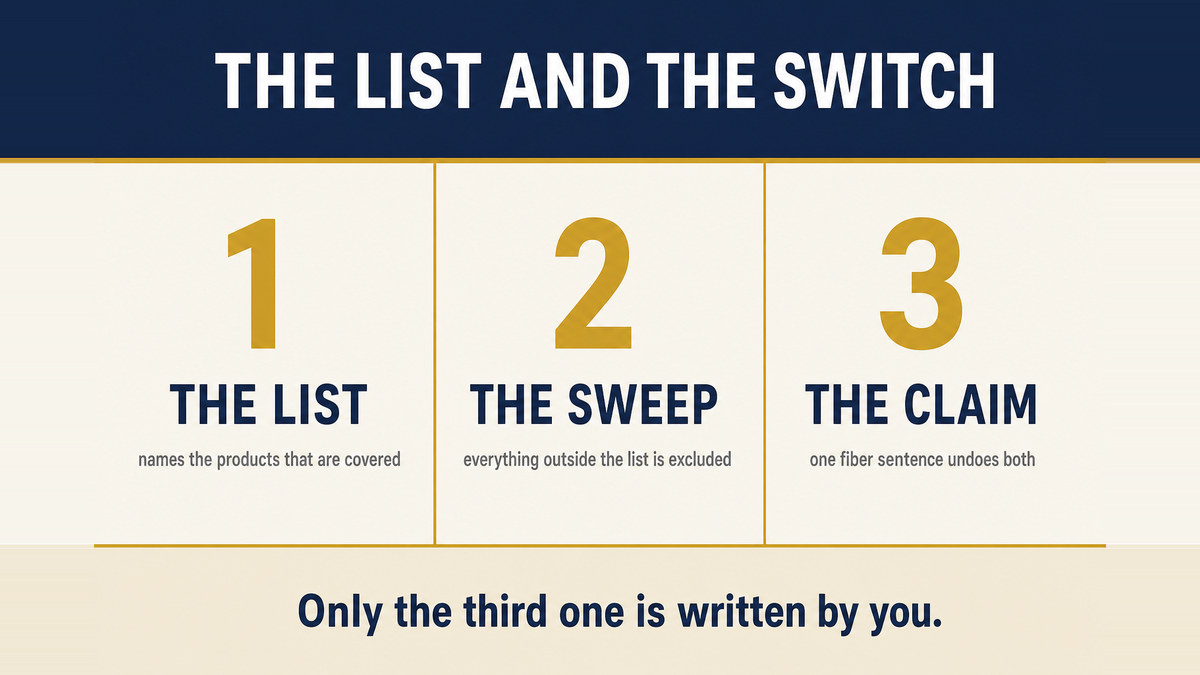
What matters is which products are inside it. § 303.45 answers that with two paragraphs that work in opposite directions. Paragraph (a) is an enumerated list of products that are subject to the Act, and it names, among others:
- Articles of wearing apparel; handkerchiefs; scarfs
- Beddings; curtains and casements; draperies
- Tablecloths, napkins, and doilies; floor coverings; towels; wash cloths and dish cloths
- Ironing board covers and pads; umbrellas and parasols; cushions
- All fibers, yarns and fabrics, including narrow fabrics except packaging ribbons
- Furniture slip covers and other covers or coverlets for furniture
- Afghans and throws; sleeping bags; hammocks
Read that list as a supplier and two things stand out. First, it names covers — twice, and both times for furniture: an ironing board cover and a furniture slip cover. A cover for a couch is on the list. A cover for a car is not. Second, it names floor coverings, which is the product in the previous article in this series. The same list reaches the mat in a footwell and does not reach the cover over the roof.
Paragraph (b) is the paragraph that decides the question, and it is drafted as a sweep rather than a list:
“Pursuant to section 12(b) of the Act, all textile fiber products other than those identified in paragraph (a) of this section, and the following textile fiber products, are excluded from the Act’s requirements.” — § 303.45(b)
So the structure is a closed list. If a product is named in paragraph (a) it is in; if it is not, the first clause of paragraph (b) puts it out. A vehicle cover is not named, and on the face of the text that is the end of the matter: no fiber content label, no invoice statement, no advertising requirement. For a factory quoting a plain cover with no claims on the packaging, that means the entire Part 303 rulebook is out of scope. It is worth saying plainly, because it is the opposite of what a buyer expects when they first read the words textile and identification act in the same sentence.
6. The Switch: One Fiber Claim Turns the Duty On
The exclusion is not unconditional, and the condition is not on the product. It is on the message. Paragraph (c) restores the whole rulebook in two situations, and the first of them is the one every supplier should read twice.
“The exclusions provided for in paragraph (b) of this section shall not be applicable: (1) if any representations as to the fiber content of such products are made on any label or in any advertisement without making a full and complete fiber content disclosure on such label or in such advertisement in accordance with the Act and regulations in this part …; or (2) If any false, deceptive, or misleading representations are made as to the fiber content of such products.” — § 303.45(c)
The mechanics are worth spelling out, because they are counter-intuitive. By default, an excluded product has no labelling duty. But the moment anyone makes any representation as to fiber content — on a label, on the carton, or in any advertisement — the exclusion stops applying to that product, and a full and complete fiber content statement becomes required. Partial disclosure is the specific thing the paragraph is aimed at. Writing “polyester” on a carton does not give you a one-word exemption; it converts a product that needed no statement into one that needs the complete one.
Two consequences follow for a sourcing buyer, and both of them are commercial rather than technical.
The switch is thrown by marketing, not by the mill. The fiber claim is written by whoever builds the listing, the carton artwork and the insert. A factory that ships a correctly excluded cover can create its own duty by printing one line of copy, and neither the mill nor the buyer may notice until the product is on a shelf in the destination market.
Once the duty is on, the content rules are not negotiable in wording. Where a fiber is present in an amount of less than 5 percent of total fiber weight, § 303.3 requires it to be designated as “other fiber” rather than by its own name, or, when more than one such fiber is present, in the aggregate as “other fibers” — with a stated exception for a fiber that has a “clearly established and definite functional significance” at that amount, for which the regulation gives the example of a composition of 96 percent acetate and 4 percent spandex. A supplier who has been printing a full list of named fibers on a laminated shell has been printing something the rule would not accept if the duty applied.
7. The Second Way Out: What the Coating Weighs
There is a second, independent exclusion, and unlike the first one it has a number in it. Paragraph (b) of § 303.45 excludes, among other things, “coated fabrics and those portions of textile fiber products made of coated fabrics”. Whether a fabric is coated is defined by weight gain, not by appearance.
“The term coated fabric means any fabric which is coated, filled, impregnated, or laminated with a continuous-film-forming polymeric composition in such a manner that the weight added to the base fabric is at least 35 percent of the weight of the fabric before coating, filling, impregnation, or lamination.” — § 303.1(o)
Thirty-five percent of the pre-coating weight is the line, and it is measurable on a scale. That makes it the only figure in this article a supplier can check in the workshop rather than argue about in a meeting: weigh the base cloth, weigh the coated cloth, and divide. A lightly proofed cover with a water-repellent finish will not come close. A cover with a heavier polyurethane or PVC layer can cross the line, and where a product is made in part from a coated fabric, the exclusion in paragraph (b) applies to the coated portion.
For a car cover the 35 percent figure is a second reason the product stays outside Part 303 rather than the primary one — the primary reason is that a vehicle cover is not on the list in paragraph (a). But it is worth asking for, for two practical reasons. A buyer who knows the coating weight knows whether the cover can be sold as breathable in the first place, because a heavier continuous film is a less breathable surface. And if the destination market ever asks why the product carries no textile label, the answer is stronger with a measured number behind it than with a reading of a list.
8. What the Label Must Carry When the Switch Is On
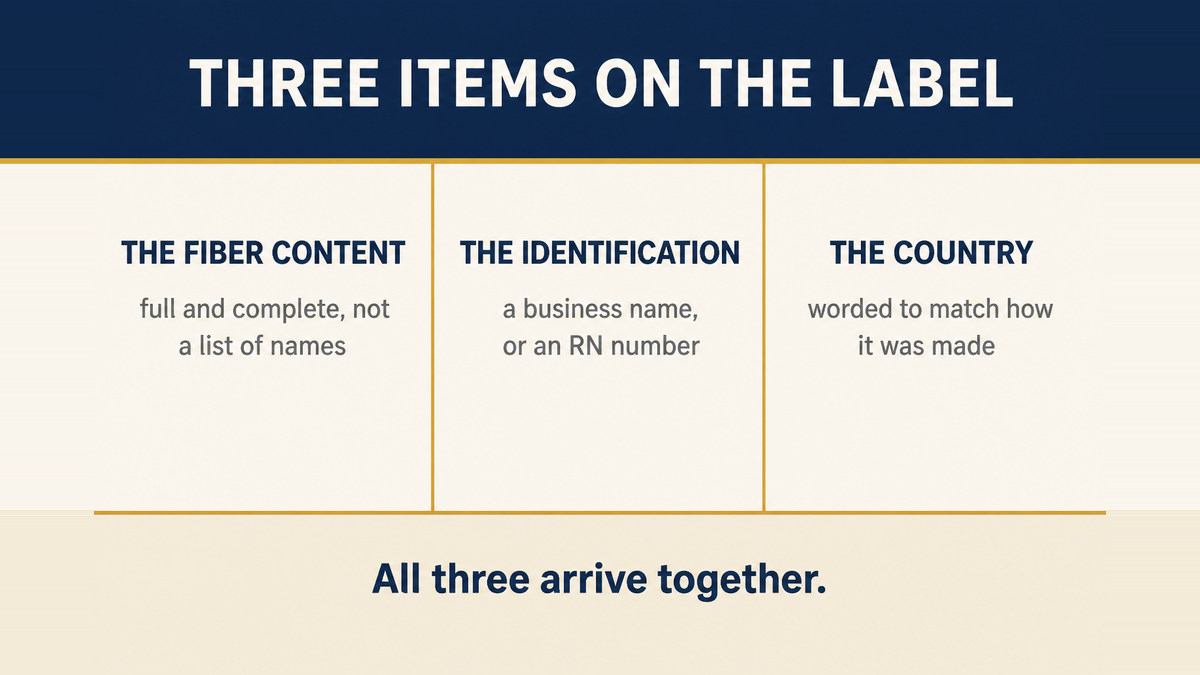
If the duty applies, it does not apply alone. Three items come with it, and the third is the one that most often goes wrong on a China-sourced order.
| Item | What the rule requires | Where it goes wrong |
|---|---|---|
| The fiber content | Full and complete, with fibers under 5 percent aggregated as other fiber or other fibers | A marketing list of every named fiber, which is not the required form |
| The identification | The name under which the business is done, or a registered house-mark word trademark, or an RN number | The factory’s name printed where the importer’s name belongs |
| The country | The country where the product was processed or manufactured, worded to match how it was actually made | One blanket origin line for a cover finished in a second country |
The identification rule is strict about what may be used. § 303.19(a) requires the name under which the person is doing business, or a word trademark used as a house mark and registered in the United States Patent Office, and it adds: “No trademark, trade names, or other names except those provided for above shall be used for required identification purposes.” A model name, a collection name or a trading style is not the required identification.
The alternative is the RN number, and this is the part to read carefully before the artwork is signed off. § 303.20(a) says registered numbers “will be issued by the Commission to qualified persons residing in the United States upon receipt of an application duly executed on the Commission’s Web site at rn.ftc.gov”, and § 303.20(b)(1) adds that they “shall be used only by the person or concern to whom they are issued, and such numbers are not transferable or assignable”. An overseas factory cannot hold one, and one brand’s number cannot be printed on another brand’s label. If the plan is to use an RN rather than a trading name, the number has to belong to the entity that qualifies for it.
Country wording is set out by how the product was actually made, and § 303.33 gives four cases with example wordings: an imported product carries the country where it was processed or manufactured; a product completely made in the United States from United States materials uses Made in U.S.A. or an equivalent clear term; a product made in the United States in whole or in part from imported materials discloses that, for example “Made in USA of imported fabric”; and a product partially manufactured in a foreign country and partially in the United States carries both, for example “Imported cloth, finished in USA” or “Sewn in USA of imported components”. A cover cut and sewn in one country and coated in another has more than one honest answer available, and the buyer is the one who has to pick.
9. Five Questions a Car Cover Quote Should Answer
A car cover quote usually carries a fabric name, a weight in grams per square metre, a coating, a colour, a size range and a price. None of those answers the question this article is about. These five do.
- What is the fiber composition, by percentage, in writing — even if you never print it? You need it if a claim ever goes on a carton, and you need it to decide whether a claim is safe to make.
- How much weight does the coating add to the base fabric, as a percentage of the pre-coating weight? This is the number that decides whether the cover has a coated-fabric exclusion, and it also tells you how breathable the surface really is.
- Which sentences about fiber will appear on the carton, the insert, the listing and any advertising? Collect them in one document. This is the item that decides whether the whole labelling rule applies at all.
- Who will hold the identification — an RN number or a business name — and is that entity resident in the United States? An RN cannot be lent, transferred or printed by a party in another country.
- What is the country of origin wording, and does it match how the cover was actually made? If cutting, sewing and coating happen in different places, one blanket origin line may be the wrong sentence.
10. Six Checks Before You Order
- The fiber composition sheet by percentage, on the supplier’s letterhead, from the mill rather than from the trading company.
- The coating weight as a percentage of the base cloth, measured on the production fabric rather than on a bench sample.
- A single collected list of every fiber claim in the channel — carton, hangtag, insert, listing title, bullet points, advertising. This is the check that decides whether the exclusion survives.
- The identification decision in writing: either the business name that will be printed, or an RN number with confirmation of the qualifying United States entity that holds it.
- The origin wording checked against the manufacturing route, including where the coating is done if that is not where the cover is sewn.
- The closure specified as parts, because on a parked vehicle the hem, the grommet and the strap are the only things between a cover and the ground — elastic tension, grommet size and material, strap length, buckle type. In every recall in this article the remedy was a restraint, and none of them changed the fabric.
Items one, two and six are the ones a factory audit can confirm on site, because each of them is a measurement rather than an opinion. Item three is the one a pre-shipment inspection should photograph, because a fiber claim lives on the carton and nobody checks the carton unless somebody is asked to. And because a car cover set is bulky rather than heavy, the freight on it turns on volume rather than weight — the same volumetric basis that decides most large, light textile accessories.
A pickup bed cover and a car cover share a word and very little else, and the two halves of this article follow that split. A pickup bed cover is a cover you drive with, and the federal record holds nine campaigns and 328,498 units of it in which the failure is always the same — the cover comes loose, leaves the vehicle and becomes a road hazard — and the remedy is always a tether, a strap or more hardware. A car cover is a cover you drive without, and the record holds nothing: car cover appears in zero of 245,845 records, care label in zero, and the words moisture, condensation and corrosion which a cover is sold against all belong to the vehicle’s own parts.
What reaches the product instead is a labelling law from 1958 whose covered products are an enumerated list, whose second paragraph excludes everything outside that list, and whose third paragraph undoes the exclusion the moment anybody makes a representation about fiber content. So the question to settle before the artwork is signed is not which fabric to buy. It is whether anyone in your channel is about to write a fiber claim, because that one sentence decides whether you owe a full fiber statement, a qualifying identification and a country wording.
Frequently Asked Questions
Does a car cover need a fiber content label?
Not by default. The federal textile labelling rules under 16 CFR Part 303 apply to an enumerated list of products, and a vehicle cover is not on that list. The same part states that all textile fiber products other than those identified in that list are excluded from its requirements. A couch cover is on the list and a car cover is not, which is the clearest way to see how the rule is drawn.
What makes a car cover fall under the textile labelling rule?
Any representation about fiber content. The same part that excludes products outside the list removes the exclusion if representations as to fiber content are made on a label or in any advertisement without a full and complete fiber content statement, or if a fiber content representation is false or misleading. A partial claim does not create a partial duty. Writing one fiber name on a carton converts a product that needed no statement into one that needs the complete one.
What is a coated fabric under 16 CFR 303?
It is defined by weight rather than by appearance: a fabric coated, filled, impregnated or laminated with a continuous-film-forming polymeric composition where the weight added to the base fabric is at least 35 percent of the weight of the fabric before coating. Coated fabrics, and the portions of products made from them, are separately excluded. The 35 percent figure is measurable — weigh the base cloth, weigh the coated cloth and divide.
Who can hold an RN number?
Only a qualified person residing in the United States. The part that governs registered identification numbers says numbers will be issued by the Commission to qualified persons residing in the United States on an application made through its website at rn.ftc.gov, and that a number may be used only by the person or concern to whom it is issued and is not transferable or assignable. An overseas factory cannot hold one, so if an RN is to appear on the label it must be the number of the entity that qualifies for it.
What country of origin wording is required?
It follows how the product was actually made. An imported textile fiber product carries the country where it was processed or manufactured. A product completely made in the United States from United States materials uses Made in U.S.A. or an equivalent clear term. A product made in the United States in whole or in part from imported materials discloses that, for example Made in USA of imported fabric. A product partly made abroad and partly in the United States carries both, for example Imported cloth, finished in USA, or Sewn in USA of imported components.
Are car covers in the federal recall file?
No. The phrase car cover appears in zero of 245,845 records, and car covers in zero. What the file does hold is the other kind of cover: nine campaigns and 328,498 units of tonneau and bed covers, all of which stay on a moving vehicle and all of which failed by detaching at speed and becoming a road hazard, with a tether, a strap or additional hardware as the remedy in every case. The phrase care label also appears zero times, so the file has no vocabulary for textile labelling at all.
Every Printed Claim, Mapped to a Clause
We return each sentence on your packaging beside the clause that permits it, and flag the two zeros the record holds for car covers.
Audit My Wording
Questions & Comments
We read every one and reply within 24 hoursA car cover is judged by its fabric claim and, in one state, by a label you can switch on. Send the material and the market, and we will name the test behind the claim and the identification line.