
LED Work Light Manufacturer: A Luminaire, Not a Lamp
 ·
Updated October 16, 2026
·
10 min read
Every other product in this series is judged by a vehicle safety standard. A work light is not. Take it out of the vehicle context and it is a portable luminaire — a lamp on a cord, or a lamp on a battery — and it is judged by the electrical safety standards for portable lighting. That is why the federal recall file, which holds 245,845 records, contains the phrase work light zero times, along with trouble light, drop light, flood light, shop light, area light and luminaire. The product is not missing from the file because nothing goes wrong with it. It is missing because it is regulated somewhere else.
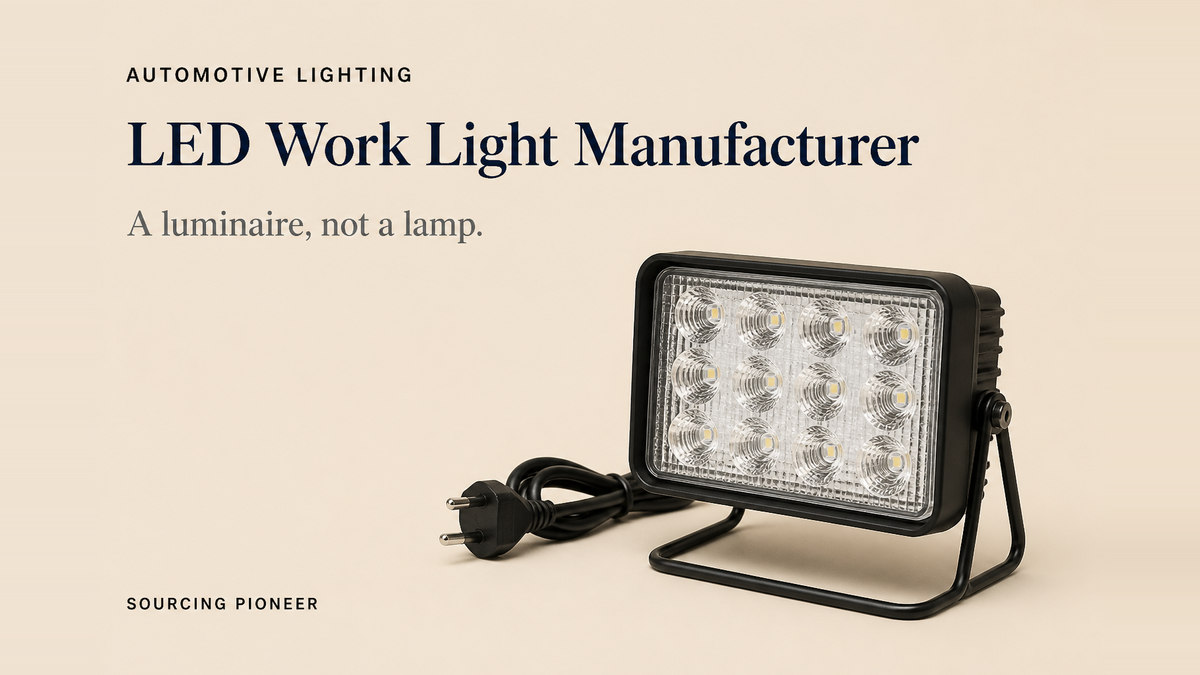
1. What a Work Light Is Made Of, and the Question That Decides Everything
Open a work light and the parts are countable: a housing, a lens or a diffuser, a board and a driver, a seal, a stand or a magnet, a cable or a battery, and a switch. In a cordless version there is also a charging port and a cell pack.
Almost none of those parts is what decides which standard the product is tested to. The deciding factor is a sentence about how the product is supplied, and it is worth reading before anything else in the project is settled.
| How it is supplied | What it is, in standards language | Which book that puts it in |
|---|---|---|
| On a flexible cord and a plug | A portable luminaire | The portable lighting standards |
| On a built-in battery, no cord | A portable luminaire operated while disconnected from a supply | The same book, and a newer section of it |
| Wirelessly, held in the hand | A handlamp, which is named separately | A different part of the international series |
| Fixed to a vehicle and fed from it | An auxiliary or cargo lamp | A vehicle safety standard, not a luminaire standard |
What this guide covers
- What a work light is made of
- The dividing line between two standards
- What the American standard covers today
- What changed in September 2022
- The battery inside a cordless work light
- Drop, water and the light itself
- The four risks a portable luminaire is assessed for
- What the record says: nothing
- What the record does contain
- The performance claim problem
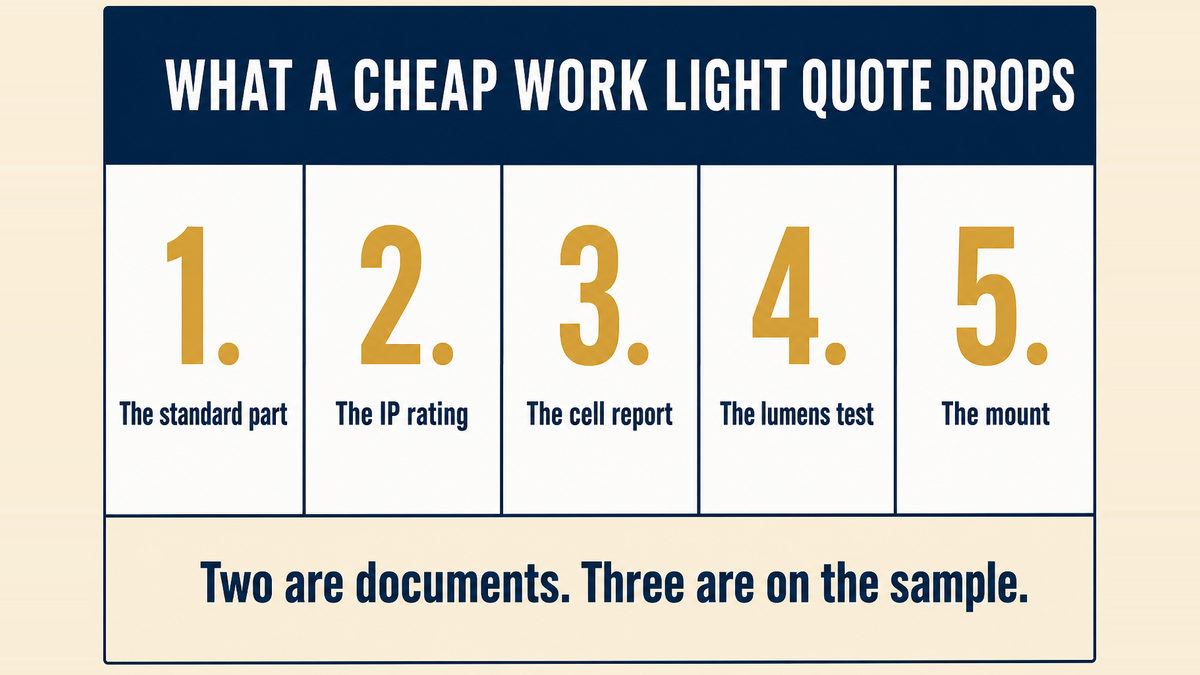
- Five questions a work light quote should answer
- Six checks before you order
- Frequently asked questions
2. The Dividing Line Between Two Standards
The international series for luminaires is IEC 60598, and it is written in parts. The general requirements sit in part 1. The particular requirements are split by product type, and two of those parts are the ones that matter here.
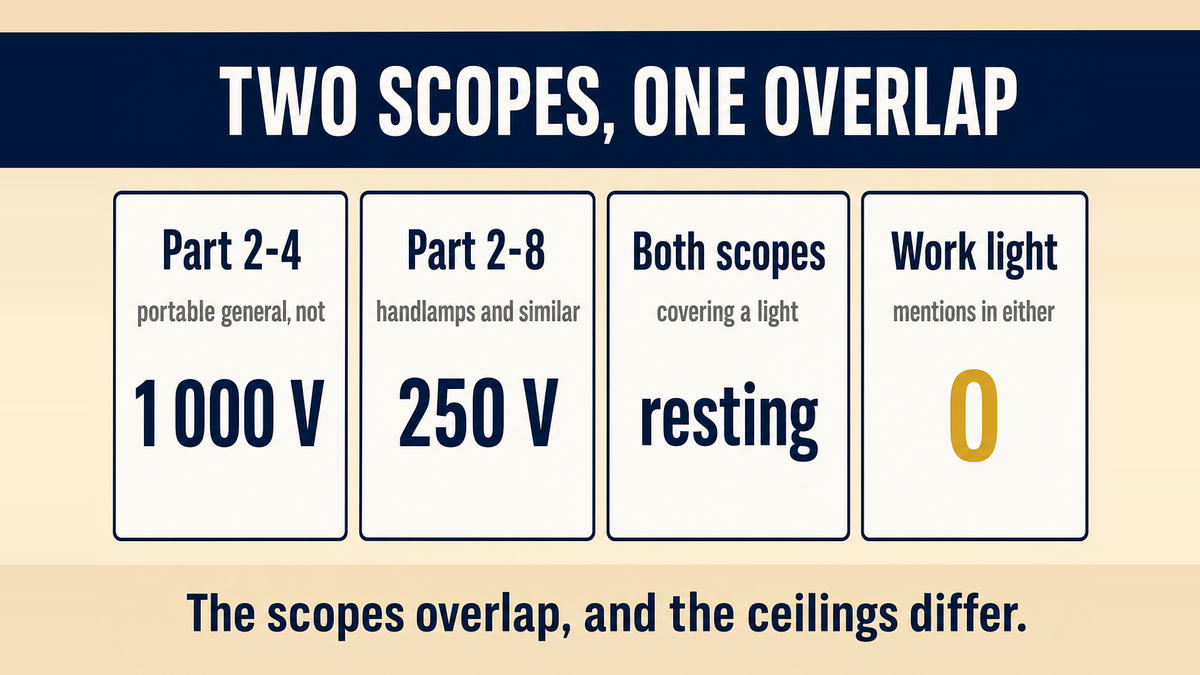
IEC 60598-2-4 is the part for portable luminaires. Its scope sentence names the products it covers and then removes one of them in the same breath:
“This part of IEC 60598 specifies requirements for portable general purpose luminaires for indoor and/or outdoor use (e.g. garden use), other than handlamps, for use with tungsten filament, tubular fluorescent and other discharge lamps on supply voltages not exceeding 1 000 V.”
Other than handlamps. So handlamps are somewhere else, and the part they are in says this about itself:
“This part of IEC 60598 specifies requirements for handlamps and similar portable luminaires which are held in the hand, hooked up or resting on a surface for use with electric light sources on supply voltages not exceeding 250 V. Handlamps which can be fixed to a support by means of a wing screw, clip or magnet, and luminaires intended for inspection of the interior of barrels, are within the scope of this part of IEC 60598.”
Read the two scopes side by side and the overlap is the story. The portable general purpose part excludes handlamps and runs to supply voltages of 1 000 V. The handlamp part covers handlamps and similar portable luminaires that are held in the hand, hooked up or resting on a surface, and runs only to 250 V. A work light on a folding base is, in plain English, resting on a surface.
That is not a contradiction in the standards; it is a border drawn in wording, and borders drawn in wording are settled by whichever document the laboratory opens. So the first thing to agree with a supplier is not which product you are buying but which part of the standard the test report is written against — in writing, before tooling. A product that can be argued into either scope can also be argued out of the one it was tested to, and that argument will happen at a border or in a customer’s complaint, not in a meeting.
Note what the handlamp part reaches as well. It names mounting by wing screw, clip or magnet, and it folds inspection lights for the inside of a barrel into the same family. A work light is exactly that kind of product: a lamp pointed into a space the user cannot see into. And the phrase work light appears in neither scope.
In North America the arrangement is different again. The relevant standard is UL 153, Portable Electric Luminaires, and UL’s own service description sets out the boundary by supply method rather than by shape: the key defining feature for a portable luminaire is the flexible cord and plug supply connection, which allows the product to be relocated easily. The same description lists what the standard is used for in this market — commercial and industrial applications such as construction area work lights, or shop lights and hand lights used in garages — and notes that most portable luminaires are evaluated either to UL 153 or to IEC 60598-1 together with the relevant part, so both routes are live for the same product.
Where the product is intended for mounting rather than standing, the pairing changes: IEC 60598-1 goes together with part 2-1 if the luminaire is surface mounted and with part 2-2 if it is recessed. A work light supplied with a bracket for permanent fitting has quietly moved folders.
3. What the American Standard Covers Today
UL 153 began as a standard for lamps that were operated while connected to a supply. Its scope has since been widened twice, and the second widening is the one that matters for the product most buyers are sourcing now.
The first widening produced UL 1576, Flashlights and Lanterns, published in 2018. It is written for flashlights with a removable and separately rechargeable battery pack, where the pack itself meets the requirements for battery-powered appliances. That is a professional-tool architecture: the pack can be taken out and charged on its own, the way a drill or a garden tool works.
That leaves out the product that actually sells in volume. As UL puts it, the flashlights readily available through online and local retailers typically have non-removable, USB-rechargeable batteries, and those were not within the scope of UL 1576. A cordless work light with a sealed, USB-charged cell pack is in the same position.
4. What Changed in September 2022
The gap was closed by a revision published on 26 September 2022, which added Supplement SA to UL 153. The change is stated plainly.
“Previously, UL 153 only covered portable luminaires intended to be operated while connected to an external power source. The new Supplement SA includes requirements for portable luminaires intended to be operated while disconnected from any external supply source, with power provided only from integral single-use or rechargeable batteries.”
Read that as a buyer and the consequence is immediate. A cordless, USB-rechargeable work light is not covered by the older flashlights-and-lanterns standard and is not covered by the older UL 153 either. It is covered by the newer supplement, which brings its own test programme:
- Requirements related to impact resistance, water ingress and photobiological hazards.
- A limit on the operating voltage, to prevent the risk of electric shock injury in wet environments.
- A limit on overall battery power, to reduce the risk of fire and high surface temperatures.
- A photobiological evaluation, because an intense beam can be pointed at the eyes at close range. The measure used is the Risk Group 0 limit.
That last item is the one most often missing from a supplier’s file, and it is the one a knowledgeable buyer can ask for by name. A cordless work light is a product designed to be pointed at things, sometimes by somebody lying underneath a vehicle with it in their hand. The photobiological question is not an abstraction.
5. The Battery Inside a Cordless Work Light
The supplement does not simply accept whatever cell the factory uses. It requires lithium battery cells to meet the relevant requirements of UL 1642, the standard for lithium batteries, or UL 62133-2, the standard for secondary cells and batteries. And it goes a step further than most product standards do: it verifies that the charge and discharge conditions offered by the product match the battery maker’s recommendations.
That sentence is the difference between a cell report and a product that is safe. A cell can be perfectly certified and still be abused by a charging circuit that pushes it harder than its maker allows. Asking a supplier for the cell report is not the same as asking what current the board charges it at, and the standard wants both. The reason the supplement reaches for it is worth stating in the supplier’s own language: lithium cells have a high energy density, which is why the risk of fire or explosion rises when a cell has a design or manufacturing defect.
The commercial reading is a two-document request. Ask for the cell report, and ask for the charge and discharge figures the board delivers, next to the cell maker’s recommended figures.
6. Drop, Water and the Light Itself
Three of the supplement’s areas have figures behind them that are worth knowing before a sample is built.
Drop. The supplement has a more demanding drop impact test than had historically been applied to portable luminaires, and the method aligns with the flashlight performance standard that the trade already recognises. The reason is mechanical: a drop can damage a lithium cell, so the test is a battery test wearing a mechanical costume.
Water. The water resistance test uses the IP codes and methods that the rest of the industry uses, again aligned with the same performance standard. So the ingress figure on the box is the figure the test used, which is not always true of products sold without certification.
Light. The photobiological evaluation answers the question of whether the beam can harm an eye, and the limit is Risk Group 0. That is a measured outcome rather than a design intention, so it cannot be answered from a datasheet for the emitter alone; it depends on the optic, the current and the distance.
7. The Four Risks a Portable Luminaire Is Assessed For
The same service description lists what the safety evaluation of a portable luminaire actually assesses, and the list is short enough to memorise. The first three are what a buyer would expect. The fourth is the one this series keeps meeting.
- Fire.
- Electric shock injury.
- Contact burns — which is about how hot the housing gets, not how hot the emitter gets.
- Mechanical injury due to mounting means failure or instability.
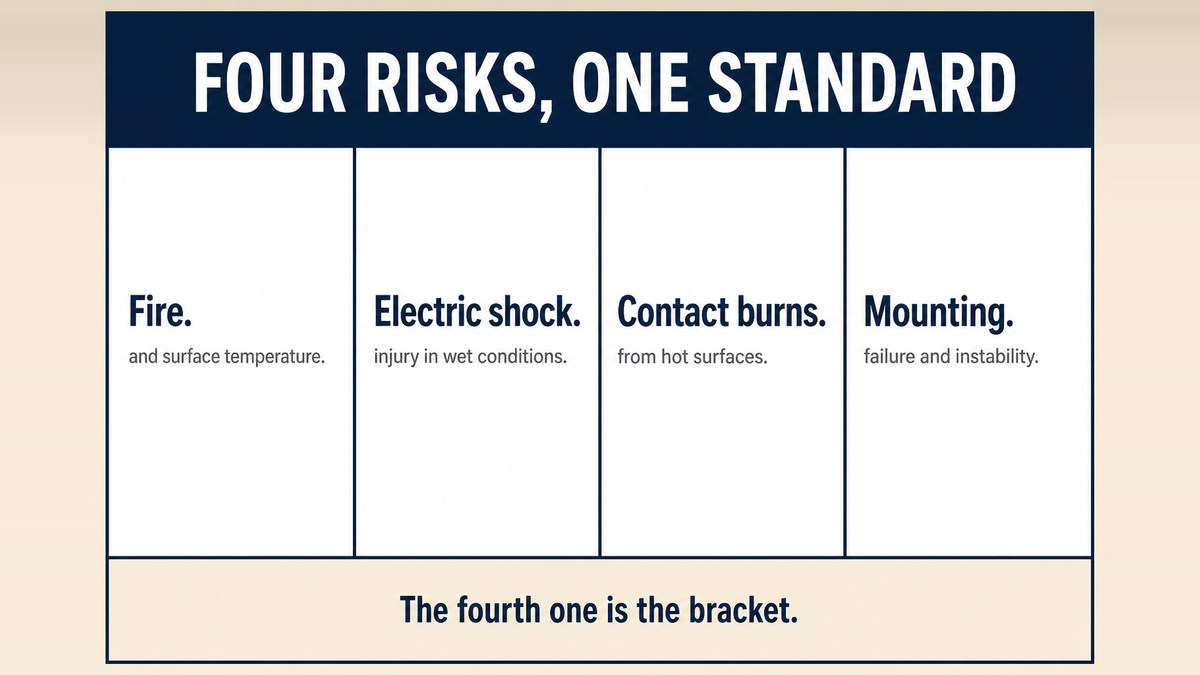
Instability and mounting failure are named as a safety risk in the standard that governs a lamp on a stand. That is the same failure mode that appeared three articles ago as a matter of fasteners on a cylinder head, and one article ago as a light bar attached to a windshield. A work light that tips over onto a hot exhaust, or falls off a bonnet onto somebody, is a product standard problem rather than a workshop accident, and it is the reason the base and the stand are part of the specification rather than accessories.
8. What the Record Says: Nothing
Method first. The federal recall file holds 245,845 records and no header row, so every field of every record is scanned rather than trusting a column map. Controls: brake appears in 28,639 records and air bag in 16,162. Every term below is matched on a word boundary, so that LED does not count the word failed.
The result is the shortest table in this series so far.
| Term the trade would use | Records | Campaigns |
|---|---|---|
work light | 0 | 0 |
worklight | 0 | 0 |
trouble light | 0 | 0 |
drop light | 0 | 0 |
flood light | 0 | 0 |
floodlight | 0 | 0 |
shop light | 0 | 0 |
area light | 0 | 0 |
luminaire | 0 | 0 |
hand lamp | 1 | 1 |
handlamp | 5 | 1 |
Nine of the eleven terms are absent from the whole file. The two that appear both belong to a single campaign: Nissan’s 20V556000, where the phrase is used to describe a lamp in the list of affected parts, filed under exterior lighting. That is one record twenty years of production could not fill.
Read that table as a conclusion rather than a gap. The federal recall file is built around parts that are on the vehicle and governed by a vehicle safety standard. A work light is not one of those parts. It is a lamp that a person carries or stands on the ground, and the standards that judge it are the electrical ones. A buying team that searches this file for its product and finds nothing has learned something correct, not something missing.
9. What the Record Does Contain
Two rows from the same scan are worth keeping, because they show how a count can be large and still empty of meaning.
| Term | Records | Campaigns | What it is actually counting |
|---|---|---|---|
LED | 1,674 | 136 | Vehicle lighting, indicator lamps and instrument displays |
mounting | 8,162 | 724 | Every bracket in every recall ever filed |
burn | 483 | 74 | Mostly burn injuries named as a consequence |
magnet | 35 | 9 | Magnetic switches and sensors, not magnetic bases |
photometric | 3 | 2 | Vehicle lamp aiming |
lumens | 0 | 0 | Nothing |
The mounting row is the control check that matters. Eight thousand records and 724 campaigns is about five per cent of every campaign in the file, and it means nothing at all, because every product with a fastener mentions mounting somewhere. Against that, magnet returns nine campaigns and every one of them is a magnetic switch or a sensor rather than a magnetic base.
So the honest summary of the survey is this. The file is rich in vehicle lighting and empty of portable lighting. The two products can look similar in a catalogue, can be made in the same factory, and are governed by documents that share no words.
10. The Performance Claim Problem
There is one place where the numbers on a work light box are checked, and it is not a safety standard. UL’s own description of the portable lighting market states the problem without softening it: the industry has seen widespread misrepresentation or exaggeration of lumens output on product packaging, which consumers rely on to guide their purchasing decisions, and poor performing products and false claims harm the retailers and resellers looking for benchmarks and transparency.
The response is a performance programme rather than a safety one. UL S 8001 tests portable lighting against the trade organisation’s performance standard, ANSI/PLATO FL-1, and the figures it certifies are the three a buyer actually sells on: brightness, beam distance and run time. Certified data is published in a searchable database, and products covered by either of the two flashlight and lantern safety standards are eligible.
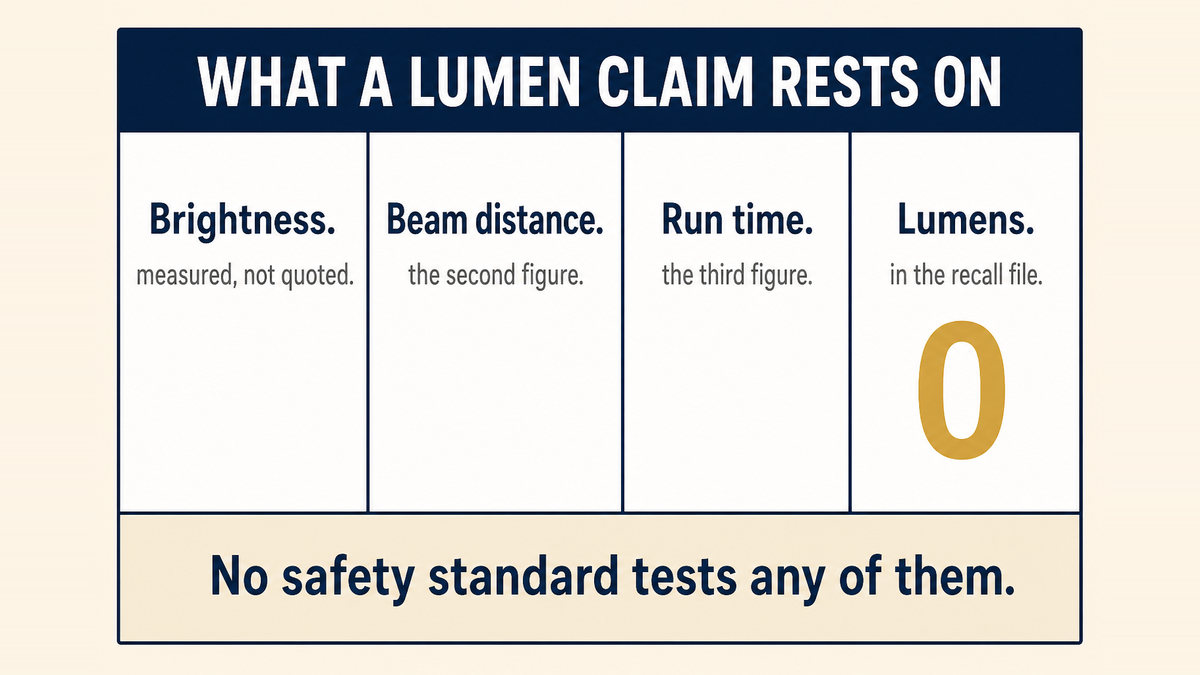
Put that beside the census and the split in this product becomes visible. The safety side asks about cells, charging, water, drop and stability. The performance side asks about brightness, distance and endurance. Lumens appears in none of the 245,845 recall records, and the three figures the customer compares are exactly the three that no safety standard measures. A buyer who negotiates only the safety file will ship a product that passes every test and disappoints on arrival; a buyer who negotiates only the lumen figure will ship a product that reads well on the box and has no test file behind it.
11. Five Questions a Work Light Quote Should Answer
A work light quote usually carries a wattage, a lumen figure, a battery capacity and a price. None of those four decides which document the product needs. These five do.
- Is it a handlamp or a portable luminaire? A product that stands on a base, hangs from a hook or clips to a surface belongs with the portable general purpose luminaires part; a product with a handle that is held belongs with the handlamps part. Two very similar products, two different documents, and the decision is made at the tooling stage.
- Is it corded, or battery-operated with an built-in cell? A corded unit is the classic portable luminaire. A cordless unit with a sealed, rechargeable pack is the case the 2022 supplement was written for, and it carries a different programme.
- Which cell is inside, and what current does the board actually charge it at? The supplement requires the cell to meet its own standard and, separately, the product’s charge and discharge conditions to match the cell maker’s recommendations. Those are two documents, not one.
- What is the IP rating, and on what method was it obtained? The supplement’s water test uses the recognised IP codes and methods, so the figure on the box should be traceable to a result rather than to a design intention.
- What is the lumen figure based on, and who measured it? Brightness, beam distance and run time are the three figures a customer compares, and they are the three that no safety standard covers.
12. Six Checks Before You Order
- The standard and the part, agreed in writing: the general luminaire requirements together with the correct particular part, or the North American standard, as applicable to the market you are selling into.
- The supply method and the cell arrangement, because a removable, separately rechargeable pack and a sealed, USB-rechargeable pack are handled differently.
- The cell report and the charging figures together, placed side by side with the cell maker’s recommendations.
- The drop and water results, with the method named. A pass without a method is a claim, not a result.
- The photobiological evaluation, if the product is handheld and its beam can be pointed at a person at close range. This is the item most often absent from a supplier’s file.
- The base, stand or magnet, with the stability and mounting test that goes with it. Mounting failure and instability are named as safety risks in the standard for this product, which is not something a work light catalogue ever says.
That list is what a factory audit turns into on-site questions and a pre-shipment check confirms from a photograph. On this product the audit matters more than usual, because almost none of the risk sits in the recall file. There is no list of past failures to learn from, so the document request is the due diligence.
Then there is the matter of the word, and on this product it is the whole problem. Your customer calls it a work light. The international standards call it a portable general purpose luminaire, or a handlamp, depending on whether there is a handle. The American standard calls it a portable electric luminaire and defines it by the fact that it has a cord and a plug. And the federal recall file, across a quarter of a million records, calls it nothing at all. Which of those names you quote against decides which documents you need, and the decision is made before the mould is cut.
Frequently Asked Questions
Does an LED work light need UL or IEC approval?
It needs to meet the standard for portable luminaires in whichever market you are selling into, and which part of that standard depends on how the product is held or supported. Internationally, the general luminaire requirements apply together with the particular part for portable general purpose luminaires, or the handlamps part if it is designed to be held. In North America the relevant standard is UL 153, Portable Electric Luminaires, and the determining feature there is whether the product has a flexible cord and plug supply connection.
What is the difference between a handlamp and a portable luminaire?
In the international luminaire series the two are separated by scope, and the portable general purpose part is written for products other than handlamps. That means a work light that stands on a folding base or hangs from a hook is covered by one part, and the same light with a handle intended to be carried is covered by another. It is a design decision rather than a testing decision, which is why it is worth settling before tooling.
Does a cordless work light need a different test from a corded one?
Yes, since September 2022. The American standard for portable electric luminaires originally covered only luminaires intended to be operated while connected to an external power source. A supplement published on 26 September 2022 added requirements for portable luminaires intended to be operated while disconnected from any external supply, with power coming only from built-in single-use or rechargeable batteries. That covers the sealed, USB-rechargeable pack that the earlier flashlight and lantern standard did not reach.
What is Supplement SA?
It is the addition to UL 153 that brought battery-operated portable luminaires into the standard. It adds requirements for impact resistance, water ingress and photobiological hazards, limits the operating voltage to reduce electric shock risk in wet environments, limits overall battery power to reduce fire and high surface temperature risk, and requires a photobiological evaluation against the Risk Group 0 limit. It also requires lithium cells to meet their own battery standard and the product’s charge and discharge conditions to match the cell maker’s recommendations.
Why is there nothing about work lights in the recall file?
Because the recall file is built around components on the vehicle that a vehicle safety standard governs. A work light is a lamp a person carries or stands on the ground, so it is judged by the electrical safety standards for portable lighting rather than by a vehicle standard. Searching 245,845 records for the words work light, trouble light, drop light, flood light, shop light, area light or luminaire returns nothing at all. A buyer who finds nothing there has found the right answer, not a missing dataset.
Do lumen claims get tested?
Not by a safety standard. The safety evaluation of a portable luminaire covers fire, electric shock, contact burns and mechanical injury from mounting failure or instability. Brightness is a performance figure, and it is checked by a performance programme rather than a safety one. That matters because the industry has a documented problem with overstated lumen figures on packaging, which is what the performance programme exists to address. It certifies three figures: brightness, beam distance and run time.
A work light never enters the vehicle safety system, and the reason is structural rather than accidental. It is a luminaire, and luminaires are judged by electrical safety standards that ask about cells, charging, water, drop, heat and stability.
The consequence for a buyer is that the usual shortcut disappears: there is no recall history to read, so the specification has to be assembled from documents instead of from other people’s mistakes. Ask whether it is a handlamp or a portable luminaire, ask whether the cell pack is built-in, ask for the cell report beside the charging figures, ask how the IP rating was obtained, and ask who measured the lumens.
Luminaire or Lamp: Where Your Unit Lands
We return the classification, the tests that follow from it, the 2022 change that moved the line, and the photobiological check.
Split My Standard
Questions & Comments
We read every one and reply within 24 hoursAn LED work light is a luminaire, so the electrical file matters more than the vehicle file. Send the model and the market, and we will check ingress rating, driver isolation and the cord type.