
Dropshipping Business Plan: The Three Numbers Every Plan Has to Answer
 ·
Updated October 14, 2026
·
14 min read
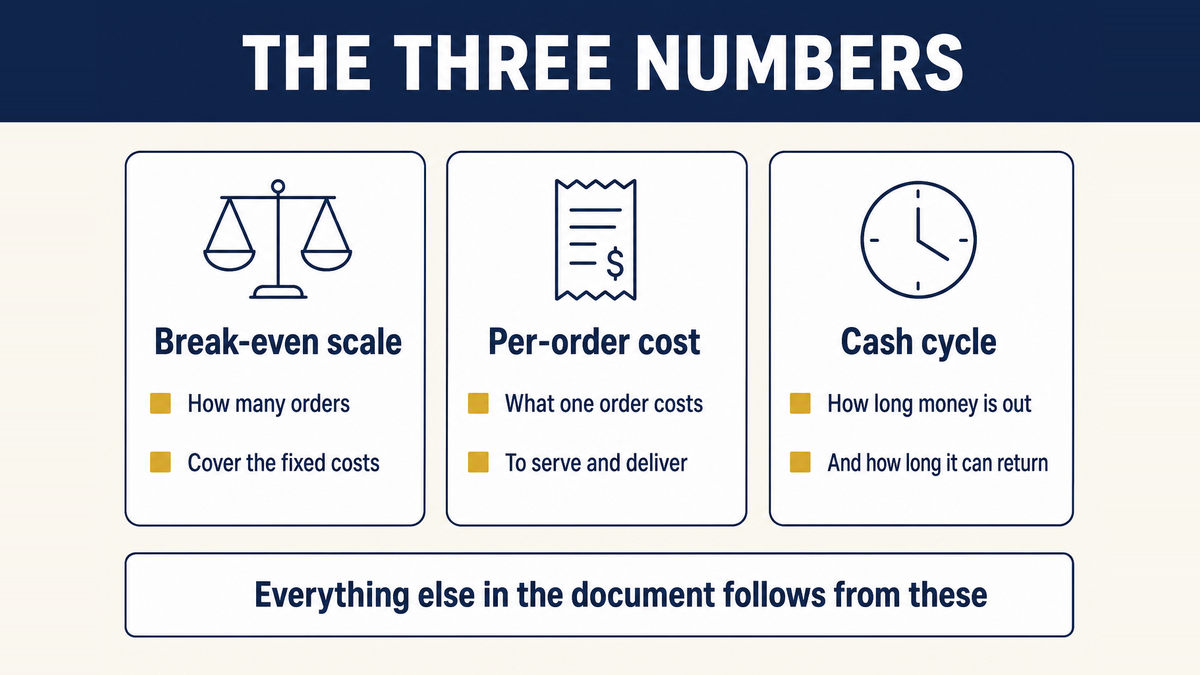
A dropshipping business plan is usually written as a description of a business: what it will sell, where the goods come from, and how the marketing will work. That is a description, not a plan. A plan is judged by the questions it can answer with a number, and three of those decide every other figure in the document. They are the scale at which the store pays for itself, what one more order costs to serve, and how long money stays out of the account before it comes back. Get those three right and the rest is arithmetic. Get them wrong and the narrative tends to get longer to compensate.
1. Why Most Plans Are Written in the Wrong Order
The usual order runs market, then product, then marketing, then a set of projections produced at the end to fit what the first three decided. For a store that holds no stock, that order is backwards. The constraint in this model is not demand and it is not supply, because both can be had on demand. The constraint is the arithmetic between them.
A plan for this kind of store has an unusual property: very little in it needs capital to test. A product page can be built in an afternoon and a first parcel ordered the same evening. So the document is not really there to unlock investment, and treating it as one produces the wrong content. What it does is fix the three figures below which the store is losing money quietly, and the whole value of writing them down is that they can be checked against what the business actually does in its first month.
There is a second reason the order matters. In a business that buys before it sells, a bad judgement shows up as unsold stock sitting in a room. In this one, the same bad judgement shows up as a growing order book and a shrinking bank balance, which is far harder to read because both look like progress. The three numbers are the instrument panel that makes the difference visible.
| The number | The question it answers | What it sets |
|---|---|---|
| Break-even scale | How many orders cover the costs that do not move | Whether the month is funded by customers or by the owner |
| Per-order variable cost | What one more delivered order costs to serve | The contribution every order has to beat |
| The cash cycle | How long money is away, and how long it can come back | How much has to sit in the account unused |
What this guide covers
2. The First Number: Break-Even Scale
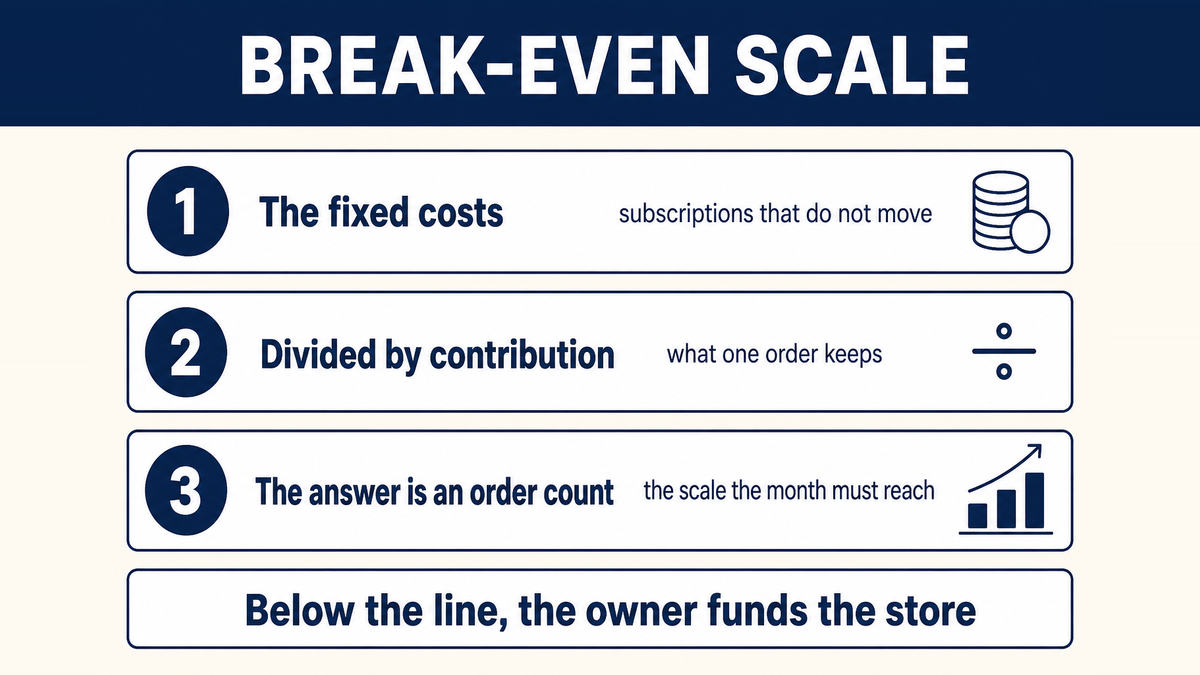
Break-even scale is the number of orders the store has to serve in a period before it has covered the costs that do not change when an order arrives. Those are the store subscription, the domain, the apps, any design work spread across the year, and the fixed part of any advertising arrangement. None of them goes up when the hundredth order comes in. All of them have to be paid before the first order contributes anything.
The arithmetic is therefore a division, and the useful part is the bottom of it. Contribution per order is what is left from a typical order after everything that varies with serving it: the unit cost, the outbound freight, the fee taken on the payment, and an allowance for the orders that come back. That calculation is set out in how a margin is actually built, and the whole plan turns on it.
Two properties of this figure are worth stating, because they change how a plan should be read. It is not a target and it is not a forecast. It is the level at which the fixed costs stop being a leak and start being covered. Below it, every additional order still improves the position; it simply has not reached the line yet. A store three orders short of break-even is not failing, and a store sitting exactly at break-even is not finished either. It has reached the point where growth stops being paid for by the store's own losses, which is a different achievement from being profitable.
The second property is that the figure moves whenever the fixed cost moves, and in this business the fixed costs are unusually easy to inflate. A subscription that adds a feature is a small monthly amount and it raises the line for every month after it. A plan that lists the subscriptions without ever dividing by contribution is a list of commitments rather than a break-even.
A single store can also have more than one break-even, and a plan should say which one it means. Where the catalogue earns a different contribution on different items, the order count that covers the fixed costs depends on the mix that actually sells rather than the mix that was planned. A store that clears the line on its expensive items and misses it on its cheap ones is not at break-even; it is at the point where an average is doing the work of hiding a line that loses money. The correction is to record the contribution for each product line and check the order count per line, which takes an extra column and removes the one number in the plan most likely to be read as good news when it is not.
3. The Second Number: What Actually Varies With Each Order
The per-order variable cost is the figure most often understated, and it is understated for a structural reason: the two largest parts of it are not on any invoice at the moment the order is placed. Outbound freight is the first. A small parcel is charged partly by the space it takes rather than by its weight once it passes a published size, so the input is the packed dimensions and not the product weight a supplier quotes. How that charge is built is set out in how volume decides what a parcel is charged.
The second missing part is the return allowance. It is not a cost that appears on the order that gets sent back. It is a cost per delivered order, spread across all of them, so it has to be carried by every order including the ones that stay. The rate to plan for and what can be cut from it are covered in what a return actually costs.
The third part is the fee taken on the payment, and its behaviour deserves its own paragraph because it changes the shape of the plan. A card fee is normally a percentage plus a small fixed amount. The percentage scales with the price, so it looks harmless at any order value. The fixed amount scales with nothing at all, and on a cheap order it can take a share of the contribution that is out of all proportion to the sale. That is the arithmetic reason a store built on many inexpensive items reaches break-even at a far higher order count than a store built on fewer expensive ones, and it is the single most useful thing a plan can say about which products to list.
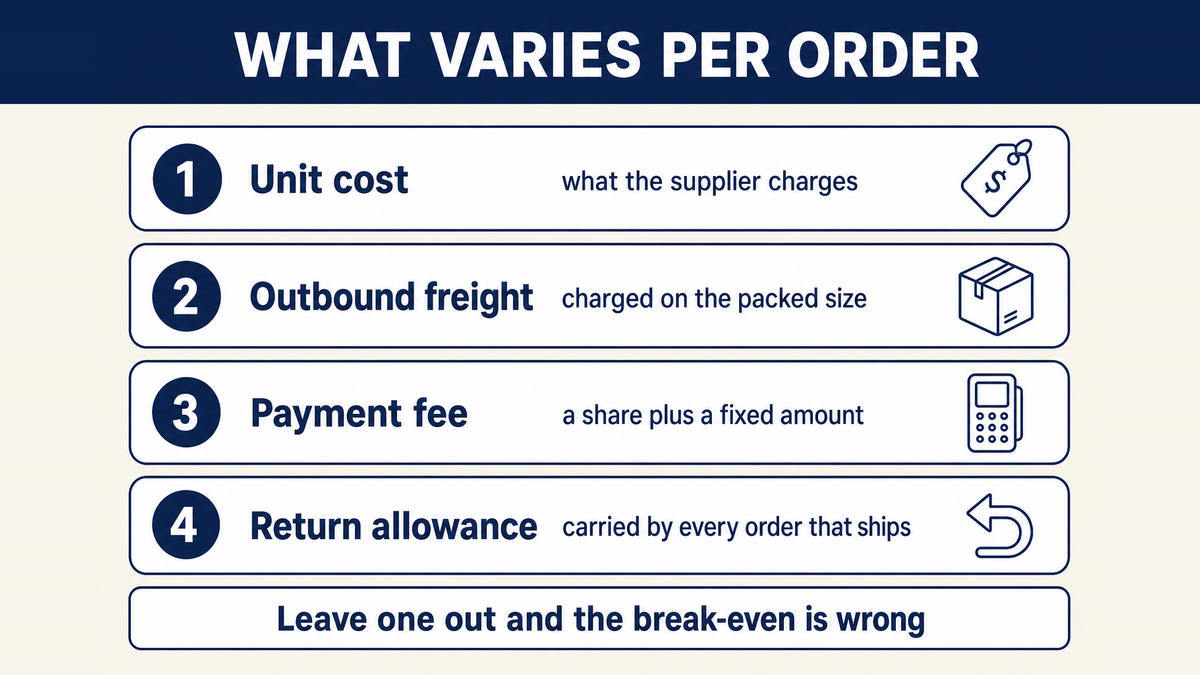
Write the four parts as a line each and the per-order figure is their sum. Leave any one of them out and the break-even number from the previous section is wrong by the same amount, which is why the two sections are one calculation rather than two.
- Unit cost
- What the supplier charges, including any per-order handling or packing charge that appears on the invoice
- Outbound freight
- Charged on the packed dimensions once the parcel passes the size at which space decides the price
- Payment fee
- A percentage plus a fixed amount; the fixed part does the damage on low-value orders
- Return allowance
- A cost per delivered order rather than per returned order, carried by every order that ships
4. The Third Number: The Cash Cycle
The cash cycle is how long money is away from the account. In a store that holds stock, that period starts when the inventory is paid for. In this model it starts later and it has a sharper end, because money can come back out after an order is complete, and the window for that is longer than most plans assume.
The route for a buyer who says an order never arrived runs through the card issuer as a billing error claim, and the statute settles both the size of the window and the standard applied inside it. One provision is worth reading closely, because it decides what the store has to be able to show.
In the case of a billing error where the obligor alleges that the creditor’s billing statement reflects goods not delivered to the obligor or his designee in accordance with the agreement made at the time of the transaction, a creditor may not construe such amount to be correctly shown unless he determines that such goods were actually delivered, mailed, or otherwise sent to the obligor and provides the obligor with a statement of such determination.
Fair Credit Billing Act, 15 U.S.C. 1666, Correction of billing errors (read 14 October 2026)
The second half of that sentence is the part that matters here. On a claim that goods never arrived, the amount cannot be treated as correctly billed until the creditor determines that the goods were actually sent. That makes the store’s own delivery record the document that closes the claim, and it means a plan that treats delivery confirmation as a customer-service nicety rather than as the evidence ending a dispute has the cash cycle wrong. The window itself is fixed in the rule that implements the section.
A billing error notice is a written notice from a consumer that: (1) Is received by a creditor at the address disclosed under § 1026.7(a)(9) or (b)(9), as applicable, no later than 60 days after the creditor transmitted the first periodic statement that reflects the alleged billing error…
Consumer Financial Protection Bureau, 12 CFR 1026.13(b), Billing error resolution (read 14 October 2026)
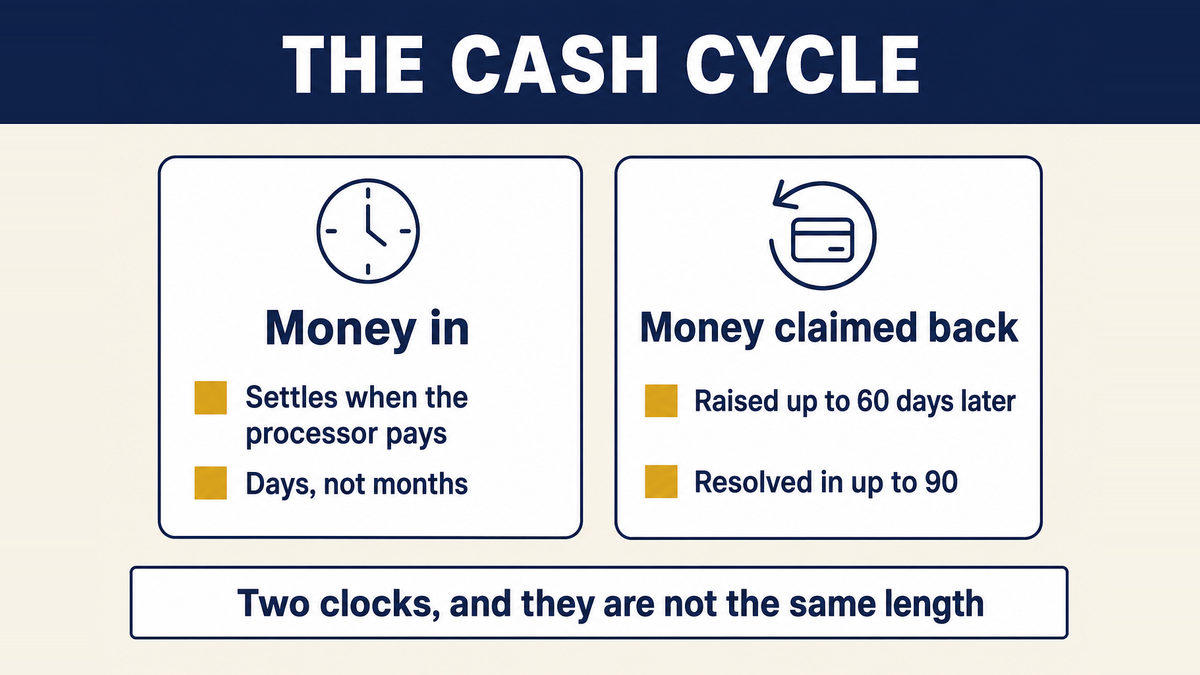
Read that beside the deadline the statute gives the creditor to resolve the claim — up to two complete billing cycles, and in no event more than ninety days — and the asymmetry most plans miss becomes visible. The money arrives when the processor settles, which is short. The money can be claimed back for sixty days after the statement, and the claim can then sit unresolved for up to ninety days, which is long. A plan that assumes an order is settled once the parcel is delivered is planning against a shorter version of the cycle than the one that exists.
The outbound side is fixed too, and it is fixed in days rather than in billing cycles.
… a refund sent by any means at least as fast and reliable as first class mail within seven (7) working days of the date on which the buyer’s right to refund vests under the provisions of this part.
Federal Trade Commission, 16 CFR 435.1, Mail, Internet, or Telephone Order Merchandise Rule (read 14 October 2026)
The two clocks run in opposite directions and they are not the same length. A refund has to be sent within seven working days of the point at which the buyer’s right to it begins, while a claim can be raised sixty days after the statement and take up to ninety days to settle. That is how a store can look profitable on paper and still be short of cash in practice, and it is why the cash figure belongs in the plan as a working-capital requirement rather than as a footnote.
What the plan should therefore state is a range rather than one number: the ordinary days from order to settled funds, and the outer limit of days before a claim can no longer be raised. The gap between the two is the amount that has to be able to sit in the account untouched, and the direction the money travels afterwards is covered in paying Chinese suppliers.
The point the sixty days are measured from deserves a second look, because it is not the date of the order. The window runs from the first statement that shows the charge, so the exposure on an item that ships slowly is longer than the exposure on one that ships quickly at the same order value. A product with a three-week lead time adds three weeks to the front of a window that already runs for two months, which is why lead time belongs in the cash section of the plan rather than in the fulfilment section. A store with two lead times effectively has two cash requirements, and the one to fund is the slower.
5. How the Three Numbers Hold Each Other Up
The three are usually written as separate sections of a plan, and they are really one calculation with three outputs. Contribution per order is the bottom of the break-even division. The per-order figure and the fixed cost together set the scale. And the scale sets the cash requirement, because the money that has to be available at any moment is the per-order cost multiplied by the number of orders in flight, plus whatever is exposed to the longest open window.
An illustration makes the link concrete. Take a store with fixed costs of 400 a month and a contribution of 6 per order. The break-even is about 67 orders a month. If an order takes a fortnight from placement to settled funds and a further sixty days remain open to a claim, then at 67 orders a month the store is carrying a little over two months of variable cost at any one time. Those figures are round numbers chosen to show the shape of the arithmetic rather than a benchmark to plan against, and what matters about them is the direction: the cash requirement is set by the scale, not by the owner’s appetite.
That is also why the three cannot be improved independently. Raising the price improves contribution and lowers the break-even order count, and it may lower the conversion rate enough to make the new count unreachable. Cutting the fixed costs lowers the break-even without touching the cash cycle. Adding an expensive item to the catalogue raises contribution per order and raises the amount tied up per order at the same time. A plan that changes one figure without showing what happens to the other two is not a plan yet, it is a wish.
There is one more connection worth writing down, because it decides when the store can start buying in bulk. The scale at which the store is comfortably past break-even is the scale at which a wholesale order can be funded from trading rather than from savings. The route from a dropshipped catalogue into buying stock is set out in moving from dropshipping to wholesale, and the trigger for it is the number in this section rather than a date on a calendar.
6. What a Plan Cannot Promise
A plan that answers the three questions is still not a forecast, and the honest version of the document says so. Three things in this model cannot be known when the plan is written, and pretending otherwise is what makes a plan useless the first time reality disagrees with it.
The first is the return rate, which is a property of the product and the buyer rather than of the plan. The correct treatment is to plan a range and to treat the upper end as the number that stops the store, then check it against the real rate after a few hundred orders. The second is the dispute rate, which behaves the same way and is the reason the cash figure is stated as a range. The third is conversion, which is the figure most plans state with the most confidence and the least evidence.
A plan that gives one number for each of the three questions and no range is not more precise than a plan that gives ranges. It has simply moved the uncertainty somewhere the document does not show, and the place it moves to is the owner’s bank account.
What the document can do is state the conditions under which it stops being valid. A return rate above the planned upper bound, a dispute rate that keeps money open longer than the range allows, or a fixed-cost subscription that raises the break-even without raising contribution are all events the plan can name in advance. Naming them turns the plan from a description of a hoped-for month into a set of triggers, and a trigger is the only part of a plan that does anything on the day it is crossed.
What makes a trigger work is the cadence rather than the wording. A plan reviewed once a year is a document. A plan whose three figures are re-derived every month from the store’s own order data is a control, and the arithmetic is short enough to run by hand in a few minutes. Re-running it on real orders is also the only way the ranges stop being estimates, because after the first few hundred orders the return rate and the dispute rate are no longer guesses — they are measurements, and the plan can be rewritten around them instead of the other way round.
7. Frequently Asked Questions
How long should a dropshipping business plan be?
Long enough to show the three numbers and the arithmetic behind them, and no longer. The useful content is the fixed cost list, the four parts of the per-order cost, the break-even division and the two ends of the cash range. Everything a reader might add about mission and market size can be removed without weakening the document, because none of it changes a figure.
What is a realistic break-even for a new store?
There is no number that applies to every store, because it is the fixed costs divided by the contribution per order and both of those move with the product mix. The two levers are the monthly fixed cost and the contribution on a typical order. A store with few subscriptions and a higher-value product reaches the line at a much lower order count than one built on many cheap items, where the fixed part of the payment fee eats into every order.
How much money do I need to keep in the account?
Enough to cover the per-order variable cost for every order in flight, plus whatever is exposed to the longest open dispute window. That window is longer than most sellers expect: a buyer can raise a billing error claim up to sixty days after the statement, and the claim can stay unresolved for up to ninety days after that. The refund clock runs the other way, in working days rather than billing cycles.
Should I include marketing in the per-order cost?
Yes, if the spend scales with orders, because anything that rises when an order arrives belongs in the per-order figure. The part that does not scale, such as a monthly retainer or a subscription with a fixed fee, belongs in the fixed costs instead. Splitting the spend along that line rather than by channel is what keeps the break-even count honest.
Do I need a business plan to start dropshipping?
You do not need a document to open a store, and you do need the three numbers, because they are the only tool that tells you whether a growing order book is funding the business or draining it. Writing them down takes an hour and gives you something to check against your first month of real orders, which is where the estimates either hold or fail.
The Days Between Paying and Being Paid
We return the cash cycle in days, the working capital it demands at your volume, and the cost that varies with every order shipped.
Chart My Cash Cycle
Questions & Comments
We read every one and reply within 24 hoursWorking out the break-even order count for a store you are planning, unsure how much has to sit in the account while orders are in flight, or trying to price a parcel on its packed dimensions rather than its weight? Send us the products you are planning to list, and our team will show you what one delivered order really costs to serve and what the rest of your plan divides by.