
Affiliate Marketing vs Dropshipping: Who Carries the Order and Who Keeps the Customer
 ·
Updated October 14, 2026
·
14 min read
Affiliate marketing and dropshipping are compared because they share one property: neither asks you to buy stock before you sell. That is where the similarity ends, and most comparisons stop there too. The difference that decides everything else is a role rather than a cost, and it decides who owes the buyer a parcel, who owes the buyer a refund, who has to admit they are being paid, and who the customer actually belongs to. This guide takes that one line and follows it through both models.

1. The Line That Decides Everything: Who Is the Seller
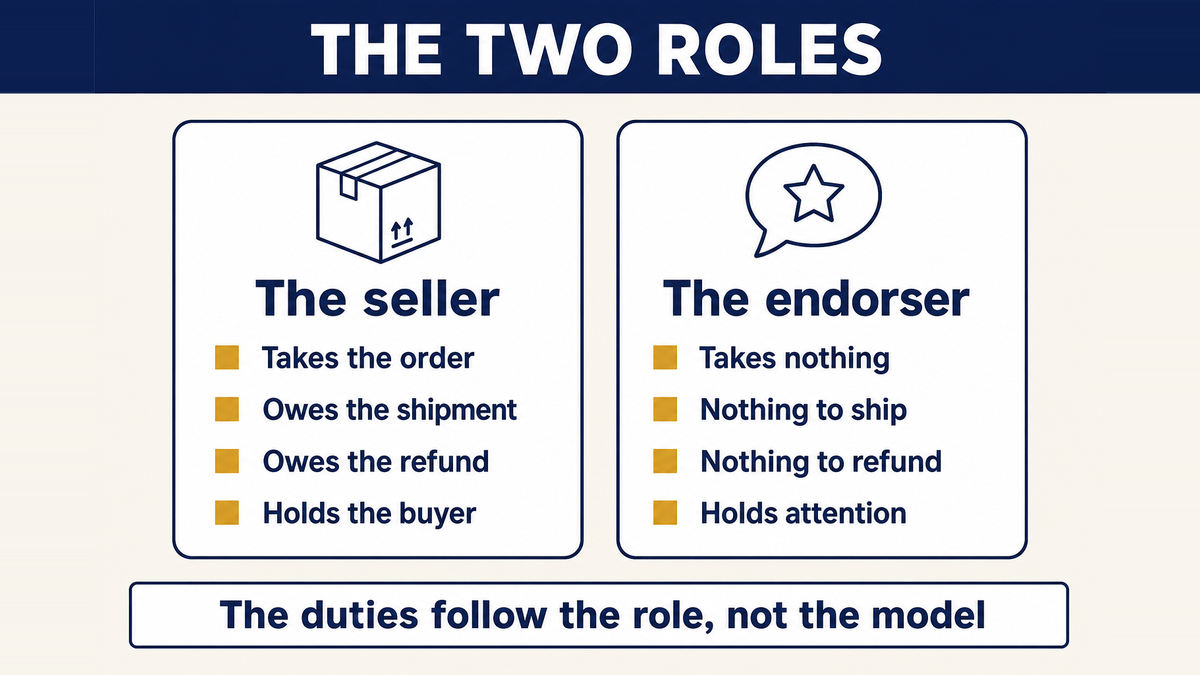
In a dropshipping store you are the seller. In affiliate marketing you are the endorser. That sounds like a label rather than a difference, and it is the most expensive thing to get wrong in either model, because the duties in this business attach to roles rather than to activities. A rule written for a seller does not reach the person who merely recommends, and a rule written for an endorser does not reach the person who takes the order.
When the two models are laid side by side as two ways to make money, the roles disappear into the comparison and the duties go with them. The duties are the part that decides who pays when an order goes wrong, so the comparison is worth rebuilding from the rulebooks rather than from the business models.
The cleanest way to see the split is to read what each rulebook is addressed to. The rule governing orders placed over the internet is written for a seller, and it is triggered by the act of soliciting the order rather than by owning the goods.
In connection with the sale, offering for sale, or distribution of goods and merchandise in or affecting commerce… it constitutes an unfair method of competition, and an unfair or deceptive act or practice for a seller: (a)(1) To solicit any order for the sale of merchandise to be ordered by the buyer through the mail, via the Internet, or by telephone unless, at the time of the solicitation, the seller has a reasonable basis to expect that it will be able to ship any ordered merchandise to the buyer: (i) Within that time clearly and conspicuously stated in any such solicitation; or (ii) If no time is clearly and conspicuously stated, within thirty (30) days after receipt of a properly completed order from the buyer.
Federal Trade Commission, 16 CFR 435.2, Mail, Internet, or Telephone Order Merchandise Rule (read 14 October 2026)
Two details in that wording carry the whole model. The rule is addressed to a seller, and it is triggered by soliciting an order rather than by holding stock. A dropshipper who never touches the parcel still solicits the order, so the duty follows the solicitation rather than the warehouse, and a store that sells before it buys is squarely inside a rule written for the party that took the money.
| Question | The seller | The endorser |
|---|---|---|
| Takes the order | Yes, and holds the payment | No, and holds nothing |
| Owes the shipment | Yes, against a stated or default time | Nothing to ship |
| Owes the refund | Yes, on the same order | Nothing to refund |
| Must disclose a payment | Not applicable | Yes, and clearly |
| Holds the buyer | The buyer is the customer | Holds attention, not the customer |
What this guide covers
Both rulebooks stand on the same statutory footing, which is why the split is a deliberate one rather than an accident of drafting. The provision that lets the Commission write rules of this kind covers rules that name specific acts or practices as unlawful in commerce (see 15 U.S.C. 57a on the Commission's rulemaking authority). One authority, two rulebooks, and each one bound to a different party in the same transaction.
That is also why the two models are not two versions of one business. A dropshipper's income is the difference between what the buyer pays and what the whole chain costs, which means every cost the chain adds is the dropshipper's problem. An affiliate's income is a share of somebody else's sale, paid by the merchant, which means the chain's costs are somebody else's problem. In one model the buyer is the customer. In the other the buyer is the merchant's customer and the affiliate's audience, and those two things behave differently when something goes wrong.
2. Who Bears the Return
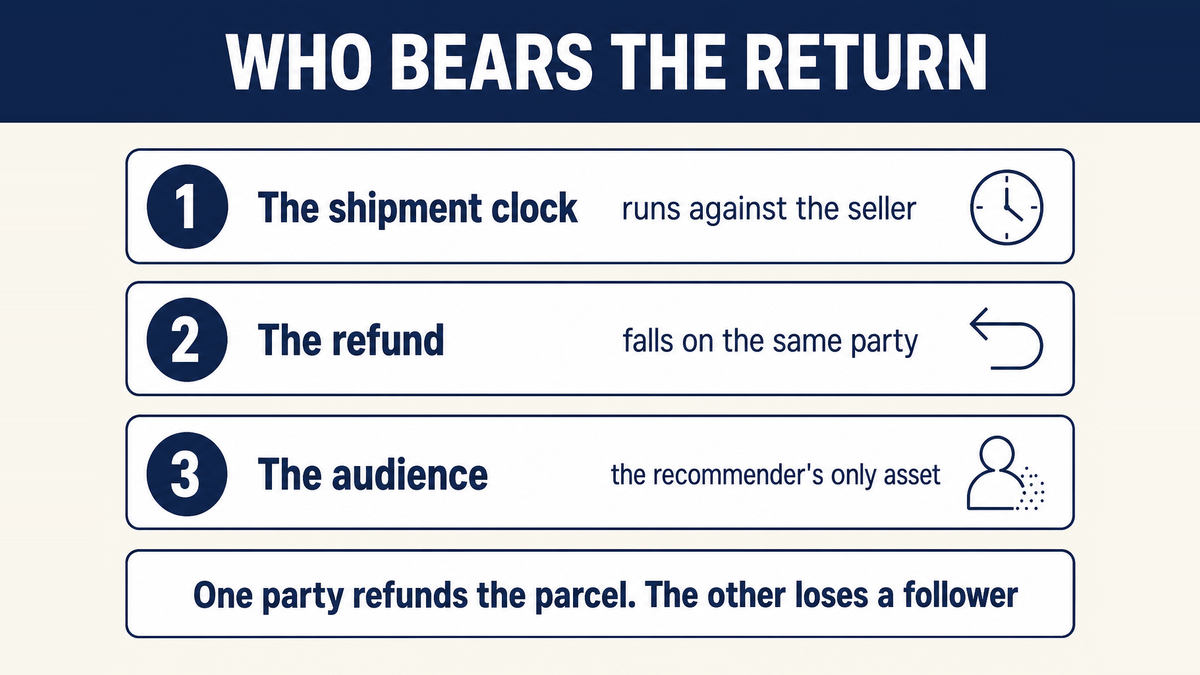
A return is a performance obligation before it is a cost line, and that distinction is what makes it the clearest test of the split. The affiliate never undertook to deliver anything, so there is nothing for a buyer to send back to them and no clock for them to miss. The dropshipper is in the opposite position, and the obligation begins earlier than most sellers expect.
The rule quoted above puts the seller under a duty at the moment of solicitation: the seller must have a reasonable basis to expect that it can ship within the time it stated, or within thirty days where it stated no time at all. Two features of that are worth holding on to. The duty is judged at the point of sale rather than after the complaint, so a seller who takes orders it cannot service has broken the rule before the first unhappy email arrives. And the failure is the prohibited practice itself rather than something a penalty is applied to afterwards, which is why accepting orders during a stock-out or a supplier shutdown is not a gamble on being caught but a different kind of mistake entirely.
Once the order has gone wrong, the refund duty lands on the same party that took the payment. The mechanism is set out in the same part of the rulebook and it is covered in full in what a return actually costs. For the comparison in this article the important point is narrower: the refund and the shipment duty are both addressed to the seller, so neither one can be passed to a recommender by agreement, and neither one can be avoided by holding no stock.
There is a second return cost that belongs in this section because it is usually filed under customer service instead. A returned parcel is charged for the journey in both directions, and the outbound charge on a small parcel is often the larger of the two once the parcel passes the size at which the carrier stops charging for weight and starts charging for space. How that line works and where it falls is set out in how volume decides what a parcel is charged, and it is a cost the seller carries on an order that has already been refunded.
The affiliate's exposure to returns is real but shaped differently, and the shape matters more than the size. An affiliate will not pay a refund and will not pay the return postage. What they have put at risk is the recommendation itself, because an audience that follows a link into a merchant that mishandles an order does not blame the merchant, it stops following the link. That produces a pattern worth knowing before either model is chosen: the seller's exposure is spread across every order and arrives within days, and the recommender's exposure is concentrated in the only asset the model has and arrives slowly, which makes it easy to underestimate while it is still growing.
3. Who Holds the Customer Relationship
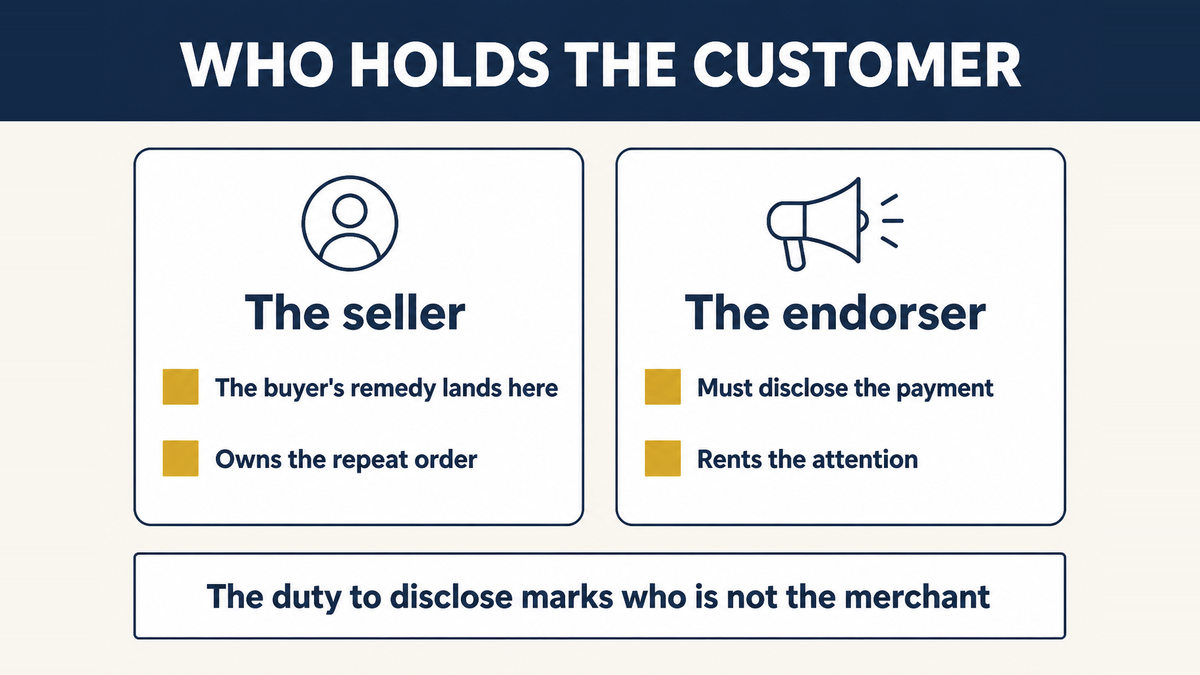
The customer relationship is the asset that never appears on a balance sheet, and the way to identify who holds it is to look for who is obliged to admit something. Only one of the two roles has to disclose that money changed hands, and that obligation is the clearest evidence of where the relationship sits.
When there exists a connection between the endorser and the seller of the advertised product that might materially affect the weight or credibility of the endorsement, and that connection is not reasonably expected by the audience, such connection must be disclosed clearly and conspicuously. Material connections can include a business, family, or personal relationship. They can include monetary payment or the provision of free or discounted products.
Federal Trade Commission, 16 CFR 255.5, Disclosure of material connections (read 14 October 2026)
Read that requirement beside the return duty and the two roles resolve into a shape. The affiliate is required to state, inside the recommendation, that a payment exists. A statement of that kind identifies the affiliate as somebody other than the merchant, which is exactly what the audience needs in order to weigh the recommendation, and it is also why the duty cannot be quietly dropped. A dropshipper has no equivalent duty, and not because the rule is lenient with them: there is nothing to disclose, because the store is the merchant and the buyer already knows who they are buying from.
The same rulebook then settles who carries the consequence when a recommendation is not honest about its basis, and it settles it in a direction most affiliates do not expect.
An advertiser may be liable for a deceptive endorsement even when the endorser is not liable.
Federal Trade Commission, 16 CFR 255.0(d), Endorsement Guides: liability of advertisers and endorsers (read 14 October 2026)
That sentence does more work than it first appears to. It means the duties of the two roles are neither shared nor mirrored, so a merchant can be answerable for a recommendation it did not write while the person who wrote it is not. The practical consequence is that running an affiliate programme is not a matter of paying a commission and waiting. The same section tells the advertiser to instruct its endorsers, monitor what they say and act to stop claims that should not be running, which makes the programme a marketing channel the merchant answers for rather than a cost it hands over.
That is the working answer to who holds the customer. The buyer's remedy runs against the merchant, so a late parcel, a product that does not match the page and a refund that has to be chased are all the merchant's problems whether or not the buyer arrived through somebody else's recommendation. What the affiliate holds is attention, and attention behaves differently from a customer. It can be large, it can convert well and it cannot be invoiced, because it lasts only as long as the recommendations are worth following.
4. What the Affiliate Actually Owes
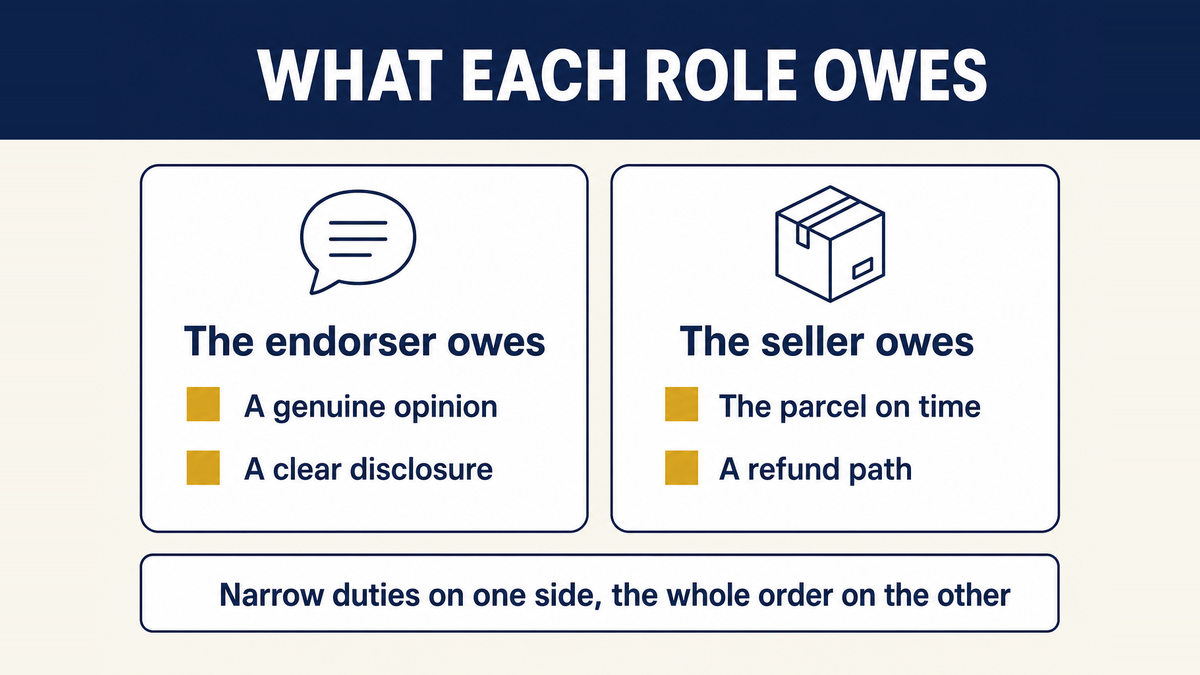
Once the duties that do not apply have been stripped away, the affiliate's obligations are narrow. Make a recommendation that reflects a genuine opinion, and disclose the connection that would change how the audience weighs it. The shipment, the refund, the warranty and the tax on the sale all sit with the merchant, which is why the model needs so little capital to begin.
That narrowness is the attraction and also the limit. The affiliate's only durable asset is the credibility of the recommendation, so the disclosure requirement is not an inconvenience bolted onto the model from outside. It is the rule that protects the asset, because an undisclosed payment does not merely break a formality: it converts a recommendation into an advertisement without saying so, which is precisely the exchange of value the audience thought it was getting and did not get.
There is one boundary worth naming, because it catches people who think of themselves as publishers rather than promoters. The same rulebook extends to the businesses sitting between a merchant and its endorsers, including agencies and the operators of review, comparison and ranking services, when they pass on endorsements without the required disclosures or direct endorsers who fail to make them. A comparison table on an affiliate site is not outside the rulebook merely because the person running it never writes in the first person, and a ranking that quietly favours whoever pays most is treated as misleading whatever the site claims about its own independence.
- The endorser owes
- A recommendation that reflects a real opinion, and a clear statement of any payment or free product behind it
- The seller owes
- The parcel, within the stated time or thirty days, and a refund path when the order does not arrive or does not match
- Neither can move
- The shipment and refund duties follow the seller; the disclosure duty follows whoever is being paid
- Where they meet
- A merchant is answerable for the recommendations it pays for, even when the endorser is not
5. Why the Two Models Are Sequential, Not Rival
Treated as a straight choice, the comparison produces the wrong question. The more useful reading is that one model generates the knowledge that the other one spends, and a seller who runs them in that order pays less for the knowledge than a seller who buys it with stock.
An affiliate finds out which products an audience actually responds to while somebody else's money carries the stock, the parcel and the refund. That is an unusually cheap way to run product research, and what it produces is not a feeling about a category but a list of items with observed demand behind them. A person who moves from that into selling has evidence before they commit, which is the difference between stocking a shelf and gambling on one. The route from recommending into buying is set out in moving from dropshipping to wholesale, and the same logic applies one step earlier when the starting point is a recommendation rather than a store.
The reverse direction works as well, which is the part usually missed. A store that already sells knows which items have demand and can predict a repeat order, and that is the hard half of affiliate content. Publishing a recommendation for a product you already ship is cheaper than publishing one for a product you have never handled, because the answer to the obvious question about quality is already known from your own returns data.
What the two models are genuinely not is interchangeable, and the reason is the payment route. A dropshipper is paid by the buyer and then pays the chain, so the money arrives before the costs do and the working capital question is about timing rather than about getting paid. An affiliate is paid by the merchant, usually after a holding period, and never handles the sale at all. How the two directions of a payment behave in this trade, and what each one costs to receive, is set out in paying Chinese suppliers. The point for this comparison is that the models sit on opposite sides of the transaction, so running both is a question of capacity rather than of conflict.
6. Choosing by the Duty You Can Carry
The usual advice is to choose on capital, and capital is the wrong axis, because dropshipping does not require stock either. The axis that actually separates the two is which duty you are able to carry, and there are three of them. Everything else in the comparison is downstream of those three answers.
The first is performance: can you commit to a delivery time and stand behind it? This is not a question about ambition, it is a question about whether the supply chain behind you has a stated time you can publish and a fallback for the weeks when it slips. A seller who cannot answer that is not choosing between two models, they are choosing whether to break a rule they have not read.
The second is disclosure: can you tell an audience that you are paid? It is a small sentence and it costs some of the effect of a recommendation, and it is the whole price of the model. Anyone who finds that price unacceptable is not really choosing affiliate marketing, because the version without the disclosure is the version the rulebook was written to stop.
The third is the relationship: do you want to be the party the buyer comes back to? A seller owns the repeat order, the returns data and the direct contact, and carries the cost of all three. An affiliate owns none of it and cannot lose what it does not hold. That is the honest version of the trade, and it is worth more than any general claim about which model is better. A sensible test before committing is to write down the answers to the three and check them against what the business can actually do this month, rather than against the version that is planned for later.
What cannot be done is to take the order and describe yourself as a recommender. The order is the thing that creates the duties, and no amount of framing moves them, because the rulebook addresses the party that solicited the sale rather than the party that describes itself a particular way.
7. Frequently Asked Questions
Is affiliate marketing better than dropshipping?
Neither is better in the abstract, and the useful question is which set of duties you can carry. Selling means committing to a delivery time, owning the refund and holding the customer. Recommending means owing a genuine opinion and a clear disclosure of any payment, and owning almost none of the risk. The two are usually run in sequence rather than chosen between, because recommending a product teaches you which ones an audience actually buys.
Who handles returns in affiliate marketing?
The merchant, because the merchant is the seller. A buyer who wants to send something back has no contract with the affiliate, so the parcel goes to whoever took the money and the refund is owed by the same party. That is why the shipment and refund duties follow the order rather than the recommendation, and it is the clearest practical difference between the two models.
Do I have to disclose that I earn a commission?
Yes, whenever the connection would not be reasonably expected by the audience and could affect how much weight the recommendation carries. The rule treats a monetary payment or a free or discounted product as a connection of that kind, and it requires the disclosure to be clear and conspicuous rather than buried. The same rulebook also makes a merchant answerable for the recommendations it pays for, even when the person making them is not.
Can I run both at the same time?
Yes, and they sit on opposite sides of the transaction, so there is no conflict of the kind people usually worry about. The limit is capacity: the seller side needs somebody who can commit to a delivery time and handle the refund, and the recommending side needs an audience worth listening to. A store that publishes recommendations for products it already ships has the cheapest version of both, because its own returns data already answers the quality question.
Which one has the lower risk?
Recommending has the narrower risk and the slower one. An affiliate pays neither the refund nor the return postage, and what is at stake is the audience, which is the only asset the model has and which erodes quietly rather than failing at once. Selling spreads the risk across every order and surfaces it within days. Slower is not the same as smaller, and the risk that arrives slowly is the one most often underestimated.
A One-Page Role Sheet, Four Columns Wide
Seller, return bearer, customer owner, disclosure duty. We write the four rows for your model and mark where commission stops covering the risk.
Map My Four Roles
Questions & Comments
We read every one and reply within 24 hoursWeighing up whether to sell the product or recommend it, unsure who the buyer would actually come back to, or trying to work out whether your supply chain can commit to a delivery time you can publish? Send us the products you are looking at, and our team will tell you what the chain can promise and which side of the order that leaves you able to stand behind.