
Dropshipping Candles: The Wick Rule, the Fragrance Question and the Breakage Rate
 ·
Updated October 14, 2026
·
14 min read
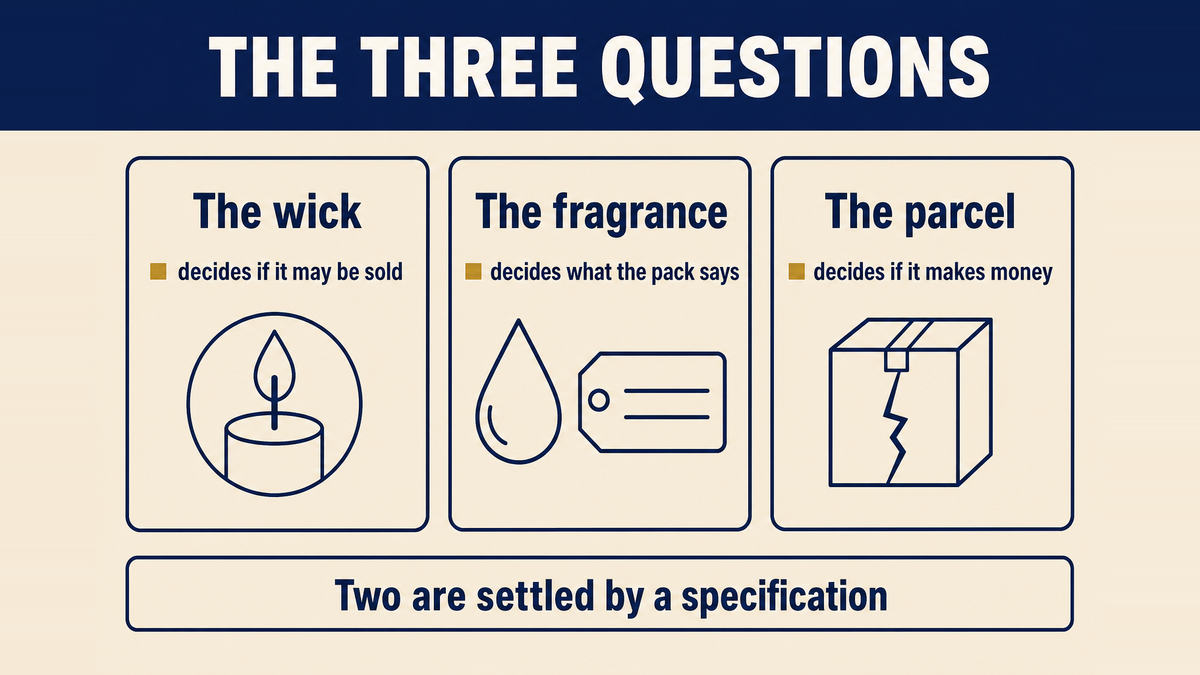
Candles look like the simplest product available to a direct-ship store. No battery, no sizing, no moving parts, nothing that can arrive dead. The simplicity is real and it hides three specific things, each of which decides something different. One is a component inside the product that carries a legal limit and cannot be seen in a photograph. The second is what goes into the wax, which decides whether the article falls inside a labelling regime at all. The third is a rate rather than a rule: a candle in a glass vessel has a chance of arriving cracked, and that chance is what decides whether the product makes money. This guide takes the three in order, starting with the one that has a number attached.

1. Three Questions That Decide a Candle
The first question is about the wick, and it is the one that separates this category from almost every other simple product. A wick can be made of cotton, or it can be made with a metal core that holds it upright as it burns. Those two look identical once the wick is set in wax, and they are treated completely differently by the rules: one is unremarkable, the other carries a limit on what the metal may contain. Because the difference is invisible, the answer cannot come from a product photograph, which makes it a question for a specification rather than for an eye.
The second question is about the fragrance. Sellers often assume that anything scented is treated as a cosmetic, and that assumption is wrong in both directions: a candle is not a cosmetic, and the fragrance it carries is not automatically harmless. What decides the position is whether the substance used meets a definition, and that definition names specific characteristics rather than categories of product. It is worth knowing before the fragrance is chosen rather than after, because the answer changes what has to appear on the packaging.
The third question is about the parcel rather than the product, and it is the one that most often turns a promising product into a poor one. A candle in glass is heavy, bulky for its value, and breakable, and the arithmetic of a damaged order includes the freight out, the freight back and the replacement out. Because that total is charged against a margin that a low-priced item cannot carry, breakage belongs in the decision rather than in the reviews.
| Question | What it decides | Where the answer comes from |
|---|---|---|
| The wick | Whether the candle may be sold at all | The wick specification |
| The fragrance | What has to appear on the packaging | What the substance is |
| The parcel | Whether the order makes money | Glass, weight and a damage rate |
What this guide covers
2. The Wick Rule: Banned Above a Limit, Labelled Below It
The rule that governs candle wicks is unusual in structure, because it sits inside a list of articles that are prohibited rather than merely regulated. That list carries its own explanation of why it exists, and the explanation is the part worth understanding first:
Under the authority of section 2(q)(1)(B) of the act, the Commission declares as banned hazardous substances the following articles because they possess such a degree or nature of hazard that adequate cautionary labeling cannot be written and the public health and safety can be served only by keeping such articles out of interstate commerce.
Consumer Product Safety Commission, 16 CFR 1500.17, Banned hazardous substances (read 14 October 2026)
Read that sentence before reading the candle provision and the structure becomes clear. A banned hazardous substance is not a product with a warning problem. It is a product where a warning is judged unable to fix the hazard, so the article itself is kept out of trade. That is why the usual remedies, such as adding a caution, amending the recommended use or attaching a notice, do not work here: the category exists precisely because those measures were already judged not enough.
The candle provision then sets out two possible states rather than one, and the limit is expressed as a share of the weight of the metal core:
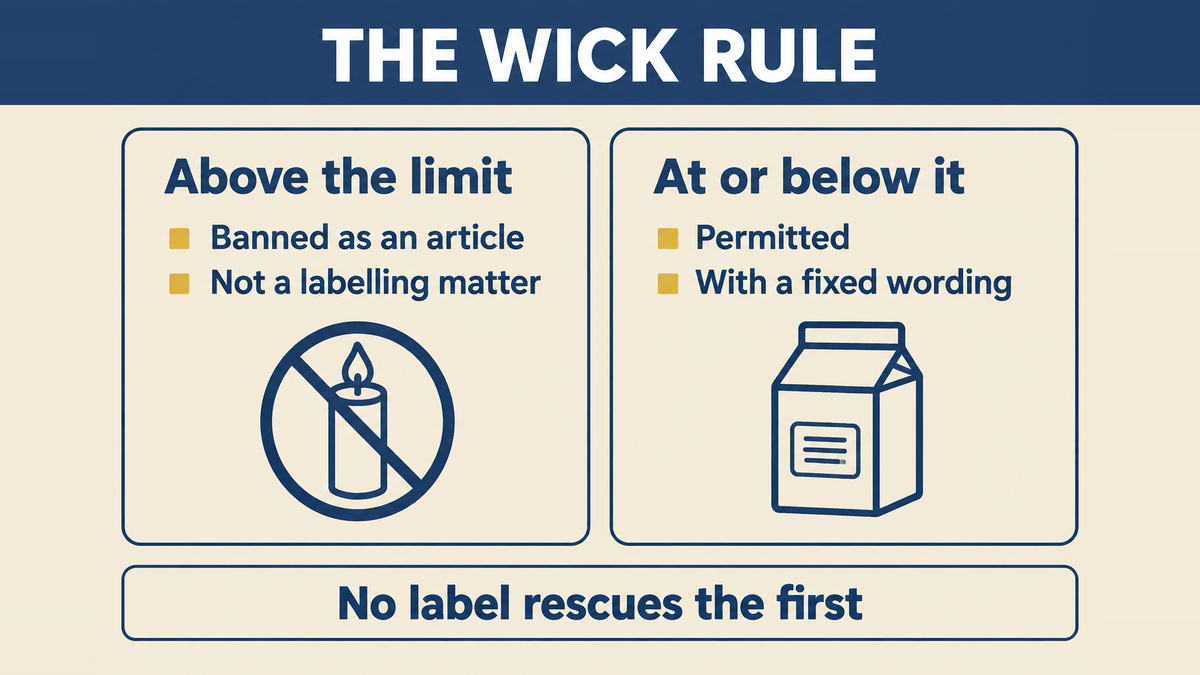
(13)(i) Candles made with metal-cored wicks. Candles manufactured or imported on or after October 15, 2003, made with metal-cored candlewicks, unless: (A) The metal core of each candlewick has a lead content (calculated as the metal) of not more than 0.06 percent of the total weight of the metal core; and (B) Each outer container or wrapper in which candles subject to paragraph (a)(13)(i)(A) of this section are shipped, including each outer container or wrapper in which such candles are distributed to a retail outlet, is labeled “Conforms to 16 CFR 1500.17(a)(13).”
Consumer Product Safety Commission, 16 CFR 1500.17(a)(13), candles and candlewicks (read 14 October 2026)
Two working states follow. A candle with a metal-cored wick whose core contains more than the stated share of lead is caught by the prohibition as it is written, and no label repairs it. A candle with a metal-cored wick that meets the limit is permitted, and in exchange it carries a labelling requirement whose wording is fixed rather than left to the seller. The neatest version of all is a wick with no metal core at all, which is why many suppliers offer one: it removes the question from the product instead of answering it.
The operational difficulty is the one named at the start of this page. Nothing in a product photograph distinguishes a cotton wick from a metal-cored one, and a supplier's assurance that a candle is “lead free” is a claim about an outcome rather than a statement about the wick. The substitution between one wick and another is also the kind of change a factory can make without telling anybody, which puts this in the same family as the specification problems described in what the common lines from suppliers really mean.
The reason a metal-free wick is worth asking for is that it turns a question nobody can answer from a photograph into a specification, and a specification is something a buyer can hold. Where the wick contains metal, the position depends on a document about the core and on a wording appearing on a container that changes with every order. Where it does not, both questions disappear and the only remaining check is whether the wick that arrives is the wick that was described. That check belongs to the same family as everything else in this category: the useful question is what the item is made of, not whether it looks safe. Where goods are checked before they leave, the wick and the container wording both belong on the list, which is the practice set out in what a pre-shipment inspection should cover.
3. Where the Label Actually Goes
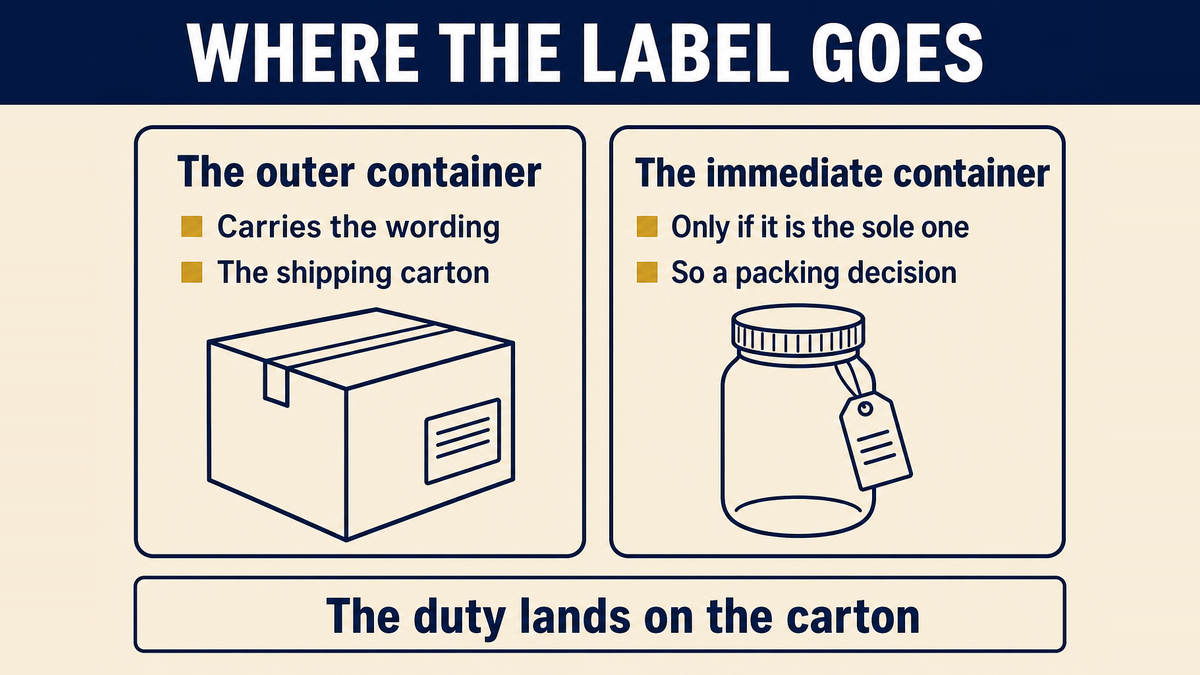
The provision names the object that has to carry the fixed wording, and it names something less obvious than the candle. The label belongs on each outer container or wrapper in which the candles are shipped, including the outer container in which they are distributed to a retail outlet, and the immediate container is expressly left out of that description unless it happens to be the only container the candles travel in.
For an ordinary wholesale arrangement this is straightforward, because there is a shipping carton and somebody packs it. For a direct-ship arrangement it raises a question that a product-focused reading of the rule misses entirely. The outer container is the parcel that goes to the buyer, it is chosen at the moment of dispatch, and in a direct-ship model the party who closes it is not the seller. That makes this one of the few labelling duties in this business that lands on an object which changes with every order rather than on a product that stays the same.
The practical consequence is that the instruction has to be transmitted rather than assumed. A seller who has ordered a carton print run has dealt with the requirement; a seller who has described the candle carefully on a product page has not, because the product page is not an outer container. It is worth checking which of the two arrangements is actually in place, since the answer differs between a mailer, a printed carton and a padded envelope. Where the candle travels with no outer container at all, the immediate container becomes the only one, and the duty moves onto the jar as a result of a packing decision rather than a labelling one.
4. The Fragrance Question
Fragrance is where most sellers import an assumption from another category. Because scented products are often thought of as cosmetics, the expectation is either that cosmetic rules apply to a candle or that a scented candle needs no attention at all. Neither is right. A candle is not a cosmetic, and the fragrance it contains is not automatically outside the rules either, because the question is decided by what the substance is rather than by what the product is called.
The definition that settles it lists characteristics rather than products, and a fragrance ingredient can fall inside one of them:
The term “hazardous substance” means: (1)(A) Any substance or mixture of substances which (i) is toxic, (ii) is corrosive, (iii) is an irritant, (iv) is a strong sensitizer, (v) is flammable or combustible, or (vi) generates pressure through decomposition, heat, or other means, if such substance or mixture of substances may cause substantial personal injury or substantial illness during or as a proximate result of any customary or reasonably foreseeable handling or use, including reasonably foreseeable ingestion by children.
15 U.S.C. § 1261(f)(1)(A), via Cornell Law School, Legal Information Institute (read 14 October 2026)
Two of the six characteristics in that list are the ones a fragrance can bring with it. The first is sensitisation, which the same section defines separately as a substance that causes a hypersensitivity reaction on normal living tissue through an allergic process and becomes evident when the same substance is applied again, and which the Commission designates rather than a supplier deciding for itself. The second is flammability, defined in its own subsection and with its own tiers. The closing clause of the definition is as important as the list, because it ties the whole thing to foreseeable handling and use rather than to intended use, and a candle is a product whose customary handling involves a flame.
What follows is that the answer depends on the substance and the documentation behind it, which makes this another specification question rather than a judgement call. The useful things to ask are boring and specific: what the fragrance is, whether it is a designated sensitizer, and what its flash point is. The reason it is worth doing is the same reason the wick rule is worth doing, because both lead to the same fork. Where a hazard can be addressed by a warning, the article carries a caution; where adequate caution cannot be written, the article can be kept out of trade. Fragrance is therefore not a labelling detail. It is the second route into the same question the wick answers.
5. The Breakage and Weight Arithmetic
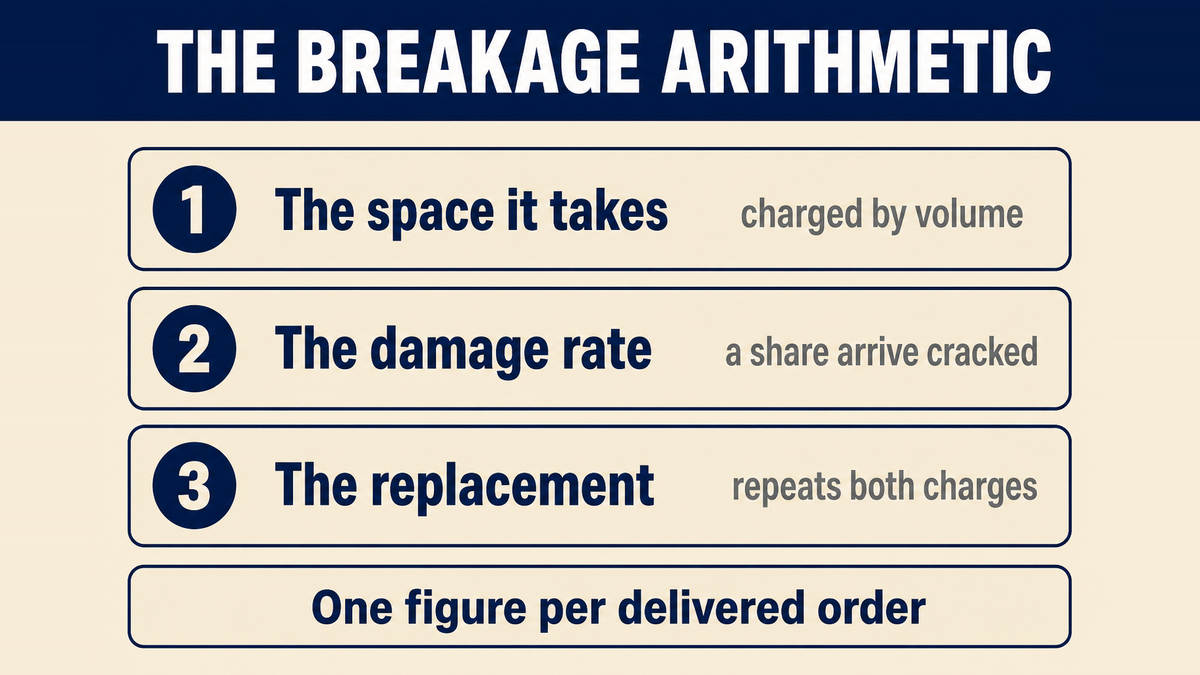
The third question is the one that decides whether the product is worth selling, and it is a measurement rather than a rule. A candle is heavy for its price, bulky for its weight, and frequently sold in glass, which means three separate charges stack on the same order. The first is the charge for space, because a parcel containing air is priced on the space it takes. The second is a damage rate, which is the share of orders that arrive cracked, chipped or deformed. The third is the replacement, which repeats the first two charges and adds a second dispatch.
The useful way to hold all three is one figure per delivered order that stays delivered, built from the item rather than from the category. The volume side is set out in how volume decides what a parcel is charged, and the box itself, which is the part you can change without changing the product, is covered in how packaging is chosen and priced. The cost of the round trip when a unit does break is the subject of what a return actually costs, and on a low-priced item it is rarely covered by the margin on the sale.
Two features of this category make the damage rate harder to treat as a constant. The first is heat, because a wax candle softens and can deform in a warm parcel, which makes the rate seasonal rather than fixed: a packing method that survives a mild month may not survive a hot one, and the same method may be fine again in winter. The second is that the failure is often invisible until opened, so a split vessel is not caught at the point of dispatch by weight or by handling. A seller planning a full year should therefore measure the rate across a warm period rather than in the season that suits the product.
Measuring the rate is cheap and it changes the decision. Send a small number of finished units to yourself and to a destination in a warm region, packed the way the supplier intends to pack them, and see what arrives. Doing that in more than one season produces a rate rather than an impression, and a rate is the only version of this number that belongs in a margin calculation, which is the arithmetic set out in how a margin is actually built. The alternative, which is reading reviews for complaints, measures the failures that were bad enough to be written about rather than the failures that happened.
What makes the category workable is that most of the arithmetic responds to design rather than to policy. Fill weight and vessel size drive the charged weight, the material of the vessel drives the damage rate, and the moulded insert drives how much of a drop the unit absorbs. A smaller fill in a tin with a shaped insert is the same fragrance in a parcel that costs less to send and less to replace, and on a product with a thin contribution per order that difference is the whole decision.
6. The Order to Check Them In
The four checks below are best done in the order given, because the first can remove the product entirely and the last is wasted effort on an item that has already failed.
| Step | What it answers | What it costs |
|---|---|---|
| Get the wick specification | Whether the candle may be sold at all | One message |
| Name the fragrance | What has to appear on the packaging | One message |
| Measure the parcel | What the order is charged | A calculation |
| Fix the container wording | Whether the duty has been met | A print run |
Three of the four are questions rather than purchases, and the only one that requires spending is the wording on the container, which is a print run rather than a test. That asymmetry is why this category rewards a seller who asks early and punishes one who asks after committing to artwork, packaging and a product page. A candle that fails the first check has no fix available, and a candle that fails it after a listing has gone live is a withdrawal rather than an amendment.
The documents worth asking for are specific and short. The fragrance should come with a name rather than a family, a statement about whether it is a designated sensitizer, and a flash point, because the flash point is the number that decides how the oil behaves in a warm container. That last point matters for anyone selling oils, refills or candle-making kits alongside finished candles, since a bottle of fragrance oil is a different article from a candle and carries its own questions rather than sharing the candle's. The heat side of the same problem, and what it does to the route a parcel can take, is covered in how the two main freight modes differ.
Read as a whole, the category has a recognisable shape that is close to the opposite of what a product list suggests. The candles that work are unremarkable: a wick with no metal core, a fragrance that comes with documents, a modest fill in a vessel that does not shatter, and an insert that holds it still. None of those choices looks like a marketing decision, and each of them is the one that decides whether the numbers hold. A product chosen for its scent and its label design without those four checks is not a product that was hard to sell. It is a product that was never properly costed.
7. Frequently Asked Questions
Are candles a good dropshipping product?
They are simple to describe and harder to run than they look. One component inside the product carries a legal limit and cannot be seen in a photograph, the fragrance decides what has to appear on the packaging, and a glass vessel produces a breakage rate that has to be recovered in the margin. The candles that work are the unremarkable ones, and they are chosen on those four checks rather than on scent or label design.
Are lead wicks still sold?
Metal-cored wicks are permitted only where the metal core contains not more than the stated share of lead, and where the outer container carries a fixed wording, so a metal-cored wick that meets the limit is a real product rather than a relic. The difficulty is that it cannot be seen: a cotton wick and a metal-cored one look identical in wax, which makes this a question for a specification rather than for a product photograph. A wick with no metal core removes the question.
Do candles need to be tested?
There is no single candle test that a seller must hold in the way some other categories work, and the obligations that do apply arrive through different routes. One is the wick provision, which attaches a lead limit and a label to a specific component. The other is the general route for hazardous substances, which turns on what the article contains rather than on the fact that it is a candle. Both are answered by documents about the components.
Is a scented candle a cosmetic?
It is not, and the assumption causes two opposite mistakes: assuming cosmetic rules apply to the candle, or assuming a scented product needs no attention at all. What matters is whether a substance used in it meets the definition of a hazardous substance, which lists characteristics including sensitisation and flammability. The answer therefore depends on the fragrance and its documentation rather than on the word fragrance.
Why do my candles arrive cracked?
Usually because the parcel was designed for the product rather than for the trip. A glass vessel needs a shaped insert rather than loose fill, and the failure is invisible until the box is opened, so it is not caught by weight or handling at dispatch. It is also seasonal, because a wax candle softens in a warm parcel, which means the rate measured in a mild month understates the year.
Every Declared Allergen, Named
We return the fragrance declaration with each sensitising substance listed, the wick route that applies, and breakage by pack format.
Declare My Fragrance
Questions & Comments
We read every one and reply within 24 hoursTrying to find out what is actually inside your candle wick, unsure whether a fragrance needs a caution on the packaging, or dealing with a damage rate that is eating the margin on a glass vessel? Send us the candle and its packed dimensions, and our team will help you check the wick specification, the fragrance documents and what the parcel is charged.