
Dropshipping Kitchen Products: The Volume Rule and the Material Rule
 ·
Updated October 14, 2026
·
16 min read
Kitchen goods look like an easy category because the products are simple and the demand is steady. They are decided by two rules instead, and neither one is about how well the item sells. The first is a shipping rule: a kitchen object is usually hollow or handled, so it takes up far more space than its weight suggests, and above a published size the carrier charges for the space rather than the weight. The second is a materials rule: anything that touches food answers to a set of rules written per substance, not per product, so a single item with a silicone head, a wooden shaft and a steel ring has three questions attached rather than one. This guide takes both rules, shows where each is written down, and works through what they do to a product choice.
1. Why Kitchen Goods Behave Unlike Other Home Products
Most categories fail on a single axis. Apparel fails on size variation, electronics on batteries, furniture on damage. Kitchen goods have a shape problem. Almost everything in the category is a solid object with a handle, a wall or a cavity, which means it encloses a lot of air and sits low in weight for the room it takes. A bowl is mostly empty space. A set of utensils is mostly gaps. This is not a defect and it has nothing to do with quality, but it decides what the parcel costs.
The reason it matters so much is that price and cost are set by different things. The price is set per piece or per set, by what the market will pay. The cost of moving the item is set by the box, and the box is decided by the object's dimensions rather than by what it weighs. Two products with the same weight and the same price can therefore carry very different freight, and the only difference between them is how much air they enclose.
The second rule runs in a completely different direction. Anything intended to touch food falls under a materials regime, and that regime is written substance by substance rather than product by product. That distinction sounds like a technicality and it is the most practical thing on this page, because a kitchen item is rarely made of one material. The moment an item has a head, a shaft and a grip, it has several substances, each with its own question, and the question is not whether the product is food safe in general but whether each substance is allowed in that use.
| Rule | What it decides | Where it is written |
|---|---|---|
| Volume | What the parcel is charged | Carrier and postal size rules |
| Material | What the item may be made of | Food contact regulations, per substance |
What this guide covers
2. The Volume Rule: One Cubic Foot Is the Line
The volume rule is not a hidden practice or a carrier's preference. It is published, with a number attached, and the sentence that carries it is short enough to keep beside a specification sheet. The postal service states the rule for parcels in its price notice:
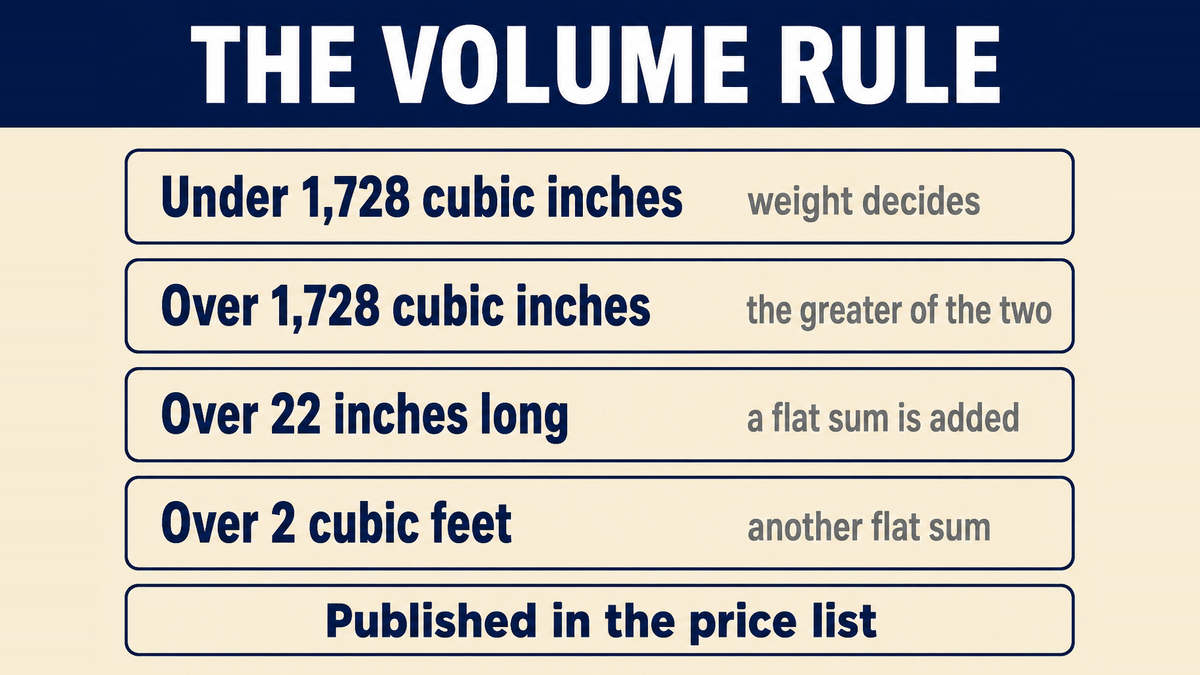
Parcels that exceed one cubic foot (1,728 cubic inches) are charged based on the actual weight or the dimensional weight, whichever is greater (as calculated in DMM 113.1.3).
United States Postal Service, Notice 123, Price List (read 14 October 2026)
Below one cubic foot the parcel is priced on weight, which is why so many sellers never meet this rule and assume it does not exist. Above it, the charge moves to whichever number is larger, actual weight or the weight equivalent of the space. A kitchen item is exactly the shape that crosses that line, because a hollow object in a protective box reaches 1,728 cubic inches at a modest size: a box of roughly twelve inches by twelve by twelve already sits at the limit, and a box long enough for a ladle or a pair of tongs passes it in one dimension alone.
The same notice adds flat sums for parcels that cross certain sizes, and they are worth knowing because they arrive on top of the weight rather than instead of it. In the tables for the service in question, a parcel over 22 inches but not over 30 inches in length adds a set amount, one over 30 inches adds more, and one over two cubic feet adds more again. The service tables show figures such as $4.50 for the first length band, $21.00 beyond 30 inches and $35.00 above two cubic feet, and those sums differ between services, so the exact number for your route has to be read from the current table rather than assumed.
The practical consequence is that length and volume act as separate triggers from weight. A rolling pin is not heavy. A knife block is not heavy. A stack of four mixing bowls is not heavy. Each of them can cross a length band or a volume line and pick up a flat addition that has nothing to do with what the parcel weighs, which is the point that a weight-based cost model misses entirely. How the charged weight is built from dimensions, and what a cubic metre comes to, is set out in how volume decides what a parcel is charged, and the box itself, which is the part you control, is covered in how packaging is chosen and priced.
A second thing worth being exact about is what gets measured. The figure that counts is the outside of the parcel as it is handed to the carrier, which includes the padding, the carton walls and any part of the product that sits proud of the box. Measuring the item from a supplier's specification sheet is a different exercise and almost always understates the size, because the sheet describes the product while the charge is levied on the parcel. Adding the padding first and measuring afterwards is the only order that produces a usable number, and it explains how two sellers can quote different freight for the same product from the same factory: one measured the item, the other measured the box.
3. What That Does to a Kitchen Product
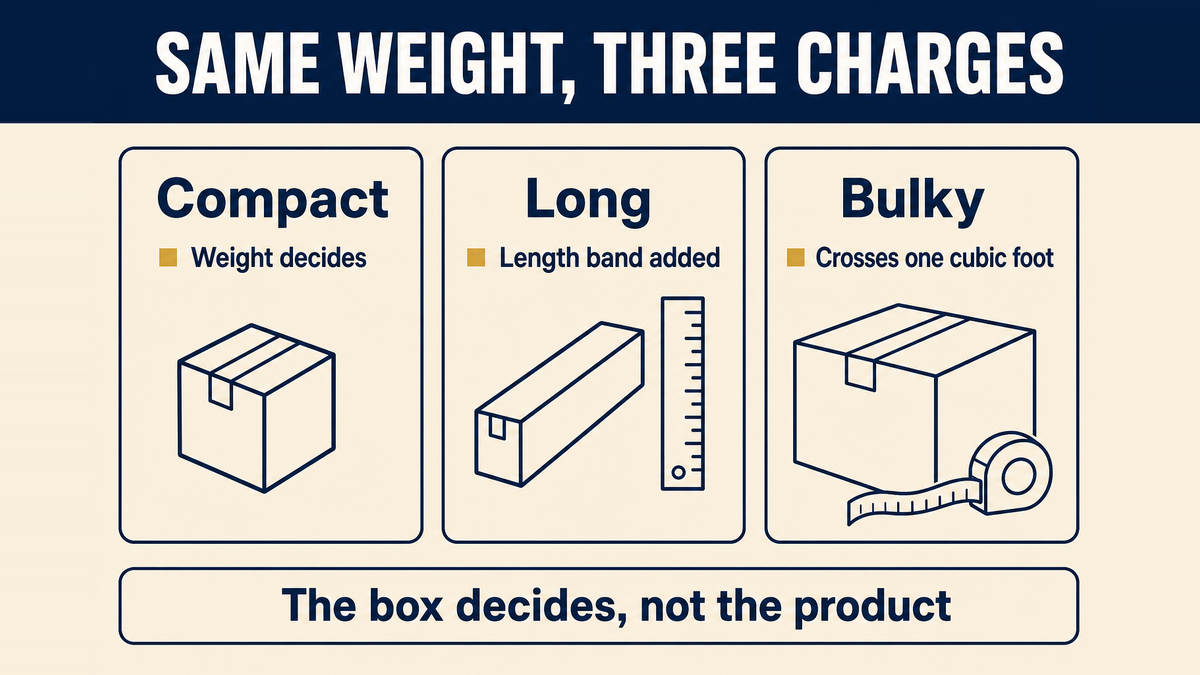
Once the rule is known, the useful measure for a kitchen item stops being weight and becomes density: how much space one item needs inside its protective box, for the weight it carries. The way to see the effect is to take three parcels of identical weight and give them the boxes their products actually require. The dimensions below are illustrative, chosen so you can substitute your own measurements and run the same arithmetic.
| Parcel at 400 g | Box (cm) | Volume | What it triggers |
|---|---|---|---|
| Compact grinder | 15 × 12 × 10 | about 110 cubic inches | Nothing — weight decides |
| Tongs or a ladle | 60 × 10 × 8 | about 293 cubic inches | Crosses the 22-inch length band |
| Mixing bowl set | 35 × 32 × 28 | about 1,914 cubic inches | Crosses one cubic foot |
All three parcels weigh the same and only one of them is charged on weight. The long one picks up a flat addition for its length, which has nothing to do with how heavy it is, and the bulky one crosses the volume line where the larger of the two figures applies. A cost model that starts from the product weight would price all three identically and be wrong about two of them, which is the most common way a kitchen product looks profitable on a spreadsheet and is not.
There is a lever here, and it is unusual in that the seller genuinely controls it. The box is not fixed by the product; it is chosen. A set packed as one large parcel and the same set packed as nested items in a flatter box are the same goods at two different freight costs, and the difference comes from air rather than from material. A handle that folds flat, a stack that nests, a lid that sits inside the bowl: each removes cubic inches without removing anything the buyer wants. The trade is that a tighter box needs better protection, so the gain is real but not free.
The trap that catches most kitchen sellers is the set. A set is priced as one unit and feels like one product, but it travels as one box, and the box is the sum of every item's dimensions plus the padding between them. A four-piece set of bowls can therefore cross the volume line while each bowl on its own would not, and the seller who costed the set from the price of one bowl finds the freight has grown faster than the order value. Building the total from the box rather than from the pieces is the same discipline as assembling a landed cost, and on a bulky category it is the line that decides whether the order is worth taking.
4. The Material Rule: Permission Is per Substance
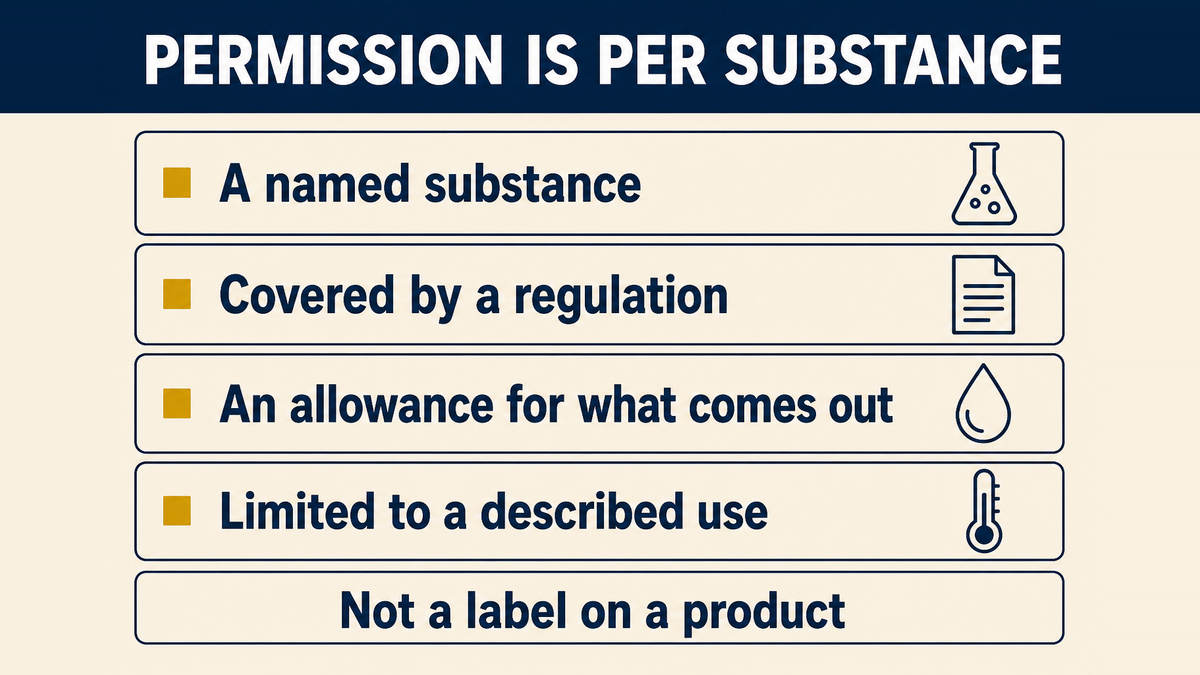
The second rule is written in a different place and in a different shape. It does not say that a product is or is not suitable for food. It lists substances, and it grants each one permission for a described use. The opening of the regulation for one common plastics family shows the structure in a single sentence:
The olefin polymers listed in paragraph (a) of this section may be safely used as articles or components of articles intended for use in contact with food, subject to the provisions of this section.
U.S. Food and Drug Administration, 21 CFR 177.1520, Olefin polymers (read 14 October 2026)
The same section then names what may be used alongside those polymers, and the list defines the boundary of the whole regime. Permitted substances are those covered by the applicable regulations in parts 170 through 189 of the same title, those generally recognised as safe, those used under a prior approval, and the specific substances listed in the section. Nothing else is in scope, which is why the permission attaches to a named substance rather than to a finished product.
Two details in the tables make the scoping concrete, and both are the kind of thing a specification sheet will not tell you. First, each entry carries a limit on how much may come out of the material in use, expressed as a percentage under stated conditions, so permission is a measured allowance rather than a label. Second, each entry is tied to a described use, and the descriptions are narrow. One polyethylene entry is permitted for articles that contact food, with the explicit exception of articles used for packing or holding food during cooking. A material can therefore be allowed for a container and excluded from a pan, and both statements are correct.
For a seller, that reframes the question. Asking whether an item is food safe invites a yes, and a yes is worth very little. The question that produces a usable answer is which substance the food-facing part is made from, which regulation covers it, and whether the way the item is used matches the use that regulation describes. On a kitchen tool the food-facing part is often only one of three materials, which means the answer can be different for the head, the shaft and the grip of a single spatula. The general framework is set out in what food contact testing covers for kitchenware and tableware, and the same reasoning applied to containers is worked through in how a plastic container is chosen for food contact.
5. Why “Food Grade” Is Not a Certificate
Because the rule is written per substance, the phrase most sellers rely on carries much less weight than it sounds. A certificate is a statement about a product at a moment in time. What these regulations grant is a permission to a named substance for a described use, and those are different objects. Understanding the difference removes three specific misunderstandings that cost sellers money.
The first is that a document for a material is not a document for an item. A paper describing a silicone compound tells you about the compound. It says nothing about the dye in the grip, the adhesive holding the ring, the coating on the shaft or the printing on the handle, each of which is its own substance with its own question. On a kitchen tool that is assembled from parts, the food-facing surfaces are the ones that matter and they are rarely all made of the one material the supplier has paperwork for.
The second is that permission is scoped to a use, and the scope is often narrower than the product. A substance permitted in contact with food is not permitted for cooking simply because of that, which is exactly the distinction drawn in the regulation's own table. So the honest version of a supplier's assurance is not that the material is approved but that it is approved for a certain kind of contact, and the second half of that sentence is the part that decides whether the item can be sold as a cooking tool or only as a storage one.
The third is that the same family of material is not one substance. The regulation distinguishes entries within a family by physical properties, with density ranges and flow limits in the table alongside the allowances. Two items described as the same plastic can therefore sit under different entries with different limits, and a substitution made by a factory to save cost can move the item from an allowed entry to one that is not permitted for that use. This is the change that no listing catches, because the item looks identical and weighs the same.
The workable habit that follows is small: put the intended use in writing, ask which substance forms each food-facing surface, and keep the answer with the product record. That is not a substitute for testing where testing is required, and it costs nothing. The reason it matters commercially is that the material rule cannot be fixed by better design, unlike the volume rule, so it is the one worth resolving before a product is chosen rather than after.
6. What the Two Rules Do to a Product Choice
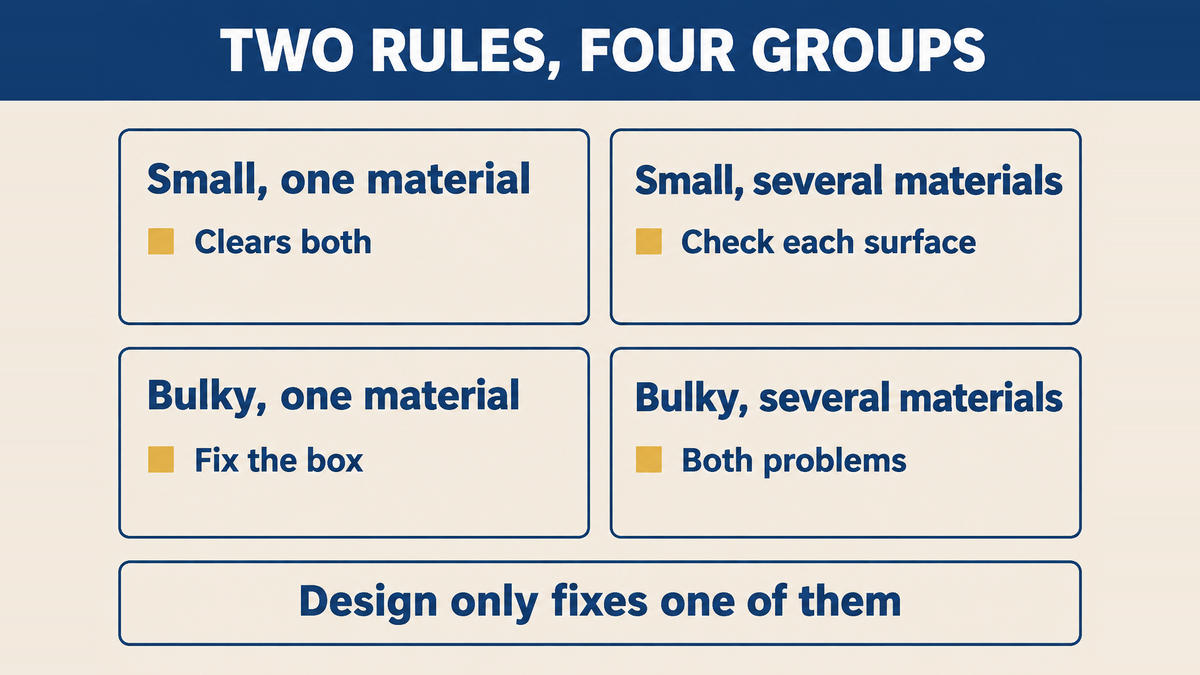
The two rules are independent, which is the most useful thing to take from this page, because it means an item can be comfortable under one and difficult under the other. An item with a single food-facing material can still be ruinous on freight. An item that packs flat and nests can still carry a material question that no amount of clever packing answers. Sorting kitchen goods by the pair rather than by the category produces four groups that behave quite differently.
| Group | Packs flat, one material | Packs flat, several materials |
|---|---|---|
| Single material | The calm group — check the use matches | Check every food-facing surface separately |
| Bulky or long | A freight problem, solvable by design | Both problems, and design only fixes one |
The group worth aiming for is small, flat and made of one material, and it is worth noticing how unexciting those products are. A silicone scraper, a flat grater, a set of measuring spoons, a bamboo board: these are the items that clear both rules without effort, and none of them appears on a list of exciting kitchen gadgets. The products that look most attractive on a trend page are usually the multi-material gadgets that pack badly, which is the opposite of what the two rules reward.
Where one problem can be engineered away and the other cannot, the priority follows automatically. Volume responds to design, so a bulky item with one material is a problem you can attack: nest it, flatten it, reduce the box, and the freight comes down. Material does not respond to design in the same way, because the food-facing surface is what it is. That is why the sensible order is to settle the material question first and then spend effort on the box, rather than picking a gadget for its appeal and discovering the material problem when a specification is requested.
The check itself takes minutes once an item is in front of you. Set the packed dimensions against the published volume line and the length bands, and see which of them, if any, the parcel crosses. Then list the materials that touch food and, for each one, ask which entry covers it and which use that entry describes. If the first check fails, the fix is a different box. If the second fails, the fix is a different product, and knowing which of the two you are facing is most of the decision. Items that fail neither are unglamorous, and they are the ones that survive a rise in freight or a change of supplier without the margin moving.
The return side behaves differently again, and it is worth pricing separately rather than folding into the same number. A bulky item that arrives chipped is expensive to replace because the replacement weighs and measures the same as the original, so the freight does not shrink when the item is refunded. That asymmetry is the reason the delivered cost of a heavy kitchen product should be built on the assumption that some share come back, which is the arithmetic behind a return rather than a margin calculation on its own.
7. Frequently Asked Questions
Are kitchen products a good dropshipping niche?
The category is steady rather than spectacular, and the two rules decide which items inside it work. Aim for something small, flat and made of a single food-facing material, because those clear both rules without effort. The gadgets that look most attractive on a trend page tend to be multi-material and bulky, which is the worst combination of the two.
Why is my parcel charged more than its weight suggests?
Because above one cubic foot the charge moves to the greater of the actual weight or the volume-based weight, which is a published rule rather than a carrier's discretion. Long and bulky kitchen items cross that line easily while weighing very little, and length bands add flat sums on top rather than instead. Measuring the box rather than the product explains the difference.
What does “food grade” actually mean?
It is a summary rather than a specification. The regulations grant permission to named substances for described uses, with allowances for how much may come out of the material in that use. So the answerable question is which substance forms each food-facing surface, whether the item is used the way that entry describes, and whether the factory has changed the material since the paperwork was issued.
Do I need testing for kitchen products?
It depends on the material and on the use, which is why the material question is worth settling before choosing a product rather than afterwards. Where testing is required it attaches to the item and the use, so a report for a similar product or a related material does not answer it. Ask what a document covers before relying on it.
How do I reduce shipping cost on bulky kitchen items?
Attack the box, since that is the part you control. Nested sets, folding handles and flatter cartons remove cubic inches without removing anything the buyer wants, and they can move a parcel back below the volume line or out of a length band. The trade is protection, so a tighter box has to be tested rather than assumed to be fine.
A Register of Every Food-Contact Surface
Each resin, coating and gasket listed against the permission it holds, with the migration test behind it on the same row.
Register My Surfaces
Questions & Comments
We read every one and reply within 24 hoursTrying to work out why a light kitchen parcel is charged as though it were heavy, checking whether a multi-material gadget has paperwork for every food-facing part, or deciding between two items that look equally appealing? Send us the packed dimensions and the materials, and our team will help you cost the parcel and check the surfaces that touch food.