
WooCommerce Dropshipping: The Costs That Move, Not Vanish
 ·
Updated October 14, 2026
·
17 min read
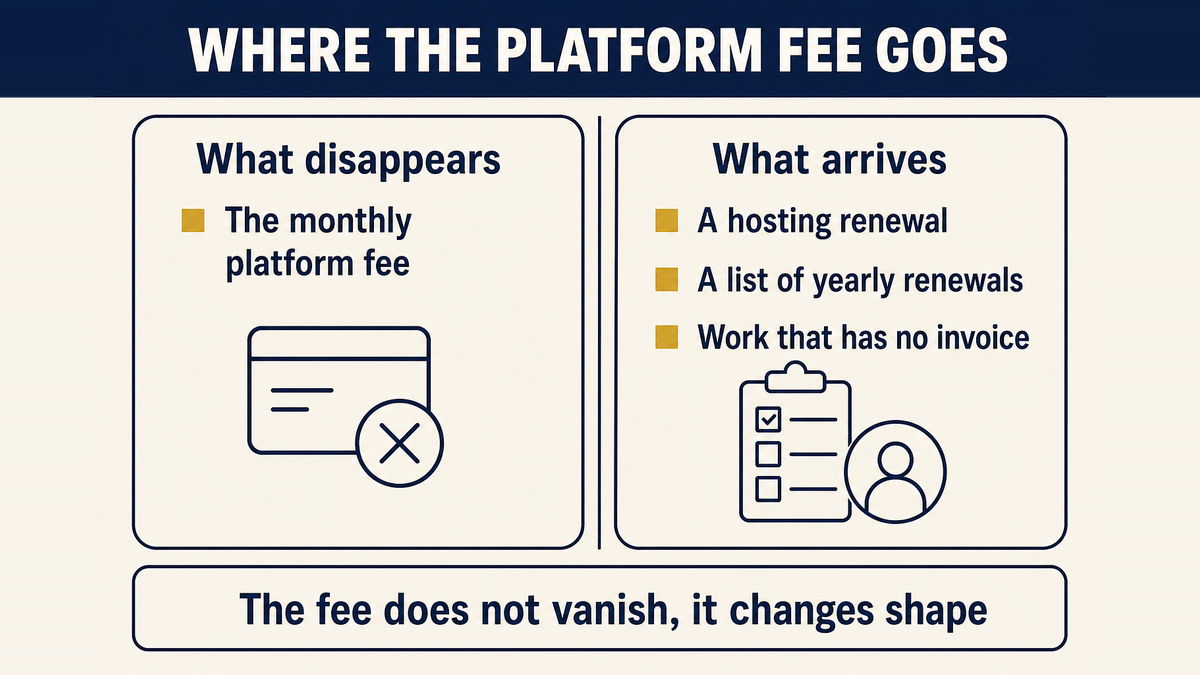
The case for running a store on WooCommerce usually comes down to one number, and it is a real number: there is no platform subscription. Against a hosted plan that charges every month whether you sell anything or not, a platform fee of zero looks like a straight saving, and for a new store it often is. The mistake is treating that single line as the comparison. A subscription does not disappear when you self-host; it changes shape. It becomes a hosting renewal, a growing list of renewals for individual features, and a set of obligations that a hosted platform used to hold on your behalf. None of those appear on the pricing page as a monthly figure, which is exactly why they get left out of the calculation.
What Changes When the Platform Fee Disappears
| Line | Hosted platform | Self-hosted |
|---|---|---|
| Platform fee | Charged monthly whether you sell or not | Zero |
| Hosting and environment | Included, invisible | Your renewal, scaling with traffic |
| Features | Included in the tier | Each one a separate yearly renewal |
| Security and payment rules | Held by the platform | Held by you |
| Card processing rate | Whatever the platform negotiates | Often lower, and you choose the provider |
What this guide covers
- Why the usual comparison stops one line too early
- What WooCommerce's own page says the cost is
- The extension list is the subscription nobody itemises
- What you take on that the platform used to hold
- Where self-hosting is genuinely cheaper
- Working out where your own crossover sits
- Which of the two suits a dropshipping operation
- Frequently asked questions
1. Why Does the Usual Comparison Stop One Line Too Early?
Because the line that stops it is the one that is easy to quote. A platform fee is a single published number that appears on a pricing page and recurs on a statement, so it is the number people compare. The costs it displaces are a hosting renewal that varies with traffic, a set of yearly extension renewals that grows with the feature list, and a category of work that does not appear on any invoice at all. Comparing the first against the other three is not a comparison; it is a comparison against the one line that happens to be convenient.
There is a second reason the mistake is so common, and it is structural rather than careless. On a hosted plan the invisible costs are genuinely invisible: hosting, security patching and platform maintenance happen somewhere you never look, and their absence from your month creates the impression that they do not exist. When you move to a self-hosted store, those costs do not appear as new charges so much as new tasks. A task has no invoice, which makes it easy to record as free, which makes the comparison look better than it is.
The way to avoid this is to convert each of the three into an annual number rather than a monthly feeling. A hosting renewal is already an annual figure. An extension renewal is an annual figure per extension. The work is measured in hours per month, and hours have a price whether or not anyone pays it, because they are the same hours you would otherwise spend sourcing products or answering customers. Do that conversion and the comparison becomes answerable. Skip it and you will keep choosing on the one line that is quoted.
It is worth being clear about what this article is not arguing. Self-hosting is not a trap, and for some stores it is plainly the better choice. What it is arguing is that the decision has a shape, and the shape is not a monthly fee against zero. It is a bundle of recurring costs against a different bundle of recurring costs, with a payment advantage on one side and a maintenance obligation on the other, and the balance between them moves as the store grows.
2. What Does WooCommerce's Own Page Say the Cost Is?
More than most comparison articles admit, because the vendor has to be accurate about its own numbers. The page does not claim the store is free; it states that the platform fee is zero and then lists what you pay instead.
… no monthly subscription. Payments: Pick your processor — No extra costs, just your solution's processing fees. Hosting: Choose your provider — $25 – $350/month for most stores, but scales with traffic and performance needs. Extensions: Add à la carte — $29 – $299/year per extension to enhance your store.
WooCommerce, published pricing and cost breakdown (read 14 October 2026)
Read the three lines together rather than the first one alone, because the range on the hosting line is doing a lot of work. Twenty-five dollars a month is a small shared environment; three hundred and fifty dollars a month is in the same territory as a mid-tier hosted plan, and the page is explicit that the figure scales with traffic and performance rather than staying where you set it. A store that grows into its hosting is a store whose platform fee did not vanish, it was merely renamed and made variable.
The extension line is the one that most often escapes the annual total, because each entry is small. Twenty-nine dollars a year is not a decision; it is a coffee. But the line is per extension, and a working store adds them up: the one that connects the supplier feed, the one that handles the shipping calculation, the one that adds the checkout field, the one that fixes the thing the last one broke. Each is individually trivial and collectively a subscription, and unlike a platform tier it has no ceiling and no bundle.
There is also a comparison on the same page that is genuinely in WooCommerce's favour, and it is worth noting because it shows the page is not one-sided. On the row covering localised selling in global markets, WooCommerce lists zero and the ability to sell in unlimited markets, while several of the named alternatives list a per-month charge per market beyond a small included number. For a cross-border operation that difference is not decorative; a store selling into several countries can add up to a meaningful monthly cost on the other side of the comparison that simply does not exist here. If your catalogue is aimed at more than one destination country, that row belongs in your arithmetic.
3. Why Is the Extension List the Subscription Nobody Itemises?
Because it is priced per item, renewed quietly, and functionally behaves like a subscription while never appearing as one. That combination is why it is the most commonly underestimated part of running a store this way.
Consider what an extension actually is in practice. It is not a single payment that sits on a disk; it is a dependency with an annual renewal, an update stream, and a compatibility relationship with the platform version and with every other extension you have installed. That last property is the important one and it is the one that turns a cheap decision into an ongoing cost. Every extension you add increases the number of ways the store can break when something else updates, and each break is discovered at the worst possible moment, which is during a working day with orders waiting.
The practical consequence is that the extension count is the variable that determines whether self-hosting is cheap. A store with two extensions has a small, predictable renewal and a low chance of a conflict. A store with fourteen has a renewal that rivals a platform tier and a support burden that appears without warning. Since the extensions are usually added one at a time in response to a specific problem, no single decision looks consequential, and the total only becomes visible when someone adds it up.
Two habits keep this under control without giving up the flexibility. The first is to record every extension with its renewal date and its annual price in the same place you record hosting, so the total is a number you can see rather than a set of transactions you can forget. The second is to ask, before installing anything, whether the requirement is genuinely unique to your business or whether it is a feature a hosted tier would include. Features that are common to most stores are exactly the ones that are cheaper as part of a bundle; features that are peculiar to your catalogue are the ones worth paying for individually. Our guide to how an order flows from a store into a supplier and a warehouse is the useful companion here, because it shows which integration points an operation actually needs and which ones are optional.
A detail worth knowing before you commit to a stack: the platform underneath is a separately maintained piece of software with its own minimum environment requirements, which the project publishes. Self-hosting therefore means owning a version specification as well as a bill. That is not difficult, but it is a fact about the model rather than a fact about your store: the published requirements and release downloads are what your host is quietly tracking on your behalf when you use a managed platform instead.
4. What Do You Take On That the Platform Used to Hold?
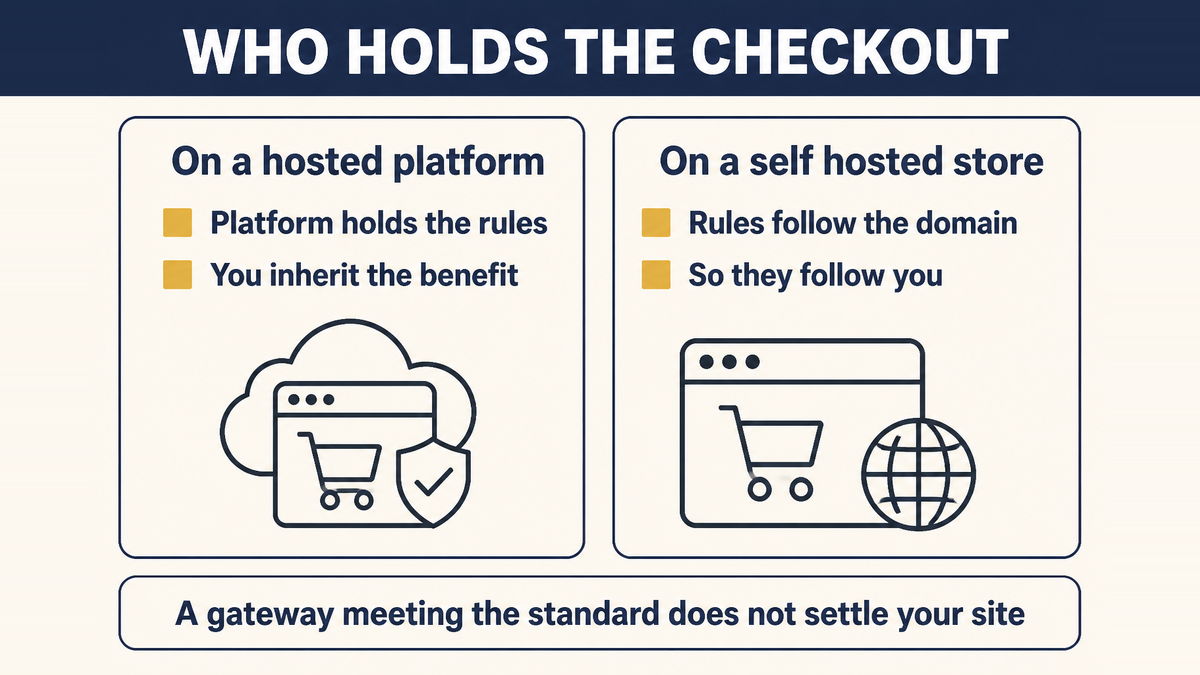
Security and the payment rules, and this is the part of the change that has no invoice line at all. On a hosted platform those obligations are held by the platform, which means you inherit the benefit of their controls without managing them. Self-hosting moves the responsibility for the storefront, the environment and the checkout page onto you, and the vendor's own documentation says so plainly rather than implying that meeting the standard at the gateway settles the matter.
Yes, WooPayments is PCI DSS compliant as a Level 1 service provider. That said, using WooPayments doesn't automatically make your entire site PCI compliant. While WooPayments handles payment processing in a PCI DSS–validated environment, your site still plays a role in presenting the checkout experience and must meet certain PCI requirements — especially around security and vulnerability management.
WooCommerce, PCI compliance documentation (read 14 October 2026)
The distinction in that passage is between two different things that share a name: the payment processing happening inside somebody else's validated environment, and the storefront that presents the checkout. The first can be outsourced completely. The second follows the domain, which means it follows whoever runs the domain. This is the cleanest available example of the general pattern, because it cannot be dismissed as vendor caution: the company selling you the platform is telling you that its product meeting the standard does not make your site meet it.
What that means in practice is not that you must become an expert, but that a question you never had to ask on a hosted plan becomes yours to ask. Which self-assessment questionnaire applies to a store where the checkout sits on my own domain, and what does the provider require me to attest? The correct answer depends on how the checkout is built, which varies between integrations, so the productive move is to put the question to your payment provider in those terms rather than assuming that a validated gateway closes it. The point is the shape of the change: an obligation that was somebody else's task list is now a line in yours.
The same structure applies to security more broadly. A self-hosted store has a public attack surface that you are responsible for keeping patched, and the work is not continuous so much as lumpy: long quiet periods punctuated by the week when an update goes wrong. That pattern is worth naming because it makes the cost easy to under-budget. A task that happens twice a year feels free in the month it does not happen, and the honest annual figure is the hours you spend when it does.
One thing this section is deliberately not doing: it is not telling you which self-assessment questionnaire you need, because the correct answer depends on how a particular checkout is implemented and that varies between integrations. Treat any article that states a single answer for all self-hosted stores as suspicious. Put the question to your provider with the architecture described, and keep their answer on file, because "we asked and this is what we were told" is a far stronger position than an inference from a blog post. If your store also sells into multiple countries, the record-keeping habit matters beyond payments, which is why our notes on what a customs broker actually does for you are worth reading alongside this.
5. Where Is Self-Hosting Genuinely Cheaper?
On card processing, and it is a real advantage rather than a rounding difference. The same pricing page that lists the hosting and extension costs also lists the processing rates it can offer, and they compare well against the rates a store pays when the platform chooses the processor for it.
Card payment processing — ~2.50-2.90% + 30¢ per transaction with WooPayments … 2.9% + 30¢ per transaction … 2.5% + $0.30 per transaction …
WooCommerce, platform comparison table (read 14 October 2026)
The reason this matters more than the fraction suggests is the same fixed-cost mechanic that decides whether small orders work at all. The percentage part of a processing fee is roughly the same across providers; the flat part and the exact rate are where the difference lives, and on a small basket a few tenths of a percentage point is a visible share of what is left over. A store selling mostly cheap items is more sensitive to this row than a store selling expensive ones, because the fixed component is charged per transaction regardless of basket size. Our earlier breakdown of what an order really costs once unit price becomes landed cost works the same arithmetic from the sourcing side.
The second genuine advantage is the one already described on the vendor's comparison table: unlimited markets at no charge, against a per-market monthly fee on several alternatives. For a store selling into several countries this is a recurring saving that has nothing to do with hosting, and it is frequently larger than the platform fee the store was trying to avoid. If you sell into three or more markets, this row alone can decide the question.
Note what these two advantages have in common. Both scale with activity, and neither is affected by how much maintenance you do. The processing saving grows as card sales grow, and the market saving grows as destinations grow. That leads directly to the property that makes the whole decision tractable: the advantages scale, and the costs do not.
6. How Do You Work Out Where Your Own Crossover Sits?
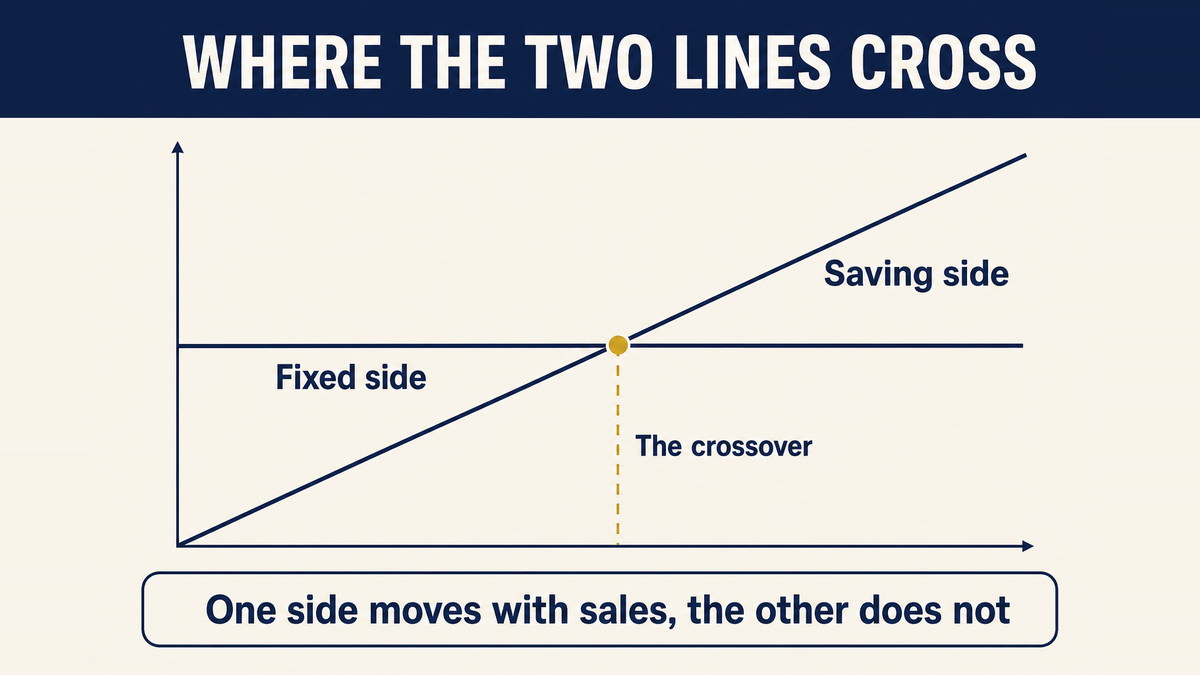
By putting the recurring costs on one side and the scaling advantages on the other, converting both to a year, and finding the sales figure at which they meet. The useful part is not the particular number; it is that a number exists, which means the choice is a calculation rather than a preference.
Take a worked example built only from the published rates above. A hosted store pays a platform fee of twenty-nine dollars a month, which is three hundred and forty-eight dollars a year. A self-hosted store pays hosting at the bottom of the published range, three hundred dollars a year, and carries a modest extension list at three hundred and fifty dollars a year. The processing gap is taken at its widest published end, four tenths of a percentage point in favour of the self-hosted store, with the same flat fee on both sides so it cancels out of the comparison.
Annual Cost at Two Sales Levels
| Line, per year | Lower volume | Higher volume |
|---|---|---|
| Card sales | $20,000 | $120,000 |
| Hosted platform fee | $348 | $348 |
| Self-hosted hosting and extensions | $650 | $650 |
| Processing advantage to self-hosting | $80 | $480 |
| Self-hosted advantage over the year | −$222 | +$178 |
The crossover in that example falls near seventy-five thousand dollars of annual card sales, which is a genuinely useful thing to know: below it the platform fee is the cheaper arrangement, and above it the processing gap overtakes the fixed costs and keeps widening. Two features of the shape matter more than the number itself.
The first is that the crossover moves further away as soon as you count your own hours. Maintenance is not in the table, so the figure above is the most favourable possible reading of the self-hosted case; every hour you spend updating, fixing or troubleshooting pushes the meeting point higher. The second is that the fixed costs are not fixed forever either, because hosting scales with traffic by design and the extension list grows with features. A store that outgrows its hosting tier and adds three more extensions can find its fixed side rising faster than its processing advantage, which is why the comparison should be re-run after a growth spurt rather than made once.
The honest summary is that self-hosting rewards stores with either high card volume or several destination markets, and penalises stores with neither. A new store with a small catalogue and a single market is usually paying for flexibility it is not yet using, which is not a criticism of the choice so much as a reason to make it deliberately rather than by default.
7. Which of the Two Suits a Dropshipping Operation?
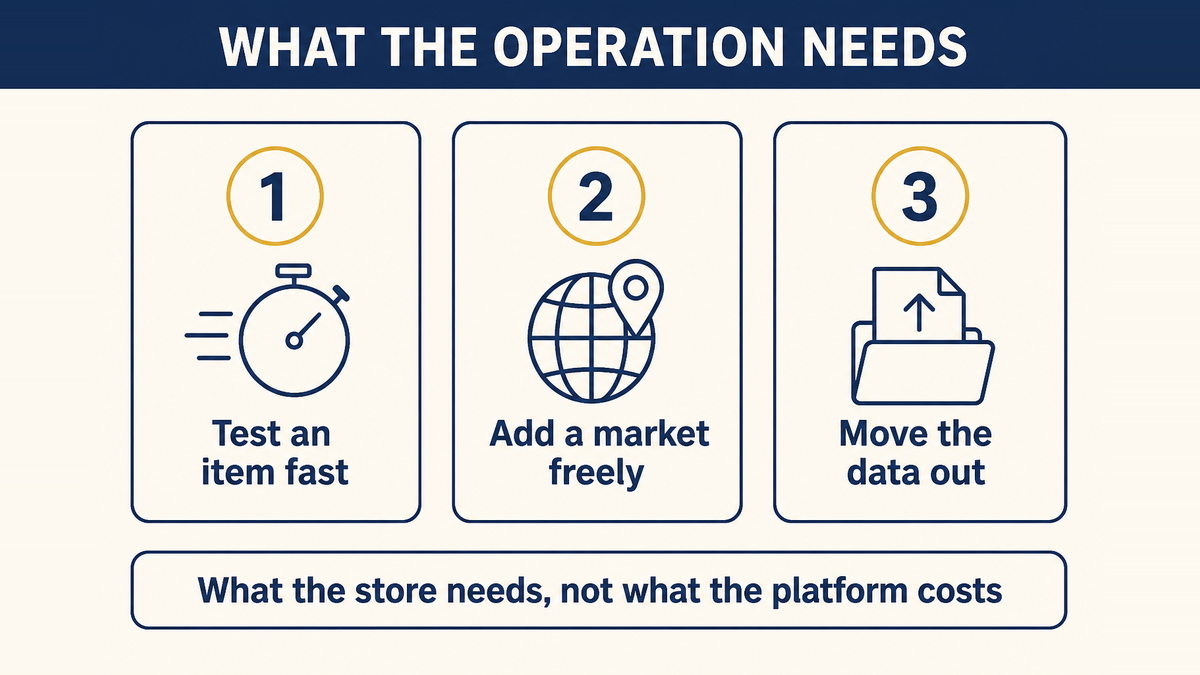
The one that lets you change products and suppliers fastest, because in this model that is the operation's only real lever. A dropshipping store's catalogue is a set of live experiments: items are tested, most fail, and the winners get reordered at volume or replaced by the next candidate. Whichever platform makes that cycle shorter is worth more than the gap between two monthly fees.
That consideration favours self-hosting more than the cost comparison does, for a concrete reason. The self-hosted side of the comparison offers unlimited markets at no charge and does not price per product or per variant, which means adding a test item, a new colourway or a new destination market is a content decision rather than a billing one. On a platform that charges per market, expanding a test into a second country has a monthly price attached, and the discipline that creates is welcome in a mature store and unwelcome in one that is still searching for its product.
The counterweight is speed of change in the other direction. A hosted plan gives you a store that works before you configure anything, and the first month of a new store is precisely when you have the least time and the least information. Buying into a subscription for a few months to find out whether the product works, and only then deciding whether the platform fee is worth displacing, is a defensible sequence. It also happens to be the sequence that makes the arithmetic easier, because by then you will know your card volume and can compare with a real number instead of a guess.
8. Frequently Asked Questions
Is WooCommerce good for dropshipping?
It removes the platform subscription and the product limit, which suits a store that swaps products often. WooCommerce's own pricing page states there is no monthly subscription, that hosting runs about 25 to 350 dollars a month for most stores and scales with traffic, and that extensions cost about 29 to 299 dollars a year each. The subscription has not disappeared, it has moved to a hosting renewal plus an extension list you control.
What is the hidden cost of self-hosting a store?
Meeting the rules, and maintenance. WooCommerce's own documentation states that using a payment provider that meets the PCI DSS rules does not automatically make your entire site meet them, because the site still presents the checkout and must meet its own security and vulnerability management requirements. On a hosted platform that obligation sits with the platform; on a self-hosted store it sits with you.
Is card processing cheaper on WooCommerce?
It can be, and that is the part of the comparison worth checking. WooCommerce's pricing page lists about 2.50 to 2.90 per cent plus 30 cents per transaction with WooPayments, against 3.49 per cent plus a fixed fee for PayPal Checkout and 2.99 per cent plus a fixed fee for standard card payments on PayPal. Since the fixed portion is charged per transaction, the gap widens on small baskets.
When does self-hosting become cheaper than a subscription?
When the annual hosting renewal plus the extensions you actually renew plus the hours you spend updating and fixing is less than the platform fee you would otherwise pay, counted over a full year rather than a month. Because the platform fee is fixed and your hosting and extension costs rise with traffic and feature count, the comparison usually holds at low volume and narrows as the store grows.
If my payment provider meets the PCI DSS rules, does my site have to as well?
The provider meeting the rules does not transfer your obligations. WooCommerce's own page makes the distinction directly: the provider handles payment processing in a validated environment, but your site still presents the checkout experience and must meet certain requirements, particularly around security and vulnerability management. Ask your provider which self-assessment applies to a store where the checkout sits on your own domain.
What You Take On That the Platform Used to Hold
We return the annual extension total, the duties you inherit by self-hosting, and the volume where that trade becomes cheaper.
Own My Cost List
Questions & Comments
We read every one and reply within 24 hoursTrying to decide whether the platform fee you would stop paying is worth the hosting, extensions and maintenance you would take on, unsure which payment compliance question to put to your provider, or wondering whether your card volume is anywhere near the crossover? Post your monthly card sales, how many markets you sell into and what you currently buy separately, and our team will help you work out which side of the line you are on.