
Investment Casting Manufacturer: Wax, Shell, Pour and Finish From China
 ·
Updated October 14, 2026
·
19 min read
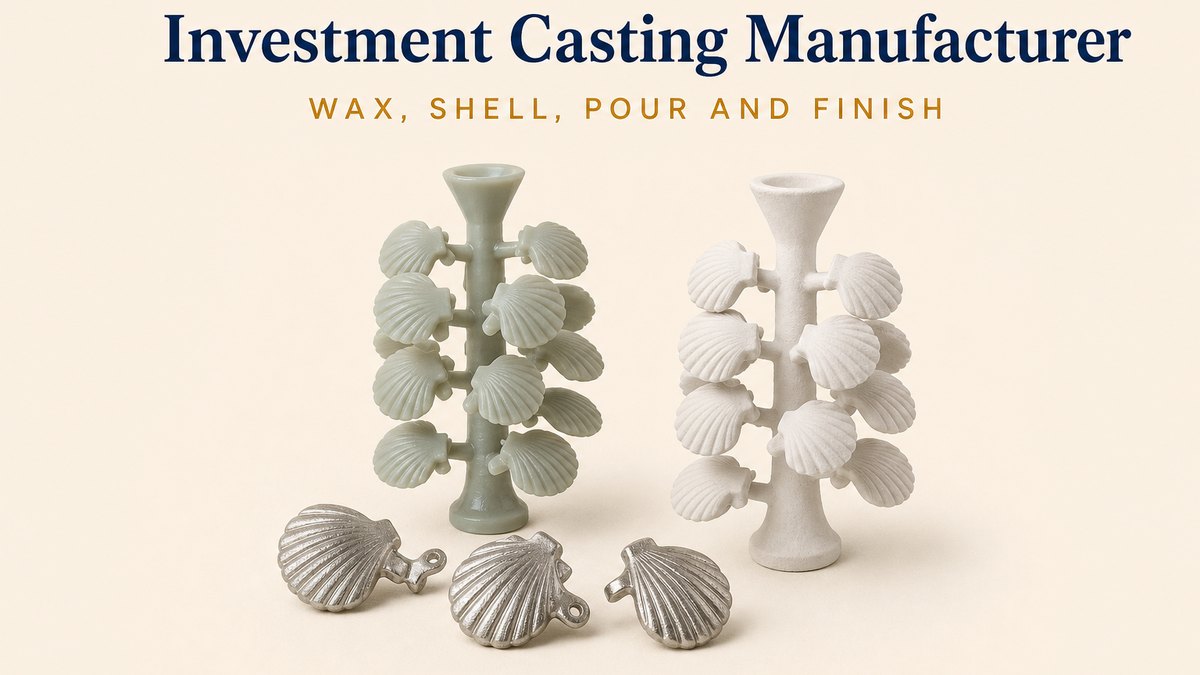
An investment casting manufacturer turns a wax copy of your part into a ceramic shell, melts the wax out, and pours metal into the space it leaves behind. The process exists for one reason: it holds fine detail and thin walls that a sand mould cannot, and it needs no draft angle, so a part can be made in the shape it will be used in rather than the shape a mould can be pulled from. The catch is that nearly all of your quality is fixed before any metal is poured. The wax pattern carries the shape, the shell carries the surface, and the pour and the finishing either keep that or spoil it. This guide covers the wax die, the shell build, the pour and cut-off, the grinding and blast cleaning that finish the part, the alloy certificate, and the paperwork a foundry should be able to hand you.
| Your part | What decides the choice | Where the cost sits |
|---|---|---|
| Thin wall, fine detail, no draft | The wax die and the number of shell coats | The die and the shell labour |
| Large and simple, high volume | Pour weight and mould cost | Sand casting is usually cheaper |
| A few hundred pieces a year | Whether a die is worth making at all | The die, not the part |
| A certificate with a heat number | Alloy control and laboratory testing | Testing and paperwork |
| A tight tolerance on a mating face | The machining allowance left on the casting | The machining steps after casting |
What Investment Casting Does That Sand Casting Cannot
Investment casting is the process to choose when the shape of the part is the problem, not the size of the order. A sand mould is made by packing sand around a pattern and then pulling the pattern out, which means the part has to be shaped so it can be pulled out, and the sand surface is coarse. Investment casting throws that constraint away because the mould is built around the pattern and then the pattern is destroyed. Nothing has to be pulled out, so there are no draft angles, no parting lines, and no limit on how fine the detail can be. Another name for the process is lost wax casting, and the name says what happens to the pattern: it is destroyed when the shell is fired, which is exactly why the mould can hold a shape a sand mould cannot.
The trade is that each part costs more to make and takes longer. Every piece needs its own wax pattern and its own shell, and the shell is built by hand, one dip at a time. That is why investment casting wins on valves, pump parts, impellers, instrument bodies, gun parts, and small brackets with awkward geometry, and loses to sand casting or die casting on a heavy, simple part made in large numbers. If your part is a flat plate with four holes, the process is the wrong one and a good foundry will say so.
The sensible way to think about it is in three bands. Sand casting is for large, simple, cheap parts where surface finish does not matter much. Die casting is for non-ferrous parts in very high volume, where the die price is spread across hundreds of thousands of pieces. Investment casting sits between them: more expensive per piece than both, but able to make a shape the other two cannot make at all. Where the shape is not the problem and the part is simple, a route such as machining the part out of solid bar instead is often the cheaper one, and it is worth pricing before the die decision is locked. A lot of buying mistakes come from choosing on price per piece before checking whether the other process can even hold the feature you need.
One more point decides more orders than it should. Investment casting is normally chosen for a part that will be machined afterwards, and the casting is deliberately made a little oversize on the faces that will be cut. That oversize, called the machining allowance, is a design decision rather than a foundry preference, and it belongs on your drawing. Leave it out and the foundry will pick a number, and the number they pick will be the one that makes their casting pass their own check rather than the one that lets you cut the face without hitting a hole. The same discipline that makes a specification sheet the foundry can actually quote from is what keeps the allowance under your control.
The Wax Pattern Is Where the Tolerance Is Decided
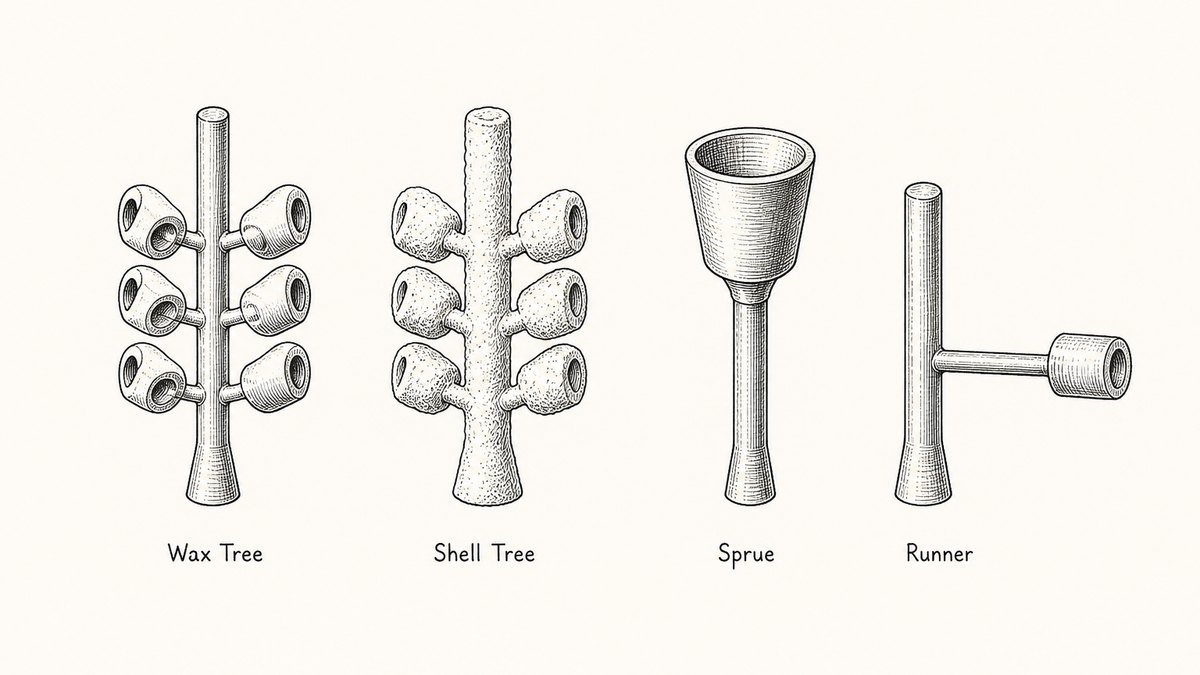
Most of the tolerance you will ever get is decided at the wax die, months before the first pour. Wax is injected into a metal die, cools, and shrinks as it does so. The die is therefore cut larger than the finished part by the amount the wax will shrink and the amount the metal will shrink later, and those two numbers are not the same for every alloy. This is why a die made for one stainless grade is not automatically right for a carbon steel part, and why the first samples exist.
The die is also the largest single line on a first order, and it is where the money is stuck if the order goes wrong. A die for a small part is a modest one-off cost. A die for a large part with several cores can cost more than the first year of castings, and it is useless to anybody but you. Ask for the die drawing before the die is cut, because a die cut for the wrong shrink factor is scrap, and nobody will pay for that twice out of goodwill.
Three things belong in the enquiry and are often left out. The alloy, because it sets the shrink factor. The surface finish on faces that will not be machined, because it decides how much hand work the die needs. And the quantity in the first order and the likely annual quantity, because that is what decides whether a hardened die or a softer, cheaper one is the better buy. A soft die wears and the parts grow with it, which shows up as a slow drift in dimensions rather than a fault.
Wax patterns are also damaged easily, and the damage is invisible until the shell is broken. A pattern dropped on the floor, or one with a nick where a runner was trimmed, becomes a casting with a lump or a hole in the same place. Good foundries inspect the pattern before it goes on the tree, and it is reasonable to ask what that check consists of. It costs nothing to ask and it is one of the few questions that separates a foundry from a workshop with a furnace.
Shell Building: How Many Coats, and What Each One Does
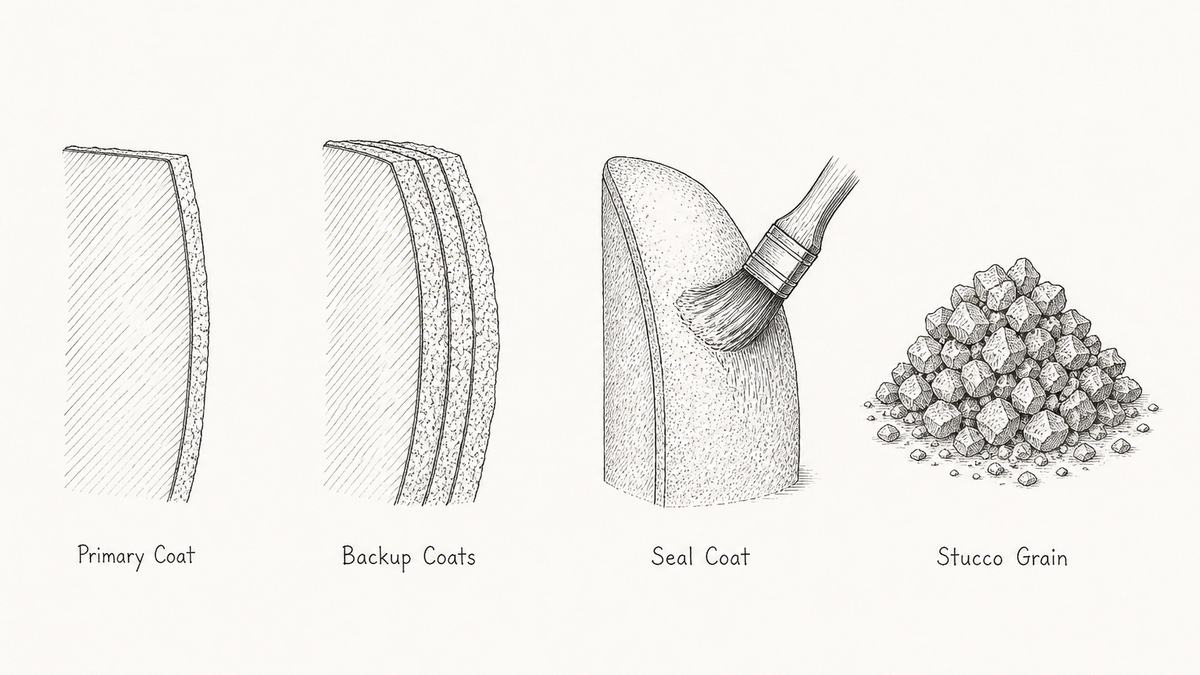
The shell is built by dipping the wax tree into a ceramic slurry and then raining dry ceramic grain over it, and repeating that cycle until the shell is thick enough to hold liquid metal. The first dip is the one that touches the part and it alone sets the surface finish. Every coat after it is there for strength. That is the whole logic of the shell, and it explains why adding coats never improves the surface: it only makes the shell stronger and slower and more expensive.
The grain changes as the coats go on. The first coats use a fine grain so the surface comes out smooth. The later coats use a coarser grain so the shell builds thickness quickly. The final coat is usually a seal coat that stops the sand from shedding into the furnace. The number of coats is chosen to suit the weight and the shape of the tree, because a heavy pour needs a shell that will not crack open under the metal.
Two things are worth asking about because they decide whether the surface you were promised is the surface you get. The first is the slurry control. A slurry that is not checked for thickness and pH drifts, and a drifting slurry shows up as a rough or blistered surface on a part that used to be fine. The second is the drying between dips. A shell dried too fast in moving air cracks. A shell dried too slowly takes days. Both are managed by rule rather than by feel in a foundry that knows what it is doing, so ask how the room is controlled and how often the slurry is tested.
Shells are also the reason an investment casting quote moves when the part changes. Changing the wall thickness changes how fast the wax cools and how the shell behaves, and changing the shape can mean a new dipping sequence. A revised drawing is not a cosmetic event in this process, which is why the drawing revision needs to be recorded on every order and matched to the die in the foundry.
Dewax, Burnout and the Furnace
Once the shell is dry, the wax has to leave without breaking it. There are two ways, and they are not equal. In a steam autoclave the tree is put under pressure and the wax melts and runs out, and most of it is recovered and used again. In a flash fire furnace the tree goes into a hot chamber and the wax burns off. The autoclave is kinder to the shell and the wax is reusable, which is why most foundries use it for anything valuable. The flash fire is faster and cheaper and it stresses the shell, so it is the method you find on low-cost work.
What follows is the burnout, and this is the step that decides the surface of the part more than any later operation. The empty shell is fired at a high temperature to burn out every trace of wax and to sinter the ceramic so it becomes strong. If the burn is incomplete, carbon is left behind, and carbon in the mould shows up on the casting as a rough patch or a surface that will not clean up. If the shell is overheated it can soften and slump. Neither fault is visible until the metal is poured, which is why the furnace record is worth asking for rather than assuming.
The furnace also sets one more choice that changes the whole cell. Thin sections need the metal to stay liquid long enough to reach the far end of the cavity, and the usual way to buy that time is to pour into a hot shell rather than a cold one. That means the shell comes out of the furnace and goes straight to the pour, and the two stations have to be close together and timed. A foundry that pours cold shells will tell you your thin wall is not castable. Sometimes that is true. Often it means the furnace and the pour are too far apart.
Pouring, Knockout and Cut-Off
The pour itself is short and the control around it is not. Metal is melted in an induction furnace, the alloy is adjusted to the specification, and the heat is given a number that follows every casting poured from it. That number is the whole basis of the certificate you will be handed later, so it is worth knowing that the numbering starts at the furnace rather than at the shipping desk. A heat number that appears for the first time on the packing list means the trace was made up at the end, which is not a trace at all.
Pour temperature and pour speed are the two variables the pourer controls, and both are set by the section thickness. Too cold or too slow and the metal freezes before it fills, which leaves a part of the casting missing. Too hot and the grain grows coarse and the metal can eat into the shell. Neither is something a buyer can check from a photograph, but both are recorded in a foundry that runs to a written practice, and asking to see that practice is a quick way to tell the two kinds of supplier apart.
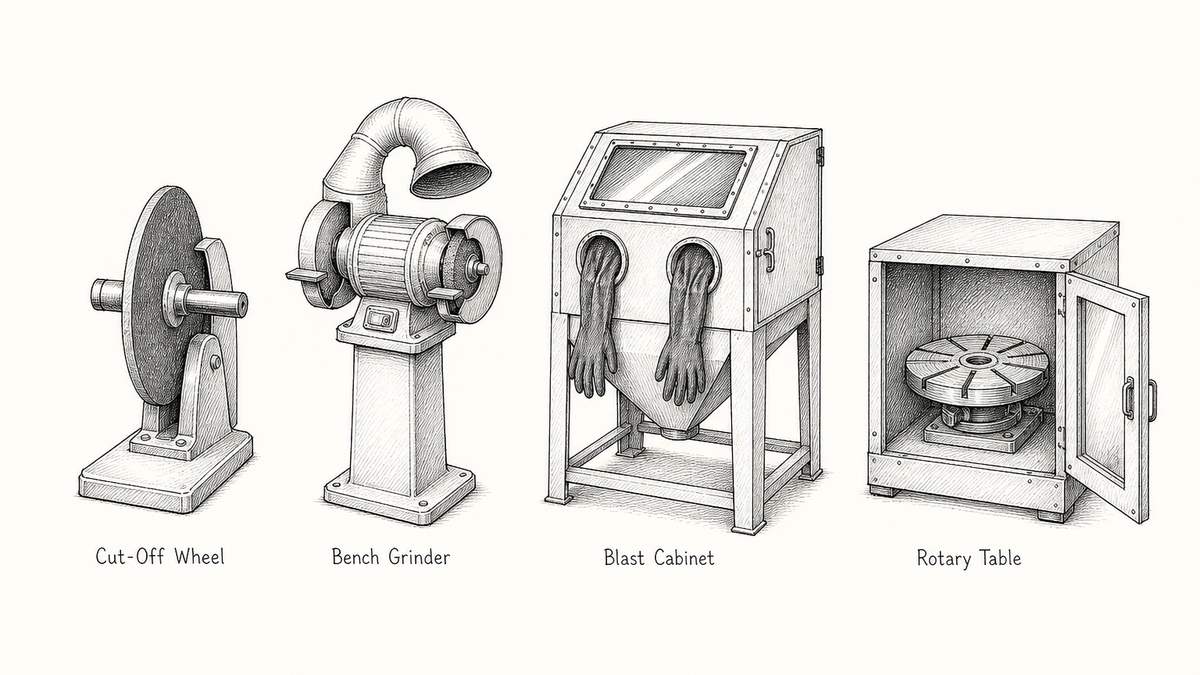
After the metal has set, the shell is broken off and the tree is cut apart. The shell is removed by vibration or by hand, and then each casting is cut off the central sprue. That cut is made with an abrasive cut-off wheel or a band saw, and it is the first operation where a person is holding a fast spinning wheel against a hard metal part. Everything after it, the grinding of the gate stub and the blast cleaning of the shell residue, happens in the same shop.
The Finishing Stage: Wheels, Cabinets and Blast Cleaning
The finishing shop is where a cheap quotation hides, and it is also the part of the order you can check without entering the building. Cutting the casting off the tree, grinding the gate stub flat, and blast cleaning the shell residue off the surface put fine metal dust and ceramic dust into the air, and in the United States that work is governed by the ventilation rule at 29 CFR 1910.94. The rule matters to a buyer because it is written in numbers, and a foundry that runs to those numbers is a foundry that will keep running when an inspector arrives.
The blast cleaning half of that rule is paragraph (a), and it covers every operation where an abrasive is forced onto a surface by air pressure, by water pressure or by centrifugal force. The core requirement is that a blast-cleaning enclosure must be exhausted so that air keeps flowing inward at every opening the whole time blasting is going on. Nothing may escape outward. To hold that, all air inlets and access openings have to be baffled so the combination of inward flow and baffling keeps abrasive and dust out of the next work area, and no visible spurts of dust may be seen at all.
Three details of the same paragraph are the ones that reveal how a shop is really run. Small access openings have to carry slit abrasive-resistant baffles fitted in several sets, and those baffles have to be inspected on a routine and replaced when worn. Blast room doors have to open from both the inside and the outside, so nobody can be trapped inside a dust-filled room. And in a setup where the abrasive is reused, the exhaust system may not be used to take the fines out of the spent abrasive; a separate abrasive separator has to be provided for that job. An exhaust that is quietly doing two jobs is an exhaust that is overloading a dust collector.
The grinding half is paragraph (b), and it comes with the two numbers worth memorising. Wherever dry grinding, polishing or buffing is done and the exposure of an employee exceeds the limits set elsewhere in the same part of the rules, a local exhaust system has to be provided and used. That system has to pull not less than a stated volume of air for each wheel, and the table runs by wheel size: a wheel up to nine inches across needs a minimum of 220 cubic feet a minute, a wheel over sixteen up to nineteen inches needs 500, and a wheel over thirty up to thirty-six inches needs 1,200. The duct has to be sized for a recommended air speed of 4,500 feet a minute in the branch pipe and 3,500 feet a minute in the main.
Two things about the grinding rule make it useful at the point of order. The hood has to be placed so the dust falls or is thrown into it in the direction of the air flow, and no wheel may be run in a way that throws dust into the operator's breathing zone. That is a statement about which side of the wheel the operator stands on, and it is decided when the bench is installed rather than when the wheel is bought. So when you ask a foundry for the wheel sizes used on your part, you are also asking whether the benches behind them were built to the number in that table.
The same paragraph then covers the person. Abrasive blasting respirators have to be worn by every operator working inside a blast cleaning room, employers may only use respirators approved under 42 CFR part 84, and a respiratory protection programme at 29 CFR 1910.134 has to sit behind them. Air for those respirators must be free of harmful dusts and gases and meet the supplied-air quality rules. It closes with a housekeeping point that catches more shops than any of the engineering: dust may not be left to build up on the floor or on ledges outside the enclosure, and walkways have to be kept clear of steel shot and similar abrasive because it is a slipping hazard.
None of this is exotic and none of it is expensive at the design stage. It is what separates a quote of one price from a quote of another, because a finishing shop with the right wheels, the right guards, the right cabinet and the right exhaust costs more to run than one without them. When a quotation is materially cheaper than the others, the finishing shop is one of the first places the difference is hidden, and the four questions above, wheel size, cabinet type, baffle condition and whether doors open from inside, will find it.
| Finishing operation | What sets it | What to insist on |
|---|---|---|
| Cutting the part off the tree | The wheel type and the size of the gate | A guard in place and the right wheel for the metal |
| Grinding the gate stub flat | Wheel diameter and the metal being ground | Local exhaust sized to the wheel, not to habit |
| Blast cleaning shell residue | Cabinet type and the abrasive used | Inward air flow at every opening, all the time |
| Final dressing for the customer | The surface the buyer will see | A written finish sample kept on file |
Which Alloys Are Poured, and How to Read the Certificate
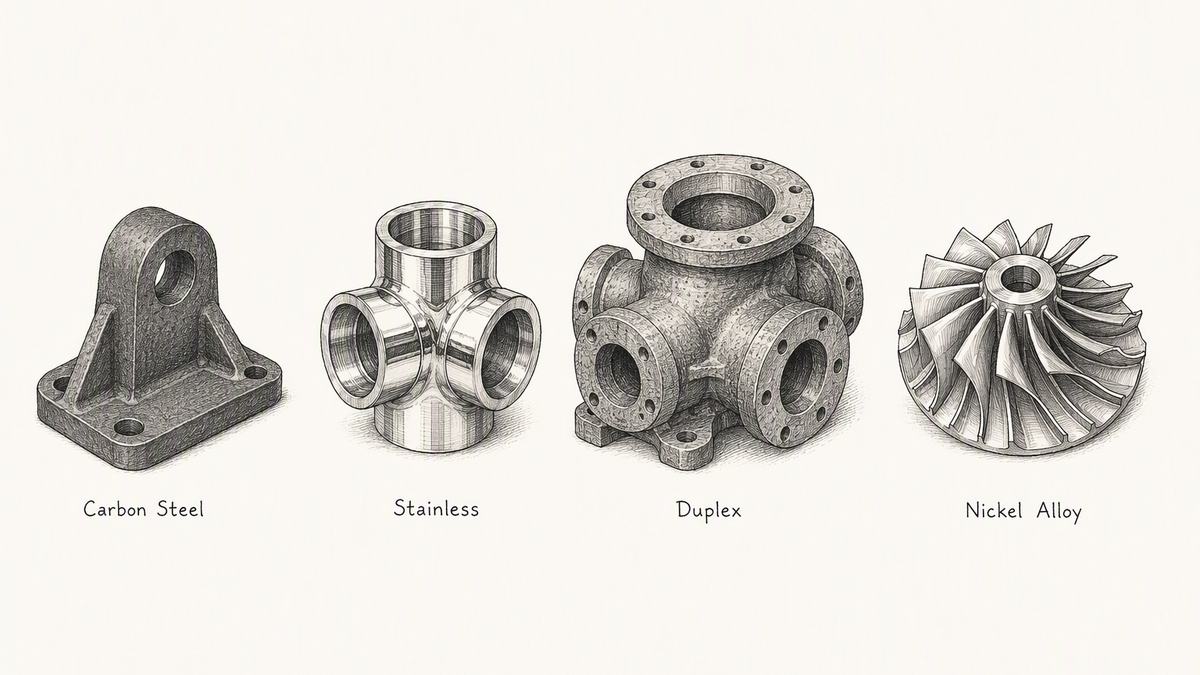
The alloy is not a preference, it is the thing the drawing names, and it decides the shrink factor, the pour temperature and the heat treatment. Carbon and low alloy steels are the everyday work. Stainless steels such as the 304 and 316 grades cover most corrosion-resistant parts. The precipitation-hardening grades give high strength with modest corrosion resistance. Duplex and super duplex stainless are used where the part meets seawater or a chemical. Nickel-base alloys handle high temperature and aggressive chemistry, and cobalt-base alloys handle wear at heat. Aluminium and copper alloys are poured where weight or conductivity matters.
What you should expect on the quotation is the exact specification, not the family. A part made to a recognised specification such as a cast stainless grade carries a known chemistry range and known minimum mechanical properties, and both can be tested. A quotation that says only that the part is stainless has told you nothing you can hold anybody to, because there are dozens of stainless grades and they do not interchange.
The certificate is where most buyers are fooled, and it happens in a friendly way. A mill certificate for the bar or ingot that went into the furnace is not evidence about your casting. It is evidence about the input. What you want is the chemistry of the heat that was actually poured, the mechanical test results from a test bar cast from the same heat, the heat treatment record, and the heat number marked on the casting itself. When all four line up on one number, the trace is real. When only a mill certificate arrives, the chain stops at the furnace door.
Two smaller points are worth knowing. Certificates come in grades of authority, and the difference is who signs. One grade is a statement by the manufacturer that the material meets the order. The higher grade is that statement backed by the results of specific tests on the specific heat, countersigned by an independent party. If your customer's own paperwork demands the higher grade, say so at enquiry stage, because it changes the price and it has to be arranged before the pour rather than after. And a test bar has to be cast properly to mean anything. A bar poured separately from a different heat, or poured badly, gives results that describe the bar rather than your part.
What the Foundry's Air Permit Actually Covers
A foundry that melts and pours metal is watched for what leaves the melt and the pour, not only for the dust in the finishing shop. In the United States that work sits under the iron and steel foundries air-emission rule at 40 CFR 63 Subpart EEEEE, and the shape of that rule tells a buyer something useful about the supplier in front of them.
The rule applies to a foundry that is a major source, which is defined by quantity: ten tons or more a year of any single listed hazardous air pollutant, or twenty-five tons or more a year of all of them added together. Below those figures the foundry falls under a different, lighter set of duties. The distinction is set at the plant level, so it is a question about the site rather than about your order.
What the rule names is the interesting part, because it is effectively a list of the equipment a foundry has to control and therefore has to keep records on. It covers metal melting furnaces, scrap preheaters, pouring areas, pouring stations, automated conveyor and pallet cooling lines, automated shakeout lines, and mold and core making lines. It also covers the fugitive emissions from foundry operations, which is the dust and fume that escapes the equipment rather than passing through it. A foundry that is a major source was split into existing and new plants against a date in December 2002, and that date decides which set of limits applies.
For a buyer, three practical things come out of this. The first is that a properly permitted foundry holds records for its melting and pouring operations, and those records are the same ones that show whether a heat was poured to a written practice. Asking for the furnace and pour records is asking for something the shop already has to keep. The second is that the permit puts a ceiling on how much metal a site may melt, so a claimed capacity that sits far above what the permit allows is a claim worth questioning. The third is about scrap, because the scrap charge is the main route by which unwanted elements enter a heat. Ask whether incoming scrap is separated by grade and whether the charge mix is recorded per heat. It is a fair question with a yes or no answer, and the answer tells you how the furnace is run.
Inspection, Gauges and the First Article
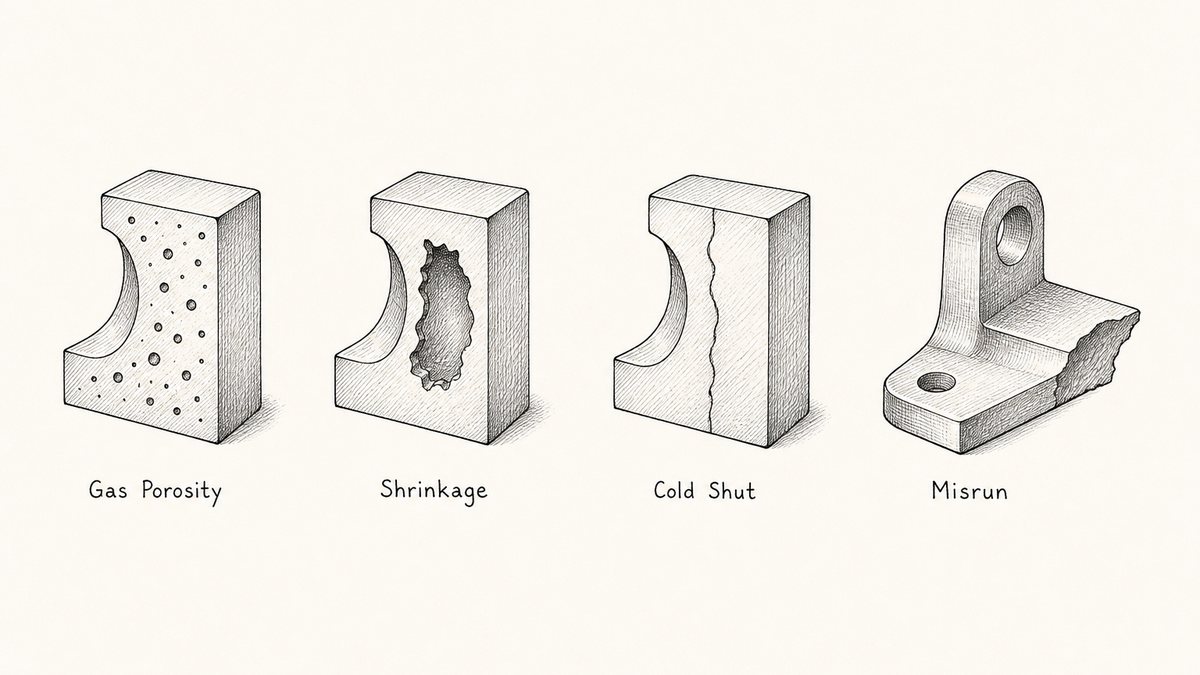
A casting can be dimensionally perfect and still scrap, because the faults that sink a part are usually inside it. Gas porosity, shrinkage, a cold shut where two streams of metal met without joining, and a misrun where the metal stopped short are all created in the pour and all invisible from outside. That is why the inspection plan has to be agreed before the first pour rather than discovered at the first failure.
Start with the dimensional side, and insist on a first article report with real numbers in it. The first part off a new die should be measured against every dimension on the drawing and the report signed, so that both sides are looking at the same measurements before a production run starts. A report full of tick marks and the word okay is not a report. Ask also which gauge was used and when it was last calibrated, because a gauge that has drifted makes every later measurement wrong in the same direction.
Then decide what non-destructive checks your part needs, and put them on the drawing. A dye penetrant check finds faults that reach the surface. A magnetic particle check does the same job for iron and steel and can find slightly deeper ones. A radiograph looks inside the wall and finds porosity and shrinkage that nothing else will. Foundries rarely volunteer these checks because each one costs money, so a part that needs them has to say so in the specification. If your part is safety related or holds pressure, one of them is not optional. A casting that becomes a pressure-retaining body on finished equipment sits in exactly that group, and the testing the finished item has to pass reaches back and dictates what the casting has to prove.
Two habits turn inspection into something you can rely on. Keep the sample. The first approved casting, signed and dated and stored, settles arguments about finish and colour years later. And make sure your own inspection and the foundry's inspection are measuring the same thing the same way, ideally by both checking the same part and comparing the two reports. That comparison is faster than any argument about a dimension, and it is the same discipline as a pre-dispatch check on the finished goods, moved back to the first part instead of the last carton.
Who Owns the Wax Die
The wax die is usually the largest single payment on a first order and the asset most easily lost, so it deserves a clause rather than a handshake. If you paid for it, it is yours. Put that in writing, along with the fact that it stays in working order and is returned to you or moved to another foundry on request. A die that is yours on paper and sitting in somebody else's rack is still a die you cannot use.
Ask what the die life is, in number of injections, and who pays when it wears out. A die does not fail suddenly. It wears, and the parts grow with it, so a die that has run twice its stated life produces castings that drift out of tolerance while the foundry reports that the dimension was fine at approval.
The die also has to be looked after between orders. Dies rust and warp in storage, and a die stored badly for a year comes back needing work before it can run. Ask where it is kept and what is done to it between runs. If the answer is a shelf in a damp corner, plan for a die repair line on the next order.
The last point is the one buyers miss. A die on its own is not the process. The wax injection pressure and temperature, the cooling time, the shell schedule, and the alloy and pour practice are all set for that part, and a die moved to a new foundry without them has to be re-developed from the beginning. So ask for four documents rather than one: the die drawing, the wax pattern drawing with the shrink allowance written on it, the injection parameters, and the shell schedule. A supplier who can hand over all four is handing over the job. A supplier who can hand over the die and nothing else is handing over a lump of steel.
How to Compare Two Quotations Line by Line
Two quotations for the same casting cannot be compared unless they describe the same thing, and the fastest way to find out is to ask both for the same nine lines. Everything else on the page is padding.
The per-piece price has to come with the quantity it is priced at and the weight of the part. A price with neither is not a price, because the cost of a casting falls sharply as the quantity rises and rises quickly with weight. Then the alloy specification, named rather than described. Then what is cast and what is machined, with the machining allowance shown on the drawing rather than left to the shop. Then the finishing standard, as a written sample or a stated surface requirement. Then the certification and the grade of certificate. Then the die cost and the ownership clause. Then packaging, because a rough crate is how a good casting arrives bent. And finally the point at which your risk starts, since a price that excludes freight and duty is not the price you will pay.
| Line on the quotation | What good looks like | Why it matters |
|---|---|---|
| Per-piece price | Stated at a named quantity and a stated weight | A price with no quantity is not a price |
| Wax die | One-off cost, with a drawing and an ownership clause | The die is yours only if it says so |
| Machining allowance | Shown on the drawing, not assumed by the shop | Who machines it decides who owns the tolerance |
| Certification | Heat number traced to your own castings | A mill certificate for the input is not evidence |
| Finish | A written sample kept on file, dated | The last operation is the one the buyer sees |
Once both quotations describe the same part, the choice is usually obvious, and the differences are small enough to be settled with a question rather than a re-quote. For the wider picture of where a casting sits in a machine order and which neighbouring families are bought alongside it, the industrial machinery category these castings belong to is the place to start.
Questions Buyers Ask Before Ordering
What is the difference between investment casting and sand casting?
Sand casting packs sand around a pattern and then pulls the pattern out, so the part has to be shaped so it can be pulled out and the mould surface is coarse. Investment casting builds a ceramic shell around a wax copy of the part and then destroys the wax, so nothing has to be pulled out. That means no draft angles, no parting line and much finer detail. The price is that every piece needs its own wax pattern and its own hand-built shell, so the cost per part is higher and the lead time is longer. For a large, simple part in volume, sand casting is usually the cheaper answer.
How much does a wax die cost, and who owns it?
A die for a small part is a modest one-off cost. A die for a large part with several cores can cost more than the first year of castings. The rule to insist on is simple: if you paid for the die, the die is yours, and that has to be written into the order rather than agreed verbally. Also ask what the die life is in number of injections and who pays for replacement. A die past its stated life keeps working, but the parts slowly grow, so the tolerance you approved quietly stops being the tolerance you receive.
Why does my casting have a rough patch on the surface?
The surface is set by the first ceramic coat and by the burnout, not by anything that happens after the pour. A rough patch usually means one of two things. Either the slurry drifted and its thickness or chemistry was out of range when your tree was dipped, or the burnout was incomplete and carbon was left behind in the shell. In both cases the fault is in a process the foundry can record and does not always record. Ask for the slurry test record covering your production dates and the furnace record for the burnout, and the answer is usually in one of them.
What is a heat number, and why does it matter?
A heat number is the number given to one melting in the furnace. Every casting poured from that melt shares it, along with the chemistry of the melt, the mechanical test results from a test bar cast from the same melt, and the heat treatment record. Those four items tied to one number are what makes a certificate worth anything. A mill certificate for the bar or ingot that went into the furnace is not the same thing, because it describes the input rather than your casting. Ask for the heat number marked on the casting itself and check it matches the paperwork.
What does the machining allowance mean on a casting drawing?
It is the extra metal deliberately left on faces that will be cut later, so the casting is a little oversize where the machining happens. It is a design decision rather than a foundry preference, and it belongs on your drawing. Leave it out and the shop will choose a number, and the number it chooses will be the one that makes its own casting pass rather than the one that lets you cut the face without breaking into a hole or thinning a wall. State the allowance on every machined face and say clearly which faces are cast to final size.
What is the biggest risk when ordering castings from China?
The risks that actually bite are the ones upstream of the pour: a die cut with the wrong shrink allowance, a shell schedule that is not followed, and a heat whose number cannot be traced to your castings. None of those can be checked from a photo of the finished part, and all three are cheap to prevent with paperwork. Require the wax pattern drawing with the shrink allowance on it, the shell schedule, and a heat number traced to your castings with the chemistry and test results behind it. Add a measured first article report and you have removed most of the exposure.
Fix the die before you fix the price
Send the drawing, the alloy and the annual quantity. We will check the die cost against the volume, put the machining allowance on the drawing where it belongs, ask for the heat number on the casting and the four documents that travel with the die, then hold the order until the first article is measured.
Request a Casting Quote
Questions & Comments
We read every one and reply within 24 hoursThe argument is almost never about the metal. It is about the die that sets the tolerance before the first pour, the shell that sets the surface, and the heat number that decides whether the certificate means anything. Send us the drawing, the alloy and the annual quantity, and we will settle those three before a foundry quotes.