
Dropshipping Profit Margin: The Fixed Costs That Decide It
 ·
Updated October 13, 2026
·
16 min read
A margin figure on its own tells you almost nothing. The number that matters is not the percentage on the product, it is what remains in your account after one order has been bought, packed, posted, paid for and advertised. Those last three costs behave very differently from the first one, and the difference explains why two stores with identical markups can end up in opposite places.

The Four Layers Between Price and Profit
| Layer | How it behaves | Why it matters |
|---|---|---|
| What the product costs | Scales with the order. | The only layer most margin guides discuss. |
| What delivery costs | Close to fixed per parcel. | Barely falls when the order gets smaller. |
| What the payment costs | Part percentage, part fixed amount. | Charged on the total, including the shipping you collected. |
| What the customer cost to win | Fixed per order, whatever the basket. | Does not shrink just because the product is cheap. |
What this guide covers
1. Why Can a 60% Margin Still Lose Money?
Because a gross margin is calculated on the product, and most of what you pay out is not about the product. Gross margin compares the selling price with the cost of the goods. It is a useful figure for a manufacturer, whose other costs are largely fixed and shared across everything it makes. It is a misleading figure for a store, because a store pays several costs on every single order.
The three that get left out of the gross figure are delivery, payment processing and the cost of winning the customer. Delivery is a parcel, and a parcel has a price whether the item inside sells for nine dollars or ninety. Payment processing takes a percentage of everything collected plus a small flat amount per transaction. Advertising takes a fixed sum per acquisition, and that sum does not fall because the product is cheaper.
That is why the same 60% markup produces one healthy store and one struggling one. The percentage is identical. The costs underneath it are distributed differently, and the store whose orders are smaller is carrying the same fixed costs across less revenue.
2. What Does One Order Really Cost?
The clearest way to see it is to write an order out in full, using posted rates rather than assumptions. Card processing on an online payment is a percentage plus a small flat amount, and the published rate most stores start on is stated plainly by the processors themselves.
Online — applies to card payments made online or through an invoice — 2.9% + 30¢.
Square, published online payment rate. PayPal lists 3.49% plus a fixed fee for Checkout and 2.99% plus a fixed fee for standard card payments on its merchant fee schedule
Take an order with a selling price of $49.00 and free delivery, where the item costs $12.00 from the supplier and the parcel costs $6.50 to send. The payment fee is 2.9% of $49.00, which is $1.42, plus the flat 30 cents, giving $1.72. Subtract all three from the price and $28.78 is left, which is 58.7% of what the customer paid.
Now the same arithmetic on a cheap item, priced at $9.99 with free delivery. The product costs $2.10 and the parcel still costs $6.50, because a small parcel is a small parcel. The payment fee is 2.9% of $9.99, which is 29 cents, plus the flat 30 cents, giving 59 cents. Subtract the three and 80 cents is left, which is 8.0% of what the customer paid.
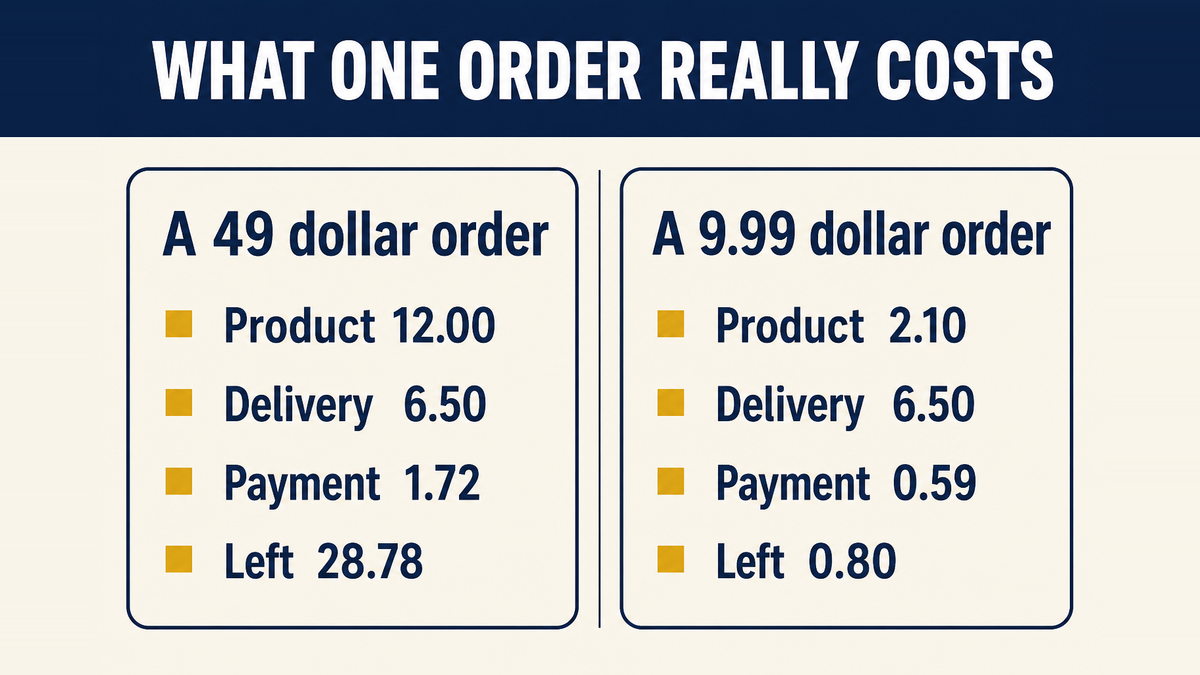
Both of those orders look similar on a product page and both would be described the same way in a marketing post. One leaves enough behind to pay for advertising and growth, and the other leaves less than the price of a coffee.
There is a further detail worth noticing in the payment fee. It is charged on the whole amount collected, and if free delivery is built into the price then part of what you collected was never yours. The fee is taken on the delivery money as well as on the product money, and nothing on the order page shows that.
3. Why Do Small Baskets Lose Money?
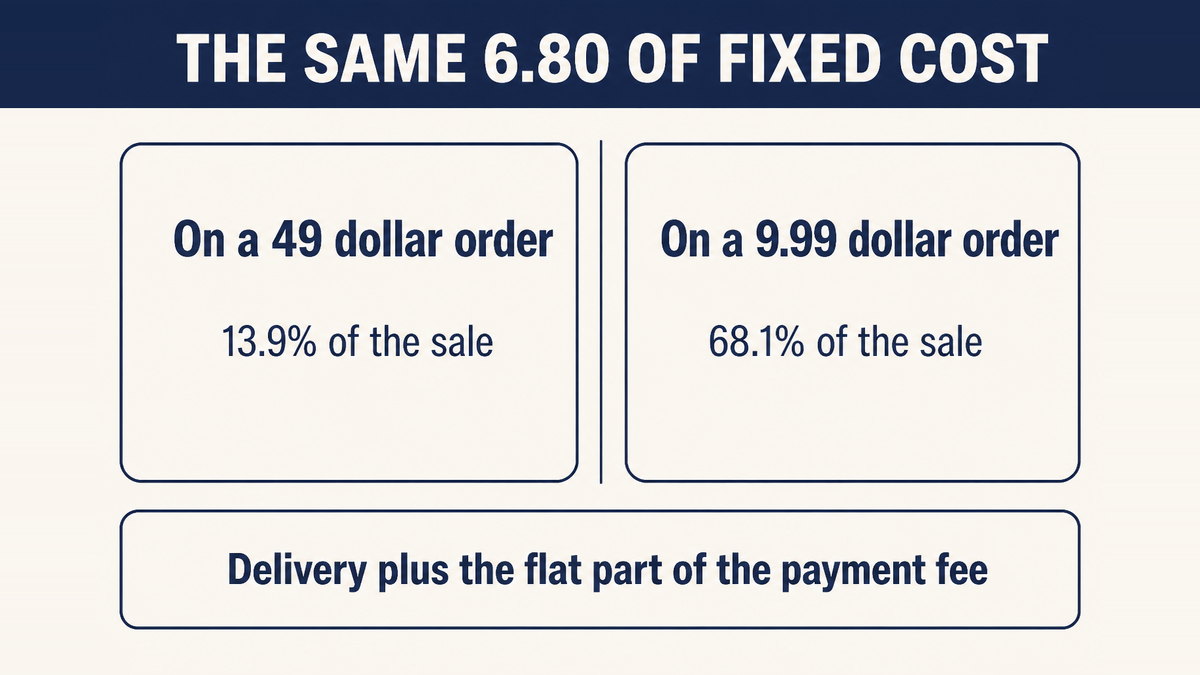
Because two of the four costs are flat. Delivery is $6.50 whether the parcel holds a $49 item or a $9.99 one, and the flat part of the payment fee is 30 cents on both. That is $6.80 of cost that does not move when the price moves.
Written as a share of the order, the same $6.80 is 13.9% of the $49 sale and 68.1% of the $9.99 sale. Nothing about the business changed between those two numbers. The only difference is how much revenue that fixed cost had to hide inside.
There is a further fixed cost that rarely appears in these comparisons, and it is the store itself. A platform subscription is charged every month whether the store takes ten orders or a thousand, and on some plans an extra percentage is charged on sales taken through payment providers other than the platform's own. Shopify's published plans put the entry tier at 27 dollars a month billed monthly, or 20 dollars a month billed yearly, with a 1% fee on sales processed through third-party payment providers on that tier. For a store turning over a thousand nine-dollar orders, a subscription is a real slice of the 800 dollars those orders leave behind.
This is the opposite of the usual advice in the category, which is to find a cheap product and sell a lot of it. Volume does not repair a per-order deficit; it multiplies it. A store selling a thousand cheap orders at 80 cents of contribution has made 800 dollars for a thousand parcels of work, and one bad week of returns can take all of it back.
The useful conclusion is not that cheap products are always wrong. It is that a cheap product has to earn its place differently. Either the parcel has to cost less to send, which is a question about weight and size, or something else has to travel in the same box, which is a question about what the customer buys alongside it. Both are sourcing decisions rather than marketing ones.
Run the two columns before you choose a product. For each candidate, write the price, the product cost and the parcel cost, then work out what is left. A product that leaves less than two dollars per order is not a cheap product, it is a product that has already spent its own margin on delivery. Our guide to what an order really costs from unit price to landed cost covers the buying side of that sum, and the difference between CIF and FOB terms covers the charges that arrive at the destination port and surprise people.
4. What Does a Refund Actually Cost?
More than the price you gave back. A refund cancels the revenue and returns the product, if it returns at all, but it does not cancel the costs that were already paid to send the order out.
Take the $49 order again. You collected $49.00 and paid $1.72 to process the payment, so $47.28 reached you. You then refund $49.00 in full and pay $6.50 for the parcel that has already left. The product cost $12.00 and did not come back. Add those together and the order has cost you $20.22.
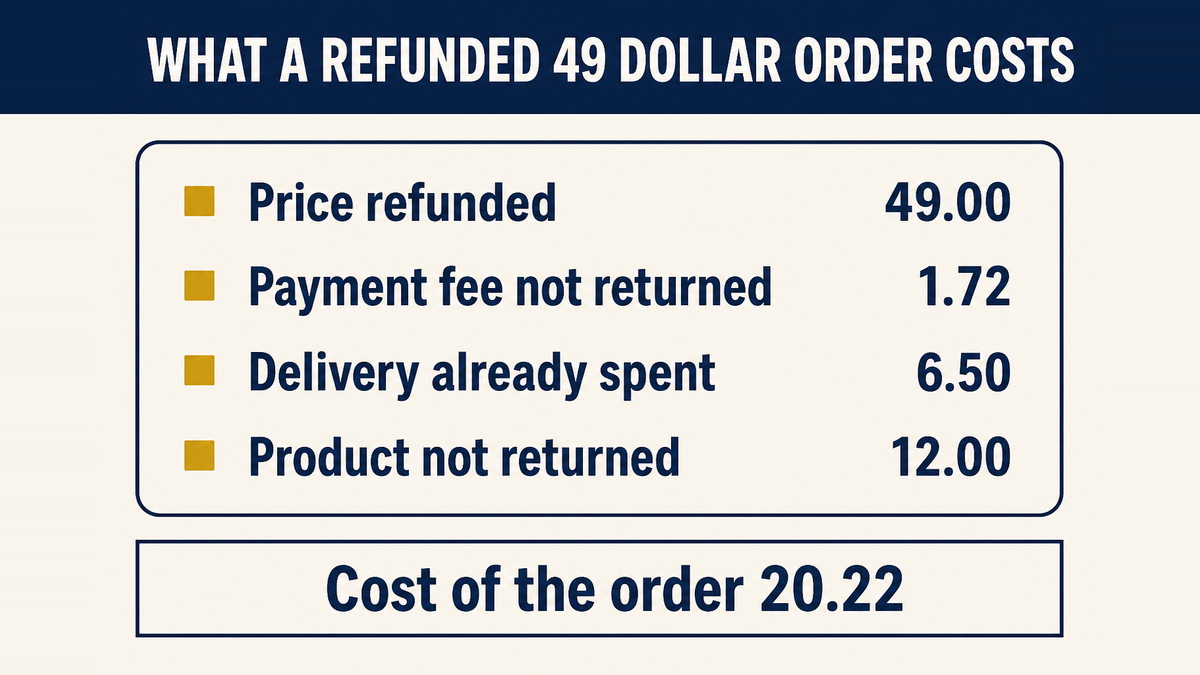
Now put that against the contribution the order would have earned. Twenty-two dollars of loss against $28.78 of profit means a refund rate of roughly one order in fourteen is enough to remove a tenth of the store's profit, and it does so in one of the least visible ways there is, because every individual refund looks like a single unhappy customer rather than a line in the accounts.
The same event is far worse on a small basket. A refunded $9.99 order costs $9.19, and that order was only earning 80 cents, so one refund wipes out more than eleven good orders of the same size. This is the strongest argument in the category for controlling what you can control: sizing that fits the first time, and an inspection before the goods ship, so the parcels that go out do not come back.
5. What Does Acquisition Cost Do to the Picture?
It turns a thin margin into a negative one, because the cost of winning an order is the least flexible number in the whole calculation. You cannot ship an ad more cheaply for a cheaper product, and you cannot ask a platform for a smaller fee because your basket is small.
Set the two orders side by side. The $49 order leaves $28.78, so it can absorb up to $28.78 of advertising and still break even. The $9.99 order leaves 80 cents, so any acquisition cost above 80 cents makes every sale a loss.
That is the arithmetic behind a pattern most people meet as a surprise. A store with a small basket can look busy and still never reach profitability, because growth increases the number of orders without changing the amount each one contributes. Spending more on advertising makes it worse rather than better, and the natural response, which is to sell more to cover the shortfall, is the thing that accelerates it.
Do not judge a product by its margin percentage alone, and do not judge it by its unit cost either. Two products can both cost the same to buy and have completely different value to you, because one is dense and light and the other needs a large parcel. The parcel is part of the product.
6. How Do You Fix It Without Raising Prices?
By changing the shape of the order rather than the number on the price tag. Almost every lever that works does so by spreading the fixed costs over more revenue or by reducing the fixed costs themselves.
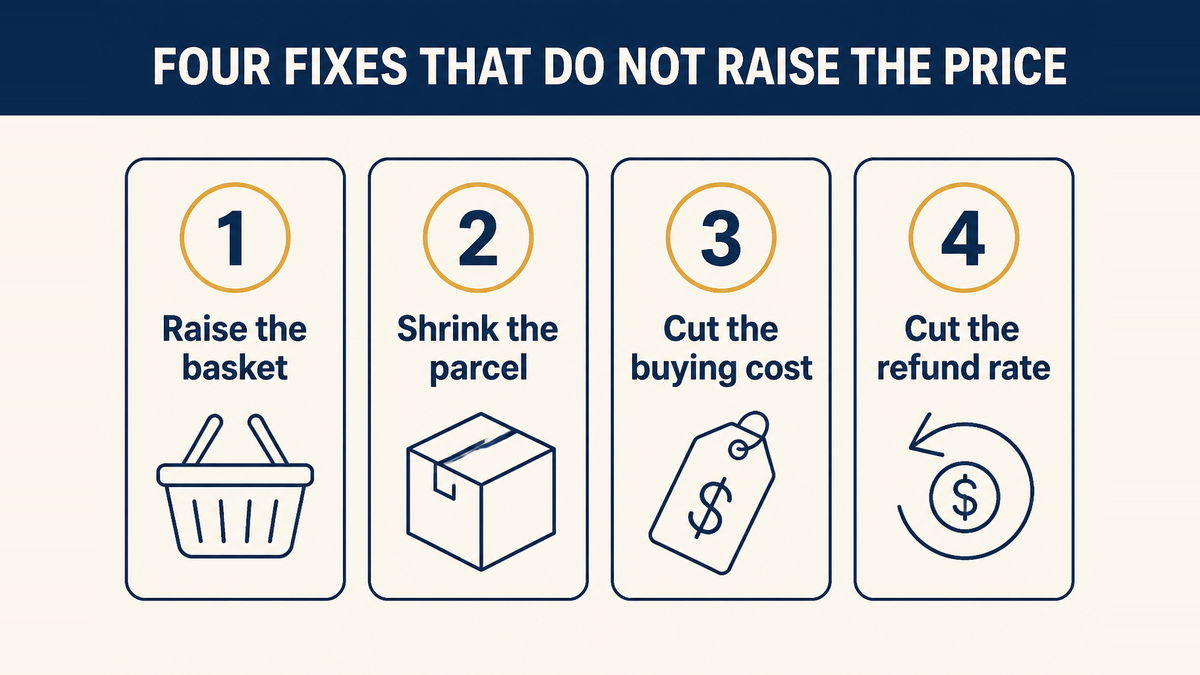
- Raise the basket, not the price. A second item in the same parcel costs almost nothing extra to send and adds its whole contribution. Bundles, multipacks and a free-delivery minimum all do the same work, and a minimum is often the single quickest change available.
- Shrink the parcel. Delivery is the largest fixed cost in the list, so reducing weight and volume is the most direct saving there is. Flat-pack, nesting and a box that fits the product all cut it, and our guide to moving from per-order fulfilment to holding stock covers what changes when you buy in quantity and ship from the customer's side of the border.
- Cut what you pay for the goods. This is the lever everyone reaches for first, and it is usually the smallest, because the product is the one cost that already scales with the order. It is worth doing at volume, and it is worth understanding properly rather than assuming, which is what our guide to sourcing agent fees and our notes on finding duty rates are for.
- Cut the refund rate. Refunds are the one cost on the list that is entirely about your own choices, and they are the most expensive per event. Fitting guidance that is measured rather than copied, and an inspection before the batch ships, remove most of them, and our comparison of what a dropshipping platform charges for shows how much of a supplier's price is service and how much is markup.
Sorted by effect, the order is not the one most sellers work in. Raising the basket is faster and larger than squeezing the supplier, and shrinking the parcel is larger than both. If you are still choosing what to sell, our notes on picking a product that sells cover the demand side, and it is worth reading them alongside the sums above rather than before them.
7. Frequently Asked Questions
What is a good profit margin for dropshipping?
A margin is only useful next to the costs it sits above. A store can show a 60% gross margin on the product and still lose money once delivery, payment fees and advertising are paid, so the number to watch is what is left after every cost, per order.
Why do small orders lose money in dropshipping?
Because delivery, the payment fee and the per-order handling charge are close to fixed. The same fixed cost is a small share of a large basket and a large share of a small one, so a cheap product sent with free shipping can be left with almost nothing once the parcel has been paid for.
How much does a refund cost?
More than the price. The payment fee is not returned when you refund, the outward freight is already spent, and the product may not come back in a sellable state. On a 49 dollar order that works out at about 20 dollars lost.
Do payment fees apply to shipping and tax?
They apply to the whole amount collected, so a fee charged on the total includes whatever you collected for delivery. That is worth remembering when free shipping is built into the price, because the fee is then charged on money that was never going to be yours.
How do I increase profit margin without raising prices?
Raise the average order value rather than the price. Bundles, a higher minimum for free delivery and larger pack sizes all spread the same fixed cost across more revenue, which lifts the margin without changing what any single item appears to cost.
One Order, Every Line, Including the Refund
We return a single-order profit line with the refund provision, the acquisition cost and the fee, so the percentage means something.
Build My Order P&L
Questions & Comments
We read every one and reply within 24 hoursNot sure whether a product leaves enough behind to pay for advertising, running a small basket that looks busy but never becomes profitable, or working out what a refund rate is really costing you? Post the product, the selling price and your parcel cost, and our team will help you work out the contribution per order.