
Hammer Mill Manufacturer: Rotors, Screens and Hammer Sets From China
 ·
Updated October 13, 2026
·
27 min read
A hammer mill breaks things by hitting them. A rotor turns fast inside a chamber, hammers on the rotor strike the material, and the pieces keep being struck until they are small enough to pass through a screen around the rotor. It is bought on capacity and output size, and it is accepted or rejected on three things the quotation almost never shows — whether the rotor is built to be rebalanced and rehammered, whether the screen and the chamber can be changed without a workshop, and whether the drive guard and the dust enclosure answer to a rule that already has a number in it. All three are drawing decisions, and all three are cheap at that stage and expensive afterwards.
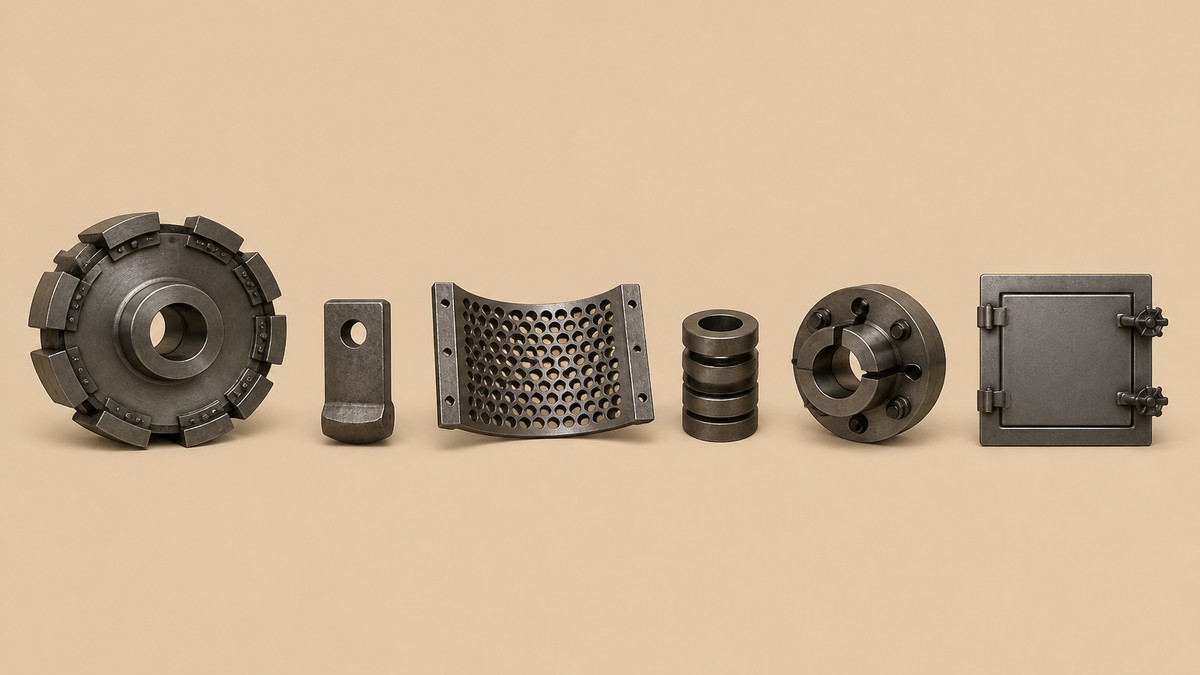
Six Lines That Decide Whether a Mill Order Is Complete
| What the buyer has to settle | Why it is not obvious | The line on your order that closes it |
|---|---|---|
| Capacity at the output size you actually want | Throughput is quoted at a coarse setting and falls sharply as the screen gets finer | Tonnes per hour at a stated screen, not a single headline figure |
| The screen, as a supplied part rather than a category | Hole size, open area and plate thickness all change the product and the wear life | Screen hole size, hole pattern and thickness, with a spare set in the order |
| Hammer type, material and how they are held on | Swung, fixed and staggered rotors behave differently, and the hammer is the wear part | Hammer type and material by name, with the pin or bolt arrangement stated |
| Whether the rotor can be rebalanced in place | A hammer change unbalanced the rotor, and the next failure is a bearing | Balance facility, hammer set matched by weight, and lifting points on the rotor cover |
| The guard on the drive, against the rule that covers it | One rule measures the exception with a number, and the number is not obvious | Guarding drawn and dimensioned, or the clear distance shown as a figure |
| What the air rules require of the enclosure | Capture system, enclosure and single-bin baghouse each sit on a different branch of the rule | Which enclosure route is being used, and the figure that has to be met |
What a Hammer Mill Manufacturer Actually Sells You
A hammer mill factory builds the chamber, the rotor body and the base frame. It buys the hammers or casts them, buys the screen plate or perforates it, buys the bearings, the coupling, the motor and the hard facing. The split matters more here than on most machines in this category, because the parts that wear are the parts the factory may not make.
The machine itself is simple enough to describe in six parts, and each one carries a specific kind of trouble.
- The rotor
- A shaft carrying one or more discs, with hammers mounted on pins or bolted to the faces. It is the heaviest rotating mass on the machine and it is the part that decides both the grind and the bearing life.
- The hammers
- Rectangular or shaped bars that strike the material. They are the wear part, they are bought in sets, and a set that is not matched by weight will unbalance the rotor the moment it is fitted.
- The screen
- A curved perforated plate or a set of bars that wraps part of the rotor and lets finished material out. Its hole size is the single biggest control over the output; its wear is the biggest cause of a product drifting out of specification.
- The chamber and liner
- The housing around the rotor, usually lined with replaceable plates because the material scours the inside as it is thrown around. A liner is a consumable, and a chamber with no liner is a chamber that will be scrapped.
- The feed
- A chute, a hopper or a feeder delivering material into the path of the hammers. On a mill fed by gravity, the feed arrangement decides how evenly the rotor is loaded, and an uneven load is what shakes a mill apart.
- The drive
- Motor, belts or a coupling, and the guard over them. A hammer mill starts under a heavy inertia load, so the starting duty sizes the drive rather than the running power.
The ancillaries around the mill decide whether it can run a shift, and they are usually bought from other factories. Material arrives from above, and on most installations that is a bucket elevator that sets the feed rate into the mill. It leaves below through an air-assisted or mechanical takeaway, and a screw conveyor matched to the mill's discharge rate is what sits under the outlet on most plants. Get either of those two wrong and the mill's own capacity figure becomes a number on paper.
There is one thing a hammer mill is often asked to do that it cannot do, and it is worth saying at the start because it is the most common disappointment. A hammer mill does not make a precise particle size. It makes a spread of sizes with a top end set by the screen, and the only way to narrow the spread is to slow the throughput or to add a classifier. A buyer who needs a tight distribution is looking for a different machine, or for a mill followed by a screen. A quotation that promises both a high throughput and a narrow cut from the same mill has not been thought through.
The Rotor: Hammers, Spacing and Tip Speed
The rotor is where the energy goes in, and three of its properties decide everything downstream: what the hammers are, how they are held, and how fast the tips travel.
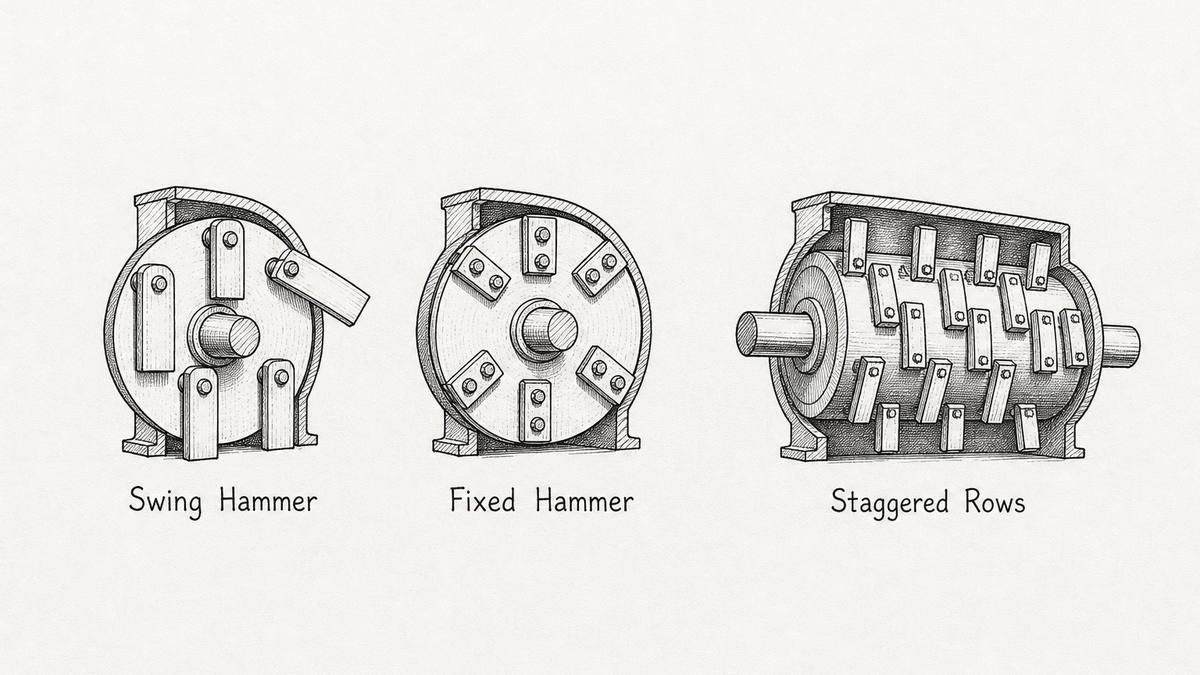
- A swung rotor
- Hammers hang loosely on through pins and are free to swing back. When something the mill cannot break arrives — a piece of tramp metal, a rock — the hammer folds out of the way instead of snapping, and the shock is not passed into the shaft. This is the usual arrangement for mixed and unpredictable feed, and it is the more forgiving of the two.
- A fixed rotor
- Hammers are bolted rigidly to the disc faces. The rotor holds its shape as it wears, so the tip clearance to the screen stays more even and the output stays more consistent. The cost is that a shock has nowhere to go: an unbreakable object either shatters or takes a rotor pin, a bearing or the shaft with it.
- A staggered rotor
- Hammers are set in several rows along the length of the rotor, each row sweeping a different path so the whole width of the chamber is covered. This spreads the load, lets the mill be built long without the material passing down one side untouched, and is what makes a wide mill work at all.
The hammers themselves are described by material and by the way they are fixed, and both should be on the order. Manganese steel work-hardens under impact and is the default for abrasive rock; a hard-faced carbon or alloy steel hammer is cheaper and is the usual choice for softer and more consistent feed; a tipped hammer is used where the tip has to last and the body does not. What a buyer should not accept is the word standard on the hammer line, because on this machine the hammers are most of the running cost.
Tip speed is the figure that connects the three. A slow rotor at a large diameter and a fast rotor at a small diameter can produce the same tip speed, and it is the tip speed rather than the revolutions that does the breaking. The value is chosen against the material: a soft, brittle material breaks at a lower tip speed and grinding it harder only makes more fines and more dust, while a tough material needs the speed before it will break at all. Ask for the tip speed as a figure and ask what material it was chosen for, because a mill quoted on revolutions alone cannot be compared with anything.
One mechanical point belongs here because it is the difference between a mill that can be maintained and one that cannot. The rotor has to be rebalanced after hammers are changed, and that means the rotor must be liftable out, or the housing must give access to the rotor in place, with the bearing housings able to take the rotor's weight while it is checked. A mill where a hammer set change requires the rotor to be cut free of a coupling has turned a one-shift job into a week, and the plant will respond by running worn hammers far too long. That is a drawing decision about lifting points, access covers and coupling type, and it costs almost nothing to get right.
The Screen Decides the Product
The screen is the machine's only real control over what comes out. Material stays inside the chamber being struck until it is small enough to pass, so the hole size sets the top of the size range and the open area sets how fast the mill can clear itself. Everything else on the mill is a way of getting material to the screen and away from it.
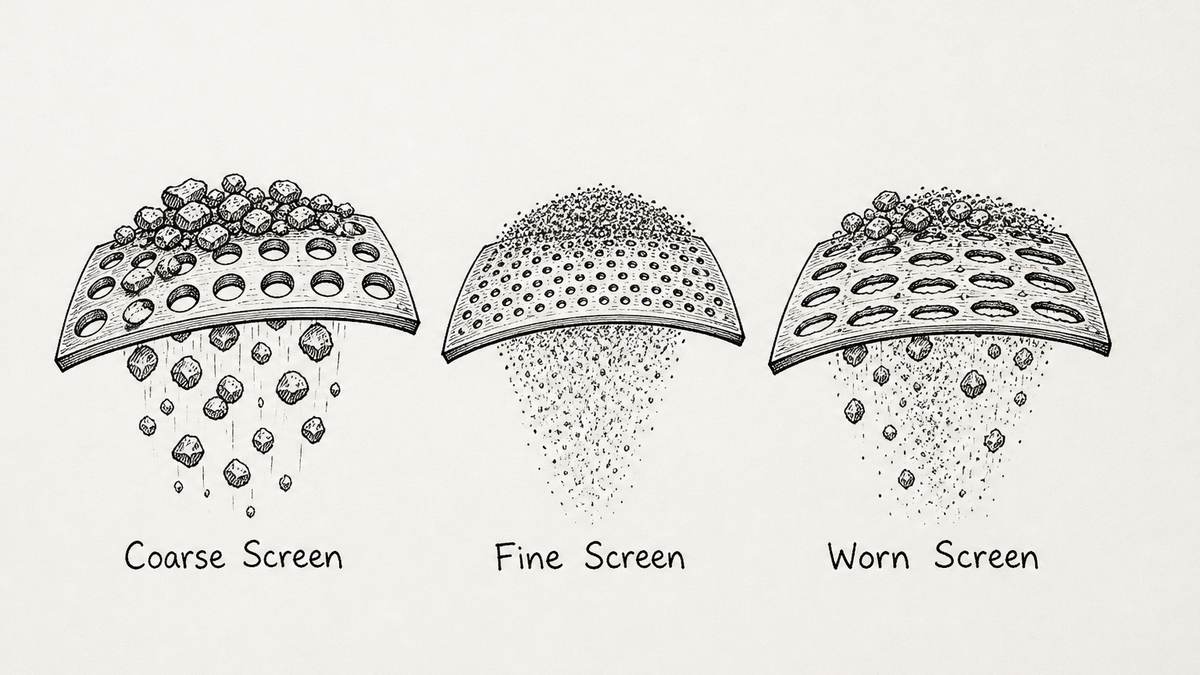
Four screen properties are worth fixing on the order, and each one is a figure rather than a description.
- Hole size
- The stated opening, and the thing that sets the top end of the output. A screen change of one step in hole size can move the product from on-specification to unsellable, which is why the spare set matters as much as the fitted one.
- Hole pattern and open area
- How much of the plate is hole rather than metal. More open area lets the mill clear itself faster and raises throughput at the same hole size, at the cost of a weaker plate that wears and stretches sooner. Round holes in a staggered pattern are the usual default; other patterns trade open area against strength.
- Plate thickness
- Thicker plate lasts longer and reduces the effective open area, because the holes become short tunnels and material bridges across them. Thin plate gives better throughput and wears out faster. The right figure depends on how abrasive the material is, which is a fact only the buyer has.
- How the screen is held in
- The least considered and the most felt item. A screen that drops in behind a hinged door and is held by two hand nuts can be changed in minutes; a screen that is bolted through the chamber wall from inside takes a shift. The plant's willingness to change screens on schedule, rather than when the product is already out of specification, follows directly from this.
One failure deserves its own warning because it is invisible until it is expensive. A screen does not only wear thinner; it also deforms. The holes closest to the feed end take the hardest hits and stretch into ragged ovals, and once that happens the product contains a fraction that is coarser than the screen was chosen to pass — a mixed output like the third panel in the figure. Nothing on the machine reports it. The stack of evidence is a product complaint, and by then several tonnes have been made. This is the argument for a screen thickness and hole check at every scheduled stop rather than a visual glance, because the change is gradual and the person looking has seen the same screen every week.
Two supporting details belong in the enquiry with the screen. The first is a spare set, in the thickness and hole size originally chosen rather than whatever the factory has in stock in six months' time. The second is a way to seal the screen against the chamber so that no material bypasses it. A screen that sits in a groove with a worn seal lets oversize material through around the edges rather than through the holes, and that failure looks exactly like a worn screen while the screen itself is still new.
Hammers Are a Wear Part, and the Order Should Say So
On most machines in this category the wear parts are a line in the maintenance budget. On a hammer mill they are the running cost, and treating them as an afterthought is how a mill ends up producing an inconsistent product with a vibration nobody can explain.
Three things about hammers decide how well they work, and all three are procurement decisions rather than operator decisions.
The set has to be matched by weight. A hammer mill rotor is balanced as an assembly. Replacing four of twelve hammers, or mixing a new hammer with worn ones, puts the rotor out of balance, and the first symptom is not a bad grind — it is a bearing that runs hot and then fails. The practical answer is to buy hammers in matched sets, to change them all at the same time, and to keep sets together from the moment they arrive rather than tipping them into a bin.
The working edge has to be described. A hammer wears at the edge that does the striking — the rounded stub in the failure figure later in this article is what a worn hammer actually looks like. Some rotors allow hammers to be turned round or reversed to present a second and third edge before replacement, which turns one set into three lives at no extra cost. Whether the rotor allows that is a detail of how the hammers are drilled and how the pins are set, and it should be asked about explicitly, because it changes the running cost by a large factor.
The pins and bolts are wear parts too. The pins that carry swung hammers wear oval, and the bolts on a fixed rotor wear at the shank. Once a pin is oval the hammer no longer sits square, the tip clearance changes, and the strike becomes uneven around the rotor. Pins are cheap; a rotor that has been run on oval pins is not.
What should be on the order is therefore a short list rather than a word: the hammer material by name, the number of hammers, whether they can be reversed, the pin or bolt material and size, the number of spare pins in the first order, and the instruction that a replacement set must be weight-matched to the original. A factory given that list will quote a mill whose hammers can be maintained. One given the word standard will quote a mill whose hammers must be replaced as a habit.
What the Air Rules Make You Build
A hammer mill throws a great deal of dust, and in the United States the rules that follow that dust are federal, specific, and written as requirements on the facility rather than as good advice. They are worth reading before the enclosure is designed, because the route the plant takes changes what has to be built.
The first question is whether the rule applies at all. The answer is narrower than most people expect, and it is set out in 40 CFR 60.670, which lists the facilities it covers:
“(a)(1) Except as provided in paragraphs (a)(2), (b), (c), and (d) of this section, the provisions of this subpart are applicable to the following affected facilities in fixed or portable nonmetallic mineral processing plants: each crusher, grinding mill, screening operation, bucket elevator, belt conveyor, bagging operation, storage bin, enclosed truck or railcar loading station…”
A grinding mill is named in that list. So a hammer mill grinding mineral in a fixed or portable mineral processing plant is an affected facility, while the same mill in a food plant or a biomass plant is answering to a different set of rules entirely. That single sentence is the reason this section is worth reading rather than assuming.
The next question is what is required of it, and 40 CFR 60.672 splits the answer in two depending on whether the dust is captured:
“(b) Affected facilities must meet the fugitive emission limits and compliance requirements in Table 3 of this subpart within 60 days after achieving the maximum production rate at which the affected facility will be operated, but not later than 180 days after initial startup as required under § 60.11. The requirements in Table 3 of this subpart apply for fugitive emissions from affected facilities without capture systems and for fugitive emissions escaping capture systems.”
Read as a buyer, that paragraph says something commercially useful: a mill with no capture system is not exempt. It is held to the fugitive limits instead, and the same applies to dust that gets away from a capture system that is working badly. So a capture hood is not a way of avoiding the rule; it is a way of changing which limit applies and of making that limit reachable rather than theoretical.
The third part is the one that decides the building, and it is where the specific figures appear:
“(e) If any transfer point on a conveyor belt or any other affected facility is enclosed in a building, then each enclosed affected facility must comply with the emission limits in paragraphs (a) and (b) of this section, or the building enclosing the affected facility or facilities must comply with the following emission limits: (1) Fugitive emissions from the building openings (except for vents as defined in § 60.671) must not exceed 7 percent opacity; and (2) Vents (as defined in § 60.671) in the building must meet the applicable stack emission limits and compliance requirements in Table 2 of this subpart.”
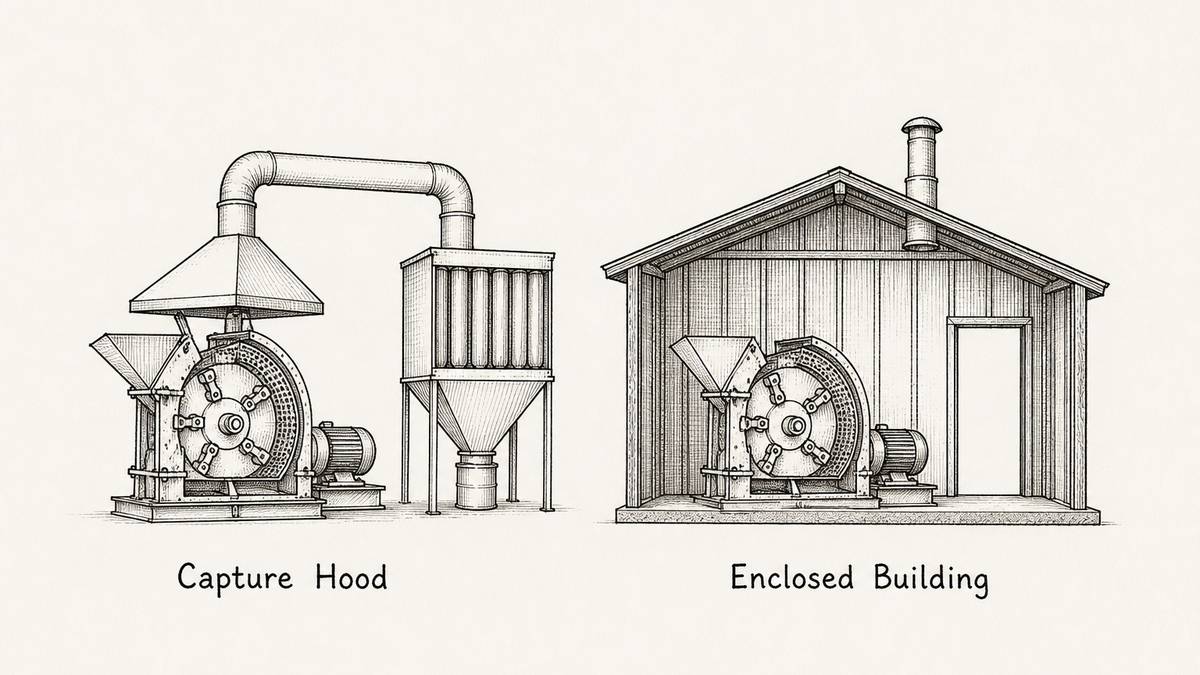
That paragraph is the whole design brief for the building, and it turns a vague idea of dust control into two checkable numbers. An enclosed facility must either meet the capture limits component by component, or the building as a whole must hold its openings to 7 percent opacity and send its vents to the stack limits. Seven percent opacity is a visible-emission test, not an instrument reading: it is a plume observation made by a trained observer, and a plant that has never had its doorway looked at does not know whether it is inside that figure.
One further paragraph is worth carrying into the equipment order, because it changes what the filter has to be designed for:
“(f) Any baghouse that controls emissions from only an individual, enclosed storage bin is exempt from the applicable stack PM concentration limit (and associated performance testing) in Table 2 of this subpart but must meet the applicable stack opacity limit and compliance requirements in Table 2 of this subpart. This exemption from the stack PM concentration limit does not apply for multiple storage bins with combined stack emissions.”
The exemption exists, and it disappears the moment two storage bins are combined onto one stack. A plant that plans to add a second bin later should know that the change takes the filter out of the exemption and puts the concentration limit and its performance test back onto the equipment. That is a decision being made by a layout drawing, and it is much cheaper to make it deliberately at the enquiry stage than to discover it after a second bin is installed.
Two practical consequences follow for the order. Ask which of the two enclosure routes the plant intends to use, because it changes whether the money goes into hoods and ductwork or into the building. And ask whether the filter is being bought against a concentration limit or only against an opacity limit, because the two do not require the same machine. Behind the mill, the dust that is captured has to go somewhere, and the air that carries it is moved by a centrifugal fan sized on the duct resistance rather than the mill's air volume — the fan is chosen against the system it sits in, not against the machine it serves.
The Guard Rule Has a Number In It
The drive on a hammer mill is a large motor turning a belt or a coupling at close range, and the guard over it is the part of the machine most often quoted as a word — guarded — and least often drawn. There is a rule that turns it into two figures, and the second one surprises people who have not read it.
The rule is 30 CFR 57.14107, and it lists what has to be guarded with unusual directness:
“(a) Moving machine parts shall be guarded to protect persons from contacting gears, sprockets, chains, drive, head, tail, and takeup pulleys, flywheels, coupling, shafts, fan blades; and similar moving parts that can cause injury.”
Then it provides the exception, and the exception is measured:
“(b) Guards shall not be required where the exposed moving parts are at least seven feet away from walking or working surfaces.”
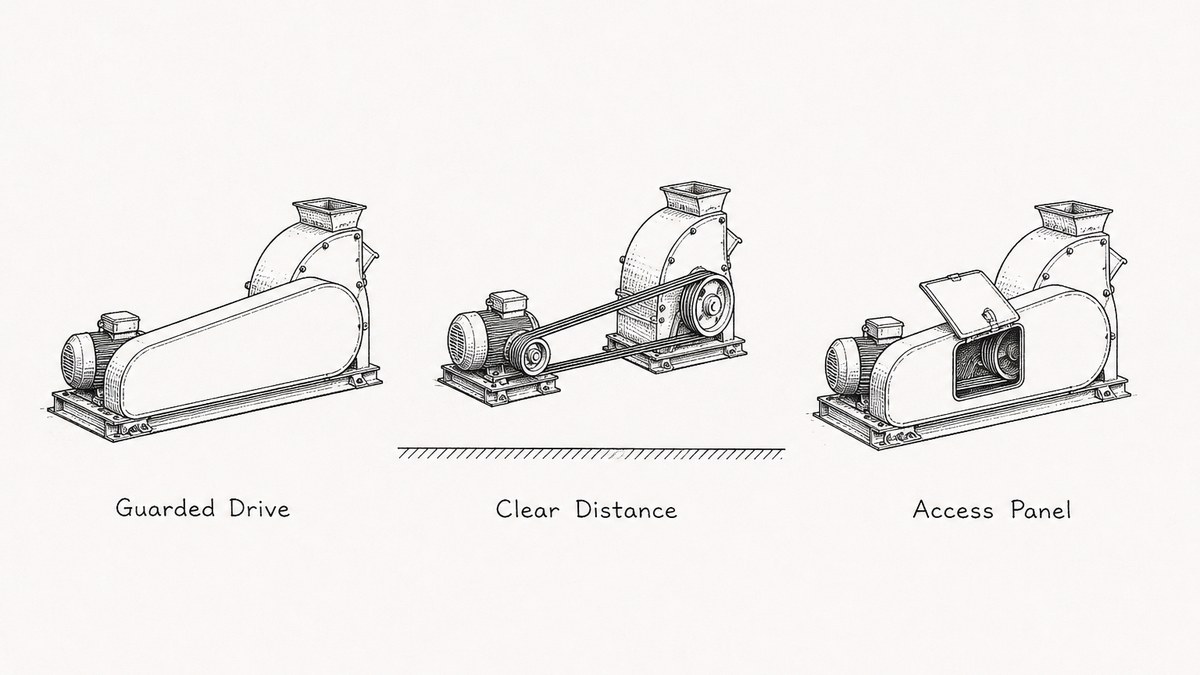
Seven feet is a long way at the side of a machine, and that is the point of quoting it. The exception is not a licence to leave a belt unguarded because nobody stands there; it is a measurable condition, and a plant that relies on it has taken on the job of keeping that space clear for the life of the mill. Every toolbox left beside the drive, every run of pipe added later, every pallet of spare hammers stored against the base frame converts the exception into a hazard without anybody deciding to do it.
For a buyer, the useful consequence is that the guard should be drawn rather than described, and the drawing should carry one of two figures. Either the guard is shown, with its fastenings and its material, so that a person cannot reach the belt or the coupling with the guard in place; or the clear distance is shown as a dimension on the general arrangement, so that the exception is being claimed deliberately and the plant can be told to keep it clear. A quotation that says the drive is fully guarded and provides no drawing has answered nothing, because the question the crew will face in ten years is not whether a guard was ordered but whether the guard can be opened for belt tensioning and closed again with one hand.
Two details decide whether the guard survives contact with a real plant. The first is access. A belt tensioning point or a grease nipple behind a guard that has to be unbolted with tools is a guard that ends up left off, so the panel in the third figure is not a convenience — it is what keeps the guard on. The second is that the guard's own fastenings matter: a guard held by four bolts of the wrong length, or by a single wing nut, is a guard that will be found hanging open. Ask for the guard material, its thickness, and how it is fastened.
One local note, since the rule quoted above sits in the mining title. It is the rule that applies to underground metal and nonmetal mines, and the surface equivalent carries the same wording with a different number. A mill on a mine site answers to one of those two; a mill in a factory answers to the general industry guarding rule, which is written differently and does not contain the seven-foot exception in the same form. Which rule applies is decided by where the mill stands and who owns it, and a buyer with a mine-site installation should say so in the enquiry, because it changes the drawing.
Feed In, Air Out: the Ancillaries That Decide Uptime
A hammer mill on its own is a machine that will not run. It needs material presented to it evenly, it needs the ground material taken away as fast as it is made, and it needs the air that carries the dust to be moved and cleaned. Those three jobs belong to equipment bought from other factories, and on most plants they are the reason a mill does not reach its rated capacity.
The feed decides the load on the rotor. A hammer mill works best when it is fed at a steady rate and the material is spread across the full width of the chamber rather than dumped in the middle. A gravity chute fed from a hopper gives whatever the hopper happens to release; a feeder under positive control gives a rate the plant can set and hold. The difference shows up as a rotor that is loaded on one side, which vibrates, which wears one bearing, which is the bearing that fails. On a mill fed from a silo or a receiving pit, the feed arrangement is usually a conveyor or an elevator, and a screw conveyor delivering at a controlled rate into the mill mouth is the arrangement that makes the rate adjustable.
The discharge decides how much the mill can pass. A mill is limited by how quickly it can clear material from around the screen, and a takeaway that is slower than the mill's own capacity backs material up until the chamber chokes. This is why a mill's quoted capacity and the conveyor under it have to be specified together. It is also why air-assisted discharge is used on fine grinding: a small airflow through the mill lifts the finished powder out of the screen area and keeps the grinding zone clear, which raises throughput without raising rotor speed.
The drive has to start a heavy rotor. A hammer mill starts against a large inertia load, and it is the starting duty that sizes the drive rather than the running power. A motor and gearbox chosen on running power alone will trip its overload on start-up, especially once material is sitting in the chamber from the previous stop. Ask for the starting condition to be stated — empty chamber or loaded — and ask for the coupling type, because a fluid coupling or a flexible coupling that tolerates the start is a different and more expensive item than a direct connection. A gear motor sized for the starting torque rather than the running torque is the same rule applied to a geared drive, and it is the single most common reason a new mill will not start reliably.
One more ancillary is worth listing because it is cheap and it saves the machine: some form of tramp metal protection ahead of the rotor. A magnet or a metal detector that catches a piece of steel before it reaches the chamber is worth far more than the hammer it would have destroyed, and on a fixed rotor it may be worth more than the rotor.
Fire, Dust and the Metal That Should Not Be There
A hammer mill makes fine dust out of material that may be combustible, and it does its breaking with repeated high-speed impact. Those two facts together are the reason this machine has a fire history that other machines in the category do not share, and the reason the dust and metal handling around it deserves the same attention as the grinding itself.
Three conditions have to line up for a dust explosion, and a hammer mill can supply all three more easily than most equipment. There has to be fuel — and a mill makes fine particles, which are the most reactive fraction of any combustible material. There has to be oxygen, which the air-assisted discharge supplies deliberately. And there has to be an ignition source, which high-speed impact against metal supplies every time something unexpected enters the chamber.
That is why the discipline around a hammer mill is mostly about what goes into it rather than what comes out. Four measures are worth writing into the enquiry.
- Keep the material out of the chamber that should not be there. A magnet on the feed, a metal detector wired to stop the feed, and a grate over the mill mouth are all inexpensive relative to the damage they prevent. On a fixed rotor the case is strongest, because a fixed rotor passes the shock straight into the pin, the bearing and the shaft.
- Remove accumulations rather than tolerating them. Dust that settles on ledges, on the chamber top and inside the ductwork is the fuel load for the event nobody wants. A mill body with no ledges, a duct that drains rather than dips, and an accessible chamber are design features, and they are the same features that make the machine quick to clean.
- Bond and earth the whole train. A mill, its ductwork, its filter and its conveyors are separate pieces of metal that are usually joined with flexible sleeves, and every sleeve is a break in the electrical path. Bonding straps across each one, and an earth connection on each major item, are invisible in a photograph and are exactly the sort of item that quietly stays out of a shipment.
- Give the pressure somewhere to go, and point it the right way. Where the plant's own risk assessment calls for explosion relief, the panels belong on the chamber, the duct and the filter housing, sized for the volume each protects, and directed so that a discharge cannot reach a walkway or a person. Relief that vents into a catwalk has solved one problem by creating a worse one.
The commercial point is the same one that runs through this whole category. A buyer who does not ask about these four will still receive a machine that looks correct in a photograph, because the cheapest appearance of each is easy to build: a mill with no magnet, a chamber with a ledge, a duct run with a dip in it, and no bonding straps between the sections. None of those omissions shows up in a price comparison, and all of them are on the drawing. The items themselves are cheap; the reason to specify them is that nothing else on the order will remind anybody.
How These Machines Actually Fail
Four failures cover most of what goes wrong on a hammer mill, and the order in which they appear in the figure is also the order in which they cost money.
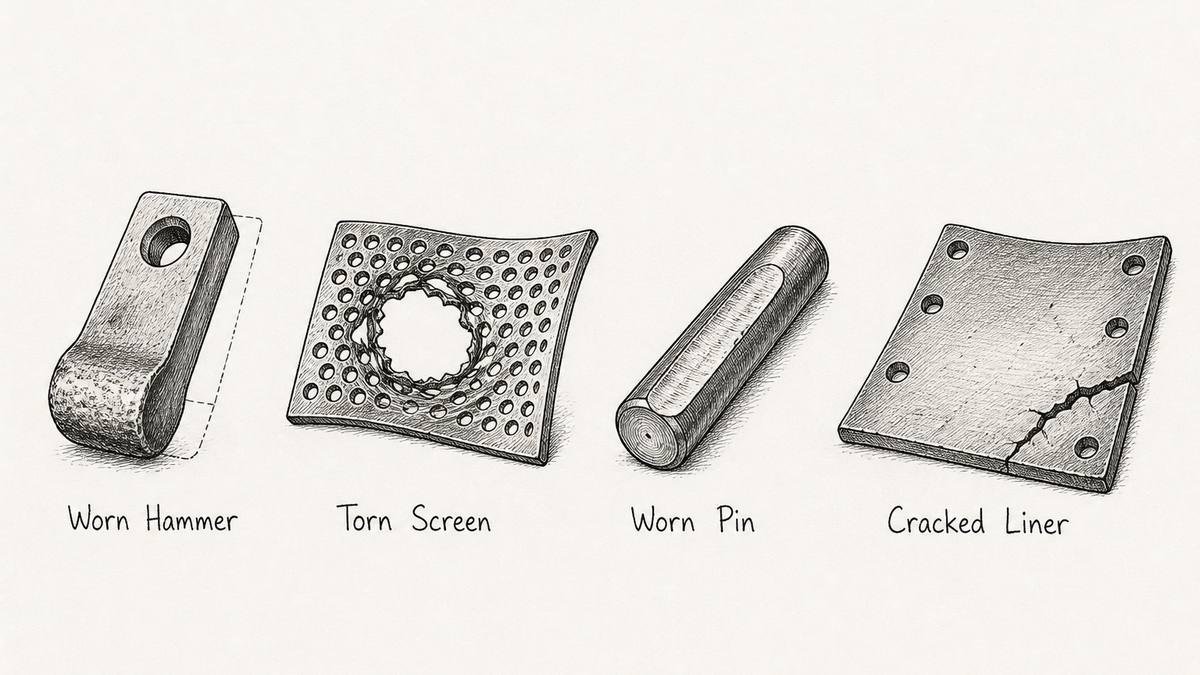
- Worn hammer
- The working edge rounds off into a stub and the mill stops breaking as efficiently as it did. The machine does not fail — it slows down, which is worse, because nobody notices. A ring of worn hammers means a longer residence time, more fines and more heat, and it is the reason a plant's throughput figure creeps down over a year without any single event to point at.
- Torn screen
- A hole in the screen lets a lump of oversize material straight into the finished product, and it does it continuously from the moment it appears. The screen tears at the point of hardest impact, usually near the feed end, and it tears faster once the plate has thinned. This is the failure that turns a machine problem into a customer problem, and it is the reason screen condition belongs on a scheduled check rather than a look.
- Worn pin
- A pin that carries swung hammers wears oval or flat on one side, and once it does, the hammer no longer hangs square. The tip clearance changes around the rotor, the strike becomes uneven, and the rotor starts to vibrate. Pins cost very little and are replaced in minutes; a rotor run on worn pins for a long period is not recoverable by changing pins.
- Cracked liner
- A liner plate cracks, usually from a corner or from a bolt hole, because a shock was passed into it or because the plate was restrained and could not expand as it warmed. A cracked liner is not just a wear item: a loose fragment of liner can be dragged into the rotor, and then it is a machine failure. Unlike the other three, this one is usually a build or design defect rather than wear, which is why it belongs on the list of things to look at in the works.
Three of those four are wear with a predictable life, and the fourth is usually a defect. That distinction decides what to do about each. Wear parts are bought and scheduled: a plant should hold a hammer set, a screen set and a pin set, and should know the measurements that tell it when to change them. A defect is inspected: the liner crack and the chamber's own condition belong to the pre-shipment check, when there is still time to correct something.
The measurements worth taking on this machine are few and all of them are taken with simple tools. Chamber internal clearance to the rotor, checked around the full circle rather than at one point, because an out-of-round chamber is what causes uneven hammer wear. Screen seating, checked by looking for a gap at the screen edges rather than at the screen face. Hammer mounting, checked for a matched set by weight and for the pins being a proper fit rather than a rattle. Liner plate condition and its fastenings. Rotor balance as an assembly, with the weight set that will ship. Guard completeness against the drawing, including how it fastens. And the bonding straps across every flexible connection in the dust train, which is the item most likely to be quietly missing. That is the argument for a pre-shipment inspection with the chamber clearance written down, and for doing it on the first machine rather than the tenth — a first article inspection on the rotor and the chamber before the run continues catches a tooling error while it is still one machine's problem.
Putting the Acceptance Test on Paper
A hammer mill is one of the easier machines in this category to test, because its output is a physical material that can be measured with a set of sieves and a scale. That makes the acceptance test worth writing down before the order rather than agreeing afterwards, and it makes the test the buyer's own lever rather than the supplier's.
Four questions have to be settled for a test to mean anything.
- What is being ground, and where did it come from
- A mill tested on a convenient demonstration material tells you that it turns. A mill tested on the plant's actual feed, at the moisture content it will actually arrive at, tells you something about the machine. Moisture is the figure most often left out and most influential, because damp material blinds a screen and slows a mill more than any other single property.
- Which screen was fitted
- The output size is a function of the screen, so a capacity figure without a screen size beside it is not a specification. The same machine with two different screens is two different machines for commercial purposes.
- How the throughput was measured
- Over what period, and whether it was a steady run or a peak. A figure taken over twenty minutes at the start of a run, while the screen is clean and the chamber is empty, is not the same as a figure taken over a shift.
- What the size distribution was
- The result of sieving the output, not a description of it. A hammer mill makes a spread of sizes, and the useful acceptance figure is the proportion passing the screen size and the proportion sitting above it. Without that, a plant cannot tell a worn screen from a changed feed.
The test is worth running on the factory's own machine before shipment, with the plant's material, and it is worth recording the four answers above alongside the sieve result. That record becomes the plant's baseline: when throughput drops a year later, the question is whether the screen, the hammers or the feed have changed, and a baseline is the only thing that answers it. Without one, every argument about a mill's performance is an argument about memory.
One practical note on where the record lives. A test result that arrives as a sentence in an email is a result that will not be found when it is needed. It belongs with the machine's other documents, which is the same reason the figures agreed at the enquiry should be written into a specification sheet that fixes the screen size and the hammer set rather than left across a thread of messages.
What to Send, and What to Check in the Quotation
An enquiry that goes out as a capacity and a material comes back as a price for a box. One that goes out in four blocks comes back as something that can be compared with the next quotation.
Ten Lines a Hammer Mill Enquiry Has to Carry
| What to send | Why the factory cannot answer without it |
|---|---|
| The material by name, with its moisture content and its hardness | Moisture blinds the screen and hardness decides the tip speed; both move the capacity by a large margin |
| The feed size going in, and the largest lump | A mill sized for screened feed is a different machine from one expected to take a lump the size of a fist |
| The output size wanted, stated as a screen hole size | Output is a function of the screen, so a size target without a screen figure cannot be designed against |
| Capacity in tonnes per hour, at that screen, with the moisture stated | A single headline capacity figure is nearly always quoted at a coarse setting and falls steeply as the cut gets finer |
| Whether the feed is steady or varies, and what arrives with it | Unpredictable feed argues for a swung rotor; a steady, screened feed makes a fixed rotor the better choice |
| The rotor type, and the hammer material by name | Hammers are most of the running cost, and the word standard tells the plant nothing about what it will be replacing |
| Whether hammers can be reversed or turned, and the pin or bolt size | This one detail changes the running cost by a large factor and is invisible unless asked about |
| The screen thickness, hole pattern and how it is held in | Thickness and open area trade throughput against wear, and the fixing decides whether screens get changed on time |
| Which air route the plant will use, and whether the filter is bought against a concentration or an opacity limit | The two enclosure routes in the rule carry different obligations, and the two limits do not need the same filter |
| What is inside the scope: feeder, takeaway, fan, filter, ductwork, guard, magnet, spares | These are the lines that move between quotations and the reason two prices for the same capacity differ by half |
Reading the answers back is quicker than it looks. Check that the capacity comes with a screen size and a moisture figure attached. Check that every wear part has a material named rather than a word. Check that the guard is drawn and either dimensioned or fastened in a way a person can undo by hand. Check which air route is being taken and which limit the filter is designed against. Check the list of items excluded from the scope, because that list is where the money is. And check that a spare hammer set, a spare screen and a set of pins are in the first order rather than in a later one, because a spare bought a year later from a factory that has changed its drawing is a spare that does not fit.
One last note on how this machine normally sits in a plant. Ground material is nearly always the input to something else rather than the finished article, and the next step is usually where the value is added. A ribbon blender that receives the ground material and the density figure is what most mills discharge towards, and the density figure the mill produces is the number that blender needs. Specifying the mill's output size without measuring what it weighs is how the next machine ends up the wrong size.
How much does a hammer mill cost?
There is no useful average, because the price follows the chamber size, the rotor type, the hammer material and how much of the machine is bought rather than made. Two mills of the same capacity can differ by a multiple if one is a small fabricated unit with swung hammers on plain carbon steel and the other is a heavy lined chamber with a fixed rotor, hard-faced hammers, a fluid coupling and a full guard and ductwork package. What a buyer can do is ask for the price broken down by block: the chamber and liner, the rotor and hammers, the screen, the drive and guard, and the ancillaries. The items that move the number most are the chamber plate thickness and liner material, the hammer material, the screen thickness, the drive and coupling, and whether the feeder, takeaway, fan, filter and spares are inside the scope at all.
What is the difference between a hammer mill and a roller mill?
A hammer mill breaks material by impact, striking it repeatedly until the pieces pass through a screen. A roller mill crushes material between pairs of rolls, and it cuts and compresses rather than shatters. That difference shows in the output: a roller mill makes a narrow, even particle size distribution and very little fine dust, while a hammer mill makes a wider spread with more fines. For anything where the size distribution matters — milling grain for a process, for instance — a roller mill usually wins on product quality. A hammer mill wins where the feed is varied, where it contains material a roller mill cannot grip, or where the shape of the particles matters less than the ability to reduce a mixed and unpredictable stream.
How do I choose between a swing hammer and a fixed rotor?
Decide from the feed. If the material is mixed, or arrives with occasional unbreakable pieces in it, a swing hammer rotor is the safer choice, because the hammers fold back and pass the shock out of the machine instead of into the shaft. If the feed is screened, consistent and free of tramp metal, a fixed rotor keeps its tip clearance as it wears, so the output stays more consistent over the life of the hammers. There is a cost trade either way: a swing rotor is more forgiving and less consistent, and a fixed rotor is more consistent and less forgiving. On a plant where the upstream screening is good and a magnet is fitted, the fixed rotor is usually the better machine.
Why does my mill's output size drift?
Three causes cover most of it, and they are worth checking in this order. The screen may have worn or stretched, which lets coarse material through the largest holes rather than through the intended ones. The hammers may have worn at the tip, which changes the clearance to the screen and lets partly broken material out before it is finished. Or the screen may no longer be sealing against the chamber, so material is bypassing the screen entirely around its edges and the screen itself is still fine. All three produce the same complaint, and all three are distinguishable by looking: hole size, hammer edge, and a gap at the screen seat. That is why screen and hammer condition belong on a scheduled check rather than on a complaint.
Does a hammer mill make an explosive dust?
Many of the materials a hammer mill grinds do, and the mill makes the most reactive fraction of them, because fine particles are the part of any powder that ignites most readily. Whether a particular material presents an explosion risk is a question for a test on that material rather than a general answer, and the test result belongs in the plant's own risk assessment. What can be said for the equipment is that the three conditions needed are all present at a mill, and that the useful measures are about what enters the machine: a magnet and a metal detector on the feed, a grate over the mouth, no ledges where dust settles, bonding straps across every flexible connection, and explosion relief sized for each volume and pointed away from people.
What should I check before the machine ships?
Seven things, and most need only simple tools. Check the chamber clearance to the rotor around the full circle rather than at one point, because an out-of-round chamber causes uneven hammer wear. Check the screen seats properly against the chamber and that there is no gap at its edges. Check that the hammer set is matched by weight and that the pins are a proper fit rather than a rattle. Check the liner plates and their fastenings. Check the rotor's balance as an assembly with the weight set that will ship. Check the guard against the drawing, including how it fastens, because a guard that needs tools to open is a guard that will be left off. And check the bonding straps across every flexible connection in the dust train, because a missing strap is invisible in a photograph and is the item most likely to stay out of a shipment.
Send the material and the cut — the capacity alone is not enough
Tell us what has to be ground and what it has to come out as. The material with its moisture and hardness, the feed size, and the screen hole size you need. Then the rotor type, the hammer material, the air route the plant will use, and what the duty has to withstand.
Request a Hammer Mill Sourcing Quote
Questions & Comments
We read every one and reply within 24 hoursMost mill arguments come down to two figures that were never written down: the screen hole size the capacity was quoted at, and the moisture in the feed it was measured with. Send us both, and we will pin them down before the order.