
Wet Scrubber Manufacturer: Sourcing Air Pollution Control Equipment From China
 ·
Updated October 13, 2026
·
26 min read
A wet scrubber is a vessel that washes dust, acid gas or smell out of an exhaust stream by bringing the gas into contact with liquid. It is bought on gas volume, pressure drop and chemical duty, and it sits at the end of a process line where the exhaust is already watched by a regulator. What makes it different from almost anything else a buyer sources is that the choice of device can be a permit decision rather than a preference: one federal rule names four acceptable types of control device, and a plant that wants a fifth has to ask the environmental agency for permission before it is even allowed to run its own test. That fact changes what you put in the enquiry.
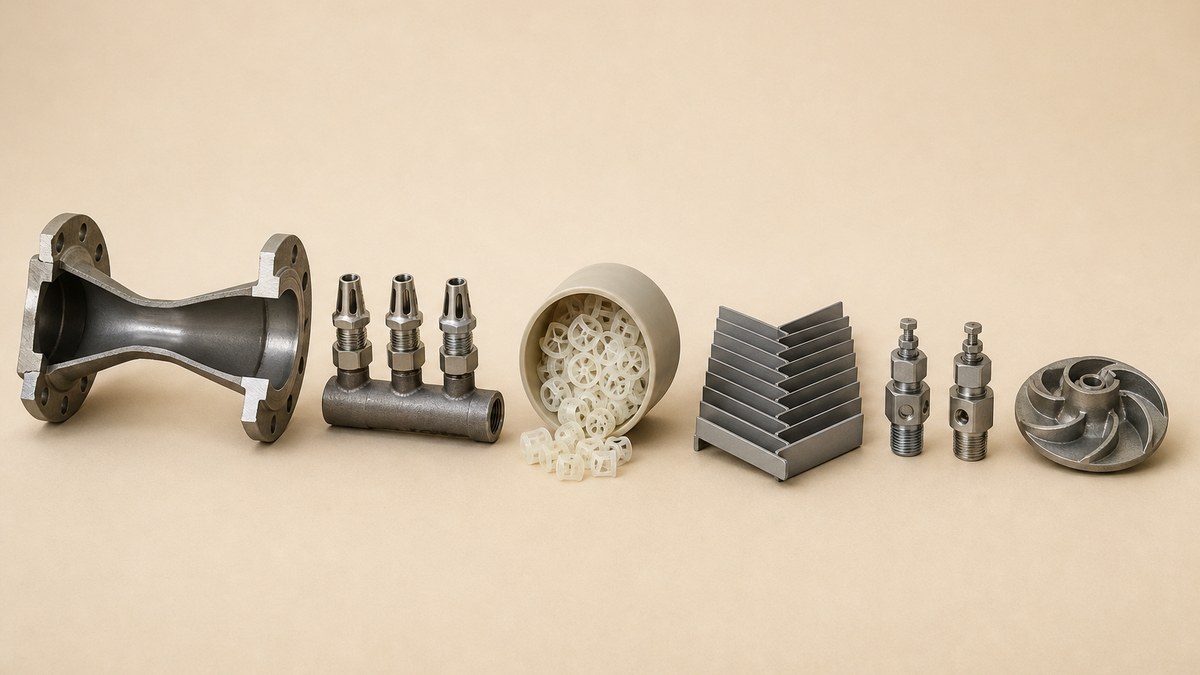
Six Lines That Decide Whether a Wet Scrubber Order Is Complete
| What the buyer has to settle | Why it is not obvious | The line on your order that closes it |
|---|---|---|
| The device category the plant will use | One rule names four accepted types, and anything else means a petition filed sixty days before the test | The device type by its rule name, written on the datasheet |
| The two numbers that become operating limits | They are fixed by the machine's own start-up test, not by the supplier's sales sheet | Pressure drop and liquid flow at the test point, and the instruments that read them |
| Venturi or packed bed | The contaminant and the turndown decide it, not the price | The type, plus the throat size or the bed depth and the design gas velocity |
| The liquid side | Recirculation, reagent and blowdown are where the running cost lives | Pump duty, nozzle count and type, reagent dosing point, blowdown arrangement |
| The materials | Wet service with acid gas eats ordinary steel from the inside | Shell, throat and nozzle material by name, together with the chloride level assumed |
| The instruments | On a regulated plant they are part of a submission, not an accessory | The instrument list with its stated accuracy and its recalibration interval |
What a Wet Scrubber Is, and the Words Around It
Strip the trade names away and a wet scrubber is a box with gas going in one end and out the other, liquid somewhere in the middle, and a pump that keeps the liquid moving. The gas and the liquid meet, the liquid takes the dust or dissolves the gas, and the dirty liquid leaves. Everything else in the machine exists to make that meeting happen efficiently, or to stop the liquid escaping up the stack.
The vocabulary is worth settling before the enquiry goes out, because suppliers use the words loosely and the looseness costs money later.
- Wet scrubber
- Any device that removes a pollutant from a gas stream by contact with liquid. It is a family name, not one machine.
- Venturi scrubber
- A duct that narrows to a throat and then widens again. The gas accelerates at the throat, liquid is injected into it, and the speed difference blasts the liquid into fine droplets that catch the dust. Excellent on fine dust, poor at absorbing gases.
- Packed bed scrubber
- A tower filled with shapes that give a large wetted surface for gas and liquid to meet on. Excellent at dissolving acid gas or smell, poor at catching fine dust.
- Spray tower
- A simple empty tower with nozzles at the top. Cheap, low pressure drop, and the least efficient of the three. Useful where the job is cooling or where a rough job is enough.
- Cyclonic scrubber
- A spray inside a cyclone body, so the gas spins and the wetted dust is thrown to the wall. A compromise device: some dust capability and some gas capability.
- Pressure drop
- The difference in pressure between the gas entering the scrubber and the gas leaving it. It is the single best proxy for how much collecting work the machine is doing, and it is one of the two numbers the plant will have to hold.
- Liquid-to-gas ratio
- How much liquid is put into contact with how much gas, usually written as litres per cubic metre or gallons per thousand cubic feet. For a venturi this figure, together with the throat velocity, sets the collection efficiency.
- Turndown
- How far the gas flow can fall below the design point and the machine still work. A packed bed turndowns badly; a venturi tolerates a wider range. Most permit problems on scrubbers are turndown problems, not efficiency problems.
- Blowdown
- The liquid deliberately drained out of the recirculation loop to stop dissolved solids and salts building up. It is a running cost and a permit condition, and it is frequently left out of a quotation.
- Mist eliminator
- The last thing the gas passes on its way out, usually a set of chevron blades or a mesh pad. It stops droplets carrying out of the vessel and it is the part most often undersized.
- Reagent
- What is added to the liquid to make it react with the gas, such as caustic soda for an acid stream. It turns a scrubber into a small chemical plant, with the storage, dosing and safety equipment that implies.
- Structural packing
- Packing moulded into a fixed geometric shape, as opposed to random shapes tipped in loose. It costs more and plugs less.
Two of those terms do most of the work in a quotation. Pressure drop is what the plant will be held to, so it is not a performance claim but a number with consequences. Turndown is what decides whether the machine still works on the days the plant runs light, which is most days.
The Rule Names Four Devices, and You Must Pick One of Them
Most equipment a buyer sources can be any shape the plant likes. A wet scrubber on a regulated source is not, because one federal rule lists the control devices it will accept by name and sets a procedure for anything outside the list. The section heading is unusually direct about it. It appears in more than one industry rule in the same words, and the version below is read from the electronic Code of Federal Regulations.
“What if I do not use a wet scrubber, dry scrubber, electrostatic precipitator, or fabric filter to comply with the emission limitations?”
The section is 40 CFR 60.2917, and the same words appear in the parallel rule at 40 CFR 60.3024, which is what makes it worth treating as the industry position rather than one subpart's preference.
And the answer the section gives:
“If you use an air pollution control device other than a wet scrubber, dry scrubber, electrostatic precipitator, or fabric filter to comply with the emission limitations … you must petition the EPA Administrator for specific operating limits to be established during the performance test and then continuously monitored thereafter.”
The same section puts a clock on it:
“You must submit the petition at least 60 days before the performance test is scheduled to begin and not conduct the initial performance test until after the petition has been approved…”
Read commercially, that is a two month delay and an open-ended approval, applied to whatever a plant buys instead of one of the four listed devices. It is the strongest argument there is for staying inside the list, and it is not an argument any of the pages ranking for this keyword make.
What the petition has to contain. The list is short and it is where the commercial weight sits, because two of the five items are about instruments rather than about the scrubber. The section requires a description of the parameters to be used as operating limits; a discussion of how emissions change as those parameters change; a discussion of how the upper or lower values will be set; a discussion of the methods and instruments that will measure them, including their relative accuracy and precision; and a discussion of how often the instruments will be recalibrated and by what method.
Stop on the fourth and fifth items. On a plant that goes down this route, the accuracy of a pressure transmitter and the interval at which it is recalibrated are written into a submission to a regulator before the machine has been bought. That turns the instrument package into a deliverable with a specification, exactly like the shell, and it is the reason the instruments get their own section further down this article rather than a paragraph at the end.
What the rule does not say. It does not require a wet scrubber. A dry scrubber, an electrostatic precipitator or a fabric filter are equally acceptable, and on many duties one of them is the better machine. What it does is remove the casual choice: either the plant picks from the four, or it takes on a petition. A supplier who does not know which four, or who suggests something outside the list without mentioning the petition, has told you something about how closely they read the rules their own product lives under.
Your Operating Limits Are Set by Your Own Start-Up Test
Here is the sentence that decides how a wet scrubber has to be built, and it is the one no competitor page carries. On an iron and steel source, for a venturi scrubber used to meet a particulate limit, the rule says:
“For each venturi scrubber applied to meet any particulate emission limit in Table 1 to this subpart, you must maintain the hourly average pressure drop and scrubber water flow rate at or above the minimum levels established during the initial performance test.”
The sentence is 40 CFR 63.7790, and it is worth reading twice, because almost nothing else written about wet scrubbers says it.
Unpack that. Two parameters are named: the pressure drop across the scrubber and the flow rate of the scrubbing water. The limits are not printed in the rule and they are not chosen by the plant. They are whatever the machine achieved on the day it was first tested. From that day forward those numbers are the floor, and running below them is a violation in itself, whether or not the stack is clean.
Three consequences follow for anyone buying the machine.
First, the start-up test is a buying event, not a formality. If the test is run sloppily, on a wet day, with the plant at half load, or with a pump that happens to be throttled, the numbers it produces follow the installation for the rest of its life. The minimum pressure drop becomes whatever was measured, and the plant has to hold that. Buyers who treat commissioning as the contractor's business are the ones who end up with an obligation set by an accident.
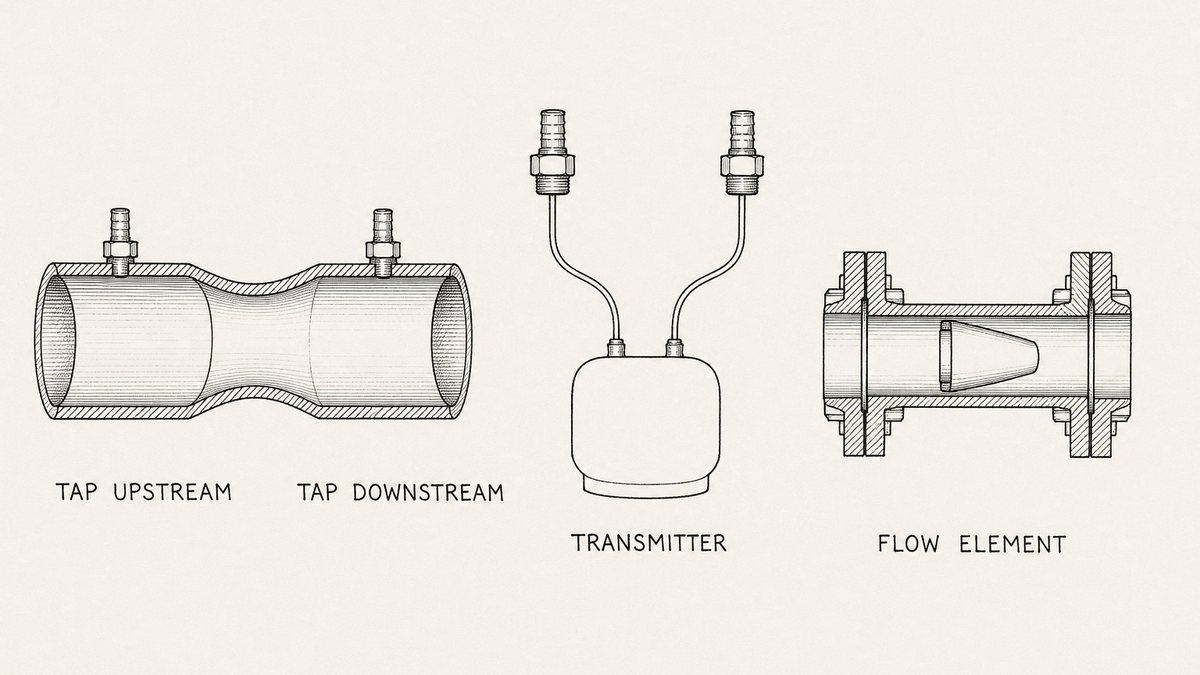
Second, the two parameters have to be measurable, permanently and hourly. A pressure drop needs taps on both sides of the scrubber and a transmitter between them. A water flow rate needs a meter in the recirculation line. Both have to be installed so that the reading reflects the machine rather than the instrument, which means the taps go where the flow is representative, not where they are convenient to weld. Both have to be logged, because the rule says hourly average, and an average needs a record.
Third, the accuracy claim has to survive the instrument. The petition route under the previous section requires the accuracy and precision of the measuring instruments to be stated, and the recalibration interval to be stated. A plant that ends up holding a pressure drop figure should be able to show that the transmitter reading it is accurate to the figure it claimed. A cheap gauge with no stated accuracy will not do that, which is why the instrument schedule matters more on a scrubber than on most equipment.
What a buyer should do with all this. Before the enquiry goes out, ask the plant two questions: which four-device category the permit names, and whether anything has already been tested or promised on the exhaust at that stack. If a test has already been run and a pressure drop figure is on the record, that figure is the design point, and the new machine has to be able to reach it on the plant's real gas flow rather than on a round figure. If nothing has been tested yet, the machine's design pressure drop is a promise the plant will have to keep, and the supplier should be told that in writing.
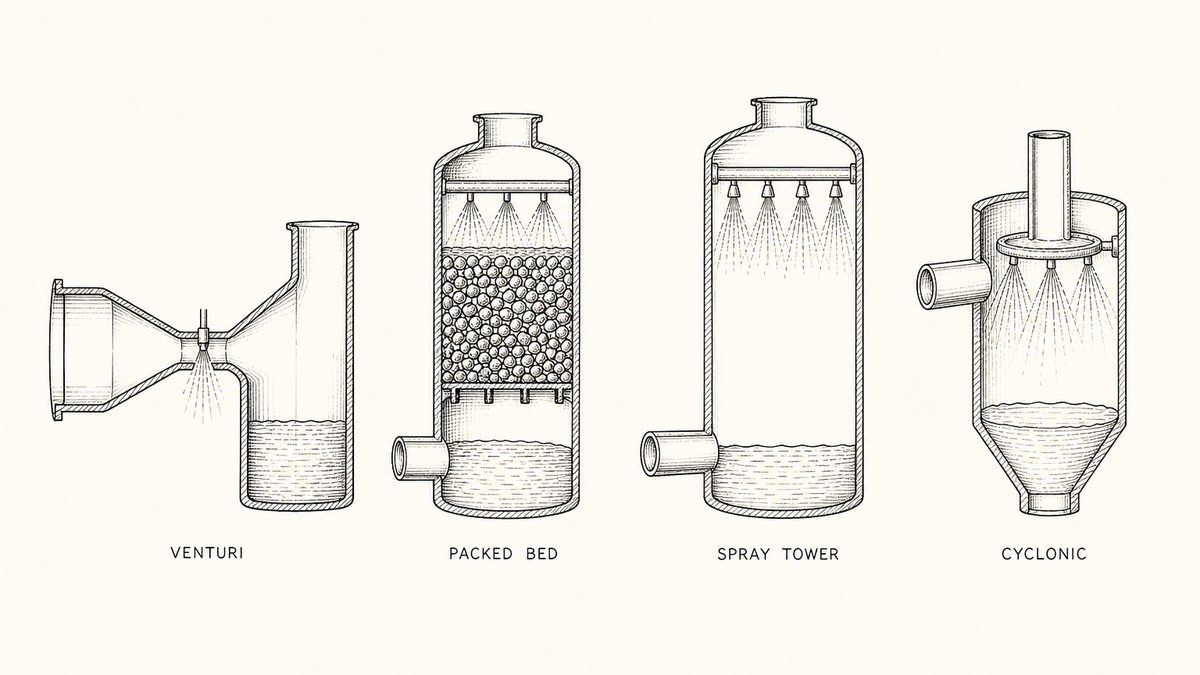
Venturi, Packed Bed, Spray Tower, Cyclonic: Which One
The choice between scrubber types is decided by one question before any other: is the pollutant a solid, or is it a gas that has to be dissolved? A venturi is a dust machine. A packed bed is a gas absorption machine. Confusing the two is the most expensive mistake in this category, because a packed bed on a dusty stream blinds in weeks and a venturi on an acid gas stream passes most of the acid straight through.
Which Scrubber Suits Which Duty
| Duty | Best fit | Why | Watch out for |
|---|---|---|---|
| Fine dust, sub-micron | Venturi | The huge speed difference at the throat atomises the liquid into droplets small enough to catch fine particles | Pressure drop is high, so fan power is the running cost |
| Acid gas, smell, soluble vapour | Packed bed | Large wetted area and long contact time let the gas dissolve into the liquid | Blinds quickly on any particulate; needs good liquid distribution |
| Cooling and knocking down coarse dust | Spray tower | Cheap, almost no pressure drop, very tolerant | Poor efficiency on anything fine; large footprint for the flow |
| Both dust and gas, moderate duty | Cyclonic | Spinning gas throws wetted particles to the wall while the liquid absorbs some gas | A compromise, so it is rarely the best at either half |
| Anything with a wide flow range | Venturi, or two in parallel | Collection depends on throat velocity, which can be held by a variable throat | A fixed-throat packed bed loses efficiency as flow falls |
Ask for the particle size, not the dust loading. A quotation that says "dust removal" without a particle size is not a quotation for anything specific. Below roughly one micron, the collection efficiency of a venturi depends steeply on the pressure drop, so the same machine quoted at two different pressure drops is two different products. If the plant cannot say what the particle size distribution is, that measurement is the first thing worth paying for, because everything downstream depends on it.
Ask what happens at half load. Plants rarely run at design flow. A packed bed's efficiency falls as the gas flow falls, because the gas spends less time in contact with the liquid and the distribution over the packing gets uneven. A venturi tolerates a much wider range because the throat keeps the velocity up. If the plant expects to run part-loaded for months, this single question can move the choice from a packed bed to a venturi or to two smaller vessels that can be run one at a time.
Count the vessels. Many installations are two or three scrubbers in series rather than one. A venturi followed by a packed bed is a common pairing where the exhaust carries both dust and acid gas: the venturi takes the solids and the packed bed takes the gas. If a quotation is for one vessel while the duty needs two functions, the quotation is not cheaper, it is incomplete.
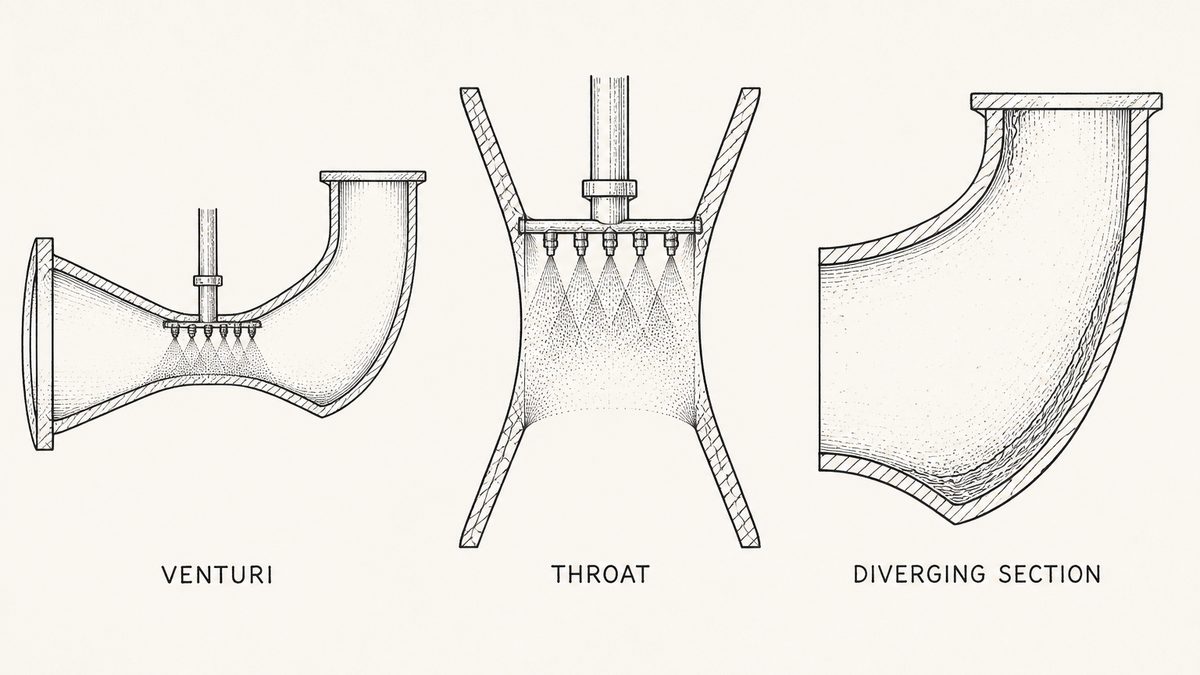
The Sections That Carry the Cost and the Failures
A wet scrubber is not a complicated machine, which is exactly why the money and the failures are so predictable. There are eight or nine parts that matter, and a buyer who can name them can read a quotation line by line instead of accepting a lump sum.
The element and the throat. The section where gas and liquid actually meet is the heart of the machine. On a venturi that is the throat and the liner inside it; on a packed bed it is the packing and the support grid under it. Both are wear parts, and both are the parts where a supplier is most tempted to save weight. The throat is usually fitted with a replaceable liner in a harder or more corrosion-resistant grade than the shell, and the reason is that the throat erodes. Ask whether the liner is replaceable, how it is fixed, and whether the throat can be re-lined without cutting the duct.
The injectors. Liquid enters through nozzles, and nozzle choice sets how fine the droplets are, how much liquid it takes to cover the cross-section, and how often the machine blocks. A nozzle that is excellent at atomising is usually poor at passing solids, and vice versa. The practical question is not which nozzle is best but which nozzle the supplier has standardised on, because a machine with proprietary nozzles means every replacement comes from one factory at one price.
The separator. After the contact section the gas has to be separated from the liquid it is carrying, and that happens either by gravity in a flooded elbow and a cyclone, or by a mist eliminator at the top of a tower. This is where droplets get carried out to the stack, where they fall out of the plume, and where a poorly sized vessel announces itself. Ask for the mist eliminator type, the blade spacing and the design velocity through it, and whether it can be cleaned in place.
The fan and its position. Most wet scrubbers are induced-draught, with the fan downstream pulling the gas through. That puts the fan after the liquid, so the fan sees a wet, dirty, often corrosive stream. Fan material and any purge arrangement matter as much as the scrubber shell. A fan placed before the scrubber sees dry gas, which is easier on the fan and worse for everything else, because the whole system then runs under pressure and any leak pushes gas out into the plant.
The ductwork. The connections into and out of the scrubber are where the layout fights the physics. A duct that enters a tower off-axis produces uneven flow across the packing, and no packing will perform as tested under uneven flow. Where the duct runs hot and the vessel is cooled by liquid, the joint between them moves, and that is the place for a flexible connection in the hot duct rather than a bolted flange that will crack at the first thermal cycle.
The liquid loop. Pump, pipework, tank, level control and the valves that keep the loop running. It is the least glamorous half of the machine and it holds most of the running cost. It gets its own section below.
The solids handling. Whatever the scrubber takes out of the gas has to leave as sludge or as a settled solid. On a dusty duty the underflow is continuous, and it usually lands on a short conveyor that takes the wet cake away or into a settling pit. Leaving this out of the scope is one of the commonest gaps in a Chinese scrubber quotation, because the supplier builds vessels and the plant builds the rest.
The instruments. They get a section of their own because on a regulated plant they are not an accessory.
Gas Volume, Pressure Drop and the Liquid-to-Gas Ratio
A buyer does not need to be able to design a scrubber to be able to test whether one has been designed. Three numbers do most of the work, and all three can be checked on the back of a quotation.
Which volume is being quoted. Gas volume changes with temperature, so the same mass flow is a much larger volume when hot. A quotation must say whether it is based on actual cubic metres per minute at the operating temperature, or on a volume corrected to a standard temperature. These two are different numbers, and quoting one while designing to the other is a real and frequent error that shows up as a machine that is too small. Whenever a gas volume appears, look for the temperature next to it. If it is not there, ask.
Pressure drop, and what it costs. Pressure drop is the price of collection, paid at the fan. Moving a given volume of gas against a given pressure drop takes a calculable amount of power, and the fan motor on the quotation should be consistent with the pressure drop and the volume. On a venturi the relationship between pressure drop and fine-particle collection is steep, so small increases in pressure drop buy real efficiency and cost real electricity. That is the trade the plant is making, and it should be made deliberately rather than as a side effect of whatever the supplier builds.
The liquid-to-gas ratio. This is how much liquid is thrown into contact with the gas, usually written as litres per cubic metre of gas. Too little and the throat does not get fully covered; too much and the fan pays for it and the mist eliminator is overloaded. The figure should come with the design gas volume and the design pressure drop, because all three are one engineering decision. A quotation that gives one of the three alone has not shown its working.
The three questions to ask. What is the design gas volume and at what temperature was it measured? What is the design pressure drop, and what fan power follows from it? What is the liquid-to-gas ratio, and what pump flow does it imply? If the answers are consistent, the quotation stands on arithmetic. If any one of them is missing, the machine may still be fine, but nobody has proved it yet.
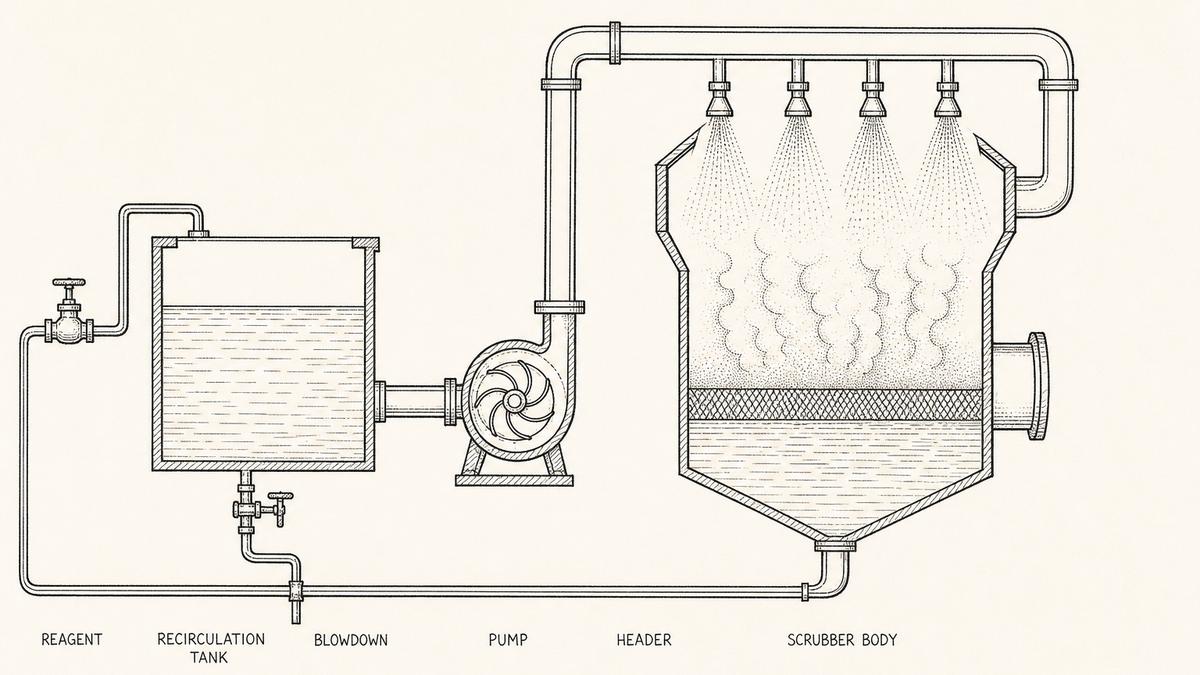
The Liquid Side: Recirculation, Nozzles and the Reagent
The liquid circuit is where a wet scrubber earns its running cost, and it is the half of the machine that a quotation is most likely to describe in one line. It is worth a closer look than the vessel, because a vessel lasts twenty years and a pump and a set of nozzles do not.
Recirculation is a closed loop that loses liquid on purpose. Liquid is pumped from a tank to the nozzles, falls through the contact section, and returns to the tank. Two things leave the loop and have to be replaced: water that evaporates into the hot gas and leaves up the stack as vapour, and water deliberately drained off as blowdown. The evaporation rate is set by the gas temperature and humidity and can be substantial on a hot exhaust. A scrubber that is not made up with water loses its level, and a scrubber that is made up with hard water slowly scales the nozzles.
Blowdown is a permit condition, not housekeeping. As the loop runs, dissolved solids and salts concentrate. Above a certain level they precipitate, and the scale lands on the packing, in the nozzle orifices and on the fan. Blowdown keeps the concentration down, and because the blowdown is itself a liquid discharge it may need its own approval. Ask the supplier to state the expected blowdown rate at design duty and the concentration it is intended to hold, because those two figures decide the water bill and the discharge paperwork.
Nozzles are a wear item with a schedule. A nozzle that starts at a given orifice erodes open, and a wider orifice makes coarser droplets, which reduces collection efficiency. This is the mechanism behind one of the failure figures further down. What matters on the order is whether the nozzles are a standard thread and a standard body size, so replacements can come from more than one source, and whether the header allows a nozzle to be changed without dismantling the duct.
Reagent turns a scrubber into a chemical plant. Where the gas has to be neutralised rather than merely washed, a reagent is dosed into the loop, caustic soda being the common one for an acid stream. That brings storage, dosing pumps, pH control and the safety arrangements that go with handling a strong alkali. None of it is difficult, and all of it is easy to leave out of a scope. A quotation that assumes water alone when the duty needs reagent is not cheap, it is short.
Ask about the pump twice. Once for the duty, and once for what it is made of. A recirculation pump on a scrubber moves an abrasive or corrosive slurry, often at a low head and a high flow. The impeller and the casing are the parts that fail first, and the material they are made of is the difference between a pump that lasts and a pump that is replaced annually. Ask for the pump make and the wetted material, not just the flow and the head.
Materials: Why Wet Service Eats Cheap Steel
Almost every wet scrubber failure that is not erosion is corrosion, and almost every corrosion problem comes from the same two ingredients meeting the wrong grade of steel. Gas streams usually carry some chloride, chloride plus water plus the wrong stainless steel gives a cracking failure that arrives suddenly and with no visible warning, and it looks exactly like a material choice that was made on price.
Plain carbon steel is a wet-service material only if it is protected. Uncoated carbon steel in a wet, mildly acid environment will last a few years and then start to pit. It is used on scrubbers in two ways: where the liquid is genuinely neutral and the gas is cool, and where it is protected by a lining. Neither is wrong. What is wrong is a quotation that says carbon steel and does not say which of the two it is, because the difference in life between them is a decade.
The stainless grades are not interchangeable. The common stainless in this industry is a standard austenitic grade, and it is the grade most likely to crack in chloride service. At higher chloride levels or higher temperatures the answer is a duplex or a higher-alloy stainless, or a change of material family entirely. The point for a buyer is that a supplier cannot choose the grade without being told the chloride level in the gas or the liquid, and often the temperature as well. If nobody has told them, they will choose on habit or on price, and the habit for a general fabricator is the cheaper standard grade.
The contact section is usually a different material from the shell. The throat of a venturi or the area under the nozzles of a tower sees fast-flowing liquid with solids in it. That is an erosion problem dressed up as a corrosion problem, and the usual answer is a harder or more highly alloyed liner at that point. A quotation that lists one material for the whole vessel has skipped this, and the omission will show up at exactly the place the machine cannot easily be repaired.
Non-metals are a real option, not an economy. Fibre-reinforced plastic vessels are common on acid duties, particularly smaller ones, because the material is immune to the chloride problem that affects stainless. Thermoplastics are used for ductwork and internals. Against that, they have temperature limits, they are not good at resisting erosion in a high-velocity throat, and their structural design depends on supports that a steel fabricator may not be used to making. A quotation in FRP is not automatically better or worse than one in steel; it is a different answer that has to be judged against the actual duty.
Ask one question that settles most of it. What chloride level and what temperature was the material chosen for? A supplier who answers with a number has done the work. A supplier who answers with a grade name has not, and on a stainless vessel that difference is the whole life of the machine.
The Instruments Are Part of the Submission
On an unregulated machine the instruments are whatever helps the operator. On a regulated one they are evidence, and the rule treats them that way. The petition route quoted earlier requires the accuracy and precision of each instrument to be stated, and the frequency and method of its recalibration to be stated, as part of the document that goes to the regulator. A pressure gauge with no stated accuracy cannot carry that. This section is what a buyer should put into the specification because of it.
The differential pressure measurement. Pressure drop is a difference between two pressures, and it is measured by tapping the duct or vessel on both sides of the contact section and connecting those taps to a single differential transmitter. Three details decide whether the reading is worth anything. The taps have to be located so the upstream one sees true inlet pressure and the downstream one sees true outlet pressure, clear of any bend or obstruction. The connecting lines have to be arranged so they do not fill with liquid or solids, because a blocked line reads as zero difference. And the transmitter has to have a stated accuracy over the range it will actually work in, which is not the same as its full-scale figure.
The liquid flow measurement. The second named parameter is the scrubbing water flow rate, so the recirculation line needs a flow element and a transmitter. The choice between a magnetic flow meter, an orifice plate and a simple rotameter follows the liquid: a dirty slurry with solids rules out the simplest options quickly. What matters commercially is that the element is sized for the actual flow, that its wetted parts suit the liquid, and that its accuracy is stated in the same terms as the pressure transmitter.
The hourly average has to come from somewhere. The rule that sets the operating limits talks about an hourly average, and an average needs a logger. That does not have to be an expensive system, but it does have to record both parameters continuously and keep the record, because the point of the exercise is to be able to show later what the machine was doing. A plant that has the two transmitters and no recorder has the measurement without the proof.
If there is reagent, there is pH. A scrubber dosing caustic into a recirculation loop controls its chemistry by pH, and pH is both an operating parameter and a safety one. It needs a probe in a place where it sees representative liquid, and it needs calibration consumables that are available locally. On a smaller installation this is often the instrument that gets forgotten, and it is the one that decides whether the reagent is being used at all.
What to write on the order. An instrument schedule, separate from the general arrangement drawing, listing each instrument by tag, by what it measures, by its stated accuracy, by its range and by its recalibration interval, with the make and model for each. That list is short and it removes most of the argument that would otherwise happen six months later. It is the reason this article treats instruments as a section rather than a bullet.
What to Put in the Specification Sheet
A scrubber enquiry that goes out as a paragraph of prose will come back as three quotations that cannot be compared. The fix is a datasheet with a revision number and a defined shape, and it barely matters what order the rows are in as long as each row exists and each has a figure or a statement against it. The general method is the same as for any fabricated industrial product and is set out in the gas and liquid data a fabricator has to build to, but a scrubber adds four rows that most templates do not have.
The duty block. Gas volume with the temperature and whether it is actual or corrected; the composition, at least the components that matter for material choice and for the reagent; the particulate loading with a particle size distribution if one exists; the inlet temperature; the moisture content; whether the stream is continuous or intermittent; and the permit limit the machine has to meet, quoted as it appears in the permit.
The process limits block. The device type by its rule name; the pressure drop the machine is to be designed for; the liquid flow rate at that design point; the turndown the plant expects; and, if a test has already been run, the figures already on the record, because those are the ones the installation will have to hold.
The material block. Shell, contact section, liner, internals, nozzles, mist eliminator, fan and ductwork, each by name, with the chloride level and temperature the choice was made against. This is the block where a vague answer costs the most money.
The instrument block. The schedule described above, plus the recorder and what it keeps.
The records block. What has to come with the machine: material certificates, a weld record, a dimensional record, a paint or lining thickness record, a factory run test of the pump and fan, and a datasheet with a revision number where no change is made without written agreement. On a scrubber this block also carries the pressure drop and flow figures the machine was designed to, because they are the numbers the plant will be held to on the day it starts up.
Sourcing From China: Factory, Trader and What to Ask
China builds a great many scrubbers, and the range of what is available runs from excellent to a steel box with a pump bolted to it. The difference is not usually visible in the quotation, which is why the questions matter more than the paperwork.
Four questions a real works answers from its own floor. How does the factory form the shell: rolled and welded steel, or wound FRP, and on what equipment? Does it make the mist eliminator itself or buy it, and if it buys it, from whom? Does it fabricate the ductwork for the whole train or only the vessel, and who bolts the two together on site? And who does the final dimensional check before paint, against what drawing? Each of those four has an answer that comes from the shop floor. A trader answers all four with a version of the same sentence.
Ask what it buys in. Almost nobody makes everything. The fan, the pump, the nozzles, the instrument transmitters and sometimes the packing are bought in from specialists, and that is normal. What matters is that the quotation says which items are bought and what make they are, because the bought items are where the running cost and the spares problem live. A quotation that lists a fan with no make has not decided yet, which means the decision will be made later, on price.
Ask for a reference on the same duty, not the same size. A list of installations that includes one on the same kind of contaminant at a comparable gas temperature tells you the supplier has met the material problem before. A list of installations that are all the same vessel size tells you less. Ask specifically for one reference where the chloride level or the acid gas was similar, because that is the part that cannot be guessed.
Agree the approval point before anything is cut. On a fabricated vessel the expensive mistakes are all made before fabrication: the wrong material, the wrong throat size, the wrong nozzle spacing. A first article on an untried throat liner and its fixings, approved in the works before the rest of the vessel is built, costs almost nothing and catches exactly those mistakes while they are still drawings and offcuts. This is also the point at which the two operating parameters should be confirmed as design targets rather than sales language.
Two commercial points worth settling early. First, whether the fan, the stack connection and the instruments are inside the scope, because they change the price by a large fraction and a cheap quotation often means they are outside it. Second, who attends the start-up test and who provides the instruments used for it, because that test sets the limits the plant has to live with. A supplier who is willing to have their engineer present at commissioning, with the transmitters already calibrated, is a supplier who expects the machine to meet its numbers.
Inspection Before Shipment, and Start-Up on Site
The advantage a scrubber has over most equipment is that nearly everything about it can be measured while it is still in the works. A vessel is round or it is not, a nozzle sprays a pattern or it does not, a tap is in the right place or it is not. What follows is the short list that matters, arranged by the failures it catches, because each check exists for a reason that has already been described above.
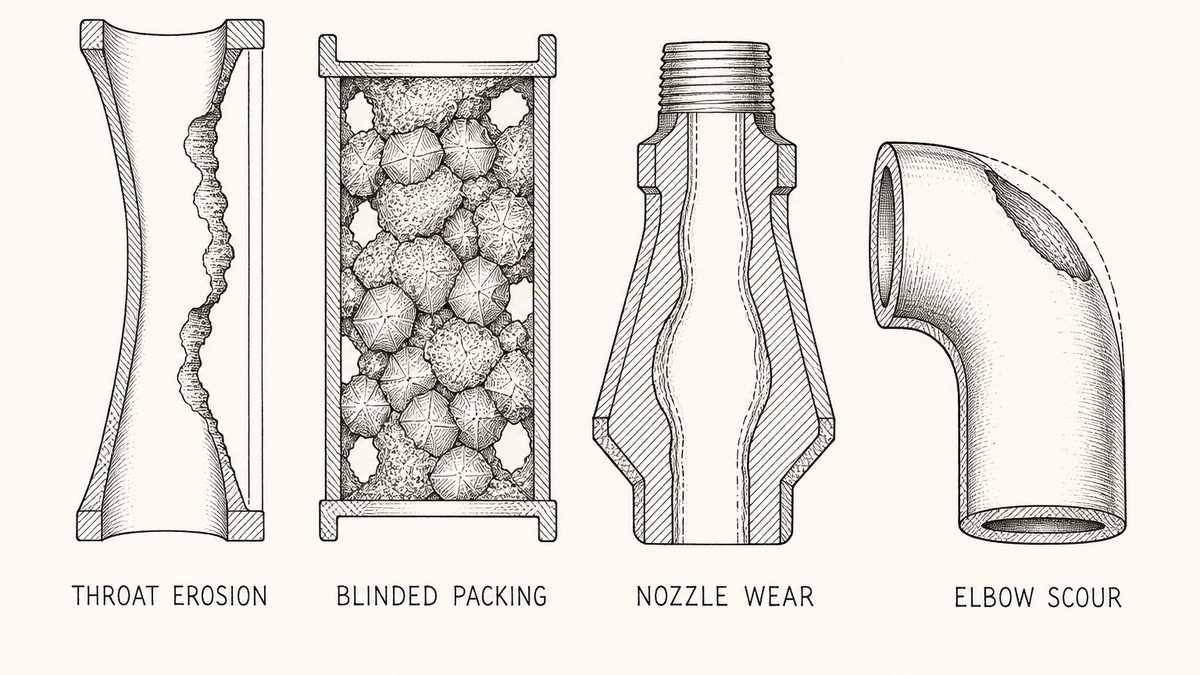
Throat erosion is the failure the material and the liner exist to prevent. It cannot be inspected away on a new machine, but the things that decide it can be checked at the works: the liner grade against the material certificate, the liner thickness at the point of highest velocity, how the liner is fixed so it can be replaced, and the straightness of the throat itself. Measure the throat opening rather than reading the drawing figure, because the throat opening is what sets the velocity the machine was sold on.
Blinded packing is a duty problem that shows up as a design problem. If the machine is a packed bed on a dusty stream, the packing will block regardless of how well it was made, and the check at the works is whether the packing is accessible and whether the support grid can be removed. On a machine that will legitimately see solids, ask for a spray arrangement above the packing that can wash it, and inspect that the nozzles for that wash actually cover the full cross-section. Packing that cannot be got at is a maintenance cost that arrives every few months.
Nozzle wear is invisible on a new nozzle and visible on a spray pattern test. The test is simple: run the header on water and look at the pattern from each nozzle. A nozzle that has not been drilled cleanly, or that has been assembled with the wrong insert, shows as a streaky or lopsided fan. This is worth doing at the works because a bad nozzle found on site means a shutdown to change it, whereas at the works it means picking up another one.
Elbow scour belongs to the design, not the duty. An elbow immediately downstream of the contact section sees a fast, wet, solid-laden stream, and thin walls at the outside of that bend are eaten through from the inside. Check the wall thickness at the bend against the drawing, and check whether the design put a thicker plate or a wear plate there at all. If it did not, that is a finding worth raising before shipment rather than after the first hole appears.
The rest of the works inspection. Dimensional check of the vessel against the general arrangement drawing, with the throat or bed dimensions measured rather than accepted. Material certificates matched against the material block on the datasheet, with the chloride figure the choice was made against recorded. Weld record and any required non-destructive testing, agreed in advance so it is done before paint rather than after. A run test of the pump and the fan, with the pump curve and the fan curve kept. The instrument schedule checked item by item, with the transmitters calibrated and the calibration certificates handed over. And the tap locations checked against the drawing, because a tap welded in the wrong place cannot be moved once the vessel is lined.
Then the start-up test, which is the event the whole article has been building towards. Because that test sets the pressure drop and the liquid flow that the plant then has to hold, it deserves the same preparation as a factory acceptance test. The instruments used for it should be the permanent ones or better, freshly calibrated. The plant should be at its normal load and its normal gas temperature, not at a convenient half rate. Both parameters should be recorded over a settled period rather than read once at the moment everything happens to be running. And the resulting figures should be written into the operating instructions with the test conditions beside them, so that a future operator can tell whether the machine has drifted or the plant has.
Worth doing alongside: a full check of the delivered equipment against the order before it is set in place, which is the same discipline as the pressure test before the tower is crated and the count of what arrived, extended to the instruments and spares.
Price, Scope and Lead Time: What Actually Moves the Number
There is no useful average price for a wet scrubber, because the spread between two machines for the same duty is a multiple rather than a percentage. What a buyer can do is understand which decisions move the number, so a quotation can be read instead of merely compared.
What moves it most. The material of construction is the first driver, and it is not a smooth scale: moving from lined carbon steel to a high-alloy stainless can double the vessel cost, and moving to FRP can take it back down again while changing the temperature limit. The gas volume is the second, because vessel diameter, duct size, fan and pump all scale with it. The presence of a reagent system is the third, since it turns a washing machine into a small chemical plant. Then, in rough order: the fan and pump make, the mist eliminator type, the instrument schedule, and how much ductwork is inside the scope.
The scope boundary is where cheap quotations are made. Two quotations can differ by a factor and both be honest, if one stops at the vessel and the other includes the fan, the ductwork, the stack connection, the instruments, the reagent system, the platform and the electrical work. The first question to ask of any quotation is where it stops. The second is which of the bought-in items are named, because an unnamed fan is not a cheaper fan, it is an undecided one.
Lead time follows the bought items, not the vessel. A steel vessel is a few weeks of fabrication. The long items are usually the fan, the alloy or FRP material itself, any instrument with a long delivery, and in a busy period the foundry castings inside the pump. A supplier who quotes twelve weeks without saying which items drive it has not bought anything yet. Ask for the lead time broken down, because the item at the front of that list is the one worth confirming at order.
Quantity hardly matters, spares do. Scrubbers are usually bought one at a time, or two where one runs as a spare. There is little volume discount to be had. What is worth buying at the same time is the set of parts that will otherwise stop the plant: spare nozzles of the same body, a spare set of packing or a spare mist eliminator section, the pump wear parts, and the instrument consumables. Those items cost little at order time and a great deal at breakdown time.
Questions Buyers Ask
How much does a wet scrubber cost?
There is no meaningful average, because the price follows the material, the gas volume and the scope rather than the size of the vessel. Two machines on the same duty can differ by a factor if one is lined carbon steel with a scoped-out fan and the other is a high-alloy vessel with the fan, ductwork and instruments included. What a buyer can do is ask for a priced breakdown by section: vessel, contact internals, liquid loop, fan and ductwork, instruments, and reagent system if there is one. That turns a total into something comparable. The single most common reason one quotation looks dramatically cheaper is that the fan, the instruments or the ductwork are not inside it.
What usually goes wrong with a wet scrubber?
Four things cover most of it, and three of them are written into the duty. The throat erodes where the velocity is highest, which is why it carries a replaceable liner in a harder grade. The packing blinds if the stream carries solids, which is a selection error rather than a manufacturing one. The nozzles wear open, which quietly increases droplet size and reduces collection until nobody can explain why the stack reading has drifted. And an elbow just downstream of the contact section scours through from the inside, which is a design choice about wall thickness. Of the four, only the first and the last can be influenced by inspecting the machine before it ships; the other two are decided by whether the right scrubber type was chosen.
Do I have to use a wet scrubber, or can I use something else?
You can use a dry scrubber, an electrostatic precipitator or a fabric filter instead, and on many duties one of those is the better machine. What you cannot do casually is use a device outside that list, because the federal rule requires a petition to the environmental agency for specific operating limits, filed at least sixty days before the performance test and approved before the test may run. That is a two month delay and an open-ended approval on a plant that is otherwise ready to start. The practical effect is that on a regulated source the device category is settled early, with the permit text in hand, rather than opened up as an engineering debate during procurement.
What pressure drop should I specify?
You specify the collection efficiency the permit needs and let the supplier tell you what pressure drop follows, then check that the fan power that goes with it is acceptable. On a venturi the relationship between pressure drop and fine-particle collection is steep, so pressure drop is where efficiency is bought and where the electricity bill is set. What you should not do is accept a pressure drop that appears nowhere except in the quotation, because on a regulated plant that figure tends to become the operating limit the machine is held to once it has been tested. Fixing it deliberately at the design stage is far cheaper than discovering it at commissioning.
How do I know whether I need a venturi or a packed bed?
From the contaminant, not the price. A venturi is a dust machine: it uses a very high gas velocity at a throat to atomise liquid into droplets small enough to catch fine particles, and it is poor at dissolving gas. A packed bed is a gas absorption machine: it gives a large wetted surface and a long contact time so that a soluble gas dissolves into the liquid, and it blinds quickly if the stream carries solids. If the exhaust carries both dust and acid gas, the usual answer is two units in series, a venturi followed by a packed bed. Ask for the particle size distribution before the enquiry goes out, because below about one micron the whole design conversation changes.
What should I check before a scrubber ships?
Six things, all measurable in the works. Measure the throat or bed dimensions rather than reading them off the drawing, because they set the velocity the machine was sold on. Match the material certificates against the material block on the datasheet, with the chloride level the choice was made against recorded. Check the wall thickness at the elbow downstream of the contact section. Run the nozzle header on water and look at the spray pattern from each nozzle. Check that the pressure taps are in the positions the drawing shows, because they cannot be moved once the vessel is lined. And check the instrument schedule item by item, with the transmitters calibrated and their certificates handed over, since those instruments are what the plant will rely on to prove it is running inside its limits.
Send the contaminant and the permit limit — the gas volume alone is not enough
Tell us what is in the exhaust and what it has to meet. Then the gas data: the volume with the temperature it was measured at and whether it is actual or corrected; the composition, at least what decides material and reagent; the particulate loading and particle size; the inlet temperature; the moisture content; and the permit limit as it appears in the permit. Then the machine: the device type by its rule name, the pressure drop and liquid flow it is to be designed to, the vessel material with the chloride level behind it, and whether the ductwork, instruments and reagent system are included.
Request a Wet Scrubber Sourcing Quote
Questions & Comments
We read every one and reply within 24 hoursMost wet scrubber arguments come down to two numbers that were never written down: the pressure drop and the liquid flow the machine will be held to. On a regulated plant those are set by the start-up test, so tell us the permit limit and we will pin them down before the order.