
Ball Screw Manufacturer: Sourcing Precision Ball Screws From China
 ·
Updated October 13, 2026
·
24 min read
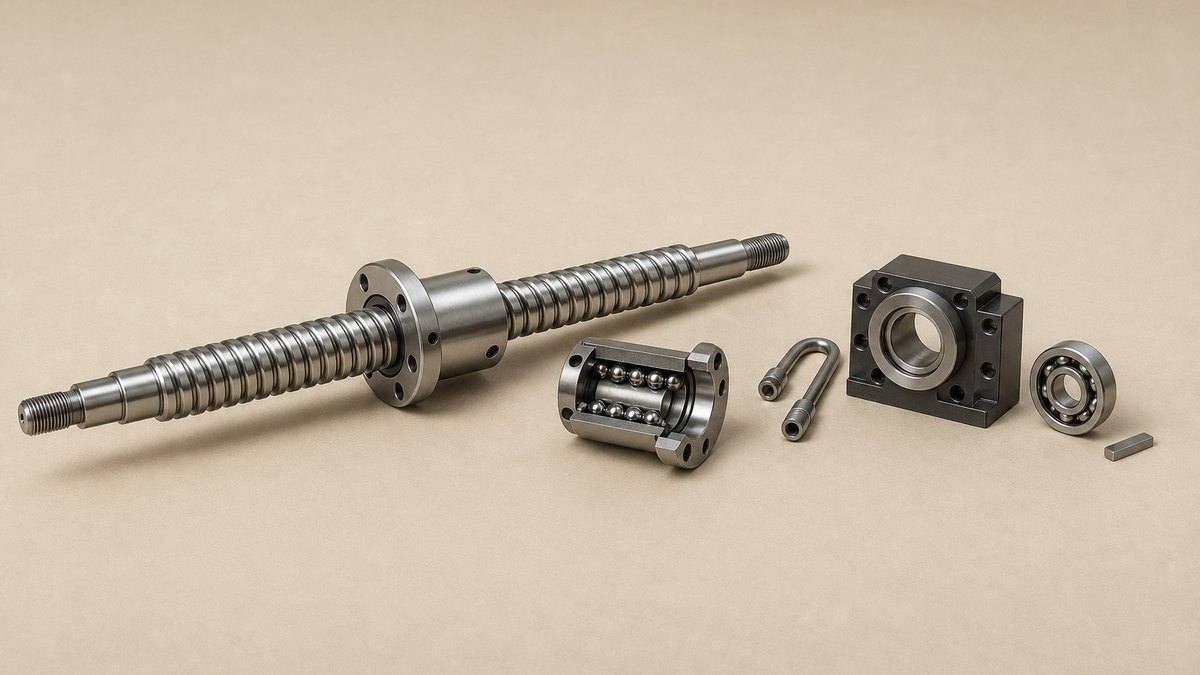
A ball screw turns a motor's rotation into precise straight-line movement by rolling a ring of steel balls between a grooved shaft and a grooved nut. Almost nothing about it rubs, which is why it needs roughly a tenth of the effort of a sliding screw, and why it is the part behind every machine tool axis, every robot arm and every automatic handling gantry. Buyers then order it on three numbers — diameter, lead and length — and the three lines that decide whether the axis works are the ones they leave off: the accuracy grade, the preload, and what holds the screw at each end. There is also one property of the part that gets almost nobody's attention until an axis drops and hurts somebody, and it is written into a free federal rule: a ball screw turns backwards on its own, so a vertical axis holds stored energy that is released the moment the power is cut.
Six Lines That Decide Whether a Ball Screw Order Is Complete
| What the buyer has to settle | Why it is not obvious | The line on your order that closes it |
|---|---|---|
| Accuracy grade, not just diameter and lead | The same shaft in the same length comes in several grades at quite different prices | The grade number, plus the length over which the travel error is measured |
| Preload and the backlash that follows it | An unloaded nut has free play; a preloaded one does not, and it costs more and runs hotter | Preloaded or not, by which method, and what backlash you will accept |
| How the screw is held at each end | One end fixed and one end simple is not the same as both ends fixed | The support arrangement at each end, with bearing type and locknut details |
| Lead accuracy against the length | Travel error is measured over a stated length, so a long screw is a harder request than a short one | Screw length, and the error allowance you need over that length |
| What holds the load when the power is off | A ball screw back-drives, so a vertical axis will run down by itself | A brake, or a self-holding arrangement, stated as a requirement |
| Dirt, coolant and chips | The ball track is open to the air at both ends of the nut | Wiper seals, and whether the nut needs a bellows or a cover |
What a Ball Screw Is, and the Words Around It
The part is one screw, one nut and a ring of steel balls, and the trade has a small vocabulary that gets used loosely. Six words carry the subject, and getting them straight at the enquiry stage prevents most of the arguments that follow.
- Ball screw and ball nut
- The screw is a hardened shaft with a helical groove ground into it. The nut is the ring that rides on it, with a matching groove inside and a set of balls running in the channel the two grooves make together. They are made for each other and are almost never interchangeable between makers: a nut from one factory will not run properly on another factory's screw, even at the same stated size. This matters commercially, because it means a spare nut is usually only available from the original maker.
- Lead
- The distance the nut travels along the screw in one full turn. It decides how fast the axis moves for a given motor speed, and it is the number most buyers order on. A lead of ten millimetres means ten millimetres of travel per revolution, so a screw driven at three hundred revolutions a minute moves the axis at three metres a minute.
- Lead accuracy and travel error
- The difference between where the nut actually is and where the drawing says it should be after travelling a given distance. It is quoted as an allowance over a stated length, never as a plain percentage, so a figure without its length means nothing. Travel error is the number that matters on a machine tool, because it feeds straight into the finished part.
- Backlash
- The free movement the nut has when you reverse direction, before it starts pushing the other way. A ball screw is not naturally free of it; the balls need a little room to roll. Backlash is removed by preload, and preload is a choice with a cost, which is why the two words travel together.
- Preload
- A deliberate squeeze put on the balls so the nut grips the groove on both flanks at once. It removes the free play and makes the axis stiff, and it is what an accurate machine needs. It also adds friction, heat and wear, so a preloaded nut that is preloaded for no reason is a nut that will die early for no reason.
- Recirculation
- The path that carries the balls from the end of their run back to the start so the nut can keep turning. The balls cannot all be in the track and travelling indefinitely; they have to be picked up at one end and returned to the other. How that is done is the single biggest difference between a cheap nut and an expensive one.
One comparison is worth settling early, because the three parts get confused and they solve different problems. A lead screw, often called an ACME screw, is the sliding ancestor: a square or trapezoidal thread running in a matching nut, cheap, quiet and happy in dirty places, but wasteful because metal slides on metal, and it wears into a slack fit as it does so. A ball screw rolls instead of sliding, which is where its efficiency comes from, but that also means it needs clean surroundings and a return path for the balls. A roller screw replaces the balls with threaded rollers, which spreads the load over far more contact points and lets the same size carry far more force, at several times the price and with very few factories able to make one. When a buyer says the axis is too weak, the answer is usually not a bigger ball screw: it is a different family altogether.
How the Balls Get Back, and Why It Decides Noise and Life
Every ball nut has to solve the same small puzzle: the channel that holds the balls runs in a spiral, so the balls must be lifted out at one end of their run and put back at the other, or the nut would jam within a single turn. There are three ordinary answers, and they are not equal.
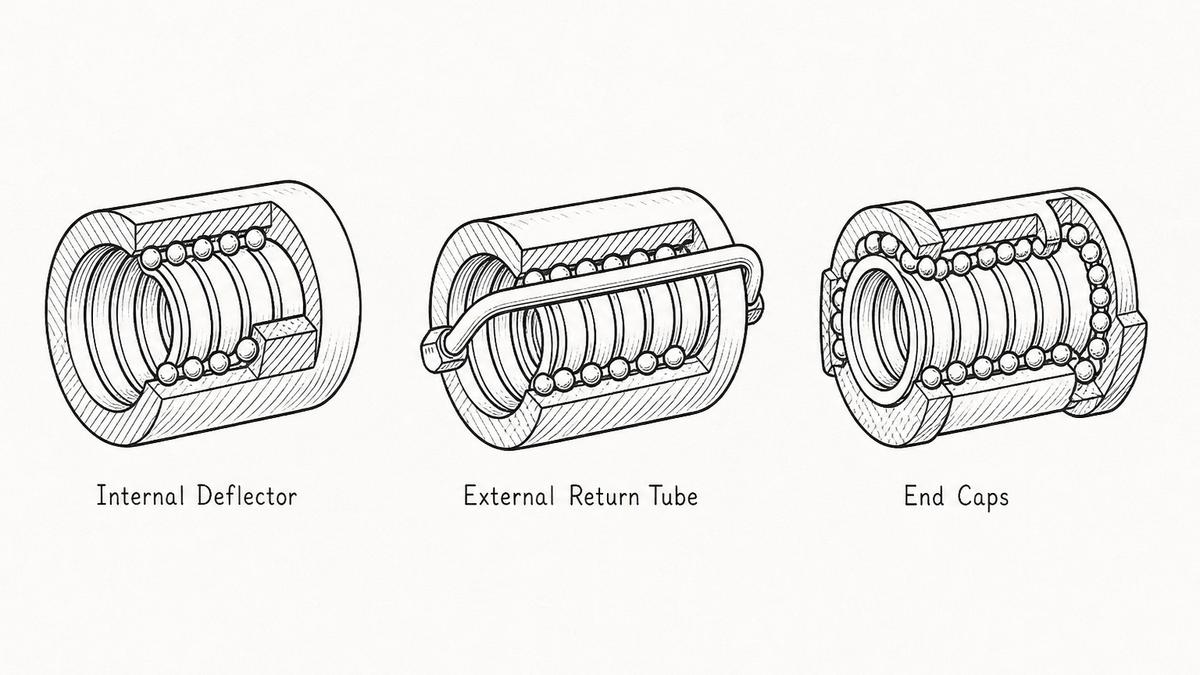
The internal deflector. A small raised wedge sits inside the nut's wall and scoops the balls up and over by one thread, so they rejoin the track one groove further along. Almost nothing is added to the outside of the nut, which makes it compact, and there is only one circuit, which keeps the balls from wandering between tracks. The limit is speed: at high revolutions the scoop has to lift the whole ball train every turn, and it starts to complain.
The external return tube. A slim tube crosses the outside of the nut from one end of a circuit to the other, and the balls run through it. It is the cheapest arrangement to make and the easiest to inspect, and it is what most of the world's general-purpose ball screws use. Two things matter about it, and the buyer should have both on the drawing. First, the tube must be positively retained, because a tube that works loose drops its balls out of the bottom of the nut and takes the axis with it. Second, the tube is on the outside, so it is the part that gets hit by a chip, a swarf heap or a careless hand during assembly.
End caps. Two circular caps, one at each end of the nut, each with a channel moulded through it, so the balls dive into the cap, cross over the outside of the nut and re-enter at the far end of the track. Because the return path sits in the caps, the nut body can be shorter and the outside of the nut is free for a flange and for mounting holes. This is the arrangement that suits fast, quiet applications, and it is also the one where a damaged cap stops the nut completely, because the caps are plastic or light alloy and they are the softest thing in the assembly.
Two practical consequences follow. Ask which arrangement is being offered, because the price difference at the same stated size is real and a quotation that names only the diameter and the lead has not told you which nut you are buying. And the number of circuits matters as much as the arrangement. A nut can have its balls split into two, three or four separate loops instead of one long one. More loops share the load better and stiffen the nut, and each loop has its own return path and therefore its own small place for dirt to collect and for a ball to jam. A three-loop nut is not three times better than a one-loop nut; it is a different set of trade-offs, and the factory will assume one of them unless you say otherwise.
The Accuracy Grade, in Plain Words
Almost every ball screw catalogue prints a grade code and almost none of them explains it, which is why so many buyers pay for accuracy they cannot use or order a screw that is too loose for the machine. The grade describes one thing: how far the nut can be from where it should be after it has travelled a certain distance. It is a travel error, measured along the screw, and it is not the same as the roundness of the shaft or the finish of the groove.
The letter and the number are one code. A grade is written as a letter and a digit, such as the codes running upward in accuracy. The smaller the number, the tighter the screw, and the more of the catalogue's price sits in that digit. The table below is the pairing the trade usually makes between a grade and a machine. It is convention rather than a rule, and the exact allowances each grade permits are set out in paid standards — the ISO ball screw document, the Japanese industrial standard and the Chinese national standard that mirrors it — which are not reproduced here and are not free.
| Grade band | What it is for | What a buyer should know before ordering it |
|---|---|---|
| Tightest three or four grades | Measuring machines, semiconductor stages, optical and inspection equipment | The screw has to be held to a controlled temperature and mounted in a way that does not push the error around. The supporting parts cost more than the screw |
| Precision machine tool grades | Grinding machines, wire and die-sink EDM, high-grade machining centres | The usual choice for a machine that has to hold a tolerance on the finished part. Worth paying for only if the machine frame and the guideways are as stiff as the screw |
| General machine tool grades | Machining centres, routers, laser cutters, automation axes that position and then work | The volume seller. Most machine builders buy here, and it is the grade most Chinese factories hold in stock |
| Transport and general industrial grades | Conveyors, gantries, picking heads, packaging and handling axes | The screw moves something to a place rather than to a size. Buying tighter here is money spent on nothing |
| Loosest grades | Manual and semi-manual movement, simple lifting, non-critical travel | Still a ball screw, so still far more efficient than a sliding screw, at a fraction of the price of anything above it |
Three details decide whether the grade is worth its price, and they are the ones the catalogues leave out.
First, travel error is quoted over a stated length. A grade allowance that applies over a short measuring length does not simply double for a screw twice as long; long screws earn extra allowance, because grinding a long shaft without letting it bend is a harder job than grinding a short one. So a grade code without the length beside it is an incomplete specification. Put the screw length and the error allowance you need over that length on the enquiry, and let the factory tell you which grade meets it.
Second, the grade belongs to the screw, and the assembled error belongs to the pair. A screw and a nut are graded from their own measurements, and the error the machine actually sees is the combination of the screw's travel error, the nut's own error and how the nut is preloaded. A buyer who assumes the assembled axis will be exactly as good as the screw's grade will be disappointed by a small amount on every axis, and on a tight-tolerance machine that small amount is the whole problem.
Third, and most usefully, the controller can often take the error out. Most modern machine controls let you measure the actual travel error along the axis and enter a correction table, so the controller compensates as the axis moves. On a machine that already has that function, buying one grade lower and mapping the error is often cheaper than buying the tighter screw, and it works on axes where the load is steady. What it cannot fix is a worn screw, an error that changes with temperature, or an axis where the error moves around from week to week. On those, the grade is the only answer.
One more distinction worth holding on to, because it is where most enquiries go wrong. A ball screw has travel accuracy and it has repeatability, and they are different things. Accuracy is whether the axis arrives where the drawing says. Repeatability is whether it arrives in the same place every time it is sent there. A grade controls accuracy. Repeatability comes from stiffness, from the guideways, from the drive and from how the two ends of the screw are held. An axis can be very repeatable and not very accurate, and for many production machines that is perfectly acceptable — the tool is set from the first good part, not from the drawing. Knowing which of the two your process actually needs is worth more than a grade code, and it costs nothing to work out before the order is placed.
Preload and Backlash: the Line Buyers Leave Off the Order
An ordinary ball nut has free play in it. The balls need a little room to roll, and that room shows up as backlash: reverse the motor and the nut moves a small distance before it starts pushing the other way. Some machines do not care. A cutting tool that only ever cuts in one direction does not care. A pick-and-place head that has to stop dead and hold a position cares a great deal. Preload is how that free play is taken out, and it is a deliberate choice with a real cost.
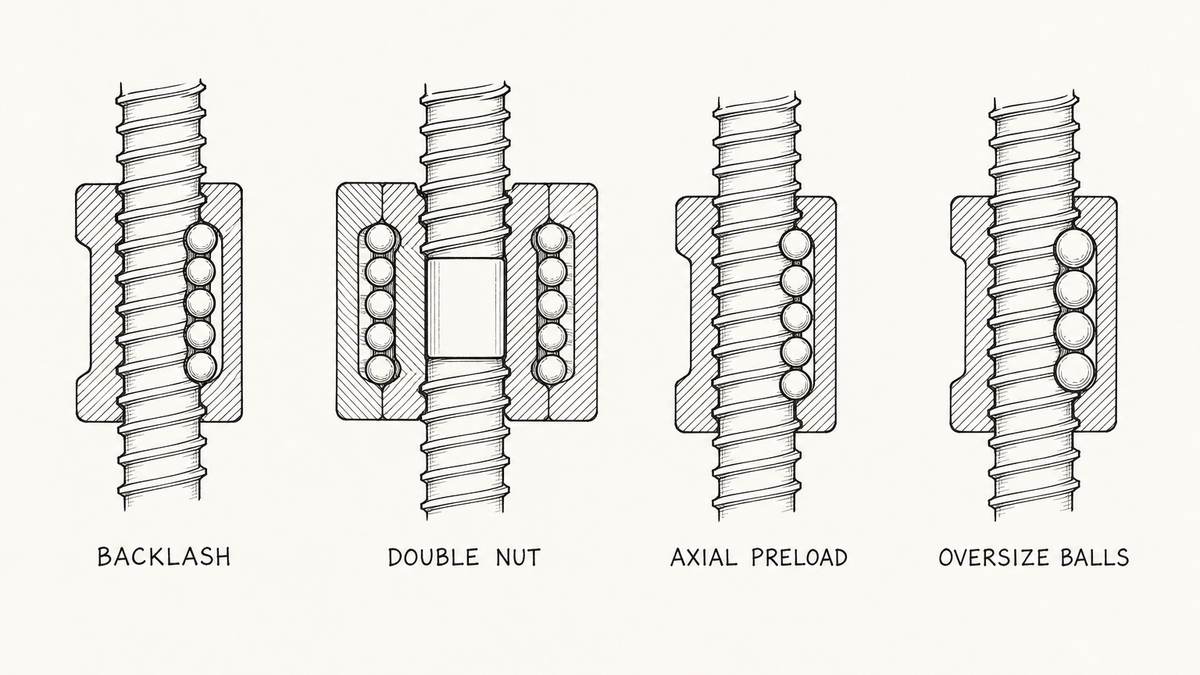
Four ways to put the squeeze on, and they are not equally good.
Two nuts and a spacer. Two nuts run on the same screw, one in each direction, and a ground spacer between them pushes them apart so each one takes one flank of the groove. It is the oldest method, it is easy to understand, it can be adjusted by changing the spacer, and it needs roughly twice the nut length — which on a short axis is the whole problem.
A single nut with a shifted track. The nut's internal track is ground very slightly along the axis from where it would sit naturally, so the balls are pressed against one flank without a second nut. It gives the stiffness of a double nut in half the length, which is why it dominates modern machine tools, and it demands a factory that can grind to that offset repeatably. A quotation that offers a single preloaded nut at a price close to an unloaded one is worth asking a question about.
Oversized balls. Balls very slightly larger than the groove was made for press against both flanks at once without any change to the nut's geometry. It is the cheapest way to remove backlash, and it is also the one with the sharpest trade-off: the interference is set by the ball size, it cannot be adjusted later, and it raises friction everywhere in the circuit.
A spring or a shim arrangement does the same job with some give built in, which suits a machine that takes shocks. It is uncommon on machine tools and finds use where the axis has to give a little rather than break.
What preload costs you, on three separate lines. First, money — a preloaded nut is a more precisely made nut. Second, drag: the nut is harder to turn, so the motor has to work harder, the axis runs warmer, and on a fast axis the heat is a real design constraint rather than an inconvenience. Third, and least understood, life. A preloaded nut carries the balls against the groove even when the machine is doing nothing, so it is always working. Makers therefore give a preloaded nut a lower load rating than the same nut free, and a buyer who orders preload for a light positioning job has quietly shortened the life of the axis for no benefit at all.
So the question is not whether preload is good. It is how much, and for what. Makers usually offer preload as a class or as a band rather than as a single figure, and the bands are not consistent between makers, so the same stated class from two suppliers is not the same squeeze. Put the requirement on the order in a way that can be checked: the lightest class that holds your positioning need, the backlash you will accept in numbers rather than words, and whether you need the stiffness in both directions or only one. Then ask what drag the preload adds, because that number tells you what it is going to cost you in heat and motor size for the rest of the machine's life.
Why Ball Screws Cost What They Cost
Buyers ask this constantly, and the honest answer is that a ball screw is expensive because it is one of the few mass-produced parts where the inspection costs nearly as much as the making, and because most of the money is not in the screw at all.
The shaft starts soft and ends up very hard. A ball screw begins as a bar of bearing-grade steel. It is turned, and then the groove is ground into it, and the grinding is done through the hardened skin rather than before it, because hardening a finished groove would distort it. So the sequence is: rough form, heat treat to a high hardness, then grind the groove to final shape in the hard metal. Grinding hard steel is slow, it consumes wheels, and it needs a machine that can hold the part straight while it does it. That single operation is the heart of the cost.
The nut has to be ground from the inside. The nut's internal groove has to match the shaft's groove almost exactly, and it is inside a bore, where a grinding wheel struggles to reach and where the operator can barely see what is happening. This is the part most factories cannot do well, and the part most likely to be quietly outsourced by a factory that claims to make the whole unit.
The balls are not ordinary balls. They are graded by size in very fine steps and are matched to the groove so the whole circuit shares the load evenly. Balls of uneven size in one circuit mean the bigger ones take the load and wear first, and that is the difference between a nut that lasts years and one that develops backlash in months.
The ends are often the biggest single line. A finished ball screw arrives with machined journals for its bearings, threads for locknuts, a keyway or a flat, and sometimes a splined or flanged end. All of that is turning and grinding on the same hard shaft, and on a short screw the ends can be more work than the screw itself. When a quotation looks high against the catalogue price of a plain screw, this is usually why — and when a quotation for a fully machined screw looks suspiciously low, the question to ask is which of those operations has been left off the drawing.
Volume is low and metrology is dear. Precision ball screws are not made in millions. A factory keeps a set of sizes in production and machines everything else to order, so setup sits in every price. And to sell a graded screw the factory has to be able to prove the grade: the laser measuring equipment that measures travel error along a long screw costs more than the grinder, and it has to be calibrated and kept. A buyer who wonders why a graded screw costs several times a loose one is paying for the grinder, the measuring machine and the person who runs it, and none of those three appear on the invoice.
The consequence for a buyer is simple. The cheapest way to buy a ball screw is to buy a standard size in a standard grade with a simple end, from a factory that already makes that size. The most expensive way is to ask for a special diameter, a special lead, a tight grade and a complicated end in a quantity of one, because every one of those choices adds setup and adds inspection without adding any benefit that the machine can measure. If a design needs something unusual, it is worth asking the factory which standard size is closest and whether the machine can be built around that instead. That question alone has saved more money on more projects than any negotiation I have watched.
How Long a Ball Screw Lasts, and What Shortens It
There is no honest single answer to how long a ball screw lasts, and any supplier who gives you one without asking about your machine is guessing. What can be said honestly is that a ball screw wears out by one of two routes, and the two have completely different causes, so the useful question is which route yours is on.
Route one is fatigue, and it is a count of revolutions under load. Every time a ball rolls over a spot in the groove it puts a stress cycle into the metal, and after enough cycles that spot gives up and a small piece of the surface comes away. This is why ball screw ratings are given as a life in revolutions at a stated load, and why a heavier load shortens life far faster than the arithmetic suggests: the stress goes up and the groove gives way much sooner. Fatigue is the normal end of a well-run ball screw, and on a correctly chosen axis it is measured in years.
Route two is everything else, and it is what actually kills most ball screws. Contamination grinds, lubrication failure scores, a misaligned support bends, an end-of-travel crash flattens, and a nut that was mounted without support sags under its own length. These do not depend on revolutions at all. A screw on a machine that runs one shift a week can die of dirt in a year while its revolution count says it should last a decade.
Then there are three things that shorten life and are almost always the buyer's own doing.
Dirt and swarf. The ball track is open to the air wherever the nut is not, so dust, grinding grit, casting sand and metal chips all collect on the shaft in front of the nut and are rolled into the groove by the next travel. The cure is a wiper seal at each end of the nut, and on a dirty machine it is also a cover: a bellows, a telescopic shroud or a steel way-cover over the screw. A wiper alone will not survive a machining centre that throws chips. Buyers who specify the seal and skip the cover usually find out which one mattered.
Lubrication, and the fact that grease and oil behave differently here. A ball screw needs a film between the balls and the groove, and the film has to be renewed. Grease stays where it is put and suits a slow or intermittent axis, but it also holds onto grit. Oil carries grit away and suits a fast or continuously running axis, but it has to be delivered reliably and it can be washed off by coolant. The important point for a buyer is that the choice belongs to the application and not to the supplier. When you order a ball screw, say whether the axis runs continuously, what speed it reaches, whether coolant or wash-down water will reach it and how the lubrication is going to be applied. The factory's recommendation changes with those answers, and a wrong choice here shows up as pitting long before the rated life arrives.
The two ends, and how they are held. Almost every premature ball screw failure I have investigated came back to the supports rather than the screw. A shaft that is held at both ends and pulled straight runs cool, quiet and true. A shaft that is held at one end only will sag and whip, and on a long screw the sag alone can be several times the accuracy the screw was bought to hold — so the money spent on a tight grade was thrown away by the mounting. The choice of arrangement is also what sets how much the screw grows when it gets hot, and a screw that is fixed at both ends has nowhere to grow except into its own bearings.
Preload, as covered above. A preloaded nut is working even when the machine is idle, so it reaches its fatigue life sooner than the same nut free. That is not an argument against preload; it is an argument for ordering the smallest amount that does the job.
A practical word on what to expect. On a general industrial axis with proper wipers, a covered screw, the right lubrication and a supported shaft, counting in years rather than months is reasonable, and the thing that will eventually end its life is fatigue in the groove. On an unprotected, unlubricated or badly supported axis, counting in months is realistic, and the end will be pitting or a jammed return path rather than fatigue. When a supplier quotes a life figure, ask what it assumes. A figure that assumes clean conditions and continuous lubrication is a target, not a promise, and the assumptions beside it are more useful to you than the number.
Stored Energy, Guards and Shaft Ends: the Rules That Follow the Part
A ball screw has one property that no other screw has, and it is the reason a whole section of a federal rule applies to it. Because it rolls rather than slides, it is efficient in both directions. Turn the nut and the screw turns; turn the screw and the nut travels. That is exactly what you want on a positioning axis and it is a serious hazard on a lifting one, because a vertical ball screw will run its load down under gravity the moment the motor stops holding it. The rules that cover this are free to read and they are unusually specific.
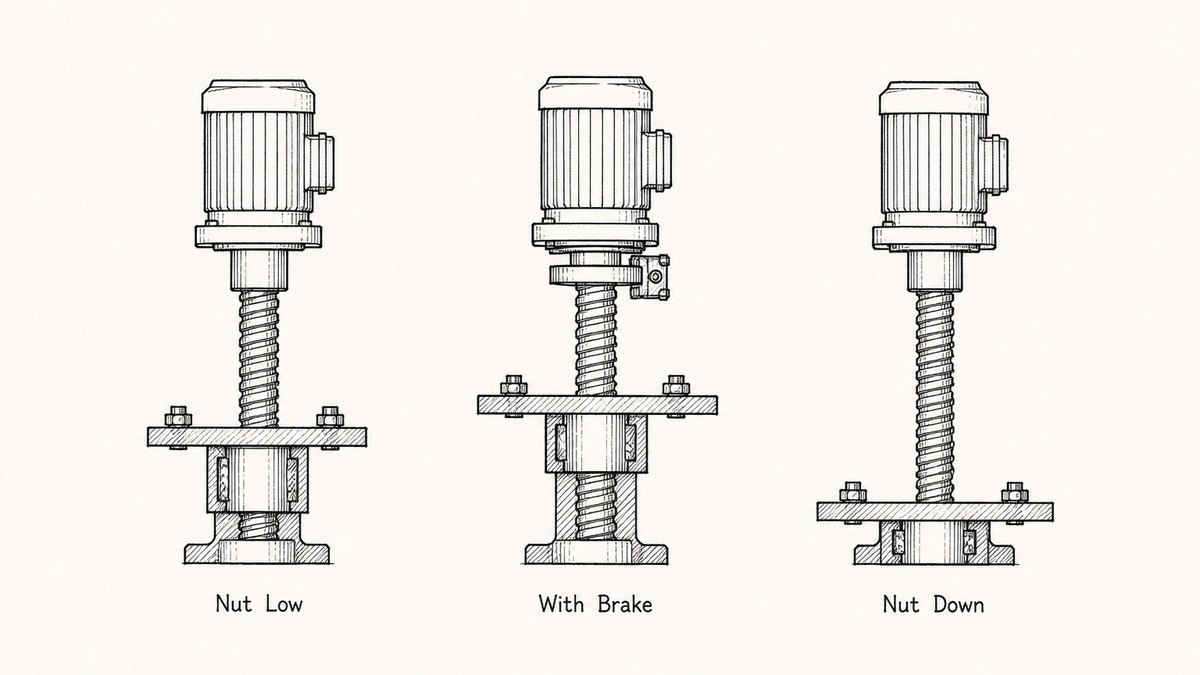
The rule is about stored energy, and it names the exact case. 29 CFR 1910.147 is the standard for the control of hazardous energy, and its scope paragraph says it covers machines and equipment in which the unexpected start-up “or release of stored energy could cause injury to employees”. The rule then explains what it means by stored energy, and the guidance in its appendix lists the ordinary cases: capacitors, springs, rotating flywheels, hydraulic systems, air, gas, steam and water pressure, and the one that matters here, “elevated machine members”.
An elevated machine member is a load held up in the air. A vertical ball screw axis holding a platform, a gantry head, a die or a pallet is an elevated machine member, and it is holding that load up with nothing but the motor's grip on a screw that is perfectly happy to turn backwards. Once a machine is recognised as one where stored energy can be released, the rest follows: the rule requires controlled procedures for shutting the machine down and isolating it, and it says plainly that after the energy is isolated, all potentially hazardous stored energy has to be “relieved, disconnected, restrained, and otherwise rendered safe”. In plain words, before a maintenance worker puts a hand into a vertical axis, the load has to be let down, blocked, or otherwise made incapable of moving — not merely have its supply switched off.
Two things this means for a buyer, and both belong on the order.
First, decide how the load is held when the power is off. A brake on the motor is the usual answer for a vertical axis, and it has to be a brake that holds, not a brake that only slows. A self-locking screw is another answer, though a ball screw is by nature not self-locking, so a self-locking solution means a different screw family or a separate holding device. Blocking in the machine is the third, and it is the least convenient for the operator. Whatever the answer, the axis has to be able to sit still with the power off, and the person who decides that is the machine designer, not the screw supplier. State it on the enquiry so the supplier knows he is not being asked for a free-turning axis.
Second, ask for energy isolating devices that accept a lock. The same rule says that whenever new machines or equipment are installed, their energy isolating devices must be designed to accept a lockout device. That is a requirement about the machine you are buying, and it is the sort of line a factory will happily ignore unless it is written down. It also has a definition worth knowing when a supplier waves at a switch: an energy isolating device has to be a mechanical device that physically prevents the transmission or release of energy, and the rule is explicit that push buttons, selector switches and other control-circuit devices are not energy isolating devices at all. A machine with a stop button and no isolator is not a machine you can legally maintain.
Then the guards, and the shaft end. 29 CFR 1910.212 requires guards that protect people in the machine area from hazards including “rotating parts”. A ball screw in motion is a rotating part, its coupling is a rotating part, and an ingoing nip point exists wherever the screw enters the nut. That last one is easy to miss and it is the one that takes fingers: the gap between the screw's groove and the nut's seal closes as the nut travels, and it closes along the whole length of the axis. A guard, a way-cover or a bellows that covers the screw also closes this hazard, which is one more reason the cover belongs in the specification rather than in the maintenance budget.
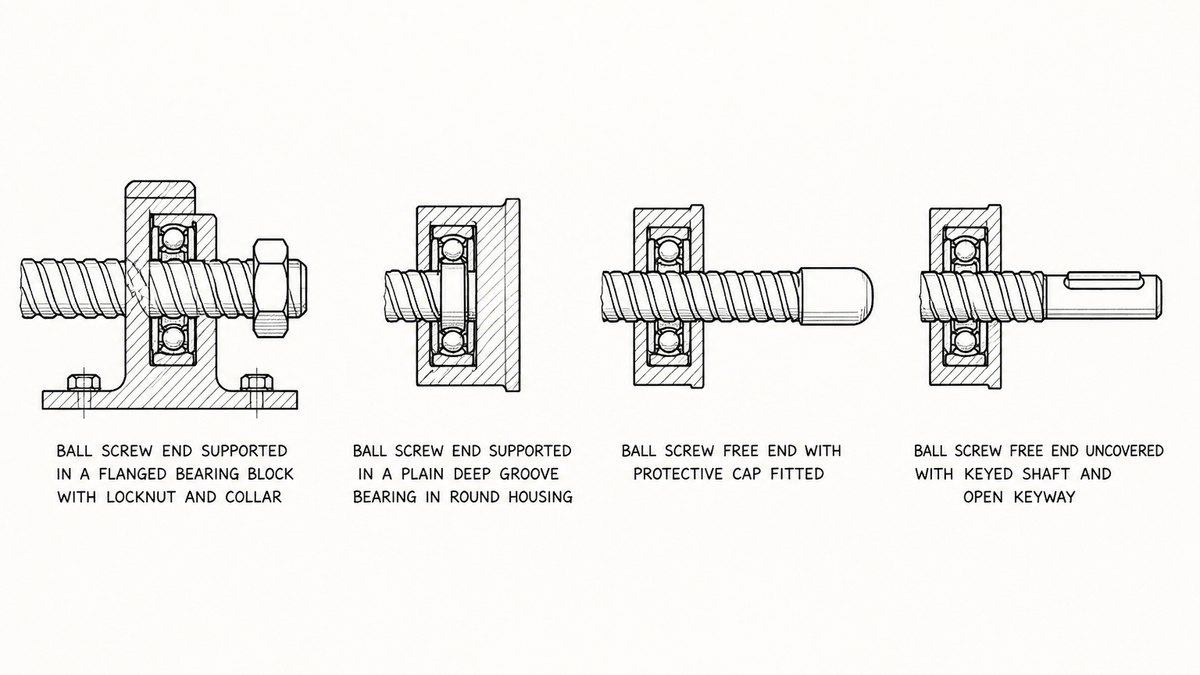
The same part of the rules has two sentences written for exactly this component. 29 CFR 1910.219 covers mechanical power-transmission apparatus and says that “Projecting shaft ends shall present a smooth edge and end and shall not project more than one-half the diameter of the shaft unless guarded by nonrotating caps or safety sleeves.” One line later it adds: “Unused keyways shall be filled up or covered.”
Read those against a real ball screw and three practical requirements fall out. A screw end that sticks out further than half its own diameter has to carry a non-rotating cap or a safety sleeve. A ball screw in a lathe or a milling machine often has a handwheel, a pulley or a bare end where the screw passes out of the machine, and that end is turning at axis speed. An unused keyway on a rotating shaft has to be filled or covered. The spare axis on the shelf, the second end of a double-ended screw, and the coupling that is being fitted next week all leave an open keyway with, quite often, a key sitting in it, and a key in an open keyway on a spinning shaft is a small blade turning at speed. And the guard has to be attached to the machine, not to the floor or to a separate stand, because a guard that moves independently of the machine will eventually stop guarding anything.
The last of the four is about the motor that drives the axis, and it is the one nobody expects. Under 10 CFR 431.12 the federal energy rules define an electric motor as a machine that converts electrical power into rotational mechanical power, and the standards in 10 CFR 431.25 apply to a motor manufactured “alone or as a component of another piece of equipment”. A servo or stepper bolted to the end of a ball screw is a motor working as a component of another piece of equipment, so it is inside the reach of the rule. The same section takes definite purpose and special purpose motors back out, and a motor built into a special housing to suit one axis is often a special purpose motor — which is a legitimate and ordinary outcome, but it is a category, and it is worth knowing which one your axis is in before somebody asks you. The practical line for an order is the certificate that the same section defines as proof of meeting the standard that applies. Where the axis is for the United States market, put that on the enquiry and see whether the answer comes back from records or from improvisation.
Four Rules That Touch a Ball Screw Axis, and Where Each One Is Written
| The requirement | What it says, in plain words | Where it comes from |
|---|---|---|
| Stored energy on a vertical axis | A load held up in the air is stored energy, and it has to be let down, blocked or restrained before anyone works on the machine — not just switched off | 29 CFR 1910.147, including the appendix list that names elevated machine members |
| Isolators that take a lock | New machines have to be fitted with energy isolating devices designed to accept a lockout device, and a push button is not an isolating device | 29 CFR 1910.147(c)(2) and the definitions in (b) |
| Guards and anchoring | Rotating parts need guarding, including the nip where the screw meets the nut, and a fixed machine has to be anchored | 29 CFR 1910.212 |
| Shaft ends and keyways | An end projecting more than half the shaft diameter needs a non-rotating cap or sleeve, and an unused keyway must be filled or covered | 29 CFR 1910.219(c)(4) |
One limit, said plainly. This section is a map of where the requirements are written and what they say, so that a buyer can read the rule that applies. It is not an opinion on whether a particular machine meets them, and it is not legal advice. Both the energy control rule and the guarding rule are free on the electronic Code of Federal Regulations and together they take under half an hour to read.
Sourcing From China: Factory, Trader, and What to Ask
This is the question the search results leave open, and it is the one that decides whether the screw in the crate is the screw on the drawing. Ball screws are made in China at every level from loose general-purpose screws to precision-ground units that hold their grade over several metres, and the difference between two suppliers is not usually honesty. It is capability, and capability is testable.
Four things only a real works can answer, and the answers are checkable.
Does it grind the nut, or buy it? This is the single best question in the whole exercise. Grinding the internal groove of a nut is the hardest operation in a ball screw and the one most likely to be outsourced. A works that grinds its own nuts will talk about wheels, dressing, internal grinding spindles and how it holds the match between the screw groove and the nut groove. A trader will talk about the nut's part number. Neither answer is a lie, but only one of them tells you the factory can fix a problem on your axis.
How does it measure travel error, and over what length? A factory that sells graded screws has a measuring machine that runs the nut along the whole length of a screw and records the error. Ask what the machine measures and how often it is calibrated. A factory that answers with a tolerance figure and no method is quoting a catalogue, not a capability.
How are the balls graded and matched? Ball size and circuit-to-circuit matching are what make a nut quiet and long-lived. A works will describe how it sorts balls and how it decides the sizes for one nut. A trader will say the balls meet the standard.
How are the shaft ends made, and on what machine? Journals, threads, keyways and flats are turned and ground on the same hardened shaft, and on many orders they are the largest part of the work. A works can tell you the sequence. A trader will quote the drawing back to you.
Then five commercial questions that sort the rest. What is standard stock, and what is made to order — because a factory with the size in production is a different proposition from one setting up for a single screw, and the difference shows in both price and delivery. What is the minimum order for a special lead or a special diameter. What the lead time is for a repeat of exactly the same drawing, since a repeat is the cheapest thing a factory can make. Whether the factory will supply the screw and the nut as a matched pair with the markings that identify them as a pair, because a nut and a screw that are separated in a warehouse are two scrap parts. And whether it will accept your inspection before shipment, which is the next section.
Two commercial realities worth carrying into the conversation. First, a Chinese factory's strength is in the middle of the range: standard sizes, standard leads, general machine tool grades, and reasonable quantities. That is where the price advantage is large and the quality is genuinely competitive. Asking the same factory for the tightest grades over the longest lengths is asking it to compete where it is weakest, and the price will show that. Second, the ends cost what the ends cost anywhere. Turning and grinding a set of journals and threads is the same work in China as it is in Ohio, and a quotation that is dramatically cheap on a fully machined screw is a quotation where something has been left off. Getting the ends right is the part of the order worth paying attention to, and the same discipline applies to any precision machining job, whether that is a ball screw or a belt pulley with a finished bore.
What to Put in the Specification Sheet
An enquiry that gives a diameter, a lead and a length will get you a price for a screw, and it will not get you the axis you designed. The full list is not long, and writing it out costs an hour that saves weeks. The general discipline for any part made to a drawing is set out in this guide to a a worked example of a part sheet; a ball screw adds its own lines on top.
The screw itself. The diameter the drawing calls out, the lead, and the overall length including the ends. Whether the lead is right hand or left hand, and whether it is a single start or a multi-start thread — a multi-start screw travels several leads per turn and is an easy detail to leave unsaid. The grade, with the length over which the travel error is to be measured. The thread form or flank angle if it is not the maker's standard, and whether the screw needs to be hollow for coolant or for a through-shaft design.
The nut. Type, and the return arrangement if you care which one you get. Number of circuits, or the load rating you need, since the factory will size the circuits to the rating. Whether it is preloaded, by which method, and what backlash you will accept, in numbers. The flange pattern: bolt circle, hole size and count, and the nut's overall length, because these decide whether the nut will fit the bracket that has already been designed. Whether the nut needs wipers, and whether it needs a lubricating port or a fitting.
Both ends, drawn. This is where most of the cost and most of the arguments live. For each end: the journal diameter and tolerance, the length, the thread for the locknut, the keyway or flat, and whether the end is to be centre-drilled. State the support arrangement — fixed at one end and simple at the other, or fixed at both — because it decides how the ends are machined and how the screw behaves when it gets hot. If the screw has a free end that will be left projecting, say so, and say that it is to be delivered with a non-rotating cap or a safety sleeve, which also satisfies the guarding requirement discussed above.
The duty, in the same breath as the dimensions. Axis speed in metres a minute and the motor's speed, because together they give the revolutions the nut will see. The load, and whether it is constant or shocks. How many hours a day the axis runs, and whether it holds position with the power off. Whether the axis is horizontal, vertical or inclined, because a vertical axis changes both the load case and the holding requirement. Whether coolant, wash-down water or grinding dust will reach the screw, because that single answer decides the lubrication and the wipers. And the ambient temperature if the machine runs hot or cold, because the screw grows with heat and the supports have to allow for it.
Then the documentation and the commercial lines. The drawing the screw is to be made to, with its revision number, and a clearance that the factory may not make changes without your written agreement. A matched pair requirement: the nut and screw to be supplied together and marked so they can be identified as a pair. A first article for a new size, because a ball screw is exactly the case where a substitution is invisible from the outside and only shows as an error on a finished part — the reason a plant holds a first article approval for parts like this, as set out in this guide to the first article approval step on a ball screw order. Whether a travel error record is to be supplied with the screw, and if so over what length. And the packaging, which for a long ground screw is a real engineering requirement rather than a detail: a screw packed unsupported over two metres will bend in transit, and a screw that arrives bent has lost its grade permanently.
Talk about the material and the hardness. A ball screw is made from a bearing-grade alloy steel, often a through-hardening grade, and the groove is ground after hardening. Two specifications matter: the steel and the hardness range after heat treatment. Ask for both in writing, and ask whether the hardness is measured on the screw itself or declared for the steel. A screw made from the right steel that was not hardened properly will dent, and denting is the failure that the whole design is trying to avoid.
Failure Modes, and Which Side Each One Is On
A dead ball screw shows its history on the surface of its groove, and reading that history is what separates a claim from a lesson. Four patterns cover almost everything.
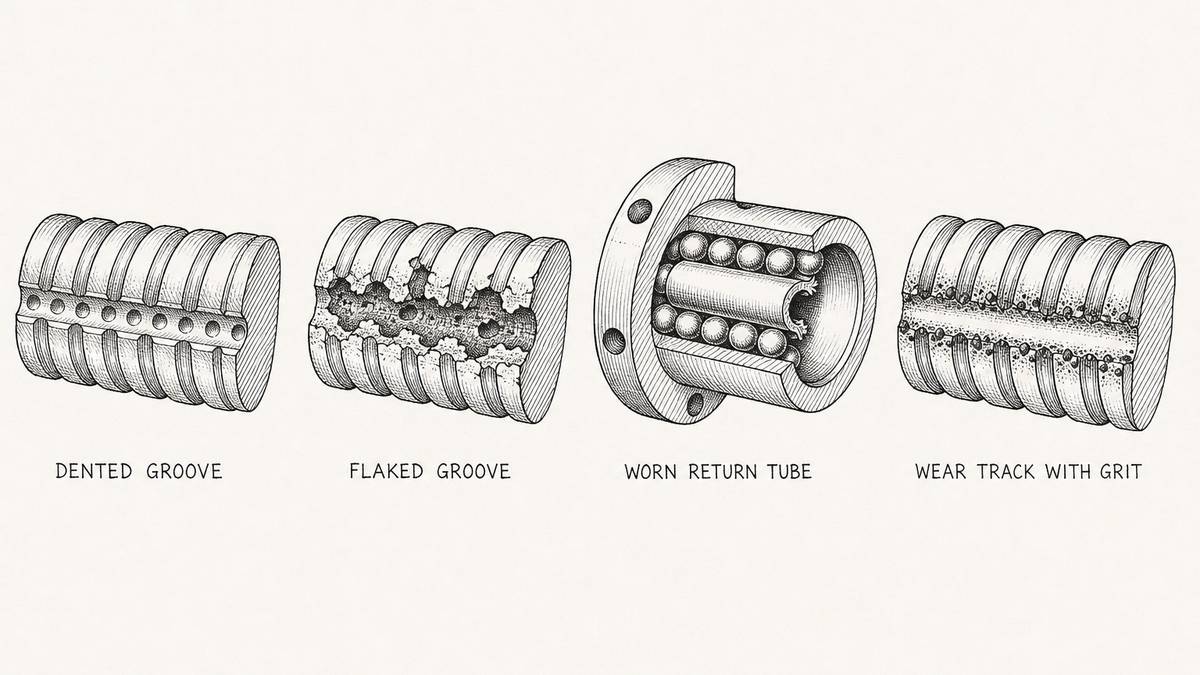
Evenly spaced dimples where the balls sat still. A row of shallow dents at regular intervals along the groove, each one exactly where a ball rested, is the signature of vibration while the machine was standing still. A servo axis that holds position is never truly still; it hunts very slightly, and the balls fret against the groove and print themselves into it. The damage happened with the machine doing nothing, which is why it so often appears on an axis that has run very few hours. It is made by the application, not by the factory, and the cure is in the control loop or in the way the axis is parked, not in the screw.
Flaking and pitting over patches of the groove. Ragged patches where the surface has broken away, with dark pits inside them, are fatigue. The metal has taken more stress cycles than it can carry at the load it was given. This pattern says one of three things: the screw was too small for the load, the axis was overloaded by a crash or a jam, or the load was not shared between the balls as it should have been because the balls were not matched. The first two are application problems; the third is a manufacturing one, and it is diagnosed by whether the damage is spread across the whole circuit or concentrated against a few ball positions.
A return tube worn through, with its inside polished bright. The tube is a thin wall carrying the whole ball train, and a tube that has opened or frayed is a tube that was worn from the inside over a long period, or was hit from the outside. Polish inside means the balls have been running against it hard, which points at a circuit that was overloaded or at ball sizes that let the train ride badly. Look at the outside of the same tube for a fresh mark before deciding, because a tube that was struck by a chip guard or a spanner is a handling failure and not a tube failure.
A heavy polished wear track along the middle of the groove with grit in it. A bright band running the length of the working zone, with a scatter of fine particles sitting in the groove, is abrasion: something harder than the screw has been rolled between the balls and the groove. This is the pattern that answers the question about wipers and covers. The grit did not come from the factory; it arrived from the machine's own environment, and it will do the same to the replacement screw unless something changes.
Six Symptoms and Which Side Each One Is On
| The symptom | What the evidence looks like | Whose side it is on |
|---|---|---|
| The axis will not hold position | Backlash measurable when the direction is reversed, with no visible damage in the groove | The supplier's if the nut was ordered preloaded; yours if it was ordered free and you expected stiffness |
| The axis is noisy or rough | Rumble through the whole travel, or a knock at one place only | The supplier's if it is rough from new; yours if it developed after a period in service, because that is wear or dirt |
| Positional error that grows along the axis | Error rising steadily from one end to the other, with the nut running smoothly | The supplier's, and it is a grade or a travel error question, so ask for the measuring record |
| Dimples at regular spacing in the groove | Evenly spaced shallow dents with the rest of the groove untouched | Yours. Vibration while the axis was holding still, not a manufacturing fault |
| Patches flaking out of the surface | Ragged patches with dark pits, spread across the working zone | Yours if the load or a crash exceeded the rating; the supplier's if the balls were not matched |
| A bright wear track with grit in it | A polished band along the groove with fine hard particles sitting in it | Yours. It is contamination from the machine, and a replacement screw will do the same without a wiper and a cover |
Two procedures make the diagnosis reliable rather than a matter of opinion. Photograph the groove at both ends of the working zone and in the middle, at enough magnification to see the surface, before the screw is cleaned up or sent anywhere. A screw that has been wiped and packed is a screw whose evidence has been destroyed, and every conversation afterwards is guesswork. Measure the backlash and the travel error before the screw is removed, because those two numbers separate the failures that look alike: an axis that has lost its preload still travels true, and an axis whose screw is worn or bent does not. And for a new size or a new supplier, run a first article check that includes a travel measurement over the full length, in the same way an incoming inspection for any machined part is built around measured features rather than appearances, which is the approach set out in this guide to the pre-shipment check.
Price, MOQ and Lead Time: What Actually Moves the Number
No honest article quotes a price for a ball screw, because the price of a ball screw without a grade, a length, a preload and two finished ends is not a price. What can be given is the list of things that move it, so that when two quotations differ by a factor you know which question to ask.
The grade is the biggest single driver, and it is not linear. Each step tighter costs more than the step before it, because grinding to a tighter travel error over a longer length means holding the screw straighter, dressing the wheel more often, measuring more and scrapping more. The price gap between the loose grades and the machine tool grades is large, and the gap between the machine tool grades and the tightest grades is larger again. This is the line to test first in a quotation, because a price that looks low for a tight grade is almost always a price for a looser one.
The length, and not in proportion. A longer screw costs more than a longer piece of steel, because holding a long shaft straight through hardening and grinding is a different problem from holding a short one, and the measuring machine has to be long enough to check it. Two screws of the same diameter at one metre and two metres do not differ by two in price.
The ends. As described above, journals, threads, keyways, flats and centre-drillings are turning and grinding work on a hard shaft, and on many orders they are the largest single line. A screw with a plain smooth end is cheap. A screw with two ground bearing journals, two threads, a keyway and a flange is not, and none of that extra cost is the screw.
The nut: preload, circuits and return arrangement. A preloaded nut costs more than a free one. More circuits cost more and carry more load. An end-cap nut costs more than a tube nut. And a matched pair costs more than two parts, because somebody has to prove they match. Each of these is a real difference in the part, so a quotation naming only the nut's size has not told you which of these you are buying.
Whether the size is in production. This is the driver buyers underestimate most. A factory that makes a given diameter and lead continuously has its tooling, its wheels and its measuring programme already set up, and a screw in that size is close to a catalogue item. A special diameter or a special lead means setup, a new wheel form, a new grinding programme and a proving run, all of which land on the first order and none of which land on the second. The practical consequence is worth acting on rather than reading: ask for the price at three quantities and ask which sizes the factory holds in production, then see whether your design can use one of them. Changing a design to a standard lead before the first order has saved more money on more projects than any amount of negotiating after it.
MOQ follows from the same fact. A standard size in a loose grade may be available in single pieces, because it is stock. A special lead in a tight grade carries a minimum that reflects the setup, and a factory quoting one piece of a special screw without a setup charge is a factory that intends to make it the way it makes a standard one.
Lead time behaves the same way. The parts of the schedule to ask about are the ones with queues: heat treatment, long grinding, and the measuring and documentation step for a graded screw. Ask which step in the sequence is the bottleneck for your size, and ask whether the screw will be measured before it is packed or only sampled from the batch. A delivery date given for a stock screw and applied to a graded special is how a project slips three weeks without anybody lying to you, and the same is true of any cut-to-order precision part, from a ball screw to a the sprocket that drives a ball screw cut to a tooth profile.
Questions Buyers Ask
Why are ball screws so expensive?
Five honest reasons, and only one of them is the screw. The groove has to be ground into steel that has already been hardened, which is slow work that wears out grinding wheels. The nut's groove has to be ground from inside a bore where a wheel can barely reach. The balls have to be graded in fine size steps and matched to the circuit so they share the load evenly. The ends — bearing journals, locknut threads, keyways — are often the largest single line and are pure machining. And to sell a graded screw the factory has to own and run a measuring machine that costs more than the grinder, which is a cost no loose screw carries. When you add low production volumes and setup on every non-standard size, the price stops looking strange. The cheapest way to buy one is a standard size, standard lead, sensible grade and a simple end.
What is the lifespan of a ball screw?
Anyone who gives you a number without asking about your machine is guessing. A ball screw ends its life one of two ways. Fatigue is the designed end: every pass of a ball puts a stress cycle into the groove, ratings are quoted as a life in revolutions at a stated load, and a heavier load shortens that life much faster than the load went up. Everything else is the real cause of most failures: dirt rolled into the groove, lubrication that was wrong or missing, a shaft supported at one end that sags and whips, a crash at the end of travel, and preload that keeps the nut working even when the machine is idle. Well protected, well lubricated and properly supported, an industrial axis is reasonably counted in years. Unprotected or badly supported, months is realistic. When a supplier quotes a life figure, ask what conditions it assumes, because the assumptions are more useful than the number.
How do I choose a ball screw manufacturer in China?
Ask four questions and listen to whether the answers come from a machine or from a catalogue. Does the factory grind its own nuts, and can it describe the internal grinding? The nut is the hardest part and the one most likely to be bought in. How does it measure travel error, over what length, and how often is the measuring machine calibrated? A graded screw needs a measuring machine, not a tolerance on a page. How are the balls graded and matched between circuits within one nut? That is what makes a nut quiet and long-lived. And how are the shaft ends made, in what sequence, on what machine? Those four answers separate a works from a reseller without anybody having to accuse anyone. Then add three commercial questions: which sizes are in production, what is the minimum for a special lead, and will the factory accept your inspection before shipment. China is genuinely strong in the middle of the range — standard sizes, standard leads, general machine tool grades, sensible quantities — and weakest at the tightest grades over the longest lengths.
What accuracy grade do I actually need?
Work backwards from what the machine has to produce, not forwards from what the catalogue offers. If the axis moves something to a place rather than to a size — a conveyor, a gantry, a picking head — a general transport grade is not a let-down, it is the correct answer, and paying more buys nothing. If the axis has to hold a tolerance on a finished part, the machine tool grades are the right territory, but only if the machine frame and the guideways are as stiff as the screw, because a tight screw on a flexible machine cannot deliver the accuracy it was bought for. Above that, the tightest grades belong to measuring machines and optical stages where the supporting parts cost more than the screw. Then check one thing before you spend: most modern machine controls let you measure the real travel error and enter a correction table, and on a steady axis that can make one grade lower perfectly adequate. Also remember that accuracy and repeatability are different. A controller can correct accuracy; repeatability comes from stiffness and from how the ends are held.
Do I need preload?
Only if the axis has to hold a position or work in both directions. Preload removes the free play that a ball screw naturally has, and it makes the axis stiff, which is what a machine tool or a pick-and-place head needs. A tool that only ever cuts one way does not need it. What preload costs you falls on three lines: a more expensive nut, more drag so the motor works harder and the axis runs warmer, and a shorter life, because a preloaded nut presses its balls against the groove even when the machine is doing nothing. Makers give a preloaded nut a lower load rating than the same nut free for exactly that reason. So the question is never whether preload is good. It is the smallest amount that holds your positioning need. Order it as a class or a band, ask for the backlash you will accept in numbers, ask what drag it adds, and remember that the same named class from two suppliers is not necessarily the same squeeze.
How do I stop a vertical axis from dropping its load?
By deciding before the order, because a ball screw is efficient in both directions and will happily run its load down when the power is off. Three ordinary answers. A brake on the motor that genuinely holds rather than merely slows, which is the usual choice for a vertical axis. A separate holding device or a blocking arrangement in the machine. Or a screw family that does not back-drive, which means moving away from a ball screw, since a ball screw is by nature free to turn backwards at both ends. Whatever you choose, the requirement belongs on the order, because a supplier asked for a free-turning axis will supply exactly that. There is a safety rule behind this as well: under 29 CFR 1910.147 a load held up in the air counts as stored energy, and before anyone works on the machine that energy has to be relieved, restrained or otherwise made safe — switching the supply off is not enough.
Send the grade, the preload and both ends — the diameter and lead are not enough
Tell us what the axis has to do, then the lines that decide whether the screw arrives usable: the diameter the drawing calls out and the lead, the start count and the overall length including the ends; the accuracy grade with the length over which the travel error is to be measured; whether the nut is preloaded, by which method, and the backlash you will accept in numbers; the return arrangement and the number of circuits if you care which you get; the flange bolt circle, hole count and nut length; and a drawing of both ends showing journal diameters and tolerances, locknut threads, keyways and flats, plus the support arrangement — fixed at one end and simple at the other, or fixed at both. Then the duty that sizes it: axis speed and motor speed, the load and whether it shocks, hours a day, whether the axis is horizontal, vertical or inclined, whether coolant or wash-down water will reach the screw, and the ambient temperature. Add the requirements that keep the machine legal and maintainable: a caps or sleeve on any projecting shaft end, no open keyway left on a rotating shaft, wipers and a cover if the machine is dirty, and a brake or holding arrangement if the load has to stay up with the power off. And for the order itself: the drawing revision the screw is to be made to with no changes without your written agreement, the screw and nut supplied and marked as a matched pair, a travel error record if you need one, a first article on a new size, and packaging that supports a long ground screw along its length instead of letting it bend in transit. If a screw has already failed, photograph the groove at both ends and in the middle before anything is wiped or packed, measure the backlash and the travel error before it is removed, and note whether the dimples are evenly spaced, whether the damage is flaking patches, whether the return tube is worn through, or whether there is a bright track with grit sitting in it. The pattern says whether the fault was made in the factory or by the way the axis is run.
Request a Ball Screw Sourcing Quote
Questions & Comments
We read every one and reply within 24 hoursA ball screw is ordered on diameter and lead, and it succeeds or fails on the accuracy grade, the preload and how each end is held. Send us the axis duty and we will check the grade against the real length before the drawing is fixed.