
Centrifugal Fan Manufacturer: Sourcing Fans From China
 ·
Updated October 12, 2026
·
18 min read
A centrifugal fan is bought on one promise: how much air, against how much pressure, for how much power. What makes this product different from most industrial goods is that the United States rules on fan efficiency are unusually exact about how that number has to be measured and unusually quiet about what the number has to be. They name the machine, they list what sits outside the rules, they fix the test, they set the power at which it starts to apply, and they leave the efficiency level itself blank. A buyer who knows that reads a data sheet very differently.
Six Lines That Decide Whether a Fan Number Means Anything
| What the buyer has to settle | Why it is not obvious | The line on your order that closes it |
|---|---|---|
| Which kind of fan you are buying | The type decides which test applies and which exclusions can be used | The type name, written the way the rules write it |
| The impeller the rating belongs to | A model is rated at the largest impeller it is sold with, not the one on your order | The impeller diameter and width you are buying, and the one the rating uses |
| Whether the efficiency rules apply at all | Nine exclusions, an embedded-fan list and two power floors stand between a fan and the test | The duty point in writing, so the power and the pressure can be checked |
| The efficiency number, and how it was measured | A figure from the easier test setup must be shown next to the figure from the required setup | Both numbers, with the setup named for each |
| Whether the test was real | The test has stability rules, and a report that cannot describe the rig is not a report | The rig, the holding times and the instrument resolution |
| Whether “meets the DOE standard” can be checked | The efficiency level for fans is still marked reserved | Which standard, and what its number is |
What the Rules Call a Fan, and Why the Definition Chooses the Test
Start with the definition, because it is longer than most people expect and every extra word in it is something a buyer can ask for.
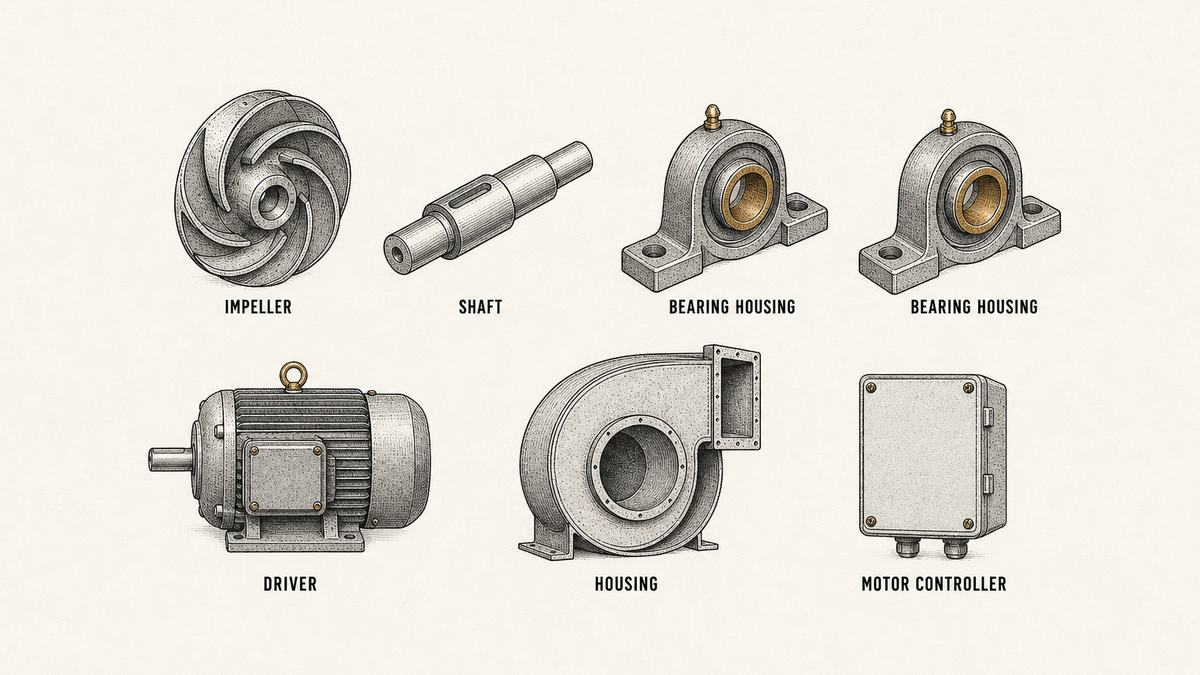
Under 10 CFR Part 431 Subpart J, a fan or blower is a rotary bladed machine used to convert electrical or mechanical power to air power, with an energy output limited to 25 kilojoule (kJ)/kilogram (kg) of air. That last limit is what separates a fan from a compressor: a fan moves air and adds a modest amount of energy to each kilogram of it. Then the definition says what the machine consists of — an impeller, a shaft and bearings and/or a driver to support the impeller, and a structure or housing. And then one more sentence, which is the one that changes orders: a fan or blower may include a transmission, driver, and/or motor controller.
Read those three parts as a checklist of what you are and are not buying. If the fan arrives as a bare shaft on bearings with no motor, that is still a fan. If it arrives with a V-belt drive and a control panel, that is also a fan, and the efficiency figure is expected to cover the parts that are inside the boundary. The practical consequence is a question worth asking early: does the rating you are being given cover the fan alone, the fan with its drive, or the fan with its drive and its motor controller? Those three answers produce three different numbers, and a supplier who cannot say which one they are quoting has not answered anything.
The same subpart is honest about what it does not touch: it does not cover ceiling fans, and it does not cover furnace fans. Those sit elsewhere in the rules, so a supplier selling both works under two rule sets, and a claim about one does not carry over to the other.
Why does this matter commercially rather than just formally? Because it decides which test applies, and the test is where the number comes from. A fan inside the definition and inside the scope has a required way of being measured. A fan outside either one has none, which means any figure on its data sheet was measured however the supplier chose. That is not a reason to distrust the supplier, but it is a reason to find out which situation you are in before comparing quotations.
The Fan Types the Rules Name, and What Each One Means
The rules do not say “fan” and leave it there. They name the types, and the names are drawn from the shape of the machine rather than from marketing. That matters, because the type name is the first thing the scope test checks.
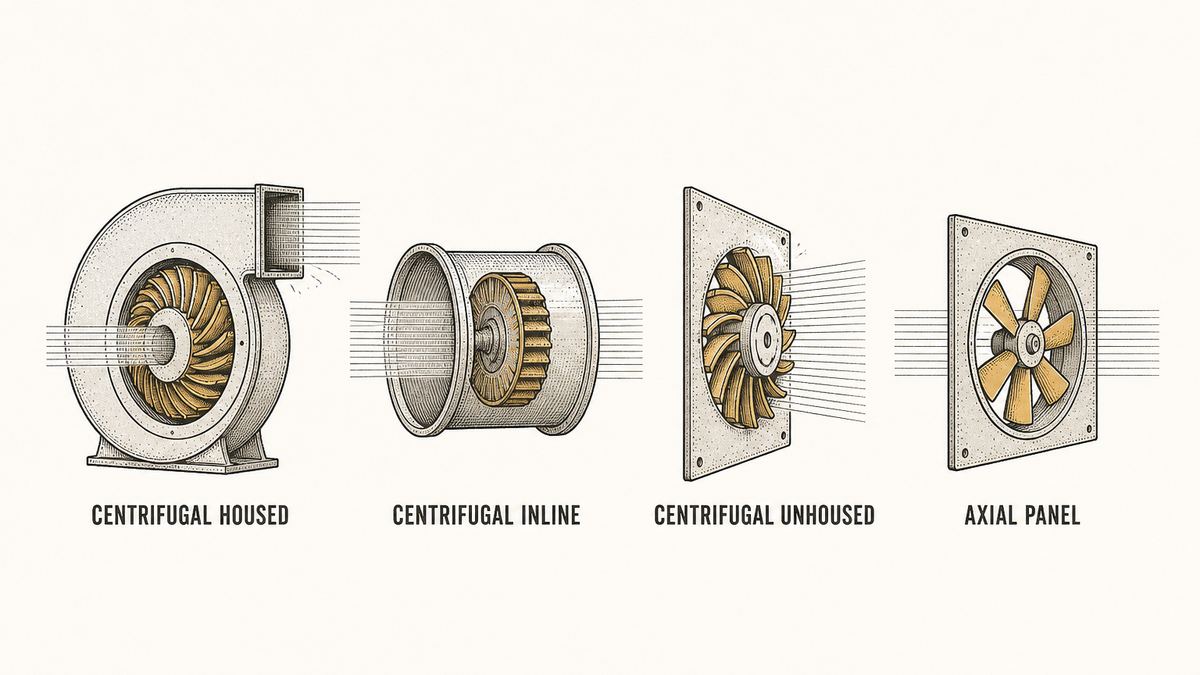
A centrifugal housed fan has a centrifugal or mixed flow impeller, and the air leaves into a housing that is usually scroll-shaped and directs it out through a single outlet. The definition adds a line that surprises people: a centrifugal housed fan does not include a radial impeller. Fit a radial impeller and the machine becomes a radial-housed fan instead, which is a separate named type with its own note that the inlet and outlet may or may not be ducted.
A centrifugal inline fan has the same kind of impeller, but the housing turns the air so that it leaves along the same axis it entered, which is what lets it sit inside a straight run of duct. A centrifugal unhoused fan has no scroll at all: the impeller sits in a panel, air enters through that panel and discharges into open space, and neither side is ducted. The definition also covers fan-array units where partition walls separate one fan from the next.
Then the axial family. An axial inline fan is an axial impeller in a cylindrical housing, with or without turning vanes. An axial panel fan has no cylindrical housing but carries a panel, orifice plate or ring with brackets, so it mounts through a wall, ceiling or other structure separating its inlet from its outlet. A cross-flow fan drives air through the impeller at right angles to its axis. And an air circulating fan is defined by what it lacks: no way to connect ducting, no pressure boundary between inlet and outlet, and it works against zero external static pressure. It is the only type tested for efficacy in cubic feet per minute per watt rather than for the index the ducted types use.
Two more named types turn up in the field rather than in a catalogue. A power roof ventilator has its own internal driver and a housing shaped to keep rain out, with a base made to sit over a roof or wall opening. A jet fan is built and sold to throw a high-speed jet of air into a space to move its air along; it is rated by thrust rather than by air volume, and its inlet and outlet are not ducted, though silencers may be fitted.
The useful discipline is to write the type name into the request for quotation in the words the rules use. “Centrifugal fan, belt driven” can mean at least three different machines; “centrifugal housed fan, full-width impeller, inlet ducted, outlet ducted” means one. The same habit of naming the exact article rather than the family is what makes a specification sheet a factory can actually build to.
The Exclusions and the Two Power Floors That Decide Whether Any of This Applies
Before any efficiency figure is required, a fan has to pass four gates in order, and most of the arguments between buyers and suppliers happen at gate two.
Gate one is the type. The machine has to be one of the named types: centrifugal housed, radial housed, centrifugal inline, centrifugal unhoused, a centrifugal power roof ventilator supply or exhaust fan, an axial inline fan, an axial panel fan, or an axial power roof ventilator fan. If it is not on that list, the test does not reach it.
Gate two is the exclusion list, and it is worth knowing by heart because it is short. The test does not apply to a radial housed unshrouded fan whose blade tip diameter is under 30 inches or whose blade width is under 3 inches. It does not apply to a safety fan, an induced flow fan, a jet fan or a cross-flow fan. It does not apply to a fan built only to be driven by an internal combustion engine, to a fan that pulls a vacuum of 30 inches water gauge or more, or to a fan designed and marketed to run at or above 482 degrees Fahrenheit (250 degrees Celsius). And it does not apply to a fan that is embedded in one of the equipment types listed in the next paragraph.
Two of those deserve a second look. The 30-inch blade tip figure is a size rather than a type, which makes it the one a buyer can check with a tape measure, and it only applies to a radial housed fan that is also unshrouded. And the high-temperature exclusion is written as designed and marketed, which cuts both ways: a supplier cannot dodge the rules by quietly not mentioning temperature if the fan is genuinely built and sold for that duty, and a buyer cannot claim the exclusion for a standard fan that would merely survive a hot day.
Gate three is the embedded list. The test does not reach fans built into single-phase central air conditioners and heat pumps under 65,000 British thermal units per hour, three-phase air-cooled small packaged air conditioning under the same figure, transport refrigeration, vacuum cleaners, heat rejection equipment such as cooling towers, evaporative condensers, dry coolers and air-cooled steam condensers, air curtains, and dedicated outdoor air systems. Supply and condenser fans inside larger packaged air conditioning, water-source heat pumps, packaged terminal units, computer room units and variable refrigerant flow systems are also outside it.
Gate four is the duty point, and this is the gate a fan on a real job usually passes or fails on. The test only applies where the fan shaft input power is 1 horsepower or more, or the fan electrical power is 0.89 kW or more, and where the fan static air power is 150 horsepower or less on a static pressure basis, or the fan total air power is 150 horsepower or less on a total pressure basis. Air circulating fans have their own floor: in scope once input power at maximum speed reaches 125 watts.
Put those four gates together and “this fan is outside the DOE test” stops being a conversation and becomes a checklist. Ask which gate the supplier is relying on, then check that gate. A supplier relying on the 30-inch rule should be able to state the blade tip diameter; one relying on the power floor should be able to state the shaft power at the duty point. If neither figure can be produced, the exclusion is a guess.
Full-Diameter, Full-Width: Why the Rating Belongs to the Biggest Impeller
Here is a quiet trap that costs buyers money, and it is written into the rules rather than invented by suppliers.
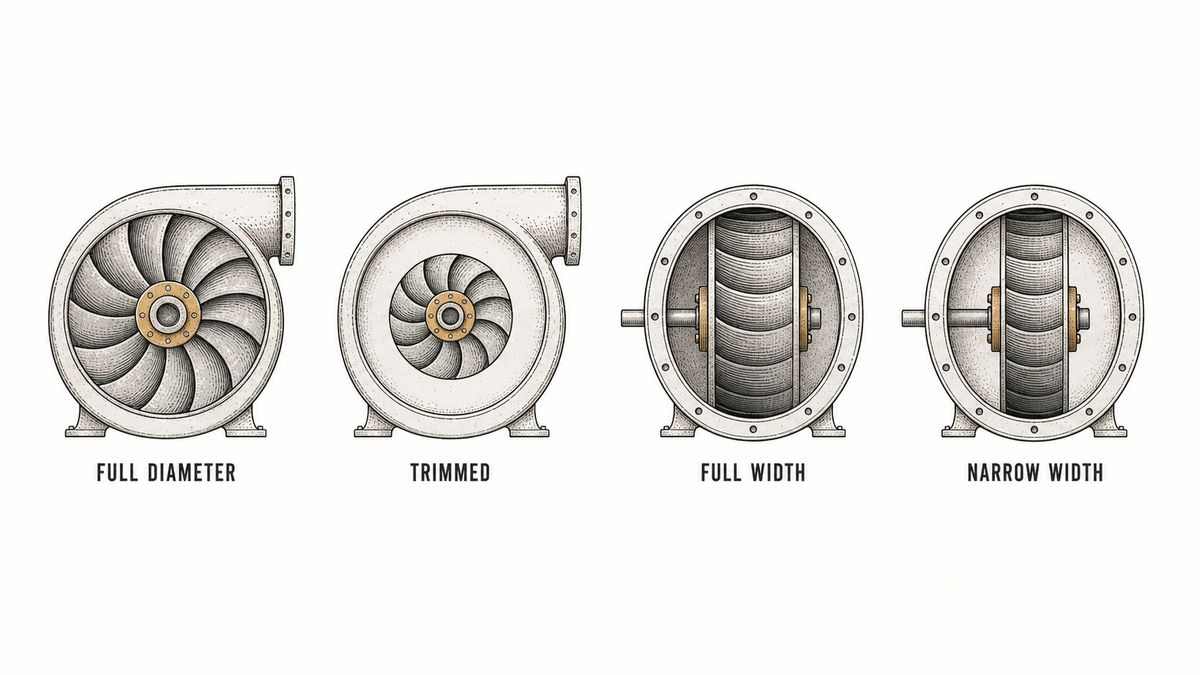
Two of the definitions are about size. A full-diameter impeller is the maximum impeller diameter with which a given basic model is distributed in commerce. A full-width impeller is the maximum impeller width with which that model is distributed. Neither definition says “the impeller on your order”. Both say the largest one the model is sold with.
Now add the definition of a basic model. It is all the units a manufacturer makes that share the same primary energy source and are essentially identical in the electrical, physical and functional ways that affect energy use. Then come two extra lines that make the trap possible: all variations of impeller widths and impeller diameters of a given full-width and full-diameter centrifugal fan may be considered a single basic model.
Read those together and you get a situation many buyers meet without noticing. One model number covers a family of impellers, from the largest the casing will take down to a trimmed one, and the efficiency rating attaches to the family at the largest. The fan on your pallet may carry a smaller impeller in the same casing, moving less air and building less pressure at the same shaft speed than the number on the sheet suggests.
Trimming an impeller is not a trick. It is a normal way of hitting a duty point between two standard sizes, and it can be the right answer where the duct resistance is lower than expected. The problem is not the practice but a quotation that gives one model number and one performance figure without saying which impeller that figure belongs to. So the question to ask is short: what impeller diameter and width is this rating taken at, and what does the fan do with the impeller I am buying? A maker will answer with two sets of figures and often two curves; a reseller will answer with the model number again.
There is a second reason to keep the impeller size explicit. A larger impeller in the same casing turns faster at the rim for the same shaft speed and puts more load on the shaft and bearings, so changing the impeller without changing those parts is a change to the machine rather than a setting on it. It is the same discipline that makes the speed limit marked on a wheel rather than on the machine worth reading in the same way.
What the Efficiency Index Is, and the Rule About the Flattering Setup
The efficiency measure for a ducted fan is the fan energy index, shortened everywhere to FEI. It is not a simple percentage, and it is not measured by holding a hand in the airstream. It is worked out under a named test procedure, and the rule names the standard it comes from.
The index is calculated under AMCA Standard 214-21, the Test Procedure for Calculating Fan Energy Index for Commercial and Industrial Fans and Blowers. It compares the fan electrical power measured at a duty point with a reference figure. The rules add two rounding instructions that tell you how carefully the sums were done: the index is rounded to the nearest hundredths place, and the fan electrical power to three significant figures. A data sheet giving an index with one decimal place, or a power figure with a single digit, is either a summary or a guess.
Then comes the rule that a buyer can actually use against a supplier, because it is written as a duty on the person making the claim. After October 30, 2023, any claim about the energy use or efficiency of a fan within scope has to follow the appendix. And the appendix adds this: an optional index figure taken in the optional test configuration listed in Table 7.1 of AMCA 214-21 must be accompanied by an index figure taken in the required test configuration.
That single sentence removes a familiar sales move. Some test setups are easier on a fan than others, so a number taken on the easier one can look better than the same fan measured the way the rules require. The rules do not ban the easier figure; they say that if you show it, you also have to show the other one. So the useful question is not “what is the index?” but “which setup is that index for, and what is the figure for the other setup?” A supplier with both numbers has done the work; one with a single number and no setup named has given you something you cannot compare.
The same logic runs through the rules for air circulating fans, which are tested differently. Their measure is efficacy in cubic feet per minute per watt at maximum speed, and the optional figures are again tied to the required one: an optional figure at a speed below maximum must be accompanied by the figure at maximum speed. A quiet fan on a low setting always looks efficient, which is why the rule insists on the top speed being shown too.
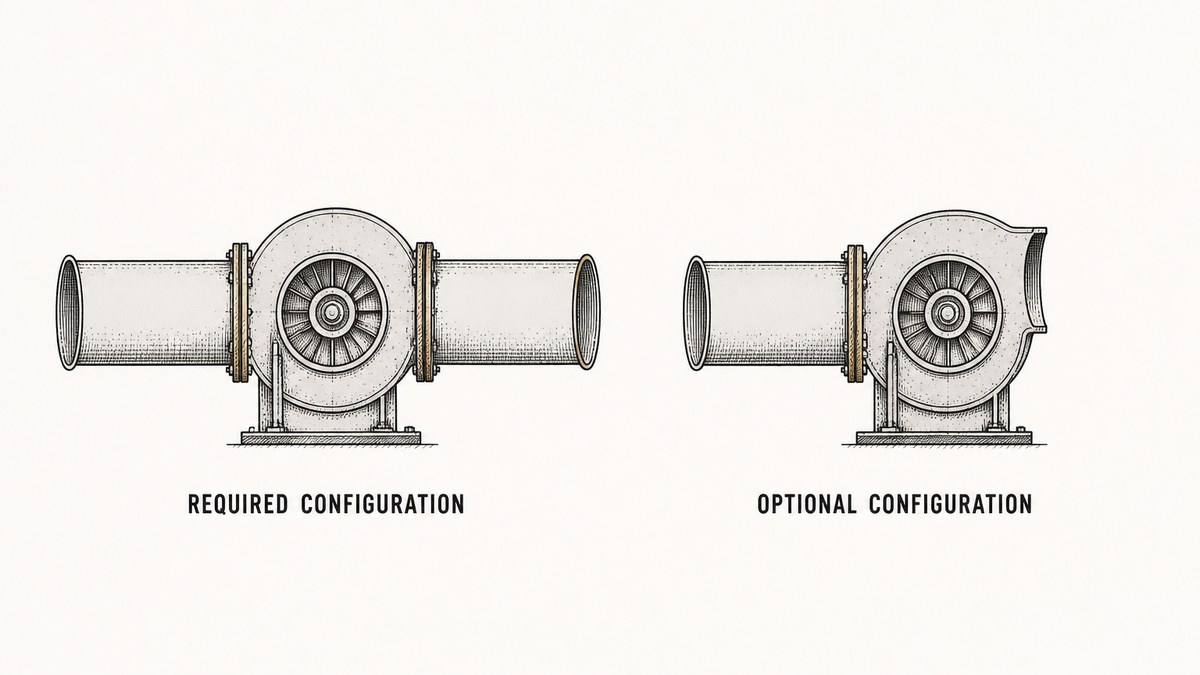
One more test condition belongs on the buyer's checklist. Fans rated for a single-phase or a multi-phase supply must be tested with that kind of electricity, and a fan that can run on either must be tested on multi-phase. So a report showing a single-phase test on a fan a customer will wire into three phases is not the test the rules ask for, and on a real installation it is the three-phase figure that decides the running cost.
Why “Meets the DOE Standard” Is Not a Sentence You Can Check Yet
This is the part of the story most quotations get wrong, and it is as much a gap in the rules as a supplier's mistake.
Subpart J contains the purpose and scope, the definitions, the list of standards brought in by reference, and the test procedure. The two sections that would carry the actual efficiency levels and the certification rules — 431.175 and 431.176 — are marked Reserved in the text as it stands on eCFR today. In plain terms: the rule says exactly how a fan has to be measured, and it does not yet say what the measured number has to be.
That is worth separating from the statute behind it, because the statute does define what a standard is. Under 42 U.S.C. 6311, the term energy conservation standard means a performance standard that sets a minimum level of energy efficiency or a maximum quantity of energy use for a product, or a design requirement for a product. So there is a legal definition of a standard, and two empty slots in the fan rules where the fan standard would go.
The practical result is that two kinds of sentence have to be kept apart. A sentence about how a fan was measured can be checked today: which standard, which setup, which test rig, what rounding. A sentence about meeting a level cannot be checked yet, because the level has not been set. When a supplier writes that a fan meets the Department of Energy efficiency standard for fans, the honest reading is that the fan has been measured the required way and that a standard is expected. It is not evidence that a cut-off has been passed, and it should never be the reason a buyer accepts a lower airflow figure.
The reason to raise this with a supplier is not to catch anyone out. A quotation built on a standard that is not yet in force tends to be light on the figures that are in force. Ask for the duty point, the airflow, the pressure basis, the impeller size, the shaft power and the index with its setup named. Those six items exist now, and a supplier who can produce them has nothing to fear from the empty slots.
How to Tell a Real Test Report From a Printed Number
A test report is a description of a rig and a set of readings. If it cannot describe the rig, it is not a report, and this section is the part a buyer can use to tell the two apart without being an engineer.
Start with what the test has to find. Testing runs in the required test configuration listed in Table 7.1 of the index standard, and at each duty point the report has to give the fan airflow in cubic feet per minute, the fan air density, the fan pressure in inches of water gauge on whichever basis is used, the fan speed in revolutions per minute, and the fan shaft input power in horsepower where the test was done shaft-to-air. Which test method applies is not the buyer's choice; it follows from a table keyed to the driver, whether a motor controller is fitted, and the transmission. An electric motor leads to a wire-to-air test or a calculated rating from one; a regulated polyphase motor on a direct, V-belt, flexible coupling or synchronous belt drive leads to a shaft-to-air test.
Then the part that separates a lab from a laptop. Before readings are taken, the test has to be held steady, and the rules give numbers for what steady means:
- The air in the room
- Barometric pressure, dry bulb and wet bulb temperature are logged at least every five seconds after the run-in, and the air density worked out from them must not move by more than one percent.
- The speed and the power
- Speed and input power are recorded at least every five seconds across at least three one-minute intervals, and the average speed of the last interval must differ from the previous by less than one percent or one revolution per minute.
- The power reading itself
- Average input power has to sit within four percent of the previous interval from a dynamometer, torque meter or calibrated motor, or within two percent, or one watt, from an electrical meter.
- The direction of the drift
- The trendline slopes from at least three one-minute intervals have to include both positive and negative values. If three slopes in a row go the same way, more sampling is required.
That last condition is the one to ask about, because it is the reason a lab cannot simply keep turning a dial until a good number appears. A machine that is still warming up, or still settling after a change, produces slopes that all lean one way. Requiring both signs means the readings have to be taken while the fan is genuinely holding a point, so the figure in the report is a figure the fan can repeat. When a supplier says a fan was tested, the follow-up is not “show me the certificate” but “how long did you hold it, and did the trendline turn?”
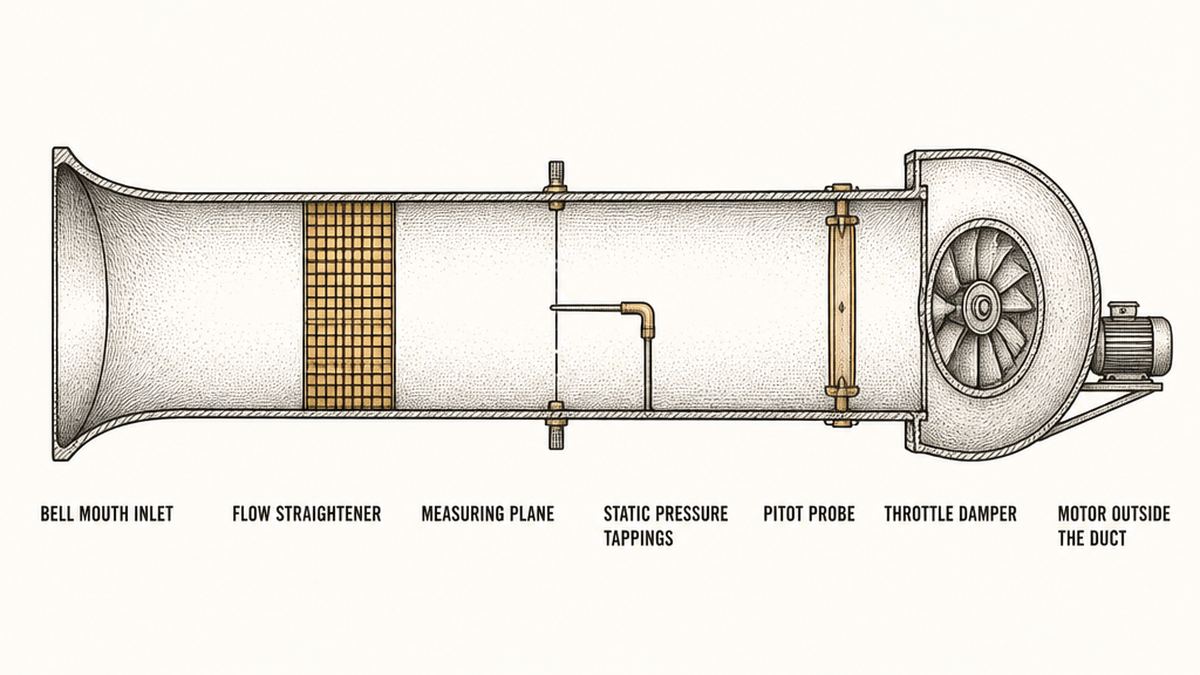
Two smaller rules finish the picture. A centrifugal power roof ventilator that works as both a supply and an exhaust unit has to be tested in both configurations, so a quotation showing only the better of the two is incomplete. And an embedded fan not built in a standalone form has to be tested in one; where parts cannot be taken out without permanent damage, the test uses extra parts matching the shape of the ones inside, except the impeller. Both point the same way: if the report cannot say which machine was on the bench, the number on it belongs to a machine you cannot buy.
The Duty Point, the System Curve, and Why One Number Is Never Enough
A centrifugal fan does not deliver an airflow. It delivers an airflow at a pressure, and that pair is fixed by the ductwork rather than by the fan alone, because a fan has a curve rather than a figure. Push the pressure up and the airflow falls; let the pressure drop and the airflow rises. The system around it has a curve too, since the resistance rises as more air passes through a filter, a coil or a length of duct. The duty point is where the two curves cross, so a supplier who quotes one airflow at one pressure has quoted a crossing point that is only yours if your ductwork matches the rig the figure came from.
This matters because the system curve moves. A clean filter has low resistance and a loaded one has more; a damper drifts; ducts collect dust. Each of those steepens the curve and drags the duty point to a lower flow, so a fan chosen exactly at the clean-filter crossing will not deliver the airflow you need once the filter is half loaded. That is why a quotation worth comparing shows two duty points, one with clean filters and one with filters at the point where they should be changed.
Reading a Centrifugal Fan Supplier's Data Sheet
Most fan listings give a model number, a maximum airflow and a price. Eight lines turn that into something you can order against.
- The duty point and the pressure basis
- Airflow and pressure at the point the fan will actually run, with static or total named. A maximum airflow figure is a free-air figure and says almost nothing about a ducted job.
- The impeller diameter and width
- The size you are buying, and the size the rating belongs to. If those are the same, the supplier can say so in one line.
- The speed and the shaft power
- Revolutions per minute and shaft horsepower at the duty point, not at the maximum the wheel could stand.
- The efficiency index and its setup
- The figure, and the test setup it was measured in. Both, or the number cannot be compared with another supplier's.
- The drive arrangement
- Direct, V-belt, flexible coupling or synchronous belt, with the motor's rating, its efficiency class, and whether a variable speed drive is included.
- The construction
- Housing material and thickness, impeller material and whether it is pressed or welded, and how the impeller is fixed to the shaft. This is where a light fan saves weight and a heavy one earns it.
- The inlet, outlet and rotation
- Inlet and outlet sizes, flange drilling, rotation direction and discharge angle. Get these wrong and the fan will not fit ductwork you have already built.
- The documents
- The test report, the outline drawing with mounting points, the balancing record and the running clearances. Cheap to produce, and the first thing to disappear from a quotation.
Send those eight lines to two or three factories as a written request rather than asking for a price on a description, and the replies do the shortlisting. A factory that builds fans answers the duty point, the pressure basis and the impeller size without pausing, because those are the figures it designs to. A trader answers the model number and the price and goes quiet on the rest.It is the same test that separates a maker from a reseller on any industrial product: ask what the impeller balance grade is and who does the balancing, because an assembler of fans cannot answer both.
What Goes Wrong, and What It Looks Like on Arrival
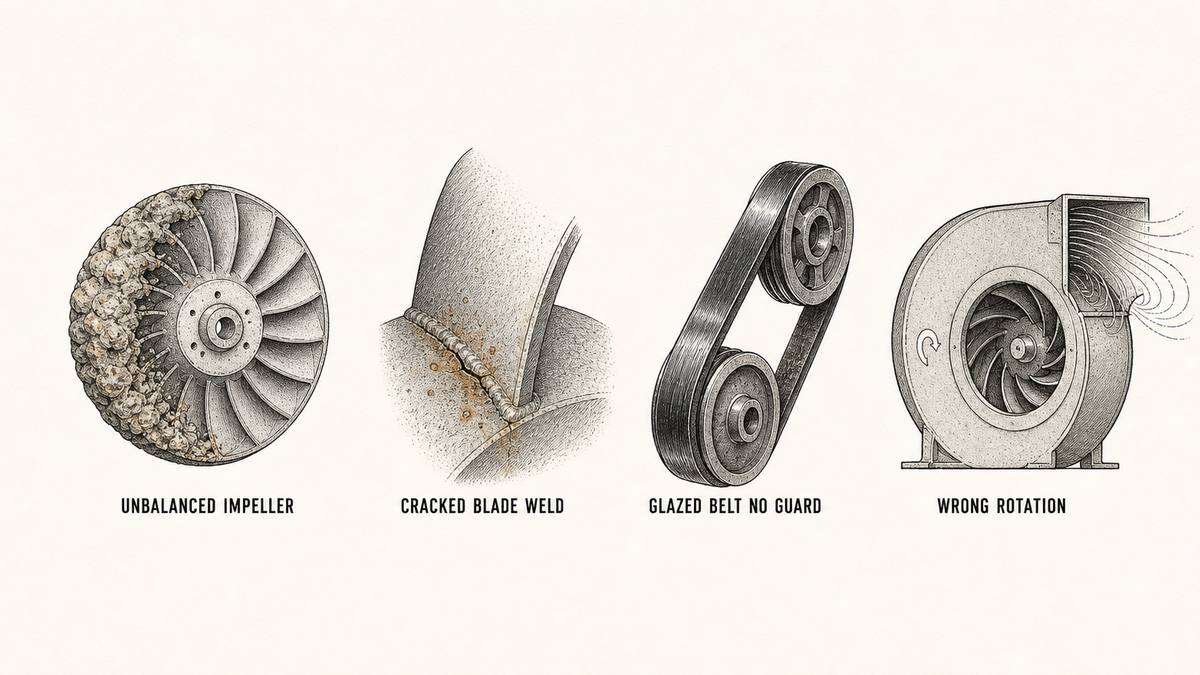
Four problems account for most fan failures, and they split between the ones that wear out and the ones that were decided on the drawing.
An unbalanced impeller. Deposits build on one sector of the wheel instead of spreading evenly, so the rotating mass is heavier on one side. The fan vibrates, the bearings take the load, and on a sticky or abrasive dust the build-up grows. It is a maintenance problem with a design cause: a wheel that cannot be cleaned evenly will do this every time it runs.
A cracked blade weld. A fine crack where the blade meets the back plate, usually with rust staining around it because the crack holds moisture. It starts as a fatigue crack, and running a fan far off its duty point feeds it. Cracks like this are found by looking, or by a dye check, which is why a first article check on a new fan model is worth the trip.
A glazed belt and no guard. A belt running slack or slipping gets hot, hardens and goes shiny on its flanks. It is on its way out, and it also says the pulleys are not lined up. The missing guard is the separate problem, and it is one of the few defects on this list that can hurt somebody the day the fan is switched on.
Wrong rotation. A scroll fan can run backwards and still move air, which is what makes this one hard to spot. It sounds normal and it looks normal, and it delivers a fraction of the airflow it should. The cause is usually a three-phase motor wired in the wrong order, or an impeller fitted so its blades lean against the direction the casing is built for. The check is the cast rotation marking on the housing against the way the wheel turns, and it takes ten seconds.
What a visual check cannot catch is the half of the problem that lives in the figures: a duty point quoted at the wrong impeller size, a curve on the wrong pressure basis, an index with no setup named, and a claim about a standard not yet in force. Those are caught by reading the data sheet rather than the machine, and on a first order they are worth reviewing before anything is built, with the results written into a the first article check on a centrifugal fan order of the first unit.
How the Price Is Built, and How to Check the Supplier Behind It
A centrifugal fan has eight cost lines and one of them is visible on a quotation. Knowing which eight they are is what makes two prices comparable.
- The impeller
- Pressed or welded, in steel, stainless or aluminium, and balanced to a stated grade. It is the part that decides how the machine behaves, and the first place a cheap quotation saves weight.
- The housing
- Material, thickness, how the scroll is formed, how the seams are welded and how it is coated. A thin casing is louder, flexes, and corrodes first at the weld.
- The drive
- Direct or belt, the motor's rating and efficiency class, the pulleys, the belt and the guard. Belting gives flexibility on speed and costs you maintenance; direct drive removes the belt and fixes the speed.
- The shaft and bearings
- Shaft diameter and material, bearing type, how the bearings are lubricated and whether they can be reached. This is the line that decides whether the fan lasts a decade or a season.
- Balancing and testing
- Balancing to a stated grade, and a run test with a report. Both are cheap, easy to leave out, and invisible in a photograph of a finished fan.
- Doors, drains and access
- Inspection doors, drain plugs and enough access to clean the wheel. On a dust or grease duty this is the difference between a fan that is serviced and one that is abandoned.
- The finish
- Surface preparation and the coating system, inside and out. On a fan handling damp or corrosive air the internal coating matters more than the external one.
- Packing and freight volume
- A fan is bulky and light, so you are buying cubic metres rather than kilograms. The packing method decides whether the casing arrives round or pressed flat.
Three of the eight lines are the wheel, the casing and the drive, and the two that vanish without a trace are balancing and the test report. A quotation naming the duty point, the pressure basis, the impeller size, the shaft power, the balancing grade and the index with its setup is one you can compare. A model number and a price is not. The same discipline works on any rotating industrial product, and it is the question that makes the load figure on a centrifugal fan.
Minimum order quantity follows the fabrication rather than the factory's goodwill. A standard fan in a standard casing is often a stock item, while a special discharge angle, a different impeller width or a stainless wheel means new drawings and fixtures, so the first order carries the tooling. A fan also ships as a bulky casing, so work out the volume before comparing freight quotations.
Then check the party you are talking to, which on this product is unusually easy to test. Ask who presses or welds the impeller, who balances it and on what machine, and who runs the test and keeps the readings. A maker owns all three and can describe them in a sentence each. A trader buys finished fans and cannot change the impeller, the casing or the test, which matters the moment a customer needs a different duty point. Ask to see the balancing machine and the test rig, and ask for the outline drawing before you place the order.On the first shipment, get the goods checked against the eight lines you wrote before they are packed, and take the number of fans to open from the sampling table. On a fan the check that matters most is dimensional plus one functional test: the impeller diameter and width against the drawing, the rotation against the casing marking, and a short run to hear the bearings.
Frequently Asked Questions
What is a fan energy index?
It is the efficiency measure used for ducted commercial and industrial fans, worked out under AMCA Standard 214-21 by comparing the fan electrical power measured at a duty point with a reference figure. The rules that adopt it require the index to be rounded to the nearest hundredths place and the fan electrical power to three significant figures, and they require an optional figure taken in an easier test setup to be shown next to the figure taken in the required setup.
Does a centrifugal fan have to meet a US efficiency standard?
Not at present, and this is the part most quotations get wrong. The fan rules in 10 CFR Part 431 Subpart J contain the definitions, the standards brought in by reference and the test procedure, but the two sections that would carry the actual efficiency levels and the certification rules are marked Reserved in the text as it stands on eCFR today. So a claim about how a fan was measured can be checked, while a claim about meeting a level cannot, because the level has not been set.
What is the difference between a static pressure basis and a total pressure basis?
They are two ways of stating the pressure a fan works against, and they give different numbers for the same fan at the same duty point. The rules allow an index to be worked out on either basis, but the two are not interchangeable, so a figure without a named basis cannot be lined up against another supplier's. Ask which basis a number uses, check that it matches the basis your engineer is designing to, and keep every quotation you compare on the same basis.
Why does a smaller impeller in the same fan casing matter?
Because the rating belongs to the family rather than to the unit. The rules define a full-diameter impeller as the maximum diameter the model is distributed with and a full-width impeller as the maximum width, and they allow variations of impeller diameter and width within a full-width and full-diameter centrifugal fan to be treated as a single basic model. So one model number can cover several impellers, the efficiency figure is taken at the largest, and the impeller on your order may be trimmed down. Ask for the rating size and the performance at the size you are buying.
What is a required test configuration?
It is the way a fan has to be set up on the test bench before a figure can be quoted. The rules require testing in the required test configuration listed in Table 7.1 of AMCA Standard 214-21, which decides how the inlet and the outlet are arranged during the test. Figures taken in the optional configuration can be quoted, but an optional figure has to be accompanied by the figure taken in the required configuration, so a data sheet showing a single number with no setup named cannot be compared with anyone else's.
How do I check a centrifugal fan supplier who says they are a manufacturer?
Ask who presses or welds the impeller, who balances it and on what machine, and who runs the test and keeps the readings. A maker owns all three and can describe them briefly. A trader buys finished fans and cannot change the impeller, the casing or the test, which matters as soon as a customer needs a different duty point. Then ask for the outline drawing with its mounting points before you order, ask for the balancing grade rather than a claim that the wheel is balanced, and get the impeller diameter and width stated in writing on the order confirmation.
Send the duty point and the pressure basis — not just “a fan”
Tell us the airflow and the pressure you need and which basis the pressure is on, then the lines that decide whether the number means anything: the fan type named the way the rules name it, the impeller diameter and width you want and the size the rating belongs to, the speed and shaft power at the duty point, the efficiency index with its test setup, the drive arrangement, the materials, the inlet and outlet sizes with the rotation and discharge angle, and the balancing grade with its report. If a fan is already installed and moving less air than the sheet promised, running hot, vibrating or whistling at the inlet, send a photograph and a short description — the symptom usually says whether it is the impeller size, the rotation, the pressure basis or the ductwork.
Request a Centrifugal Fan Sourcing Quote
Questions & Comments
We read every one and reply within 24 hoursSourcing centrifugal fans and getting quotations that all say “one fan, this airflow”? Send the duty point and the pressure basis, then the lines that decide whether the number means anything: the fan type named the way the rules name it, the impeller diameter and width you want and the size the rating belongs to, the speed and shaft power at the duty point, the efficiency index with the test setup it came from, the drive arrangement and the motor's efficiency class, the housing and impeller materials, the inlet and outlet sizes with the rotation and discharge angle, and the balancing grade with its report. If a fan is already installed and moving less air than the sheet promised, running hot, vibrating, whistling at the inlet or leaving dust on the wrong side of the filter, describe what you saw and roughly when it started, because the symptom usually says whether it was the impeller size, the rotation, the pressure basis or the ductwork around it.