
Wire Rope Manufacturer: Sourcing Wire Rope From China
 ·
Updated October 12, 2026
·
17 min read
Wire rope is the one product in a lifting order where a hidden saving is paid for by someone standing under the load. Two ropes of the same diameter and the same outside look can carry very different working loads, and the difference is inside the rope: the core, the number and size of the wires, and the way the strands are laid up. Then there is the part almost nobody writes into an order, which is what has to happen to the rope after it has been in use — because a wire rope has published conditions under which it must come out of service, and if your supplier ships rope without the markings the rule expects, the end user is already outside the rules before the first lift. This guide covers what a rope is actually made of, why the core decides what it can do, what the numbers on a certificate mean, why a rope fails at its end rather than in the middle, when a rope has to be taken out of service, how the price is built, what goes wrong, and how to test a supplier before you commit.
What You Are Buying, and the Line That Decides It
| If you want | What it means in practice | The line on your order that decides whether it works |
|---|---|---|
| A rope that carries the load it is sold for | The wires and the core carry it, and neither is visible from outside | The rope class, the core type and the minimum breaking force |
| A rope that does not twist under load | A single-layer rope on a single-part lift will rotate, and the load spins with it | The rope construction, plus the lay direction and whether it is rotation-resistant |
| A rope that survives a drum or a sheave | Repeated bending over a small radius breaks wires from the inside out | The rope class chosen for the drum diameter, not for the price |
| An end that holds the rated load | The end fitting is weaker than the rope, and it is where the failures happen | The termination type, plus its stated efficiency against the rope's breaking force |
| A rope the end user can legally use | The rule expects a permanent marking that states the safe working load | The marking, the tag, and a proof test certificate where one is required |
| A price that survives a second quote | The steel and the end fittings are the money, and the fittings are bought in | The cost lines shown separately, with the rope weight per metre stated |
What Are You Actually Buying? A Rope Is a Machine, Not a Cable
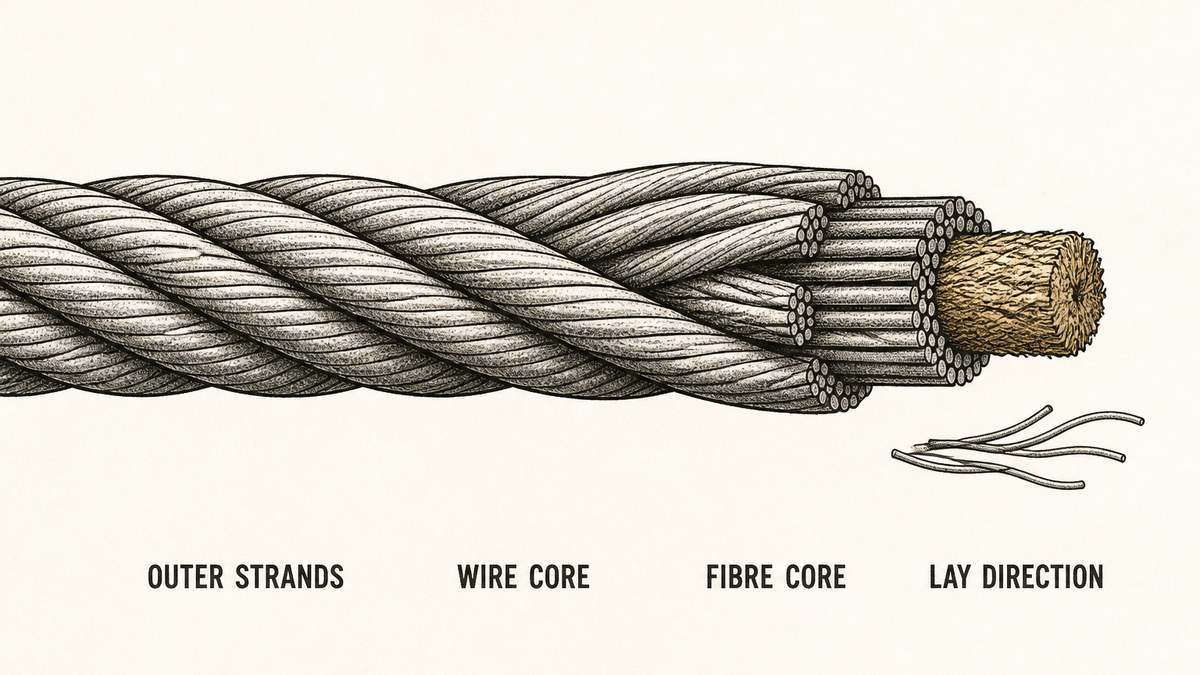
The word cable hides the whole problem. A wire rope is built from the inside out, and each level of that build is a specification your supplier can change without changing the picture on the quotation.
Wire. The individual steel wires, drawn to a diameter and a tensile grade. This is the smallest unit and the one that fails first. A worn rope is not one thing breaking; it is a growing number of individual wires breaking, which is exactly why the rules on removal from service are written as counts of broken wires rather than as a single pass or fail.
Strand. Wires laid helically around each other to form a strand. The way a strand is built decides how the rope behaves when it bends: many small wires in a strand give a rope that is flexible and easy to handle but wears away faster at the surface, while fewer, thicker wires give a rope that stands up to abrasion on a drum but resists bending less happily.
Core. The centre the strands are laid around. A fibre core gives a softer rope with more give, and it is lighter and cheaper. A steel core — either a wire strand or an independent wire rope core — adds strength, adds crush resistance, and changes how the rope behaves under load. Two ropes of the same diameter with different cores are two different products with different working loads and different prices, and the only way to tell them apart is to cut one and look at the middle.
The lay. The direction and pattern in which the strands are laid around the core, and the direction the wires are laid inside each strand. This is written as a two-letter code in most specifications, and it matters because it decides whether the rope tends to rotate under load and how it behaves when it is spliced. It is also the part that is easiest to get wrong on a repeat order, because a rope assembled with the opposite lay looks correct on a reel.
The commercial consequence is simple. A quotation that says “eight millimetre wire rope” describes the outside of the product and nothing else. The same sentence fits a rope with a fibre core and a rope with a steel core, a rope built for abrasion and a rope built for bending, and a rope with the same measured diameter at a fraction of the breaking force. If your order stops at the diameter, you have agreed to buy whatever the factory's standard build was that week.
Why Does the Core Decide What the Rope Can Do?
Because the core is what the load runs through, and because a rope cannot be stronger than the way its parts are arranged.
Three decisions sit at the centre of every wire rope quotation, and they are worth understanding before you look at a price.
The rope class, written as two numbers. A common description such as six by nineteen or six by thirty-seven means six strands, each made of roughly nineteen or thirty-seven wires. The first number tells you how many strands are laid around the core; the second tells you how many wires are in each strand. More, smaller wires make a rope that bends more easily and feels softer in the hand. Fewer, larger wires — a six by seven rope, for example — make a rope that resists wear at the surface and resists being crushed, and bends badly over a small sheave. There is no better class, only a class that matches the machine. A rope chosen for bending and then run over a drum that is too small will lose wires from the inside, where nobody looks, long before the outside of the rope shows anything wrong.
The core, which is what the strands are laid around. A fibre core lets the strands bed down and gives the rope a softness that many users like, and it carries no load worth counting. A steel wire core adds metal in the middle, which raises the breaking force for the same outside diameter, resists the rope being crushed flat on a drum, and holds the strands in position. An independent wire rope core goes one step further: the core is itself a small wire rope, which makes it the most crush-resistant of the common builds and the one most often specified where a rope runs over multiple sheaves. The catch is that a fibre core rope left somewhere hot must be taken out of service permanently, because heat destroys the fibre — the rules are explicit that a fibre core rope exposed above a stated temperature is finished, not merely suspect.
The lay, and the rotation problem. When a rope is loaded it tries to untwist, and the load responds by turning. On a single-part lift — one rope running down to the load — that rotation is a real hazard, and it is why rotation-resistant ropes exist. They are built by laying the outer strands in one direction and the inner strands in the other, so the two effects cancel. The cost sits in handling: a rotation-resistant rope is usually stiffer, harder to splice, and more easily damaged by a badly shaped drum groove. So the question to your supplier is not “which is better” but “which of these two constructions is my application” — and if the answer arrives without a question about your drum or your number of parts, the person answering is quoting a catalogue rather than a product.
Two specification details are worth writing down now, because they come from the rules that govern how a finished rope may be used. First, in the classes most commonly used for slings, there is a required minimum clear length of rope between the end fittings — stated as a multiple of the rope diameter — so a very short sling made from the wrong class is not a shorter version of the right product, it is a product that falls outside the rule. Second, a welded end attachment has to be welded before the rope is assembled into the fitting, and it has to be proof tested at a stated multiple of its rated capacity before first use, with the certificate kept. Both of those are things a buyer can put in an order; neither of them is something a factory will volunteer.
What Do the Numbers on a Wire Rope Certificate Actually Mean?
They describe the rope at the moment it was made, under test conditions, and they are three different numbers that are routinely confused with each other.
Minimum breaking force. The load at which the rope itself is expected to fail, taken from a test where a made-up sample is pulled until it breaks. It is a minimum, not an average, and it is the number your specification should state, because it is the one the manufacturer's catalogue can be checked against.
Working load limit. The load the finished assembly is allowed to carry, worked back from the breaking force by dividing it by a factor. That factor, not the breaking force, is what a safety rule or a national standard fixes for a given use. The practical point is that the working load limit belongs to the finished assembly — rope, plus the way it is ended, plus the number of parts — and not to the bare rope. A quotation that gives you a breaking force and lets you assume the working load is handing you half the information.
The efficiency of the termination. A rope almost never fails in the middle of a clean length. The end is a weak point, and different ways of making an end keep different proportions of the rope's strength. Two assemblies built from identical rope can therefore have different working load limits purely because one has a better end. This is the single most useful number to ask for and the one most often missing: what percentage of the rope's breaking force does this termination hold?
Three practical consequences follow. First, when you compare two quotations for the same diameter, compare the breaking force rather than the diameter — if one is lower, ask what the core is. Second, specify the working load of the finished assembly and the factor behind it, so the factory has to build the rope and the end together instead of selling a rope and then a fitting. Third, ask the test certificate to name the sample tested and the standard used, and check the sample is the build you are buying: a certificate for a different class of rope is a certificate for a different product, the same discipline that applies to any certificate arriving with a Chinese component.
Why Does a Wire Rope Fail at Its End Rather Than in the Middle?
Because the end is where the load stops being carried by the rope and starts being carried by a fitting, and the rope has to change shape to make that happen. Every termination disturbs the rope: the strands are bent, squeezed, wrapped or buried back into the rope, and each of those actions removes some of the strength the rope had when it was a plain length.
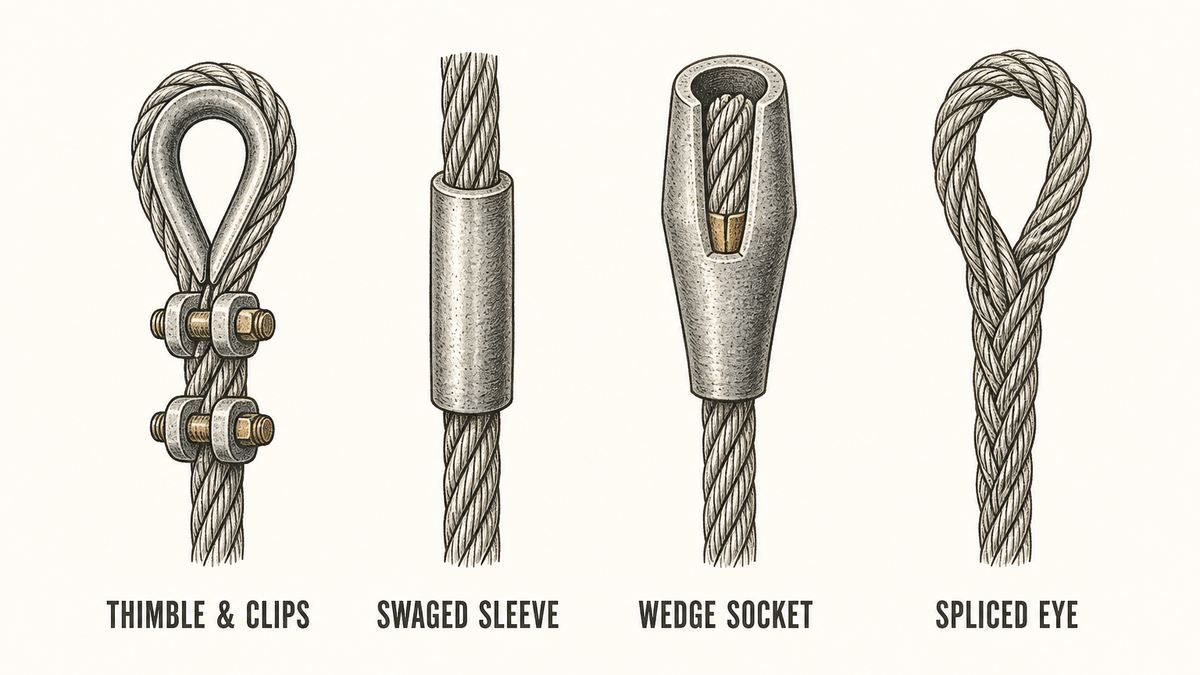
Four terminations cover almost everything you will be quoted, and they trade differently.
Thimble and U-bolt clips. A soft eye is formed around a metal thimble and held by two or more U-bolt clips. It is the cheapest end, it can be made by anyone with a spanner, and it is the one most likely to be fitted wrongly. The rule that matters here is small and precise: the U-bolt must be fitted so that the U-shaped section bears on the dead end of the rope — the short tail — not on the loaded side. Fitted the other way round, the clips saddle the live end, and the assembly loses efficiency and slips under repeated load. The number of clips and their spacing are also fixed by a table rather than by eye, and they change with rope diameter. Two further rules are worth knowing because they surprise people who are used to making ends by hand: an eye splice has to have at least three full tucks, and on slings and bridles the eyes must not be formed with wire rope clips at all. So the clips you may legitimately use to make a soft eye for one purpose are not permitted for another, and the difference is the application, not the hardware.
Swaged sleeve. A metal sleeve is squeezed onto the rope with a press, so the rope and the fitting become one piece. It is compact, tidy, hard to tamper with, and it holds a high proportion of the rope's strength when it is made properly with the right die. Its weakness is that the quality is invisible: a badly pressed sleeve looks exactly like a good one until it pulls, and it pulls all at once rather than showing a warning. If you buy swaged ends, the press settings and the die used are production parameters, not preferences, and the factory should be able to state them.
Wedge socket. The rope is run into a tapered metal socket and a wedge is trapped behind it, so the load pulls the rope tighter into the taper. It is strong, it is easy to inspect, and it is easy to assemble — which is both its advantage and its risk, because the rope must be seated with the correct length of tail protruding and the tail must be secured, or the assembly can pull through. A wedge socket is also the termination where the small construction rules bite: the rope tail has to be held by something that stops it drawing back, and the protruding strand ends in a splice must be covered or blunted so nobody handles a row of sharp wire points.
Spliced eye. The strands of the rope are unwound and tucked back into the body of the rope to make a loop. It is the traditional end, it uses no extra hardware, it is gentle on the rope, and it needs a skilled hand. It is also the end where the minimum length rules matter most, because a splice needs room to be made, and a rope cut too short cannot be spliced back to full efficiency whatever the workshop does.
Two buying points follow. First, specify the termination and its efficiency together with the rope, and treat the two as one product with one working load — because that is how the finished assembly is judged. Second, if the end involves welding, the rule is specific: the welding has to be done before the rope is assembled into the fitting, and the finished welded attachment must be proof tested at twice its rated capacity before it is first used, with the certificate kept and available for examination. A supplier who welds a fitting with the rope already in it has produced something the rule does not allow, and you will not find that out from the invoice.
When Does a Wire Rope Have to Come Out of Service?
Under published conditions, and they are written as counts and measurements rather than as an opinion. This is the part of a wire rope order that almost never appears in one, and it is the part that decides whether the end user can legally use what you sold them.
The marking, first, because it is a condition of use rather than a nicety. The United States workplace rules for slings say that an employer must use only wire rope slings that carry a permanently affixed and legible identification marking prescribed by the manufacturer, stating the recommended safe working load for the type or types of hitch used, the angle on which that figure is based, and the number of legs if there is more than one. Read that as a buyer and the requirement becomes an order line: every assembly ships with a permanent tag or marking that states the safe working load, the hitch it applies to, the angle it assumes, and the number of legs. Rope that arrives on a reel with a paper label on the outside, and no marking on the assembly itself, leaves your customer unable to use it lawfully however good the rope is. You can read the requirement, and everything below, in 29 CFR 1910.184.
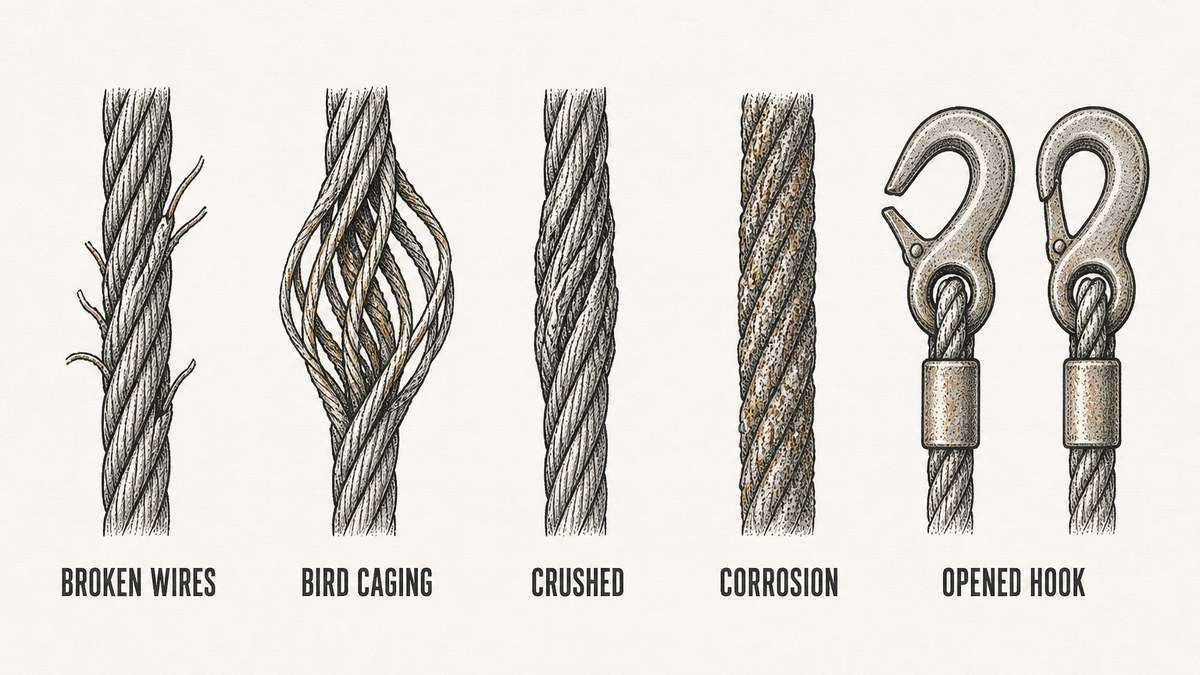
The removal conditions. A wire rope sling must be taken out of service immediately if any of the following is present. Ten randomly distributed broken wires in one rope lay, or five broken wires in one strand in one rope lay. Wear or scraping of one third of the original diameter of the outside individual wires. Kinking, crushing, bird caging, or any other damage that distorts the rope structure. Any evidence of heat damage. End attachments that are cracked, deformed or worn. Hooks opened more than 15 percent of the normal throat opening, measured at the narrowest point, or twisted more than 10 degrees out of the plane of the unbent hook. Corrosion of the rope or the end attachments.
Two things about that list are worth noticing, because they are the difference between reading a rule and understanding it. The first is that almost every item is a count or a measurement, not a judgement — which means a buyer can turn the whole list into a checklist with a ruler, a set of callipers and a count, and a trained person can then decide in a minute whether a rope stays in service. The second is that most of the list is about the rope's history rather than its appearance. Heat damage and corrosion are conditions, not wear, and a rope can look sound and still be finished.
A second, different count. The rules for rigging equipment used in construction carry their own limit for wire rope: the rope must not be used if, in any length of eight diameters, the total number of visible broken wires exceeds 10 percent of the total number of wires, or if the rope shows other signs of excessive wear, corrosion or defect. Notice that this is not the same measure as the sling rule. One counts broken wires over a rope lay; the other works out a percentage over a fixed length. One is written for a made-up sling, the other for rope used in hoisting and pulling generally. If your product is used in both settings — and lifting slings very often are — the stricter of the two is the one that governs, and the practical answer is to know both and apply the tighter. Both are short enough to read, and the construction version is at 29 CFR 1926.251.
Three further limits belong on the same page, and they are all things a buyer can put into a specification rather than discover later. A fibre core rope of any grade must be permanently removed from service if it has been exposed to temperatures above 200 degrees Fahrenheit — not inspected, removed, because the core is destroyed and the rope cannot be trusted again. A rope with a steel core used outside a stated temperature band must follow the maker's own recommendations for that temperature rather than a general figure. And where a rope bends, the machine around which it bends matters as much as the rope: the crane and hoisting rules deal with drum and sheave condition for exactly this reason, and a rope running over a worn or undersized sheave will fail while every measurement on the rope still looks acceptable. That part of the rules is at 29 CFR 1910.179.
The conclusion is not that you should become a safety officer. It is that three lines belong in every wire rope order and almost never are: the permanent marking with its safe working load, hitch, angle and number of legs; the proof test certificate where welded ends are used; and a statement of the construction. Those three cost nothing and they are the difference between a commodity and a product a professional user can put into service.
How Is the Price Built?
A wire rope quotation is a steel price with some bought-in hardware and a little machine time around it. That is worth saying plainly, because it explains why rope prices move for reasons that have nothing to do with the design.
The wire. The largest line and the only one that moves on its own. Wire is drawn from steel rod and priced by weight against the metal market, so a quotation for delivery in three months carries a risk that has to sit somewhere. The fix is the same one that works on any steel product: ask for the rope weight per unit length, so the metal becomes a figure you can check instead of a promise you have to trust.
Stranding and closing. The machine time that turns wire into strands and strands into rope. It is a real part of the cost and it scales with the number of operations, which is why a rope with many small wires costs more to make than a rope with fewer thick ones at the same weight.
The core. A fibre core is cheap and carries no load. A steel wire core costs more and raises the breaking force. An independent wire rope core costs more again, because the core is a finished rope in its own right. This is the single easiest line to change without changing anything the buyer can see from outside.
The end fittings. Bought in, not made. Thimbles, clips, sleeves, sockets and hooks are their own supply chain, and their quality varies as much as the rope's. Because they are bought in, they are also the line where a quotation can quietly change supplier between the sample and the shipment.
Making the ends. Splicing by hand is skilled labour and takes time. Pressing a swaged sleeve takes a press and a die, which is faster but carries the cost of the tooling. Fitting clips takes minutes.
Testing and marking. The proof test where one is required, the pull test on samples, and the permanent marking on each assembly. This is the cheapest line in the whole quotation and the first one removed, because no customer can see whether it happened.
Reels and packing. A rope has to arrive coiled without a kink and without a set. Steel is heavy, so the packing also decides what you pay to move it, and a badly coiled reel that takes a permanent bend in transit turns a good rope into scrap.
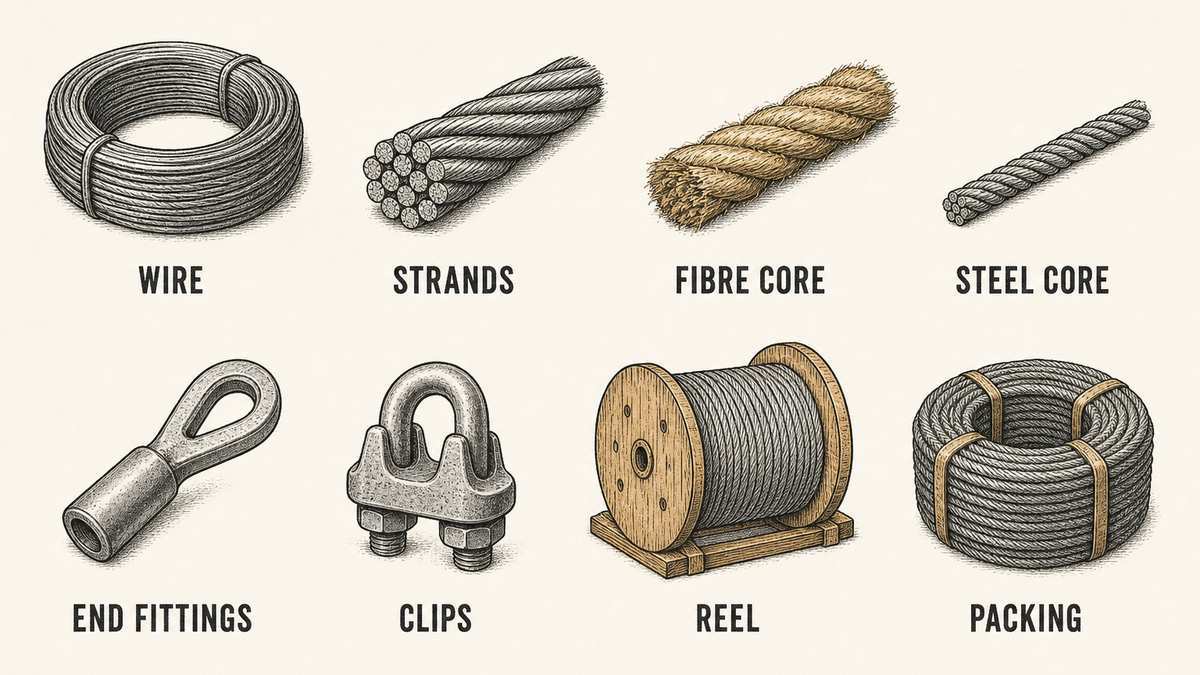
The habit that makes a quotation comparable is to ask for the split and to ask for the rope weight per hundred metres inside it. Two suppliers quoting the same diameter with a large gap between them are rarely disagreeing about the wire price. They are disagreeing about the core, the class, or the fittings, and one of them has left a line out.
What Goes Wrong?
Four failures cover most of what you will hear about, and only one of them is visible from a distance.
The end pulls. A swaged sleeve, a set of clips or a wedge socket lets go, and the load drops. This is the failure with the worst consequences and the shortest warning: where a pressed end is under-made, the first sign is the failure itself. It is also the failure most likely to be a workmanship problem rather than a material problem, which means it is the one your inspection plan should target with a sample pull rather than with a photograph.
The rope flattens along one side. The outer strands wear flat where the rope runs over a sheave or winds onto a drum, the wires there become thin, and the rope loses strength exactly where it bends most. It looks like slow wear and it is; the cause is usually a machine problem rather than a rope problem, which is why the drum and sheave rules exist.
The rope kinks. A kink is a sharp permanent bend, and it damages the rope in a way that no amount of care afterwards undoes. It happens when a rope is run slack and then snagged, or when a reel is unwound with a loop in it, and it is the failure most often caused during transport and unpacking rather than in service. A rope that arrives with a kink has arrived damaged.
The clips slip. The clips were fewer than the table calls for, spaced wrongly, or fitted with the U-bolt on the wrong side, and the tail draws through under load. Of every failure on this list it is the easiest to prevent and the easiest to miss, because the assembly looks correct to anyone who has not been shown the difference.
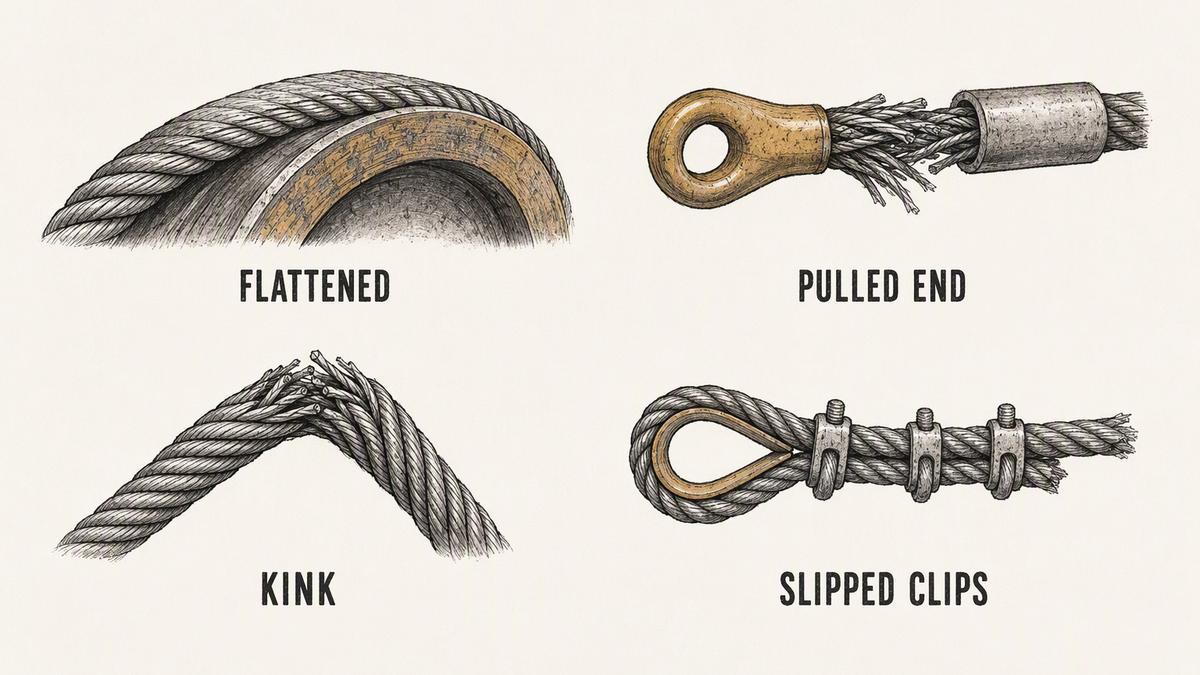
The pattern is the same as in every loaded component in this category. None of these four is a materials accident. Each is a decision made at the quotation stage or at the bench, and every one of them is decided long before the rope reaches a load. That is why the tests below matter more on a wire rope than on almost anything else you can source: the consequences are not a refund, they are an injury.
How Do You Check a Manufacturer Before You Commit?
Start with the supply chain, because a rope factory is a drawing and stranding operation wrapped around bought-in steel and bought-in hardware.
Ask who draws the wire, and to what grade. A serious rope maker knows the wire source and its tensile grade; an assembler buys finished rope and fits ends to it. Only one of them can change the rope construction for you.
Ask which class and which core, for each line of the order, and have it written down so the second order is not a different product.
Ask who makes the end fittings, and for the efficiency figure for the termination proposed as a percentage of the rope's breaking force. A supplier who cannot answer that is not used to being asked.
Ask how the permanent marking is applied, and what it says. A printed paper label is not a permanent marking. Ask what the tag is made of, where it is fixed, and whether it carries the safe working load, the hitch type, the angle and the number of legs.
Ask for the proof test certificate on welded ends. The rule requires the test and the certificate, so this is a normal request rather than a difficult one.
Then test a sample yourself. Five things, all of them cheap, and the first is the one that matters most:
- Cut a sample open and look at the middle. Count the strands, check whether the core is fibre or steel, and compare the wire count against what the quotation claims. The outside diameter is the one thing that cannot be relied on, so this is the only test that settles whether the product is what was ordered.
- Weigh a measured length. Weight per metre is the direct measure of how much steel is in the rope, and a kitchen scale is enough.
- Bend a short sample over a radius close to your real sheave or drum and work it back and forth, then look for broken wires at the crown of the bend. A few minutes on a bench beats a catalogue table.
- Check the lay direction against the certificate by following the strands with a finger. A rope made in the opposite lay is a different product, and on a repeat order it is the easiest thing to get wrong.
- Read the marking on a finished assembly as a user would. If it does not give the safe working load, the hitch, the angle and the number of legs, the assembly cannot go into service — and fixing a tag is far cheaper than explaining it to a customer.
Then turn the answers into an inspection plan, because a sample you tested and a shipment you did not are two different things. The usual structure works here as everywhere: a first article inspection on the first assembly off the line, a the sample size for a wire rope batch, and a pre-shipment inspection before the reels are packed. Three checks belong in it specifically: the sample cut and wire count, the weight per metre, and a photographed marking on a finished assembly. One note on freight, because steel is dense: the arithmetic that surprises buyers on heavy goods is how actual and volumetric weight differ, and a rope order is charged on the heavier of the two.
One document is worth having before the first order. The specification sheet should state the rope class, the core, the lay, the diameter, the minimum breaking force, the termination and its efficiency, the working load of the finished assembly and the factor behind it, the marking wording, the proof test requirement, the packing and the tests — the specification sheet for a wire rope sets out the format. And if you are still deciding between a factory and a trader, telling a wire rope maker from a reseller and the wire rope certificate checked at the issuer are the two checks to run first.
Where Does a Cheap Quotation Get Its Money Back?
Eight lines get trimmed on this product, and they are listed in roughly the order they go.
- Fewer or finer wires in the strand. The rope still looks right and still measures right, and it carries less.
- A fibre core where a steel core was specified. The largest invisible saving on a wire rope, and the one that costs the most in strength.
- A lower tensile grade of wire. Nothing about the finished rope declares it, and the breaking force falls quietly.
- Cheaper end fittings. Bought-in hardware is a real line, and a lighter thimble or an unbranded sleeve looks the same until it is loaded.
- Clips instead of a pressed or spliced end. Faster and cheaper, and far more sensitive to how well the person fitting them was trained.
- Clips fitted the quick way. U-bolts saddling the live end, too few, spaced by eye. It costs nothing and it is the most common cause of a slipped end.
- No proof test, no certificate, and a paper label instead of a permanent marking. The end user then cannot lawfully put the assembly into service, and you cannot prove the rope was tested.
- A lighter coil and cheaper packing. A rope that takes a set or kinks in transit arrives as a worse product than the one that was tested, and it is the one saving on this list that the customer sees the moment the reel is opened.
The way to use this list is not to police it item by item. It is to put the same written specification in front of two or three factories and ask each one to confirm, line by line, that their price includes the class, the core, the fittings, the marking and the proof test. Two quotes for the same diameter are not a comparison. Two quotes that both state the core, the breaking force, the termination efficiency and the marking are a comparison, and the cheaper one is then cheap for a reason you can read.
Frequently Asked Questions
How do I know what working load a wire rope assembly has?
From three things, not one: the rope's minimum breaking force, the proportion of that force the termination keeps, and the factor that converts the result into an allowed load. The working load belongs to the finished assembly rather than to the bare rope. Ask for the termination efficiency as a percentage and for the factor the working load is based on, or you have half the answer.
Why does a wire rope fail at the end rather than in the middle?
Because the termination is where the rope stops carrying the load as a rope. Making an end bends, squeezes or buries the strands, and each of those actions removes some of the strength the rope had as a plain length. Different terminations keep different proportions, so two assemblies built from identical rope can have different working loads purely because of how the ends were made. That is also why a badly pressed end gives no warning and fails all at once.
What is the difference between a fibre core and a steel core?
A fibre core gives a softer, lighter, cheaper rope and carries no load worth counting. A steel wire core adds metal in the middle, which raises the breaking force for the same outside diameter and resists the rope being crushed flat on a drum. An independent wire rope core is a small wire rope used as the core, the most crush-resistant common build. Two ropes of the same diameter with different cores are different products, and cutting one open is the only way to tell them apart. A fibre core rope must also be permanently removed from service if it has been exposed to high heat.
When must a wire rope be taken out of service?
Under published conditions stated as counts and measurements rather than opinions: ten randomly distributed broken wires in one rope lay, or five broken wires in one strand in one rope lay; wear of one third of the original diameter of the outside individual wires; kinking, crushing or bird caging; any evidence of heat damage; cracked, deformed or worn end attachments; hooks opened more than 15 percent of the normal throat opening or twisted more than 10 degrees; and corrosion of the rope or the end attachments. A separate rule for rigging equipment sets a second, different limit: no use if visible broken wires exceed 10 percent of the total in any length of eight diameters.
What does the marking on a wire rope sling have to say?
Four things: the recommended safe working load, the type or types of hitch it applies to, the angle that figure is based on, and the number of legs where there is more than one. The workplace rules require an employer to use only wire rope slings carrying a permanently affixed and legible marking prescribed by the manufacturer that states all four. Read as a buyer, that is an order line rather than a formality, and a paper label on the outside of the reel is not a marking on the assembly.
What should the specification sheet for a wire rope order say?
The rope class and wires per strand; the core type; the lay; the diameter; the minimum breaking force; the wire tensile grade; the termination and its efficiency as a percentage of breaking force; the working load of the finished assembly and the factor behind it; the wording on the permanent marking; whether a proof test and certificate are required; the packing; and the tests run per assembly and per shipment. Written as figures rather than descriptions, it makes two quotations comparable.
Send the core and the termination — not just “8 mm wire rope”
Tell us the application, the diameter range and how the rope will be used, then the lines that decide whether the assembly holds: the rope class and wires per strand, the core type, the lay, the wire tensile grade, the minimum breaking force, the termination and its efficiency, the working load of the finished assembly and the factor behind it, the wording of the permanent marking, whether a proof test with a certificate is required, and the packing. Add your target volume and the destination. We will come back with the factories whose core, class and end fittings match your application, the specification written as figures rather than descriptions, the wire, stranding, core, fittings and end-making lines shown separately so quotations become comparable, a sampling plan built around cutting a sample and weighing a length rather than photographing a reel, and a clear statement of which supplier owns which failure on what you are buying.
Request a Wire Rope Sourcing Quote
Questions & Comments
We read every one and reply within 24 hoursSourcing wire rope and rope slings and getting quotations that all say “8 mm wire rope”? Send the rope class and wires per strand, the core type, the lay, the wire tensile grade, the minimum breaking force, the termination and its efficiency, and the wording you need on the permanent marking, and we can usually say which lines are missing from them. If rope has already arrived with an end that pulled, a flat worn section, a kink out of the reel, or a tag that does not state a safe working load, describe what you saw and roughly when it appeared, because the symptom usually says whether it was the core, the class, the end fitting or the end-making.