
USB Cable Manufacturer: Sourcing Cables From China
 ·
Updated October 12, 2026
·
18 min read
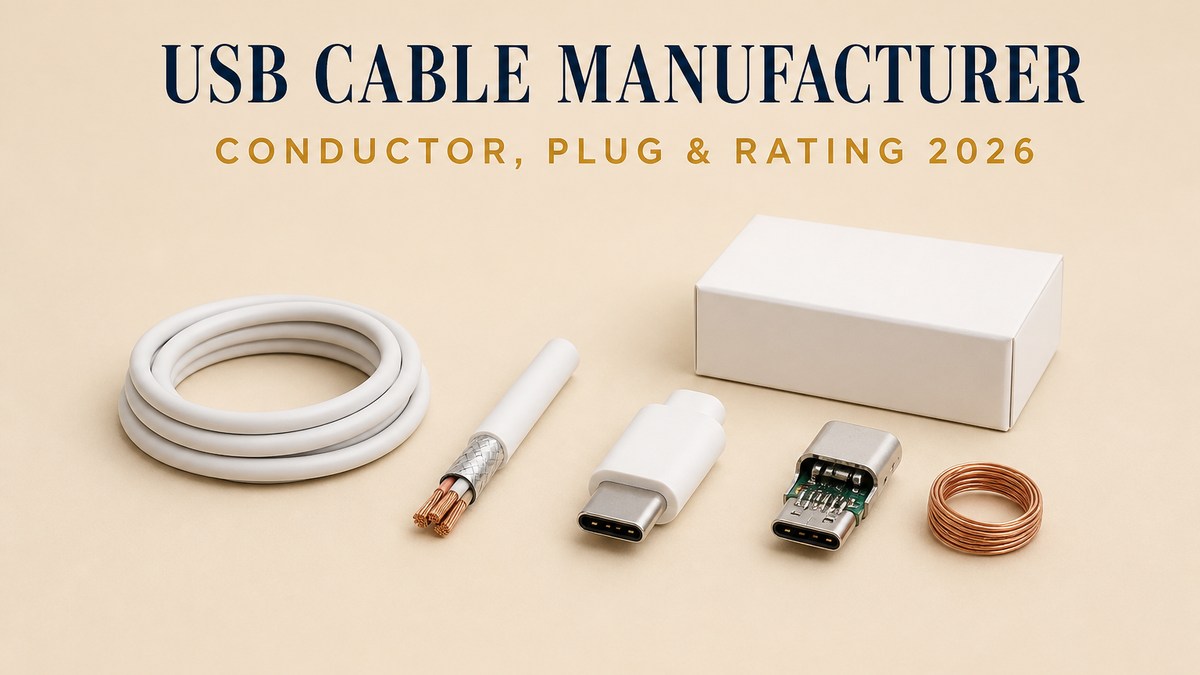
A USB cable is the cheapest item in most orders and the one your customer will judge fastest. Everything that decides whether they judge it well is inside the jacket or inside the plug, and both of those places are the two places a photograph cannot reach. The outside of a cable carries no information at all: two cables can look identical, weigh almost the same, carry the same moulded plug, and behave completely differently on the same charger. That is not a quality-control problem you can solve by looking harder. It is a specification problem, and it is solved by putting three things into writing that almost nobody puts into writing — the conductor size per core, the cable's written rating, and the identity of the connector the factory assembles onto the end. This guide covers what a cable is actually made of, why the wire inside decides what it can do, what the numbers on a cable really mean, why the plug is a certification question rather than a design choice, how to check a factory's certification claim in the organisation that issues it, how the price is built, what goes wrong, and how to test a sample in ten minutes at your own desk.
What You Are Buying, and the Line That Decides It
| If you want | What it means in practice | The line on your order that decides whether it works |
|---|---|---|
| A cable that charges as fast as the device allows | The connector does not carry the current, the wire behind it does | The conductor size per core, and the cable's written rating |
| A cable that still works after a year of use | It breaks at the joint where the wire meets the contact, not in the middle | The overmould and the strain relief, plus a bend test on a sample |
| A cable you can sell in the European Union | The plug on the device end is set by rule, not by the market | The connector type, and a document for the connector the factory uses |
| A cable you can honestly call certified | The claim is tracked by an identity number in a public register | The Test ID, looked up in the register by you rather than shown to you |
| A cable that does not lose power along its length | The same wire over more length loses more of what goes in | The length and the conductor size given together, never one without the other |
| A price that survives a second quote | Most of the cost is metal, and metal moves | The cost lines shown separately, with the conductor weight stated |
What Are You Actually Buying? Four Parts, and Only One of Them Is the Plug
A cable is not one product with one price. It is four layers wrapped around each other, plus an assembly on each end, and the industry sells at least three different products inside the same outside shape.
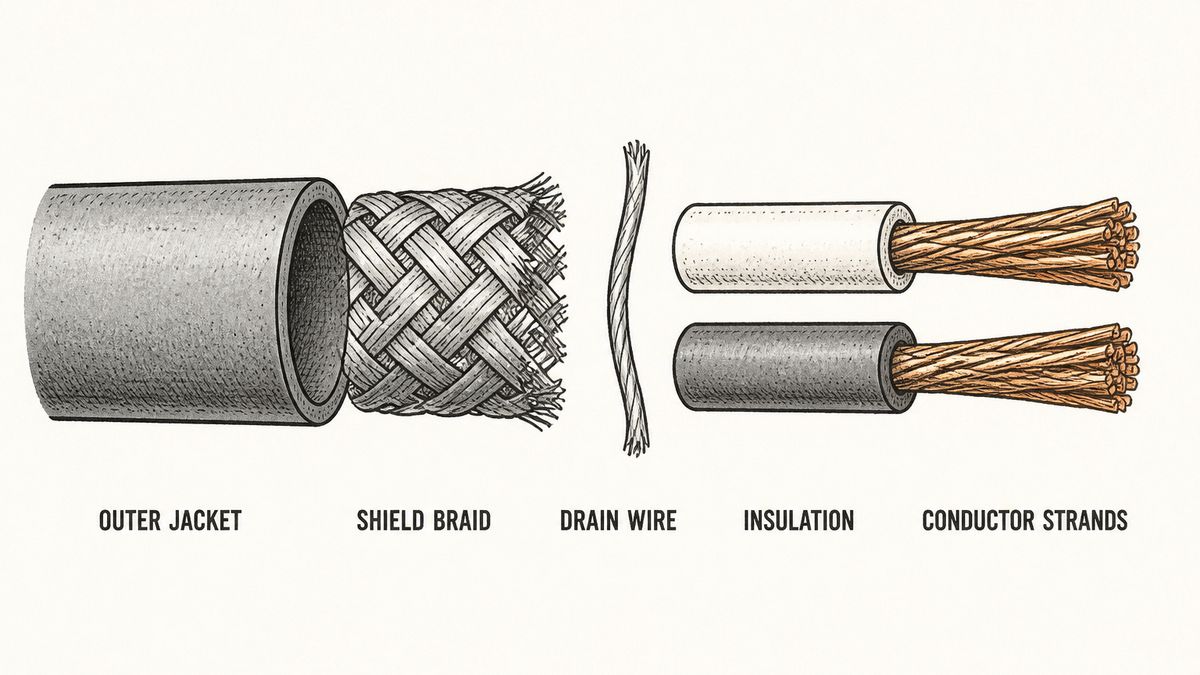
The conductors. The metal that carries the current and the data. In a cable that has to bend, the conductor is never one solid core — it is a bundle of thin strands, because a single thick core would work-harden and crack after a few hundred bends. The number of strands and their total thickness is the single most important number in the product, and it is the number most often left off a quotation. A cable's conductor is described in two ways: the size of each strand, and how many of them are used. Both matter.
The insulation on each conductor. Every strand bundle is covered before the cables are laid together, otherwise the power cores would simply short against each other inside the jacket. This layer decides how much voltage the cable can hold safely and how much heat it can take. It is also the layer that makes one cable stiff and another flexible at the same thickness.
The shield and the drain wire, or their absence. A shield is a wrap or braid of fine metal around the inner cores, with a bare drain wire running beside it to carry interference away. It is there for the data pairs and for high-speed work. It is also the first thing a quotation removes, because it costs metal and assembly time and no customer can see whether it is there. A charging cable often has no shield at all, and that is a legitimate design for a cable whose only job is power.
The jacket. The outer cover. Its job is to hold the bundle together and survive the customer's bag, and its material decides whether the cable goes stiff in a cold car or turns sticky in a hot one.
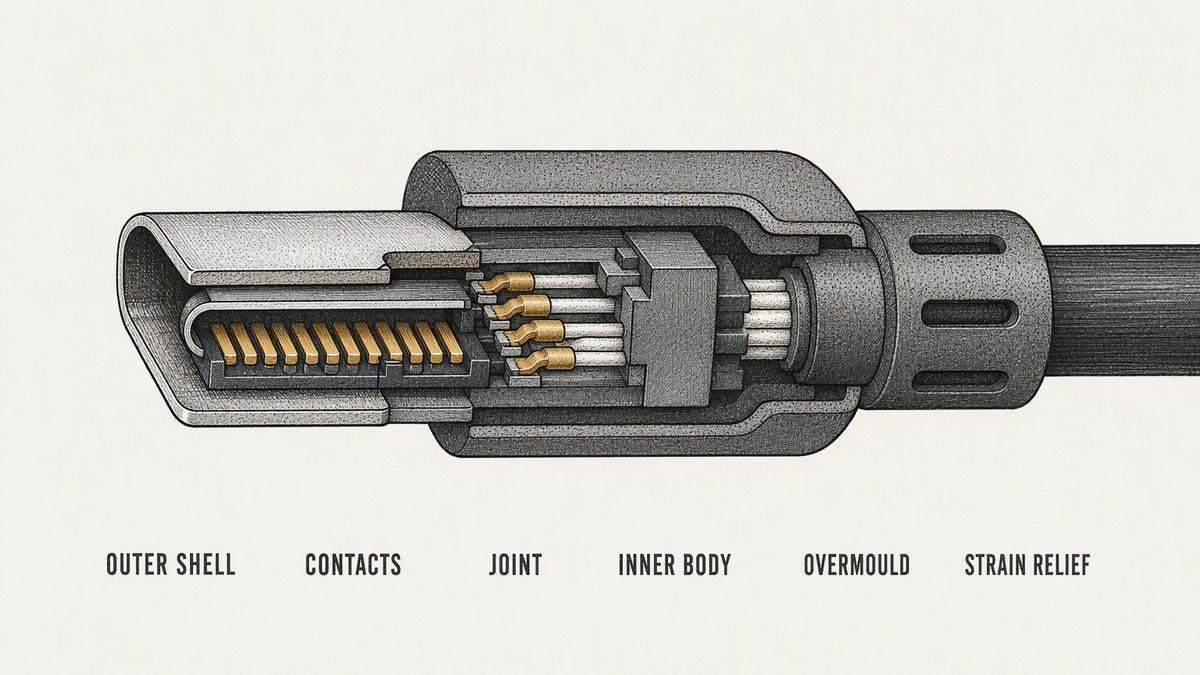
The two plugs. Officially an assembly rather than a part: a metal shell, a set of contacts, a small piece of circuit board or a direct solder joint behind each contact, and an overmoulded body that holds the whole thing. The body is the part that fails, and the joint behind it is where it fails. Electrical safety and materials testing for electronic accessories is a separate subject from the plug's own approval, and it is worth reading before you choose the jacket and insulation materials, because those two layers are what the material rules are aimed at.
The commercial point that follows is that “a USB-C cable, one metre, black” describes nothing at all. That phrase fits a cable whose conductor is heavy enough to carry a laptop's charging current, and it fits a cable that carries almost nothing, and the two are sold at prices that differ by a factor most buyers never notice until they open the box. If your order says no more than that sentence, you have agreed to buy whatever the factory's standard build happens to be on the day.
A second point matters for how you write the order. A cable that only charges and a cable that also carries data are different products. The charging build needs the power cores plus the small pair used for the handshake between the two devices; the data build needs every pair, laid and twisted to a controlled pattern, usually with the shield and drain on top. Factories run both, often on the same line, and the same outside jacket. So the first question is not which factory, it is which of the two products you are buying.
Why Does the Wire Inside Decide What the Cable Can Do?
Because current is carried by metal, and the amount of metal is the one thing the outside of a cable does not tell you.
Three things decide what a cable can pass along. The first is the total cross-section of the conductor: more copper carries more current with less heating. The second is the length, because the same conductor over a longer run loses more of what is put in. The third is the quality of the two joints at the plugs, because a good cable with a poor joint performs like a poor cable. The outside diameter does not appear in that list. Two cables of exactly the same thickness can differ in conductor size, because the space inside the jacket is filled with whatever the factory chose to fill it with, and filling it with insulation compound is cheaper than filling it with copper.
This is why the same cable behaves differently on two different phones, and why the same phone charges at different speeds from two cables that look like brothers. Charging is a conversation. The charger and the device agree on a power level, and the agreement starts from the lowest safe setting and moves up as each side confirms what the other can take. A cable built around a light conductor sits at the bottom of that range and the agreement never rises. Nothing is broken, nothing is warm, and the customer sees a charge time that makes them think the device is faulty. This is the failure mode that costs you a review without ever producing a return, because the cable still works.
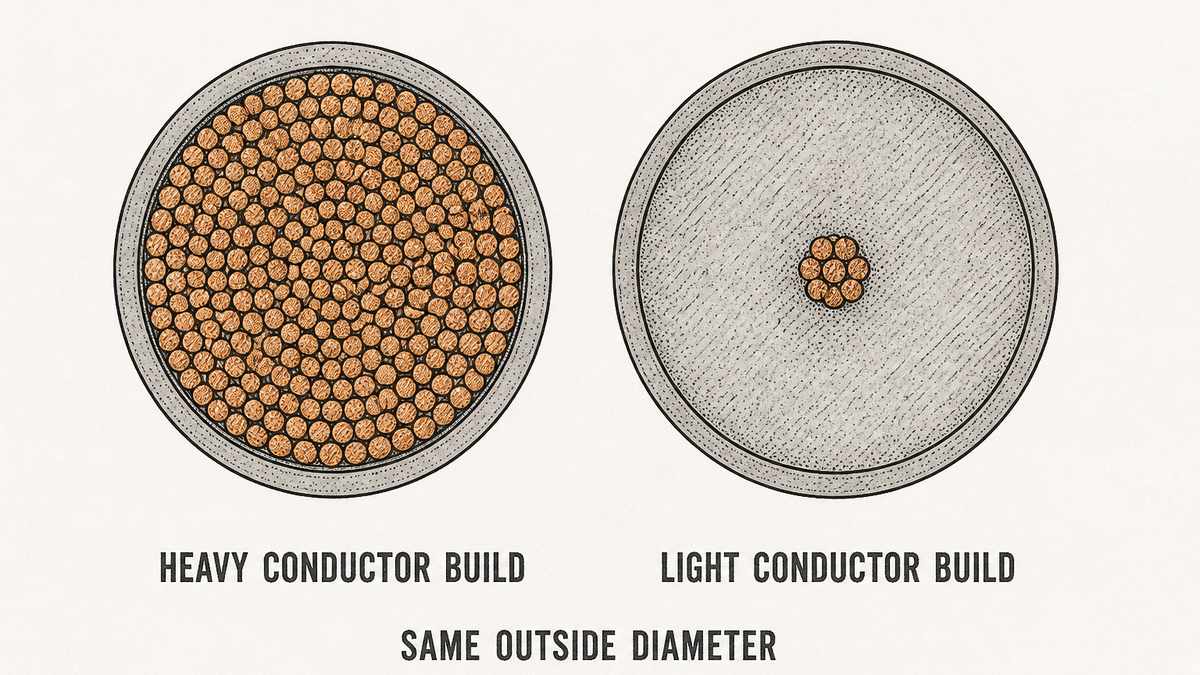
There is a cheap way to settle this before you order, and it belongs in every cable order. Cut one sample open, look at the conductor bundle, and weigh the copper in a fixed length. Copper weight per metre is a number, it repeats, and it is the only measure that survives the fact that the outside of the cable says nothing. A factory that resists giving you a weight is telling you something; one that gives you a weight and then ships a lighter cable has handed you a claim you can check.
Length and conductor size have to be written together, and this is where most specifications fall apart. A build that is comfortable at one metre is working harder at two, because the loss grows with the length while the conductor stays the same. If your range includes three lengths, the order should state the conductor size for each length rather than one figure for the range. Buyers who write one figure for all lengths usually discover the problem in the longest cable, and they usually discover it after the whole shipment has been packed.
One further detail belongs on the same line: how the strands are joined to the contacts. A hand-soldered joint and a machine-welded joint behave differently after a thousand bends, so ask which the factory uses. The answer is free, and it tells you whether the person quoting you has seen a cable fail.
What Do the Numbers on a Cable Actually Mean?
They describe what the cable was designed and rated to carry. They are not a description of the plug, and they are not a measure of quality. A cable has a written rating, the rating was set when the cable was designed, and the same outside shape is sold at different ratings. That is the whole reason a quotation for “a cable” is not comparable with another quotation for “a cable” until both say which rating they are building to.
The ratings are set by the standard that defines the connector, and the standard has moved twice in the last few years, so it is worth knowing the current picture rather than the version that was true when your supplier learned the trade. The organisation that publishes the specification, the USB Implementers Forum, states plainly that when the power delivery specification was updated to Revision 3.1 in 2021, the change enabled delivering up to 240 W of power over a full-featured USB Type-C cable and connector. Before that update, power delivery was limited to 100 W, delivered at 20 V through Type-C cables rated at 5 A. The connector specification was then updated to Release 2.1 to define the cable requirements for the higher power level, and new fixed voltages were added so that 28 V, 36 V and 48 V correspond to power levels of 140 W, 180 W and 240 W. The same update added an adjustable mode, where the device being charged can ask for voltages between 15 V and whatever fixed voltage the charger tops out at, and it removed the assumption that power only flows one way. You can read this on the USB charger and power delivery page that the forum maintains.
The rating is a design decision made at the factory, not a property of the plug. A Type-C plug is a Type-C plug. What differs is the conductor inside the jacket and the small amount of electronics some cables carry so that the two ends can agree on a power level. Two cables with the same plug can be built to different ratings, and the plug will not tell you which one you are holding.
Higher ratings are not automatically better for your product. If your product is a short charging cable for a small accessory, the higher rating adds copper and cost for nothing, and it may make the cable stiffer and less pleasant to use. The correct move is to match the rating to the device the cable is sold for, state it on the order, and state it on the specification sheet — not to buy the top rating and hope.
The rating has to be paired with the length. A build that carries its rated current comfortably at one metre is doing more work at two metres with the same conductor, and the cable that underperforms is then the long one in the range. If you sell three lengths, the order needs three lines.
One warning about how these numbers get used in marketing. The testing programme page shows the forum actively discourages its members and the industry from using specification names as consumer branding, because loose use of the terminology misleads buyers. That is a polite way of saying plenty of products describe themselves with a specification name they were never tested to. Treat every specification name on packaging as a claim to check.
Why Is the Plug a Certification Question Rather Than a Design Choice?
Because the forum requires that every product seeking its certification uses a certified connector. That single line changes the plug from something your factory chooses into something your factory buys, with a paper trail attached to it.
Read the requirement literally: all products seeking USB-IF certification must use USB-IF certified connectors. The practical meaning is that the plug on the end of your cable is a bought-in component that has already been through the testing programme in its own right, and the cable factory is assembling a part it did not design. This has three consequences that matter commercially.
First, the connector is a supply question, not a moulding question. The right question to a factory is not “which plug do you use” but “which connector brand and part number, and can you show the certification for that part”. A factory that buys connectors from whichever trader is cheapest this month cannot answer that question, and the answer will change between orders without anyone telling you.
Second, a certified connector does not make a certified cable. The connector passing its own tests says nothing about the assembly. The conductor can still be too light, the joints can still be poor, and the overmould can still split after a few hundred bends. The connector requirement is a floor, not a pass.
Third, the plug is no longer purely a market question in the European Union. The forum maintains a separate product list for the European requirement, described on its EU conformity list page as covering conformity to the USB specifications as defined in European legislation, and tested against the cable and connector specification and the power delivery specification. Two details on that page are worth more to a buyer than the list itself. The first is that the list distinguishes between products that are fully certified and products that have met only the conformity requirements — so appearing on the list is not the same as being certified, and the difference is visible if you look for it. The second is that the list is maintained by the companies themselves and the forum takes no responsibility for its contents, which is a fair description of how every self-reported register works. What the European rules require of your product, which product groups they cover and from which date, is a question for your testing partner or customs broker rather than for this article, because both the coverage and the dates are set by category.
The reason to care even if you never sell in Europe is that the European requirement has dragged the connector market toward one shape and a defined set of tests, and the same connectors are used everywhere. A factory that can talk about conformity testing is a factory that buys its connectors from a serious supplier. That is a useful signal about the rest of the build.
How Do You Check a Factory's Certification Claim?
By asking for the identity number rather than the certificate, and then looking the number up somewhere the factory does not control.
The forum's testing programme is built around a Test ID. Its own description of the programme explains that it uses several test specifications together with a Test ID to track and define the criteria used to judge a product, and that products passing that level are considered certified and are added to a register called the Integrators List, which is also what gives them the right to license the logos. The register is linked from that page, so the claim has a destination you can visit. Two honest notes about it: the register is not something we can promise you can browse freely without an account, and it is worth knowing that the same page states that using the certified logos also requires a current trademark licence agreement on file with the forum. A factory that has a certified product but no licence on file is not allowed to put the logo on your packaging.
The part of the programme that matters most to an importer is hidden in the detail, and it is this: a Test ID is only assigned once the product has been accepted for testing by an Authorised Independent Test Lab, and the same page states that only the lab locations the forum has identified are authorised to test for its certification, while satellite locations that are not listed are not authorised to perform any of that testing. Put those two statements together and you get a question worth asking on every order: which listed lab produced the test data, and what is the Test ID? A report from a lab that does not appear on the authorised list is a lab report. It is not certification, whatever it is called on the quotation.
The second thing worth understanding is how one test can cover several products, because this is where genuine claims and exaggerated ones look identical on paper. The forum runs a route called Qualification by Similarity, in which testing one product can allow very similar products to be added to the register without being tested themselves. Where there are significant differences between products, each has to be tested, and the judgement of what counts as significant rests with the programme's review board. The forum then states the part that a buyer should read twice: responsibility for making sure that production models do not differ from the samples that were tested lies with the vendor, and audits that turn up differences between shipping product and the sample tested can lead to a required re-test, withdrawal of certification, and legal action.
That paragraph is the reason a certification claim is only half a question. The other half is: which model was tested, and is the model you are buying the same one? If a factory shows you a certification for a cable and then quotes you on a build with a lighter conductor, the certification does not travel with the change. It stops applying, and the risk lands on the party whose name is on the packaging. the usb cable certificate checked at the issuer sets out the same discipline for factory paperwork, and it is the same habit: take the number, go to the source, and check that the thing you are buying is the thing that was tested.
Two closing points on the certificate itself. A certificate with no identity number is a picture. A certificate that names a model number which does not appear anywhere on your order is a picture of somebody else's product. And if the factory cannot tell you the difference between the product that was tested and the product being offered to you, assume there is one, because the party carrying the risk is the one that is supposed to know.
How Is the Price Built?
A cable quotation is a metal price with some plastic, some assembly and a little testing wrapped around it. That is worth saying out loud because it explains why cable prices move when nothing about the design has changed, and why the cheapest quotation is almost always cheaper in the metal.
Copper. The largest single line and the only one that moves on its own. It is bought by weight and priced against the metal market, so a quotation given for delivery in three months carries a risk that has to sit somewhere — usually in a note that the price is subject to the copper price on the day of shipment. Ask for the conductor weight per unit in the quotation. It turns an invisible commodity into a number you can check, and it makes a later price increase a conversation about a figure rather than about trust.
Insulation compound. The layer on each conductor. This is where the material rules on electronic accessories land, and where a factory can move from one grade to another without changing anything a customer can see. The relevant question is what the compound is, not how it looks.
Shield and drain. Present in a data build, absent in a power-only build, and quietly removable from either. If your product is sold as a charging cable, the honest position is that a full shield may be unnecessary. If your product is sold as a data cable and the shield is missing, the cable is not the product on the box.
Jacket compound. The visible layer, and the one that decides whether the cable feels expensive. Soft-touch compounds cost more than basic ones and are often the first thing a cheap quotation changes, because the difference shows up in the hand only after a few months of use rather than in the first photograph.
Connector shells and contacts. Bought in, then assembled. A certified connector costs more than an uncertified one, and the difference is invisible on the finished cable. This is where a quotation can look identical to a good one and not be one.
Plating on the contacts. Contacts are plated to stop them corroding, and the thickness of that plating is a cost line with a very long fuse. A thin flash looks and works like a proper layer for months, then the contact goes dark and the customer concludes the cable is rubbish rather than concluding the plating was thin.
Assembly and test. The joints behind the contacts, the overmoulding, and whatever testing the factory actually performs. The last item is the easiest to remove, because no customer can see it. If you have specified that every cable is checked before packing, the quote should carry that as a line; if it does not, the check is not happening.
Packing and the retail box. Often quoted separately, and often where a comparison between two factories turns out to be a comparison between two different products. A cable quoted with a plain bag and a cable quoted with a printed retail box are not the same offer, and the difference is frequently larger than the difference in the cable itself.
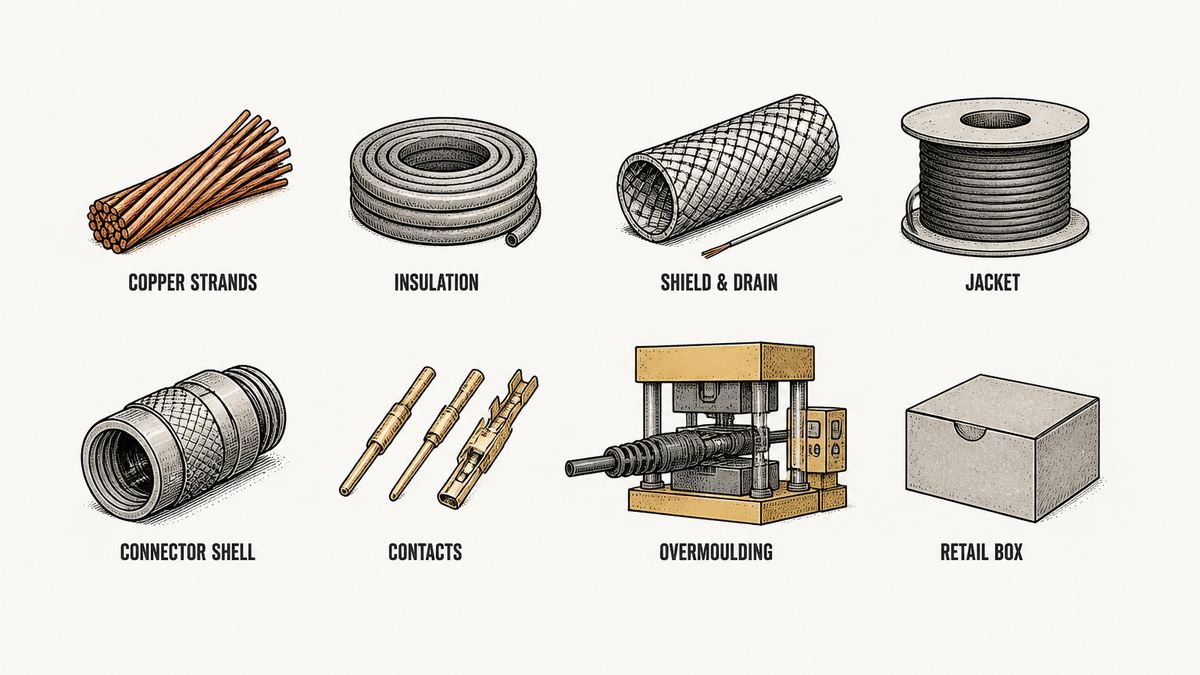
One habit makes this manageable. Ask for the quotation split into material, connector, assembly, testing and packing, with the conductor weight inside the material line. You will not get a clean split from every factory and you do not need one. You need enough of a split that a cheaper price can be explained. When a second quote comes in well below the first, the split says which line moved — and a price that moved in the copper is a different offer from one that moved in the testing.
What Goes Wrong?
Four failures cover most cable complaints, and they are worth separating because only one of them is caught by looking at the outside of the product.
The joint at the plug breaks. This is the classic field failure and it is not caused by the customer being rough. Every bend of a cable works the joint where the stranded conductor meets the contact, and a plug whose overmould does not support the cable as it bends concentrates all of that movement into a very short length of metal. The symptom is a cable that only works when it is held at an angle, and it arrives after the customer has been using it for months. It is the failure you can predict from a drawing, and the one you can test with thirty bends at your desk on a sample — a cheap jig or even a pair of pliers and patience will do, and you are looking for the overmould turning pale or splitting where the cable enters it.
A flattened or kinked section. Inside the jacket, the conductors have a natural bending radius, and a cable forced below it creases. A crease does not always look bad from outside, but inside it can leave the shield crushed against a conductor or a strand broken. On a cable that then fails, the crease is usually the place to look. It is also the reason the packing method matters: a cable folded tightly to fit a small box can arrive creased before the customer has done anything.
A contact goes dark and stops conducting. Plating thin enough, heat from a current the cable was never designed for, and a little moisture are enough. The customer sees a cable that charges intermittently and blames the device. The cause is the plating line in the quotation, which is the line nobody keeps.
The cable that is simply too light for its length. Nothing is damaged and nothing is broken. The cable charges slowly, and because charging is negotiated between the charger and the device, a light conductor means the negotiation settles at a low level and stays there. This is the failure with the worst commercial outcome in this category, because it produces complaints and reviews without producing a return. The customer keeps using it and keeps being annoyed by it.
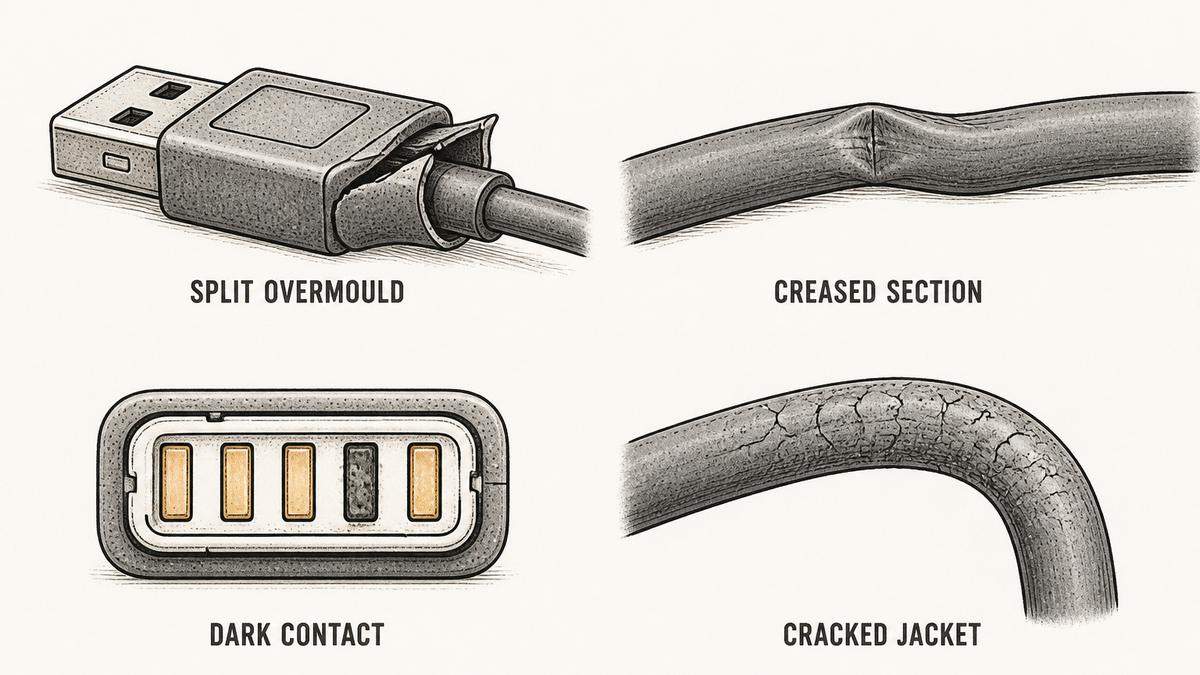
The pattern in all four is that the failure is decided at the drawing stage and shows up at the customer. That is why the sample test below is worth the twenty minutes it takes, and why it is more valuable on a cable than it is on almost any other product in this price range.
How Do You Check a Manufacturer Before You Commit?
Start with the supply chain, because a cable factory is an assembly operation surrounded by bought-in parts.
Ask who makes the conductor. A serious cable operation knows the strand supplier, or draws its own. A trader buys finished cable and moulds plugs onto it. Both are legitimate businesses; only one of them can change the conductor for you, and only one of them can tell you what the conductor actually is.
Ask which connector they use, and for the part number. Then ask for the certification for that connector, and for the list of lab locations the cable's own test data came from. If none of it exists, that is your answer, and it is a better answer than a vague assurance.
Ask for the Test ID and which model it covers. The number is what makes the claim checkable. The model matters more than the number, because a claim is attached to the sample that was tested. Sourcing a Bluetooth speaker from China runs the same logic on a product where the bought-in parts are the whole product, and it is a useful comparison if electronics is new to you.
Ask for the conductor weight and the rating per length. One line per length in the range, not one line for the range. Then ask what the factory does when a length is added later.
Then test a sample yourself. Five things, all of them cheap:
- Cut one open and weigh the copper. A fixed length, stripped of jacket, on a kitchen scale. Compare it with a cable you already trust. This is the one test that cannot be talked around, because the number does not care what anyone says.
- Bend the plug joint thirty times and look for the overmould going pale or splitting where the cable enters. Then bend it the other way, because a strain relief that only survives one direction is not a strain relief.
- Charge a real device and time it against a cable you trust. Same charger, same device, same starting charge level. This is the test that catches a light conductor, and it takes ten minutes.
- Wobble the plug in the socket. It should seat firmly with no sideways movement. Movement means the shell dimensions are wrong, and a loose plug damages the device socket — which is the one failure a customer will never forgive a cable for.
- Weigh the whole cable. At the same length, the heavier cable nearly always has more copper. It is not a measurement, it is a quick filter, and it costs nothing.
Then turn the answers into an inspection plan, because a sample you tested and a shipment you did not are two different things. The usual structure applies: a first article inspection on the first production piece, a sampling plan sized from the AQL table rather than from a feeling, and a the check on an usb cable before the cartons are sealed. On a cable, three things belong in that plan specifically: the conductor weight, the bend test on the plug joint, and a charging time measured against a reference cable. Those three catch the failures that photographs cannot show, and they are quick enough to run on a sample of a shipment rather than on one piece.
One more piece of paper is worth having before the first order. If the cable carries your own brand, the specification sheet should hold the conductor figures, the rating, the length, the connector part number and the contact finish, written as numbers rather than grade names. the specification sheet for an usb cable sets out the same exercise for a general product, and the cable version is easier than most because nearly every line on it is a figure.
Where Does a Cheap Quotation Get Its Money Back?
A cable is a good place to hide a saving, because the two things that decide performance are both invisible. The eight lines below are the ones that get trimmed, roughly in the order they get trimmed first.
- Fewer or finer strands in the conductor. The saving is real metal, and the cable still works on a phone charger, so nothing in the first thirty days gives it away.
- The shield and drain removed. Invisible, saves metal and assembly, and only shows up when the cable is asked to carry data at speed rather than current.
- A cheaper insulation compound. Shows up as a cable that runs warmer under the same load and as a harder, less forgiving feel.
- A thinner jacket, or a cheaper compound. Shows up months later as stiffness or as a fine network of cracks along the bend.
- An uncertified connector. The single largest invisible saving, because the connector is a bought-in part whose cost sits entirely inside the cable.
- A thinner plating layer on the contacts. Cheap now, and expensive at the customer's desk in a year.
- Faster assembly and no in-line test. The joints get less attention and nothing gets checked, so a small share of the shipment becomes returns.
- A plainer retail box and a folded cable. A box that is honest about being plain is fine. A cable folded smaller than its bending radius to fit a cheaper carton is not, and it is the one saving on this list that the customer can see the moment the parcel is opened.
The useful way to use this list is not to guard against it feature by feature. It is to ask each of the two or three factories you are considering to quote the same specification with the lines written out, and then compare the answers to the lines. Two quotes for “a USB-C cable” are not a comparison. Two quotes that both state the conductor weight, the rating, the connector part number and whether the shipment is tested per unit are a comparison, and the cheaper one is then cheap for a reason you can read.
Frequently Asked Questions
How can I tell whether a sample cable is really a fast charging cable?
By the conductor, not by the plug. Strip a fixed length, weigh the copper, and compare it with a cable you already trust at the same length. Then charge a real device with the same charger and time it against that trusted cable. A cable with a light conductor will still charge, it will simply settle at a lower power level, so the only reliable signal is a measured charge time plus the metal weight. If the factory gives you a rating in watts or amps and cannot give you the conductor figure behind it, treat the rating as a marketing line.
What is a USB-IF Test ID, and what should I ask for?
It is the identity number the testing programme uses to track a tested product. Ask for the Test ID, ask which model it was issued for, and ask which authorised lab produced the test data. Then check that the model on the Test ID is the model you are being quoted, because a certification is attached to the product that was tested rather than to a factory or a brand.
Can a factory just print the USB logo on the box?
No, and the rule is worth understanding. Products that pass the testing programme are added to the register and get the right to license the logos, and using the logos also requires a current trademark licence agreement on file with the forum. A factory with a certified product but no licence cannot put the mark on your packaging. If a supplier offers the logo without being able to name the product in the register, that is a mismatch to resolve before you print anything.
Do I need a different cable for different devices?
You need the right two things: the connector the device takes, and a cable rating that covers what the device wants. Charging and data are also separate jobs. A power-only build carries the current cores plus the small pair used for the handshake, while a data build carries every pair, usually with a shield and a drain wire. They can wear the same jacket and the same plug, so if you are sourcing a charging cable, say so, and make sure your specification is not describing a data cable by accident.
Does a longer cable charge more slowly?
At the same conductor size, yes. The resistance of the wire adds up with length, so a build that is comfortable at one metre is doing more work at two metres. That does not mean long cables are bad, it means the conductor size and the length belong on the same line of the order. If your range includes three lengths, write three lines rather than one, or the longest cable in the range becomes the one that generates the complaints.
What should the specification sheet say?
The bare minimum is the connector type and its part number, the conductor size and strand count per core, the cable's rating, the length, the jacket and insulation materials, the shield arrangement, the finish on the contacts, the retail packing, and which tests will be run per unit or per shipment. Written as figures rather than grade names, that is a document two factories can both quote against, and it is the only version of a cable specification that makes two quotations comparable.
Send the conductor weight and the rating — not just “USB-C cable”
Tell us the device your cable is sold for, the length range, and the connector on each end, and then the lines that decide whether the cable performs: the conductor size and strand count per core, the cable's rating, the shield arrangement, the jacket and insulation materials, the connector part number with the certification behind it, the Test ID and the model it covers, the plating on the contacts, the assembly and in-line testing, the retail packing, and the market you are shipping into. Add your target volume and whether the artwork is finished. Those answers settle the metal content, the plugs and the claim before a price means anything. We will come back with the factories whose conductor, connector sourcing and in-line testing match your product, the specification written as figures rather than grade names, the material, connector, assembly and testing lines shown separately so quotations become comparable, a sampling plan built around weighing copper and bending a plug joint rather than photographing a box, and a clear statement of which supplier owns which failure on what you are buying.
Request a USB Cable Sourcing Quote
Questions & Comments
We read every one and reply within 24 hoursSourcing charging or data cables and getting quotations that all say “USB-C cable”? Send the conductor size and strand count per core, the cable's rating, the length range, the connector part number, and the Test ID with the model it covers, and we can usually say which lines are missing from them. If cables have already arrived that charge slowly, fail at the plug after a few months, or turn up with a contact that has gone dark, describe what you saw and roughly how long the cable lasted, because the symptom usually says whether it was the conductor, the joint behind the contacts, the plating or the length.