
Puzzle Manufacturer: Sourcing Jigsaw Puzzles From China
 ·
Updated October 12, 2026
·
19 min read
A jigsaw puzzle is a picture glued to a board and cut by a die, and of those three things the picture is the only one you supply. The two the factory decides — how the board is laminated and how the die cuts it — are the two that decide whether the puzzle is a product or a complaint, and neither of them is visible in a photograph of a finished box. There is a second thing that makes this category different from most of what you can source: a puzzle aimed at young children carries a set of safety rules into the United States with it, one of those rules names puzzles on its own list, and the age grading printed on the box is the claim that decides which of those rules you have to meet. This guide covers the four parts you are actually buying, why the board decides whether the puzzle holds together, what the die decides, how the piece count is really established, which children's safety rules apply and who they bind, how the price is built, what goes wrong, how to check a manufacturer, and where a cheap quotation gets its money back.
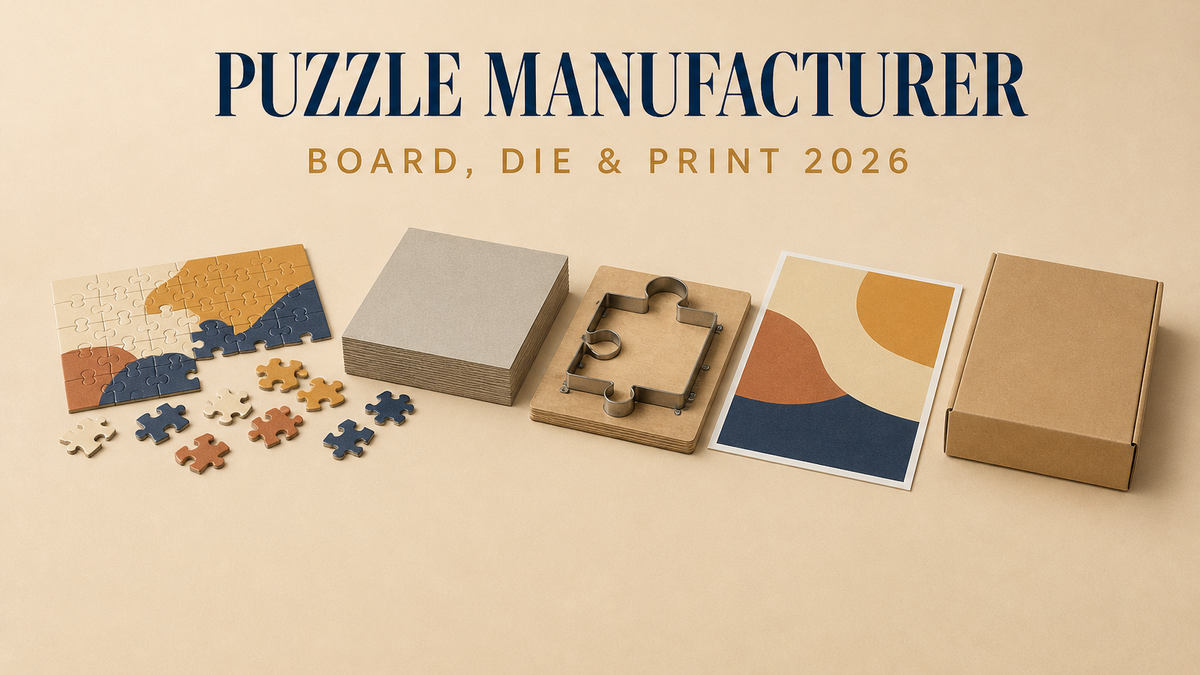
What to Pin Down First, by What You Are Making
| If you are making | Pin this down first | Because |
|---|---|---|
| A puzzle for adults or as a gift | The board build and the cut quality, before the artwork resolution | Adults notice a torn cut edge and a piece that will not sit flat. The picture is what sells the first unit, and the board and the die are what sell the second. |
| A puzzle that will be labelled for children under three | The piece size against the small parts test, before anything else | Puzzles aimed at that age group are named in the small parts rule, so a piece that will fit the test cylinder fails regardless of how good the board is. |
| Anything sold into the United States as a toy | Which safety standard the toy has to meet, and who certifies it | The mandatory toy standard in the US is a specific published standard, and the certificate that goes with the shipment has to be based on testing rather than on the factory's own word. |
| A puzzle with a printed, coated surface | The surface coating and what is in it | A printed surface on a children's article is subject to a separate rule about what may be in the coating. It is a materials question, not a printing-quality one. |
| A short run for a promotion or a brand | The die and the setup as separate one-off figures | A cutting die is a tool that does not scale with quantity. On a small run it is the largest number on the invoice, and a quotation that hides it cannot be compared with anything. |
| A quotation that looks cheap | The board thickness, the board construction and the die's condition | Three lines that change the feel of every piece in the box and none of which can be seen from outside it. |
What Are You Actually Buying? Four Parts, and Only One Is the Picture
Four, and the split of responsibility is unusual. You supply the image; the factory supplies the board it is glued to, the die that cuts it and the box it goes in. That means the two parts a customer judges with their hands are both the factory's, and your artwork only decides whether they pick the box up in the first place.
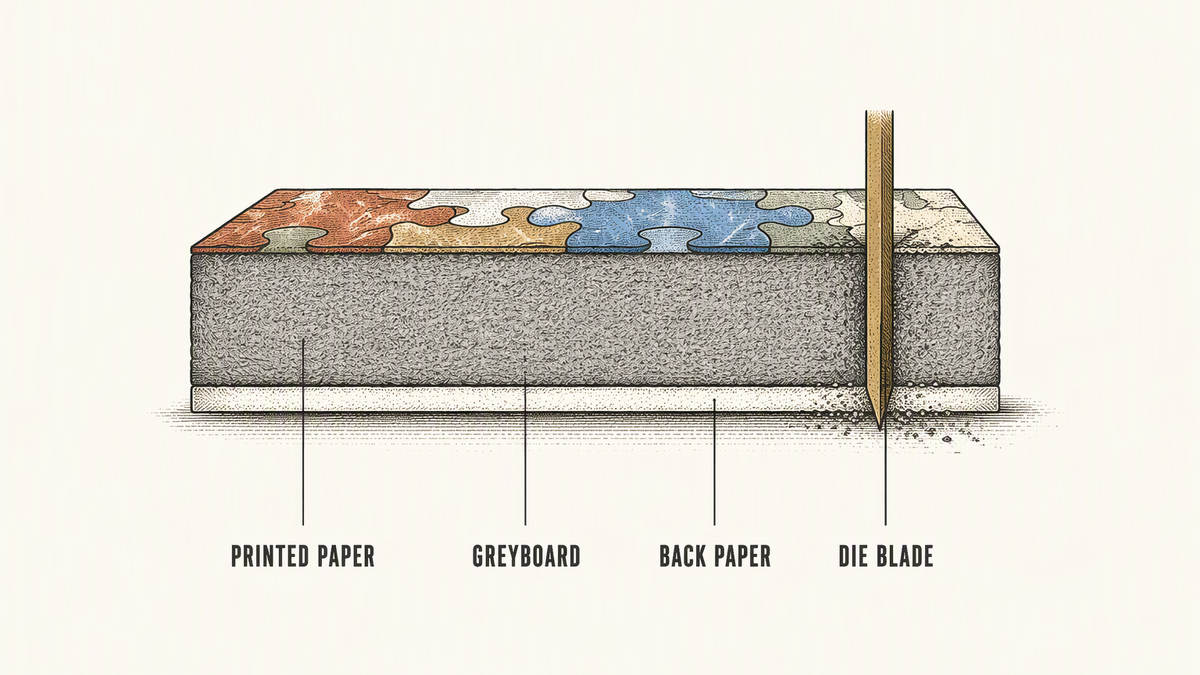
The printed sheet is your artwork, printed onto paper that will then be glued to the board. The paper matters as much as the printing: a heavier paper takes the glue and the cut better, and a thin one shows the board texture through the ink. Ask what the sheet is and what it weighs, not only what the printing method is.
The board is the middle layer, and it is where the feel of the puzzle comes from. Thicker board means pieces that sit up in the hand and survive being assembled repeatedly; thinner board means a cheaper puzzle that dents at the cut edges and feels flimsy the moment somebody picks up a piece. Ask for the board thickness as a figure, and ask whether it is the same board the sample was made from.
The back paper is the layer that surprises buyers. It is not there for looks; a board carrying a printed sheet on one face only is unbalanced, and an unbalanced board curls. This is the same principle you meet in any laminated panel, and it is the reason a puzzle that looked flat at the factory can arrive bowed: the back is the cheapest place to save money and the saving shows up as a shape rather than a defect.
The die is the fourth part and the one that decides whether the puzzle is pleasant to do. It is a tool, not a consumable, and it is the only part of this product that wears out in a way the customer can feel. The next section but one is about it, because cut quality is the single most common reason a jigsaw gets a bad review.
Why Does the Board Decide Whether the Puzzle Holds Together?
Because the puzzle is a laminate, and a laminate fails at its interface. The printed sheet is glued to the board, the board is glued to the back sheet, and the failure everybody recognises — a piece where the picture layer lifts and bubbles away from the board — happens at one of those two glues rather than inside the materials. Nothing about the artwork or the printing prevents it.
Delamination is the failure to design against, and it starts small. A single piece with a lifted corner is enough to convince a buyer that the whole puzzle is badly made, and it usually appears after the puzzle has been used once or twice rather than out of the box. It comes from glue applied unevenly, from a board whose surface is not sealed, or from a board and a paper that move differently when the humidity changes — which is the same reason the back layer exists at all.
Balance is what keeps the puzzle flat, and it is invisible. A board with a printed face and an unprinted back is a board under permanent tension, and it will curl towards the colder, drier side. A board with a paper back of a comparable weight is balanced and stays flat. You cannot see the difference on a finished box, and you cannot feel it through the lid, but you can see it the moment you open a puzzle in winter and the pieces will not lie flat on a table.
Board thickness is a feel decision, and it is also a cut decision. A thicker board is stiffer, which helps flatness, and it gives the die more material to cut cleanly. Push thickness down to save cost and the pieces become floppy, the cut edges dent against the table, and the die has to work harder for the same result. Ask for the figure rather than the grade name, because grade names are local and figures are not.
And the board is where a cheap quotation hides the most money. The image, the box and the cutting are all visible in some form. The board is inside the product, its thickness is a single number, and a change from one board to a slightly thinner one at the same colour produces a puzzle that looks identical on the shelf and feels different in the hand. Weighing a single finished piece is the fastest way to catch it, and it is a test you can run yourself on a sample against a production unit.
What Does the Die Decide?
Everything the customer feels with their fingertips. The die is a set of thin steel blades bent into the jigsaw outline and set into a plywood base, and when it is pressed through the printed board it separates the pieces. A sharp die in good condition cuts the paper cleanly and gives a piece with crisp edges. A blunt die crushes and tears its way through, and the result is a puzzle that sheds paper fibres on the table and has pieces whose edges look furry.
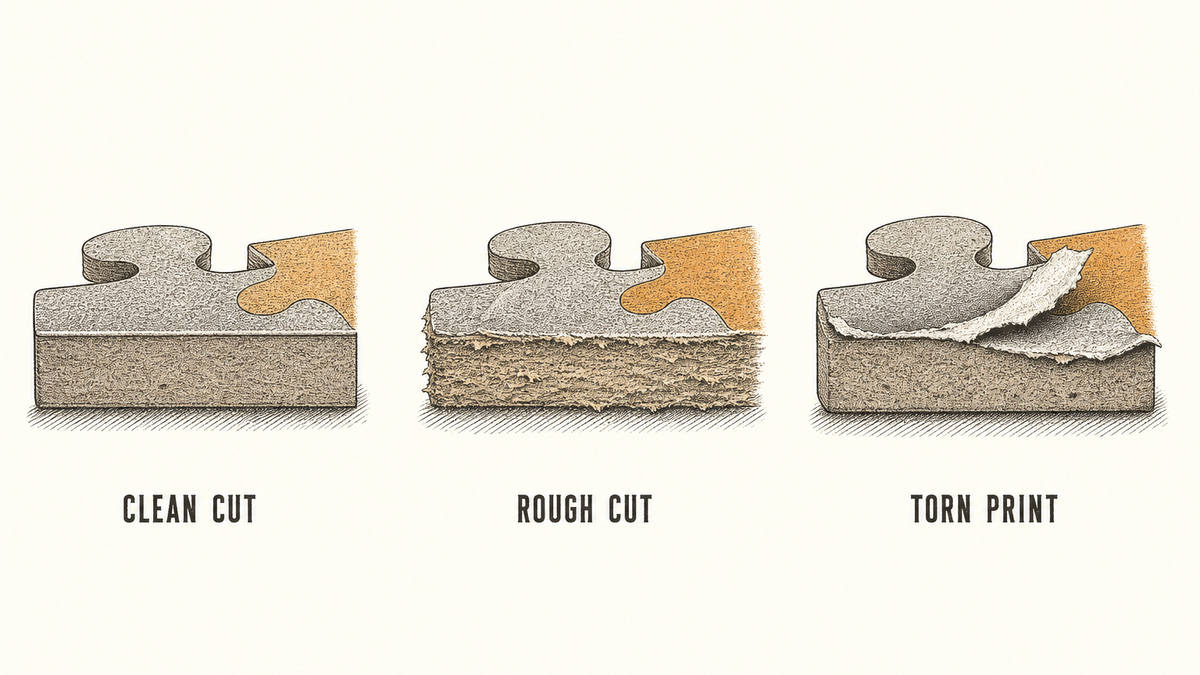
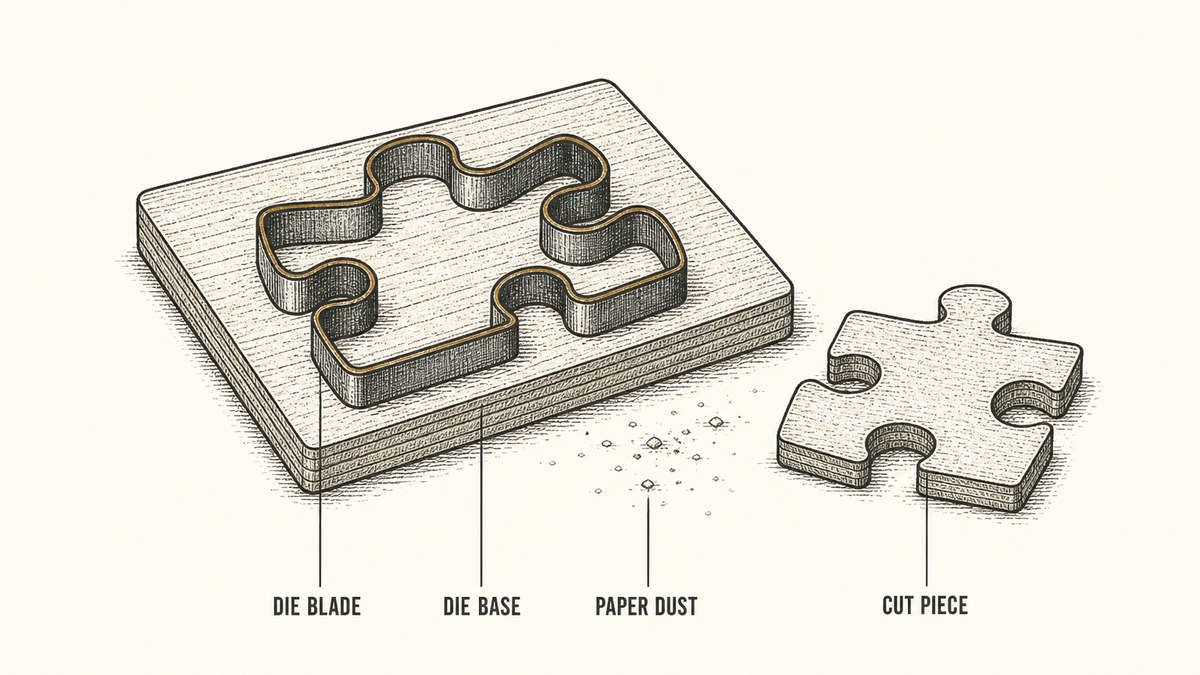
A die has a life, and it is measured in impressions. Every press compresses the blade edge a little, and at some point the edge is rounded enough to tear rather than slice. So the useful questions are how many puzzles the die is rated for, how the factory tracks its condition, and what happens when it wears — because a die is expensive to replace and a supplier under cost pressure has every reason to keep running a blunt one. Ask for the rated life as a number, and ask who pays for a replacement in the middle of your order.
Cut quality and fit are two different things, and both are decided by the die. A clean cut gives crisp edges; the fit decides whether the pieces hold together when somebody picks the puzzle up. Both come from the same tool, and both are judged by the same test: assemble a section, lift it, and see whether it holds and whether the seams are tight. A puzzle where the seams are loose enough to see through is a puzzle that will not stay assembled on a board.
“Clean cut” and “dusty” are not marketing words, they are the two observable outcomes. Run a finger along a cut edge on a sample. A clean cut feels like the edge of a card. A rough cut feels slightly furry and leaves a visible grey line of paper fibre. A badly worn die leaves the printed surface torn along the cut line, which shows up worst on dark, solid printed areas — so if your artwork has large areas of a single strong colour, you have made the die's condition far easier to see, and you should say so when you order.
Then there is the tooling arrangement, which is a commercial question rather than a technical one. A cutting die for your design is a one-off cost, and on a small run it is often the largest single line on the invoice. Ask who owns the die while it is in use, what happens to it if you move the order elsewhere, and whether it is stored for a reprint. A supplier who will not answer those three questions is a supplier whose tooling you do not control, which is a problem the second time you order.The same discipline applies to any new tooling — check the tool on a sample run before it runs your production.
How Do You Know the Box Has the Right Number of Pieces?
You ask, because the number printed on the box is established by weighing rather than by counting, and that makes piece-count accuracy a statistical outcome rather than a guarantee. This is one of the few places in this product where the honest answer from a factory is more useful than an impressive one.
How the count is actually done. A finished run of pieces comes off the die as a sheet, and counting ten thousand small irregular shapes by hand is not something a factory does. The usual method is to weigh a known quantity of pieces, establish a weight per piece, and then batch by weight. That means the count is only as accurate as the weight estimate, and that a run can end up a piece or two either side of the number on the lid. Ask which method the factory uses, and ask what tolerance they work to.
Why it matters more than it looks. A single missing piece turns a finished product into a return, and the reason is that the customer cannot complete the picture. There is no partial use for a jigsaw. So the piece count is not a detail that can be managed by apology, and the practical consequence is that the count has to be verified somewhere in the process rather than assumed. Ask how the factory checks, and ask for the check to be part of the inspection plan rather than a promise: opening a sample of finished boxes and counting them is slow, and it is the only check that catches the problem before a customer does.
The number on the box is a claim you are making. If the lid says a thousand pieces, the customer will count if the puzzle does not work, and a short count is a straightforward and undeniable failure. That makes this a line worth writing into the specification as a figure with a tolerance, in the same way you would write a weight or a dimension, and worth confirming with your own count on a sample of finished boxes.Have the rest of the inspection done against your own list, with the sample size taken from the batch rather than from habit.
Which Children's Safety Rules Does a Puzzle Carry Into the United States?
Three sets, at least, and the decision that puts you into one set or another is the age grading you print on the box. That single line of artwork is not marketing — it is the claim that decides which safety requirements your puzzle has to meet, and it is worth understanding before the artwork is finalised rather than after.
The mandatory toy standard. In the United States the toy safety standard sits in 16 CFR Part 1250 and it does something very specific: the rule requires that each toy comply with all applicable provisions of a published industry standard, incorporated by reference into the regulation. Read that as a buyer and it means the answer to “what standard do I have to meet” is not a matter of opinion and not a phrase a supplier can apply to themselves. There is a named standard, and the toy has to meet it.
The small parts rule, which names puzzles. A second rule decides whether pieces are small enough to be a hazard. In 16 CFR Part 1501, the purpose section explains that a toy or other article intended for children under three which presents a choking, aspiration or ingestion hazard because of small parts is classified as a banned hazardous substance, and the scope section then lists what is covered. The list is explicit, and among the toys it names are preschool toys, games and puzzles intended for use by children under three. A puzzle is not an edge case here; it is one of the products the rule was written with in mind.
How the test works, in plain terms. The size requirement says that an article subject to the rule must not be small enough to fit entirely within a test cylinder of the dimensions set out in the rule, and the procedure says to place the article into the cylinder without compressing it — if it fits entirely, in any orientation, it fails. If it does not fit, the article is then subjected to the use and abuse tests of the hazardous substances regulations, excluding the bite tests, and any components that have come off as a result are placed into the cylinder one at a time. If any of them fits, the article fails. For a puzzle the implication is direct: a piece that fits the cylinder is a failure, and a piece that can be broken or detached during the abuse sequence and then fits the cylinder is also a failure, even if the piece as supplied was large enough.
The boundary, which is the part buyers miss. The same rule says it does not apply to toys or articles solely intended for use by children three years of age or older. So the age grading is the pivot. Labelling a puzzle for children under three brings it inside the small parts rule and turns piece size into a hard constraint on the die; labelling it three-plus keeps it outside that rule and moves the question to the general toy standard instead. Neither choice is better, and the mistake is to leave the decision unmade and let whatever the printer types become the claim. Decide the age grading deliberately, put it in the specification, and make sure the artwork and the packaging both say the same thing.
And a rule about what is in the surface. The printed face of a puzzle is a coating on an article intended for children, and coatings are regulated separately for what may be in them under 16 CFR Part 1303. This is a materials question rather than a printing one, and it is answered by how the ink and the varnish are specified rather than by how they look. Ask the factory what the coating is, and ask your testing partner which rule applies to your product and destination.
Then the certification route, which is where the responsibility lands. The mandatory standard is given force through the Consumer Product Safety Improvement Act, and the practical consequence for an importer is that the product needs to be supported by certification based on testing rather than by a supplier's assurance. I am deliberately not going to state the mechanics from memory, because the details of who may test, what the certificate must contain and when it must be produced are exactly the things worth getting right first time. Confirm the current requirement, the accredited testing route and the certificate content with a testing house or a customs broker who handles children's products, on the same basis as any other toy safety testing for the US and EU, and build the cost of doing that into the project before you commit to the artwork.
The record worth keeping. Because the age grading is your claim and the piece size follows from the die, the useful file for a puzzle product is short: the age grading as it appears on the box, the piece size measured against the rule's criteria, the standard the product was tested to, the name of whoever tested it, and the date. That is a page you can produce later, and the alternative — trying to reconstruct why a puzzle was graded the way it was, two years after the die was made — is not a page anybody enjoys writing.
How Is the Price Built?
Eight lines, and the one that dominates a first order is the one that does not exist at all on the second. Cutting dies are tools, and tools are paid for once.
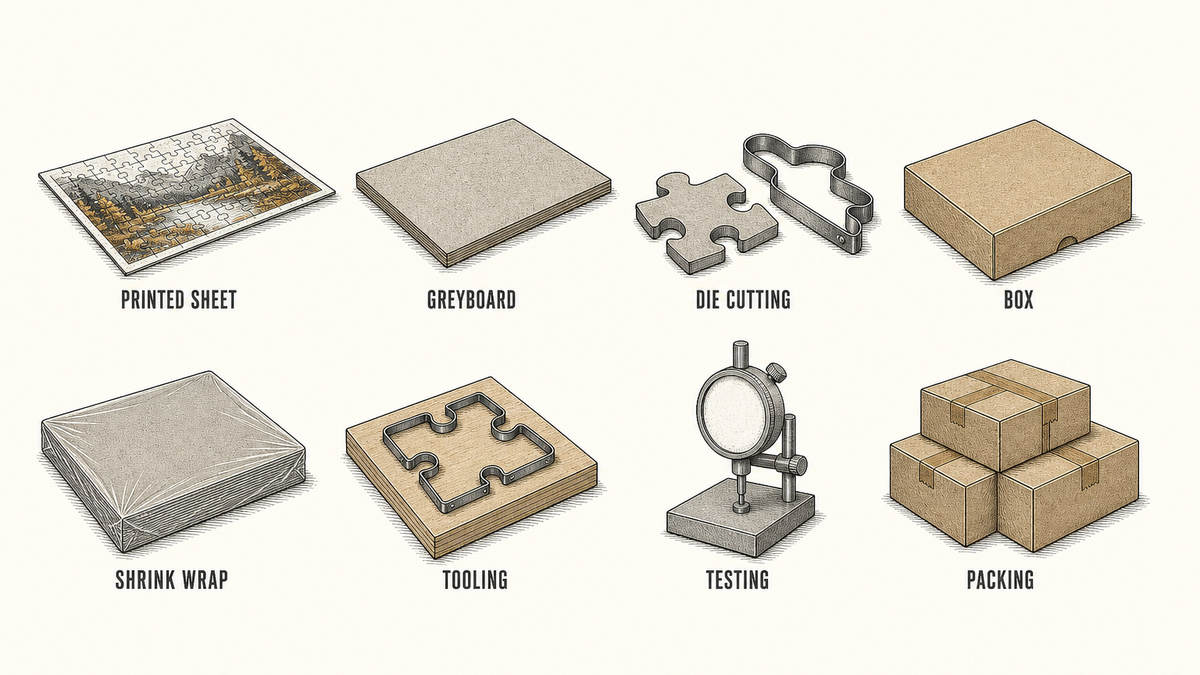
The printed sheet. Priced by the paper and by the printing, and it scales with the size of the puzzle rather than the piece count. A larger puzzle with the same number of pieces uses more paper, which is worth remembering when you compare a quotation for a big easy puzzle with a quotation for a small hard one.
The greyboard. Priced by thickness and by area, and it is the cheapest line to reduce and the most expensive one to have reduced. This is the line to ask for as a figure with the same answer as the sample.
The die cutting. An operation rather than a component: press time, labour and the wear on the tool. It is also where the die's condition is quietly paid for, because a blunt die runs faster than a sharp one in the short term and produces the failures that come back later.
The box. A rigid or folding box, printed, and on a gift or promotional puzzle it is very often the most visible part of the product. Ask for the box separately: it is a different manufacturing process from the puzzle, frequently made by a different supplier, and the two are quoted together so often that buyers stop separating them.
The shrink wrap and the packing. Film, inserts, and the carton the boxes ship in. A puzzle is a dense, flat product, so a container reaches its weight limit before it runs out of space — the relationship between the two is set out in how the volumetric weight of a puzzle is worked out, and the point at which sharing a container stops making sense is calculated rather than assumed, on the same basis as full or shared container for a puzzle.
The tooling. The cutting die, and on a first order usually the largest single number. It does not scale with quantity, so a cheap unit price and a cheap first order are often two different quotations. Ask who owns the die and what happens to it if you move the order, because that answer decides what your second order costs.
The testing. Charged per product rather than per unit, and it does not get cheaper because the order is small. On a children's product this is not an optional line, and a quotation that does not mention it is a quotation that has left something out rather than one that has found a saving.
Two notes belong to the order rather than the product. Ask for the tooling and the setup as separate figures, because that is the only way a first order and a reprint can be compared. And ask which lines are per unit and which are per design, because a range of three puzzles sharing one board thickness and one box size carries three dies and one printing setup, which changes what a range costs compared with three separate products.
What Goes Wrong?
Four failures, and the one thing they have in common is that none of them can be seen in a photograph of a sealed box. Two of them happen before the puzzle is opened, and two happen the first time somebody uses it.
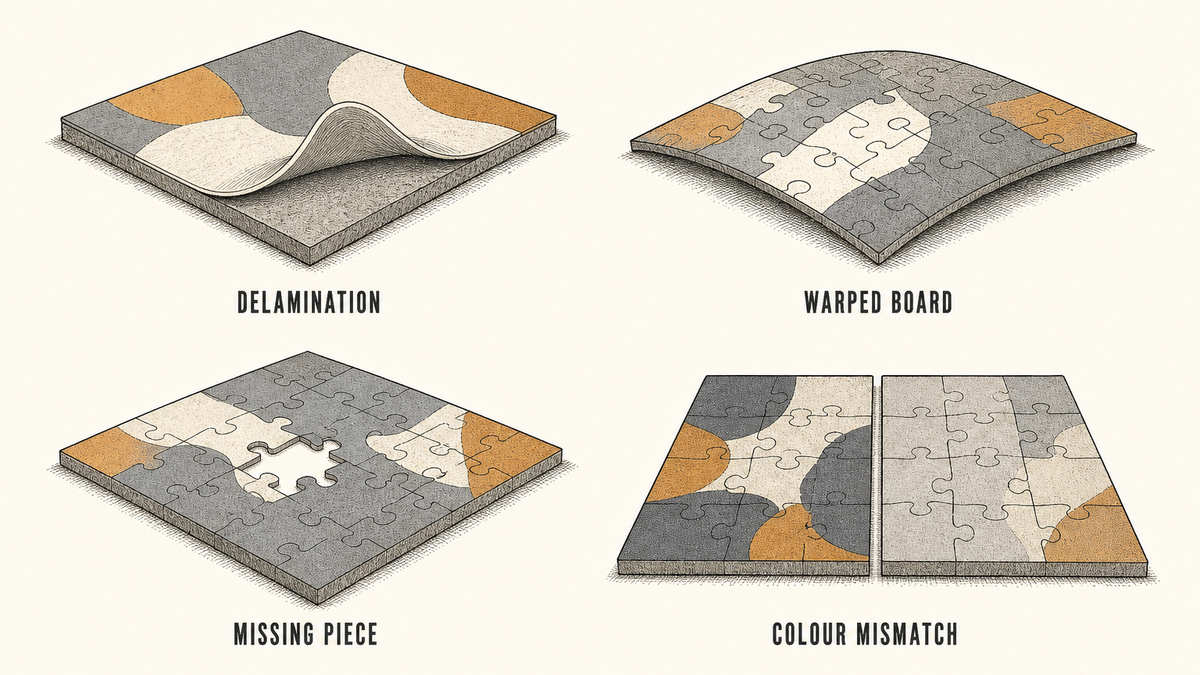
A lifted print. The paper layer bubbles or peels away from the board, usually at a corner and usually after the puzzle has been assembled once. It is a glue or balance problem, and it is the failure that does the most damage to a brand because it makes the whole product look cheap in a way the customer can hold in one hand. The defence is board quality and a back layer, both of which are specification items rather than inspection items.
A bowed board. The puzzle arrives curved, and the pieces will not lie flat on a table. This is the unbalanced laminate described earlier, and it is often blamed on shipping when the cause is the construction. The practical test is cheap: leave a sample puzzle out of its box in a dry, warm room for a few days and see whether it stays flat. A construction that curls there will curl in a customer's house.
A missing piece. The count was wrong, and because the count is established by weight, the cause is usually the counting method rather than carelessness. The customer cannot complete the picture and the whole unit becomes a refund. Nothing about the rest of the product matters once this has happened, which is why the check has to happen before the boxes are sealed rather than in the complaint.
A colour that does not match across sheets. This is the failure specific to this product and the one buyers least expect. Puzzles are printed in sheets, a large run can span two print passes, and two passes of the same image can differ in tone by an amount that nobody notices on a single sheet and everybody notices the moment pieces from two sheets sit next to each other in an assembled picture. The visible symptom is a faint vertical band down the finished puzzle. Ask how a run is kept within one print pass, and ask what the factory does if it cannot be — because the answer decides whether your large order is one product or two.
How Do You Check a Manufacturer Before You Commit?
Start with the question that reveals the shape of the company: who makes the board, who prints the sheet, and who makes the die? A puzzle factory usually laminates and cuts, and buys in the printed sheets, the board and often the die as well. A supplier who can name all three is one who knows what is inside their own product; one who claims to make everything has told you less. The general method is in telling a puzzle maker from a reseller. Where a supplier sits matters less than what they make, and the ground each of China's two toy clusters is good at is set out in sourcing toys in Yiwu or Shantou.
Ask for the board as two numbers. The thickness and whether there is a back layer. A supplier who answers “good quality board” has answered a different question, and this is the single line where a cheap quotation makes most of its money.
Ask about the die as a tool rather than a service. Its rated life, how its condition is tracked, who owns it, and what happens to it if you move the order. A supplier who can answer has thought about their tooling; one who cannot is planning to run whatever is in the press.
Ask how the piece count is established and verified. Not whether it is right — how they know. The honest answers are methods, and a supplier who offers a method has given you something you can put in an inspection plan.
Ask for the age grading in writing, and check it against the artwork. The age printed on the box is the claim that decides which safety requirements apply, and it needs to be a decision rather than a default. If your product is intended for children, the certification route belongs in the same conversation, and where a supplier offers a management-system or factory certificate, check it against the issuer's own record rather than the file you were sent, using the approach in the puzzle certificate, checked in the certifier's own register.
Then test the sample with your hands. Weigh one piece and use it as your reference for the whole order. Run a finger along a cut edge and look for grey fibre. Assemble a section, lift it, and see whether it holds and whether the seams are tight. Leave the puzzle out in a dry room and check it for curl. Count a box. Measure one piece against the rule's test criteria if the product is graded for young children. Every one of those tests costs minutes and finds something a specification sheet cannot.
Inspect before it ships, and write the plan in figures. What to check is the board thickness, the cut edges on sampled pieces, the piece count on opened boxes, the assembled fit, the box print and board, and the age grading on both the box and the artwork. The plan is written the same way as any other and recorded as a product specification sheet the factory works from, then confirmed against the carton marking that lets a receiving warehouse identify the goods without opening them, covered in the carton marking on a puzzle. And if the product is going into the United States as a children's article, confirm the certification and entry requirements with a using a customs broker before the boxes are printed, not after.
Where Does a Cheap Quotation Get Its Money Back?
A cheap puzzle quotation is usually a real price for a thinner board, no back layer and a die that should have been replaced a hundred thousand impressions ago. Eight lines go missing, and the customer finds all of them.
- The board thickness. A thinner board at the same look, producing floppy pieces, dented cut edges and a puzzle that feels disposable. It is the largest material line and the easiest to move quietly.
- The back layer. Downgraded to a lighter paper, or left off where nobody will see it. The saving is real, the board is now unbalanced, and the bill arrives as a puzzle that will not lie flat.
- The die. A blunt die kept in service, because replacing one is expensive and tearing paper costs the supplier nothing today. The result is dust on the table, furry edges and torn print on dark areas.
- The piece count. A weight estimate left unchecked, so the odd box goes out short. This is the cheapest line to leave alone and the most expensive one to get wrong, because a short count is a refund rather than a complaint.
- The box. Thinner board, a smaller print area and a plainer finish. On a gift or promotional puzzle the box is the product the buyer sees first, so this is where the saving is most visible and it is usually made in a different factory from the puzzle.
- The testing. Skipped, or done once on a prototype rather than per product. It is a per-design cost, it does not scale down with a small order, and on a children's product the consequence is not a complaint but a border.
- The age grading. Left to whatever the printer sets, so the box either claims an age the product does not meet or avoids claiming one at all. Either way the claim on the box is now doing work nobody intended it to do.
- The shrink wrap and packing. Thinner film, no inner protection and a carton chosen to fit a pallet rather than to protect a box. Puzzles are flat and dense, so a carton that is under-specified fails at the edges where the picture is.
Close those eight lines on the enquiry rather than in a complaint: the board thickness with a back layer specified, the sheet paper and the printing method, the die's rated life and condition tracking with the ownership arrangement, the piece count as a figure with a tolerance and the method used to check it, the box by board and print, the surface coating by what is in it, the age grading decided deliberately and carried on both box and artwork, and the tests that will be run per design.
One closing point about this category. A puzzle is a low-price product with an unusually high standard of finish, because the customer handles every single piece and can feel a torn edge, a floppy board, a lifted print and a missing piece without any tool at all. That makes it a product where the two decisions worth the most attention are the two that never appear in a photograph: how the board was constructed, and how sharp the tool was on the day it was cut.
Frequently Asked Questions
What is the minimum order for a custom jigsaw puzzle?
There is no single figure, because the real constraint is the cutting die rather than the factory. A die is a one-off tool that does not scale with quantity, so a small run carries the whole tooling cost on a small number of units and the unit price rises steeply. Ask for the tooling and the setup as separate figures from the per-unit price, and then ask what quantity makes the tool cost small. That question gives you a real answer, where asking for a minimum order quantity gives you a number chosen to sound reasonable.
What is the difference between a clean cut and a dusty cut?
A clean cut is made by a sharp blade that separates the printed paper and the board without tearing either. The edge feels like the edge of a card, the seam is tight and there is no debris. A dusty cut is made by a blade whose edge has rounded, so it crushes its way through: the edge feels furry, a thin grey line of paper fibre sits along the cut, and on dark solid printed areas the surface tears. Nothing about the design causes it and nothing about the board prevents it — it is the condition of one tool, and the way to catch it is to run a finger along a cut edge on a sample rather than to look at a photograph.
Do I need a separate die for every puzzle design?
For a die-cut jigsaw, yes — the die defines the cut pattern, and that pattern is usually fixed to the artwork so the image sits correctly across the pieces. Two puzzles with the same piece count and the same cut layout can sometimes share a die if the design is built to allow it, which is worth asking about when you plan a range, because it is the difference between one tool and five. What you should never assume is that a die bought for one design can be re-used for a different one without the artwork being built around that cut from the start.
What age rating should I put on a puzzle?
Decide it deliberately, because in the United States the age grading is the claim that decides which safety requirements apply. The small parts rule names puzzles intended for children under three and sets a size test for them, and the same rule says it does not apply to articles solely intended for children three or older. Labelling for under-threes brings piece size into the design as a hard constraint on the die; labelling three-plus keeps the product outside that rule and shifts the question to the general toy standard. Neither is better, but leaving the decision unmade and letting the printer set whatever looks normal is how a product ends up with a claim on the box that nobody checked.
Why is the picture lifting off my puzzle pieces?
Because the puzzle is a laminate and the failure is at the glue line between the printed paper and the board. It comes from glue applied unevenly, from a board surface that was not prepared for it, or from a board that carries a printed face and an unprinted back and therefore moves differently on each side as the humidity changes. It almost always appears after the puzzle has been used once or twice rather than out of the box, which is why a sample that looked perfect in the factory can still produce complaints. The defence is a board specification with a back layer rather than an inspection at the end of the line.
How is the piece count of a jigsaw puzzle determined?
Usually by weight rather than by hand. A factory weighs a known number of pieces to establish a weight per piece, then batches finished pieces by weight, which is far faster than counting and means the count is only as accurate as that estimate. The practical consequence is that the number on the box is a statistic rather than a guarantee, so it belongs in the specification as a figure with a tolerance and in the inspection plan as something to check by opening sampled boxes and counting them. A short count is the one defect a customer can prove without any tools, and it makes the whole unit a refund.
Send the board build and the age grading — not just the artwork
Tell us what the puzzle has to feel like and who it is for, and then the lines that decide whether it works: the board by thickness with a back layer specified, the printed sheet by paper and printing method, the die's rated life and condition tracking with who owns the tool, the piece count as a figure with a tolerance and the method used to check it, the cut quality you will accept with the test that proves it, the box by board and print, the surface coating by what is in it, the age grading decided deliberately and carried on both the box and the artwork, the tests that will be run per design, and the market you are shipping into. Add your target volume and whether the artwork is finished. Those answers settle the board, the tool and the claim before a price means anything. We will come back with the factories whose board build, cutting condition and box supply match your product, the specification written as figures rather than grade names, the tooling, testing and unit costs shown separately so quotations become comparable, a sampling plan built around weighing a piece and running a finger along a cut edge rather than photographing a box, and a clear statement of which supplier owns which failure on what you are buying.
Request a Puzzle Sourcing Quote
Questions & Comments
We read every one and reply within 24 hoursSourcing jigsaw puzzles and getting quotations that all name the same piece count? Send the board thickness with a back layer specified, the piece count as a figure with its tolerance, and the age grading you intend to print on the box, and we can usually say which lines are missing from them. If puzzles have already arrived with a lifted print, a board that will not lie flat, furry cut edges or the odd box a piece short, describe what you saw and roughly when it appeared, because the symptom usually says whether it was the board build, the glue, the condition of the die or the counting method.