
Pet Toy Manufacturer Guide: Materials, Safety, Testing and Sourcing
 ·
Updated October 11, 2026
·
21 min read
A pet toy is the only product most buyers will ever import that has no safety standard of its own. The rules everyone quotes at you — the toy safety standard, the children's lead and phthalate limits — are written for toys for children. A dog toy is not a children's toy. So there is no net underneath your specification, and the specification is the whole product. That changes the order of work: you cannot start from the drawing, you have to start from how the toy will fail in a mouth that is stronger than a child's, and then choose the construction, the material and the tests that keep that failure small. This guide covers the four construction families and what each one fails at, how material choice follows the failure mode, what has to go into your own specification and testing plan, where the tooling money goes, what comes back as a claim, and where a cheap quotation takes its money back.
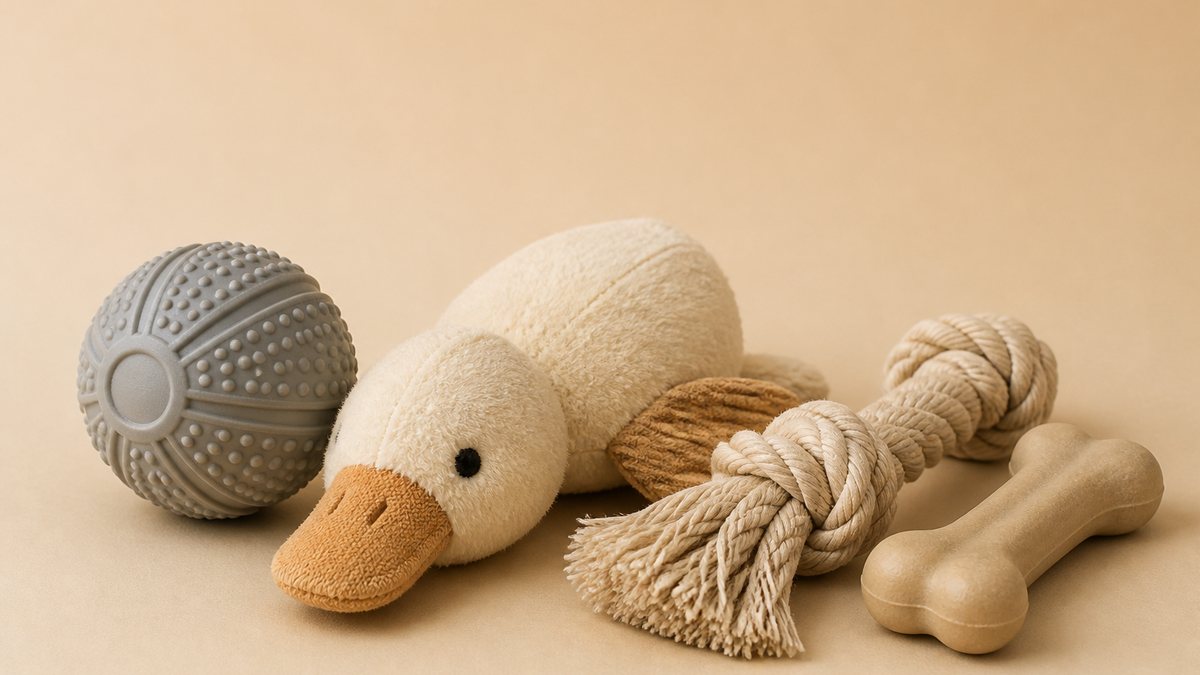
What Each Construction Family Actually Buys You
| If the toy is | The construction | What it fails at, and what that means for your spec |
|---|---|---|
| A chew toy that is meant to survive a mouth | Moulded rubber, TPR or nylon | Fails by tearing into pieces that can be swallowed. Spec the tear resistance, the wall thickness, and a piece size that cannot lodge. |
| A comfort or fetch toy that is allowed to be soft | Sewn plush with stuffing | Fails at the seam, and then lets the stuffing out. Spec the stitch type and count, the seam strength, and the stuffing containment. |
| A tug or fetch toy made from cord | Braided rope or knotted cord | Fails by unravelling into long strands that can be swallowed whole. Spec the end finish and the strand length after breakage. |
| A hard, long-lasting chew | Injection moulded nylon or hard plastic | Fails by splintering or by holding a sharp edge after it is scored. Spec the impact behaviour and the edges after wear. |
What Is a Pet Toy Manufacturer Actually Making?
A pet toy factory is almost never a toy factory in the way a children's toy factory is. The work is closer to soft goods, rubber moulding and rope work, and the four construction families are made by four different kinds of production line. Most suppliers do one or two of them well, which is why the first decision is not which factory to use but which family your product belongs to.
What you are buying splits into four things, and only the last one shows on a price sheet:
- The construction and the assembly method
- Whether the toy is moulded in one piece, sewn from panels, braided from cord or assembled from a moulded part plus a textile part. The assembly method is what decides the failure mode, and the failure mode is what your specification has to prevent. A one-piece moulded toy has no seam to fail and no stuffing to escape; a sewn plush toy has both.
- The material and the colourant
- Two toys can look identical and be made from different polymer grades with different colourant systems. Colourants are the part of a toy that most often carries the substances buyers worry about, they are the cheapest place to cut, and they are invisible in a photograph.
- The small parts inside
- A squeaker, a rattle, a crinkle layer or a plastic ring. These are the parts that come out, and they are held in by a process rather than by a design. How a squeaker is fixed is a specification line, not a manufacturing detail.
- The testing and the record that travels with it
- Because there is no product standard to point at, the test plan and the report are not paperwork to be filed — they are the evidence that your specification was met. For a pet toy going into a shop, that record is part of the product.
The useful habit is to stop treating the toy as a product and start treating it as a failure mode with a price attached. That is the same discipline that governs any bought-in part where the interface decides the outcome, and it is set out in a the manufacturing review of a pet toy design. On a pet toy the review is shorter than usual, because almost every failure can be found by one question: when this breaks, what comes off it?
Start From How the Toy Fails
Buyers normally specify a pet toy by describing what it should look like. The failures that generate claims are not about appearance. They are about what separates from the toy and goes down a throat, so the four families are worth reading as four failure modes rather than four product categories.
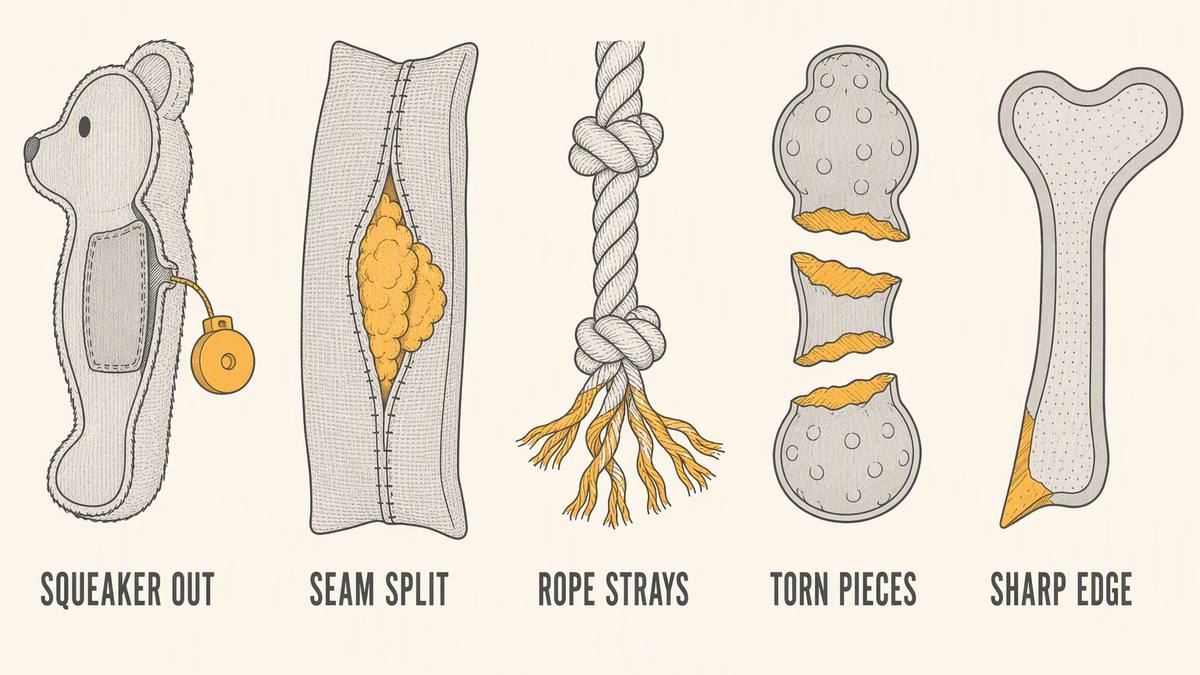
The failures that come back most often are consistent across the category:
- A squeaker pulled out of a plush toy. It is the classic pet toy claim: the dog works at the toy until the squeaker comes free, and a small hard object that squeaks is exactly the thing worth swallowing. Whatever holds the squeaker in has to be treated as a small-parts retention requirement, not as trimming.
- A seam that opens and releases stuffing. A burst seam hands over a mouthful of loose filling, and stuffing is the material most likely to cause a blockage because it clumps. The stitch type, the stitch density, the seam allowance and the strength of the thread all sit underneath this one failure.
- A rope that unravelled into strands. A braided toy that gives way does not produce a broken toy, it produces several metres of cord, and a length of cord is far more dangerous than a lump. How the ends are finished, and whether the braid can unravel from the end inwards, is the specification line that decides it.
- A moulded toy that tore into pieces. Rubber and nylon chew toys fail by tearing, and the question is the size of the piece that comes away, not whether the toy is strong. A tear that produces a large, soft, round piece is a different product from a tear that produces a hard fragment with an edge.
- A hard chew that developed a sharp edge. A hard toy that survives chewing still changes shape, and a scored edge that was rounded when new can hold a point after a few weeks. Surface finish and edge radius are specification lines even on a part nobody thinks of as having edges.
Materials: What Each Family Is Actually Made From
Once the failure mode is named, the material almost chooses itself, because each family has a small number of workable materials and each one has a trade that matters in a mouth rather than in a specification sheet.
- Moulded rubber and TPR
- The chew family. Natural rubber gives the best bounce and the softest feel in the mouth; TPR and TPE are easier to mould and to colour and are common in treat-dispensing toys. The trade is between softness, which is gentle on the mouth but tears sooner, and hardness, which lasts longer but produces harder fragments when it does go. Either way the specification that matters is the tear behaviour and the size of the pieces, not the hardness number on its own.
- Injection moulded nylon and hard plastic
- The long-life chew family, and the one closest to a normal technical moulding. Nylon is tough and takes a surface texture well. The failure to design against is not breakage but edge condition after wear — a part that is smooth when new can hold a sharp edge once it has been chewed flat, and the radius on that edge is a moulding line rather than a machining line.
- Polyester plush and fleece
- The comfort family. The fabric is rarely the failure; the construction is. What matters is the weave density (a loose weave lets stuffing migrate through it), the colourant, and how the panels are joined. Fleece and long-pile fabrics hide a weak seam better than a flat weave, which makes them more dangerous rather than safer.
- Rope, cord and cotton canvas
- The tug family. Cotton rope is the traditional material and it behaves predictably when it fails, because it unravels. Synthetic cord is stronger and lasts longer, and produces longer, thinner, more dangerous strands when it does give way. The choice between them is genuinely a trade, and it should be made on the failure behaviour rather than on durability alone.
One clarification saves arguments later. The material of the toy and the material of its colourant are two separate specifications, and the second one is where a cheap toy differs from an expensive one while looking the same. Ask for the colourant system by name, and ask whether the colour is in the polymer or applied to it, because a surface-applied colour can be licked, chewed or washed off — and on a pet toy, all three of those things happen every day.
There Is No Pet Toy Standard, So Your Specification Is the Net
This is the part of pet toy sourcing that surprises buyers most, and it is worth being blunt about it. Pet toys sit in a gap. The safety rules that people assume protect a toy are aimed at children's products, and the best-known of them, ASTM F963, the consumer safety specification for toy safety, is written for toys children use. The lead and phthalate limits that are quoted in the same breath come from the same children's product body of rules. A dog toy is not a children's toy, so those numbers are not automatically the numbers that apply to your product.
At the same time, a pet toy is a consumer product, and some rules are written for consumer products generally rather than for children's products — the ban on lead-containing paint at 16 CFR Part 1303 is one of them. The result is a patchwork rather than a single answer, and the practical consequence for a buyer is the same either way: you cannot point at a standard and say the toy meets the rules, because there is no single standard to point at.
What replaces it is a written specification that you own. The lines worth stating, because each one maps to a real failure, are these:
- The materials and their grades, named rather than described. "TPR" is a family, not a grade, and the grade decides both the feel and the tear behaviour.
- The colourant system, and whether the colour is inside the material or applied on top of it.
- Lead and phthalate limits, with the number written down. If you are going to quote a limit, quote a specific figure rather than a concept, and make it part of the order rather than a hope.
- Small part retention: what has to stay attached, and the force it has to withstand. A squeaker, a rattle and a crinkle layer are all small parts with a retention requirement.
- Seam and joint strength, for any toy that is sewn or knotted together.
- Piece size after damage. The requirement is not that the toy never breaks, it is that what comes off is large enough to be seen and too large to be swallowed.
- Edge condition after wear, on any hard toy.
- Marking and labelling: material, country of origin, batch or date code, and whatever care or warning wording your market requires.
Two forces push this specification into existence even when a buyer would rather not write one. The first is liability: whoever places the toy on the market carries the responsibility for it, and a supplier's promise is not a substitute for a document. The second is commercial — many large retailers and online marketplaces ask for a test report from an accredited laboratory before a listing is allowed, and that report has to be produced against a requirement. If you never wrote one, the laboratory will use something generic, and you will have paid for a document that does not describe your product.
Colourants, Squeakers and Small Parts: Where the Claims Come From
Three features account for most of the quality problems buyers actually meet, and all three are cheap to control and expensive to ignore.
The colourant. Colour is the most common place where a cheap toy differs from a good one without looking different. A pigment that is mixed into the polymer cannot be licked off; a colour applied to the surface can be removed by a tongue, a tooth or a wash, and on a pet toy all three happen daily. The colourant is also where the substances buyers worry about are most likely to sit, because pigments are the most variable and least scrutinised material in a soft product. Ask for the colourant system by name, ask whether it is in the material or on it, and if the toy can be washed, ask what the colour does after repeated washing.
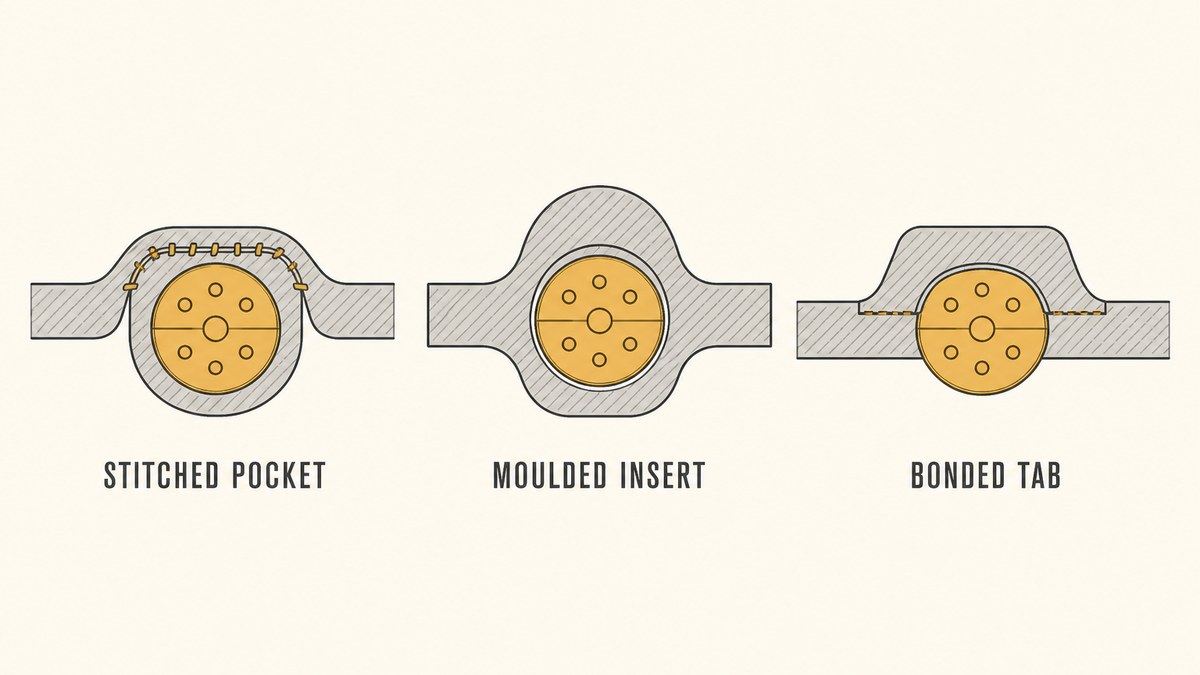
The squeaker. A squeaker is a small, hard, round object that makes an interesting noise, which makes it the single most attractive thing in the toy to swallow. It is held in by construction rather than by design — a pocket, a tab, an insert moulded into a rubber body — and how it is held is the whole specification. A retention test that pulls the squeaker away from the toy at a stated force takes minutes and settles the question, whereas a visual check in a factory settles nothing.
Small parts and what comes off after damage. The useful test is not whether the toy has small parts when it is new. It is what separates from it after it has been chewed, pulled and torn. A hard fragment with an edge, a clump of stuffing or a length of cord are all worse than no break at all, and this is the failure the veterinary profession sees most often: swallowed toy material is a common cause of an intestinal blockage, which is a surgical problem rather than a stomach upset. The American Veterinary Medical Association's pet care guidance is a reasonable place to point a buyer who wants to understand why a "slightly damaged" toy is not a small concern.
All three of these are lines on the order rather than capabilities of a machine. That is why they are the cheapest thing on this list to improve and the first thing a low quotation quietly drops.
Size and Chew Strength: the Two Numbers Marketing Cannot Give You
Two attributes decide whether a toy is safe in practice, and neither of them has a standardised scale that a supplier can honestly quote.
Size. A toy has to be too large to be swallowed whole by the animal it is sold for, and that is a physical requirement rather than a marketing tier. The specification line that carries it is the smallest dimension of the smallest piece that can come away, not the diameter on the box. This is also why a size ladder needs to be built from the animal's mouth rather than from the shelf: a range that looks tidy in a photograph can still include a size that a large dog can take in one bite.
Chew strength. There are no standard durability ratings for pet toys, and the words used on packaging — tough, durable, indestructible — are marketing rather than measurements. Chewing power varies so widely between breeds, between individual animals, and between a puppy and an adult of the same breed that a claim which is true for one dog is false for the next. The honest approach is to stop promising durability and start specifying behaviour:
- Specify what the toy does when it fails, rather than claiming that it will not. A toy that tears into large soft pieces is a safer product than one that shatters into hard fragments, even if the second one lasts longer.
- Specify for the smallest animal in the size band, because that is the animal most likely to swallow a piece.
- Specify supervision wording into the label or the listing, since no toy survives every animal and the market expects the limitation to be stated.
None of this is a reason not to sell a tough toy. It is a reason to sell it on the strength of what it does when it gives way, which is a claim a supplier can actually be held to, and which an inspector can actually check.
What to Test, and What a Test Actually Proves
Testing a pet toy has one rule that overrides the others: test the finished toy, not the components. A fabric mill can send a certificate saying its polyester is free of a substance, and a polymer supplier can do the same for its pellets, and neither document says anything about a toy assembled from both, with a colourant, a squeaker and a thread. The toy is an assembly, and the assembly is what goes into a mouth.
A workable test plan for a pet toy has four parts, and they are not interchangeable:
- Chemical testing on the finished toy
- Run against the limits you wrote into the specification rather than against a generic list. The sample has to be the assembled product, including the colourant on the outside, because that is the surface that gets licked. If a colourant or a material supplier changes, the test has to be repeated — a substitution inside an unchanged toy invalidates the report.
- Physical testing of the retention features
- Pull the squeaker, pull the seam, pull the knot. Retention tests are quick, they are destructive, and they answer the only question that matters about small parts: at what force does it come free. Ask for the test on the finished toy, with a stated force, and a pass or fail result per batch.
- A damage-then-inspect test
- Abrade or tear the toy deliberately, then examine what separated. This is the test that finds the failure modes in the first section of this guide, and it is the one most often left out because it does not exist as a standard test a laboratory sells by name.
- A batch record that travels with the shipment
- Every test above proves a sample, not a production run. The record is what connects the sample to the cartons you receive, and it only has value if it carries an identifier that can be matched to the goods.
Then inspect what arrives, because a report without an inspection is a report about somebody else's toy. A written sampling plan is what keeps acceptable meaning the same thing to your supplier and to you, and the same the sampling plan for a pet toy order approach used for any other imported component applies here — with the sample size and the defect definitions written down before the first shipment rather than argued about after it.
Injection Mould, Sewing Line or Rope Machine: Where the Tooling Money Goes
The four construction families have completely different development economics, and knowing which one you are in tells you your minimum order before you ask anybody for a price.
The moulded family needs a tool. A chew toy made from rubber, TPR or nylon needs an injection mould or a compression mould, and that is a real one-time cost that has to be amortised over the order. The shape of the economics is the same as for any moulded part: below a certain quantity the tool dominates the unit cost, and above it the tool disappears into the price. If you have priced that trade before, the arithmetic is set out in what an what a pet toy tool costs — the product is different, the crossover is the same question. And because a mould is the kind of asset that decides who controls your future price, settle who owns the tool after a pet toy order before it is cut.
The sewn family needs a pattern, not a tool. A plush toy is panels, stitching and filling. The development cost is a pattern, a sample and any printed or embroidered branding, which is far cheaper than a mould and far faster to change. That makes plush the cheapest family to customise and the easiest to iterate — and it is also the family where the quality risk sits in the stitching rather than in the tool.
The rope family needs labour. Braiding, knotting and finishing are hand or machine operations with almost no tooling at all. Development is cheap and minimum quantities can be small, but the labour content per unit is high, so the unit price is driven by time rather than by material or by tooling. This is the family where a supplier's wage structure shows up most directly in the quotation.
The practical consequence is that a buyer with a small budget should be choosing between plush and rope, and a buyer with volume should be looking hard at moulded. Choosing the wrong family for your quantity is the most expensive mistake available in this category, because it cannot be fixed by negotiating the unit price.
Who Makes Pet Toys, and What a Cheap Quote Leaves Out?
The suppliers you will meet fall into three groups, and the difference shows in what they can answer rather than in what they can quote.
- A factory that owns the right production line. Moulding, sewing or rope work, in house, with its own quality checks. It can tell you how it retains a squeaker because it does it every day.
- A general soft-goods factory. Capable of sewing anything, and willing to try moulded parts by buying them in. Often good value on plush, and a risk on anything where a retention feature has to be engineered rather than sewn.
- A trading company. Quotes from a catalogue or from another factory's samples. Fine for an off-the-shelf item, and the wrong source for a toy whose spec you wrote yourself, because there is nobody in the conversation who can answer a question about seam density.
A cheap quotation is usually a quotation for less than you assumed. Six lines get quietly dropped, and they are the same six every time:
- The colourant system. A cheaper pigment, or a surface colour instead of a colour mixed into the material, is the most common substitution and the hardest to see.
- The small-part retention feature. A squeaker held by a stitched pocket and a squeaker held by an insert are not the same product, and the second is cheaper to make.
- Seam density and thread. Shorter stitches and a stronger thread cost money and buy the one failure mode plush toys actually have.
- The test report. A low quote usually excludes testing, and a report produced against a generic requirement does not certify your specification.
- Batch marking. A toy with no batch or date code cannot be traced, which makes every claim an argument about which shipment it came from.
- The piece-size requirement. Nothing in a normal factory process stops a moulded toy from being made in a wall thickness that tears into small hard fragments. That is a specification line, and dropping it costs nothing and buys nothing.
Two checks make the comparison cheap. First, establish who you are actually dealing with, because a factory and a trading company answer a question about seam density completely differently — the method is described in whether a pet toy plant is a plant or a reseller. Second, check any certificate that carries weight against the issuer's own record rather than against a photograph, using the approach set out for the pet toy certificate, checked in the certifier's own register. Neither check costs anything, and both change the questions you ask.
Finally, price the toy where it lands. Pet toys are bulky for their weight, so they pay for volume rather than for mass, and freight is where a light, cheap product stops being cheap — the what a pet toy order costs once it has landed. A plush toy that ships flat and a moulded toy that ships in a pallet carton can have the same factory price and very different landed costs. Pet food sits at the other end of that scale, because kibble is dense and pays for mass rather than for volume, and unlike a toy that category also has a real set of import rules standing under it — the guide to private label pet food walks through that side of the category.
What Comes Back as a Claim?
Five complaints account for most of what returns from a pet toy, and each one points back at a specification line rather than at a factory's competence.
- The squeaker came out
- The retention feature was a pocket or a tab rather than an engineered hold, and nobody pulled it to a stated force before the run. It is the single most common pet toy claim because a squeaker is precisely the object a dog works hardest to reach.
- The seam opened and the stuffing came out
- Stitch density, thread strength, seam allowance or the direction of the seam relative to the load. A sewn toy with a low stitch count looks identical on the shelf and fails on the first serious pull, and the failure is a design line rather than a workmanship error.
- The colour wore off, transferred or faded
- A surface-applied colour, or a colourant that migrates out of the material. On a toy that is licked and washed, this is the failure that produces the complaint about the dog's paws being stained — and it is a colourant system decision.
- The rope unravelled
- An unfinished or under-finished end, or a braid that can be unwound from the outside in. The claim is not that the toy broke, it is that the toy produced a length of cord, which is a different and more serious report.
- A piece tore off and was small and hard
- The material tore in a way that produces fragments rather than large soft pieces, which is a wall-thickness and tear-resistance decision made when the mould was cut. It is the failure that turns a unit-price conversation into a veterinary bill.
Four of those five were settled by a line on the specification and one by the colourant system, which is the argument for spending the time writing limits rather than on the last few per cent of the unit price.
Frequently Asked Questions
Do pet toys have to meet a safety standard?
There is no single pet toy safety standard equivalent to the toy safety standard that applies to children's products. The well-known toy safety specification and the children's lead and phthalate limits are written for children's products, and a pet toy is not one of those, so those numbers are not automatically the numbers you must meet. Some consumer product rules, such as the ban on lead-containing paint, are written for consumer products generally. The practical answer is that you write the limits into your own specification and test against them, because there is nothing else to point at.
How do I stop a squeaker from being pulled out?
Treat it as a retention feature with a number attached, not as trimming. Specify how it is held — an insert moulded into a rubber body, a reinforced stitched pocket, or a tab bonded to the fabric — and then specify a pull force it has to survive, tested on the finished toy. A test that pulls the squeaker until it comes free tells you the force, and a force written into the order is the only thing a factory can be held to. A visual check in the factory tells you nothing about a dog.
Which material is safest for a chew toy?
There is no universally safest material, because each one trades one failure for another. Softer rubber and TPR are gentler in the mouth but tear sooner; harder TPR and nylon last longer but produce harder pieces when they go, and can hold a sharp edge after wear. The decision should be made from the animal you are selling to and from what the material does when it fails, then checked with a damage-then-inspect test on the finished toy. Choosing on durability alone is how a toy ends up lasting longer than it should.
How much does it cost to develop a custom pet toy?
It depends almost entirely on which construction family you are in, not on the design. A plush toy needs a pattern and a sample, which is cheap and fast to change. A rope toy needs almost no development at all but carries more labour in every unit. A moulded chew toy needs a mould, so development is a real one-time cost that has to be paid back over the volume — which means the honest answer is that a moulded toy is expensive to start and cheap to repeat, and a plush toy is the reverse.
Do I need to test every batch?
Not every test on every batch, but you need a rule that decides which ones. The two that belong on every batch are the physical retention tests, because they are quick, destructive and cheap. Chemical testing can follow a lower frequency on the condition that nothing changed — and the moment a material, a colourant or a sub-supplier changes, the previous report stops describing your product and the test has to be repeated. The record is only useful if it carries an identifier that can be matched to the cartons you receive.
What should be printed on a pet toy?
What your market requires, plus what you need to trace a complaint. In practice that means the material, the country of origin, a batch or date code, and whatever care or supervision wording your retail customers ask for. The batch code is the one buyers most often leave off and the one that matters most, because without it every quality complaint becomes an argument about which shipment the toy came from — and a claim you cannot trace is a claim you pay for in full.
Send the failure mode, not just the picture
Tell us which construction family the toy belongs to, the animal and the size band it is for, the materials and colourant system you want, what has to stay attached and at what force, the limits you need tested, your target volume and your market's labelling requirements. Those answers settle the construction, the material, the retention features and the tests before a price means anything. We will come back with the configuration we recommend and why, the materials and colourant named by type rather than by family, the small-part retention and seam requirements written as measurable lines, a test plan against your limits rather than a generic list, and a batch-marked record that can be matched to the cartons you receive — with tooling, testing and inspection shown separately rather than folded into the unit price.
Request a Pet Toy Sourcing Quote
Questions & Comments
We read every one and reply within 24 hoursIf you are holding a pet toy quotation and trying to work out whether two quotes describe the same toy, post three things and we can usually say: which construction family it is in, what the toy is made from including the colourant, and what has to stay attached to it. If you already have a sample, add what came off when it was pulled and torn, and whether the retention features were tested at a stated force. Those two answers explain most of the gap between two pet toy quotations, and they are the two a short quote tends to leave out.