
Silicone Rubber Compression Molding in China: Tooling, Shore Hardness & Costs (2026 Guide)
 ·
Updated October 1, 2026
·
20 min read
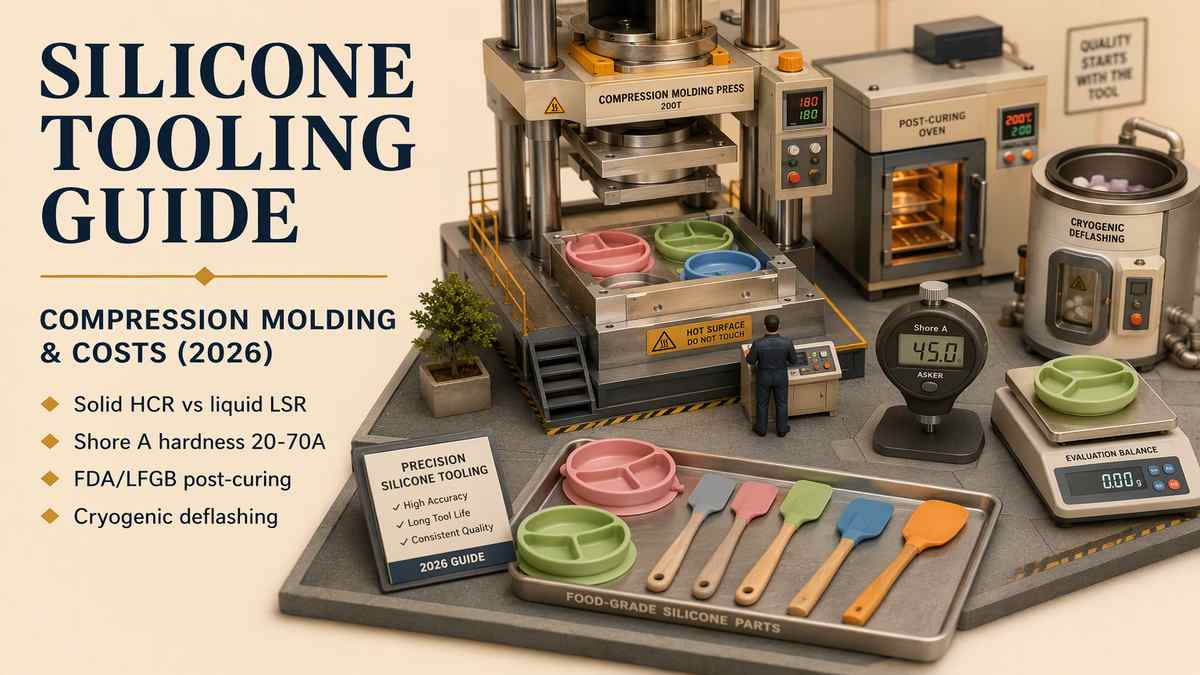
Direct Answer: In 2026, Silicone Rubber Compression Molding in China is the most cost-effective manufacturing process for producing custom flexible consumer goods, kitchenware, baby products, and waterproof sealing gaskets. Compared to rigid plastic injection tooling, silicone compression molds cost 60% to 75% less (\$1,200 to \$3,500 for 1-to-4 cavity steel molds) with fast 10-to-15 day toolmaking lead times. Getting custom silicone right requires managing three core engineering specifications: (1) Shore A Hardness selection (20A to 80A) to match product flexural elasticity; (2) Platinum-cure vs. Peroxide-cure raw silicone selection combined with mandatory 4-hour 200°C post-curing baking to pass FDA 21 CFR 177.2600 and German LFGB food-grade extraction tests with zero chemical odor; and (3) Thermal shrinkage calculation (2.5% to 4.0%) in 3D CAD tooling cavities to achieve tight ±0.1 mm dimensional accuracy.
Silicone rubber is an extraordinary material: heat-resistant from -40°C to +230°C, dishwasher safe, BPA-free, hypoallergenic, and silky to the touch. From high-margin baby feeding sets on Amazon to silicone kitchen spatulas and IP68 waterproof O-rings, China’s primary silicone manufacturing clusters in Guangdong (Dongguan, Huizhou) and Zhejiang (Ningbo) produce over 70% of the world’s silicone consumer products.
However, many importers struggle with common production defects: receiving sticky products with a strong chemical smell, discovering ugly rough flash edges that peel in customer hands, or parts that are either too floppy or too stiff because the wrong Shore hardness was specified.
In this comprehensive 2026 engineering guide, we compare solid compression molding vs. liquid silicone rubber (LSR), break down the Shore A hardness durometer scale, detail the mandatory post-curing baking protocol for FDA/LFGB certification, expose 3 common factory shortcuts, and outline a 5-step SOP to source custom silicone products in China with zero defects.
Silicone Compression Molding vs. Liquid Silicone Rubber (LSR)
To choose the right silicone manufacturing technology for your production volume and budget, review this comparative engineering matrix:
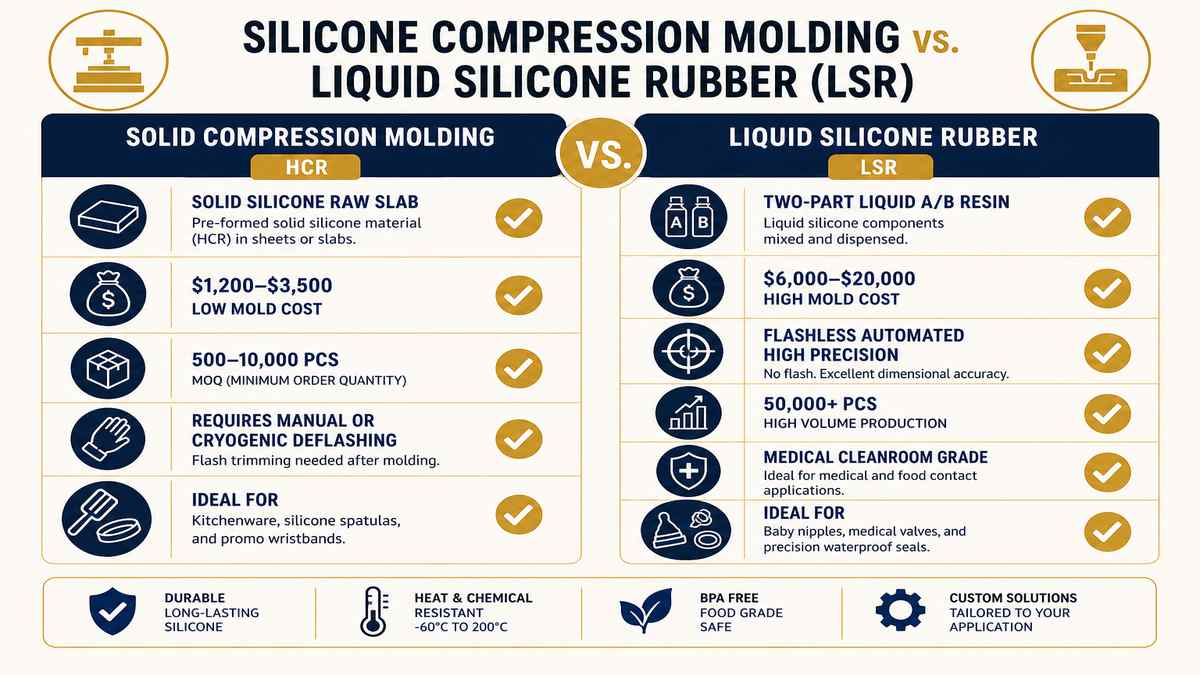
| Evaluation Dimension | 1. Solid Compression Molding (固态油压模压) | 2. Liquid Silicone Rubber (LSR / 液态注塑) |
|---|---|---|
| Raw Material Form | Solid High Consistency Rubber (HCR) pre-cut slabs. | Two-part liquid A/B chemical formulation. |
| Upfront Mold Tooling Cost | Ultra Low ($1,200 – $3,500) for steel mold. | High ($6,000 – $20,000+) with cold deck runners. |
| Molding Process & Speed | Manual loading into heated mold; 2–4 min vulcanization. | Automated closed-loop injection; 20–40 sec cycle. |
| Part Flash & Parting Lines | Requires manual tearing or cryogenic deflashing. | Flashless (Micro-precision parting lines). |
| Minimum Order Quantity (MOQ) | Low (500 – 1,000 pcs). | High (10,000+ pcs to justify setup). |
| Multi-Color / Marbling FX | Excellent (Allows hand-mixed camouflage & marbling). | Monochrome per shot (Requires 2-shot LSR press). |
| Best Product Applications | Kitchenware, baby suction plates, phone cases, bands. | Baby bottle nipples, medical check valves, optical lenses. |
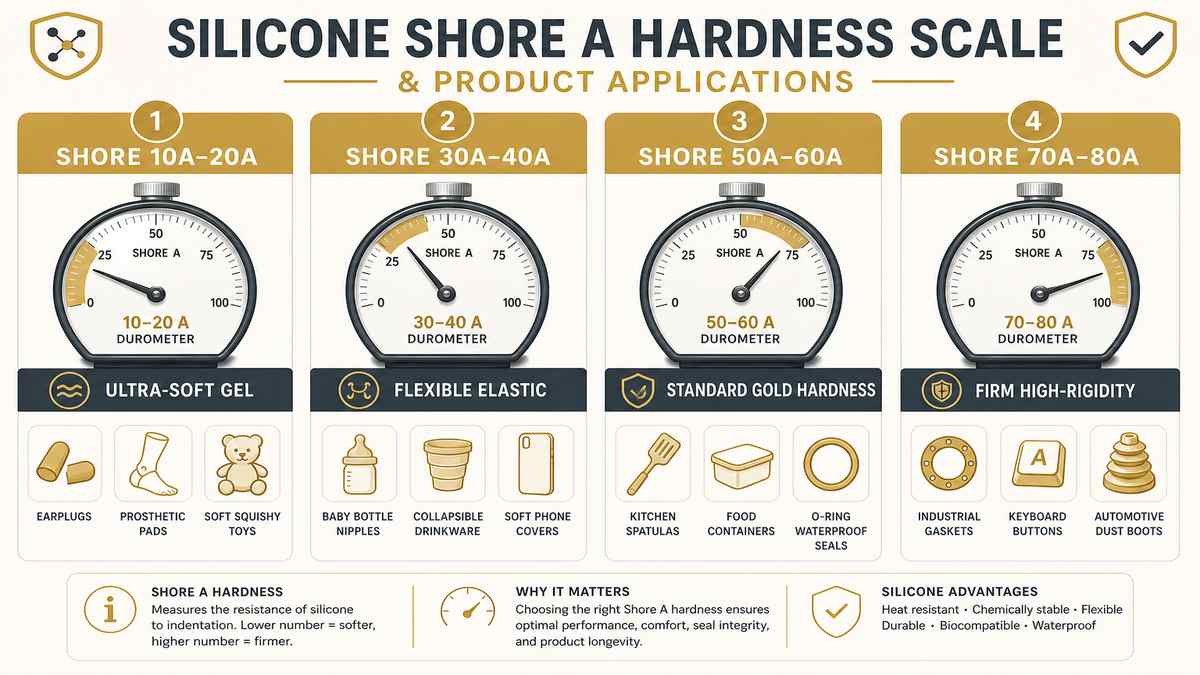
The Shore A Hardness Scale: Matching Durometer to Product Function
Silicone firmness is measured on the Shore A Durometer Scale under ASTM D2240 standards. Selecting the correct hardness is essential for product usability:
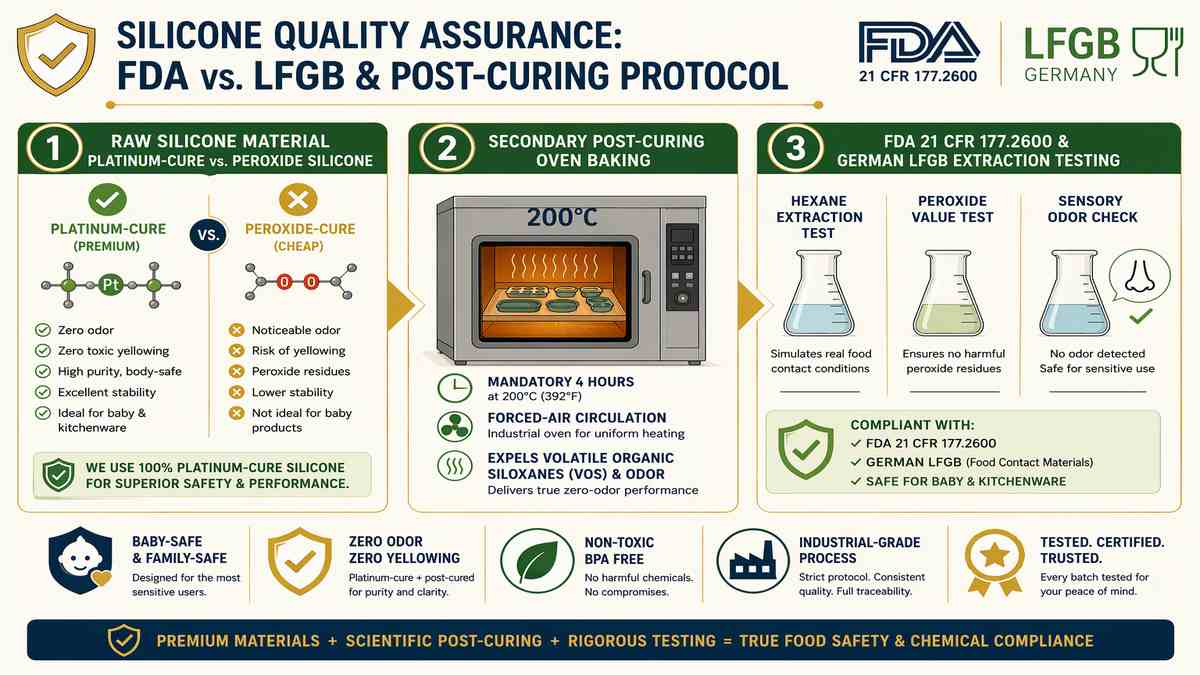
Food-Grade Standards: FDA vs. LFGB & The Post-Curing Protocol
If you are selling silicone products for kitchenware, infant feeding, or beverage contact, passing international chemical safety rules is non-negotiable:
Anti-Dust Surface Coating & Multi-Color Molding
To eliminate surface stickiness and achieve multi-color aesthetics on custom silicone products, consider these two advanced finishing options:
3 Dirty Tricks in Silicone Sourcing & How to Prevent Them
Low-cost silicone workshops cut corners that result in sticky, smelly, and tearing products. Guard your brand against these three common practices:
5-Step SOP for Sourcing Custom Silicone Products in China
Follow this standard operating procedure to source custom silicone merchandise with zero quality defects:
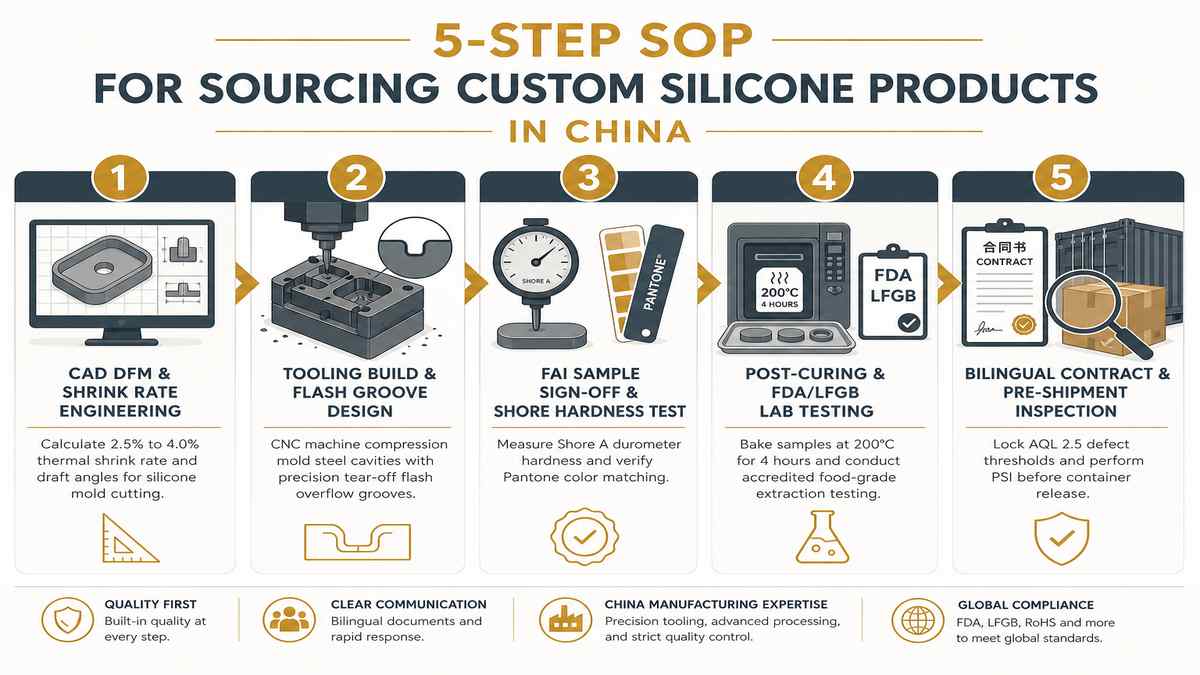
- Execute CAD DFM & Shrink Rate Engineering: Review 3D CAD files for draft angles (≥1.0°), calculate 3.0% thermal shrink expansion, and design precision tear-off flash grooves under ASTM International Rubber Testing Standards ASTM D2240.
- Audit Silicone Factory & Tooling Lines: Audit bidding silicone manufacturers in Dongguan and Ningbo under our China factory audit checklist review, checking automated hydraulic presses, dust-free mixing rooms, and high-capacity post-curing ovens certified under ISO 9001 Quality Management Standards.
- Sign Enforceable Bilingual Tooling & Mold Contract: Lock mold ownership, food-grade platinum material clauses, and defect replacement terms into an enforceable bilingual manufacturing sales contract under PRC law, applying principles from our guide on OEM vs ODM product customization models.
- Inspect FAI Golden Samples & Shore A Durometer: Order physical prototype samples and execute a comprehensive first article inspection (FAI) sample review, checking Shore A hardness with digital durometers, Pantone color match, and tear-off edge smoothness.
- Perform FDA/LFGB Lab Testing & Pre-Shipment Inspection (PSI): Submit production samples to an accredited testing lab (SGS or TÜV) for FDA 21 CFR 177.2600 extraction tests, and perform a comprehensive pre-shipment inspection (PSI) in China under AQL 2.5 standards to check for bubbles, foreign black spots, and flash burrs before releasing container balances.
Illustrative Scenario: How an Amazon Brand Solved Silicone Odor & Scaled
To see how professional silicone quality engineering drives e-commerce success, review this baby tableware case study:
A baby products brand in Denver, Colorado developed a custom divided silicone baby feeding suction plate with matching training spoon (Initial order: 5,000 sets, \$24,000 total order value).
- The Chemical Stench Disaster: The founder initially sourced from a cheap factory in Guangdong. When the initial sample batch arrived, opening the polybag released a pungent chemical vinegar smell. Testing revealed the factory used cheap peroxide curing and skipped post-curing baking. The samples failed German LFGB sensory smell tests.
- The Platinum-Cure & Post-Curing Upgrade: Sourcing Pioneer helped the brand transfer production to a cleanroom-certified silicone manufacturer in Dongguan. The tooling was built using P20 steel with precision tear-off flash channels (\$2,800 mold fee). Production was upgraded to 100% German Wacker food-grade platinum-cure silicone (Shore 55A) with mandatory 4-hour 200°C post-curing baking.
- Flawless Lab Testing: Production samples underwent SGS chemical testing, passing FDA 21 CFR 177.2600 and German LFGB with 100% zero extractable siloxanes and zero odor. Suction base testing confirmed 5.5 kg holding force on smooth highchair trays.
- The Commercial Outcome: The suction plates launched on Amazon, earning Amazon’s Choice badge with a 4.9-star rating, zero odor complaints, and generating over \$380,000 in first-year revenue.
Frequently Asked Questions (FAQ)
How much does a silicone compression mold cost in China?
Silicone rubber compression molds in China are highly economical, ranging from $1,200 to $3,500 for single or 2-cavity tooling, and $3,500 to $7,000 for high-cavity mass-production molds (e.g., 8-cavity kitchenware molds). This is 70% cheaper than plastic injection molds because compression tooling requires no complex ejector pin systems or hot runner manifolds.
What is the difference between solid silicone compression molding and liquid silicone rubber (LSR)?
Compression molding uses pre-cut slabs of solid High Consistency Rubber (HCR) placed into a heated mold, which is cheap ($1,500 tooling) and ideal for kitchenware, bakeware, and wristbands. Liquid Silicone Rubber (LSR) injection molding uses two-part liquid platinum-cure silicone injected into a sealed mold, creating flashless, medical-grade, micron-precision parts at higher tooling costs ($6,000 to $20,000).
What Shore A hardness should you choose for custom silicone products?
For baby nipples and squishy toys, use 20A to 30A (ultra soft); for baby bibs, collapsible drinkware, and phone cases, use 40A to 50A (flexible elastic); for kitchen spatulas, suction plates, and O-ring seals, use 50A to 60A (standard gold firmness); for industrial gaskets and keyboard buttons, use 70A to 80A (rigid firm).
Why is secondary post-curing baking required for food-grade silicone?
Post-curing involves baking molded silicone parts in a forced-air industrial oven at 200C for 4 hours. This essential step expels volatile low-molecular siloxanes and curing odors, ensuring the product passes FDA 21 CFR 177.2600 and German LFGB food-contact tests with zero chemical smell.
How do Chinese factories remove flash lines on silicone molded parts?
Factories remove flash through manual knife trimming, precision tear-off groove tooling design (which allows workers to tear flash cleanly by hand), or automated cryogenic deflashing (freezing parts with liquid nitrogen at -100C and tumbling them with plastic beads).
Manufacture Food-Grade Silicone Products with Lab-Certified Safety
Our China engineering team audits silicone tooling steel cavities, checks Shore A durometer hardness, conducts on-site post-curing baking audits, and supervises FDA/LFGB extraction testing.
Get Free Silicone Sourcing & Tooling Review
Questions & Comments
We read every one and reply within 24 hoursReviewing a silicone compression mold quote, wondering about Shore A durometer hardness selection for your product, or need on-site FDA/LFGB post-curing inspection in Dongguan or Ningbo? Post your silicone sourcing questions below — our on-the-ground manufacturing engineers will guide your technical decisions.