
Plastic Injection Mold Costs in China: Tooling Types, Steel Grades & Lifespans (2026 Guide)
 ·
Updated October 1, 2026
·
20 min read
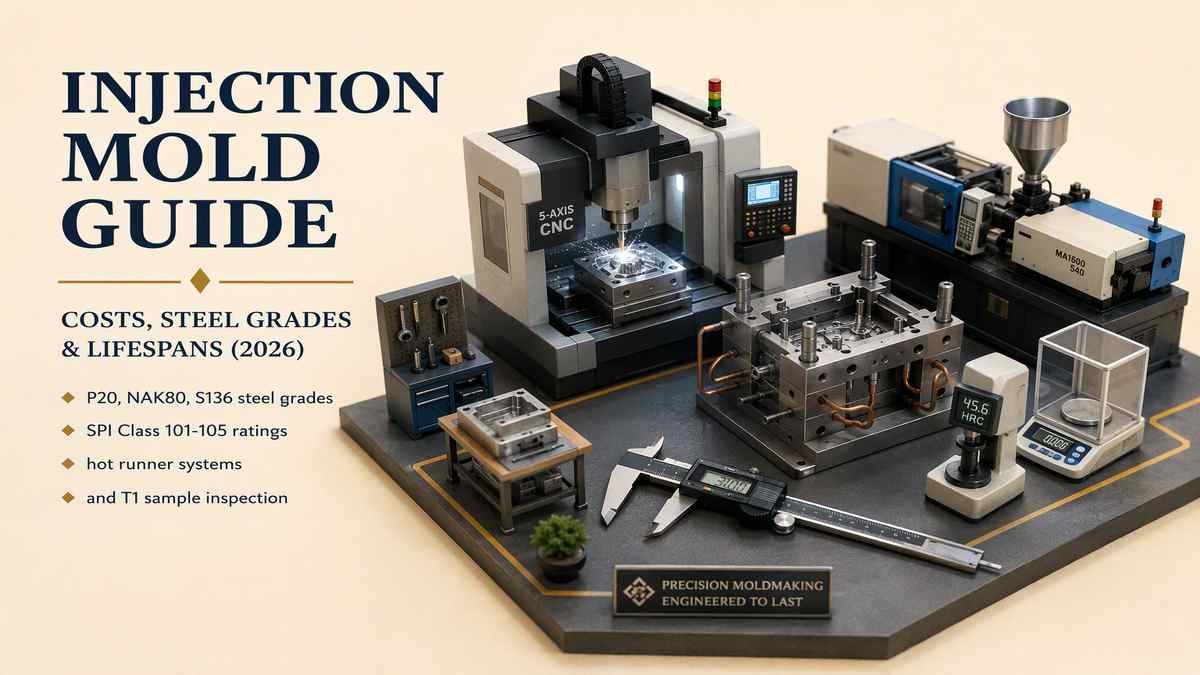
Direct Answer: In 2026, plastic injection mold tooling costs in China range from $1,500 to over $45,000+, governed directly by steel grade metallurgy, cavity count, side-action mechanism complexity, and SPI mold class standards. For small prototype runs (500–5,000 shots), rapid prototype soft tooling (SPI Class 105 in aluminum or S50C steel) costs \$1,500–\$3,500 with 10–14 days turnaround; for standard commercial production (50,000–300,000 shots), medium-volume tooling (SPI Class 103/104 in pre-hardened P20 or 718H steel) costs \$3,500–\$12,000; and for high-volume automated manufacturing (500,000–1,000,000+ shots), precision multi-cavity hardened tooling (SPI Class 101/102 in S136 or NAK80 steel with hot runner systems) costs \$12,000–\$45,000+. Sourcing molds from China saves 50% to 70% compared to Western toolmakers, provided you conduct strict DFM reviews and check mill steel certificates on-site.
Plastic injection molding is the manufacturing backbone for consumer electronics enclosures, kitchenware, medical disposables, and automotive components. However, for hardware startup founders and brand managers, decoding an injection mold quotation from a Chinese toolmaker can feel like navigating a minefield of technical acronyms.
Why does one factory quote \$4,000 for a mold while another quotes \$14,000 for the exact same 3D CAD model? The difference lies in the invisible engineering inside the steel block: the hardness of the core and cavity inserts, cooling circuit layout, lifter mechanisms, and runner gate technology.
In this comprehensive 2026 engineering guide, we break down injection mold pricing benchmarks across SPI Class 101–105 tiers, compare the 5 major tool steel grades (P20, 718H, NAK80, S136, H13), explain the 6 engineering cost drivers, expose common factory steel substitution tricks, and provide a 5-step SOP to manage your mold build from initial DFM to final T1 trial sign-off.
China Injection Mold Costs & SPI Class 101–105 Classification Matrix
The Plastics Industry Association (SPI) Standards establish 5 standardized mold classifications based on production volume, steel hardness, and automation level. Review this cost benchmark matrix:
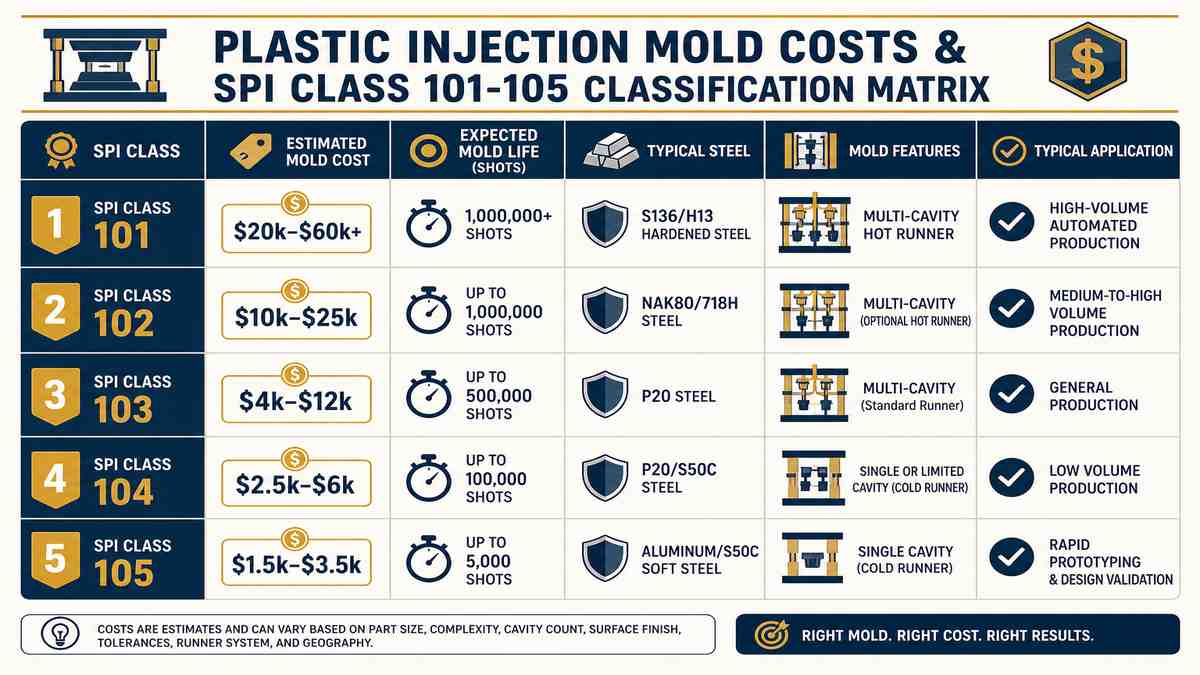
| SPI Mold Class | Typical China Cost (USD) | Rated Mold Lifespan | Core & Cavity Steel Grade | Best Production Volume |
|---|---|---|---|---|
| Class 101 (Extreme Volume) | $20,000 – $60,000+ | 1,000,000+ Shots | Hardened Stainless S136 / H13 (HRC 48–54) | 1M+ units (Fully automated multi-cavity hot runner). |
| Class 102 (High Volume) | $10,000 – $25,000 | Up to 1,000,000 Shots | Hardened NAK80 / 718H / S136 (HRC 38–48) | 250k – 1M units (High-precision consumer electronics). |
| Class 103 (Medium Volume) | $3,500 – $12,000 | Up to 500,000 Shots | Pre-hardened P20 / 718H (HRC 28–34) | 50k – 250k units (Standard Amazon consumer goods). |
| Class 104 (Low Volume) | $2,500 – $6,000 | Up to 100,000 Shots | P20 / S50C Carbon Steel (HRC 20–28) | 10k – 50k units (Pilot production & niche runs). |
| Class 105 (Prototype Tooling) | $1,500 – $3,500 | 500 – 5,000 Shots | 7075 Aluminum / S50C Soft Steel | Kickstarter testing, fit checks, visual prototypes. |
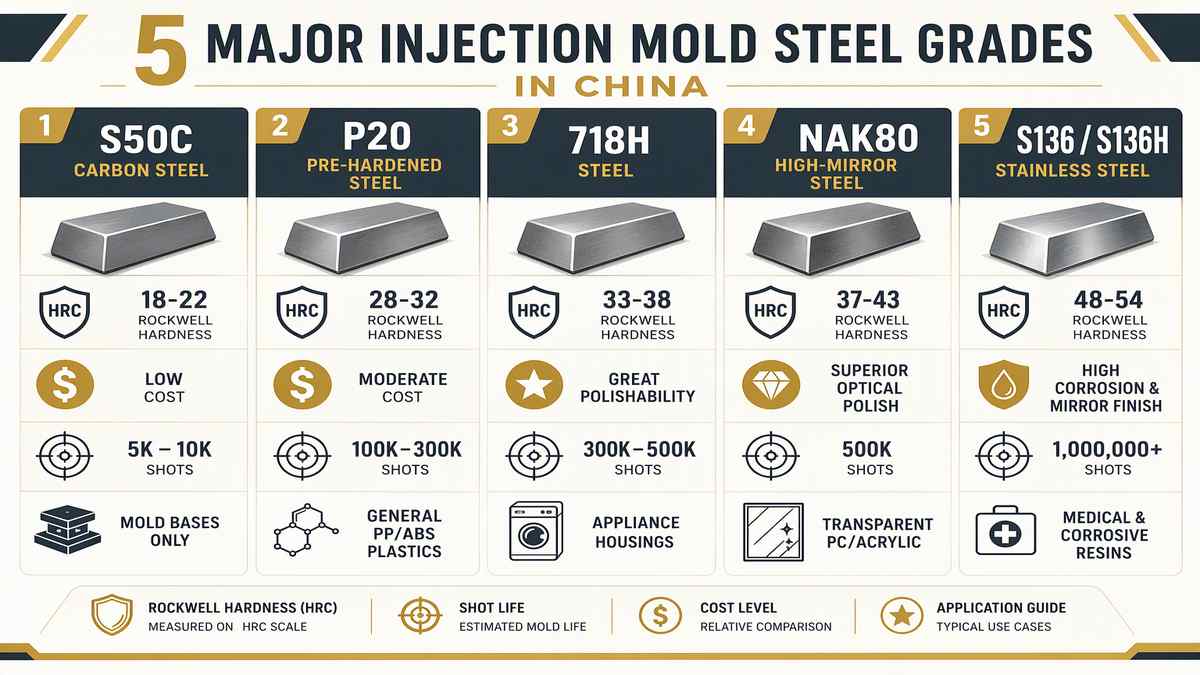
5 Major Injection Mold Steel Grades: Hardness, Polish & Lifespans
The steel selected for the mold's core and cavity inserts directly dictates mold longevity, surface gloss, and wear resistance under ASTM International Steel Testing Standards. Here is the engineering breakdown:
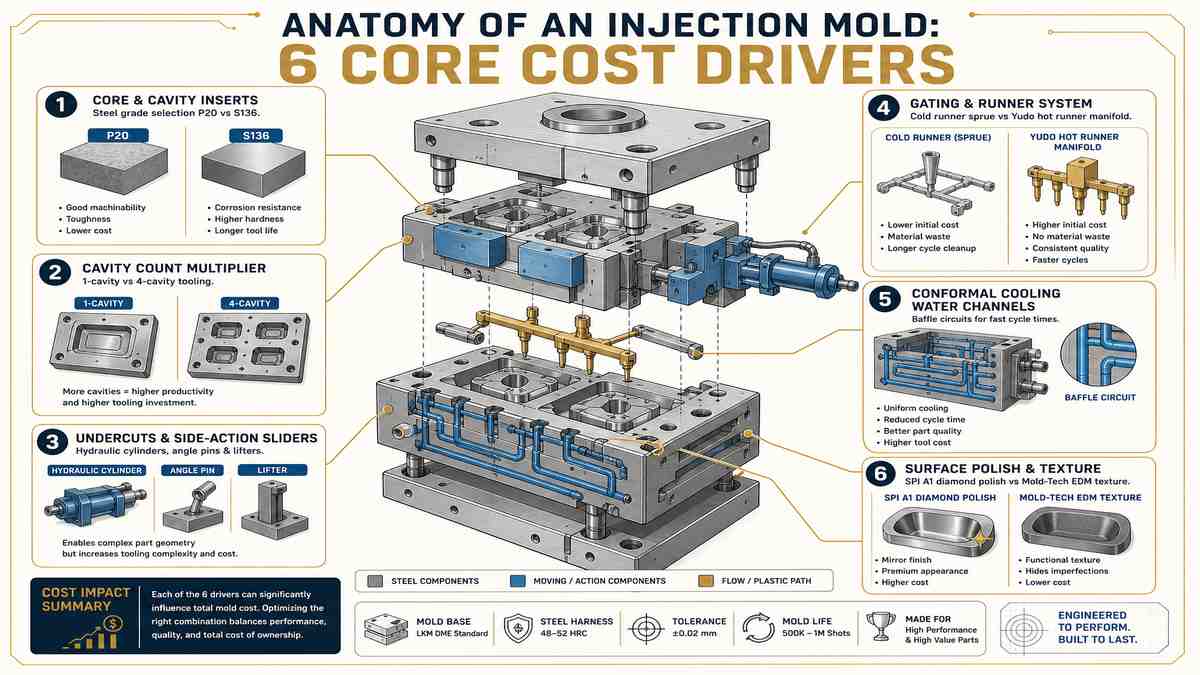
The 6 Core Engineering Cost Drivers of Injection Mold Quotes
When you submit a 3D CAD model for quotation, toolmakers calculate tooling fees based on these six physical and mechanical variables:
3 Dirty Tricks Mold Makers Use & How to Prevent Them
Low-cost Chinese mold shops frequently cut corners to win tenders. Protect your investment against these three common practices:
5-Step SOP for Sourcing, Tooling & Inspecting Injection Molds in China
Follow this standard operating procedure to manage your mold fabrication from 3D CAD design to mass production:
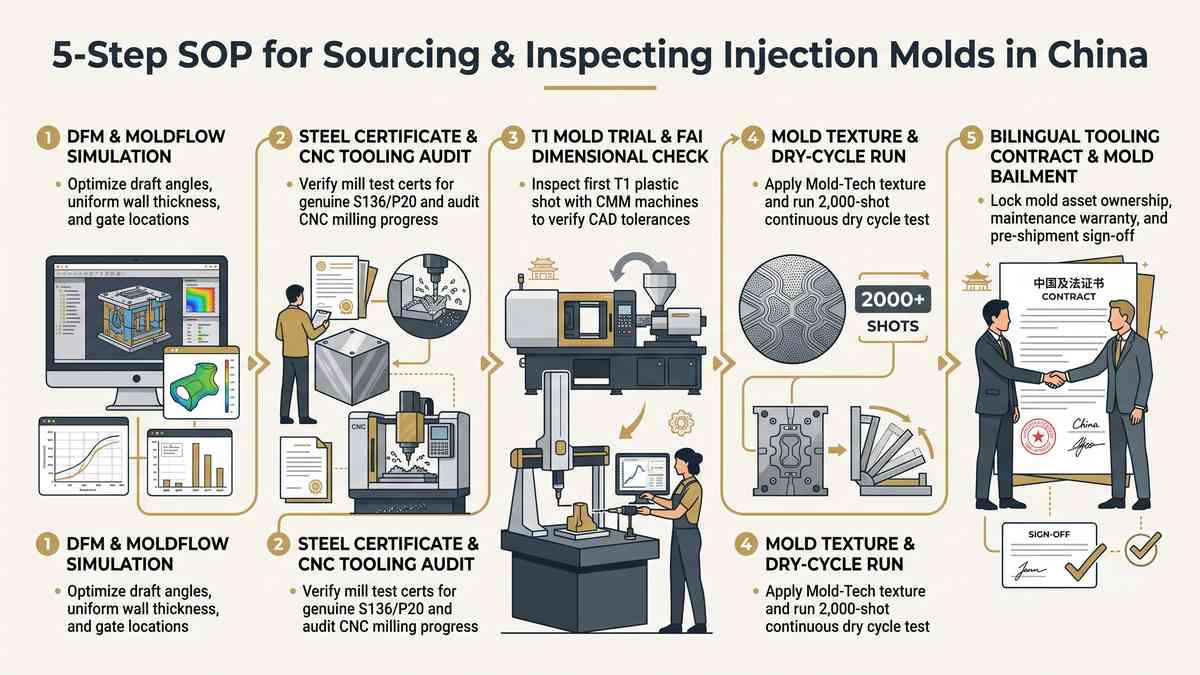
- Execute Comprehensive DFM & Moldflow Analysis: Before cutting steel, review the moldmaker's Design for Manufacturing (DFM) report. Check draft angles (≥1.5° per side), enforce uniform even wall thickness, and check gate placement to eliminate weld lines.
- Audit Toolroom & Check Steel Mill Certificates: Audit the factory's CNC milling and EDM wire-cutting equipment using a structured China factory audit checklist review under ISO 9001 Quality Management Standards, checking raw steel mill certificates for genuine P20, NAK80, or S136.
- Sign Enforceable Bilingual Tooling & Mold Bailment Contract: Lock mold ownership, rated shot warranties (e.g., 300,000 shots guaranteed), and unconditional mold relocation rights into an enforceable bilingual manufacturing sales contract under PRC law with 50/30/20 payment terms (50% deposit, 30% on T1 sample approval, 20% on mass production sign-off).
- Inspect Tooling T1 Trial Shots with FAI Sign-off: Order 20 to 50 plastic parts from the initial T1 mold trial. Execute a formal first article inspection (FAI) sample sign-off with Coordinate Measuring Machines (CMM) and digital calipers, checking dimensions against 3D CAD target 3D CAD dimensions before authorizing mold texturing or custom logo engraving on product finishes.
- Execute Continuous Dry-Cycle Run & Pre-Shipment Inspection (PSI): Require a continuous 2,000-shot dry-cycle mold test to check smooth slider action and ejector pin return, then perform a comprehensive pre-shipment inspection (PSI) in China under AQL 2.5 standards before releasing final production payments.
Illustrative Scenario: How a California Brand Built a Precision S136 Mold
To see how investing in proper tooling engineering prevents costly supply chain failures, review this smart home enclosure case study:
A smart home hardware brand in Irvine, California required a custom weather-proof injection molded housing for their dual-band video doorbell (50,000 annual production volume, \$180,000 finished goods value) using flame-retardant UV-stabilized PC/ABS resin.
- The Low-Ball Tooling Trap: An unvetted mold shop quoted \$4,500, claiming to use S136 steel. However, Sourcing Pioneer's on-site engineering review revealed the shop had no vacuum heat-treatment furnace, planned to use unhardened carbon steel, and lacked conformal cooling channels, which would have caused severe part warpage.
- The Precision Tooling Execution: Sourcing Pioneer helped the brand partner with an ISO 9001 certified precision moldmaker in Ningbo. The mold was built using genuine vacuum-hardened S136 stainless steel (HRC 50), an integrated Yudo 2-drop valve gate hot runner system, and high-precision side sliders for waterproof silicone gasket grooves (\$14,800 total mold investment).
- T1 Trial & Dimension Sign-off: The initial T1 sample trial achieved tight dimensional tolerances of ±0.03 mm on mating clips. The mold completed 100,000 consecutive shots with zero plastic flash or burrs.
- The Commercial Outcome: The hot runner system cut cycle times from 34 seconds to 21 seconds, reducing unit plastic piece costs by 28% and saving the company over \$35,000 in first-year production costs while maintaining an IP65 waterproof rating.
Frequently Asked Questions (FAQ)
How much does a plastic injection mold cost in China in 2026?
Plastic injection mold costs in China range from $1,500 to $3,500 for rapid prototype soft tooling (5,000 shots), $3,500 to $12,000 for standard production molds (P20 steel, 100,000 to 300,000 shots), and $12,000 to $45,000+ for high-precision multi-cavity hot runner molds made from hardened S136 or NAK80 steel (1,000,000+ shots).
What is the difference between P20 and S136 mold steel?
P20 is a pre-hardened tool steel (HRC 28-32) that is economical, easy to machine, and ideal for standard non-corrosive plastics (PP, ABS, PS) up to 300,000 shots. S136 is a high-grade stainless tool steel that can be vacuum heat-treated to HRC 48-54, offering extreme corrosion resistance against abrasive/flame-retardant resins, high-mirror polishability, and lifespans exceeding 1,000,000 shots.
What is an SPI mold classification?
The Plastics Industry Association (SPI) classifies injection molds from Class 101 to Class 105 based on production volume and steel hardness: Class 101 is high-volume fully automated (>1,000,000 cycles), Class 102 is medium-to-high volume (<1,000,000 cycles), Class 103 is medium volume (<500,000 cycles), Class 104 is low volume (<100,000 cycles), and Class 105 is prototype only (<5,000 cycles).
When should you choose a hot runner system over a cold runner?
Choose a hot runner system (e.g., Yudo or Mold-Masters) for high-volume orders (50,000+ units) or multi-cavity molds. Hot runners eliminate plastic sprue waste, reduce cycle times by 20% to 40%, and improve part cosmetics by eliminating visible gate marks, easily offsetting the $1,500 to $4,000 hot runner surcharge.
What should buyers check during the T1 mold trial in China?
During T1 trial, inspect first plastic shot parts for sink marks, flash, flow lines, and warpage. Measure critical dimensions using Coordinate Measuring Machines (CMM) against 3D CAD files to confirm tolerance rules before authorizing mold texturing or shipment.
Build Precision Injection Molds in China with True Steel Certifications
Our China tooling engineers conduct DFM moldflow reviews, audit CNC toolrooms on-site, check genuine S136/P20 steel certificates, and supervise T1 plastic trial shots.
Get Free Injection Mold Tooling Consultation
Questions & Comments
We read every one and reply within 24 hoursReviewing an injection mold quotation from China, wondering whether P20 or S136 steel is right for your resin, or need on-site T1 trial inspection in Ningbo or Shenzhen? Post your tooling questions below — our on-the-ground mold engineers will guide your technical decisions.