
Why Amazon Products Get Removed, and How to Stop It Happening
 ·
Updated August 24, 2026
·
Updated August 24, 2026
A listing coming down is rarely a surprise in hindsight. Almost every removal traces back to something that was already true when the product was listed — a word in the title, a certificate that was never obtained, a supplier claim nobody checked. This page covers what actually triggers removals, and which of them you can prevent before you order.
Find the exact reason in Seller Central before doing anything else. The notification names a category, and the fix is completely different for each one. Guessing wrong wastes the days that matter. If the reason given is a patent complaint, that has its own process — see how to handle a patent complaint.
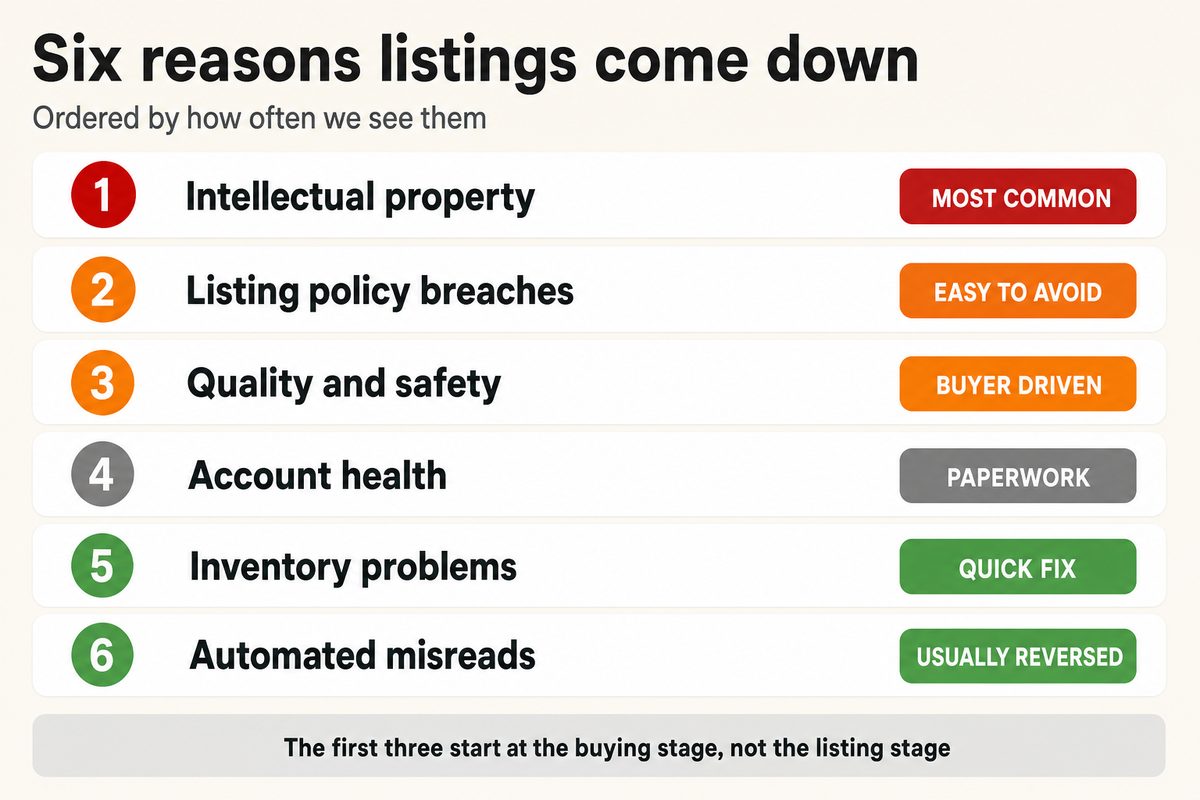
We are a sourcing company. Most of the removals we see start at the buying stage, not the listing stage, and that is the angle this page takes.
Intellectual property: the biggest single cause
This accounts for more removals than anything else, and new sellers hit it hardest because most of it is unintentional.
Trademark
A trademark protects brand identifiers — words, logos, patterns, sometimes even sounds. Using one without permission is infringement, and it does not need to be deliberate.
Obvious cases: writing a famous brand name in your title, printing a logo close to a well-known one, using a protected brand word even when your product is unrelated.
The trap most sellers miss: ordinary words can be registered trademarks within specific categories. A plain descriptive word that seems safe may be protected for the exact category you are selling in. Search the word in the trademark database for your category, not just as a general term.
Patent
Design patents cover how a product looks; utility patents cover how it works. Both cause removals, and both catch sellers who never copied anything.
Two things worth knowing. A design patent can be triggered by close resemblance rather than an exact copy, and changing the material does not necessarily help — if it looks like the protected design, that is what gets compared. And a patent under application does not show up in any search. Products listed during that window can be removed later, once the patent is granted, even though your research genuinely showed nothing.
Copyright
Copyright covers original material: photos, listing text, artwork, video. The common failures are copying a competitor’s images or descriptions, and printing licensed characters on products without rights to them.
Partial copying is still copying. Cropping an image, changing its colour, or rewording a description while keeping its structure can all be judged substantially similar.
Policy violations on the listing itself
These are the easiest to avoid and the easiest to trip over, because they are about wording rather than the product.
Restricted and gated products
Some categories cannot be sold without approval or paperwork, and listing first and sorting it out later does not work — the listing comes down and the certificate cannot be produced retroactively.
Anything intended for children is the most common case for sourcing buyers. Toys, children’s clothing and children’s furniture carry testing requirements in most markets. Electrical goods, anything claiming a medical benefit, and products containing batteries also commonly need certification before they can be listed.
The rule that matters: the requirement belongs to the market you sell into, not to your supplier. A factory exporting worldwide can still hand you goods your marketplace will not accept.
Review and ranking manipulation
Paying for reviews, inserting review requests into packaging, or using services that promise ranking improvements. These lead to account-level consequences rather than just a removed listing, which makes them the most expensive mistake on this page.
Worth flagging because packaging inserts are often added by the factory as a helpful extra. Check what is going into the box.
Quality and safety
These removals are driven by buyer behaviour rather than by a rule you broke, which makes them harder to see coming.
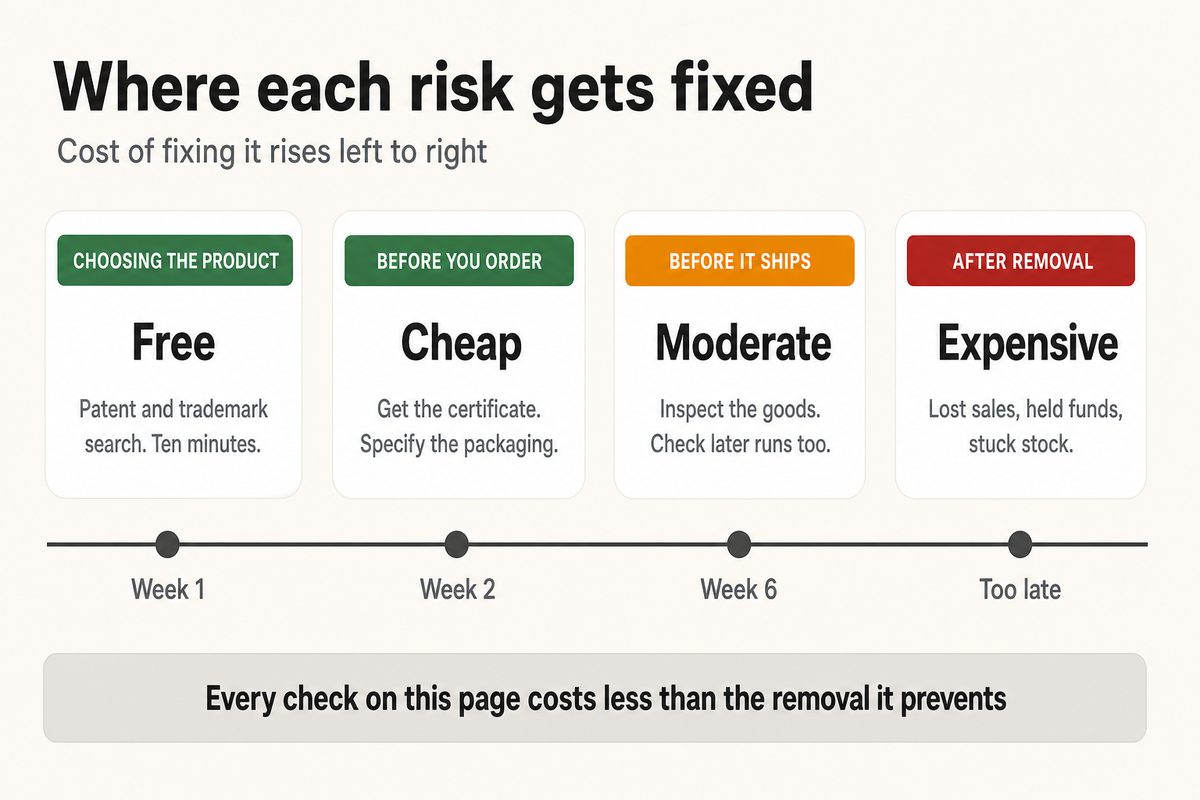
All three trace back to the order rather than the listing. Which is why the checks below happen before you buy, not after.
Account health, inventory and misfires
Three smaller causes that are worth knowing because the fixes are quick.
Account health. A poor account rating or a string of past violations can take products down even when the product itself is fine. Mismatched business details — a registered address that does not match your tax records — also flags accounts. Fixing your paperwork is dull and takes an afternoon.
Inventory. Long periods out of stock can suspend a listing, as can a count that does not match what the warehouse holds. Both are recoverable by restocking or reconciling.
Automated misreads. Amazon’s systems scan listings, and they sometimes get it wrong — a word that partially matches a brand name, or a phrase that makes a product look like it is aimed at children when it is not. These are frustrating but usually resolve quickly once you point out the error, because there is no actual violation to argue about.
The removals that start with your supplier
This is the part most articles skip, and it is where a sourcing company can be more useful than a seller-tactics blog.
1. The product infringes and they knew
Factories copy popular designs. A supplier offering a product that closely resembles a well-known one, at a suspiciously good price, is a risk you are taking on. Ask directly whether they hold rights to the design, and get the answer in writing.
2. The certificate does not exist
“We have all certificates” is not a certificate. Ask for the document, check the date, and check it names the product you are buying and the factory making it. Reports get reused across products they do not cover.
3. Packaging inserts you did not ask for
Cards asking for reviews, or offering a gift in exchange for feedback, are sometimes added by the factory. This is an account-level violation and you may not know it happened until it does. Specify what goes in the box.
4. Quality drift after the first order
The sample is good, the first run is fine, the third run is thinner. Complaint-driven removals often follow a material change nobody told you about. Inspecting later runs, not just the first, is what catches this.
Checking who you are dealing with upfront prevents most of this. Our guide to running a background check on a supplier covers what to look for, and what suppliers say and what they actually mean covers the specific claims worth pushing on.
Getting a listing back
Most removals are recoverable. The sellers who take longest are the ones who appeal before they understand what they are appealing against.
What not to do: submit the same appeal repeatedly, argue that the rule is unfair, or open a second case while the first is open. All three slow it down.
One thing worth accepting early: some removals are not worth reversing. If the product needs certification you cannot get, or the design genuinely infringes, the faster answer is to clear the stock and move on rather than spend six weeks appealing something that will not be granted.
A checklist before you order
Everything here happens before money moves, which is the only stage where fixing it is cheap.
Ask us what will get this removed
Send the product, the market you sell into, and the supplier you are considering. You will get an honest read on what certification that market needs, whether the design looks risky, and what to write into the order so the packaging does not create a problem.
Get a straight answerCommon questions
Why was my Amazon listing removed with no warning?
There is almost always a notification in Seller Central naming the category of the problem, even when the email is vague. Start there, because the fix differs completely depending on whether it is intellectual property, a policy issue, a certification gap or an inventory problem.
Which products need certification before I can list them?
It depends on your market, not your supplier. Children’s products, electrical goods, anything with batteries and anything making a health claim commonly require documentation. Confirm what your destination country requires before ordering, and ask the supplier for that exact document.
Can my supplier get my listing removed?
Yes, in several ways. Supplying a design that infringes someone else’s rights, providing certificates that do not cover your product, adding review-request cards to packaging, or quietly changing materials on a later run. All of these show up as your violation.
Is copying a competitor’s product description really a problem?
Yes. Listing text is covered by copyright, and rewording while keeping the structure can still be judged substantially similar. It is also one of the easier violations to detect automatically. Write from the product itself.
What if Amazon removed my listing by mistake?
Automated scans do misread listings — a word that partially matches a brand, or phrasing that makes a product look like it targets children. These usually resolve quickly once you explain the error, because there is no real violation to dispute.
How long does an appeal take, and how many can I submit?
There is no fixed timescale, and anyone quoting you one is guessing. What does matter is quality over quantity — submitting the same appeal repeatedly makes each one less likely to succeed. Fix the underlying problem, submit once with documents attached, and wait rather than opening a second case.
How do I stop review-request cards ending up in my packaging?
Specify in the order exactly what goes in the box and that nothing else does. Factories sometimes add inserts as a helpful extra, and this is an account-level violation you may not discover until it causes one.
Where to go from here
If a listing is down right now, identify the stated reason first and work the specific fix. If it names a patent, the patent complaint process is a separate path and worth reading before you reply to anyone.
If nothing is wrong yet, the useful work is at the buying stage. Our step-by-step guide to buying from China covers where these checks fit into the wider process — choosing a product, checking the supplier, and getting the paperwork before the goods ship rather than after.
Questions & Comments
We read every one and reply within 24 hoursHad a listing come down and not sure which category it falls into, or want a second opinion before you appeal? Post what the notification says below and I will tell you how I would read it.