
Is Alibaba Legit? What the Badges Do and Do Not Prove
 ·
Updated August 24, 2026
·
Updated August 24, 2026
Yes, Alibaba is a real company and a real marketplace. That is the easy part of the answer, and it is also the part that helps you least. The useful question is not whether the platform is legitimate — it is whether the specific supplier in front of you is, and how you find that out before your money moves.
This page answers both. First the honest version of “is Alibaba legit”, then the checks that actually separate a real factory from a well-dressed listing.
Alibaba is legitimate. It is a listing platform, not a shop — so the platform being real tells you nothing about any individual seller. Every badge you see was either bought or self-declared. The checks below are the ones that are not.
What Alibaba actually is
Alibaba.com is a business-to-business listing site. Factories and trading companies post what they can make; buyers contact them and negotiate directly. The platform hosts the listings, handles some payments, and stays out of everything else.
That last part matters more than people expect. Alibaba does not stock, inspect, or ship your goods. Compare that to a normal online shop, where the shop owns the product and carries the responsibility. Here the platform is closer to a directory with a payment system attached.
People also mix it up with AliExpress. Same parent company, different job: AliExpress sells single items to consumers, Alibaba handles bulk orders between businesses. If you are buying one of something, you are on the wrong site. Temu and AliExpress compared covers the consumer end.
So is it legit?
The platform, yes. Alibaba Group is a public company, one of the largest in the world, and millions of orders run through the site without incident.
But «is Alibaba legit» is usually asked by someone about to send money to a stranger in another country, and for that person the honest answer is more useful than the reassuring one:
The platform is legitimate. Some sellers on it are not. Nobody stops a trading company from describing itself as a factory, and nobody checks that the photos on a listing show a building the seller has ever entered.
This is not unique to Alibaba. Any open marketplace has the same shape. The difference is that here you are wiring several thousand dollars to a company you cannot visit, in a country whose business records you cannot read, which raises the cost of getting it wrong.
So the platform question is settled. The rest of this page is the supplier question.
What the badges actually mean
Most buyers use the badges as a shortlist filter. That is reasonable — but only if you know what each one is telling you, because none of them means “this supplier is honest”.
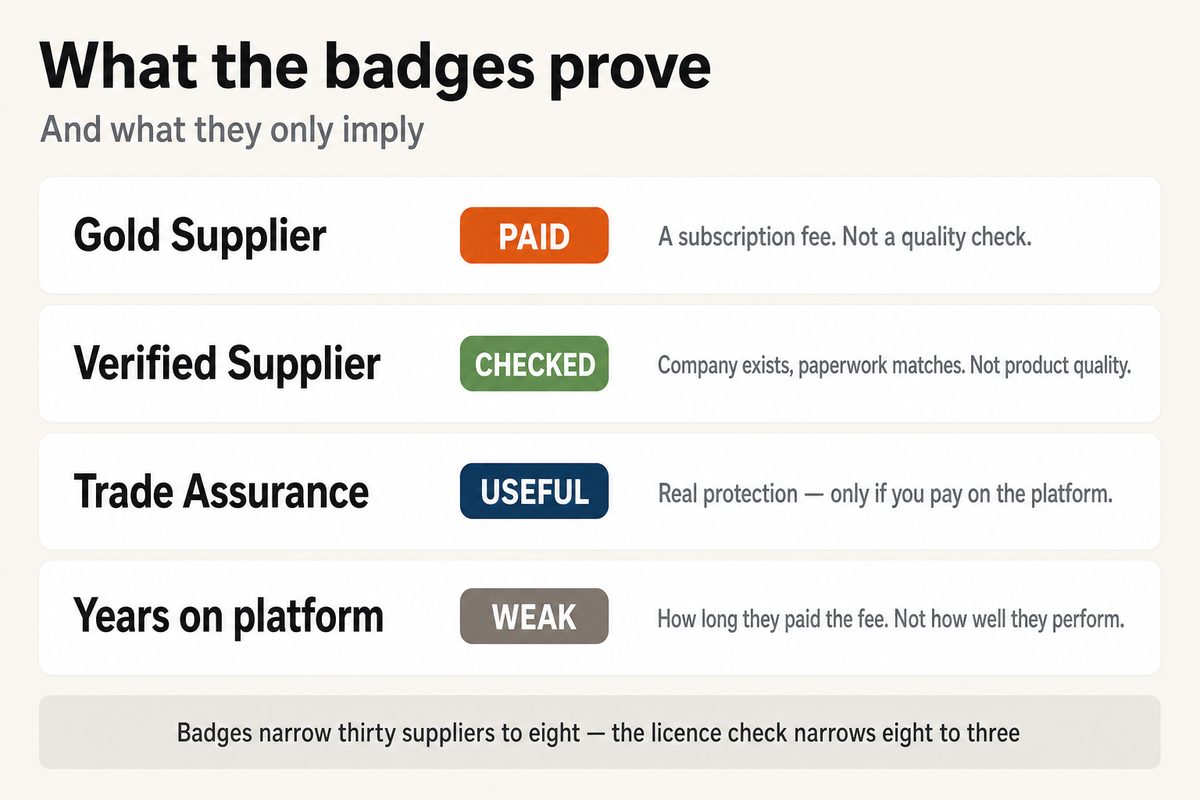
Gold Supplier
This is a paid subscription. It means the seller pays Alibaba an annual fee for better placement and more listings. It is a marketing spend, not a quality check. A supplier in their first month can have it.
Verified Supplier
A third party confirmed that the company exists and that some stated details are accurate. Genuinely useful — it rules out pure fiction. But it confirms existence and paperwork, not whether they can make your product well.
Trade Assurance
The most useful of the four, and the most misread. It protects orders placed and paid through the platform, against the terms written in that order. Move the conversation to WhatsApp and pay by bank transfer, and it covers nothing.
Years on the platform
Shows how long they have paid for membership, not how long the business has existed or how well it performs. A five-year seller with poor quality keeps the badge as long as the fee clears.
None of this makes the badges worthless. Use them to narrow a list of thirty down to eight. Just do not treat the shortlist as a verified list — the real checking starts after.
The check that settles it in two minutes
Here is the single most useful thing you can do, and most buyers never do it.
Ask for the business licence and read the business scope line.
Every registered Chinese company has a licence stating what it is permitted to do. That line is not marketing copy — it is a registration record, and it settles the factory-or-trader question immediately.
If the business scope includes 生产 (production / manufacturing), it is a factory. If it lists only 销售 (sales) or 贸易 (trade), it is a trading company. You do not need to read Chinese — paste the line into any translator and look for those words.
Two more things worth reading on the same document:
A supplier who will not send the licence has told you something useful. A real factory sends it without hesitation — it is a routine document, not a secret.
You can also look the company up in China’s public registration records to confirm the licence matches what is filed. Running a background check on a supplier walks through how.
A second check that costs nothing
Run the listing’s factory photos through a reverse image search. It takes about a minute and tells you whether those photos belong to this seller.
Stock photos of a generic production line, or images that turn up on twenty other listings, do not prove dishonesty — plenty of small traders use whatever pictures they were given. But it does tell you the photos are not evidence of anything, so you should stop treating them as evidence.
The stronger version of the same idea: ask for a short video walk-through of the line making your product type, filmed now rather than sent from a folder. A factory can do this on a phone in five minutes. A trader has to ask someone else, and the delay itself is informative.
Trading company is not the wrong answer
Once people learn to spot trading companies, the instinct is to avoid them. That is usually a mistake.
A good trading company earns its margin. It has relationships with factories that would not take your 500-unit order directly, and it absorbs the coordination you would otherwise do yourself.
The problem is never that a supplier is a trading company. It is not knowing that they are — because then you are paying a middleman margin while believing you are at the source, and you cannot tell who actually controls quality when something goes wrong.
Warning signs that are worth acting on
Some are obvious. These are the ones that look reasonable at the time.
1. Moving you off the platform early
A supplier suggesting WhatsApp or email before you have agreed anything is normal in itself — but if the payment also moves off-platform, your Trade Assurance protection disappears with it. Keep the order on the platform even if the chat is elsewhere.
2. A price well below everyone else
If four quotes cluster together and one is 40% lower, that gap is real and it comes from somewhere: thinner material, a different component, or a price that rises after the deposit clears. Ask what specification the low quote is based on.
3. Confident answers with no numbers
“Yes, no problem, we can do it” to every technical question. A factory that makes your product will volunteer specifics — tolerances, material grades, what they cannot do. Vagueness usually means they intend to subcontract it.
4. Reluctance about samples or inspection
Both cost the supplier time, so mild resistance is normal. Firm refusal is not. A supplier confident in their output has no reason to keep an inspector out of the building.
5. Certificates for a similar product
Test reports are issued per product, not per factory. A certificate for a related item does not cover yours. Check that the product named on the report is the one you are buying.
How to actually order safely
The protection is not one decision. It is the order you do things in.
Step five is the one people skip, and it is the only one that is genuinely hard to recover from. The standard terms are 30% deposit and 70% before shipment — the timing of that 70% is your entire negotiating position. How the deposit and balance work explains the mechanics.
If something does go wrong
Your position depends almost entirely on two things you decided earlier: whether the order went through the platform, and whether you have already paid in full.
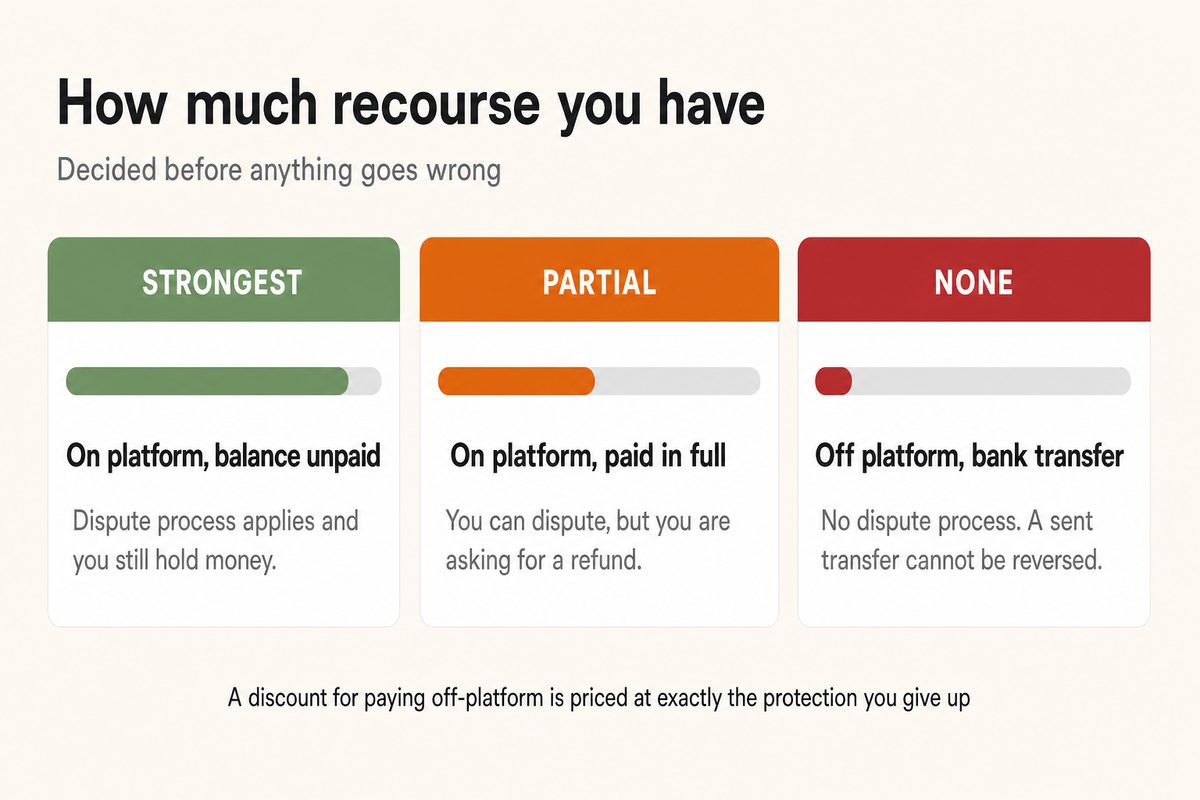
This is the practical argument for keeping the first order on the platform even when the supplier offers a discount to move off it. That discount is priced at exactly the value of the protection you are giving up.
Send me the listing before you pay the deposit
Paste the Alibaba link, the quote, and what they told you about their factory. You will get back a straight read on whether the story holds together — and if it does not, which part does not.
Send an enquiryWhere to go next
Common questions
Can I get scammed on Alibaba?
Yes, and the most common version is not dramatic. It is goods that arrive slightly wrong — thinner material, different finish, a component swapped for a cheaper one — from a supplier who is still answering messages. Outright disappearance happens but is rarer, and it almost always follows an off-platform bank transfer.
Is Trade Assurance real protection?
Yes, within limits worth understanding. It covers orders placed and paid through the platform, judged against what the order document says. Two things break it: paying outside the platform, and an order that describes the goods too vaguely to enforce. Write the specification into the order itself.
Are Verified Suppliers safe to buy from?
Safer than unverified, but the badge confirms the company exists and its paperwork checks out — not that it makes good products. It rules out the fictional, not the mediocre. Use it to shortlist, then check the business licence yourself.
Should I avoid trading companies?
No. A good trading company handles small and mixed orders that factories decline, and manages the export paperwork properly. The risk is not dealing with one — it is dealing with one that told you it was a factory, because then you cannot tell who controls quality. The business licence answers this in two minutes.
What is the safest way to pay?
Through the platform, with the balance held until after inspection. Bank transfer is standard in the trade and fine once you know a supplier, but it offers no recourse on a first order. Consumer transfer services and personal accounts should be a hard no — a real company invoices from a company account.
Is Alibaba cheaper than dealing with a factory directly?
Not necessarily. Listing prices are opening positions, and many sellers on the platform are traders adding a margin. Direct factory pricing is usually lower, but factories want larger orders and less hand-holding. The platform is buying you access and convenience, not automatically the lowest price.
Questions & Comments
We read every one and reply within 24 hoursLooking at a supplier right now and something feels off? Paste the details below — the badges they show, what they said about their factory, or the quote itself. I read every one of these.