
Water Pump Manufacturer: The Part No Clause Names
 ·
Updated October 22, 2026
·
12 min read
Every article in this series has ended with the document that decides the product. A tyre has its own standard moulded into it. A wiper blade leans on a system standard it can never be named in. A jack has a workplace rule with a stamp in it, a tire changer has a hazard sentence, an extinguisher has a test result, a cargo net has a formula, an exhaust has a label. This one is different again, and it is the last shape in the set: nothing names a water pump. No marking duty, no listing, no rating, no workplace rule. What decides whether the part is any good is a test nobody is required to run — which means the specification is not something a buyer looks up. It is something a buyer writes.
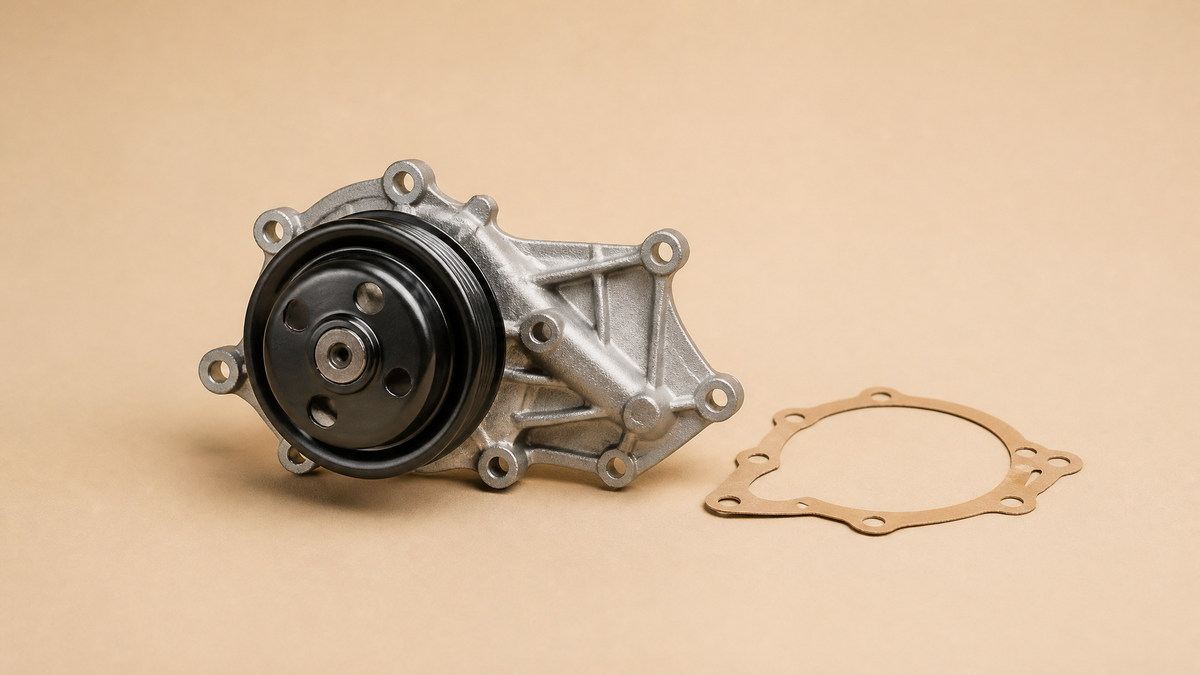
1. The Part No Clause Names
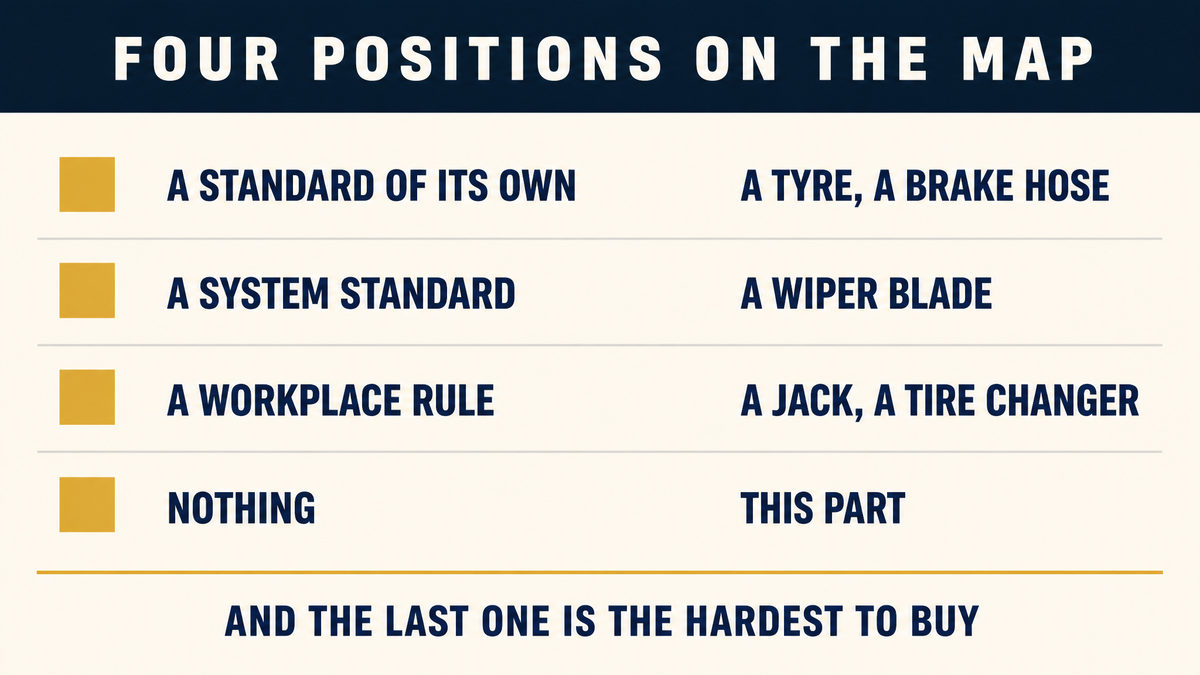
It helps to see where this product sits, because the series has now covered every position on the map. There are parts with a standard of their own: a tyre under its marking rule, a brake hose under a performance rule, a rim under a marking duty. There are parts covered only through the system they belong to: a wiper blade under the wiping standard, which writes its requirements on the vehicle. There are machines covered by a workplace rule: a jack, a tire changer. And there is this: a component whose failure is a roadside breakdown, which no federal standard and no workplace regulation names. The list of rules that could is public, and it takes ten minutes to see the gap.
Two things follow, and both change how an order document should be written. First, there is no mark to check. Nothing requires a water pump to carry a rating, a symbol, a serial number or a date. So the usual shortcut in this trade — photograph the mark, read the number, compare it with the document — is not available. Second, there is no failure the record is obliged to count. A pump that weeps at 40,000 miles is a warranty claim, not a recall, and the owner pays for it.
That leaves one honest source of evidence, and it is not a document at all. It is a test the buyer commissions, on a sample, before the batch is made. The rest of this article is about what that test should contain and what the four parts inside the casting have to survive.
2. Four Things That Decide It
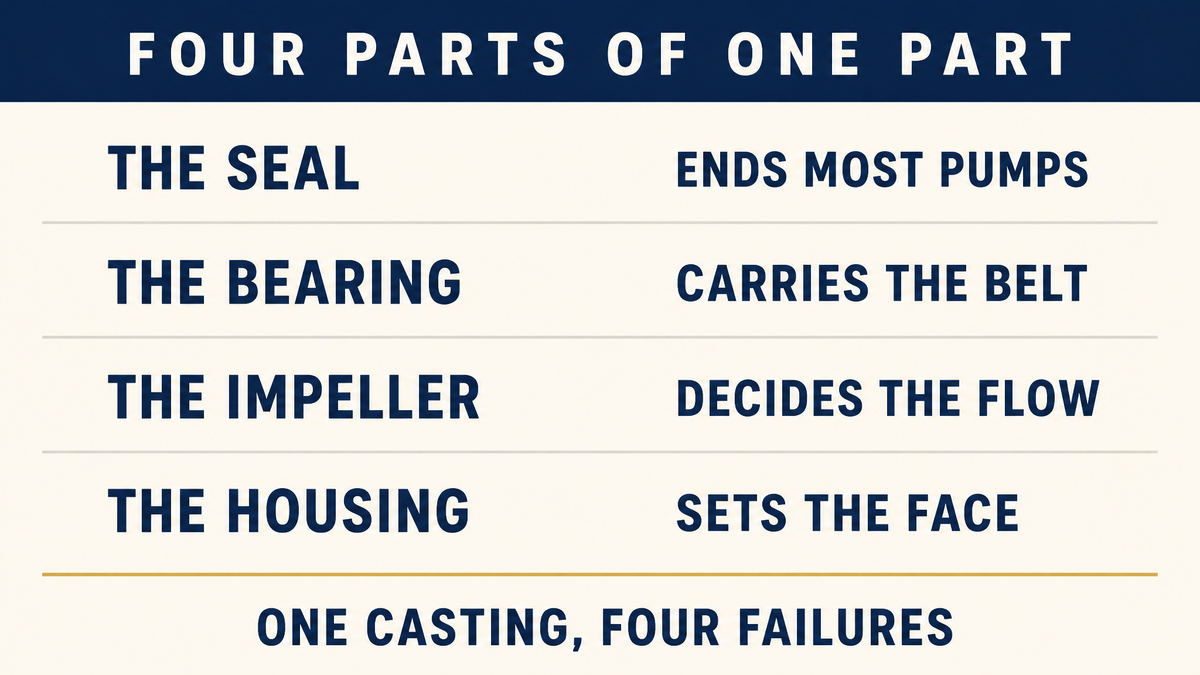
A water pump looks like one part and behaves like four. Each of them fails in its own way, and each has a question a buyer can ask that a catalogue cannot answer.
The seal. This is the part that ends most pumps, and it is the cheapest component in the casting. The question is not whether there is a seal but which type: a mechanical seal with two lapped faces, or a lip seal running on the shaft. Ask what the faces are made of, what the spring is made of, and whether the design has a weep hole between the seal and the bearing so that a leaking seal shows itself before it reaches the grease.
The bearing. A pump bearing carries a radial load from the belt and a thrust load from the impeller, in a housing that heats and cools every day. Ask for the bearing's clearance class and its grease fill, and ask whether the shaft and bearing are a matched assembly pressed as a unit or assembled by hand. The second answer is the one that shows up as noise at 30,000 miles.
The impeller. Three kinds are sold: cast iron, stamped steel, and moulded plastic. They differ in how they wear when the coolant is old, how they cavitate at high speed, and how they fail when they fail — a plastic impeller can lose its vanes quietly while the shaft still turns. Ask for the material, the vane count and the clearance to the housing, which is the number that decides flow.
The housing and the gasket face. A cast aluminium body has a machined face, and the flatness of that face is what the gasket depends on. Ask how the face is checked after machining, and ask what the gasket is made of, because a paper gasket and a moulded rubber one fail differently at the same temperature.
3. The Test You Commission
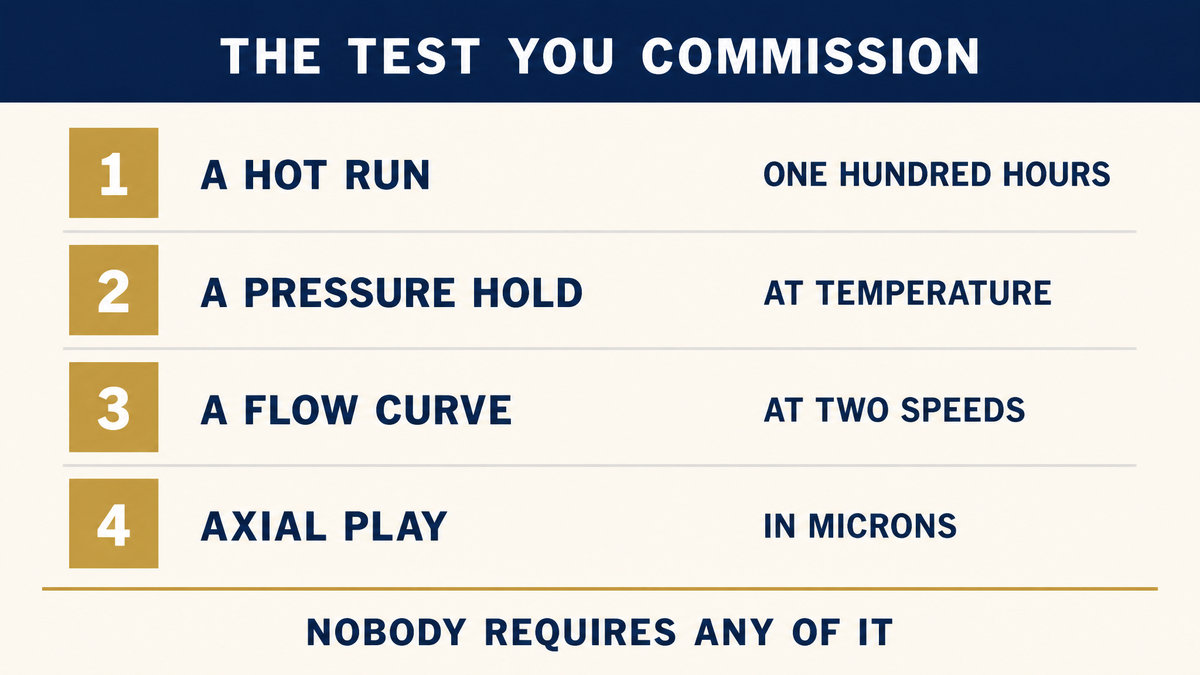
If no rule requires a test, the test has to come from the order. Four measurements cover what the four components do under load, and all four can be run on a bench by a third party inside a week.
A hot run. The pump circulating coolant at the temperature the engine sees, long enough for the seal and the bearing to reach their working temperature. A hundred hours is a common figure for a first article, and the point is that the sample is still hot when the next three measurements are taken.
A pressure hold, at temperature. A cold pressure test passes pumps that fail hot, which is why the hold belongs after the hot run: cap the outlet, apply the pressure the cap is rated at, and watch for a drop across a fixed period.
A flow curve at two speeds. Flow at idle and flow at speed, against the head the system imposes. One point proves nothing; two points show whether the impeller is doing its job or merely turning.
Axial and radial play. Measured on the shaft after the hot run, in microns. It is the only number in the set that predicts bearing noise before the noise arrives.
None of that is novel engineering. What is unusual is that nobody requires it — not a standard, not a regulator, not a listing body. So it is either written into the order or it does not happen, and the sample that reaches a buyer is the sample a factory chose to send.
4. The Seal, Specifically
If one component decides whether a pump reaches its second timing belt, it is the seal, and the reason is that the seal is the only part of the pump that lives in two environments at once. On one side is coolant, which is water with an additive package and a pH that drifts as it ages. On the other side is a bearing packed with grease. Everything between them is a pair of faces or a lip, and both designs fail in ways that look identical from outside.
Ask a supplier which design they use and the answer tells you what you are buying. A mechanical seal has two lapped faces pressed together by a spring, and it tolerates pressure better but punishes misalignment and dry running. A lip seal runs on the shaft and depends on the shaft's surface finish, which is why the grinding of the shaft is a specification rather than a detail. Neither is automatically better. What matters for a buyer is that the design is stated, because the two fail at different mileages under the same duty.
Then ask the question that separates a pump designed to be diagnosed from one designed to hide. Is there a weep hole between the seal and the bearing? A pump with one shows coolant at the housing when the seal begins to pass, which gives the owner a warning. A pump without one lets the coolant travel into the bearing and announces the problem as a noise, by which time the shaft, the bearing and often the belt are gone.
The last seal question is about the spring. Coolant is corrosive, and a spring that rusts loses its face pressure before the faces wear out. Ask what the spring material is and whether it is isolated from the coolant path. A supplier who cannot answer has not thought about it, which is itself the answer.
5. The Pulley, the Belt and the Line
Fitment in this category has a trap that does not exist in most of the series. A pump can bolt on perfectly and still be wrong, because the pulley diameter sets the speed at which the impeller turns. Match the bolt pattern and the outlet orientation and the part looks right. Change the pulley by a few millimetres and the pump runs at a different speed, which changes the flow at idle and the load on the bearing at speed.
So the drawing matters more than the photograph, and four dimensions belong on it: the pulley diameter measured across the groove, the groove profile that matches the belt, the pulley offset from the mounting face so the belt runs in line, and the mounting face flatness. A supplier quoting from a photograph of an old pump is quoting a shape. A supplier quoting from a drawing with those four numbers is quoting a part.
Two more fitment facts belong in the order because they are invisible after installation. The inlet and outlet orientation has to match the hose runs, and the gasket face has to be the same profile, because a gasket that is close but not identical will seal cold and weep hot. Both are cheap to confirm and expensive to discover.
6. What the Price Difference Is Buying
Two quotations thirty per cent apart are rarely the same design, and the gap is almost always in five places. Knowing them turns a price argument into a specification argument.
The impeller. Stamped steel is the cheapest and the thinnest; cast iron wears better in dirty coolant; moulded plastic is light and quiet until it is not. The seal. A lip seal and a mechanical seal are different products with different costs. The bearing. Bearing grade is a real line item, and a cheaper grade is often the difference between a quiet pump at 60,000 miles and a noisy one at 25,000. The machining. A gasket face that is milled and checked costs more than one that is cast and brushed. The gasket itself. Paper, composite and moulded rubber have different costs and different failure temperatures.
There is a simple way to use that list in a negotiation. Ask the supplier to price the same part twice: once as quoted, and once with the better seal, the better impeller and the checked face. The difference between those two prices is the cost of the design, separated from labour, packaging and freight. It is usually smaller than buyers expect, and it is the most useful number in the whole conversation.
7. What the Record Says
Method first. The federal recall file holds 245,845 records, has no header row, and every field is scanned. Controls: brake 28,639, air bag 16,162. Twenty-five terms were counted, and three came back at zero.
| Term | Records | Campaigns |
|---|---|---|
pump | 11,978 | 502 |
impeller | 83 | 14 |
seal | 1,457 | 213 |
bearing | 3,739 | 195 |
coolant | 886 | 116 |
thermostat | 26 | 3 |
radiator | 197 | 32 |
hose | 3,221 | 430 |
leak | 13,524 | 1,456 |
shaft | 3,057 | 411 |
housing | 2,094 | 242 |
gasket | 252 | 36 |
pulley | 197 | 29 |
belt | 14,327 | 808 |
fan | 1,105 | 95 |
overheat | 9,229 | 607 |
cap | 2,228 | 171 |
cooling | 6,339 | 675 |
engine | 22,834 | 1,660 |
water | 4,507 | 510 |
corrosion | 3,294 | 342 |
dealer | 41,528 | 505 |
cavitation | 0 | 0 |
weep | 0 | 0 |
boil | 0 | 0 |
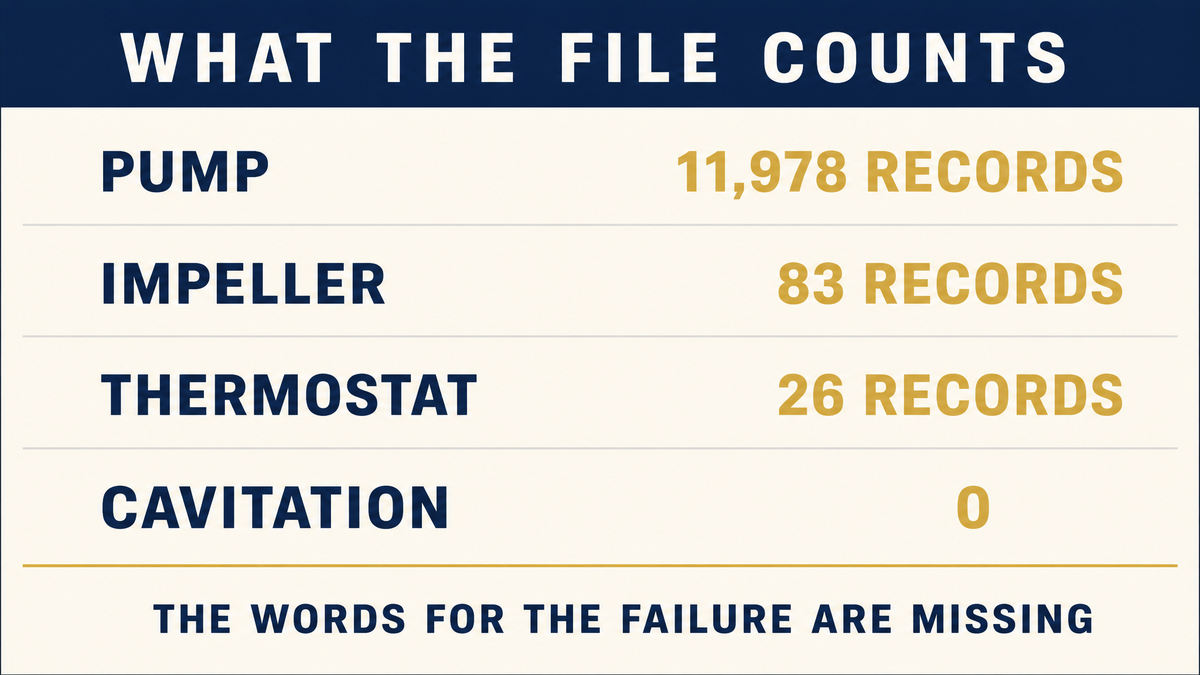
The pump is in the file, and it is somebody else's pump. pump reaches 11,978 records across 502 campaigns, and the largest rows are fuel pumps: a DENSO campaign at 2,483,801 units under the fuel pump heading, another DENSO at 2,156,057, a Hyundam at 183,323. The word in this file means the part that moves fuel, not the part that moves coolant.
The cooling system is a small corner. Headings containing cooling run from engine and engine cooling: engine at 1,159 campaigns down to cooling system: fan at 134, cooling system: hoses and lines at 124 and the plain cooling system heading at 93. There is no water pump heading at all. The component that fails most often on that loop does not have a column.
The three zeros are the failure vocabulary. cavitation, weep and boil return nothing across a quarter of a million records, while overheat reaches 9,229 and leak 13,524. So the file records the symptom a driver reports and not the mechanism that caused it — which is exactly the gap this article has to fill with a bench test, because no record will tell a buyer what a seal did at temperature.
The finding. Everything about this product sits outside the record and outside the rule. The word that names it belongs to a different part, the component heading does not exist, and the three words for how it fails are zero. That is not a gap in the data; it is the shape of a category where nobody writes the standard. The specification can only come from the buyer, and the only place it can live is the order document and a test report.
8. Five Questions a Water Pump Quote Should Answer
A quotation in this category usually arrives as a part number crossed to an engine list, a quantity and a price. Four of the five questions below are about what is inside the casting, and the fifth is about the drawing.
- Which seal design, and is there a weep hole? A mechanical seal with lapped faces or a lip seal on a ground shaft. Either is acceptable; not knowing which is not. The weep hole is what turns a seal failure into a warning instead of a bearing failure.
- Which bearing grade, and is the shaft pressed as a matched assembly? The bearing carries the belt load and the impeller thrust in a housing that cycles in temperature every day. The assembly method is what shows up as noise at 30,000 miles.
- What is the pulley diameter, the groove profile and the offset, on the drawing? These three numbers decide the pump speed and the belt line. A pump that bolts on and runs at the wrong speed is the silent failure in this category.
- What did the hot test show, and who ran it? Hours at temperature, pressure held at temperature, flow at two speeds, and the axial play afterwards. A cold pressure test is not the same test.
- What does the better-specified version cost, side by side with the quoted one? Better seal, better impeller, checked face. The difference is the cost of the design, and it is usually the smallest line in the quotation.
9. Six Lines to Put in the Order
Everything above reduces to six lines, and every one of them is a line a factory can answer in writing before a sample is made.
| Line | What to write | Why it is on the list |
|---|---|---|
| 1 | The seal type, its face materials and its spring material | The seal ends most pumps, and the spring is what keeps it working |
| 2 | A weep hole, and where it drains | It converts a seal failure into a warning |
| 3 | The bearing grade and the shaft assembly method | Noise at 30,000 miles is decided here |
| 4 | The pulley diameter, groove profile and offset, on the drawing | It sets the speed, and the speed sets everything |
| 5 | The hot test: hours, temperature, witness | Nobody requires it, so it only happens if written |
| 6 | Two prices: as quoted, and better specified | It separates the design cost from labour and freight |
Five of the six lines are about what is inside the casting, which makes this the most design-heavy row in the series. There was no mark to photograph, no scope to read and no formula to run, so the specification had to be built from a seal, a bearing, an impeller and a drawing.com/factory-audit-checklist-guide/" target="_blank" rel="noopener">how an audit reads a bench report is where a claimed test becomes evidence, and the carton that keeps a gasket flat is where the face survives the trip — with how a pump's packed volume decides the freight worth settling at the same time, because a casting is dense and a carton of them is heavier than it looks.
Frequently Asked Questions
Is there a federal standard for a water pump?
None of the standards read for this series names one. There is no marking duty, no rating, no listing requirement and no workplace rule that reaches the part. That is unusual even in this batch: a jack at least had a stamping rule, and a tire changer had a guarding sentence. A water pump has nothing, which is why the specification has to be written by the buyer.
How does a water pump fail?
Usually at the seal first, then at the bearing. Coolant reaches the bearing through the same housing, so a seal that passes quietly takes the bearing with it. A pump with a weep hole between the two gives the owner a visible warning; one without it announces the problem as a noise, by which time the shaft and often the belt are finished.
What test should I ask a supplier for?
Four measurements on a bench sample: a hot run with coolant at working temperature, a pressure hold taken at that temperature rather than cold, a flow curve at idle and at speed, and axial and radial play on the shaft measured after the hot run. None of it is required by any rule, so it has to be written into the order.
Why does the pulley diameter matter?
Because it sets the speed at which the impeller turns. A pump can match the bolt pattern, the outlet orientation and the gasket face and still be wrong, if the pulley diameter or the offset puts the belt line in a different place. That changes flow at idle and the load on the bearing at speed, and nothing about the outside of the part shows it.
Is a mechanical seal better than a lip seal?
Neither is automatically better. A mechanical seal with two lapped faces tolerates pressure but punishes misalignment and dry running; a lip seal depends on the finish of the shaft and costs less. What matters is that the design is stated, because the two fail at different mileages under the same duty and they are not interchangeable in a specification.
What actually drives the price difference between two quotes?
Five things: the impeller material, the seal design, the bearing grade, whether the gasket face is machined and checked, and the gasket material itself. Asking the same supplier to price the part twice, once as quoted and once better specified, isolates the cost of the design from labour, packaging and freight.
The water pump is where the search ends. Every other part in this segment could be traced to a sentence somewhere; this one cannot. No FMVSS names it, no inspection item tests it, and the recall file discusses the engine around the casting rather than the casting itself.
That is not a gap to be closed with a certificate. It is a gap to be closed with a drawing: seal face, bearing, impeller clearance and housing flatness, each carrying a number and a method of measuring it.
The Test You Commission, Written as a Brief
We return the four factors that decide the pump, the seal specification, and the bench brief with its pass criteria.
Write My Test Brief
Questions & Comments
We read every one and reply within 24 hoursThere is no clause for a water pump, which is why every serious quotation ends up as a drawing. Send the engine and the duty point, and we will write the four dimensions.