
Head Gasket Manufacturers: The One Joint That Has to Hold Three Things at Once
 ·
Updated October 15, 2026
·
12 min read
Most gaskets in a vehicle seal one thing. A head gasket seals three, and it does so in a joint that is moving. Combustion pressure pushes outward from every cylinder; oil arrives under pressure from the galleries; coolant circulates a few millimetres away. All of it passes across a single sheet of material clamped between a cylinder head and a block that expand at different rates as the engine warms. It is the hardest sealing job on the vehicle, and it is the one part in this series whose federal record describes the same engine failing the same way three times in nineteen months.

1. One Joint, Three Fluids, and Three Different Pressures
A head gasket sits between the cylinder head and the engine block and seals everything that crosses that interface. The engineering problem is that the three things crossing it are not comparable.
Combustion pressure is a cyclic pressure spike that rises and falls with every firing stroke, and it is orders of magnitude above anything else in the engine. It tries to lift the head off the block and force its way sideways out of the joint.
Oil arrives from the galleries at the engine's normal oil pressure, and it is looking for any path into a coolant passage or out of the engine.
Coolant sits under the pressure the filler cap allows, and it is looking for any path into a cylinder, where even a small amount becomes a misfire and eventually a hydraulic lock.
The complication is that the joint is not rigid. The head is usually aluminium and the block may be iron or aluminium, so the two grow at different rates as the engine heats. The gasket therefore has to accommodate relative movement while maintaining a seal against a pressure spike that arrives thousands of times a minute — and it has to do this while the clamping load on it changes with temperature.
| The element | What it decides | What a vague quote hides |
|---|---|---|
| The construction | Which surface finish it needs to seal | Layered steel or composite, and the finish it assumes |
| The compressed thickness | Head height, compression ratio and clearances | The thickness and its tolerance |
| The combustion sealing rings | Whether the joint holds the pressure spike | Ring material and its forming |
| The coating | Whether it seals at low clamping load | Coating type and coverage |
| The clamping load | Whether any of the above can work | The bolt specification and the sequence |
What this guide covers
- One joint, three fluids, and three different pressures
- The inspection standard does not look at it
- What one engine produced in nineteen months
- Construction is matched to the surface
- Thickness is a dimension, not a detail
- What a cheap head gasket quote leaves out
- What to check on a sample
- Where the unit price comes from
- Frequently asked questions
2. The Inspection Standard Does Not Look at It
As with the rest of the engine, there is no federal inspection provision to fall back on. The in-use inspection standard is organised as one section per system, and its sections cover brakes, brake power unit, steering, suspension, tyres and wheel assemblies. There is no engine section, and therefore no figure, marking or test that a head gasket must satisfy at inspection.
That is worth stating plainly because it shapes the whole specification. Nothing outside the vehicle will check this part. Whether it seals is discovered by the person who fitted it, and the consequences of it not sealing are discovered later and at greater cost.
3. What One Engine Produced in Nineteen Months
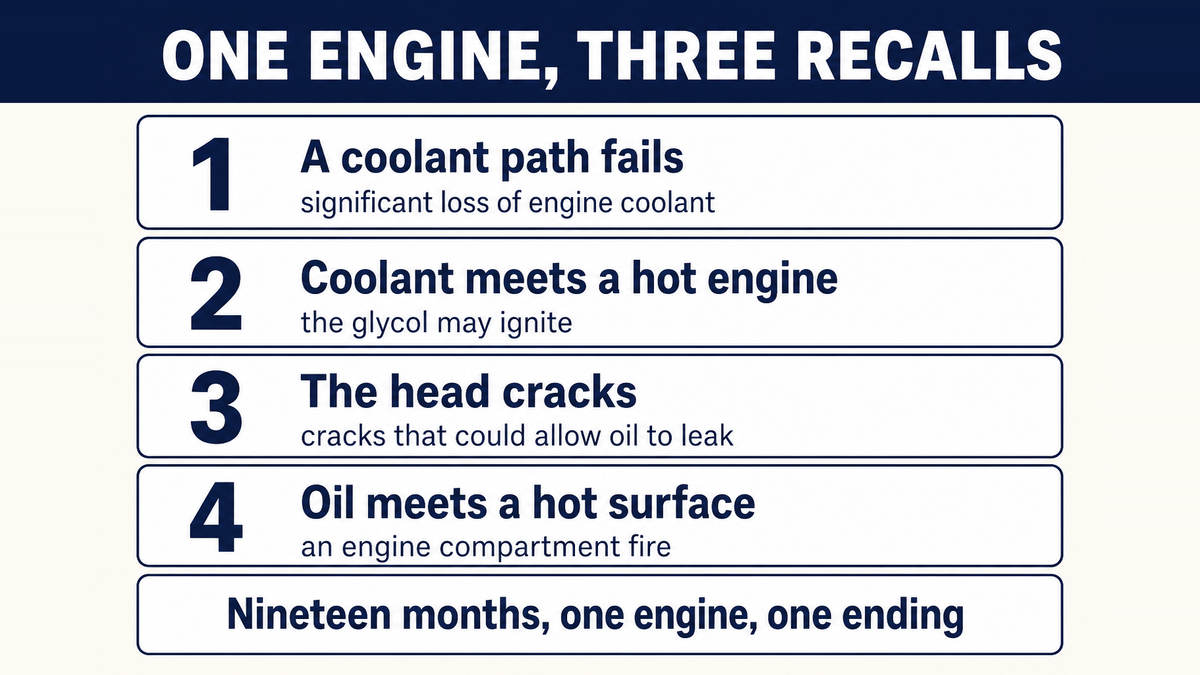
The clearest specification for this joint is the federal record of it failing. Take a single engine — a 1.6 litre unit in one model year — and read the campaigns in order. Three of them concern this joint area, and all three end in the same place.
The first, reported in April 2012, described a cylinder head cup plug that could come loose, with the consequence that leaking coolant evaporating on a hot engine could ignite. The second, reported the following month, described coolant leaks leading the engine to overheat and leak flammable fluids which, on contact with the hot exhaust, could cause a vehicle fire.
The third is the one that belongs to this article, and it is about the head itself:
The affected vehicles may experience localized overheating of the engine cylinder head which may cause cracks that could allow oil to leak.
National Highway Traffic Safety Administration, recall campaign 13V583000, reported 25 November 2013 (read 15 October 2026)
And the consequence, in the record's own words:
Leaking engine oil may come into contact with a hot engine surface potentially resulting in an engine compartment fire.
National Highway Traffic Safety Administration, recall campaign 13V583000, reported 25 November 2013 (read 15 October 2026)
Three campaigns, one engine, nineteen months, and a common ending. The first is a coolant path failing, the second is the consequence of that, and the third is the cylinder head itself cracking and letting oil out. Anyone supplying a gasket for this joint is supplying the seal that stands between normal operation and that sequence.
The remedy is worth noticing too, because it is not a part swap. The record states that dealers would "modify the engine shielding, cooling and control systems". As with the cooling system in the previous articles, the answer was partly a change to how the vehicle behaves rather than only to what it is made of.
4. Construction Is Matched to the Surface
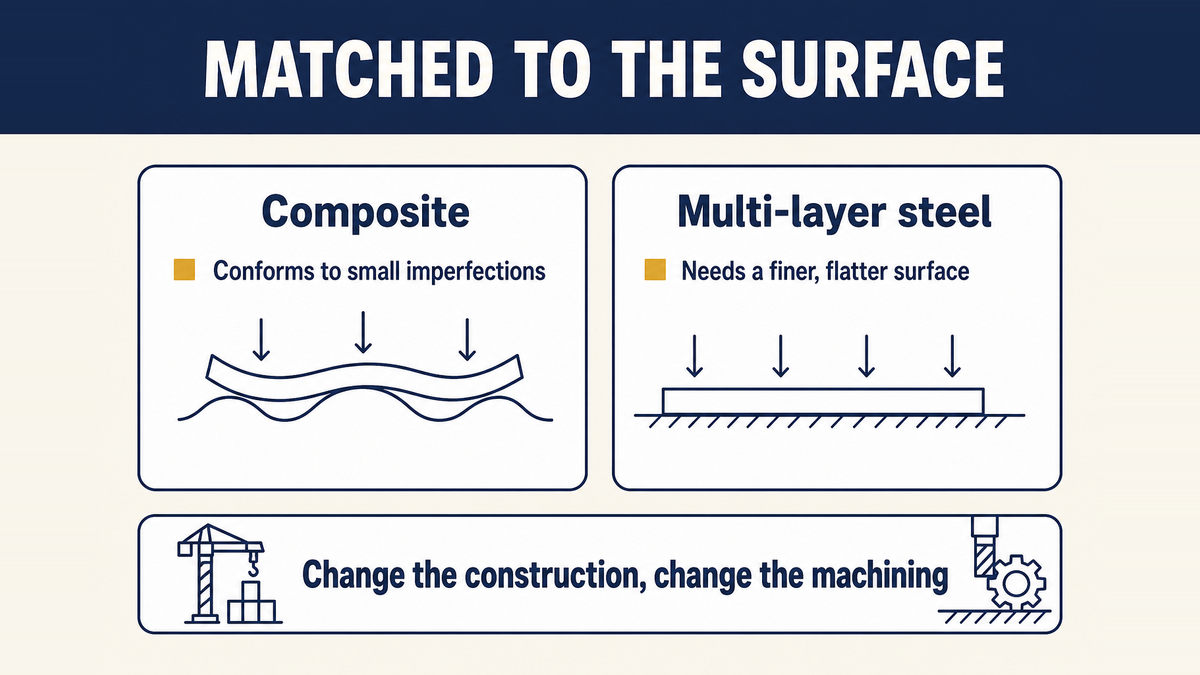
A head gasket is not a universal sheet of material, and the single decision that shapes a quotation is which construction it uses. Modern gaskets fall into two broad families.
Composite gaskets carry a fibrous or graphite facing on a metal carrier. The facing conforms to small imperfections in the head and block surfaces, which makes them forgiving of a surface that is not perfect.
Multi-layer steel gaskets are stacks of thin steel sheets with formed sealing beads and a coating. They are stronger and better suited to high combustion pressures, and they need the surfaces they seal against to be finer and flatter, because a layered steel gasket does not conform the way a fibrous facing does.
That produces the point a buyer needs to hold: the gasket and the surface it seals against are a matched pair. A multi-layer steel gasket supplied for a job where the head was refinished to a coarse finish will leak — and the leak will be blamed on the gasket rather than on the mismatch. Equally, an engine designed around a layered steel gasket cannot be served by substituting a composite one without changing what the assembly does under combustion pressure.
The practical consequence is that the construction belongs in the catalogue data and in the quotation. Two gaskets that fit the same engine and look similar in a photograph may require different machining of the head, and a buyer who cannot state which construction they are selling cannot tell a customer what surface finish the job needs.
5. Thickness Is a Dimension, Not a Detail
The second decision a quotation has to settle is thickness, and it is easy to treat as a minor figure because a gasket is thin. It is not minor, because the gasket is part of the engine's dimensions.
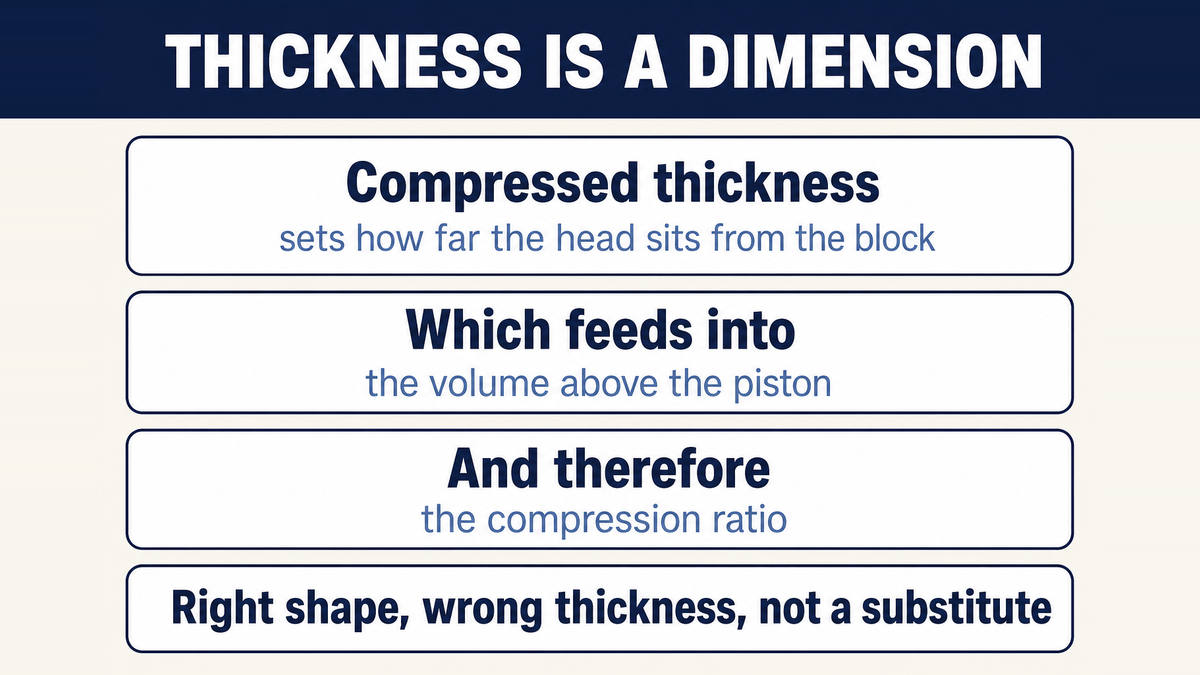
When the head is clamped down, the gasket's compressed thickness sets how far the head sits from the block. That distance feeds into the volume above the piston, and therefore into the compression ratio. It also affects the clearance between the valves and the pistons on engines where that clearance is tight, and it changes the height at which the camshafts sit if they are carried in the head.
So a gasket that is the right shape and the wrong thickness is not a working substitute, even though it will bolt up and seal. The compressed thickness and its tolerance belong in the quotation alongside the bore size, and a supplier who cannot state both has not specified the part.
The clamping load completes the picture. A gasket seals because it is compressed, and the compression comes from the head bolts. The bolt specification and the tightening sequence are part of how the assembly achieves the load the gasket was designed for, which is why a gasket's instructions and the bolt requirements travel together.
6. What a Cheap Head Gasket Quote Leaves Out
A head gasket is a small part with an outsized consequence, and the savings are all inside the layers. Five places a low quote tends to come from:
The construction and the coating. Whether it is layered steel or composite, and what the coating is. The coating is what lets the gasket seal at low clamping load, before the engine has warmed and the joint has settled, and it is the cheapest layer to thin.
The combustion sealing rings. The formed rings around each cylinder are what hold the pressure spike. Their material and forming decide whether the joint holds at peak pressure, and they are the part of the gasket that a visual check cannot assess.
The compressed thickness and its tolerance. Stated as a measured figure on the finished part, not as an assumed one. This is the line that decides whether the part is dimensionally correct for the engine, and it is frequently missing.
The apertures and their positions. Oil feed holes, coolant passages and dowel holes have to line up, and a restrictor that is the wrong size changes the flow through the joint. Aperture positions are a drawing requirement rather than a shape that can be eyeballed.
The information that ships with it. Which surface finish the construction needs, and what the clamping requirements are. A gasket supplied without that information has left the most consequential decisions to whoever opens the box.

7. What to Check on a Sample
A head gasket is flat and measurable, so the sample stage is largely dimensional. Six checks cover the ground.
- Compressed thickness, measured, on more than one piece from the batch — the figure that decides whether the part is correct for the engine rather than merely the right shape.
- Bore apertures and their edge condition, plus the position and size of every oil and coolant aperture against the drawing.
- The construction, confirmed by sectioning a sample: layer count, ring forming and coating presence on the faces that seal.
- The coating, its type and coverage, including whether it reaches the immediate area around the combustion rings.
- Flatness, since a gasket that is not flat cannot be clamped evenly however good its construction is.
- The information pack: the surface finish the construction requires, the clamping requirements, and the applications the part number covers.
On the factory side the usual visit checks apply — who supplies the steel and the coating, whether the rings are formed in-house or bought in, and who signs off the first article. Our sequence is in the factory audit checklist, and the stamping and forming side is covered in metal stamping and machined parts. Where a supplier also holds a social or ethical audit, the scheme behind the certificate is worth reading — see social audit schemes compared.
8. Where the Unit Price Comes From
A head gasket's price is built from the steel or carrier and its facings, the coating, the forming of the combustion rings and apertures, and the packaging. The materials set the cost, and the coating and the ring forming are where the quality lives; both are inside the part and neither is visible on a finished unit. Because the part is flat and light, the packaging is a small line that decides whether it arrives usable.
Weight is low, so a gasket moves on volume and packing density rather than mass — the method is set out in how volume decides what a shipment is charged. Gaskets are usually bought as a set for an engine rather than singly, which means the completeness of the set is as much a part of the product as any individual sheet.
A quotation worth comparing therefore names the construction and the coating, the compressed thickness and its tolerance, the bore and aperture dimensions, the material of the combustion rings, and the surface finish the construction requires. How the goods are described for entry is the subject of how an HTS code is assigned, and the origin paperwork behind it is set out in the certificate of origin guide.
9. Frequently Asked Questions
Is a head gasket covered by any federal standard?
No. The in-use inspection standard is organised as one section per system and has sections for brakes, brake power unit, steering, suspension, tyres and wheel assemblies, with no engine section. A head gasket therefore carries no figure, marking or test that a federal inspection is directed to check, and its fitness is established by the engine it is fitted to.
Why is the head gasket the hardest sealing job on a vehicle?
Because one joint seals three things at once. Combustion pressure arrives as a cyclic spike far above any other pressure in the engine, oil arrives from the galleries under normal oil pressure, and coolant sits a few millimetres away. On top of that the joint moves, since the head and the block expand at different rates as the engine heats.
Does the thickness of a head gasket matter?
Yes, and it is a dimension rather than a detail. The compressed thickness sets how far the head sits from the block when clamped, which feeds into the volume above the piston and therefore the compression ratio, into valve-to-piston clearance where that is tight, and into the height of camshafts carried in the head. A gasket of the right shape and the wrong thickness is not a working substitute.
What is the difference between composite and multi-layer steel?
Composite gaskets carry a fibrous or graphite facing on a carrier and conform to small imperfections in the surfaces they seal. Multi-layer steel gaskets are stacks of thin steel sheets with formed sealing beads and a coating; they suit higher combustion pressures but need the head and block surfaces to be finer and flatter. The gasket and the surface are a matched pair, so a change of construction changes the machining the job needs.
What should a head gasket quotation contain?
The construction and the coating, the compressed thickness with its tolerance, the bore and aperture dimensions, the material and forming of the combustion sealing rings, and the surface finish the construction requires. Because the gasket seals by being compressed, the clamping requirements and the fitting information belong with the part rather than being left to whoever opens the box.
Surface Finish, Then the Gasket to Match
We return the surface roughness the block presents, the gasket construction that suits it, and the three pressures the joint holds.
Match My Surface
Questions & Comments
We read every one and reply within 24 hoursA head gasket is a seal with a thickness, and the thickness belongs to the engine design. Send the engine code and the drawing, and we will confirm compressed thickness, bore and coating.