
Textile Inspection in China: Score the Roll, Then Set the Limit
 ·
Updated October 24, 2026
·
11 min read
Textile inspection is a count. A checker rolls the fabric out on a lit table, finds each defect, and turns its length into points. The points are the score. Here is the part that surprises buyers: the standard gives you the scoring method and stops there. It does not say how many points are too many. That number is yours to write into the order, and if you leave it out, nobody is failing the roll.
The Short Answer
Textile inspection in China is a visual check of every roll, or of a sample of rolls. A machine pulls the fabric over a tilted, lit surface while a checker reads it. The checker marks defects, measures width and length, and compares shade between pieces.
Two methods cover most of the work. The four-point system scores defects by length and gives a number per 100 square yards. The AQL method treats rolls or pieces as units and samples them, which is the same logic used for cartons of finished goods.
The choice matters more than the method. Four-point scoring tells you how bad a roll is. AQL tells you how many rolls you are willing to accept. A good inspection uses both: score every roll, then apply a written limit to each one.
So the useful question is not which method is right. It is which number you wrote down. Then it is whether the report is checked against that number, or against nothing at all.
How the Four-Point System Scores a Roll
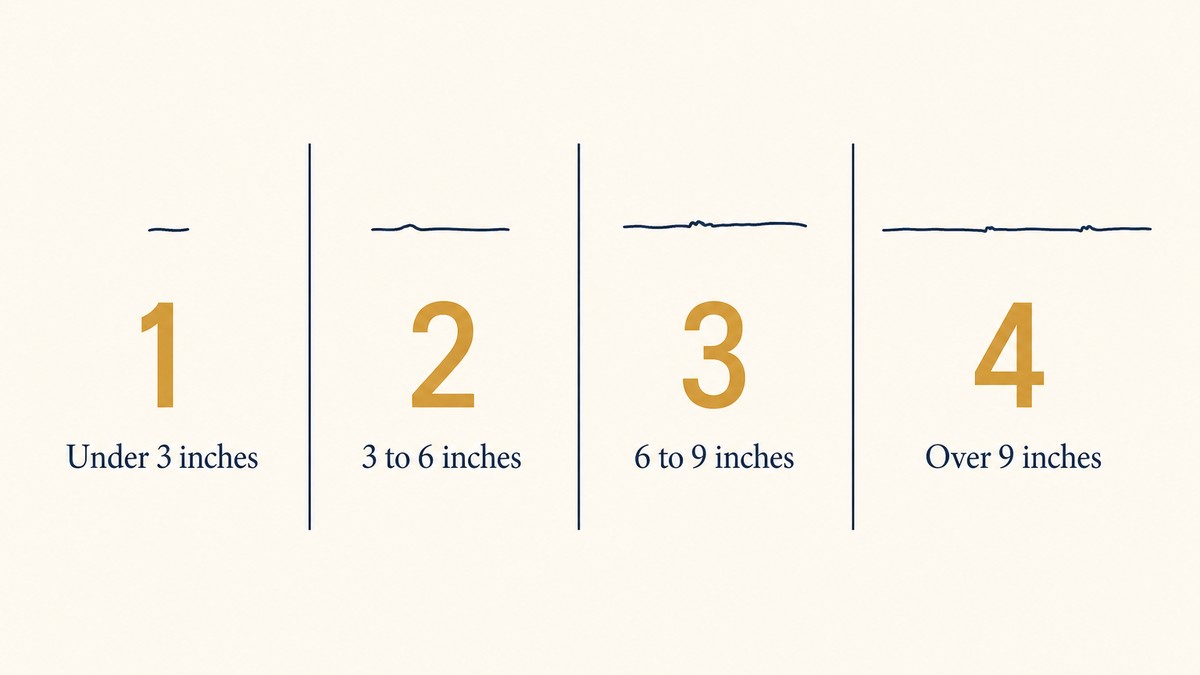
The method is simple enough to learn in five minutes. A defect shorter than three inches scores one point. Three to six inches scores two. Six to nine scores three. Anything longer scores four, and four is the ceiling for one defect.
Holes score four regardless of size, because a hole is a hole. A run or a slub that repeats across the width is counted once per occurrence. The checker adds the points across the roll, divides by the area, and reports points per 100 square yards.
That last step is where hand-written reports drift. Points per 100 square yards needs the actual area, and the actual area needs the measured width and the measured length. If a mill uses the stated width of 60 inches while the roll measures 58, the area is smaller and the score flatters itself.
Ask for three numbers on every roll line: measured width, measured length, and the point total. With those three, anyone can redo the division. Without them, the score is a claim.
The Missing Number: Nobody Sets the Pass Mark
This is the single most useful thing to know about fabric inspection. The four-point method gives you a way to score. It does not give you a level at which a roll fails. That level is a commercial term, agreed between buyer and mill, and it belongs in the order.
Common practice sits somewhere between 20 and 30 points per 100 square yards for apparel fabric. That range is practice, not law, and I would not treat it as a target to copy. What matters is that a number exists in writing before the first roll is cut.
Here is why the gap causes trouble. Two checkers can score the same roll honestly and get 24 points. One works for a buyer whose order says 20, so the roll fails. The other works for a buyer who wrote nothing, so the roll passes by default. Same fabric, same report, opposite outcomes, and no one has done anything wrong.
The fix costs one line. Write "No roll may exceed 25 points per 100 square yards" next to the width tolerance and the shade rule. Then give the sheet to whoever inspects. A limit on the order is worth more than a longer report.
If a mill will not accept a written limit, that refusal is information. It does not always mean the fabric is poor. It can mean the mill has never been asked, and has no habit of measuring against a number.
Offer a middle ground: a limit for the first shipment only, with a re-check on the second. A mill that takes that offer is usually able to meet it. A mill that refuses both has told you how the third shipment will go.
An Average Can Hide a Bad Roll
A lot can pass on average and still hold one roll you cannot cut. Suppose ten rolls score 18, 19, 17, 20, 16, 22, 19, 18, 21 and 58 points. The average is about 22.8, which passes a 25-point limit. One roll is a write-off, and the average said nothing about it.
The remedy is a second limit, applied to each roll instead of the lot. "No single roll above 40 points" catches the outlier in the example and leaves the other nine alone. Both numbers go in the same sentence, because one without the other is easy to game by accident.
Ask also how a failed roll is handled. A mill that marks the roll and removes it from the shipment is doing the job. A mill that re-rolls the fabric onto a new tube and calls it a new roll has moved the problem, not solved it.
| Limit | Applies to | What it stops |
|---|---|---|
| Points per 100 sq yd | The lot average | A generally poor batch |
| Points per single roll | Each roll | One bad roll hiding in a good average |
| Measured width | Each roll | Cuttable width shrinking under the stated figure |
| Shade group | Each roll | Two dye lots mixed in one shipment |
Four lines on one page do more work than a forty-page report nobody reads. They also give the inspector something to fail against, which is the only way an inspection has teeth.
Sampling Rolls Is Not the Same as Sampling Cartons
Most buyers arrive with an AQL table they already use for finished goods, and try to apply it to fabric. It half works, and the half that fails is worth understanding.
AQL treats each unit as pass or fail and samples a set number from the lot. On cartons that is fine, because every carton holds the same product. Fabric is not like that. One roll can be 100 yards and the next 40, so the same defect count means very different quality per yard.
There is a second difference. A carton hides its contents until you open it, so sampling finds problems you could not see. A roll shows its defects on a lit table, and the four-point score reads them directly. Sampling adds a step without adding much information.
That is why fabric buyers often pay for a full roll-by-roll check instead of a sample. Every roll goes over the table, gets a score, and gets a width reading. On a large order the cost per roll drops, and on a small one it is the only way to know what you bought.
If you do sample, sample by roll and report the worst roll, not the average. A sample that reports only the average repeats the mistake from the last section, with extra steps.
Two Checks That Sit Outside the Defect Count
A fabric can score beautifully and still be unsellable in the United States. Two legal checks run beside the visual count, and most inspection reports leave both out. Neither is about how the cloth looks.
| Check | What the rule says | What the inspector does |
|---|---|---|
| Fibre label | A fibre under 5% is called "other fiber", unless it has a clear job | Reads the label against the mill sheet |
| Flammability | Apparel fabric is tested and placed in one of three classes | Asks for the lab report and the fabric it names |
Start with the label. 16 CFR 303.3 covers fibres present in amounts under 5%. The rule is blunt: such a fibre is not named. It is grouped and called "other fiber", or "other fibers" when there is more than one.
There is one exception, and it is the part people remember wrongly. A fibre under 5% may be named if it has a clearly established and definite functional role at that amount. The rule gives its own example: 96% acetate with 4% spandex.
So a fabric labelled "97% cotton, 3% elastane" makes a claim the rule does not allow. The exception applies only if the mill can show the elastane does a specific job at 3%. In practice this turns up on stretch woven fabric sold to small brands. It is caught by a buyer reading the label, not by a machine.
Then the burn test. 16 CFR 1610.3 describes the method in plain terms. A specimen is held in a frame at 45 degrees. It is brushed first if the surface is raised, and a standard flame is applied for one second. The lab records how long the flame takes to climb 127 mm, which is five inches.
The same section says the standard sets three classes and bars fabric whose burning makes it unfit for apparel. It also requires testing before and after refurbishing. That last point catches recycled and re-finished fabric, where a coating or a wash can change how the cloth burns.
For an inspector on the floor, the useful action is narrow. Ask for the lab report. Then check that the fabric named on it is the fabric in the roll: same blend, same weight, same finish. A report for a similar fabric is not a report for your fabric.
Where in China the Check Actually Happens
Fabric is usually checked at the mill, not at the garment factory. The mill runs the roll over its own machine, writes a ticket, and ships. By the time the cloth reaches the cutting table, the defects are already inside the bundle.
That timing decides who can fix a problem. A defect found at the mill can be cut out, replaced or credited. The same defect found at the garment factory is a delay, because the cloth has already travelled and the order is already behind.
So ask where the inspection happens before you agree a price. A check at the mill gate is cheaper and earlier. A check at the garment factory is closer to your product, and it is the right place for a second look on shade and width.
Who pays is a separate question, and it is worth settling in writing. Some mills include a roll check in the price. Some charge per roll. A third party adds a day rate and travel. None of these is unusual, and all of them should appear as a line, not as a surprise.
One habit helps more than any clause. Ask for the mill's own ticket with the third-party report, side by side. Two independent scores on the same roll tell you whether the mill's number holds up on the rolls nobody checked.
A mill ticket is usually short. It carries the roll number, the length, the shade group and a mark count, and it is signed by whoever ran the machine. It rarely carries the measured width, and it almost never carries the point score as a number per area.
That is not dishonesty. The ticket was designed for the mill's own cutting floor, where the checker knows the fabric and the machine. It was not designed for a buyer six thousand miles away who has to decide whether to pay a balance.
Metres, Yards, Width and Weight
Chinese mills quote in metres and kilograms. US buyers plan in yards and ounces. The gap is small per roll and large per order. It shows up as a shortage at the cutting table, not as a defect on a report.
Width is the second trap. A mill may quote 60 inches and ship 58, because the stated width is the greige width before finishing. Ask for cuttable width, measured on the finished roll, and write that number into the order with a tolerance.
Weight per square metre, usually written GSM, moves with dyeing and finishing. A tolerance of plus or minus five percent is common. Without a stated tolerance, a 5% drop passes quietly and your yield per garment changes.
Length per roll deserves its own line too. A roll sold as 100 yards that measures 96 is inside many mill tolerances and outside most buyers' assumptions. Measure and record each roll, then compare the total against the commercial invoice before the balance is paid. The paperwork that travels with an import shipment has to agree with these numbers, or a shortage turns into a customs question.
None of this needs new equipment. A tape, a scale and a form cover all four checks, and the form is the part most buyers skip.
What to Put in the Order
Five lines turn an inspection into a decision. Each one is short, and each one removes an argument later.
- Score method
- Name the four-point system and say the report must show points per 100 square yards, with the measured width and length behind the number.
- Pass level
- One number for the lot average, and a second, looser number for any single roll. Both in the same sentence, so neither can be applied alone.
- Spot check
- Every roll or a stated share of rolls. Say which, and say that a failed roll is removed and marked. It is not re-rolled.
- Shade rule
- One dye lot per shipment, or a stated number of shade groups, with the lot number written on each roll ticket.
- Measurements
- Cuttable width, GSM and length per roll, each with a tolerance. These three decide your yield, and none of them is a defect.
Put the same five lines into the specification sheet the mill works from, not into a separate email. A term that lives in an email gets lost when the file is handed to a new merchandiser.
Then decide who checks. A mill ticket alone is a supplier marking its own work. A third-party check at the mill gate covers the cloth. Later, a pre-shipment check on the cut and sewn goods covers the finished product. Together they cover both ends without paying twice for the same roll.
Four Patterns Worth Slowing Down For
The first is a report with a score and no measurements. Points per 100 square yards cannot be checked without width and length, so a score on its own is a number someone typed.
The second is a single average across a shipment. It hides the one roll that will stop a cutting line, and it is the most common shape of a report that looks clean.
The third is a shade rule with no lot numbers. Colour matching by eye under mixed light is how a two-tone shipment gets signed off. Ask for lot numbers on tickets, and check under one light source.
The fourth is a mill that offers to re-inspect its own failed roll. That is not a second opinion. It is the same opinion with a new ticket.
Questions Buyers Ask About Textile Inspection
What is the four-point system in fabric inspection?
It scores each defect by length. Under three inches is one point, three to six is two, six to nine is three, and anything longer is four. Holes score four whatever their size. The total is divided by the area and reported per 100 square yards.
What is a good score per 100 square yards?
There is no official figure. Between 20 and 30 is common for apparel fabric. That range is trade practice, not a rule. What matters is that your order states a number, because a report with no limit cannot fail anything.
Should every roll be inspected or just a sample?
For apparel fabric, every roll is usually better. Rolls vary in length, so a defect count per roll says little without the area behind it. A full roll check also gives you a width reading for each roll, which sampling cannot.
Does a fabric label have to name every fibre?
No. Under 16 CFR 303.3 a fibre below 5% of the weight is grouped as "other fiber". It is not named. It may be named only when it has a clear functional role at that amount, and the rule's own example is 4% spandex in acetate.
Is flammability testing part of a fabric inspection?
Not usually. It is a lab test, not a visual check. 16 CFR 1610.3 describes the method: a specimen at 45 degrees, a one-second flame, and the time to burn 127 mm. The inspector's job is to confirm the lab report matches the fabric in the roll.
Why is the delivered length short of the order?
Mills cut in metres while many buyers plan in yards, and each roll carries its own tolerance. A few percent per roll adds up across a shipment. Measure each roll, total the length, and compare it with the invoice before the balance is paid.
The Bottom Line
Textile inspection is a scoring system with no built-in verdict. The four-point method tells you how much is wrong with a roll. It does not tell you whether that amount is acceptable, because that is a business decision and the standard stays out of it.
So write the verdict yourself. One number for the lot, one for any single roll, a width, a weight and a shade group. Five lines, on the same sheet as the price, given to whoever stands at the table.
The defects you will find are ordinary: slubs, holes, shade drift, a roll two inches narrow. What decides whether they cost you money is whether someone wrote down the limit before the fabric was cut.
Have the Rolls Scored Before Cutting
Send us the fabric and the order. We write the score method and the pass level into the sheet, check rolls at the mill gate, and photograph the ticket beside the cloth. You get the numbers and the bad rolls, before the cloth is cut.
Book a Roll Check
Questions & Comments
We read every one and reply within 24 hoursHave you been quoted a fee with no scope behind it? Send the line and the drawing. Tell us what the factory says the fee buys, and whether the tool is yours afterwards. We will tell you what is missing before the deposit.