
Private Label Dropshipping: The Five Costs It Adds, and When They Pay Back
 ·
Updated October 13, 2026
·
17 min read
Private label is not an upgraded version of dropshipping. It is a different business that happens to sell through the same store, and the difference is five extra cost lines that plain dropshipping never carries. Most guides answer "what is private label" and then list suppliers. That does not help you decide anything, because the only question that matters is whether the added cost is repaid at the volume you can actually sell. So this is the cost model, line by line.

The Five Lines Private Label Adds
| Cost line | Charged how | What it does to your cash |
|---|---|---|
| Tooling or a new mould | Once, before anything is made. | Spent before a single unit exists, and not refundable if you change your mind. |
| A minimum order quantity | Per batch, paid in full up front. | Buys stock you must store and sell, not stock you have already sold. |
| A longer lead time | Between paying and selling. | Ties up the money for months, so the same cash buys fewer rounds a year. |
| Packaging, artwork and labels | Once per design, then per unit. | Cheap per unit and expensive to get wrong, because a reprint is a second full run. |
| Testing and labelling rules | Per product and per market. | A fixed fee you pay whether you sell ten units or ten thousand. |
What this guide covers
1. What Actually Counts as Private Label?
Private label means the product is yours in a way the supplier's own catalogue item is not. That is the whole test, and it draws a clean line between three things people say in the same breath.
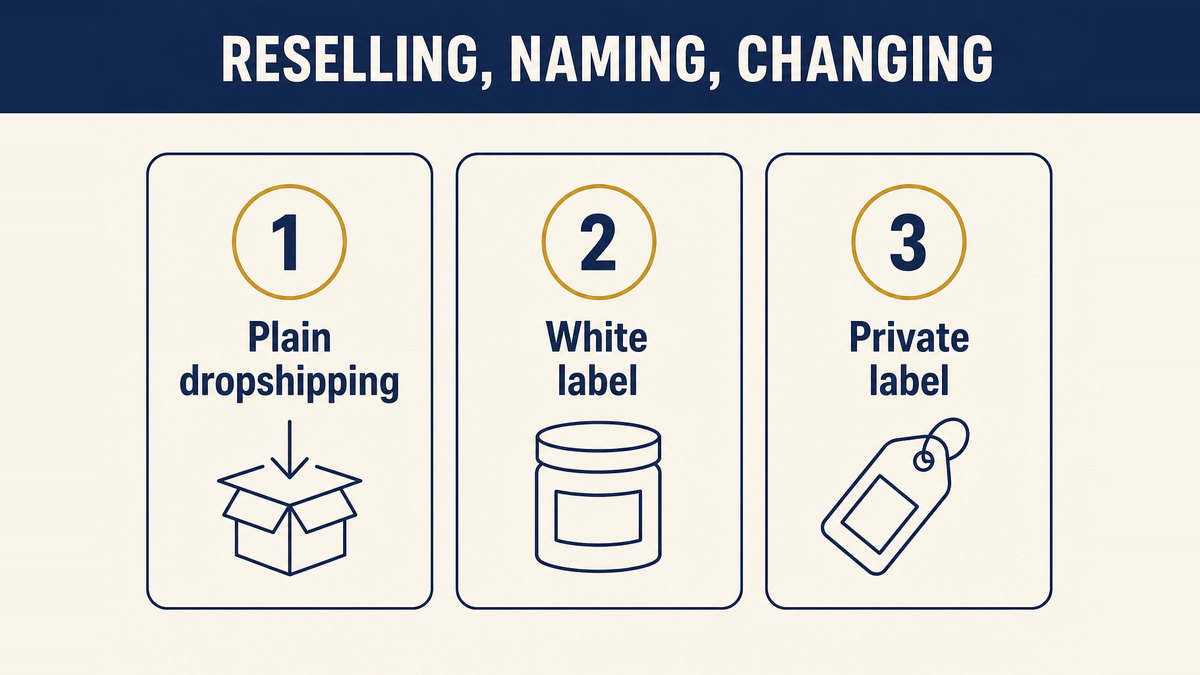
Plain dropshipping is reselling: you list an item that exists already, and anyone else can list the same one tomorrow. White label is naming: the supplier makes one product and sells it to several buyers, each of whom puts their own name on it, so the product is identical and only the label differs. Private label is changing: you decide what the item is, and it is made to that description rather than picked from a list.
Only the third one triggers the five costs, and that is why the question "is private label better than dropshipping" has no general answer. It is not better or worse, it is more expensive and more defensible, and whether that trade is worth it depends entirely on your volume.
2. What Are the Five Costs Private Label Adds?
Each one is charged at a different moment, which is why they are easy to underestimate. Two of them arrive before the first unit exists, one of them arrives every batch, and two of them arrive once and then behave like a fixed fee forever.
- Tooling or a new mould
- If the shape has to change, someone has to cut a mould before anything can be made. This is the single largest upfront cost and it is the one people forget, because quotes for the product itself rarely mention it. A new mould only earns its place if you expect to sell the item long enough to spread it, so it belongs on products you have already proved, not on guesses.
- A minimum order quantity
- Factories set a floor because changing a line over costs them time. You pay for the whole batch in full, which means the money leaves long before the stock does. The practical problem is not the size of the commitment, it is what happens if you are wrong about the colour, the size run or the season.
- A longer lead time
- Production plus freight takes weeks that plain dropshipping does not spend. Nothing about that delay costs you money directly, and that is what makes it invisible. It costs you rounds: cash tied up for three months instead of three days turns over four times a year instead of a hundred, so the same money does less work.
- Packaging, artwork and labels
- Cheap per unit and expensive to redo, because a mistake is not a correction, it is a second production run. Artwork has to be final before printing, and the printing has to be checked before the batch ships.
- Testing and labelling rules
- Some markets ask for specific words, warning text, contact details or a batch number, and some categories need a test before they can be sold. These are fixed costs: the same fee whether the batch is three hundred units or thirty thousand, which is exactly why they are painful on a first small order.
3. What Do Those Costs Add Per Unit?
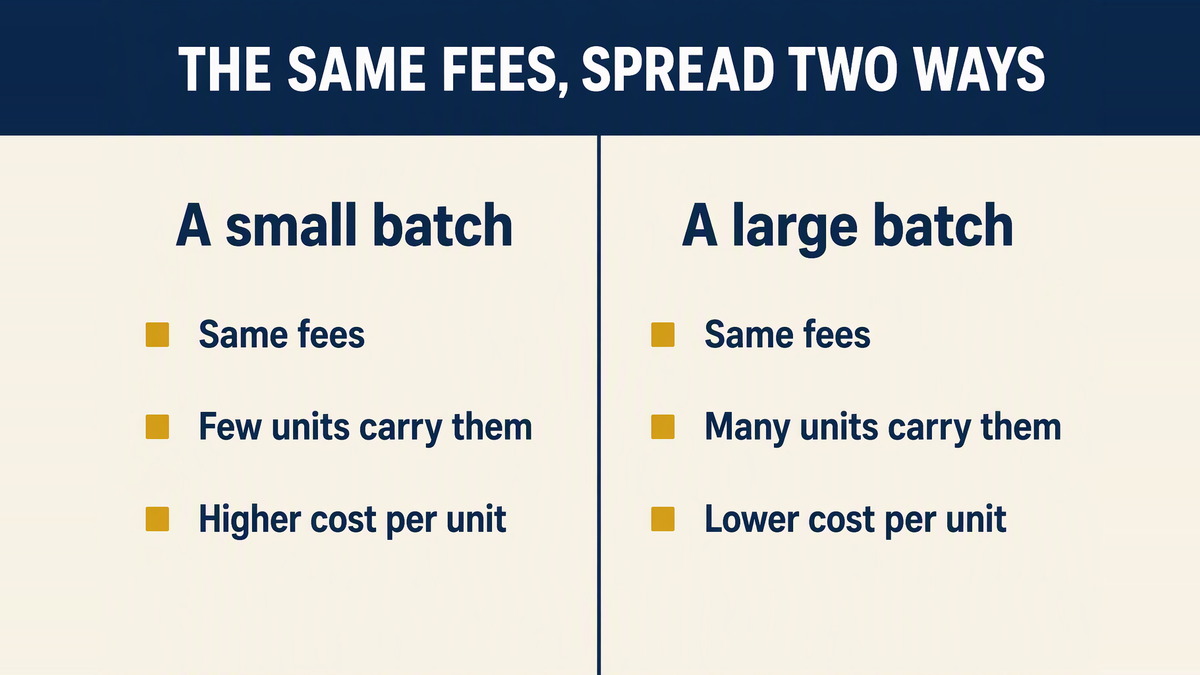
This is the part that decides everything, and the answer is not a number. It is a rule: the once-only costs are divided across the batch, so the cost per unit falls as the batch grows, while the product itself costs the same per unit no matter how many you make.
That single fact explains why two sellers can quote wildly different numbers for the same private label product and both be right. The one ordering three hundred units is spreading tooling, artwork and testing across three hundred units. The one ordering thirty thousand is spreading the same fees across a hundred times as many, so each unit carries almost none of them.
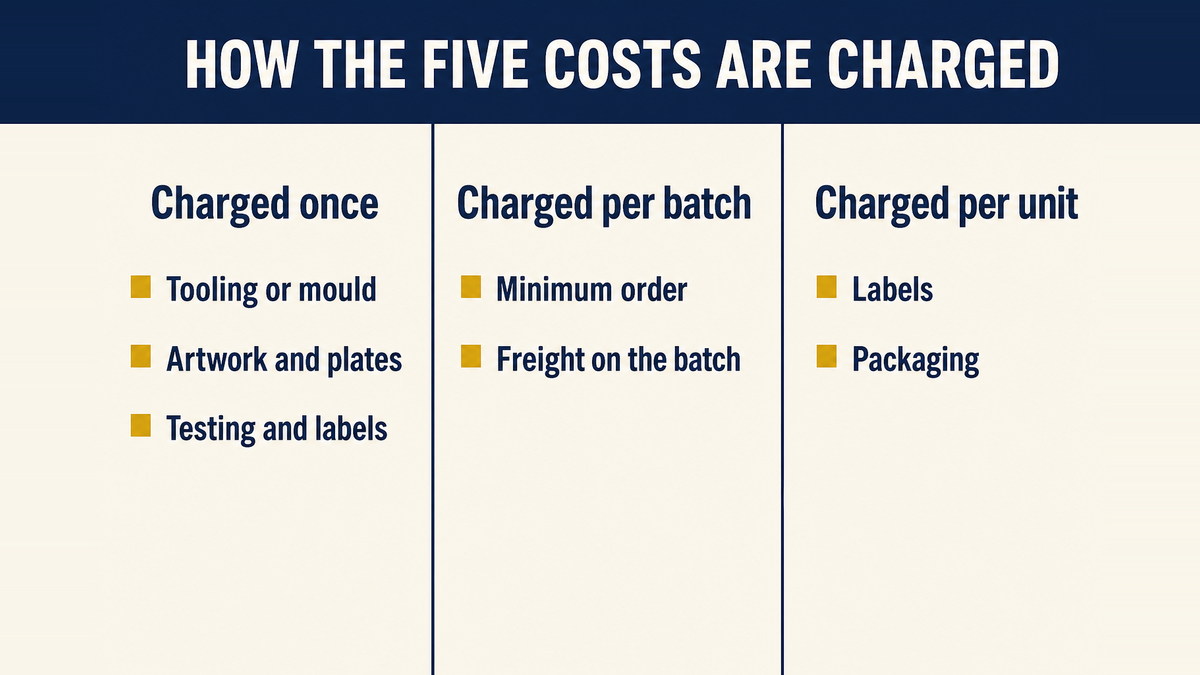
So when you build the comparison, sort the five into three groups rather than adding them up as one figure. Costs charged once belong to the project and should be divided by the units you expect to sell in total. Costs charged per batch belong to the order and should be divided by the units in that order. Costs charged per unit belong to the product and can be compared directly with a dropshipping supplier's price.
The mistake is treating all five as the same kind of number. A mould divided by three hundred units looks alarming. The same mould divided by the units you will sell over two years looks like a rounding error. Neither version is dishonest, but only one of them is the number you are actually committing to, and it is the total you expect to sell rather than the batch you are about to order.
Before you compare anything, write down two numbers: the total units you honestly expect to sell, and the price you can sell at. Every upfront cost should be divided by the first number, not by the first order. Sellers who divide by the first order talk themselves out of products they would have made money on, and sellers who never divide at all talk themselves into products they cannot sell.
4. At What Volume Does It Pay Back?
It pays back when the money you save on the cost of the goods, added up across the units you sell, is larger than the five costs you paid to get there. There is no volume that works for every product, because the answer depends on how much cheaper your version is per unit — and that gap is usually smaller than people expect on a first order.
Two things move that break-even point, and both are inside your control.
- How much cheaper the unit is. If your private label version saves you two dollars a unit against the resold one, you need to sell a lot of units to clear a few thousand in upfront costs. If it saves eight, you clear the same amount four times as fast.
- How long you keep selling it. The upfront costs are shared across everything you sell of that product, not just across the first batch. A product you sell for three years carries its mould lightly; a product you sell for one season carries it heavily.
There is a version of this that goes wrong in the opposite direction, and it is more common than the first. A seller sees that the cost per unit keeps falling and orders a batch far larger than they can sell, on the theory that the bigger order is always the better one. It is not, because the cheapest possible unit price on stock you cannot sell is still a loss. The right batch is the one you are confident of clearing while it is still current, not the one with the lowest unit cost.
That is also why the honest first step is rarely the product. Building the packaging and the label first changes what your customer sees, costs a fraction of a new mould, and gives you real selling evidence. Only once that version has sold is the larger commitment worth making, and by then you are making it with numbers rather than with hope.
5. What Are You Actually Buying?
You are not buying a cheaper product. If that were the whole offer, plain dropshipping would already give it to you. You are buying the right to decide what the product is, and that right has a value that does not show up in a per-unit table.
It shows up in three places. A product nobody else can list at the same price, because it is not the same product. A price you can raise without losing the sale, because there is no identical listing to compare you against. And a reason to keep the customer, because the label on the parcel is yours and the next order has a place to come back to.
Against that, you are giving up something real. You lose the ability to drop an item and walk away, because you already paid for the batch. You lose the freedom to change the colour next month, because the artwork is printed. And you take on the storage, the ageing stock and the eventual write-off. Those are the trade-offs, and they are worth naming before you commit rather than after.
Two of the five costs depend on rules rather than on your supplier, so they are worth checking in your own market instead of taking on trust. Duty is set by how your product is classified, and that is a look-up rather than an opinion — the USITC Harmonized Tariff Schedule is where that starts. What has to appear on the product or its label before it can be sold is set by the market you sell into, and the UK's own guidance on placing manufactured goods on the market is a clear worked example of how specific those rules get.
6. In What Order Should You Do Things?
The order matters because it controls how much money is at risk at each step. The version that loses the least is also the version that teaches the most, and it moves from cheap and reversible to expensive and permanent.
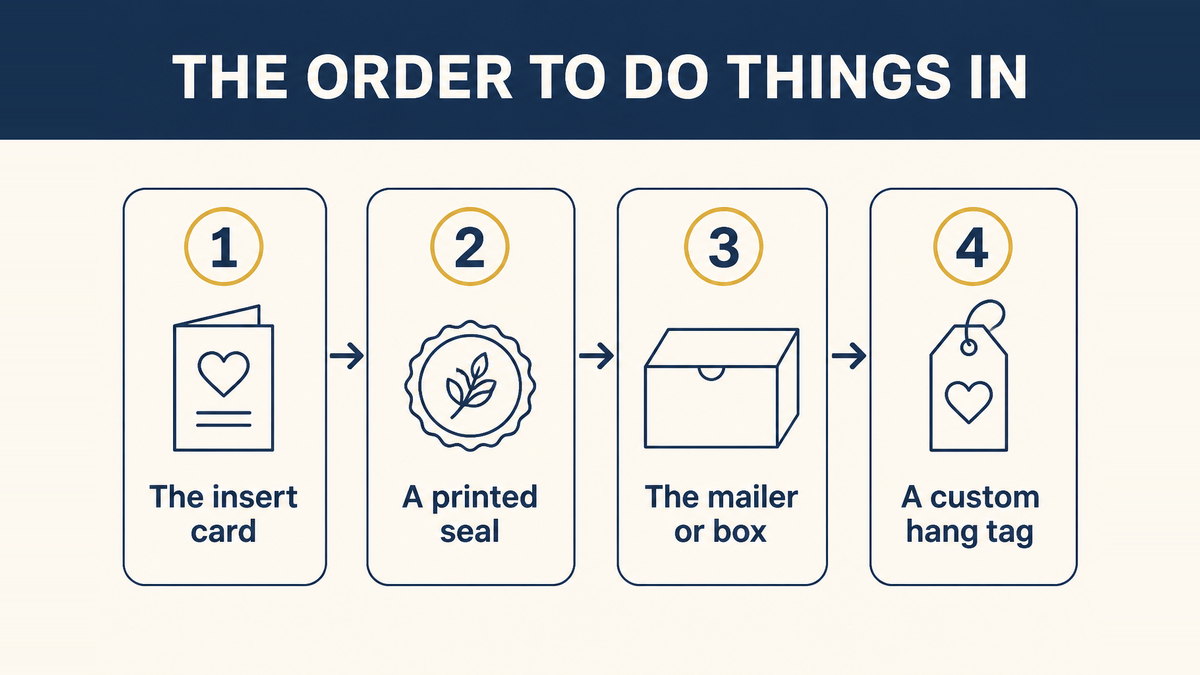
- Sell the plain version first. Run the product as an ordinary resold item for long enough to know it sells at the price you want. This costs nothing extra and gives you the only evidence that matters.
- Change the packaging and the label next. Same product, your name on it. This is the cheapest useful test of private label, because it needs no mould and no re-testing, and it tells you whether your customers care about the branding at all.
- Order a small branded batch. Now you are committing real money, but to a small quantity you can clear. Hold the artwork back from print until it is final, and have the goods checked before they ship rather than after they land.
- Change the product itself last. Only once the earlier steps have sold should you spend on a new shape, a new material or a new mould. By then you are making the largest commitment in the process with the most evidence behind it.
Most of the pain people report from private label comes from doing these in the wrong order — spending on a mould before the product was proved, or printing packaging before anyone had asked for the brand. Each step is reversible up to the last one, which is exactly why the cheap steps belong first.
When you do get to the batch, the two habits that protect you are the ones that apply to any order from a factory. Have the first batch inspected before it ships rather than after it sells, which is what an independent quality inspection is for, and keep the paperwork yours on every parcel, which our guide to blind dropshipping from China covers.com/how-to-find-reliable-private-sourcing-agents-dropshipping-china-guide/" target="_blank" rel="noopener">sourcing agent is the usual middle path.
7. What Are the Three Ways It Goes Wrong?
Almost every failed private label order fails in one of three ways, and none of them is about the product being bad.
The batch is too big for the demand. The unit price keeps falling as the order grows, so the biggest order always looks the most efficient. It is not, if you cannot sell it. Stock you cannot move is a total loss, not a cheap unit price, and aged stock also costs you storage while it waits.
The design is finalised too late. Artwork, label wording and packaging sizes have to be settled before printing starts. Changing a word after the plates are made is a second print run, and it is charged as one. The same applies to a label that turns out to be missing something the market requires.
The upfront costs are treated as the product price. Tooling and testing are charged once, so dividing them across the first order makes private label look impossible, and ignoring them entirely makes it look free. Both mistakes lead to the same bad decision, taken for opposite reasons.
If you want the wider version of this decision, including what the move from per-order buying to holding stock does to your cash, our guide to moving from dropshipping to wholesale covers the same ground from the other direction, and the one on choosing a supplier you will not outgrow covers the step before this one.
8. Frequently Asked Questions
Is private label the same as white label?
No. With white label you put your name on a product the supplier already makes and anyone else can buy. With private label you change the product itself, which is why tooling, quantity commitments and testing costs appear. White label is the cheaper half-step and private label is the commitment.
What is the smallest private label order I can place?
It depends on how much the supplier has to change. A new label on an existing item can start at a few hundred units, while a new shape or a new mould usually starts in the thousands. Ask what the smallest change is that still makes the product yours, because that is where the cheapest useful test sits.
Why does private label need more cash up front?
Because you pay for the whole batch before it sells. Plain dropshipping pays for one unit after the customer has already paid you, while private label pays for a few thousand units and then waits for production, freight and selling. The money is not lost, it is simply tied up for months at a time.
Does private label always increase my margin per unit?
It lowers the cost of the goods, which is not the same thing. Tooling, labels and artwork are charged once and spread across the batch, so the cost per unit falls as the batch grows. On a small first order the added costs can leave you no better off per unit than plain dropshipping.
What should I change first on a private label order?
The packaging and the label, not the product. They are cheaper to change, they carry the brand your customer actually sees, and they do not need new tooling or re-testing. Change the product itself only once the packaging version has sold, so the larger commitment is made with real evidence behind it.
Five Costs, Then the Per-Unit Figure
We return each added cost, the per-unit figure it produces at your volume, and the point where the total beats a catalogue item.
Table My Five Costs
Questions & Comments
We read every one and reply within 24 hoursWorking out whether a private label batch is worth it, been quoted a mould price that changed the maths, or stuck with stock you cannot move? Post the product, the quantity and the price you sell at, and our team will help you separate the once-only costs from the per-unit ones.