
Bra & Lingerie Manufacturing Sourcing Guide: Underwire, Cups, Lace & Fabrics
 ·
Updated October 8, 2026
·
16 min read
A bra is the hardest garment in apparel to make well. One style can carry twenty to thirty components, and every one of them has to line up with a graded pattern or the fit fails. This guide covers the three construction routes and what each one costs, what an underwire actually is and how to spec it, the fabric and elastane levels that decide recovery, the findings nobody writes into a spec, and the labelling law that makes the fibre label on your product a legal document rather than a design choice.
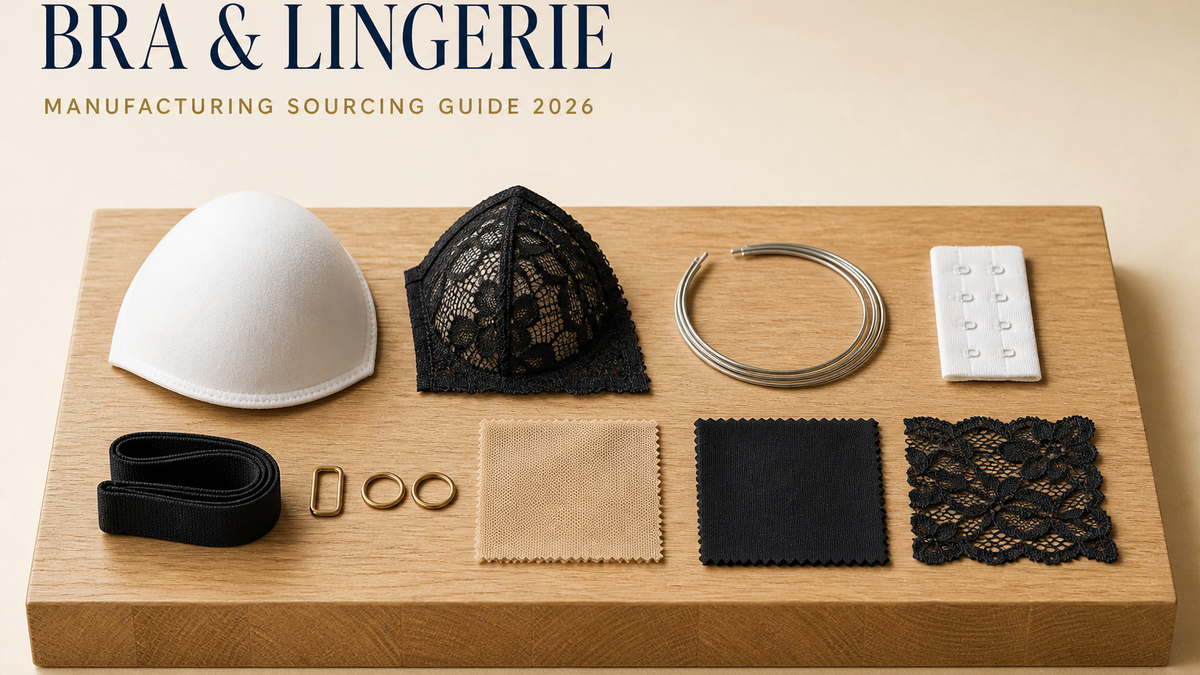
Which Construction and Materials to Order, Matched to Your Price Point
| If you are launching | Order this | Because |
|---|---|---|
| A soft everyday bra | Cut-and-sew, lightly lined | No cup mould to pay for, so a small first order is possible. Fit depends on your pattern, not on a tool. |
| A smooth T-shirt bra | Moulded spacer foam cup | The seam-free surface is the whole product. A mould is a fixed cost, so volume has to justify it. |
| A lace statement set | Cut-and-sew over raschel or Leavers lace | Lace is bought by the metre, so the shape can change between runs without new tooling. |
| A wireless or bralette line | Power mesh and stretch jersey | Support comes from fabric tension, so the elastane level in the mesh is the specification that matters. |
| A shapewear or control line | Double-layer power mesh, bonded | Bonding avoids stitch lines under clothing. Ask how the bond holds after fifty washes. |
| A value multipack | Cut-and-sew, single-layer microfibre | Fewest components and no tooling. Keep the hook-and-eye tape consistent so sizing stays predictable. |
What this guide covers
- What makes a bra factory different
- Cup construction: the decision that sets cost and fit
- Underwire: what it is and how to specify it
- Fabrics for intimate apparel
- Findings and hardware
- Sizing, grading and fit control
- Labelling law: the fibre label is not decoration
- Testing and certification
- Tooling, MOQ and sampling
- A five-step sourcing roadmap
- Frequently asked questions
1. What Makes a Bra Factory Different From a Garment Factory
Most apparel factories can sew a t-shirt. Very few can build a bra that fits. The difference is not skill on the machine, it is three pieces of equipment and one piece of know-how that a general factory does not own.
The equipment is a cup moulding press, an underwire insertion and bar-tack setup, and a cutting table set up for the small, curved panels an intimate garment is made from. The know-how is size grading, which is the art of expanding a base pattern across cup and band sizes without the shape collapsing.
| Factory Type | What It Can Do | What It Cannot Do |
|---|---|---|
| General apparel factory | Cut-and-sew knits, sleepwear, robes, camisoles, simple bralettes | Moulded cups, reliable size grading, underwire construction |
| Intimates specialist | Everything above plus cup moulding, underwire, hook-and-eye application, graded sizing | Nothing relevant — but MOQ is higher and lead time is longer |
| Seamless and bonding plant | Seamless circular-knit bras, bonded seam-free shapewear | Cut-and-sew lace work and classic underwire styles |
A useful first test: ask which of these three the factory specialises in, then ask to see the cup moulding press over a video call. A factory that owns a press will show it in seconds. A factory that subcontracts the moulding will change the subject, and that subcontract is where your fit problems begin.
The question that separates a real intimates factory from a trading company pretending to be one: ask them to send a graded pattern for one of your styles across three cup sizes, with the measurement points marked. A production manager who lives in this category can produce it in a day. A reseller cannot produce it at all.
2. Cup Construction: The Decision That Sets Your Cost and Your Fit
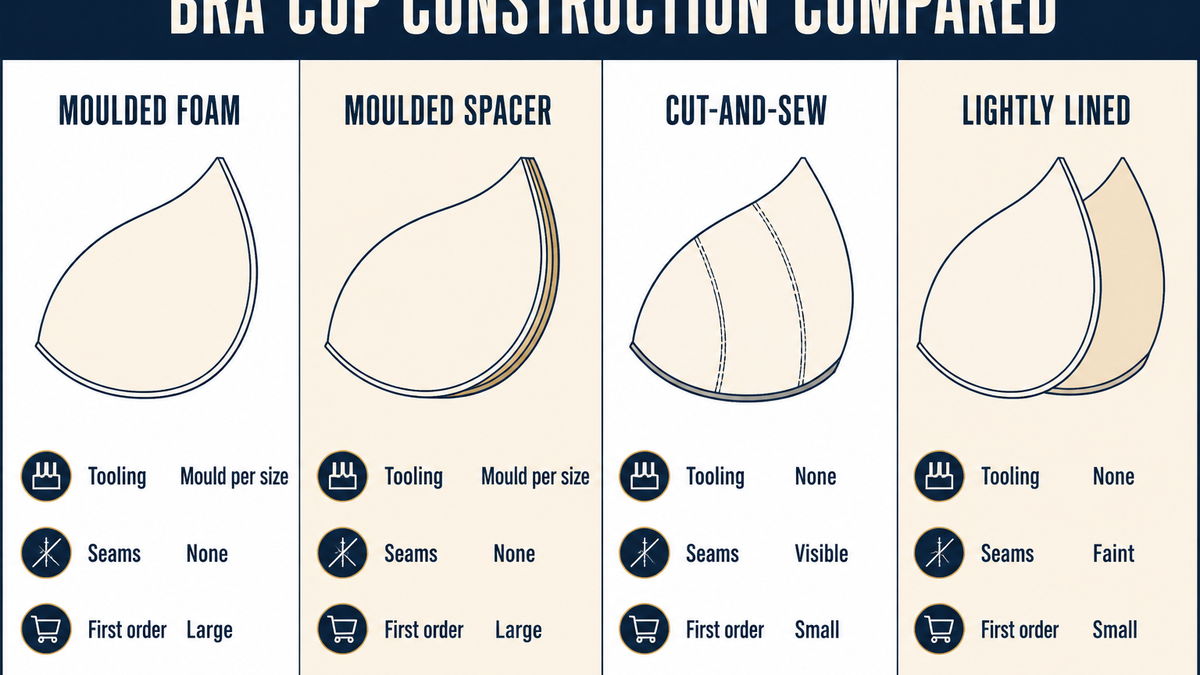
There are three cup routes in commercial production, and the choice between them drives both the tooling bill and how the bra feels. This is the first thing to settle, because it decides whether you can start small or have to commit to a large first order.
A. Moulded cups
Moulded cups are pressed from a foam or spacer sheet in a heated press. The result is a smooth, seam-free surface that disappears under a t-shirt, which is the entire commercial promise of the style. The process needs a mould per cup size, and a mould is a one-off payment that only pays for itself across a large run.
Two grades cover most of the market. Standard foam is the cheaper option and gives a firmer, more structured shape. Spacer foam is a knitted three-layer fabric that breathes far better and drapes more naturally, which is why it carries a premium and why it is the usual choice for a comfort-led brand. Ask which one is in the quote, because the two look identical in a photo.
B. Cut-and-sew cups
Cut-and-sew cups are built from separate panels stitched together over a wire. There is no mould and no tooling bill, so a new brand can start with a small order and change the shape between seasons. The trade-off is visible seams under a thin top, and a fit that depends entirely on how good the pattern is.
For a first collection, this is usually the right route. It lets you test the market, learn your customers’ size distribution, and postpone the mould decision until you know which style is selling.
C. Lightly lined and unlined
A lightly lined bra uses a thin foam or mesh layer for coverage without shaping. It sits between the other two on cost and it grades more forgivingly than a moulded cup, because the lining follows the fabric rather than forcing a shape into it. Unlined is the cheapest of all and the most common route for lace and bralette styles.
| Route | Tooling | Realistic First Order | Seams Under Clothing | Best For |
|---|---|---|---|---|
| Moulded foam | Mould per cup size | Large | None | Firm shaping, t-shirt bras, value multipacks |
| Moulded spacer | Mould per cup size | Large | None | Comfort-led brands, breathability |
| Cut-and-sew | None | Small | Visible | Lace sets, first collections, seasonal shapes |
| Lightly lined | None | Small to medium | Faint | Everyday basics, smoothing without shaping |
| Unlined | None | Small | Visible | Bralettes, lace, sheer styles |
You can tell a moulded cup from a cut-and-sew cup without turning the garment over. Press the cup flat between your palms. A moulded cup springs back into its curved shape on its own, like a shell. A cut-and-sew cup stays flatter and shows where the seams want to fold. Do this on the pre-production sample, because the two routes are sometimes swapped between the sample and the bulk order when a supplier is protecting its margin.
3. Underwire: What It Actually Is and How to Specify It
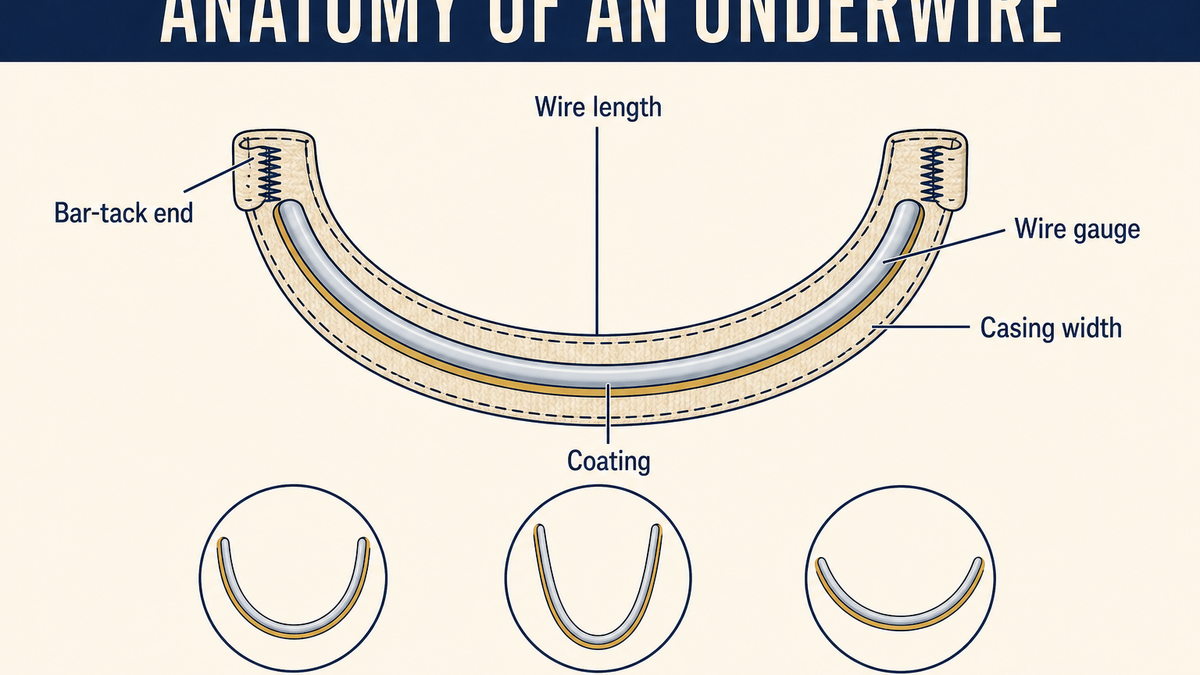
Most underwire is nylon-coated steel wire bent into a U shape. The plastic coating is not cosmetic. It stops the metal from rubbing against the body, and it is the part that fails first: when a coated wire is bent too sharply in handling, the coating cracks and the exposed steel becomes a snag point inside the casing.
The alternative is plastic or polymer wire, which is lighter and completely safe near the skin but gives a softer shape and cannot be bent to fit a customer. For a soft-cup or comfort-focused line that is a reasonable trade. For a structured lift it is not.
The wire code is not universal
Wires are quoted by a code that ties the wire length and height to a cup size. The trap is that these codes are factory-specific. A wire that fits a 34C in one factory’s system is not the same wire as a 34C in another’s, and switching suppliers without re-approving the wires will move the fit.
So the wire must be approved the same way you approve a fabric: as a named item with its code, its length, its height and its gauge recorded, and a physical reference piece kept with your sealed sample. When you approve a golden sample, keep the wire that is in it.
Casing, and why wires break out at the underarm
The casing is the fabric channel the wire sits in. Its width has to match the wire gauge, and its stitching has to be tight enough that the wire cannot travel. Almost every complaint about a wire poking out at the underarm is a casing or tolerance problem rather than a wire problem. The casing was cut a few millimetres short, or the stitch line drifted, and the wire worked its way to the opening over weeks of wear.
- Wire length
- Must match the cup depth at the graded size, not just the base size. Length errors show up first at the largest cup in the range.
- Wire gauge
- The thickness of the wire. Too thin and it flexes out of shape; too thick and it will not sit flat against the ribcage.
- Casing width
- Stated in millimetres on the spec. A casing even slightly narrow will not let the wire seat, and the bra will sit away from the body.
- Bar-tack ends
- The stitched closures at each end of the casing. These take repeated load, so the bar-tack setting is the single most common quality failure on an underwire bra.
- Nickel release
- Where a wire or any metal finding sits against the skin for long periods, it falls under the EU restriction on nickel release from articles in prolonged skin contact, listed under REACH Annex XVII. Ask your supplier for the test report.
The wire test you can run on a sample
Bend the wire gently with your thumbs to the sort of curve it will take in wear, then release it. It should return to shape without a kink. Then run your fingertip along the full length of the coating looking for a crack, a thin spot or a rough patch. Finally, press the wire hard against both bar-tack ends of the casing. A sample that gives at the ends will not survive a season of machine washing.
4. Fabrics for Intimate Apparel
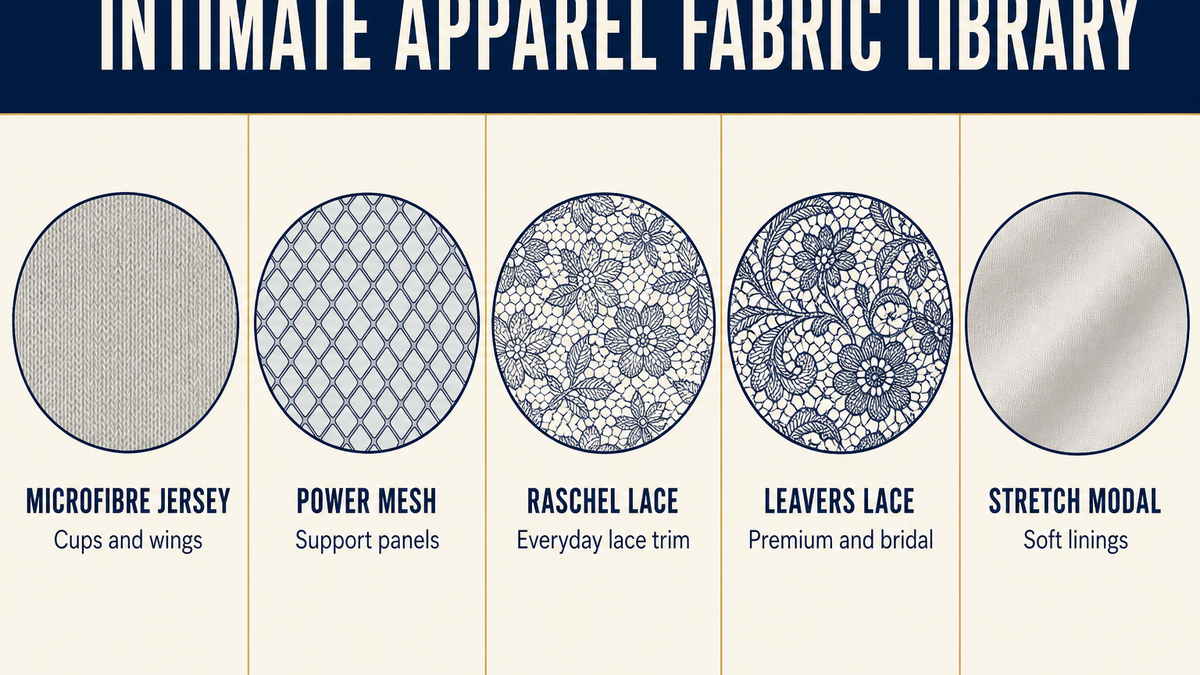
Intimate apparel uses a small, specific fabric library. What matters in this category is not the fibre name on the label, it is two numbers: the weight of the fabric and the percentage of elastane in it. The weight sets how opaque and how supportive the panel feels. The elastane percentage sets whether the garment recovers its shape after a wash or slowly stretches out and stays that way.
| Fabric | Typical Use | What to Check |
|---|---|---|
| Microfibre jersey (polyamide and elastane) | Cups, wings, everyday bras | Elastane percentage and recovery after washing; the surface must not pill |
| Power mesh | Support panels, wings, shapewear | Tension direction — mesh is usually stretchier one way than the other |
| Raschel lace | Everyday lace trim and overlays | Stretch percentage and edge finish; the scalloped edge is often left raw |
| Leavers lace | Premium lace, bridal | Narrower and more expensive; ask for the width and the repeat length |
| Stretch modal | Soft linings, sleepwear, bralettes | Low recovery — fine for comfort, poor for support |
| Bamboo viscose | Soft linings, sustainable positioning | Very low recovery and it weakens when wet; avoid it in a support panel |
| Cotton jersey | Lining, comfort waistbands | No natural stretch, so it is normally blended with elastane |
| Satin | Woven cups, trims, sleepwear | A woven, so it has no cross-stretch; cut direction must be marked on the pattern |
Elastane is the specification that decides whether the bra survives
Elastane is the fibre that gives the fabric its memory. Too little and the band loses tension after a few washes, so the bra rides up at the back. Too much and the fabric feels rubbery and the edges roll. Write the elastane percentage into the order as a number with a tolerance, the same way you would write a wire gauge.
The recovery test needs no equipment. Cut a strip of the fabric ten centimetres long, stretch it out firmly, hold it for thirty seconds, release it, and measure again. A good intimate fabric comes back very close to its original length. A cheap one stays stretched. Repeat it after three warm washes, because the second test is the one that predicts what your customer will see in a month.
Ask for the fabric weight in grams per square metre and the elastane percentage on the same document. Suppliers quote one or the other, and a fabric that is heavy enough but under-elastaned will still fail on the band. If you are sourcing fabric separately from the garment, the same logic applies to writing a fabric specification that a mill can quote against.
5. Findings and Hardware
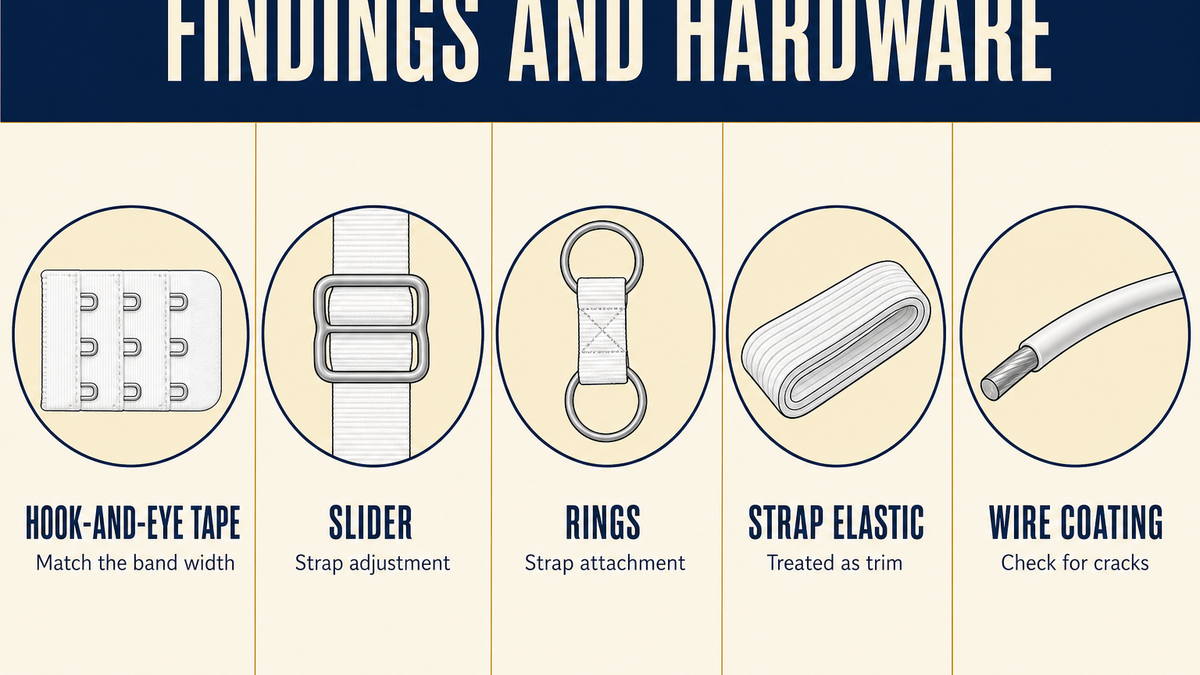
Findings are the small bought-in parts that hold the garment together, and they are where a specification is most often left blank. A bra carries a hook-and-eye closure, two sliders, two or four rings, straps, and between three and six metres of elastic. Each of these is a line item that a supplier will choose for you if you do not choose it yourself.
Hook-and-eye tape
The closure is bought as a tape that is cut to the band width. It is described by the number of rows and the number of hooks, so a three-row, two-hook tape is written as 3×2. Two things go wrong here. The tape width must match your band height, or the back band will not sit flat. And the hook spacing must be consistent across the size range, because a band that closes on a different setting as it grades will not fit the customer who bought her usual size.
Ask for the same tape supplier to be used across the whole range, and ask for the tape to be named in the specification. Suppliers switch tapes to save a few cents, and the customer notices it before you do.
Sliders, rings and strap elastic
Sliders and rings are usually metal or coated metal on a premium bra and moulded plastic on a value line. The metal versions are where a chemical rule applies, not just a durability question. Metal in prolonged contact with the skin falls under the EU restriction on nickel release, so a nickel-free finish or a test report is the thing to ask for rather than a description of the plating.
The elastic exemption, and why it matters for your label
Here is a detail almost nobody in this category gets right. Under the United States rules for textile labelling, elastic added to a garment for structural purposes is treated as trim, and trim is not counted in the fibre content disclosure. Where the elastic is part of the base fabric and does not exceed a set share of the surface area, the label carries the fibre content followed by the words “exclusive of elastic”.
That matters because elastane is expensive. A supplier who wants to hit a lane price by cutting elastane content has a place to hide it, and a buyer who never reads the label rule has no way to catch it. The labelling section below sets out what the label must say.
6. Sizing, Grading and Fit Control
In most garment categories, a size is a body measurement. In intimates, a size is a shape. That is why grading, rather than sewing, is the skill that separates the factories. A supplier who can sew a beautiful 34B sample and cannot grade it to a 38DD is not an intimates factory, whatever the website says.
How grading works, and where it goes wrong
The factory starts from a base size and applies a grade rule to each measurement point. Band sizes usually move in whole steps, cup sizes increase in depth and in wire length, and the relationship between the two is what keeps the shape recognisable across the range. When a supplier grades by scaling the whole pattern up proportionally, the cups get taller and wider at the same time and the shape turns into a cone.
So ask a specific question before you place an order: which size is the base size, and what is the grade rule for the underband, the cup depth and the strap position? A production manager who can answer in numbers is the one you want. A vague answer means the grading will be done by eye at the sample stage and by hope at the bulk stage.
Fit is a quality check, not just a design decision
Most buyers treat fit as something settled by the sample and then assume production will match it. It will not, unless you make it a measured check on the bulk order. The four things that drift in production are the underband tension, the cup depth at the fullest point, the strap length and the position of the hook-and-eye tape.
- Underband tension
- Measured stretched, not flat. A band cut short feels tight in the shop and stretches out at home; a band cut long rides up straight away.
- Cup depth
- Measured at the fullest point with the cup laid flat. This is the measurement that decides whether the wire sits against the ribcage or floats.
- Strap length
- Checked at both slider extremes. Straps that are cut to one length across the whole size range will not fit the ends of it.
- Hook-and-eye position
- Aligned to the band centre on every piece. A closure sewn off centre is the complaint that reads as “the back sits crooked”.
- Wire ends
- Both bar-tacks present, tight and at the same height on the two sides.
Put these on the inspection sheet as measured values with a tolerance, and sample across the size range rather than pulling everything from the middle. A batch that passes at 34B can still fail at the top of the range, and that is the size your returns will come from.
7. Labelling Law: The Fibre Label Is Not Decoration
This is the part of intimate apparel sourcing that buyers discover last and wish they had read first. In the United States, the label on a textile product is not a design element. It is a legally required disclosure enforced by the Federal Trade Commission, and the rules are specific enough that a designer’s note on a hang tag can create an obligation the brand did not plan for.
The statute behind this is the Textile Fiber Products Identification Act, and the Federal Trade Commission sets out how it applies in practice in its guidance on labelling requirements under the textile and wool acts. Four rules from that guidance matter most in this category.
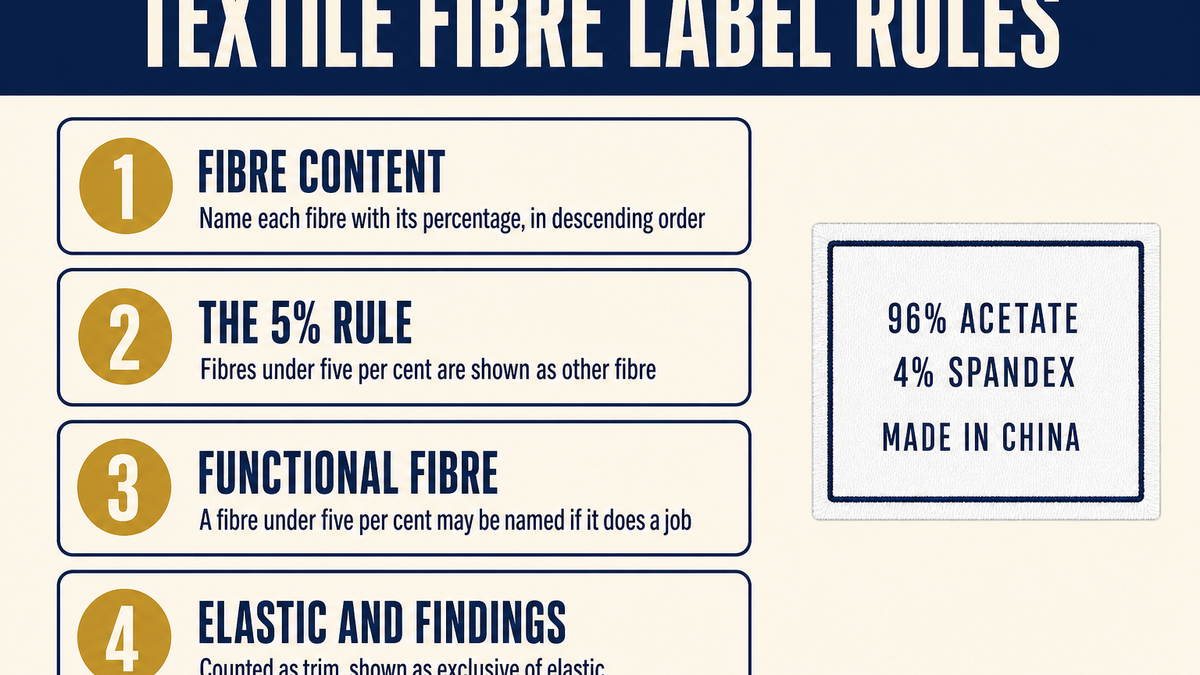
Rule one: fibre content, in descending order
The label must name each fibre by its generic name and give its percentage by weight, listed in descending order of predominance. If a product is made from a single fibre, the word “All” can be used in place of “100%”. For a bra, that means the main shell fabric drives the headline figures, and the percentages have to be accurate, not rounded to whatever looks cleanest on the artwork.
Rule two: the 5% rule
As a general rule, only fibres making up five per cent or more of the fibre weight need to be named. Anything below that line is disclosed as “other fibre” or “other fibres” instead of by its name. This is why so many labels end in a small “other fibres” line rather than listing every component.
Rule three: the functional significance exception, which is where elastane lives
There is an important exception, and it is written specifically for the way elastane works. A fibre below the five per cent line may still be named and given its percentage if it has a clear functional significance at that amount. The Federal Trade Commission’s own example is spandex used for elasticity, and the label it shows is “96% Acetate, 4% Spandex”.
So the presence of a spandex or elastane line on your label is not decoration and it is not optional rounding. It is a statement that a small quantity of that fibre is doing a specific job. If your supplier quietly reduces that percentage to save cost, the label on the garment becomes a wrong statement, and the brand carries that risk rather than the factory.
Never let a supplier print a fibre content that came from a different style. Fibre content copied between products is the single most common labelling failure in apparel, and it is the brand’s name on the label, not the factory’s. Approve the label artwork against the actual fabric test report before the printer runs.
Rule four: elastic and findings are treated as trim
Elastic added to a garment for structural purposes counts as trim and is not included in the fibre content disclosure. Where elastic is part of the base fabric and stays under a set share of the surface area, the fibre content is followed by the statement “exclusive of elastic”. This is why a bra label can legitimately show a shorter fibre list than the number of materials you can count on the garment.
The same principle covers other trim: collars, cuffs, waistbands, binding, tape, gussets and findings are all excluded. And materials that are not fibres at all, such as the metal of a slider or the plastic of a ring, do not appear in the fibre content at all.
And country of origin
The label must also disclose where the product was processed or manufactured, with the country determined under the customs rules rather than by agreement between you and the factory. Getting the wording of that origin marking right is a separate exercise, and the acceptable and unacceptable short forms are set out in our breakdown of made in PRC versus made in China labelling. Care labelling is required as well, but under a separate rule, so it is a second line of artwork rather than part of the fibre statement.
8. Testing and Certification
Intimate apparel sits against the skin for long periods and gets washed more often than almost any other garment, so the tests that matter here are chemical safety and colour fastness rather than strength. Ask for the reports before production, not after.
- Harmful substances
- The industry standard is the OEKO-TEX STANDARD 100, an independent testing system for textiles that checks for harmful substances according to how the product will be used. The OEKO-TEX STANDARD 100 scheme aligns with several chemical rules at once, including restricted substances lists, limits on lead and bans on certain colourants. For a garment worn next to skin, this is the certificate your retail buyer will ask for.
- Colour fastness to washing
- Black and deep-coloured intimate garments are the usual failures. Ask for the result at the wash temperature printed on your care label, not a cooler one.
- Colour fastness to perspiration
- A separate test from washing, and the one that matters most for a garment worn against skin. It is normally reported for both acidic and alkaline solutions.
- Nickel release
- Applies to any metal in prolonged skin contact, including plated sliders, rings and coated wire. The EU restricts nickel release from such articles under REACH Annex XVII, and the current list of restrictions is published by the European Chemicals Agency. Ask for a nickel release report rather than a description of the plating.
- Pilling and abrasion
- The test that predicts how a microfibre or modal surface will look after twenty washes. Cheap fabric passes on day one and fuzzes by month two.
- Dimensional stability
- Measure the garment before and after three washes at the labelled temperature. Shrinkage in the band is what turns a good fit into a bad one.
Run the wash and recovery tests on three pieces rather than one, and take them from different points in the production run. Fabric behaviour varies across a roll, and the roll that went into the last third of your order is the one nobody checked.
9. Tooling, MOQ and Sampling
The minimum order on a bra is set by setup time, not by material cost. A cut-and-sew style needs a pattern, a graded size run and a sample, which a factory can absorb on a modest order. A moulded style needs a press tool per cup size before a single piece is made, and that is the cost that forces the volume up.
The lowest barrier for a first collection. You pay for pattern making and sampling rather than for a mould, and you can change the shape next season without writing off a tool.
The smooth surface that sells a t-shirt bra. The press tool is a one-off cost per size, so the style only makes sense if you expect to repeat it across several seasons.
Little or no tooling, but the highest material cost per piece because Leavers lace and premium mesh are bought by the metre. Keeps sample quantities small and margins workable.
Sample the fit on real bodies before you sample the colour
Most sampling processes in this category get the order wrong. Factories default to making a beauty sample in the base size for the buyer to photograph, and the buyer approves it. That sample tells you nothing about whether the bra fits the sizes above and below it.
Ask for three samples at the start: the base size, the smallest size in the range and the largest. Wear them, or have someone in each size wear them for a few hours. Fit problems in intimates show up after an hour of wear, not on a hanger. Approve the fit across the range first, then settle colour and trim.
Seal a golden sample for every size you sell, not just for the base size, and keep the sealed piece with its wire code and its fabric card attached. When the bulk order arrives, you are then comparing measurements against a physical reference rather than against a memory of how the first sample felt. This is the same discipline that applies to a first article inspection in any product category, and it matters more in intimates than almost anywhere else.
Put the sampling stages into the order confirmation rather than into an email chain, so the milestone payments are tied to approvals rather than to dates. If you are placing the order through a factory with limited English, the same protections belong in a written contract.
10. A Five-Step Sourcing Roadmap
Worked in this order, these five stages keep the expensive mistakes out of your order.
- Fix the construction route before anything else. Decide moulded, cut-and-sew or lightly lined, because it decides your tooling bill, your realistic first order and the shape of every downstream decision.
- Write the component specification. Wire code, gauge and casing width, fabric weight and elastane percentage, hook-and-eye tape format, elastic width, and the five measured fit points with their tolerances. Most quality failures in this category trace back to a line nobody wrote.
- Check the factory’s equipment, not its showroom. Ask for the cup moulding press, the wire insertion setup and the cutting table live on a video call. A short factory audit answers in an afternoon what a month of emails will not.
- Approve the fit across the size range. Sample the base size, the smallest and the largest, wear them, and seal a golden sample for each size with its wire code recorded. Then approve colour and trim.
- Measure the bulk order, don’t just look at it. Take the five fit measurements from pieces drawn across the size range, check the bar-tack ends on every wire, and confirm the fibre test report matches the label artwork before it goes to print.
The inspection stage is the one to formalise. A pre-shipment inspection with measured values and a sampling plan across sizes catches the drift that a visual check misses, and the first production run deserves its own first article inspection before the line runs at full speed. Label artwork and woven labels sit in the same approval loop, so treat them as a production item rather than as stationery, in the same way our guide to custom logo printing and finishing treats branding on any product. All of it belongs in the written order rather than in a chat thread, which is what a bilingual sales contract is for.
Everything in this guide sits inside our Apparel, Fashion & Bags sourcing hub, which collects the fabric, component and factory guides for this category in one place.
11. Frequently Asked Questions
Why is a bra so much harder to manufacture than other garments?
Because of the component count and the grading. A single style can carry twenty to thirty pieces, including a moulded or stitched cup, a wire in a casing, a closure and several metres of elastic. Every one of those has to line up with a pattern that has been graded across cup and band sizes. A t-shirt factory can sew, but it does not own the press, the wire setup or the grading knowledge.
Should I choose moulded or cut-and-sew cups for a first collection?
Cut-and-sew, unless you already know your volume. Moulded cups need a press tool per cup size, which is a fixed cost you only recover across a large run. Cut-and-sew has no tooling, so it lets you start small and change the shape between seasons. Move to moulded once one style has proved itself and you can commit to a repeat order.
Why do wires poke out at the underarm, and how do I stop it?
Almost always because of the casing rather than the wire. If the casing is cut short, is too narrow for the wire gauge, or the bar-tack closing the end is weak, the wire travels to the opening over weeks of wear. Write the casing width on the specification, check both bar-tacks on every piece in the bulk order, and bend-test the wire on the sample.
Does my underwear label really have to list the spandex percentage?
If the garment is sold in the United States and the product is a covered textile item, yes, at least in effect. Fibres making up five per cent or more of the weight must be named with their percentages in descending order. Below that, a fibre can normally only be shown as “other fibre”, with one important exception: a fibre under five per cent may be named where it has a definite functional significance, and spandex used for elasticity is the Federal Trade Commission’s own example. That is why “96% Acetate, 4% Spandex” is a legitimate label line.
What certifications should I ask for on an intimate apparel order?
Start with the OEKO-TEX STANDARD 100 certificate for the fabric and the trims, since the garment sits against the skin. Add colour fastness to washing and to perspiration, a nickel release report for any metal finding or coated wire, and a dimensional stability test at the wash temperature on your care label. Ask for the reports before production starts, because a failed test is a rework decision at that point rather than a shipping emergency.
What is a realistic first order for a new lingerie brand?
It depends entirely on the construction. A cut-and-sew or unlined style can often start at a modest quantity because there is no mould to pay for, while a moulded style needs enough volume to justify the press tool per cup size. Ask for pricing at two volumes so you can see where the break points fall, and sample the smallest and largest sizes in the range before you commit, because that is where the fit problems will be.
Get Your Construction and Spec Checked Before You Order
Our team reviews your construction route and component specification line by line, checks the cup moulding press, wire setup and cutting table at the factory, measures the five fit points across the size range, and verifies the fibre report against your label artwork before it goes to print.
Request a Lingerie Sourcing Quote
Questions & Comments
We read every one and reply within 24 hoursNot sure whether to order moulded or cut-and-sew cups, worried the wires will break out, or trying to work out what your fibre label is legally allowed to say? Post your construction route, fabric weight or sample measurements below and our team will help you read them.