
Hydraulic Press Manufacturer: Sourcing Presses From China
 ·
Updated October 12, 2026
·
26 min read
A hydraulic press is sold on a number, and the number is real: tonnage. Almost everything else on the quotation decides how much of that tonnage ever reaches the work. This guide covers the four figures that set the machine up, the frame and the bed that eat part of the load, the hydraulic circuit that produces the force, the guarding that keeps hands out, and the part of the job that begins when the power is switched off but the machine is still holding a slide in the air. It also covers one sentence in the United States rules that most quotations get wrong, and it is worth reading before you compare a single price.

Six Lines That Decide Whether a Press Quote Is Complete
| What the buyer has to settle | Why it is not obvious | The line on your order that closes it |
|---|---|---|
| Which press rule actually applies | The United States rule titled Mechanical power presses names hydraulic and pneumatic presses in its own list of machines it does not cover | The rule by number, not “the press standard” |
| What the tonnage is rated at | Tonnage is the force the cylinder can make, and the frame and bed decide how much arrives at the die | The rated tonnage with the bed size and load position it applies to |
| Which frame type, and how far it moves under load | An open frame springs open at the throat, so the tooling closes to a different line under load than it did when set | The frame type and the deflection figure at rated load |
| What holds the slide up during service | Cutting the power leaves oil under pressure in the cylinder and a slide that may be held up only by that pressure | The isolation point, the stored-energy step and the blocking method |
| What keeps hands out of the die area | Guarding is a separate requirement from the press rule and it falls on the general machine guarding rule instead | The guard type, how the interlock works and who checks it |
| What limits the pressure in the circuit | The relief valve setting is the only thing standing between the pump and the frame, and a gauge you cannot read is not a check | The relief valve setting on the drawing, and a gauge you can see from the floor |
What a Hydraulic Press Is, and the Four Numbers That Decide Everything
Start with what the machine is, because a hydraulic press is usually described by one number and then bought against four.
The machine produces force by pushing oil. A pump takes oil from a tank and pushes it into a closed cylinder, and because a liquid does not squeeze down, the pressure it builds is the same throughout the oil. That pressure acting on the area of a large piston produces a large force, which is why a modest pump and a modest motor can move a very heavy slide. Nothing about that is new; it is the reason the hydraulic press replaced the flywheel press for work that needs a long, slow, controllable push rather than a short blow.
Four numbers describe the machine, and a quotation that leaves any of them out is incomplete.
- Tonnage
- The force the cylinder can produce, usually written in US tons or in metric tonnes. It is a force, not a pressure. A quotation that does not say which ton it means has left a gap of roughly ten percent in the most important figure on the page.
- Stroke
- How far the slide can travel. It decides the tallest part you can put between the dies and how much room you have to load and unload by hand.
- Daylight
- The clear gap between the slide and the bed when the slide is fully open. This is the figure that decides whether your die set and your part will fit at all, and it is the figure buyers forget until the press has been built.
- Bed size
- The working area of the bed, and the position of the T-slots. It sets the largest die you can bolt down and, as the rest of this article shows, how much of the rated tonnage you can usefully apply.
Those four are related, and the relationship is where most of the confusion in a press quotation lives. Tonnage is a force. When a force is applied over an area, the result is pressure on the work, so the same press with a small die on it presses much harder per unit of area than the same press with a large die. That is why a quotation that gives tonnage alone tells you nothing about whether a particular job will be possible: the job depends on the pressure at the die face, and the die face is the buyer's decision, not the factory's.
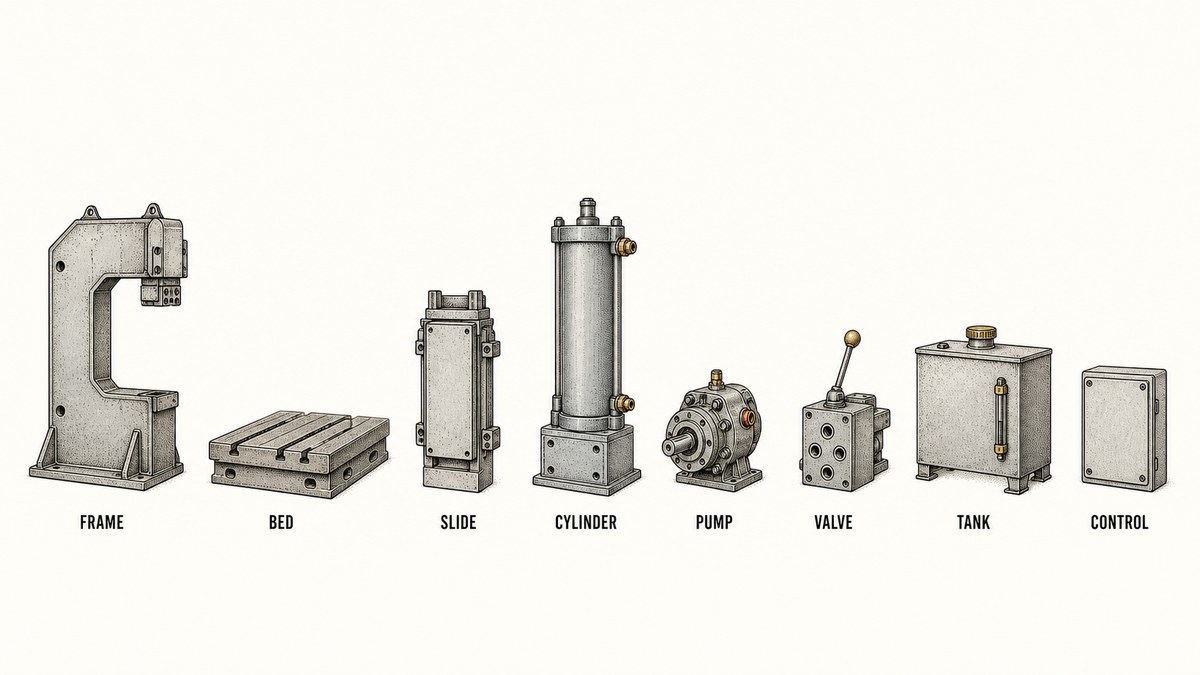
One more distinction belongs at the start, because it decides everything in the next section. A mechanical press stores energy in a spinning flywheel and releases it through a clutch, so the force arrives as a blow and the machine has to be stopped mechanically before anyone goes near the tooling. A hydraulic press stores its energy in oil under pressure and in the weight of the slide, and it can be stopped anywhere in its travel and hold there. That single difference is why the two machines are covered by different rules, and the American rulebook says so in plain words.
The Press Rule Everyone Quotes Does Not Cover Your Press
This is the most useful paragraph in this article, and it is one sentence long.
In the United States, the rule that everyone in the press trade refers to as the press standard is 29 CFR 1910.217. Its title is Mechanical power presses, and its own first paragraph carries a list of machines it does not cover. Section 1910.217(a)(5), headed Excluded machines, reads:
“Press brakes, hydraulic and pneumatic power presses, bulldozers, hot bending and hot metal presses, forging presses and hammers, riveting machines and similar types of fastener applicators are excluded from the requirements of this section.”
Read that twice, because it is the whole point. A hydraulic press is named in the exclusion list. So is a press brake, and so is any pneumatic press. If the machine you are buying is driven by oil or by air rather than by a flywheel and a clutch, then 1910.217 — the rule with the control reliability requirements, the presence-sensing device provisions, the brake monitoring language and the periodic inspection certification — does not apply to it. Not because those provisions are wrong, and not because they are bad practice to copy. They do not apply because the rule says they do not apply.
Two related details are worth knowing while you are in the section. Paragraphs 1910.217(a)(1) through (a)(3) are marked Reserved, which means the text that used to sit there has been taken out and nothing has replaced it. And the requirements that do remain in 1910.217(b) are still useful reading, because they describe how a well-built press behaves: components must be designed, secured or covered so that a broken or loosened part cannot fall on anyone; a friction brake that stops or holds the slide must be self-engaging, meaning it needs an outside force to release it rather than an outside force to apply it; a foot pedal must be protected against being stepped on by accident and must carry a nonslip pad; and a counterweight, if there is one, must have its travel enclosed. None of that binds a hydraulic press. All of it tells you what a factory that thinks about safety puts on a machine anyway.
So what does apply to a hydraulic press? Three rules carry the load, and all three are free to read in full.
The general machine guarding rule. Section 1910.212 applies to every machine in a general industry workplace, not to a named family of machines. It requires that one or more methods of machine guarding be provided to protect the operator and other employees in the machine area from hazards such as those created by the point of operation, ingoing nip points, rotating parts, flying chips and sparks. Point of operation is the phrase that matters on a press: it is the place where work is actually performed on the material, and it is exactly where a press operator's hands are.
The control of hazardous energy rule. Section 1910.147 covers the servicing and maintenance of machines where the unexpected start-up or the release of stored energy could injure someone. On a hydraulic press this is not a formality, because the machine stores energy in two places at once: in the oil that is still under pressure, and in the weight of a slide that may be resting on that pressure. A whole section of this article is given to it.
The materials handling rule. Section 1910.176 covers how material is moved and stored around the machine, which on a press means the coil, the blank, the finished part and the die. It is the rule that decides whether the space around your press is part of the machine or an afterthought.
There is also a family of consensus standards, the B11 series, published by the American National Standards Institute, which the press trade does use for guarding design and for the safety distance calculations that go with light curtains. Those standards are sold rather than published free, so this article does not summarise them and does not quote a figure from them. If your safety officer is designing a guard, that is the document they need, and no article, including this one, is a substitute.
Why does the exclusion matter commercially rather than just legally? Because of what it tells you about the person quoting. A supplier who writes “meets OSHA 1910.217” on a hydraulic press quotation has cited a rule that excludes the machine. That is rarely dishonest; it is shorthand that has been copied from quotation to quotation for years. But it is a reliable sign that the supplier is working from a template rather than from the scope paragraphs, and the supplier you want designing your guard and your isolation point is the one who has read the scope. When a Chinese factory answers the question “which rule applies to this machine, and what is its number?” without hesitating, you have learned more about that factory than a factory audit certificate can tell you.The same instinct makes sorting a press builder from a reseller a question of what they can describe rather than what they can show.
Tonnage: What the Number Means, and Where It Goes
Tonnage is the force the cylinder can produce. It is not the force that arrives at your die, and the difference between those two numbers is where presses disappoint people.
Picture the load path on an open frame. The cylinder pushes down on the slide. The slide pushes down on the die. The die pushes down on the work and the bed. The bed pushes down on the frame, and the frame, being a single piece of steel bent into a C, pushes back up to close the loop. Every part of that loop has to carry the load, and every part of it moves a little while doing so. The circle of steel does not stay the shape it was when it was machined. It springs open.
How much it opens is called deflection, and it is measured in thousandths of an inch or in fractions of a millimetre at a stated load. A pressmaker who knows their product will quote a deflection figure for the frame at rated tonnage, and sometimes for the bed as well. A pressmaker who does not quote one has either never measured it or would rather you did not ask. This is the single most useful extra figure you can request, because it is the figure that decides whether a die that was set to close with a certain gap will still close with that gap when the press is at full load.
Deflection has a second consequence that catches buyers later. Because the frame is deforming, the alignment between the slide and the bed changes as the load comes on. On a lightly loaded press this is invisible. On a press run near its rated tonnage it is not, and the practical symptoms are parts that vary in thickness from one side of the bed to the other, or a tool that pinches on one edge and needs shimming. When you meet that problem on a machine already in service, the cause is usually the frame and the off-centre load, not the tooling.
Off-centre loading is worth stating plainly because it is the most common way a correct press is used incorrectly. A press is rated at a force, and it is usually rated with the load applied in the middle of the bed. Apply that same force at the far edge of the throat of an open frame, and the frame has much more leverage over itself. The result is more deflection per unit of load, more twist, and a machine that behaves as though it were smaller than its rating. If your work sits off centre, the honest move is to say so on the enquiry and ask what the maker recommends, because the answer may be a heavier frame rather than a bigger cylinder. Buying tonnage to solve a stiffness problem is one of the more expensive ways to fix it.
One more distinction finishes this section. The pressure gauge on a hydraulic press reads pressure, not force. The force is the pressure multiplied by the area of the piston it acts on. That means a press and its gauge can be perfectly honest and still mislead a buyer who assumes the gauge is a tonnage readout: the same gauge reading means different forces on machines with different bore cylinders. When you ask a factory for the relationship between the gauge and the tonnage, a good one will give you the piston bore and let you do the arithmetic yourself. A poor one will say that it is set up fine.
Frame Types: The Same Tonnage, Three Different Machines
Two presses can carry the same tonnage on the nameplate and behave so differently that they are not the same product. The frame is why.
The C-frame press has a single upright and a throat, so the slide comes down over a bed that is open on three sides. Loading is easy, long parts can be fed in from the side, and the machine is compact and cheap to build. The cost is the open loop: the throat acts like a lever, and the further from the upright you work, the more the frame has to resist. A C-frame press is normally rated at the centre of its bed, and working near the outside edge of the throat is working against a smaller effective machine. If your parts need to be loaded from the side, this is the frame you want, and you should ask for the throat depth and the load position the rating applies to rather than assuming the number on the plate is available everywhere.
The H-frame press, also called a straight-side or double-upright press, closes the loop. Two uprights carry a top member and a bed, so the load path forms a rectangle instead of a hook. The result is far more stiffness for the same weight of steel, almost no springing open, and alignment between slide and bed that holds up under load. It costs more, it takes more floor space, and feeding a long part in from the side is usually impossible. On work where the die has to close to a fine gap, or where the load is off centre, the extra stiffness is not a luxury; it is the difference between a press that repeats and a press that needs adjusting every shift.
The four-post press puts four vertical tie rods between a top plate and a bottom plate, with the cylinder at the centre of the top. The load path is symmetrical, which makes this the frame of choice for large bed areas and for work where pressure has to be even across a wide die — forming a panel, pressing a stack of parts, or a moulding operation. The four rods are the structure, and they carry a set pre-tension. That has a practical consequence a buyer should know before ordering spare parts: if a four-post press is ever dismantled, the rods have to be re-tensioned correctly on reassembly, and a press that was put back together without that step will behave oddly — uneven pressure, wandering alignment, and a bed that seems to fight the slide.
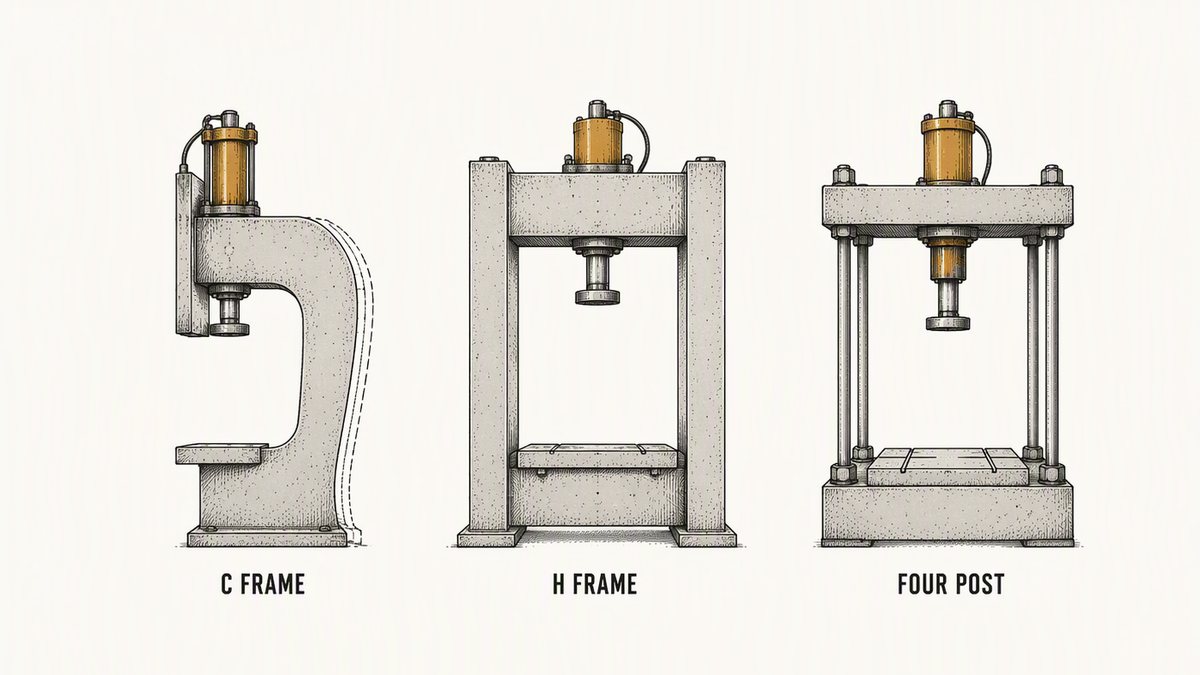
Whichever frame you choose, four questions belong on the request for quotation, and the answers separate the factories that design from the ones that assemble. First, what is the frame type, in the maker's own words? Second, for an open frame, what is the throat depth and at what position does the rated tonnage apply? Third, what is the frame deflection at rated load, and at what bed position was it measured? Fourth, and this is the one that gets missed, was the frame stress-relieved after welding? A welded steel frame carries locked-in stresses from the welding itself. A maker who stress-relieves the frame after welding and machines it afterwards is building a press whose alignment will still be there in five years. A maker who welds, machines and paints in one pass is building a press whose alignment may drift as those locked-in stresses find their own level. It is a slow fault, it is hard to prove after the fact, and it is entirely visible in the process description — which is the same reason a factory that can describe its own process is worth more than a factory that can only show a certificate.
Inside the Hydraulic Circuit, Where the Force Is Made
The hydraulic circuit is where the tonnage comes from, and it is the part of the press that a buyer is least likely to specify and most likely to regret.
Follow the oil round the loop. It starts in the tank, which is not just a container: it holds enough oil to let the circuit run without overheating, it gives dirt a chance to settle, and it usually carries the filler, a breather and a sight glass so somebody can see the level without opening anything. From the tank the pump draws oil and pushes it into the circuit. Most industrial presses use a gear pump, which is simple, solid and inexpensive, or a piston pump where higher pressures are needed. A fixed-displacement pump moves an amount of oil proportional to its speed, so the flow rate on a press like this is set by the motor speed, and the pressure is set by whatever the oil meets on the way. That is the sentence that explains most of what follows.
Because the pressure is set by resistance rather than by the pump, the circuit needs something to decide what the maximum pressure will be. That part is the relief valve. When the load stalls the slide, or when the slide reaches the end of its stroke, the pump keeps pushing oil and the relief valve opens to let it escape back to the tank rather than letting the pressure climb until something breaks. Two consequences follow. The first is that the relief valve setting is the real limit on the force the press can produce, whatever the nameplate says, because force is pressure multiplied by piston area and the relief valve caps the pressure. A press with a big cylinder and a low relief valve setting cannot make its rated tonnage. The second is that a relief valve is where hydraulic energy turns into heat, so a press that is regularly working against a stalled load will heat its oil, and a circuit with no cooler will eventually cook the oil and the pump with it.
Next in the loop is the directional valve, which decides where the oil goes. A manual lever is the simplest and the cheapest, and it is still common on presses in small workshops. A solenoid valve allows a pendant or a control panel to do the switching. A proportional valve lets the slide speed be varied smoothly rather than switched between two rates. Which one you need follows from how the press will be operated, not from how impressive it sounds on a quotation, and it is worth being honest about this: a workshop with one operator and one job gains nothing from a proportional control that nobody will ever adjust.
At the end of the loop sits the cylinder, and here the geometry is the whole story. The bore of the cylinder sets the force at a given pressure, which is why a factory will sometimes reach tonnage by enlarging the cylinder rather than by increasing the working pressure. The rod diameter matters for a different reason: on the return stroke the oil acts on the piston area minus the rod area, so the force that pulls the slide back up is always less than the force that pushes it down. A press whose return force is slight will be slow to open and may struggle to pull a heavy die set clear, and that is a specification a buyer can ask for in figures rather than discover on the shop floor.
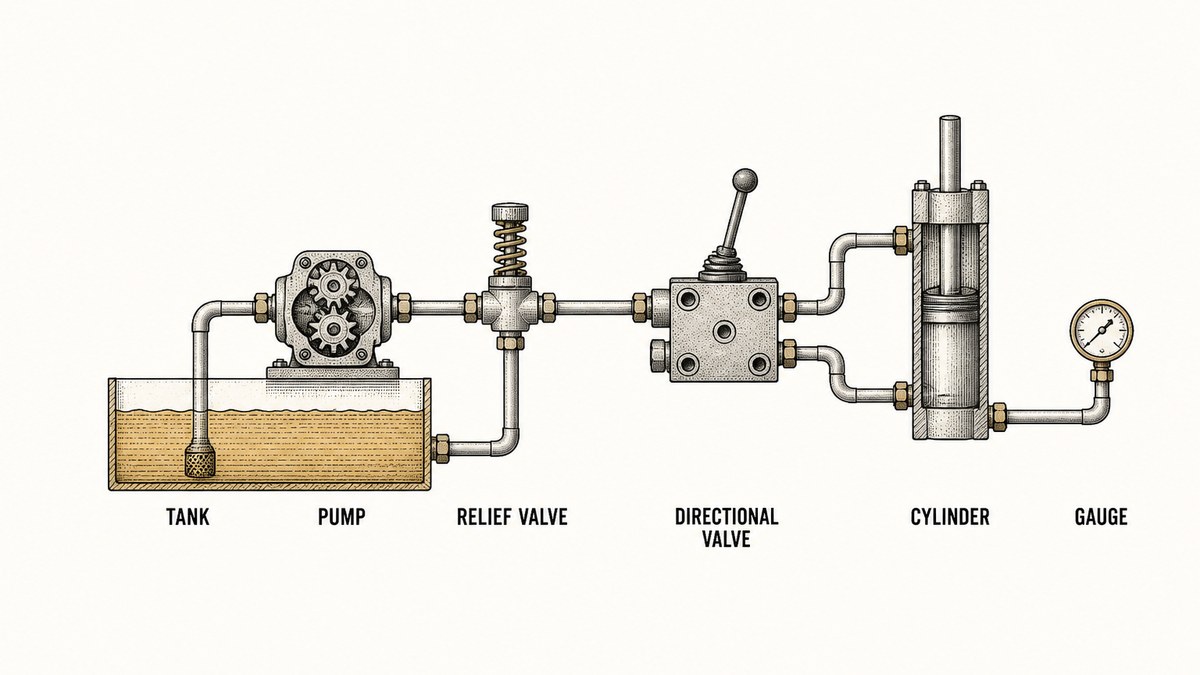
Two supporting systems decide how long the circuit lasts, and both are easy to leave out of a specification. Filtration is the first. Oil carries abrasive dust, and the pump is the part that suffers, so the filter and its rating matter more than the colour of the paint. Ask where the filter sits, what it is rated to and how it is changed. Cooling is the second. A press that runs a few strokes a minute will look after its own temperature through the tank surface. A press that runs continuously, or one that holds pressure for long periods, will need a cooler, and a quotation that does not mention one is either assuming light duty or has not thought about it.
Finally, the hoses and pipes. A high-pressure hose is a wear item, and it carries a working pressure and a burst pressure that should be on the drawing. It should also carry a date, because rubber ages whether or not the press runs, and a hose that has been sitting in a warehouse for years before it was fitted can fail early for reasons that have nothing to do with the press. When your first press arrives, look at the hose markings. It is a two-minute check that tells you whether the factory buys from a supplier who marks their product or from someone who does not.
The Bed, the Span, and Why the Middle Is the Weak Point
The bed is a heavy steel plate with slots in it, and it looks far too solid to be the weak part of anything. It is not the weakest part, but it is where the rated tonnage quietly gets diluted.
The reason is that a bed spans. It is a plate resting on supports at two ends, whether those supports are the uprights of an H-frame, the base of a C-frame or the four posts of a four-post press. A load applied in the centre of a span bends the plate down, and a load applied near a support barely bends it at all. The plate does not have to fail for this to matter: a fraction of a millimetre of sag under the middle of a die changes the thickness of the part coming off it. On a job with a tight tolerance, the symptom is parts that measure correct at the edges of the bed and thick in the middle, and the tooling takes the blame for a fault that belongs to the bed.
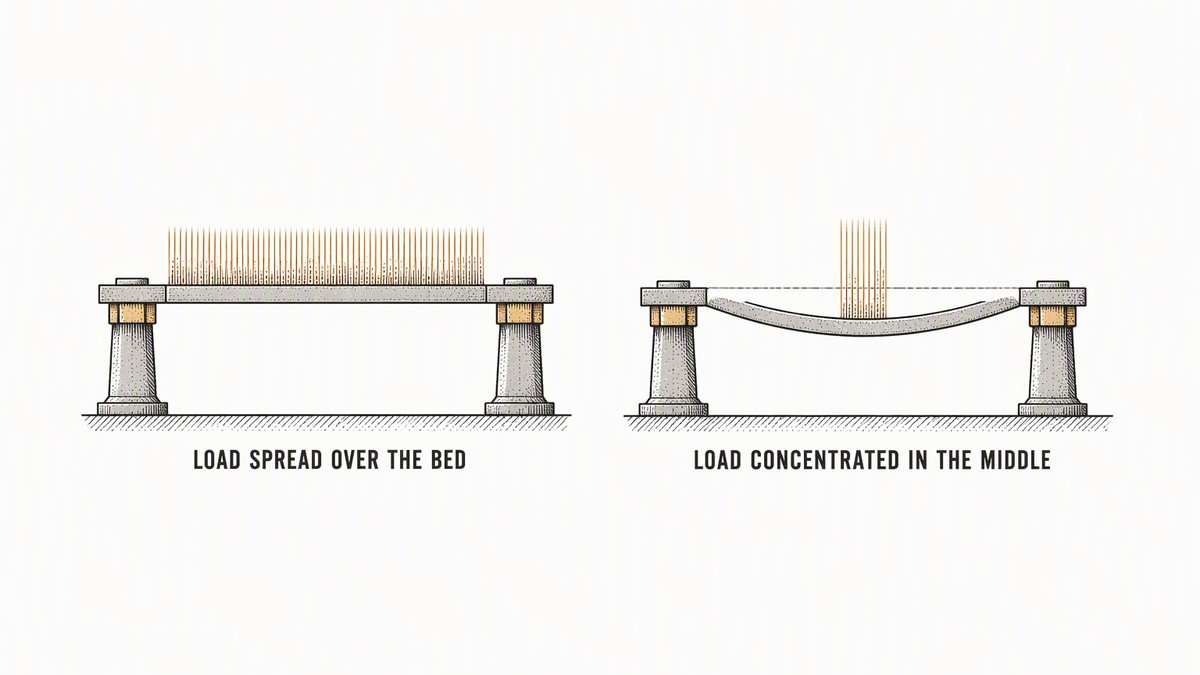
Three habits stop this from becoming a problem. The first is to ask the maker for the bed's rated load at the centre of its span, not just the tonnage of the press, because those are two different numbers and only one of them describes what will happen at the middle of the bed. The second is to spread the load. A die shoe — a thick plate bolted to the bed and carrying the die — spreads the force over a larger area and stiffens the span, which is why press shops that care about repeatability use one. The third is to keep the work as near the supports as the tooling allows. If the job can only be run in the middle of a long bed, that is worth knowing before the press is ordered, because the answer may be a smaller press with a shorter span rather than a larger press with a longer one.
One safety point belongs in this section because it lives in the same gap. The space between the bed and the die is usually filled with a spacer, a block or a set of parallels, and that block is carrying the full tonnage. A block that is too small for the load, or that is not properly seated, is not a shim: it is stored energy waiting for a moment to release. Press shops have been injured by blocks that were the wrong size for the job, and the fix is not skill or care, it is hardware — a properly sized, properly seated spacer, and a bed and die arrangement that does not invite improvisation. If your process will need spacers, specify them, and if the factory offers to supply the press without them, ask what they expect you to put in that gap.
Controls, and the Two-Hand Question
The control system is where the buyer's safety decisions and the operator's working life meet, and it is usually settled by whoever writes the cheapest paragraph in the offer.
There are four common ways to start a hydraulic press. A manual lever valve is the oldest and still the simplest: the operator pulls a lever and oil goes where it is told. A pendant or panel of push buttons allows the press to be started from a position away from the die, which is useful, and also allows it to be started from a position where the die cannot be seen, which is not. A foot pedal leaves both hands free to hold the work, which is exactly why it is the most dangerous of the four on a press where a hand could be in the die area at the moment the slide comes down. A two-hand control requires both hands to be on two buttons at the same time before the slide will move.
The two-hand control deserves a proper look, because it is the option buyers most often ask for and the one most often misunderstood. Its logic is simple and honest: if both of the operator's hands are on the buttons, neither of them can be in the die. Its limits are equally simple. It protects only the hands that are on the buttons. If the same press can also be started from a pendant on the other side of the machine, or from a foot pedal, then the two-hand control guarantees nothing at all — the operator can hold the work with one hand, stand on the pedal, and reach into the die with the other. A two-hand control is a safeguard for one operator standing at one station, and the moment the machine offers a second way to start it, the safeguard has to be reconsidered rather than assumed.
That is also why the exclusion in 1910.217 matters on the control panel and not only on the guard. On a mechanical press the rule sets out in detail what a two-hand control must do, including how closely in time the two buttons must be pressed and how far the control must be from the point of operation. On a hydraulic press those provisions do not apply, so the buyer cannot point at a paragraph and say the control meets it. What remains is the general duty to protect the operator from the point of operation, plus the consensus standards that the safety trade actually uses for the distance and timing figures. If a supplier offers a two-hand control on a hydraulic press and can explain what makes it effective — what happens if only one button is pressed, whether the buttons must be held for the whole closing stroke, and what stops the slide if a button is released — that supplier has thought about the machine. A supplier who says only that the press has two-hand control has named a feature and answered nothing.
Three control details belong on the request for quotation. First, how many places can start the press, because that number decides whether any single safeguard is meaningful. Second, what the buttons must do during the closing stroke — on a hydraulic press the slide can be stopped anywhere, so a control designed so that releasing either button stops the slide is a genuinely useful safeguard, and it costs almost nothing to specify. Third, what the emergency stop actually stops. Stopping the pump motor, releasing the directional valve and removing the electrical supply are three different actions with three different results, and the one that matters is whether the slide is left held up by oil pressure after the button has been pressed. That question is the doorway into the next part of this article, which is the part that keeps people alive when the press is being serviced rather than run.
Guarding: What Applies When the Press Rule Does Not
Because 1910.217 excludes hydraulic presses, the guarding duty on your press lands on the general machine guarding rule, and that rule is deliberately broad.
Section 1910.212 applies to machines generally rather than to a named family. It requires that one or more methods of machine guarding be provided to protect the operator and other employees in the machine area from hazards such as those created by the point of operation, by ingoing nip points, by rotating parts, by flying chips and by sparks. Every phrase in that list has a counterpart on a hydraulic press. The point of operation is where the die meets the work. The nip points are wherever two surfaces close on each other, including the slide against a fixed stop. The rotating parts are the pump, the motor and any cooling fan. The flying chips are the flash, the slugs and the fragments of a part that gives way. A broad rule is not a weak rule; it is a rule that has to be read as covering whatever the machine actually does.
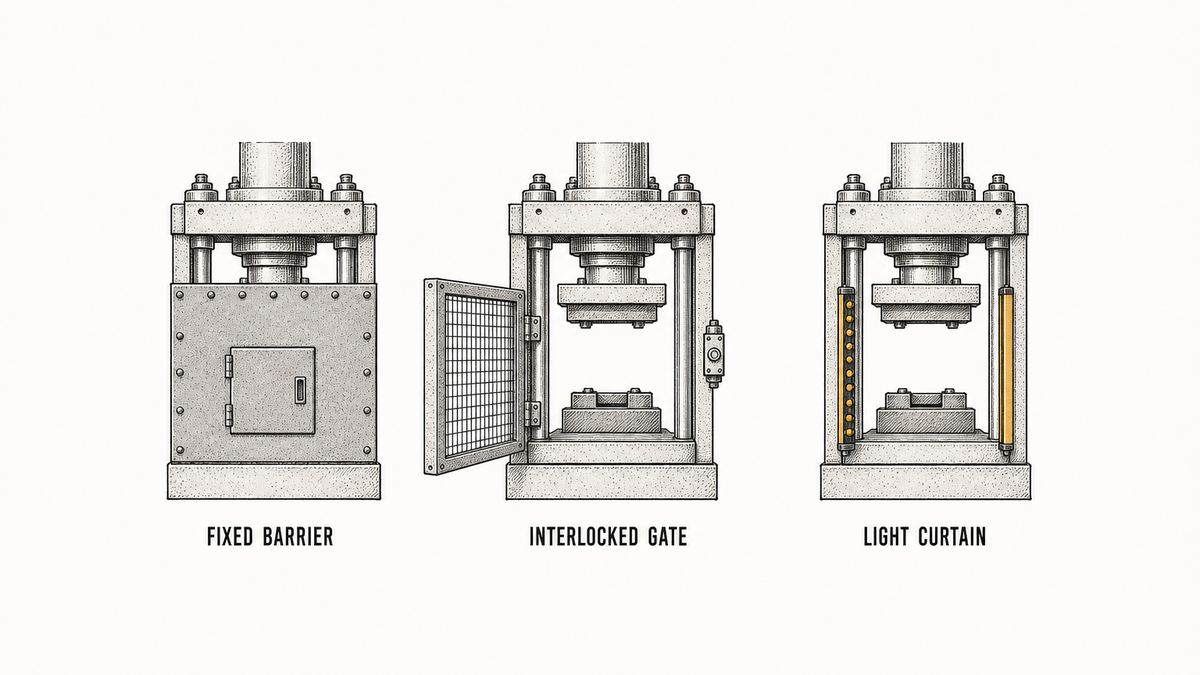
Three guarding approaches dominate press work, and they fail in three different ways.
A fixed barrier is a panel or a cage bolted to the machine so that the operator cannot reach the die area at all. It has no moving parts, no switch to defeat and nothing to adjust, which is why it is the most reliable of the three and the one that operators dislike most. Its weak point is the access door. A fixed guard has to be opened to load a part, change a die or clear a jam, and a hinged access panel that swings freely is a fixed guard that is open for most of the working day. The honest question about a fixed barrier is not whether it exists but how the work gets in.
An interlocked gate is a barrier with a switch, arranged so that the press cannot start while the gate is open, and often so that opening the gate stops the slide. Its reliability rests entirely on the type of switch. A positive-mode interlock — one with a physical actuator that is forced apart by the gate rather than merely sensed by it — cannot be defeated by taping a contact closed, which is the oldest trick in every workshop. A proximity switch or a reed switch can be. When you are buying, ask what the interlock is and how it works when the gate is open; a supplier who describes a mechanism has answered the question, and a supplier who describes a feature has not.
A light curtain is a photoelectric device that watches the opening with a beam, or a set of beams, and stops or prevents the slide from moving if anything breaks the field. It has one great advantage: there is no physical barrier, so loading and unloading are unimpeded and the guard is far less likely to be bypassed. It has one great danger on a hydraulic press, and it is worth stating carefully.
The effectiveness of a light curtain depends on where it is mounted, and that position is worked out from how long the machine takes to stop. The calculation adds together the time for the sensing device to react, the time for the control to respond, and the time for the machine to actually stop. On a mechanical press the third term is dominated by the brake. On a hydraulic press there is no brake in that sense: there is a valve that has to shift and oil that has to stop moving and a slide with weight that has to slow down. That is a different set of times, and in many cases a longer one. So a light curtain installed at a distance copied from a mechanical press installation, or at a distance that someone estimated, is not a safeguard. It is a safeguard-shaped object in the wrong place.
Two habits turn a guarding decision into a guarding result. The first is to write the guard into the order rather than to add it afterwards, because a guard designed with the machine can be built into the frame, and a guard added later is bolted to whatever surface happens to be available. A factory that builds both the press and the guard can tell you how the two fit; a factory that builds the press and buys the guard elsewhere will hand the problem to you.
The second is to keep administrative measures in their place. A warning sign, a written procedure and a training session are worth having, and none of them is a guard. The general guarding rule asks for a method of guarding, which means something physical between the operator and the hazard. If the answer to “how is he protected?” begins with “he is trained to”, then the machine is not guarded, and the fact that the operator is careful today does not change what the machine will do on the day he is tired.
Lockout, Stored Energy, and the Sentence That Names Hydraulics
Everything so far has been about a press that is running. This section is about a press that has been switched off, and it is the section that most often decides whether somebody goes home.
The rule is 29 CFR 1910.147, the control of hazardous energy. It covers the servicing and maintenance of machines and equipment in which the unexpected start-up of the machine or the release of stored energy could cause injury to employees. Read the second half of that sentence again, because it is the half that applies to a hydraulic press even when the electrical supply has been isolated perfectly. It requires an energy control program, documented procedures for each machine, a periodic inspection of those procedures, and training for the people who do the work.
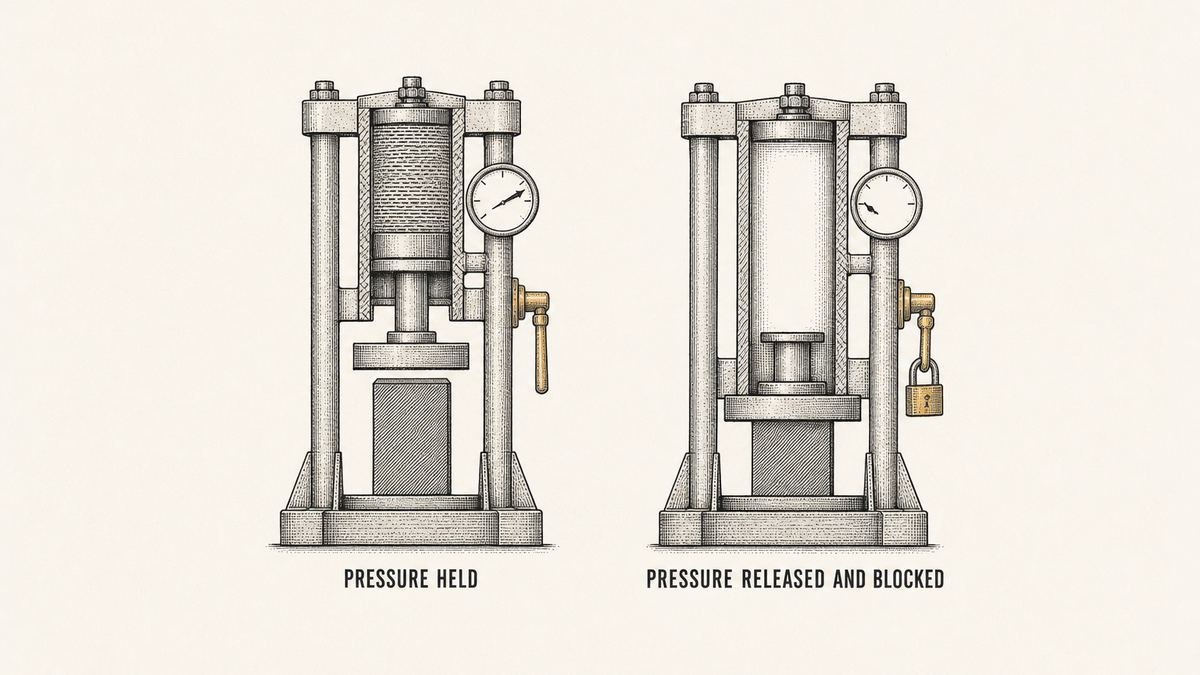
On a hydraulic press the energy sources are more than they first appear. There is the electrical supply to the motor and to the control panel. There is the oil under pressure inside the cylinder, and the oil held in the pipe runs behind it. There is the weight of the slide, which on most presses is substantial and which is often held up by nothing except that pressure. There may be an accumulator, which is a device whose entire purpose is to store hydraulic energy and then give it back. And on some tooling there are springs, in a stripper plate or a cushion, which are compressed whenever the press is closed and which release when it opens.
The official guidance on how to deal with all of that is unusually direct. Appendix A to 1910.147 sets out a typical minimal lockout procedure, and its step for dealing with stored energy names the culprits in a list:
“Stored or residual energy (such as that in capacitors, springs, elevated machine members, rotating flywheels, hydraulic systems, and air, gas, steam, or water pressure, etc.) must be dissipated or restrained by methods such as grounding, repositioning, blocking, bleeding down, etc.”
In ordinary words: it is not enough to cut the power. Anything that is still holding energy has to be emptied or held back, and the methods named are grounding, repositioning, blocking and bleeding down. On a press, four items on that list apply at once — the hydraulic system, the elevated slide, any springs in the tooling, and any accumulator. That is why the procedure for a press cannot be the same as the procedure for a lathe or a saw.
Work through what has to happen in order, because the order is the procedure. The press is stopped using its normal controls. The energy isolating device is operated so the machine is separated from its supply. A lock is applied to that device — and this is where the hardware question lives, because a device that cannot be locked cannot be locked. Oil pressure is bled down to the tank and the gauge is read to confirm it. The slide is brought down or held by a mechanical block so that its weight is carried by steel rather than by oil. Any accumulator is drained. Springs are released or restrained. Then, and only then, does anybody put a hand in the die area.
Two details of the rule are easy to miss and have real consequences for what you buy and how you write your own procedures.
The first is the difference between a lock and a tag. A tag is a warning label; a lock is a physical barrier. The appendix is blunt about the trade: where the energy isolating devices are not lockable, tagout may be used provided the employer meets the provisions that require additional training and stricter periodic inspections; and where tagout is used even though the devices are lockable, the employer must provide full employee protection and again faces the additional training and the more frequent inspections. In other words, choosing tags is not the light option. It is the heavy one, and it is heavier still if the machine was capable of taking a lock all along. That is a strong argument for specifying a lockable isolator on the press at the ordering stage, because the cost of a lockable disconnect is trivial next to the cost of running a tagout programme for the life of the machine.
The second is what happens when more than one person is working, and when the shift changes. The rule sets out how a group lockout must work: one authorised employee takes primary responsibility for a set number of people working under the protection of a group device such as an operations lock, there has to be a way for that person to find out the exposure status of each individual in the group, and where more than one crew or trade is involved an overall co-ordinator is designated. Then comes the sentence that makes it real: each authorised employee affixes a personal lockout or tagout device to the group device or the group lockbox when they begin work, and removes it when they stop. Nobody's protection depends on somebody else remembering. And where shifts change, specific procedures have to exist for the orderly transfer of protection from the outgoing to the incoming person, so that there is no gap in which the press is unlocked and a new die is going in.
All of that has a purchasing consequence, which is why it belongs in a sourcing article rather than only in a safety manual. The equipment a hydraulic press needs in order to be lockable and able to hold a slide safely is not expensive, and it is far easier to specify at the quotation stage than to retrofit:
- A lockable isolation point
- One device, identifiable, that separates the press from its electrical supply and accepts a padlock or a lock hasp. Ask where it is, what it looks like, and whether one lock fits every press in your workshop.
- A pressure bleed and a readable gauge
- A bleed valve that lets the trapped oil return to the tank, and a gauge positioned where a person standing on the floor can watch it fall to zero. A gauge that faces the wall is not a check.
- A blocking point for the slide
- A place under the slide where a purpose-made steel block or prop can be stood, and a maker who will tell you the size and the load it has to carry. Improvised blocking is a common cause of press injuries.
- An accumulator, if there is one, with a drain
- An accumulator's job is to store energy and give it back later. Ask whether the press has one, and if it does, what method is provided for emptying it.
- The procedure document
- A written lockout procedure specific to the machine, naming each energy source and each step. A factory that can write one for its own press has understood its own product. That is a better test of a supplier than most of the paperwork buyers normally ask for.
Tooling, Die Setting, and the Highest-Risk Ten Minutes of the Week
The press is only half of what you buy. The tooling is the other half, and the routine the tooling forces on you is the part that decides how the machine is really used.
A die has to be located in the press, and the way that is done is settled by the T-slot pattern on the bed, the bolt holes or dowel holes provided, and the shut height the die needs. Shut height is the distance between the slide face and the bed with the die closed, and it is one of the few figures that has to match exactly: a die that is too tall will not go in at all, and a die that is too short may leave the press unable to reach the work within its stroke. Before ordering, send the factory the drawing of an existing die and ask them to confirm the bed size, the slot spacing and the shut height range. A factory that returns the drawing marked up with the fit has done the work. A factory that replies that it is no problem has not opened the drawing.
Die setting is the highest-risk ten minutes of a press operator's week, and it deserves to be treated that way rather than as a chore that interrupts production. In that window the press is stopped, the guard is open, the slide is nearby, a heavy die is being moved, and the person doing it is a skilled tradesman who has done it a thousand times. The energy is still there — the slide may be resting on oil pressure if the press was only switched off and not bled down, and the die itself is heavy enough to injure without any power at all. The lockout procedure above is not bureaucracy aimed at this moment; it is written for this moment. And the practical reason it gets skipped is time.
That has a design consequence that is worth more than any instruction. The longer a die change takes, the more pressure there is to leave the press unlocked while it happens, and the more changes get deferred into the end of a shift. Quick-change arrangements — a sub-plate that stays in the press and accepts different dies, hydraulic or mechanical clamps instead of individual bolts, and ball-lock fittings that locate and hold in one action — make the changeover shorter. A shorter changeover is not just a productivity gain: it removes the strongest commercial argument for cutting the safety procedure short. Buyers who specify quick-change tooling on safety grounds usually find it pays for itself in machine time as well, which is a happy outcome rather than a coincidence.
Three more tooling points belong on the enquiry. First, the die cushion: if the job involves drawing a shell or holding a blank while it forms, the press needs a cushion or a similar device, and it is far cheaper built in than added later. Second, the ejection or knockout: how the finished part leaves the die, whether by a mechanical stripper, a hydraulic ejector or by hand. By hand, on a press, is an answer that should prompt a second look at the guard. Third, the storage: dies are heavy, they get stacked, and a stack of dies in a rack is a materials handling question under 1910.176 rather than a press question. Buyers spend a great deal of attention on the press and none on where the tooling lives, and then discover that the racks are too short.
Reading a Hydraulic Press Supplier's Data Sheet
Most press listings give a tonnage, a picture and a price. Ten lines turn that into a machine you can order against, and every one of them is a figure the factory already has.
- The tonnage, and which ton it is
- The rated force, and whether it is written in US tons or metric tonnes. The difference is about ten percent, which is larger than the tolerance on most jobs.
- Stroke, daylight and shut height range
- Three figures, not one. Stroke is how far the slide moves, daylight is the gap when it is open, and the shut height range is what the press will accept with a die closed. A quotation that gives stroke alone will not tell you whether your die fits.
- Bed size, slot pattern and rated load at the centre
- The working area, the position of the T-slots, and the load the bed itself will carry in the middle of its span. That last figure is not the same as the tonnage of the press.
- Frame type, throat depth and deflection
- Which frame, how deep the throat is on an open frame, and how far the frame moves at rated load. Ask at which bed position the deflection was measured.
- Cylinder bore and rod diameter
- The bore sets the push force at a given pressure. The rod diameter sets the return force, which is always smaller, and a press with a slight return force is slow to open and may struggle to clear a heavy die.
- Pump, motor and flow rate
- The pump type, its displacement and the motor rating. Together these set how fast the slide moves when it is not under load, which is most of the working cycle.
- Relief valve setting, and whether it can be locked
- The pressure the circuit is allowed to reach, and whether the setting can be sealed so it stays where it was set. An adjustable relief valve in an open workshop does not stay where it was set.
- Working pressure, and the gauge
- The normal working pressure, the gauge range, and, if the pressmaker publishes it, the piston area that converts a gauge reading into force. Without the last one, the gauge tells an operator that something is happening rather than what is happening.
- The control arrangement
- How many stations can start the press, which of them are buttons and which are pedals, whether the buttons must be held through the closing stroke, and exactly what the emergency stop stops.
- The safety hardware and the paperwork
- The guard type, the interlock, the location of the electrical isolator, whether it accepts a lock, where a blocking prop can be stood, and whether the factory will supply a written lockout procedure for its own machine.
Add the drawings and the schematics and the list is complete: an outline drawing showing the mounting points and the bed, a hydraulic schematic, an electrical schematic, and the record of whatever test was run on the machine before it was packed. Send all of it as a written request to two or three factories rather than asking for a price against a tonnage, and the replies sort themselves. A factory that builds presses will answer the cylinder bore, the bed load and the relief valve setting from memory, because those are the figures it designed to. A trader will answer the tonnage and the price and go quiet on the rest.It is the same test that separates a maker from a reseller on any industrial product, and the same discipline is what makes a rated load worth reading off the hardware rather than off the paperwork.
What Goes Wrong, and What It Looks Like on Arrival
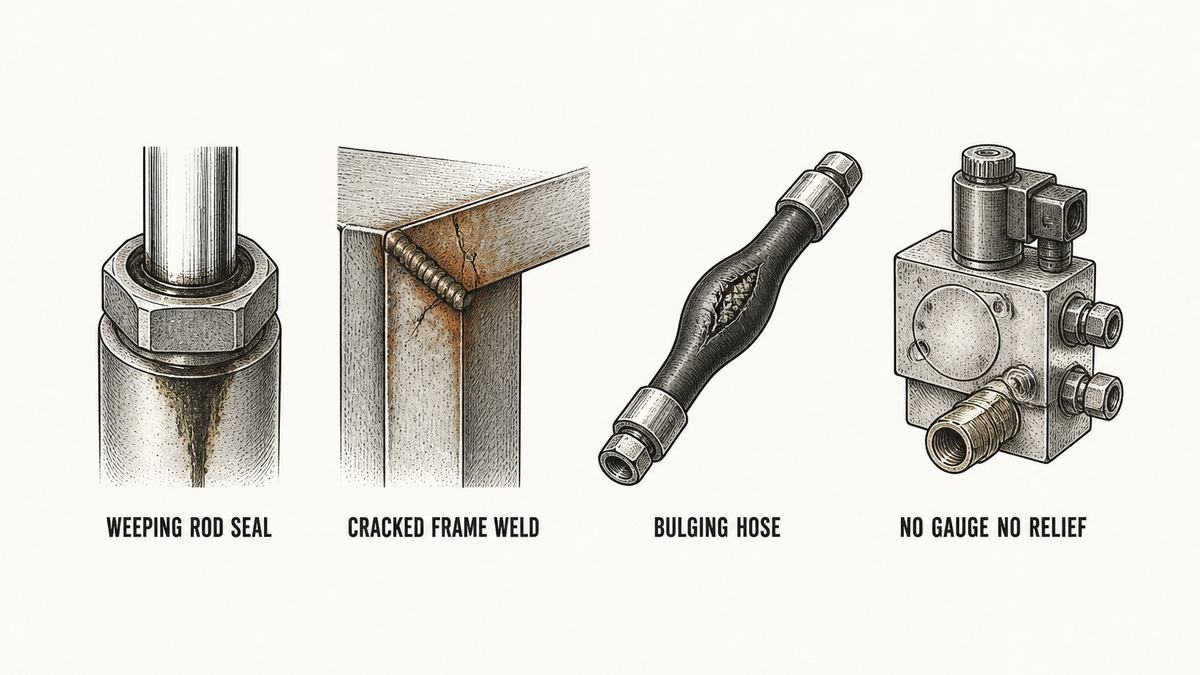
Four faults account for most of the trouble on a hydraulic press, and they divide neatly into the ones that announce themselves and the ones that wait.
A weeping rod seal. A thin ring of oil around the cylinder rod, and a wet stain running down the barrel below the gland. It starts as a film and becomes a drip. On a press working in a clean shop it is a maintenance item; on a press working near abrasive dust it is the beginning of a worn rod and a scored bore, because dust that reaches the rod gets dragged past the seal on every stroke. The check on arrival is to wipe the rod clean, run the press through twenty strokes, and look again. A film is normal on a new machine for the first few hours. A bead that forms and falls is not.
A cracked frame weld. A fine crack along the toe of a weld where an upright meets a top or bottom member, often with rust staining because the crack holds moisture. It usually begins as a fatigue crack at a point where the frame is deforming under load, and it grows faster on a press that is run near its rated tonnage or loaded off centre. This is the fault that the stress-relief question from earlier in this article is trying to prevent, and it is why a first-article check on the frame of the first machine of a new design is worth the cost of sending somebody. On later machines it is a visual item: look at every weld toe in the load path, particularly at the corners.
A bulging hose. A high-pressure hose that has swollen in the middle of its length, or whose outer cover has split to show the braid underneath. Both mean the hose is finished, and a hose that burst under pressure is a whipping steel-reinforced object, not a leak. Hoses are wear items and should be treated as such: kept off hot surfaces, routed so they do not rub, and replaced on a schedule rather than on failure. When a new press arrives, look at the hose markings for a working pressure and a date, and look at how the hose is routed. A hose that lies against a hot manifold or crosses a sharp edge was routed by somebody in a hurry.
No gauge, or no relief valve. The fourth fault is two omissions wearing one coat. A press with no pressure gauge gives its operator no way to know what the circuit is doing, and a press whose relief valve has been wound up beyond its setting — or removed and blanked — has no limit at all on the force it can build once the slide is stalled. Both are visible in a photograph and both are invisible in a quotation. Ask for the relief valve setting in writing and ask whether it can be sealed. Then, when the press arrives, look for the valve and look for the gauge, and check that the gauge faces somebody who can read it.
What a visual check cannot catch is the half of the problem that lives in the paperwork, and on a press that half is larger than usual. Nobody can see, by looking at a finished machine, whether the rated tonnage applies at the centre of the bed or anywhere on it; whether the frame was stress-relieved after welding; whether the light curtain was placed at a distance calculated for this machine or copied from another; whether the isolation point accepts a lock; or whether the quotation's claim about a press standard refers to a rule that excludes the machine. Every one of those is decided before the steel is cut, and every one of them is settled by reading rather than by looking.On a first order it is worth putting the answers in writing and having the first machine checked against them before the rest of the batch is built, using the tools a specification sheet a factory can build to gives you.
How the Price Is Built, and How to Check the Supplier Behind It
A hydraulic press has ten cost lines, and a quotation shows one of them. Knowing the other nine is what makes two prices comparable instead of merely different.
- The frame
- The heaviest single item. Steel grade and plate thickness, how the members are cut and fitted, how much welding there is, whether the frame is stress-relieved after welding, and how it is machined afterwards. Two frames can weigh the same and cost very differently to make.
- The cylinder
- Bore, wall thickness, rod diameter and rod finish, plus the quality of the seal pack and the gland. This is the part that produces the tonnage and the part that leaks first.
- The hydraulic power unit
- Pump, motor, relief valve, directional valve, tank, filter and, if the duty calls for it, a cooler. A cheap unit saves on the pump and on the filter, and both savings come back as a shorter life.
- Hoses, pipes and fittings
- Pressure rating, material, routing and the quality of the crimped ends. Small money on the quotation and the cause of most leaks in service.
- Controls and electrical
- Buttons or lever, one station or several, plain relays or a small controller, and the enclosure rating. This is where a quotation can look generous, by adding features the job will never use.
- Guarding and interlocks
- Fixed guards, interlocked gates, light curtains, and the engineering time to work out where a light curtain belongs. The guarding is often the cheapest line on the whole machine and the only one that protects a person.
- Machining
- The bed surface, the slide face, the cylinder bore and the guideways. Precision here is what makes the press repeat, and it is invisible once the machine is painted.
- Stress relief and finish
- Heat treatment after welding, surface preparation and the coating system. Both are easy to remove from a quotation because neither can be seen on the finished product.
- Testing
- A run test, a pressure test at the relief valve setting, and a written record. The cheapest line to include and the first to disappear.
- Packing and freight
- A press is heavy and awkward, and freight is a large share of the landed cost. The packing method decides whether the bed arrives flat and the paint arrives intact.
Two of those lines are worth more attention than the rest when you compare offers. The first is stress relief and the machining sequence that goes with it, because a press whose frame was welded, machined and painted in one pass will cost less and may slowly lose the alignment it was sold with. The second is testing, because a factory that runs a pressure test at the relief valve setting and writes down what it saw has a number to defend, and a factory that does not has nothing to check it against.
Minimum order quantity on this product follows the engineering more than the factory's appetite. A stock press in a standard size is often available in small numbers. A non-standard bed, a different daylight, a specific stroke, a particular control arrangement or a guard designed around a customer's own die means new drawings and, on the frame, new fixtures and a new stress-relief cycle, so the first order carries that work and the quantity follows it. Because the machine is heavy, a single press is already a large shipment, so work out the volume and the weight early and compare freight quotations on the same basis.
Then check the party you are talking to, and on this product the test is unusually concrete. Ask who machines the cylinder bore and on what machine, because that answer tells you whether the factory has a boring mill or buys cylinders in. Ask who does the frame welding and whether the frame is stress-relieved before the final machining, because that answer tells you whether the factory understands why alignment drifts. Ask for the hydraulic schematic, which any real maker of presses already has as a drawing rather than as a habit. Ask what test is run before packing and what record is kept. Finally, ask whether they will write a lockout procedure for the machine they are selling you, naming each energy source and each step.A factory that can write that document has thought about the person who will service the press, and that is a better sign of an engineering company than any certificate, though the certificates matter too — and a certificate is only worth what the issuer's database says.When the first machine is ready, have it checked against the ten lines you wrote before it ships, and take the number of machines to open from the sampling table. On a press the check that pays is dimensional plus one functional: the bed flatness and the slot positions against the drawing, the isolation point and the blocking point where they were supposed to be, and a run under pressure with the gauge watched.
Frequently Asked Questions
Does a hydraulic press have to meet the OSHA press standard?
No, and the rule says so itself. The United States rule usually called the press standard is 29 CFR 1910.217, and its title is Mechanical power presses. Paragraph 1910.217(a)(5), headed Excluded machines, states that press brakes, hydraulic and pneumatic power presses, bulldozers, hot bending and hot metal presses, forging presses and hammers, riveting machines and similar fastener applicators are excluded from the requirements of that section. A hydraulic press is named in that list. What applies instead is the general machine guarding rule in 1910.212, the control of hazardous energy rule in 1910.147, and the materials handling rule in 1910.176.
How do I work out what tonnage I need?
Start from the pressure the job needs at the die face and multiply by the area of the part being formed, then add a margin for friction, for the tooling and for the stiffness of the frame. Tonnage is a force, so a small die concentrates it and a large die spreads it. Two habits make the estimate safer: buy the frame rather than the cylinder if the load will sit off centre, because a stiffer frame loses less of its rating to deflection, and state the bed position the load will sit at when you ask for a rating, because tonnage quoted for the centre of the bed is not available at the edge of a throat.
What is the difference between a C-frame and an H-frame press?
A C-frame press has one upright and an open throat, so it is compact and easy to load from three sides, but the open frame springs under load and the further from the upright you work, the more it moves. An H-frame press closes the load path with two uprights and a top and bottom member, so it is far stiffer and holds alignment much better under load, at the cost of more steel, more floor space and harder side loading. A four-post press is the third common option and spreads the load most evenly over a large bed. The practical test is to ask for the frame deflection at rated load and the position it was measured at.
What does lockout mean on a press, and why is it different?
It means more than switching the machine off, because a press stores energy in places that electrical isolation does not reach. The official guidance in Appendix A to 29 CFR 1910.147 lists stored or residual energy as that held in capacitors, springs, elevated machine members, rotating flywheels, hydraulic systems and air, gas, steam or water pressure, and says it must be emptied or held back by methods such as grounding, repositioning, blocking or bleeding down. On a press that means four things at once: the electrical supply, the oil pressure in the cylinder and the lines, the weight of an elevated slide, and any accumulator or compressed spring. The slide has to be carried by a mechanical block rather than by oil before anyone reaches into the die area.
What should I specify for guarding on a hydraulic press?
Specify the guard as part of the machine rather than adding it afterwards, and specify how the work gets in. A fixed barrier with an access door, an interlocked gate and a light curtain are all acceptable, and each has its own failure mode: a fixed barrier is only as good as the door that stays open, an interlocked gate is only as good as the type of switch in it, and a light curtain is only as good as the distance it is mounted at. That distance depends on how long the machine takes to stop, and a hydraulic press stops by closing a valve and slowing a heavy slide rather than by applying a brake, so the time is not the same as on a mechanical press. Ask who works out the mounting distance and against which standard, and do not accept an administrative control as a substitute for a guard.
How do I check a hydraulic press supplier who says they are a manufacturer?
Ask four concrete questions and listen to how specific the answers are. Who machines the cylinder bore, and on what machine? Who welds the frame, and is the frame stress-relieved before final machining? Will they send the hydraulic schematic? What test is run before the machine is packed, and what record is kept? A maker answers all four from memory and can send the drawings. A trader answers the tonnage and the price and refers the rest to the factory, which is a fine answer if they say so, and a warning if they do not. Then ask whether they will write a lockout procedure for the machine, naming each energy source and each step, which is a document only a factory that understands its own product can write.
Send the die drawing and the tonnage basis — not just a tonnage
Tell us the force you need and where the load will sit, then the lines that decide whether the press will repeat: the frame type with its throat depth and its deflection at rated load, the stroke, the daylight and the shut height range your die needs, the bed size with the slot pattern and the load it carries at the centre of its span, the cylinder bore and rod diameter including the return force, the pump and motor rating, the relief valve setting and whether it can be sealed, the control arrangement with the number of start stations, and the safety hardware — guard type, interlock, a lockable isolator, a blocking point for the slide and a written lockout procedure. If a press is already in service and behaving oddly, describe the symptom: parts that vary in thickness across the bed, a frame weld you can see rusting, oil around the rod, a gauge that never moves, or a die change that takes so long the procedure gets skipped. The symptom usually says which of the ten lines was decided badly.
Request a Hydraulic Press Sourcing Quote
Questions & Comments
We read every one and reply within 24 hoursSourcing hydraulic presses and getting quotations that all say “this tonnage, this price”? Send the force you need and where the load will sit, then the lines that decide whether the press will repeat: the frame type with its throat depth and its deflection at rated load, the stroke, the daylight and the shut height your die needs, the bed size with the slot pattern and the load it carries at the centre of its span, the cylinder bore and rod diameter including the return force, the pump and motor rating, the relief valve setting and whether it can be sealed, the control arrangement with the number of start stations, and the safety hardware — guard type, interlock, a lockable isolator, a blocking point for the slide and a written lockout procedure. If a press is already in service and behaving oddly, describe what you saw and roughly when it started: parts that vary in thickness across the bed, a frame weld you can see rusting, oil around the rod, a gauge that never moves, or a die change so slow that the procedure gets skipped. The symptom usually says which part of the specification was decided badly.