
High Ticket Dropshipping: The Fee Stops at Ten Dollars
 ·
Updated October 14, 2026
·
15 min read
Almost everything written about this subject is a list of products, which is the least useful form the advice could take. A catalogue of expensive items tells you what other people have sold, and it tells you nothing about whether your own costs behave differently when the order gets bigger. That question has a definite answer, and the answer is published. Two of the major payment processors cap their bank transfer fee at ten dollars per transaction, which means that above a certain order value the cost of collecting the money stops rising altogether. Understanding why that happens, and what replaces the costs that stop mattering, is the whole of the useful analysis here. The product list can come afterwards.
What Stops Growing, and What Takes Its Place
| Cost | On a small order | On a large order |
|---|---|---|
| Fixed payment fee | A visible share of the price | A rounding error |
| Bank transfer fee | One per cent of the price | Capped, so it stops rising |
| Shipping per parcel | Large relative to a cheap item | Still a large absolute figure, and often freight rather than parcel |
| Capital tied up | Small | The real constraint, because you fund it first |
| Dispute exposure | Small | The whole transaction, not a fraction of it |
| Duty and entry | Simplified route may apply | Above the limit, a classification and an entry |
What this guide covers
1. Why Do the Fixed Costs Stop Mattering?
Because they are charged per order rather than in proportion to it, so their share of the price falls as the price rises. That single property explains most of what is genuinely different about selling expensive items, and it is arithmetic rather than strategy.
Take the fixed part of a card fee as the clearest case. PayPal publishes a US dollar fixed fee of 49 cents per transaction, so on a twenty dollar order that fixed component is two and a half per cent of the price before any percentage rate is applied, and on a two thousand dollar order the same 49 cents is two hundredths of one per cent. Nothing about the processor changed and nothing was negotiated; the order got bigger. The same applies to the minutes spent handling an order, which do not shrink because the item is cheap, and to the parcel, which costs roughly the same to move whether the contents are worth fifteen dollars or fifteen hundred.
This is worth stating plainly because it inverts the usual advice. The standard guidance to a new seller is to pick a cheap product so that the testing is affordable, and for the purpose of testing that is sound. But a catalogue built permanently from cheap items is a catalogue where three costs sit permanently at their most punishing ratio, and no amount of operational improvement fixes that, because the ratio is set by the order value. Our article on the things that separate a product which sells from one that does not is about demand, and this section is about a different axis entirely.
A useful consequence follows, and it is the closest thing to a definition this article will offer. High ticket is not a price band; it is the point at which the costs that do not scale have become unimportant. A seller with a two hundred dollar average order has already moved most of the way there, because the fixed fee is a quarter of one per cent, and a seller with a two thousand dollar average order has finished the journey. What matters is not the label but whether the fixed items still appear in your thinking when you price something.
2. Where Does the Fee Actually Stop Growing?
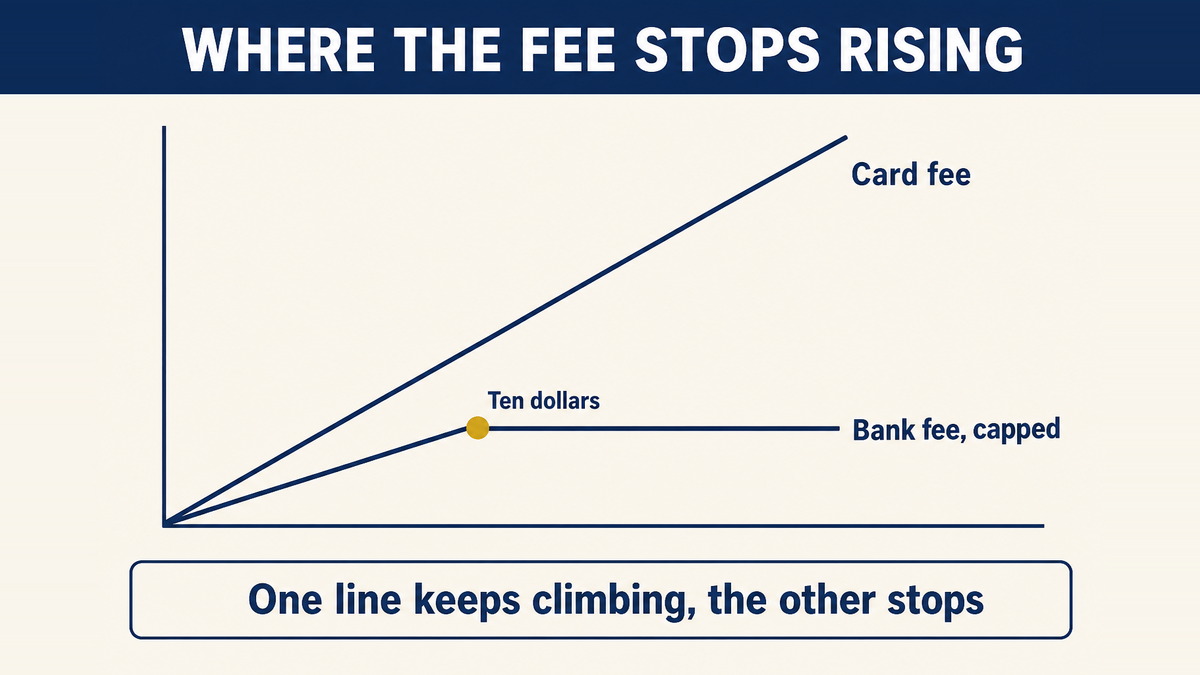
At ten dollars, on a bank transfer, according to both of the processors whose pricing is published. This is the single most useful published fact in this subject and it is almost never mentioned in the guides, because those guides are about which product to choose rather than about what collecting the money costs.
ACH bank transfer (via invoice) — Applies to payments made on invoices with an ACH bank transfer. 1%, $1 min, $10 fee cap
Square, published processing fees (read 14 October 2026)
Pay by Bank (ACH) 1% (capped at $10.00 per transaction)
PayPal, business fee table (read 14 October 2026)
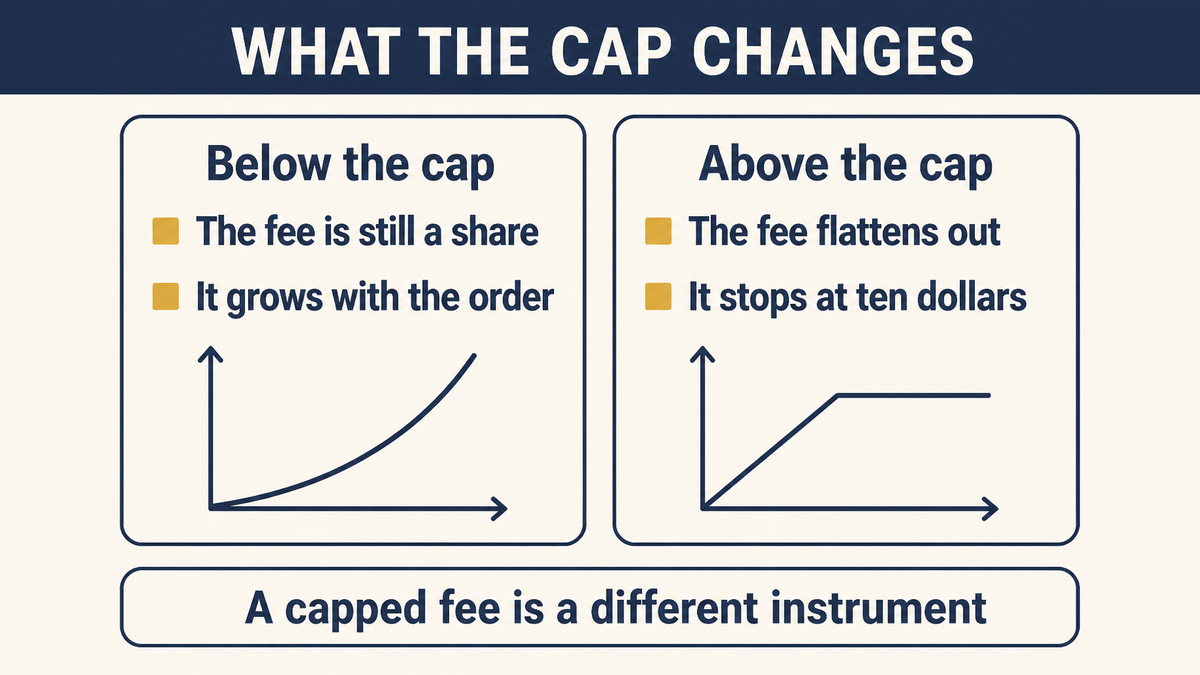
Two independent processors publishing the same structure is what makes this worth building on, because it is not one company's promotional rate. The mechanic is simple and the consequence is not: a percentage fee grows with the order, and a capped percentage fee grows until it hits the cap and then stops. On a five hundred dollar order, one per cent is five dollars, which is under the cap and therefore still proportional. On a two thousand dollar order, one per cent would be twenty dollars, which is capped at ten, so the effective rate is half a per cent. On a five thousand dollar order the effective rate is a fifth of one per cent.
What the Same Order Costs to Collect
| Order value | Card at 2.99% + fixed | Bank transfer, capped | Difference |
|---|---|---|---|
| $500 | $15.44 | $5.00 | $10.44 |
| $2,000 | $60.29 | $10.00 | $50.29 |
| $5,000 | $149.99 | $10.00 | $139.99 |
Read the third row as the point of the table. The card fee has grown by a factor of ten against the first row while the bank fee has not moved, and the difference between them is now larger than the margin on many small orders. That is what a cap does to a scaling business, and it is why the payment side of an expensive catalogue deserves more attention than the product side gets in most of what is published.
One caution belongs with the table. The card rate used is PayPal's published rate for standard credit and debit card payments, and the bank rows use each processor's published cap. Those are the numbers on the pages cited, and rates change, so the right response is to read your own provider's current table rather than to treat this as a quotation. The structure is the durable part: a capped percentage fee is a different instrument from an uncapped one, and the difference between them grows with every order.
3. What Are the Three Costs That Replace Them?
Capital, dispute exposure, and duty. Each of them is small on a cheap order and each of them scales with the amount, which is the exact opposite of the costs that disappear. Replacing one set of problems with another is not a reason to avoid the change, but going into it without knowing which set you are trading for is how the move goes wrong.
The capital you fund before the customer pays
A large item has to be bought before it is sold, even when you never touch it, because a supplier will not dispatch a valuable article on the strength of an order you have just received from a stranger. In practice that means either paying upfront or paying a deposit, and either way the money leaves before the customer's payment settles. The size of the gap is the cost, and it is a working capital cost rather than a fee: it is what you could have done with that money during the weeks it is committed. Our notes on how payments to a Chinese supplier are arranged and split cover the mechanics of the outbound side, and our breakdown of what an agent's fee covers is relevant here because on a valuable order the agent's share is a large absolute number even when the percentage is unchanged.
The dispute that reverses the whole transaction
A card dispute on a twenty dollar order is an irritation. On a two thousand dollar order it is the order, plus the item, plus the shipping, plus the argument. The rule underneath is worth knowing because it defines when a delay turns into a loss: under the billing error rules a charge for goods not delivered to the customer as agreed counts as a billing error, so an unresolved delivery problem gives the buyer the right to dispute the full amount rather than negotiate over part of it. Our guide to the things suppliers say that need checking is the front end of this problem, because a promise made carelessly at the quotation stage becomes a delivery failure on an order too large to absorb.
The limit that sends the shipment down a different route
A small shipment can travel under a simplified route, and a valuable one usually cannot, so the two are not simply the same process at different sizes. The provision sets the boundary and also limits which transport modes it covers.
(a) … any shipment of merchandise imported by one person on one day having a fair retail value … not exceeding $800 … (b) The exemption provided in paragraph (a) of this section is suspended for merchandise arriving via all modes other than through the international postal network …
19 CFR 10.151, Importations not over $800 (read 14 October 2026)
Three details in that text matter for an expensive catalogue. The limit applies per person per day rather than per shipment, so it is a daily allowance. Splitting a large order into parcels to stay underneath it is not a route the section allows, because it excludes a shipment that is one of several lots sent separately for the express purpose of securing free entry. And the second paragraph means the simplified route is currently available on the postal network rather than on every commercial line, so the transport decision is also a customs decision. For a high ticket seller the practical reading is that duty and entry costs are part of the landed cost of the product rather than an occasional surprise, which is what our guide to how a tariff code is assigned to goods exists to help with.
4. What Does Freight Do to a Large, Heavy Item?
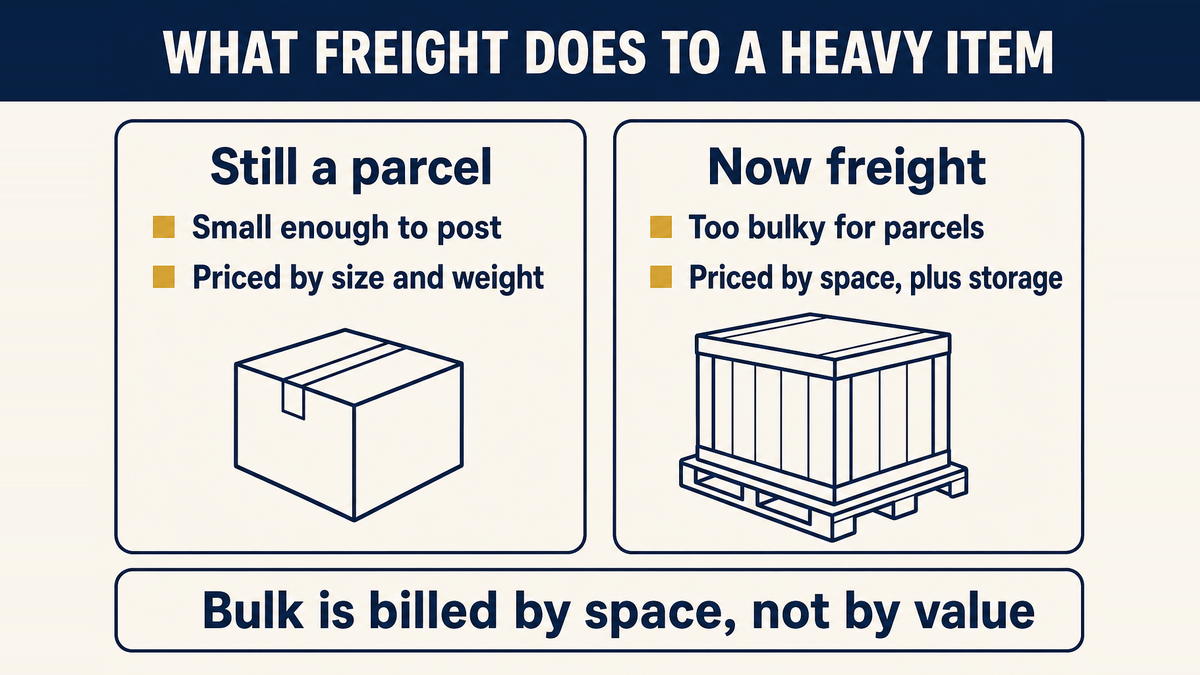
It undoes part of the advantage, because expensive goods are often bulky and the carrier prices the space rather than the value. This is the cost that most frequently surprises a seller moving upmarket, and it is the one where the arithmetic is least intuitive.
The mechanism is that carriers bill on whichever is greater between the actual weight and a figure calculated from the dimensions, which is why a large light parcel can be charged as though it were heavy. A product's shipping cost is therefore a property of its packaging as much as of its contents, and a design that reduces the box reduces the cost on every order that follows. Our guide to how volumetric weight and CBM are worked out sets out the calculation, and our notes on the difference between gross and net weight cover the adjacent trap, which is quoting a rate against the wrong weight.
Above a certain size, the item leaves the parcel network altogether and moves as freight, which brings its own cost structure. Freight is priced on the space occupied and on how easily the goods handle, it is usually quoted per load rather than per piece, and it introduces charges that have nothing to do with transport at all. Our guide to demurrage and detention charges covers the ones that appear when a container is not collected or returned on time, and they are worth knowing about before rather than after, because a single day of one of them can equal a meaningful share of the margin on an order. Our comparison of air freight against sea freight from China works through which is worth it at which value and weight, and that trade-off is genuinely different for a valuable item, because the cost of the goods being late is higher while the freight itself is also higher.
There is a further consequence that belongs to the sourcing side rather than the shipping side. A valuable item is usually also one where a defect is expensive, because the unit price is high and the buyer's expectation is higher still. That makes inspection a larger line than it would be on a cheap catalogue, and it changes what the check is for: on a low-value order it protects the margin, and on a high-value one it protects the whole transaction. Our notes on where a customs broker fits into an inbound shipment are the companion piece, because a held shipment on a valuable order is a cost measured in weeks rather than in a fee.
5. Why Is the Cheaper Payment Method Not Always Available?
Because on some channels you do not choose it. This is the honest limit on everything in section two, and it deserves its own section rather than a footnote, because a seller who reads the cap and then assumes they can apply it everywhere will be disappointed in a way that has nothing to do with the arithmetic.
Where you control the checkout, you can offer a bank transfer alongside cards and price accordingly. That covers invoiced orders, wholesale arrangements, and a store of your own where you have added the option deliberately. Where a marketplace controls the checkout, the payment methods on offer are the platform's decision, and the seller's only lever is the price. The cap is therefore realisable on some of your revenue and not on the rest, and the proportion is a fact about your channel mix rather than about your payment provider.
The tempting response is to drop card payment entirely and capture the saving on every order, and it is usually the wrong one. Card payment is what buyers expect by default, and a checkout that will only accept a transfer asks the buyer to do something unfamiliar with a large sum of money, which is precisely the situation in which people abandon an order. The saving on a two thousand dollar order is around fifty dollars, and losing one order in forty to a checkout that feels risky gives that back. The sensible arrangement is a choice: cards as the default and a transfer offered as an alternative, with the difference in cost reflected in something the buyer can see, such as a small discount or an additional service rather than a penalty.
A related point about where the saving actually shows up. Because a capped fee grows more slowly than the order, an expensive catalogue has a structurally better payment ratio than a cheap one, and that difference is a margin advantage that exists whether or not the seller thinks about it. The sellers who capture it are the ones who notice that a large order is not simply a large version of a small one, and who price the two differently rather than applying a single percentage to everything.
6. What Should You Check Before Committing to a High Ticket Product?
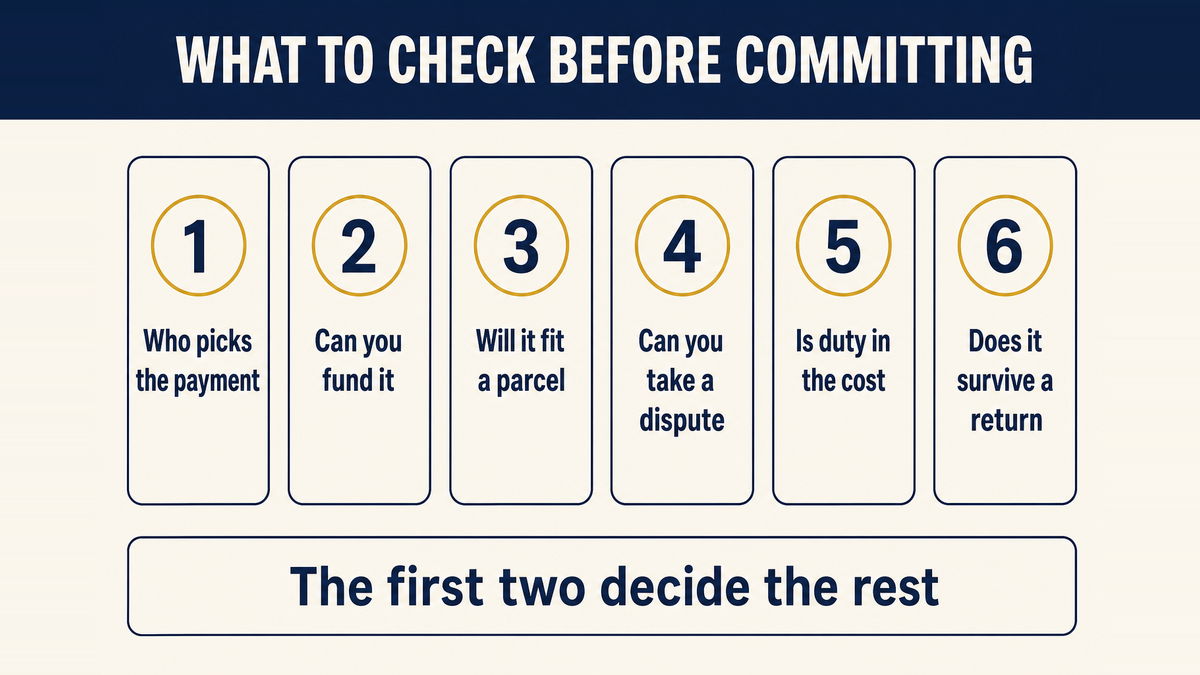
Six things, and the order matters because the first two decide whether the other four are worth investigating. Most product lists published on this subject begin at step five, which is why they read as encouraging and turn out to be unusable.
- Whether the buyer's payment method is one you control
- If the channel fixes the payment method, the capped fee is unavailable and the payment advantage reduces to the smaller change in the fixed component. Work out what share of your intended sales will be on a channel where you choose before building the economics on the cap.
- Whether you can fund the order before settlement
- A valuable item is bought before it is sold, so the working capital requirement is the entry ticket rather than a later problem. Work out the largest single order you could fund and how long the money would be committed, and treat that as the constraint on your order size rather than as a detail.
- Whether the item is small and light enough to stay in the parcel network
- Because expensive goods are frequently bulky, and bulk moves the shipment into freight pricing with its own charges. Our notes on what a warehouse charges to store, pick and send an order show how those charges appear once the goods are held, which is the arrangement a high ticket catalogue usually needs.
- Whether you can absorb a full-transaction dispute
- A dispute on a large order is not a small version of a dispute on a cheap one, because the whole amount is in play and the goods may already be with the customer. Ask what your process is when a valuable item is delayed, disputed or returned, and whether the answer involves paying for the item twice.
- Whether the duty and entry cost is inside your landed cost
- On a valuable shipment this is a line rather than an exception, and it changes the price you need. Build it into the landed cost calculation rather than discovering it at the border.
- Whether the margin survives a second attempt
- On a valuable item, one return can consume the margin from several sales, so the question is not the margin on a clean order but the margin after the failure rate. Price for the failure rate you actually have rather than the one you hope for.
7. Frequently Asked Questions
What counts as a high ticket product in dropshipping?
The useful definition is not a price band but the point at which the costs that do not scale stop mattering. A fixed payment fee of forty nine cents is two and a half per cent of a twenty dollar order and two hundredths of a per cent of a two thousand dollar one. Once the order is large enough that the fixed items are a rounding error, the business is behaving like a high ticket operation whatever the catalogue calls it.
Is the payment fee lower on a large order?
On a bank transfer it stops growing entirely, because both Square and PayPal publish a cap. Square lists an ACH bank transfer at one per cent with a ten dollar fee cap, and PayPal lists Pay by Bank at one per cent capped at ten dollars per transaction. Card rates have no such cap, so the gap between the two widens with the order value rather than staying fixed.
What are the biggest risks of selling high ticket items?
Three, and all three scale with the amount rather than staying constant. The first is capital, because a large order is funded before the customer pays. The second is dispute exposure, because a card dispute reverses the whole transaction rather than a small part of it. The third is duty and entry, because a shipment above the small shipment limit leaves the simplified route and needs a classification and an entry.
Can I use the cheaper payment method on every order?
Often not, and it is worth being clear about why. On a marketplace the platform chooses the payment methods and the seller does not. The bank transfer rate is available where you control the checkout, such as an invoiced order or a store where you have added the option, so the saving is realisable on some channels and not others. Removing card payment entirely to capture it usually costs more in lost sales than it saves.
Why does freight matter more on high ticket items?
Because expensive goods are often large or heavy, and carriers bill on whichever is greater between actual weight and a figure derived from the dimensions. A large light parcel is charged as though it were heavy, and goods that will not fit a parcel network move as freight with its own charges, including storage if a container is not collected promptly. On a cheap item these are absorbed; on an expensive one they are a large share of the landed cost.
A Model Where the Fee Stops Mattering
One worksheet running three ticket sizes through the costs that scale, crate, insurance, surcharge, with the crossover marked.
Run My Ticket Model
Questions & Comments
We read every one and reply within 24 hoursWorking out whether a large order really leaves more behind after freight and duty, unsure whether you can offer the cheaper payment method on the channel you sell through, or wondering how much working capital a high ticket item would tie up? Post the item, its dimensions and weight and where it would ship from, and our team will work the numbers with you.