
Enamel Pin Manufacturer Sourcing Guide: Hard Enamel, Plating and Keychains
 ·
Updated October 9, 2026
·
24 min read
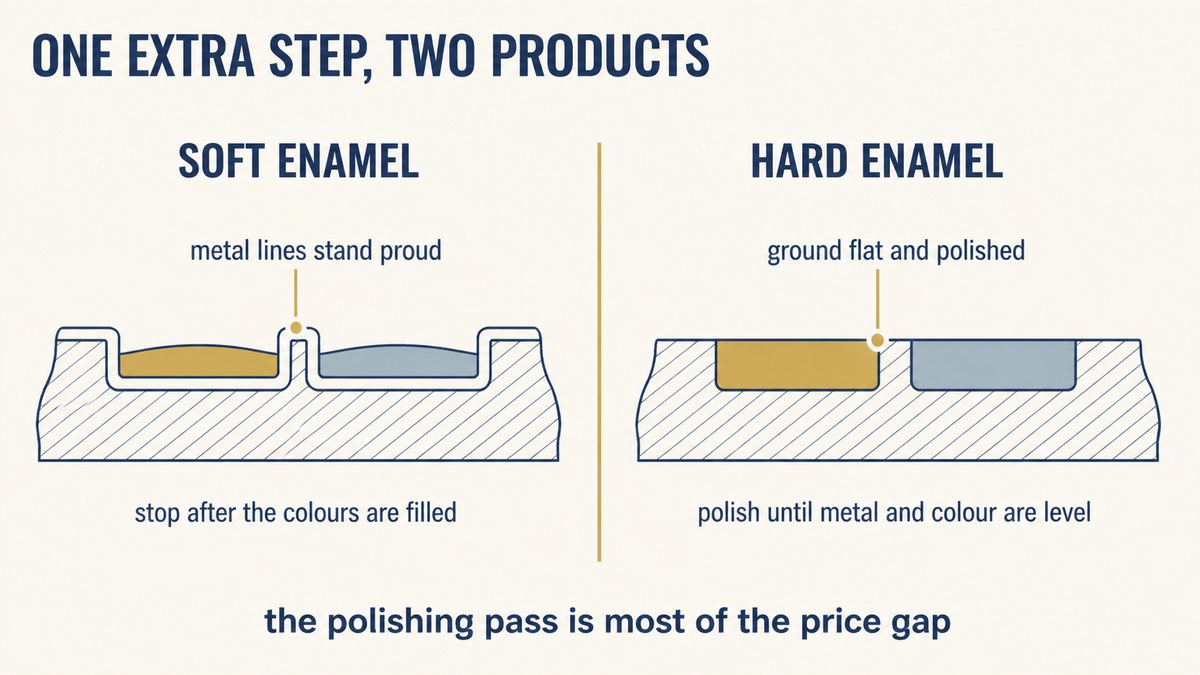
Hard enamel and soft enamel are the same materials made by the same process, and the difference between them is one extra step: after the colours are filled, hard enamel is ground flat and polished so the metal lines sit flush with the surface, while soft enamel is left with the lines standing proud and the colour recessed. That single step is most of the price gap, most of the durability difference, and most of the confusion in a first pin order. This guide covers how a pin quotation is built, why the die you pay for once decides your minimum forever, where plating wear actually shows up, how keychains fit the same factories, and what the lead rules say about the metal and the enamel — because the answer is different for each of them.
What to Order, by What You Are Making
| If you are making | Specify this | Because |
|---|---|---|
| A premium pin for a brand or a fan club | Hard enamel, the plating named, and the number of enamel colours counted | Hard enamel is the polished version and it reads as the more expensive product in the hand. The plating decides how the metal lines look and where wear will show, and each colour is a separate fill and bake. |
| A cheap promotional pin at volume | Soft enamel, and a design with fewer colours | Soft enamel skips the polishing pass, so it costs less and takes less time. Fewer colours means fewer fills, and the fill count is what the price tracks once the die is paid for. |
| A keychain to match the pin | The material by name, and the attachment fitting | Acrylic, zinc alloy and PVC keychains are three different products from three different processes. The attachment is bought in, so it is the line most likely to delay a delivery. |
| Anything with a magnetic back | Confirmation the magnet cannot be removed, and the pull force | A magnet that can be separated from a worn accessory is a different regulatory question from one that cannot, and it is the only part of a pin with a mandatory rule written about it. |
| A pin for children | A testing plan agreed before the die is cut | Children's products carry limits that adult accessories do not, on both the metal and the finish. Deciding this after tooling means paying for tests you did not plan for. |
| A range of twelve designs | One die and a set-up quoted per design, not a blended figure | Every design needs its own die. A blended price hides which designs are carrying the cost, and it will not hold once you reorder the range unevenly. |
1. What a Pin Quotation Actually Covers
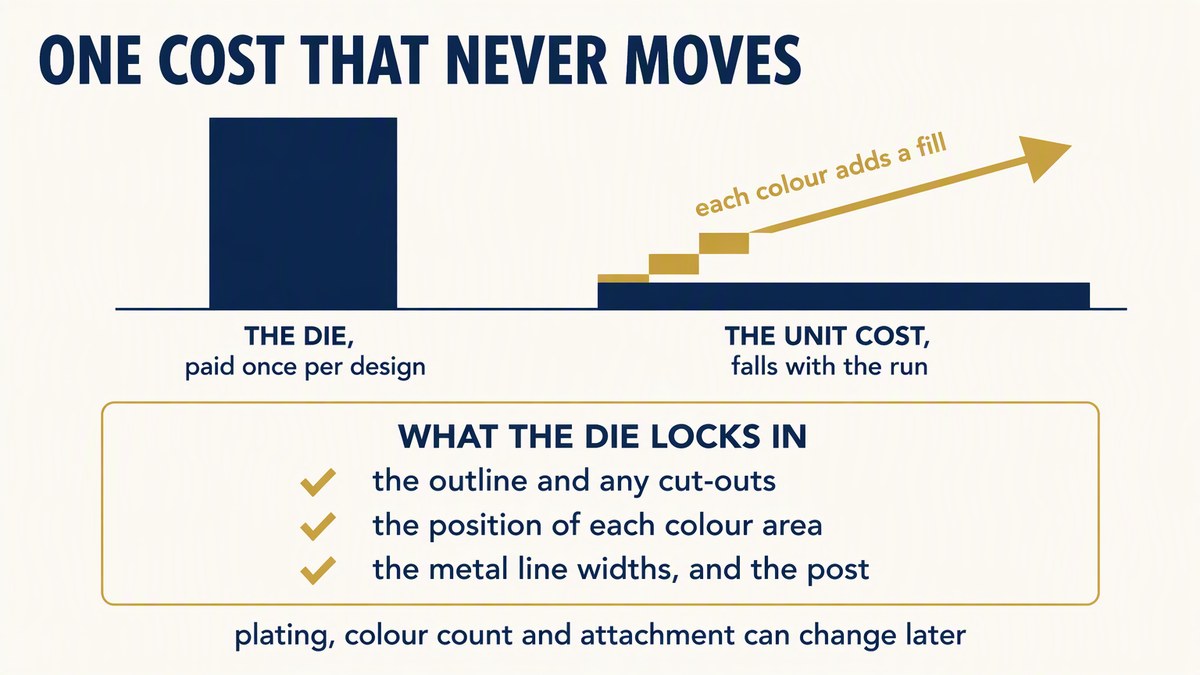
A pin has a one-time tooling cost and a per-unit cost, and they behave in opposite directions. The die is paid once per design and does not care how many you order. The per-unit cost is driven by how many enamel colours have to be filled, and it falls as the run gets longer.
- The die
- The tool that stamps or casts the metal blank for your design. One per design. This is the largest single line on a first order and it never appears on a reorder.
- The metal
- Priced by weight, and the blank is small, so this is a minor line. Zinc alloy is the usual material; brass costs more and takes a sharper edge.
- The plating
- Applied before the enamel goes in. One bath, one colour of metal line. Gold, silver, nickel, black nickel and antique finishes are the common set, and the finish decides where wear will be visible.
- The enamel fills
- One pass per colour, each cured. This is where a design's complexity turns into money, because seven colours is seven fill operations rather than one.
- The polishing pass
- Only on hard enamel. The surface is ground flat and polished until the metal and the colour are level, which is what gives hard enamel its glassy look and its resistance to chipping.
- The attachment
- The clutch, ring or magnet on the back. Bought in from a different supplier, priced per piece, and the component most likely to hold up a delivery.
- The backing card
- A printed card the pin is mounted on. Small money per unit and the single cheapest way to make a pin look like a product rather than a loose object.
2. Hard Enamel Against Soft Enamel
This is the first decision in every pin order and the one most often described badly. Both versions start the same way: the metal blank is cast or stamped, plated, and then the recessed areas are filled with coloured enamel, one colour at a time, each cured before the next goes on. The difference comes after the colours are in.
| Hard enamel | Soft enamel | |
|---|---|---|
| What happens last | The surface is ground flat and polished so the metal lines and the enamel end up level. | Nothing further. The enamel stays recessed below the metal lines, which stand proud. |
| How it looks | Smooth and glassy, with the metal reading as a thin line inside a flat surface. | Textured, with the metal outline raised and the colour sitting in the valleys. |
| How it feels | Flat and dense, closer to a coin than to a badge. | Fine ridges, because the proud metal lines are felt as raised edges. |
| Wear | Resists chipping better on the face, because there is no raised edge to catch on anything. | Colour sits proud of nothing and recessed below the metal, so the lines protect the enamel but the lines themselves take the hits. |
| Relative cost | Higher, because of the grinding and polishing passes and the extra handling. | Lower, and faster to produce. |
The practical consequence is that the choice is not about quality in a simple sense. Soft enamel is a legitimate product with a deliberate look, and a lot of promotions and giveaways are better in soft enamel because the raised lines make a small logo readable at a distance. Hard enamel is what a fan club or a brand sells as merchandise, because it survives being worn and handled.
3. The Metal and the Plating
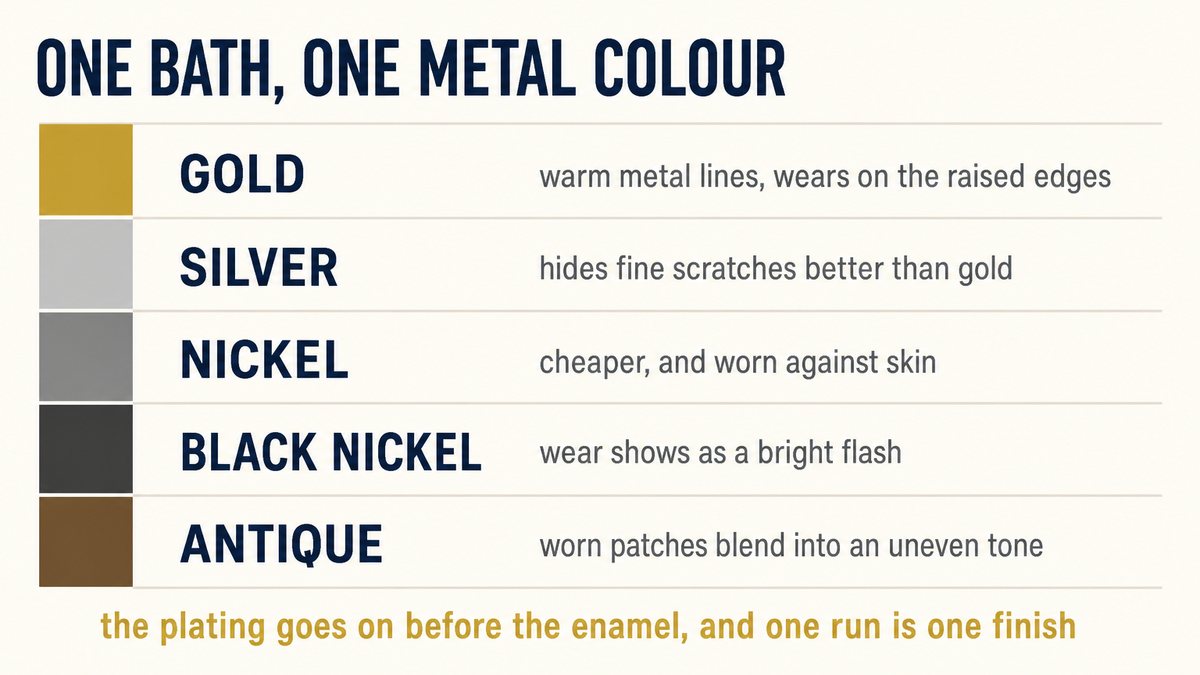
The plating is applied before the enamel goes anywhere near the pin, so it decides the colour of the metal lines you will see between the colours. That makes it a design decision as much as a durability one, and it is a single choice: a run is plated in one finish.
| Finish | What it looks like | Where it wears |
|---|---|---|
| Gold | Warm yellow metal lines. The default for anything meant to look like an award or a badge. | Wears toward the base metal on the raised edges and the highest points of the design. |
| Silver | Bright neutral metal. Makes saturated colours read more strongly, because there is less competition from the metal. | Same as gold. Silver hides fine scratches better than gold, which is why it is the safer choice for a pin worn daily. |
| Nickel | Slightly darker and cooler than silver, and cheaper. | The finish most likely to be a problem for someone with a metal sensitivity, because it is worn against skin and clothing. |
| Black nickel | A dark gunmetal line. Turns a bright design into a restrained one. | Shows the base metal underneath as a bright flash when it wears, which is more visible than wear on silver. |
| Antique finishes | A deliberately darkened metal that makes recessed detail read well and suits vintage designs. | The most forgiving finish in service, because a worn patch blends into a surface that is already uneven in tone. |
Two things the plating decision settles
First, the whole run is one finish. You cannot plate half a run gold and half silver without splitting it into two runs, each with its own set-up. If you plan to sell a pin in two metal colours, quote them as two orders rather than assuming the second colour is free.
Second, the plating is the durability story. A pin wears from the edges inward, and the first thing to go is the plating on the high points. This is why the finish matters more than the enamel on a pin that gets handled: the enamel is recessed or level and largely protected, while the metal line is the part in contact with fingers, pockets and lanyards. If a customer sends you a photograph of a worn pin, look at which part has changed colour before you accept a quality claim.
Ask for a sample in the finish you actually intend to sell, not a stock sample in the finish the supplier keeps on the desk. Plating changes the whole look of a design, and a sample in bright silver tells you almost nothing about how the same colours will read against black nickel. When you approve the sample, keep it sealed and dated — that piece of metal is the only reference that settles a colour argument eighteen months later.
4. Dies, Colours and Why a Design Change Costs Money
The die is the shape. Once it exists, you can change the plating, the number of enamel colours and the attachment, but you cannot change the outline, the position of a cut-out, or the thickness of a metal line without cutting a new tool. That is the same rule that applies to any tooled product, and it has the same consequence: the design decision has to be finished before the tool is cut.
Why a range multiplies rather than adds
Twelve designs is not one order spread across twelve products. It is twelve dies, and then twelve separate fill sequences, because the colours are different. Ask for a quotation that shows the die cost per design as its own line. A blended figure across a range is impossible to reorder against, because when you later want more of one design and less of another the blend has no meaning.
The colour count is the per-unit lever
Once the die is paid for, the thing that moves the unit price is how many colours have to be filled. Each colour is applied into its own recessed areas, cured, and then the next colour goes in. That means:
- Fewer colours is genuinely cheaper per unit, and it is the lever you control without changing the tool.
- Adjacent colours need a metal line between them, and that line is part of the die. Two colours that touch cannot simply bleed into each other on the finished product.
- Designing within a small palette is a cost decision, not only a taste decision, and it is worth making at the artwork stage rather than when the quote comes back.
If your artwork is a logo that also goes on a backing card, a sleeve and a lanyard, the same file has to work across all of them. Our custom logo printing and finishing guide covers how the options differ across those surfaces.
5. Keychains: The Same Factory, Different Product
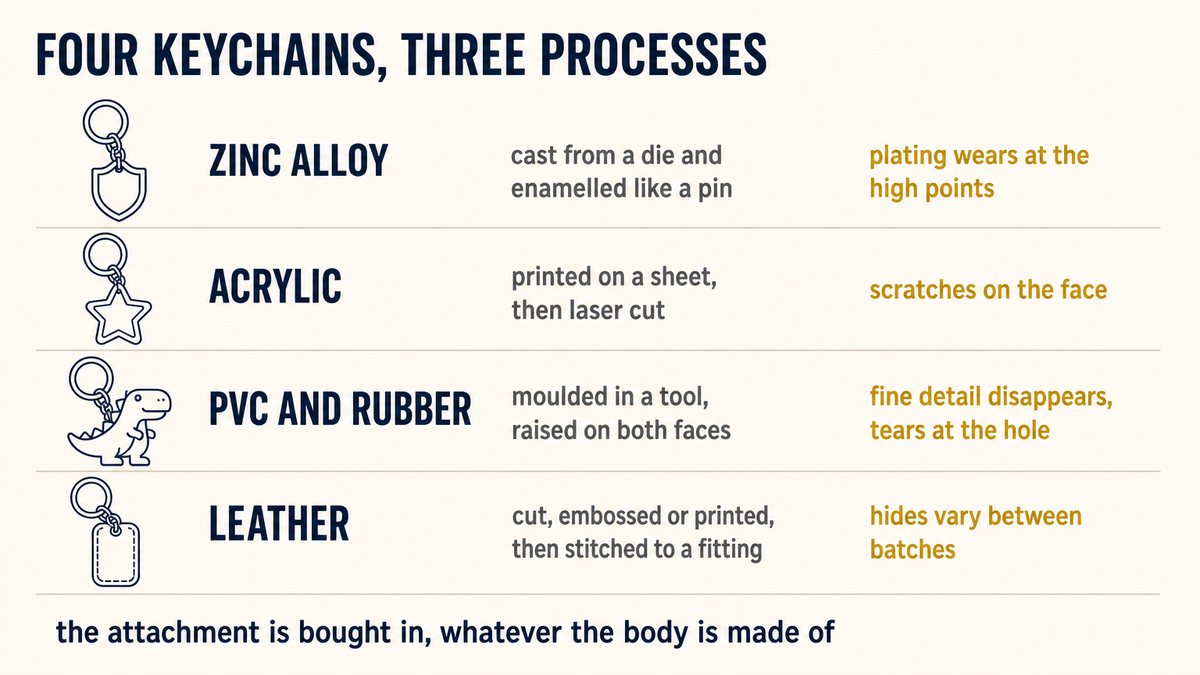
Keychains are usually ordered alongside pins because the same supplier base makes both, and the same buyer wants the two to match. They are not the same product, and the material you choose decides the process, the tool and the price.
| Material | How it is made | What it means for you |
|---|---|---|
| Zinc alloy | Cast from a die and enamelled, exactly like a pin. Often the same die artwork reused at a larger size. | The closest visual match to a pin, and the only route where your pin artwork carries over with almost no redrawing. Needs its own die because the scale is different. |
| Acrylic | Printed onto a sheet, then laser cut to shape. A clear layer can be bonded over the print to protect it. | Full-colour artwork is possible, including photographs and gradients, which enamel cannot do. Lighter and cheaper, and it reads as a different, more modern product than a metal keychain. |
| PVC and rubber | Moulded in a tool, so it can carry a three-dimensional shape with relief on both faces. | The only option that gives a soft, thick, sculpted object rather than a flat one. Needs a mould, and the softness that makes it appealing is also what makes fine detail disappear. |
| Leather | Cut from hide and either embossed with a die or printed, then stitched or riveted to a fitting. | A premium feel and a texture the others cannot match. Hides vary, so the colour and the grain are never identical between batches and should be agreed as a range rather than a single shade. |
Two practical points carry across from pins. The first is that the attachment is a separate purchase whatever the body is made of, so a chain, ring or clasp can hold up an otherwise finished order. The second is that the material sets the wear pattern: acrylic scratches on the face, soft PVC can tear at the hole, leather darkens and softens, and metal plating wears at the high points. Decide which failure you can live with before you choose the material, because each one fails in a way the customer will notice.
6. Attachments and Magnetic Backs
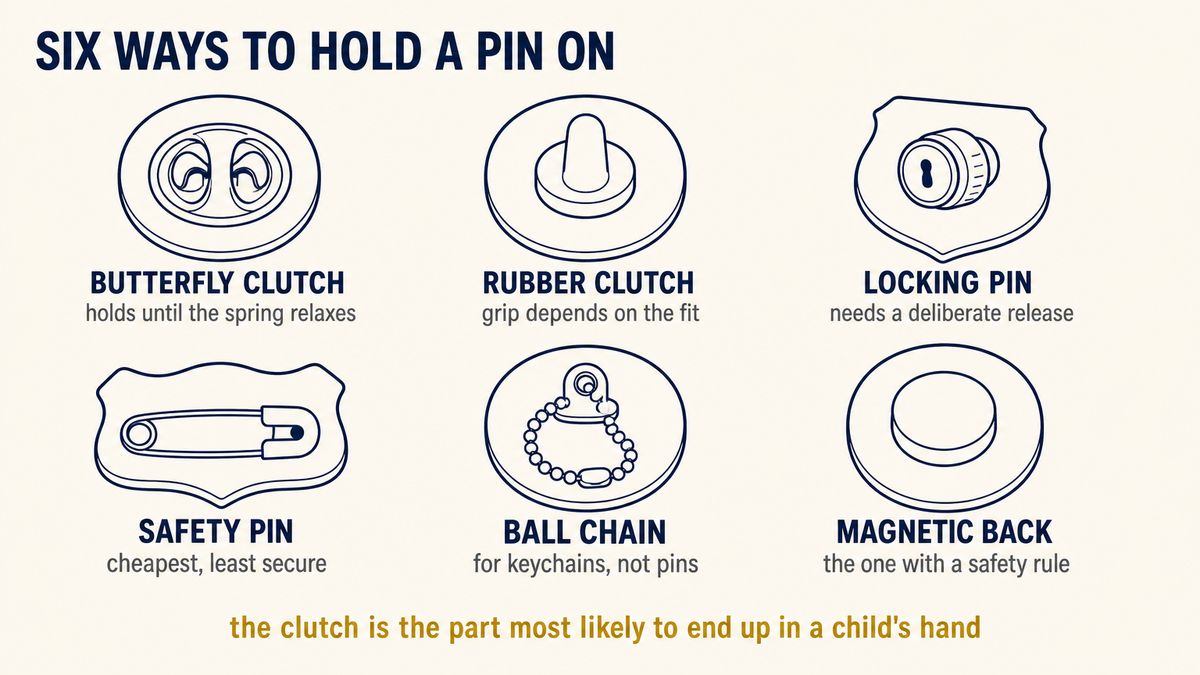
The attachment is a small, cheap component with an outsized effect on how the product is received, because it is the part the customer touches twice a day. It is also bought in rather than made, which means it has its own supplier and its own delivery schedule.
Specifying the attachment properly
Three lines turn the attachment from a default into a decision. Name the type. Name the material, because a metal clutch and a rubber clutch are different components from different suppliers. And ask for the pull-off force on a production piece, because a clutch that grips on a sample but not on a batch is a product that generates returns rather than complaints.
Then check the post itself. The post is cast as part of the pin, and a post that is too thin bends, while a post that is set at a slight angle will not sit flat on fabric. This is a die-level feature rather than an assembly step, so it is decided at the artwork stage and cannot be corrected later without a new tool.
7. Lead, Plating and What the Rules Say
A pin is a metal object with a coloured finish on it, and the finish is where the interesting question sits. Most supplier conversations on this topic produce a single word — "lead-free" — which is not an answer to either of the two questions that actually matter: what is the metal made of, and what is the finish classified as.
The lead-in-paint ban, and the exclusion that decides the analysis
The relevant rule is the lead-in-paint ban at 16 CFR Part 1303. It declares paint and similar surface-coating materials to be banned hazardous products when the lead content is above 0.009 percent by weight of the total nonvolatile content or of the dried film. That figure started at 0.06 percent and was reduced to 0.009 percent effective 14 August 2009. The same rule also bans toys and other articles intended for use by children that bear lead-containing paint, and it applies to products made after 27 February 1978.
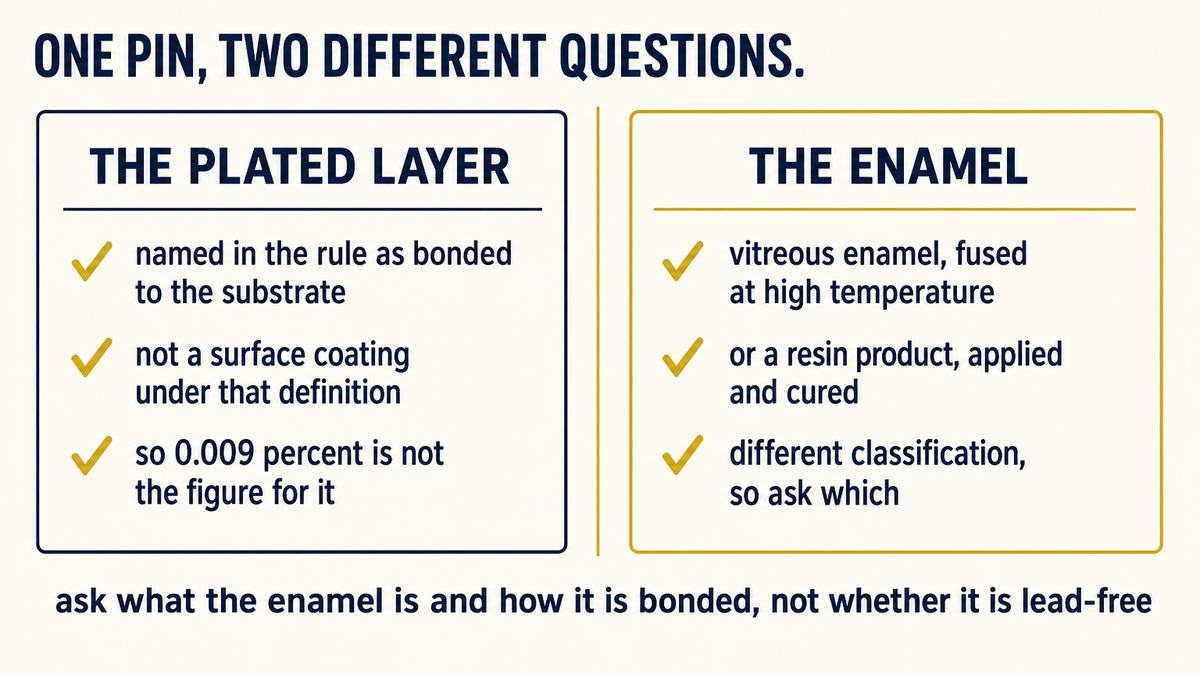
Now the part that decides how you read a pin. The rule defines what counts as paint, and the definition excludes three things: printing inks, materials that actually become part of the substrate such as the pigment in a plastic article, and materials that are actually bonded to the substrate such as by electroplating or ceramic glazing.
Read that exclusion against your own product and two separate answers appear.
The plating is named in the exclusion. A plated layer is bonded to the substrate rather than sitting on top of it, so it is not a surface coating for the purposes of this rule. That does not make the plating unregulated as a material, but it does mean the 0.009 percent paint figure is not the number to apply to it.
The enamel is your own question to settle. "Enamel" describes both a vitreous material fused onto metal at high temperature, which sits close to the ceramic glazing the rule names, and a resin-based product applied and cured, which behaves much more like a surface coating. The rule's answer turns on what the finish actually is rather than what it is called, so the question to put to a supplier is not "is it lead-free" but "what is the enamel, and how is it bonded to the metal".
Magnetic backs, and why a pin is not a phone case
If you sell a magnetic back, there is a mandatory rule to look at, and it lands differently on a pin than it does on almost any other product. The magnet standard at 16 CFR Part 1262 covers a "subject magnet product", defined as a consumer product designed, marketed or intended to be used for entertainment, jewellery — including children's jewellery — mental stimulation, stress relief, or a combination of these purposes, and containing one or more loose or separable magnets.
Jewellery is an explicit limb of that scope, and a pin is worn as ornamentation. So while a protective phone case falls outside the list of purposes, a magnetic pin is a much closer question, and the answer turns on how the product is designed and marketed rather than on the fact that it is made of metal.
Two consequences follow. If the product is in scope, every loose or separable magnet that fits entirely within the small-parts cylinder must have a flux index below 50 kG² mm², measured using the method in ASTM F963-17 — and the rule applies to products manufactured after 21 October 2022. And regardless of scope, the design answer is the same one that applies to any magnetic product: the magnet must not be able to come free. The rule's own findings describe an estimated 26,600 magnet ingestions treated in United States hospital emergency departments between 2010 and 2021 and five fatal incidents, four involving children two years old or younger, and the hazard it identifies is a loose or separable magnet rather than a magnet that is enclosed.
The cylinder used in that test comes from the small-parts method at 16 CFR Part 1501, which is worth knowing for a second reason on this product. A pin's clutch is a detachable component, and Part 1501 sets out how a component that comes free during use-and-abuse testing is judged — it is tested in the cylinder one piece at a time, and if it fits entirely without being compressed the article fails. That part applies to articles intended for children under three years old, so it is not the rule for an adult pin. But it gives you the right test to apply to your own design, and on a pin it points at exactly the part most likely to end up in a child's hand: the clutch.
8. Inspecting a Pin and Keychain Order
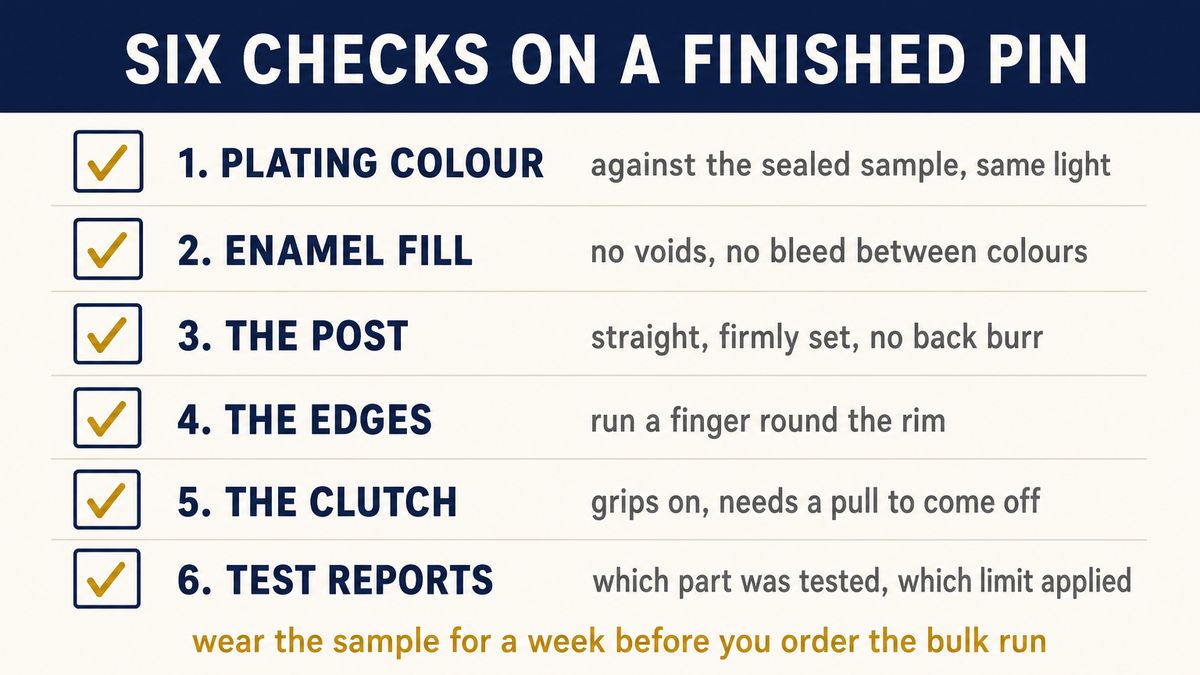
Pin inspection is almost entirely visual and tactile, which is good news, because it means you can do most of it yourself with a sealed sample and good light. Run these on a piece taken from production rather than the sample the supplier chose.
- Plating colour against the sealed sample, under the same light. A plating bath drifts, and a shift between two runs is visible when the two pieces are held side by side and invisible when they are not. This is why the sample is sealed.
- Enamel fill. Look for voids where the colour has not reached the edge of its recess, and for bleed where two colours have touched. On hard enamel, check that the surface is genuinely level rather than nearly level.
- The post and the clutch. The post should stand straight and be firmly set, with no burr around it on the back. The clutch should grip when pushed on and need a deliberate pull to remove.
- The edges and the back. Run a finger around the rim and over the back for a sharp edge or a burr. A pin is handled constantly, and a rough edge is the defect customers complain about most often after plating wear.
- Attachment pull and print registration on keychains. Pull the fitting and confirm it does not part company with the body. On acrylic and printed keychains, check the print against the artwork and look for scratches on the face.
- Lead test reports, by part. The metal, the plating and the enamel are separate questions, so ask which of them the report covers and which limit was applied. Our pre-shipment inspection guide covers how to write the brief so the report comes back with measurements rather than an opinion.
One habit is worth more than the list. When you approve a sample, seal it, date it and keep it in a drawer. Plating colour and enamel shade are the two things most likely to drift between orders, and both are arguments that a sealed sample settles in about ten seconds. Our first article inspection guide sets out the same pattern of agreeing the reference before production rather than after delivery.
Ask for a sample in the finish and the attachment you actually intend to sell, then wear it for a week before you place the bulk order. A pin worn on a jacket for seven days will show you the two things no factory photograph shows: where the plating wears, and whether the clutch still holds. It costs you one sample and it is the cheapest test in the whole order.
9. A Five-Step Sourcing Roadmap
- Finish the artwork before the die. Outline, cut-outs, metal line widths and the number of colours are all locked when the tool is cut, and none of them can be changed afterwards without paying for a new die.
- Choose hard or soft enamel by the process, not the word. Ask what happens to the surface after the colours are filled, and quote the two versions separately so you can see what the polishing pass actually costs you.
- Name the plating and count the colours. One finish per run, and each colour is a separate fill on every pin. The colour count is the per-unit lever you control without touching the tool.
- Specify the attachment and test it on a production piece. Type, material and pull force, with the post checked for straightness before the die is approved.
- Settle the finish question before you sell it. Find out what the enamel is and how it is bonded, get the test report that names the limit and the part tested, and confirm the magnet cannot come free if you are selling a magnetic back.
Everything in this guide sits inside our Sports & Gifts Products sourcing hub, which collects the gift, award and promotional product guides in one place.
10. Frequently Asked Questions
What is the difference between hard enamel and soft enamel?
The difference is one extra step after the colours are in. Both versions start the same way: the metal blank is cast or stamped, plated, and then each colour is filled into its own recessed areas and cured. In hard enamel, the surface is then ground flat and polished until the metal lines and the enamel are level, which gives a smooth glassy finish and makes the metal read as a thin line inside a flat surface. In soft enamel nothing further happens, so the metal lines stay proud and the colour sits recessed in the valleys, which gives a textured surface with fine ridges you can feel. Hard enamel costs more because of the grinding and polishing, and resists face chipping better because there is no raised edge to catch. Soft enamel is genuinely cheaper and often reads better at a distance, because the raised lines make a small logo legible.
How much of a pin order is the die?
The die is a one-time cost per design and it is usually the largest single line on a first order, because the metal blank for your shape has to be tooled before anything can be made. It does not appear again on a reorder, which is why the price of a second order of the same design falls sharply. The consequence for a range is worth planning for: twelve designs is not one order spread across twelve products, it is twelve dies and then twelve separate colour fill sequences. Ask for the die cost as its own line for each design rather than accepting a blended figure, because a blend cannot be reordered against when you later want uneven quantities of each design.
Why does adding a colour to the design cost more per unit?
Because each colour is a separate fill operation on every single pin. The metal blank has separate recessed areas for each colour, and each one is filled, cured, and then the next colour goes in. So a seven-colour design is seven passes rather than one, and the extra labour applies to every unit in the run rather than to the tool. Two colours that touch also need a metal line between them, which is part of the die rather than something the enamel does on its own. Once the die is paid for, the colour count is the per-unit lever you control without touching the tool, so it is worth deciding the palette at the artwork stage rather than when the quote comes back.
Where does a pin wear out first?
The plating, on the high points. A pin is handled, put in pockets and clipped to lanyards, and the metal line is the part in contact with all of it, while the enamel is either level with the surface or recessed below it. So the first visible change is usually the plating wearing on the raised edges and the highest points of the design, showing the base metal underneath. That is also why the finish you choose matters more than the enamel on a pin that gets used: bright silver hides fine scratches better than gold, black nickel shows the underlying metal as a bright flash when it wears, and an antique finish is the most forgiving of all because the surface is already uneven in tone.
Is a magnetic pin back covered by the magnet safety rule?
It is a closer question than it looks, and it turns on the scope wording. Under 16 CFR Part 1262 a subject magnet product is one designed, marketed or intended for entertainment, jewellery including children's jewellery, mental stimulation or stress relief, and containing a loose or separable magnet. Jewellery is an explicit part of that list, and a pin is worn as ornamentation, so unlike a protective phone case a magnetic pin sits much nearer the scope — and whether it falls inside turns on how the product is designed and marketed. If it is in scope, each loose or separable magnet that fits entirely within the small-parts cylinder must have a flux index below 50 kG2 mm2 measured by the method in ASTM F963-17. Either way, the design answer is the same: the magnet must not be able to come free, because the hazard the rule identifies is a loose or separable magnet.
Does the lead-in-paint ban apply to a pin's plating and its enamel?
Not in the same way, and that is the useful part. The rule at 16 CFR Part 1303 bans paint and similar surface-coating materials above 0.009 percent lead by weight, and it defines what counts as paint by excluding printing inks, materials that become part of the substrate such as pigment in a plastic article, and materials bonded to the substrate such as by electroplating or ceramic glazing. Plating is named in that exclusion, because it is bonded rather than sitting on the surface, so the 0.009 percent figure is not the number to apply to it. The enamel is your own question: the term covers both a vitreous material fused onto metal at high temperature and a resin-based product applied and cured, and those sit in different places under that definition. So the question to ask a supplier is not whether it is lead-free, but what the enamel is and how it is bonded, and the test report should name which part was tested and which limit was applied.
Get the Die, the Colours and the Finish Specified Before You Order
Our team writes the specification for the die, the enamel process, the plating and the attachment, quotes each design and each colour as its own line so the range can be reordered unevenly, agrees the reference sample before the tool is cut, and runs the plating and clutch checks on the first batch.
Request an Enamel Pin Sourcing Quote
Questions & Comments
We read every one and reply within 24 hoursCOMMENTS INTRO FOR THIS ARTICLE — write a topic-specific question prompt here.