
eBay Dropshipping: The Defect That Starts at the Supplier
 ·
Updated October 13, 2026
·
16 min read
Almost every article about selling on eBay this way argues about whether you are allowed to. That argument is a distraction, and it misses where the model actually fails. eBay does not police this arrangement through a permission you either have or lack. It polices it through a scorecard that runs every month and turns your fulfilment quality into your account economics. The part that catches people out is specific: when your supplier has nothing left to send, the cancellation that follows is recorded against you. Nothing in the process reaches the party who caused it.

What eBay Measures, and What It Costs When You Miss
| The metric | Minimum on eBay.com |
|---|---|
| Cases closed without seller resolution | No more than 2, or 0.3% of transactions, whichever is higher |
| Transaction defect rate | No more than 2% of transactions |
| Late shipment rate | Not a Below Standard trigger on its own, but a low rate is needed for Top Rated |
| Tracking uploaded within handling time, validated by the carrier | At least 95% of transactions, and only for Top Rated |
What this guide covers
- The clause that actually governs dropshipping on eBay
- The defect that starts on a shelf you cannot see
- When the shipping clock starts, and whose clock it is
- How the monthly evaluation really works
- The 95% tracking gate and the returns-location catch
- What Below Standard costs, and what you can get removed
- Frequently asked questions
1. What Clause Actually Governs This on eBay?
A clause inside the Selling practices policy, rather than a dedicated set of dropshipping rules. This matters commercially, because a great deal of advice on this subject is built on a policy document that, as far as I can establish, is not published as a standalone article on eBay's own help site.
On 13 October 2026 I read eBay's Selling policies hub and the Selling practices policy directly on ebay.com. The hub lists the Selling practices policy, the Seller protection policy, the Seller standards policy, the Service metrics policy, the Tax policy, the Intellectual property and VeRO programme, Prohibited and restricted items, and product safety guidance. A separate drop shipping policy is not among them. The only wording I could confirm that speaks to this arrangement sits in the Selling practices policy, under the requirement that you meet the expectations you have set in your listing:
Items you list must be in your inventory or you must have an existing agreement with a third party to fulfil the delivery of the item under the terms of your listing.
eBay, Selling practices policy (read 13 October 2026)
Read that sentence twice, because both halves matter and they point in opposite directions. The second half is permissive: an existing agreement with a third party is an accepted way of fulfilling. The model is contemplated rather than forbidden. The first half and the closing qualifier are where the work is, because the obligation is not to have an agreement but to fulfil under the terms of your listing. Whatever handling time, delivery estimate and returns promise you published become the standard you are held to, and no arrangement with a supplier changes that.
This is the correct frame for everything that follows. eBay is not asking whether you own a warehouse. It is asking whether the promise on the listing was kept, and it measures that monthly with numbers.
2. Why Does a Supplier's Stockout Become Your Defect?
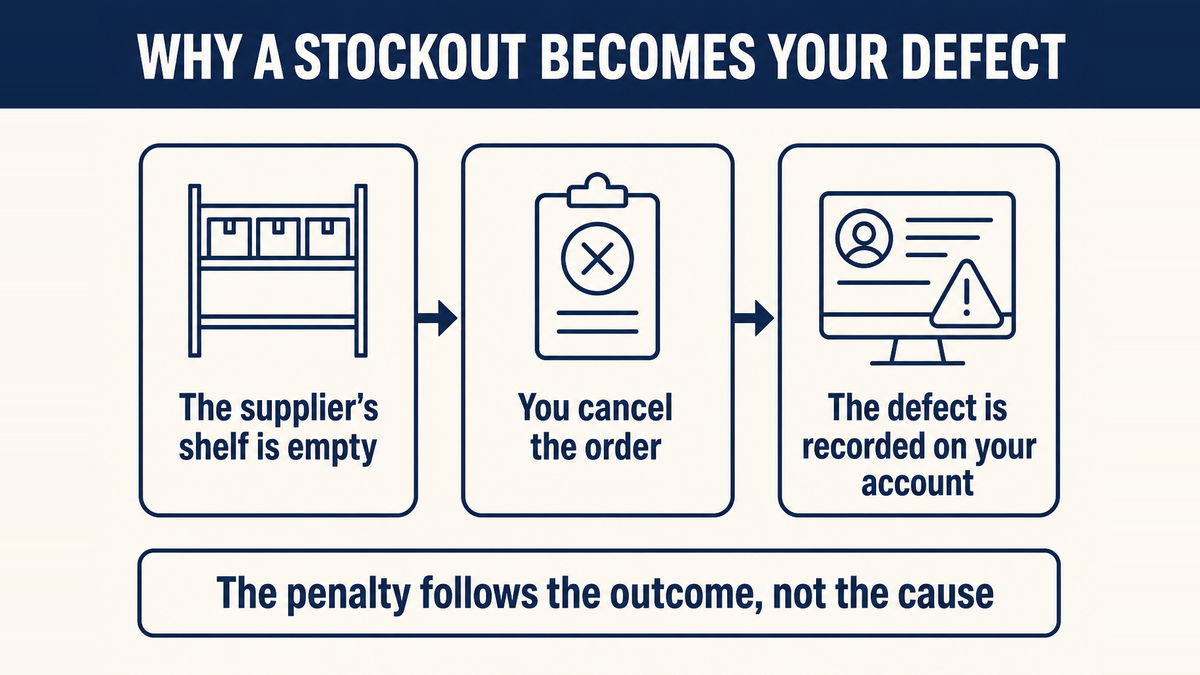
Because eBay names it as the first example of a defect. The seller standards policy defines a transaction defect as follows, and the parenthetical is the important part:
We count a transaction defect when either of these things happen: The seller cancels the order unexpectedly (e.g. because it was out of stock, or because they sold it to someone else). The buyer reports an issue, but the seller doesn't resolve it.
eBay, Seller standards policy (read 13 October 2026)
An empty shelf at your supplier, and a cancellation on your account. That is the whole exposure in one line, and it is structural rather than accidental, because the party who can see the stock is not the party who carries the penalty. Two features of the model make it worse than it looks on a process diagram.
The first is that a stockout is invisible until it matters. When you buy per order, you never receive a stock count. You learn that an item is unavailable at the moment you try to buy it, which is after a customer has already paid. A seller holding stock finds out when the shelf looks thin and has time to act; a seller buying per order finds out at the worst possible moment and has no time at all.
The second is that the defect is attributed to the outcome rather than the cause. There is no field in the evaluation for a supplier who let you down. One buyer, one cancellation, one defect, regardless of whose fault it was in any ordinary sense of the word. eBay does have a defect removal route, and I cover what it removes in the last section, but its stated grounds are events outside your control such as severe weather or carrier disruption. A supplier who ran out is not on that list.
The practical consequence is that the number of items you list is a supply decision, not a marketing decision. Every additional listing is a further promise you must be able to keep on demand, and the cheapest way to lower your defect rate is usually to list less.
3. When Does the Shipping Clock Start?
At the handling time you published. Not at the moment your supplier receives the order, and not at the moment you find out there is a problem. This is the second place where a dropshipping operation and an eBay scorecard disagree about how time works.
The seller standards policy sets out how lateness is counted, and the mechanics reward good record-keeping:
- With tracking from an integrated carrier
- An item is counted as late when the delivery scan is after the latest estimated delivery date and there is no carrier scan within your handling time. Both conditions have to hold, which means a carrier scan inside your handling window protects you even if the parcel then travels slowly.
- With no tracking available
- eBay asks the buyer, when they leave feedback, whether the item arrived on time. If they say it arrived after the estimated date, it counts as late. The absence of tracking does not remove the question; it hands the answer to the other party.
- The delivery service
- The policy states that sellers are responsible for shipping within their stated handling time, using the delivery service selected by the buyer. Choosing a slower line than the buyer paid for is not a saving; it is a miss.
For a store shipping per order out of China, the practical reading is uncomfortable in a specific way. The handling time you can honestly hold is set by how quickly your supplier can hand a parcel to a carrier, and the only way to make that short is to have the goods somewhere you control before the order arrives. That is not an argument for holding stock as a matter of principle. It is the arithmetic that decides how aggressively you can advertise your own handling time, and therefore whether you can meet the Top Rated Plus requirements at all.
Two things worth settling before you set a handling time. The first is your supplier's genuine daily cut-off and how long a parcel waits for a carrier scan, which our notes on what a China warehouse charges to store, pick and send an order work through in detail. The second is what the transit actually looks like, since an estimated delivery date that was optimistic when you wrote it will keep producing late shipments long after the listing is live. Our guide to realistic transit times from China is the piece to set that date from.
4. How Does the Monthly Evaluation Actually Work?
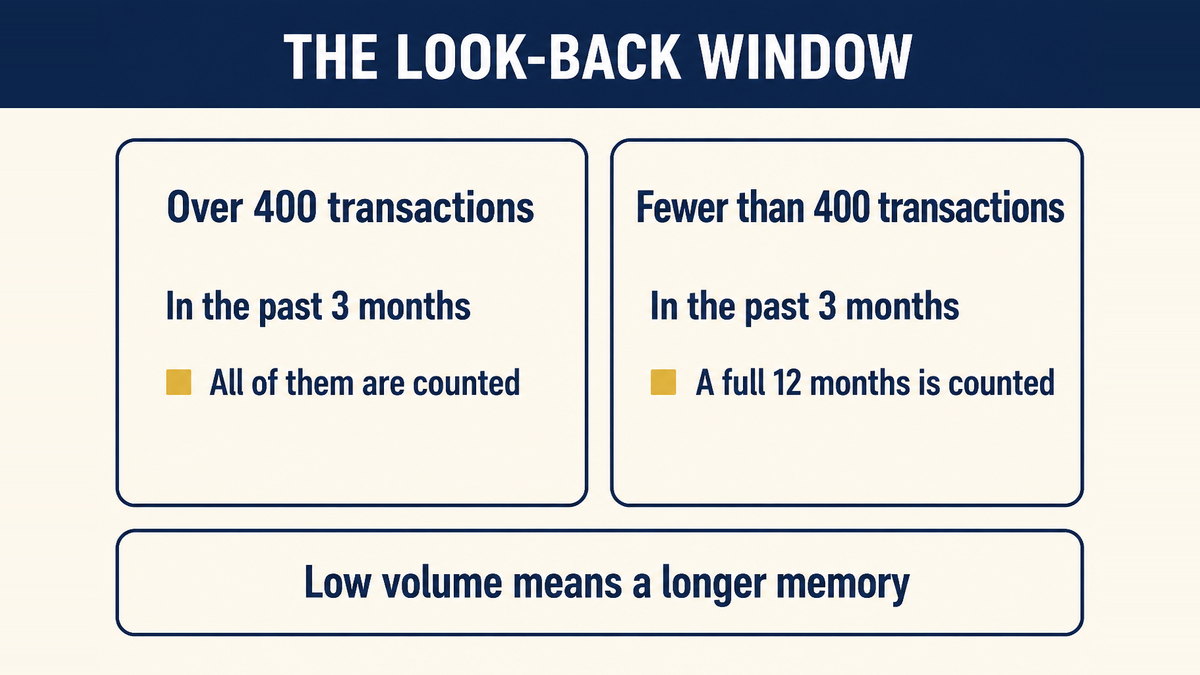
On the 20th of each month, against a look-back window that changes with your volume. The policy is explicit about the window because a fixed one would be unfair to both ends of the scale:
- More than 400 transactions in the past three months: eBay counts all of those transactions.
- Fewer than 400: eBay counts all of your transactions from the last 12 months.
That second line is the one to sit with if you are small. A store doing a few dozen orders a month is evaluated against a full year of its own history, which means a bad fortnight in March is still on the scorecard the following February. The most common way a new store ends up Below Standard is not a terrible month; it is one bad product launch inside a year-long window that has not rolled off yet.
The minimum standards on eBay.com are the two numbers in the matrix above: no more than 2 cases closed without seller resolution, or 0.3% of transactions, whichever is higher, and no more than 2% of transactions carrying defects. Two safeguards soften those limits, and both change what you should worry about.
- A defect rate only bites above four buyers
- The policy states that you are only evaluated as Below Standard if your transaction defects are associated with more than 4 different buyers. Five defects spread across five buyers is a different situation from five defects from one furious buyer, and eBay treats them differently on purpose, so that a single difficult transaction cannot wreck an account.
- One defect per transaction, and only paid orders count
- There can only be one defect per transaction, and only transactions where the buyer has paid are counted. A transaction cannot be penalised twice.
Then there is the second evaluation running alongside the first. Service metrics do not measure you against a fixed number but against your peers, comparing sellers with a similar profile to find those whose buyers report problems at a significantly higher rate. The policy is careful about one detail that matters if you sell a product with a known failure mode: it counts buyers who reported a problem regardless of whether the issue was resolved. Fixing the problem does not remove the report from the comparison. Because that evaluation is relative, it can tighten without you doing anything differently, and a peer group of sellers who handle returns flawlessly will make an average operation look worse than it did a year ago.
Two ways this evaluation surprises people. The first is that the international picture is not one scorecard. eBay runs four regional seller standards programmes, split by the destination the item is sent to rather than the site you list on: a US programme, a UK programme covering the UK and Ireland, a German programme covering Germany, Austria and Switzerland, and a Global programme for everywhere else. Your seller level does not carry over between them, so it is possible to be Top Rated on eBay.com and Above Standard in the Global programme at the same time. If any part of your traffic ships overseas, your standing in that programme is decided by orders you may think of as exceptions.
The second is that the evaluation is not the only clock. eBay Money Back Guarantee lets a buyer recover their money if an item did not arrive, arrived faulty or damaged, or does not match the listing, and those cases feed the same metrics when they end without your resolution. A dispute you consider closed can still be counting against you.
5. What Is the 95% Tracking Gate, and Where Does the Returns Promise Land?
The tracking requirement is the hardest of the Top Rated criteria for anyone shipping per order from overseas, and the returns requirement is the most expensive. Both are stated plainly, and both are decided by where your items physically sit.
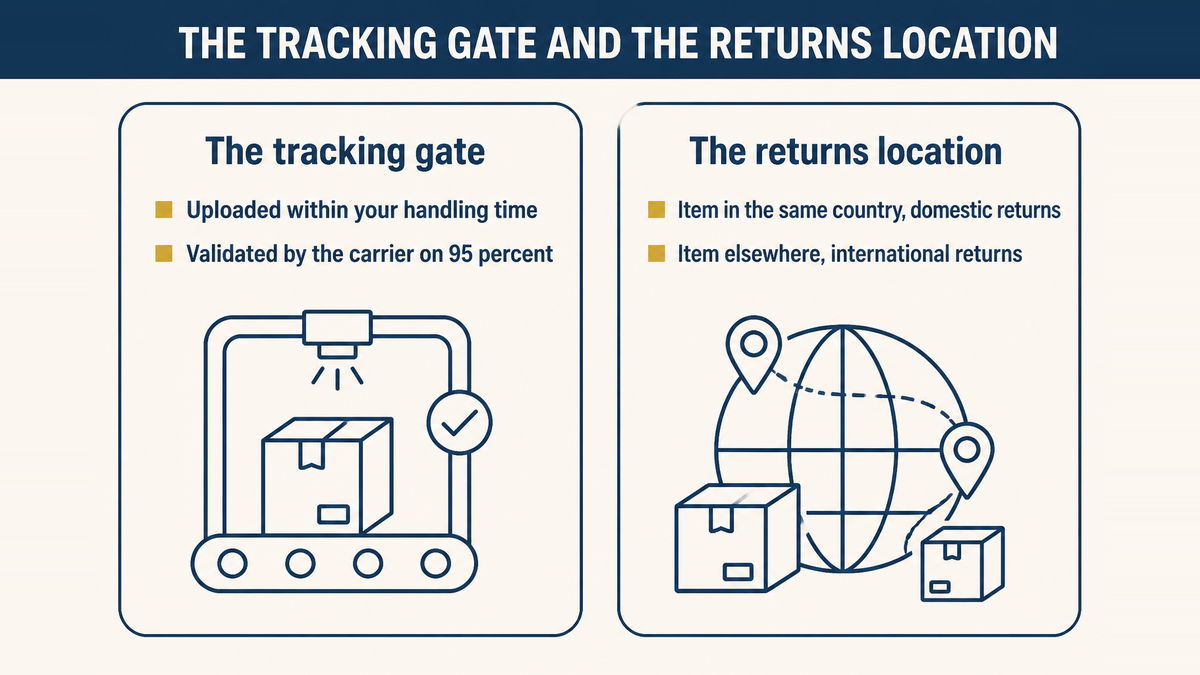
Upload tracking: At least 95% of transaction have tracking uploaded within handling time and validated by carrier. … Your eBay account has been active for at least 90 days. You have at least 100 transactions and $1,000 in sales with US buyers over the past 12 months.
eBay, Seller standards policy — Top Rated seller requirements (read 13 October 2026)
Three conditions sit inside that sentence, and each one is a supply-chain requirement rather than a bookkeeping task. The tracking has to be uploaded within your handling time, so a number you generate before dispatch does not satisfy it. It has to be validated by the carrier, which means the line you ship on must produce a genuine scan rather than a label sitting in a system. And it has to happen for at least 95% of transactions, which is a rate, not a one-off. A store whose supplier hands parcels to a consolidator twice a week cannot reach 95% on a one-day handling time, however well its order management software performs.
The other Top Rated criteria are worth reading as a set, because they explain who the programme is designed for. No more than 0.5% of transactions with defects, associated with no more than 3 different buyers. A late shipment rate of no more than 5 or 3% of transactions. An account active for at least 90 days. At least 100 transactions and $1,000 in sales with US buyers over the past 12 months.
Then the returns condition, which is where the physical location of your stock decides your cost. Top Rated Plus requires same- or one-business-day handling plus 30-day or longer free returns, and eBay is specific that the free returns requirement is based on your item's location. If the item location is in the same country as the site you listed on, that means 30-day free domestic returns. If the item location is not in the same country, it means 30-day free international returns. For a seller shipping per order from China, qualifying therefore means funding the return leg of a parcel that has already crossed the Pacific once, on every return, for a product the customer has already held.
The reward for clearing all of that is real. Top Rated Plus listings carry a seal in search results, and the policy grants a 10% discount on your final value fees, calculated on the total amount of the sale including shipping and tax, though not on the per-order portion of the fee. One condition on the discount is easy to miss: it is only available to sellers resident in the country in which they are Top Rated. Selling through eBay.com does not by itself qualify an overseas resident for the fee discount, even if they somehow reach the status.
The cheapest way to reach a short handling time is to have the goods somewhere you control before the order arrives. Our guide to moving from per-order buying to holding stock works through the point at which that becomes cheaper than paying for speed on every parcel, and our breakdown of what a bulk order really costs to land is the input that calculation needs.
6. What Does Below Standard Cost, and What Can You Get Removed?
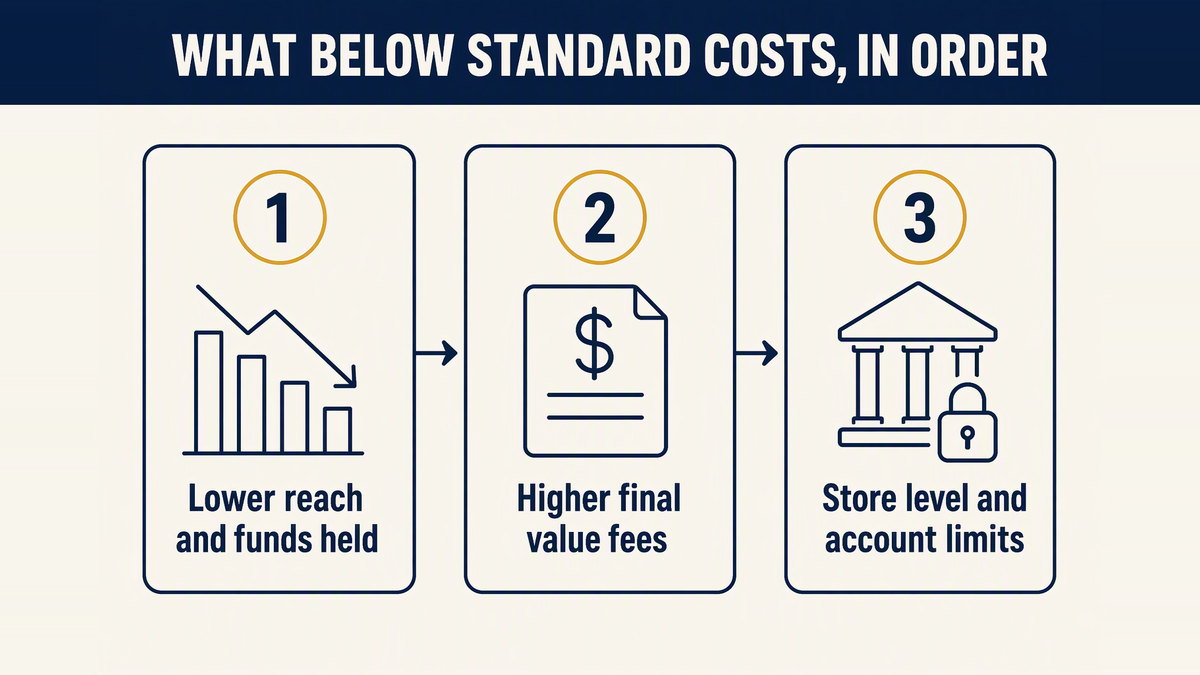
More than a fee, and in a deliberate order. eBay applies some consequences immediately after the evaluation and others from the first of the following month, and the immediate ones are mostly about cash and reach rather than price.
What eBay Applies, and When
| Timing | What changes |
|---|---|
| Straight after the evaluation | Items may sit lower in search results, selling limits may fall, Promoted Listings is blocked, funds from your orders may be held until tracking shows the item is on its way, and you lose the ability to deduct an amount from a refund when a return comes back used or damaged |
| From the 1st of the following month | You may be charged higher final value fees until performance improves |
| After a prolonged period | Your Store may be moved down to the Basic level, and selling restrictions may be placed on the account and related accounts, including restrictions on registering a new one |
The fund hold is the consequence that damages a per-order seller most, because it attacks the model's own cash rhythm. Buying per order means paying a supplier before a buyer's money settles, and a hold that waits for a tracking event lengthens exactly the interval you were already borrowing against. A store that misses the standard does not simply pay more; it has to fund more, for longer, on the same working capital.
The deduction rule deserves a line of its own. Losing the right to deduct for an item returned used or damaged converts a partial loss into a total one, and the category where that hurts most is the one where customers most often change their minds. It is a cost that appears in the returns line rather than the fee line, so it is easily attributed to the wrong cause.
What eBay removes, and how to ask
The appeals process is more generous than its reputation, and it is specific about the evidence that works. Three protections are worth knowing in advance, because each one depends on a record you have to create at the time:
- Events outside your control. The policy states that defects and late shipments are removed when something outside your control happens, giving severe weather and carrier disruptions as the examples. A supplier stockout is not on that list.
- Arrived late but sent on time. A late shipment will not be counted if the item arrives after the estimated date but tracking shows you sent it on time. This is the strongest argument for uploading tracking on every order, including the cheap ones.
- Abusive buyers. If eBay determines that a buyer has violated its Abusive buyer policy, it removes the associated defects automatically.
On timing, a case closed without seller resolution can be appealed within 30 days of eBay's decision. A late shipment can be appealed on valid tracking showing the item arrived by the expected delivery date, or that there was a carrier scan within your stated handling time. And if removing a defect puts you back above the minimum standard, the policy says the seller level is adjusted at the next evaluation rather than immediately, which is a reason to act on a borderline month before the 20th rather than after it.
One thing to check before you rely on a protection. Requesting defect and late shipment removals runs through Seller Help, which per the seller performance overview is available to sellers who have listed or sold an item within the past 120 days. An account that has gone quiet may find the route closed just when it is needed. If you are winding down a product line, settle the outstanding defects while the window is still open rather than discovering the limit later.
Two further pieces to read alongside this one. Our guide to the reasons marketplace listings get taken down covers the adjacent risk of losing a listing rather than a standard, and our notes on what a supplier directory really delivers for the money are the counterpart to this article if you are choosing where the stock comes from in the first place.
7. Frequently Asked Questions
Does eBay allow dropshipping?
The requirement that governs it is in eBay's Selling practices policy, which says items you list must be in your inventory or you must have an existing agreement with a third party to fulfil the delivery of the item under the terms of your listing. The model is contemplated; the obligation for meeting your own stated terms sits with you.
Can a supplier being out of stock hurt my eBay account?
Yes. eBay counts a transaction defect when the seller cancels the order unexpectedly, and it gives out of stock as the example. If your supplier has none left and you cannot ship, the cancellation is recorded against your account, not theirs.
How often does eBay evaluate seller performance?
On the 20th of each month. The look-back window depends on volume: with more than 400 transactions in the past three months eBay counts all of them, and with fewer it counts all transactions from the last 12 months.
What are the minimum standards on eBay.com?
No more than 2 cases closed without seller resolution, or 0.3% of transactions, whichever is higher; and no more than 2% of transactions with defects. A defect rate only leads to Below Standard when the defects involve more than 4 different buyers.
What does being Below Standard actually cost?
Immediately: lower placement in search, reduced selling limits, no Promoted Listings, and funds from your orders may be held until tracking shows the item is on its way. From the first of the following month you may be charged higher final value fees, and a prolonged period can lead to your Store being moved down a level and restrictions on the account.
Each Supplier Failure, Mapped to Its Defect
We return the supplier failures that become your defects, the clock start for each shipping service, and the monthly evaluation arithmetic.
Ledger My Defects
Questions & Comments
We read every one and reply within 24 hoursFallen Below Standard over a supplier who ran out, unsure whether the handling time on your listing is honest, or trying to work out if your tracking can ever reach 95% validated within the window? Post the product, the handling time you advertise and how your supplier hands parcels to a carrier, and our team will help you check it before the 20th.