

Dropshipping Pricing Strategy: Three Methods and How Each One Fails
 ·
Updated October 14, 2026
·
14 min read
Pricing advice for a dropshipping store usually arrives as a choice between three named methods: add a margin to your cost, match what the market is charging, or charge what the product is worth to the buyer. Picking one feels like the decision, and it is not, because each of the three fails for a specific reason and the reasons are not interchangeable. One fails on the number it starts from, one fails on an assumption about somebody else's business, and one fails when a claim about value is attached to a price that has to be real. This guide takes the three in turn, names the failure condition of each, and then looks at the part of pricing that is not a choice at all.
1. Three Methods, and the Part That Is Not a Choice
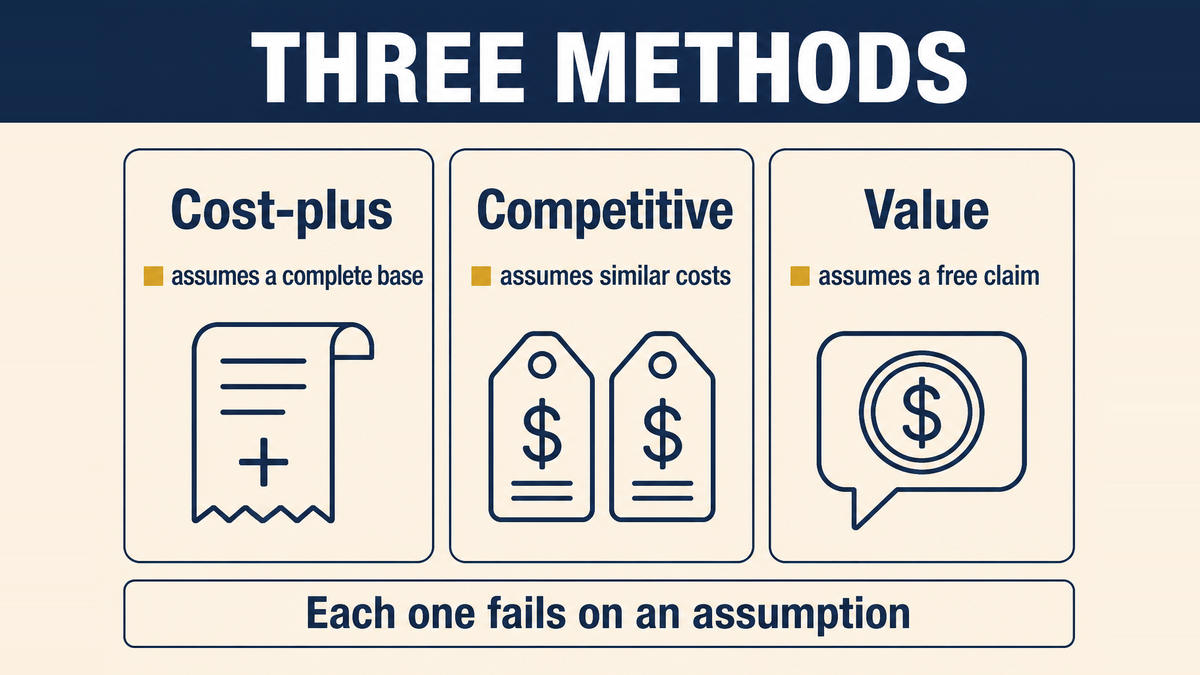
Cost-plus starts from what the item costs you and adds a margin. Competitive pricing starts from what other sellers are charging and positions against it. Value pricing starts from what the buyer believes the item is worth and works backwards. Each is a legitimate way to arrive at a number, and each carries an assumption that decides whether the number is any good.
The first method assumes the cost base is complete. That assumption fails quietly, because an incomplete base still produces a confident-looking price, and the shortfall shows up as a margin that never appears in the bank. The second assumes that a competitor's price was built from costs similar to yours. That assumption fails whenever the competitor holds stock, buys in larger quantities or has been running long enough to spread its fixed costs, and the failure is invisible because the price you are matching looks like a market fact rather than a business decision somebody else made.
The third method assumes that the value claim can be expressed freely. That assumption meets a specific obstacle, because statements about price are among the few things in this business where the wording is regulated: a comparison against a previous price, against another seller's price or against a suggested retail price is not simply a marketing device. The method is still yours to choose. The way the number is displayed is not, and that is the part most guides leave out.
| Method | What it assumes | What breaks it |
|---|---|---|
| Cost-plus | That the cost base is complete | A base missing fees, returns and fixed costs |
| Competitive | That the rival's costs resemble yours | Matching a price built on someone else's economics |
| Value | That the value claim can be made freely | Rules about how a price comparison may be shown |
What this guide covers
The three methods are usually presented as alternatives, and in a working store they are not. A seller arrives at a number with one method and checks it with another, which is exactly where the failure conditions become useful: cost-plus supplies a floor, competitive pricing supplies a ceiling, and value pricing decides where between the two a product should sit. The mistake is treating any single one of them as the whole answer. A floor with no ceiling produces a price nobody buys at, a ceiling with no floor produces a price that loses money, and a value claim with no floor behind it produces both at once.
2. Cost-Plus: It Fails on the Base, Not the Margin
Cost-plus is the method most sellers start with because it is the only one that can be done alone. Take what the item costs, add a percentage, and a price appears. The difficulty is that the method does not produce a decision, it produces an answer to a question that was asked imprecisely, and the imprecision sits entirely in the first number.
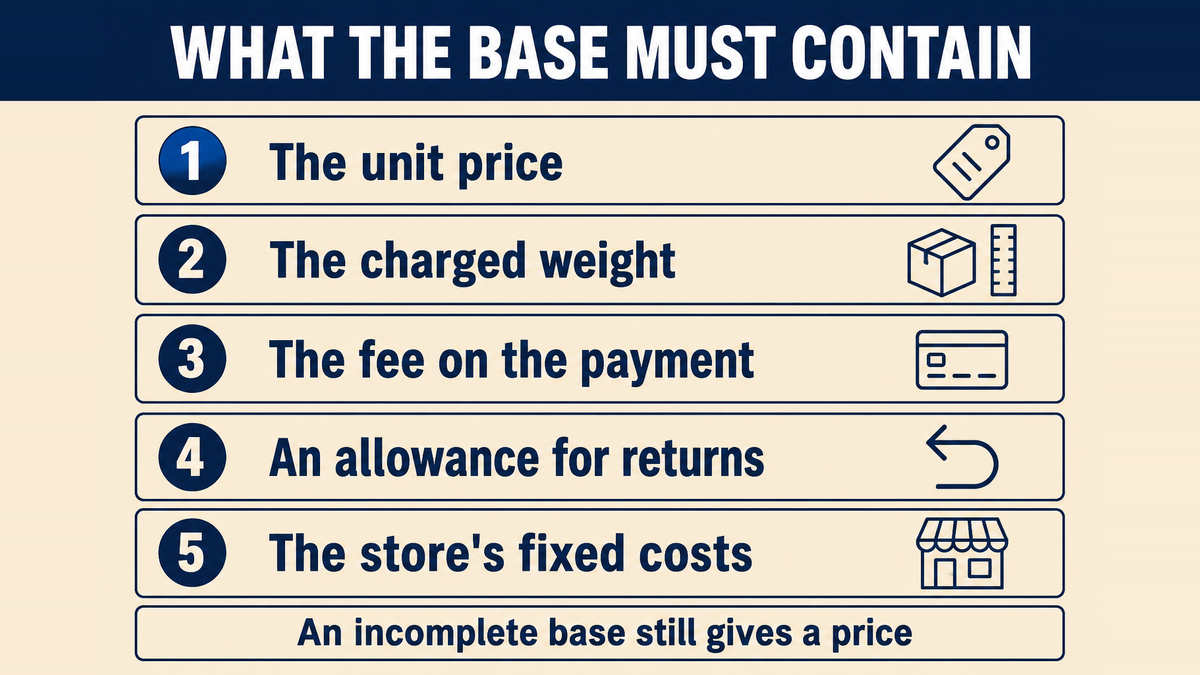
The reason the base is usually short is that unit price is the most visible cost and per-order costs are the least visible. A price built from the unit and the postage will look healthy and will omit the fee charged on the payment, which takes a percentage of the sale and a small fixed amount that is proportionally larger on a cheaper item. It will omit the allowance for goods that come back, which on a product with a return rate is a real cost per order rather than an occasional event, as set out in what a return actually costs. And it will omit the fixed costs of running the store, which do not shrink when sales are slow and therefore have to be carried by the orders that do happen.
Freight is the component most often understated in this particular business, for a structural reason. A small parcel is not charged on its weight once it passes a published size, and above that line the charge follows the space the parcel occupies. The line and the additions that come with it are published, so the input is knowable, but it is knowable only from the packed dimensions rather than from the product's weight, which is the number a supplier quotes. How the charge is built is set out in how volume decides what a parcel is charged, and the full assembly of a base from quoted price to delivered order is covered in how a landed cost is put together.
The failure condition is therefore easy to state and easy to miss. Cost-plus fails when the base is incomplete, and an incomplete base does not produce a warning. It produces a margin that looks generous, a bank balance that disagrees, and a search for the problem in the wrong place, usually in advertising. The way to test the base is not to inspect it but to compare the predicted margin with the observed one over a month, because the difference between the two is the size of whatever was left out. The full version of that calculation is how a margin is actually built.
3. Competitive: You Are Copying a Decision, Not a Fact
Competitive pricing begins with what the market is charging, and it feels like the most objective of the three methods because the input is a number somebody else is already publishing. The difficulty is that a published price is not an observation about the market. It is the output of one business's cost structure, buying volume, cash position and current strategy, and treating it as a fact means adopting a decision without the conditions that made it possible.
Three versions of this happen constantly. A rival who holds stock buys at a lower unit cost, ships from a domestic warehouse and reaches the buyer in two days; matching that price means matching the price without the cost base or the delivery speed. A rival selling a low-priced item with a high order value per customer can absorb a thin margin on one product because something else in the basket carries it. And a rival in a launch phase may be buying position deliberately, at a price it intends to raise once the listing has history, which makes the number you are matching a temporary investment rather than a market level.
The second problem is that the price on the page is often not the price paid. A coupon, a bundle, a free-shipping line and a membership discount all change the amount, and a seller comparing headline figures can end up matching a number that nobody actually pays. That matters because the comparison shopper is precisely the buyer who looks at all of it, so the effective price is the one being compared, and it is usually lower than the headline.
Undercutting has its own failure condition, which is that it sets a floor you then have to live under. A price reduced to win a comparison is difficult to raise afterwards, and the customer it attracts is the one with the least attachment to the store, which means the cost of acquiring them has to be paid again for the next order. The useful way to hold competitor pricing is as evidence about the ceiling rather than as a target: it tells you what the market will bear, and it says nothing about what your costs allow you to accept. What the market will bear is also a moving target, which is the argument in how a product trend reaches a seller.
4. Value Pricing: The Claim Meets a Rule
Value pricing starts from what the buyer thinks the item is worth and works backwards to a number, which makes it the method that best survives a change in your costs. Its failure condition is different in kind from the other two, because it is not commercial. Value pricing usually needs to be expressed as a claim about the price, and a claim about a price is one of the few pieces of marketing language with rules attached.
The rule for the most common version of that claim, the reduction from a former price, is stated in one sentence that is worth reading before any discount is designed:
If the former price is the actual, bona fide price at which the article was offered to the public on a regular basis for a reasonably substantial period of time, it provides a legitimate basis for the advertising of a price comparison. Where the former price is genuine, the bargain being advertised is a true one.
Federal Trade Commission, 16 CFR 233.1(a), Former price comparisons (read 14 October 2026)
Three requirements sit inside that sentence and each of them is a question about history rather than about presentation. The price has to have been actual rather than illustrative, it has to have been offered to the public rather than held internally, and it has to have applied on a regular basis for a reasonably substantial period rather than for a single afternoon. A number invented in order to be crossed out fails all three at once, and it fails them regardless of how the page is laid out.
The same part of the rules covers the other two comparisons a store is likely to make. A comparison against another seller's or a manufacturer's stated price sits in its own section, as does the comparison against a suggested retail price, and an offer that depends on buying something else, such as a bundle or a two-for-one, is dealt with separately again. The practical shape of the constraint is one principle rather than a list: a comparison has to be anchored to something that actually happened. The striking part is the asymmetry it creates. A store may choose any price it likes for a product, and it may not describe that price using a comparison that the underlying history does not support.
There is one further asymmetry worth naming, because it explains why the third method causes the most trouble in practice. A claim about value is the easiest of the three to make and the hardest to document, since it depends on what a buyer believes rather than on a figure the store holds. What the other two methods rely on is at least recorded somewhere: the unit price is on an invoice and the competitor's figure is on a page. A claim about worth has no equivalent artefact, so a store can end up asserting a position about value that nothing in the business supports. Writing the claim down, with the reason for it, is the cheapest protection available.
5. Three Display Tactics the Rules Constrain
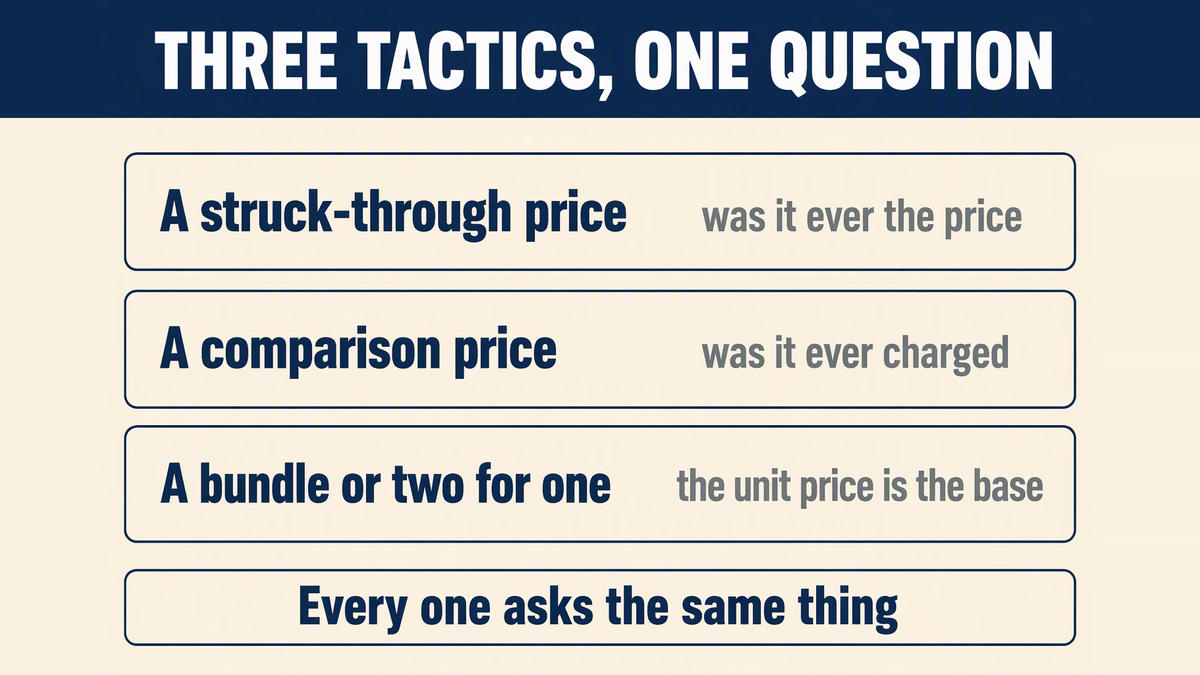
The rules are easier to work with as three specific tactics rather than as a principle, because each tactic is a thing a store actually does and each has one question attached to it. The question is always about history: what was the price before, and did the thing the page says actually happen.
| Tactic | What the rule looks at | The failure |
|---|---|---|
| A struck-through price | Whether that price was really offered, regularly, for a substantial period | An anchor that never existed as a selling price |
| “Compare at” or a retail price | Whether the comparison price is a genuine price in the market | A suggested price nobody ever charged |
| Two for one or a bundle | The price of the merchandise the buyer is actually buying | A single-unit price raised to fund the free item |
The first tactic is the one almost every store uses and the one where the failure is most common, because a permanent discount is a discount with no former price behind it. If an item is offered at the reduced figure all year, the reduced figure is the price, and the crossed-out number is an illustration. That is a presentation problem rather than an arithmetic one, which is why it is easy to fall into and why correcting it costs nothing except the design that made the page look urgent.
The second tactic fails in a specific and familiar way. A suggested retail price is a real thing and comparing to one is not forbidden, but the comparison has to be with a price that means something in the market rather than a figure created by the seller to be compared against. Where the same item has been widely sold at a much lower level, a comparison to a high figure is a claim about the market that the market does not support. The third tactic works the same way from a different direction: the offer has to be judged on the price of the merchandise being bought, so a bundle that is only a good deal because the single unit was marked up is not the offer it appears to be.
Read across the three, the two positions that carry no risk at all are worth naming. One is a single price with no comparison attached, which makes no claim and therefore cannot make a false one. The other is a genuine seasonal reduction from a price the store really charged for a substantial period, which is exactly the situation the rule was written to permit. The rest sits in between, and where a store is unsure which side of the line a page falls on, the practical test is whether the crossed-out number can be found in the store's own history at the level and duration claimed.
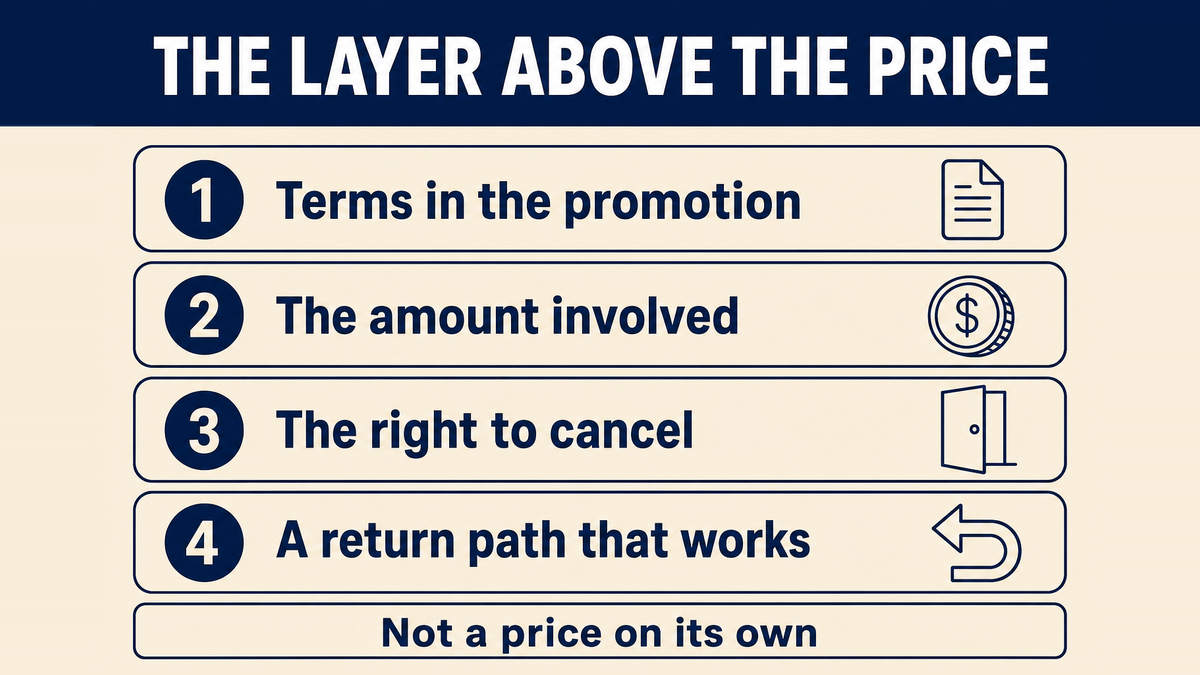
6. The Layer Above the Price
A store rarely sells one product for one figure, and the layer above that figure has its own rules. Subscriptions, memberships, clubs and recurring deliveries are all ways of pricing a relationship rather than an item, and they carry obligations that a one-off sale does not. The rules covering this layer were last revised this year, and the structure is worth knowing because it turns the presentation of the offer into a condition of it.
In connection with the sale, offering for sale, or distribution of goods and merchandise in or affecting commerce… it is an unfair or deceptive act or practice, for a seller in connection with the use of any negative option plan to fail to comply with the following requirements: (1) Promotional material shall clearly and conspicuously disclose the material terms of the plan, including: … (iii) The right of a contract-complete subscriber to cancel his membership at any time…
Federal Trade Commission, 16 CFR 425.1, Use of Prenotification Negative Option Plans (read 14 October 2026)
That requirement sits on top of a wider one. The plan rules are one application of the Commission’s general authority over conduct in commerce, which is why the disclosure terms are treated as a condition of the offer rather than as a matter of presentation. See 15 U.S.C. 45, Unfair methods of competition unlawful.
Two consequences follow for a store that prices anything on a recurring basis. The first is that the terms of the plan belong in the promotion rather than in the small print of an account page, and the list the rule gives includes the mechanics of the plan, the amount involved and the right to cancel. The second is that cancelling has to work, because a separate provision addresses what happens when goods are sent to somebody who declined a selection or has already given notice, including a duty to credit the return and to cover the cost of sending it back.
There is also a cost input that belongs in this layer and is easy to price out of sight. The duty and tax position on goods entering a market is part of what the offer costs rather than a separate administrative matter, and on a recurring arrangement it repeats with every shipment rather than being absorbed once. That side of the arithmetic is set out in what a seller really owes. The wider point is that a low headline figure is only low if the terms behind it are stated, and a figure that requires a plan is never a price on its own.
7. Frequently Asked Questions
What is the best pricing strategy for dropshipping?
There is no method that is best in the abstract, and the useful question is which failure you are best placed to avoid. Cost-plus fails when the cost base is incomplete, competitive pricing fails when you copy a price built on somebody else's costs, and value pricing fails when the value claim is expressed as a comparison the history does not support. The third is the only one of the three that is constrained by a rule.
What markup should I use?
A markup is a result rather than a setting, so the answer depends on what has to be covered before anything is left over. The unit price is only the visible part of that, and the charges that most often go missing are the fee taken on the payment, an allowance for orders that come back, and the fixed costs of running the store spread across the orders that do happen. Comparing a predicted margin with an observed one over a month is the fastest way to find the gap.
Can I show a crossed-out price?
Yes, where the crossed-out figure is the actual price at which the item was offered to the public on a regular basis for a reasonably substantial period. If the item has been sold at the lower figure all year, then the lower figure is the price and the higher one is an illustration, which is the failure to avoid. The test is whether the figure can be found in the store's own history at the level and duration claimed.
Should I price below my competitors?
Undercutting sets a floor you then have to live under, and it is difficult to reverse once a listing has history. It also attracts the buyer with the least attachment to the store, so the cost of acquiring them has to be paid again for the next order. Competitor prices are more useful as evidence about the ceiling, which is what the market will bear, than as a target your own costs have to meet.
Is a subscription a good way to price a dropshipping store?
It can be, and it changes what has to appear in the promotion rather than only in the account area. The rules covering plans of this kind require the material terms to be disclosed clearly and conspicuously, including the mechanics, the amount and the right to cancel, and a separate provision addresses what happens when goods are sent to somebody who has already declined or cancelled. A headline figure that requires a plan is never a price on its own.
Which Display Tactics the Rules Allow
We return each display tactic you plan to use, the clause constraining it, and the comparison price you are permitted to show.
Rule My Tactics
Questions & Comments
We read every one and reply within 24 hoursTrying to work out why the margin you planned never reaches the bank, unsure whether the price you are matching is one you can actually afford, or wondering whether a crossed-out figure on your page has the history behind it? Send us the product and the packed dimensions, and our team will build the cost base and show you the floor your price has to clear.