
Dropshipping Car Accessories: Why Fitment Decides the Return and the Seller Carries the Duty
 ·
Updated October 14, 2026
·
13 min read
Car accessories look like a good catalogue for a store that holds no stock: the parts are small, the buyers are motivated, and the same item sells for years. Two things make it harder than it looks, and neither of them is demand. The first is fitment, which turns a simple order into a compatibility question the seller has to answer before shipping something they never inspect. The second is that a number of the parts in this category are regulated as motor vehicle equipment, and the rules that come with that attach to the part rather than to the person who installs it. This guide takes both.
1. The Two Problems in One Category
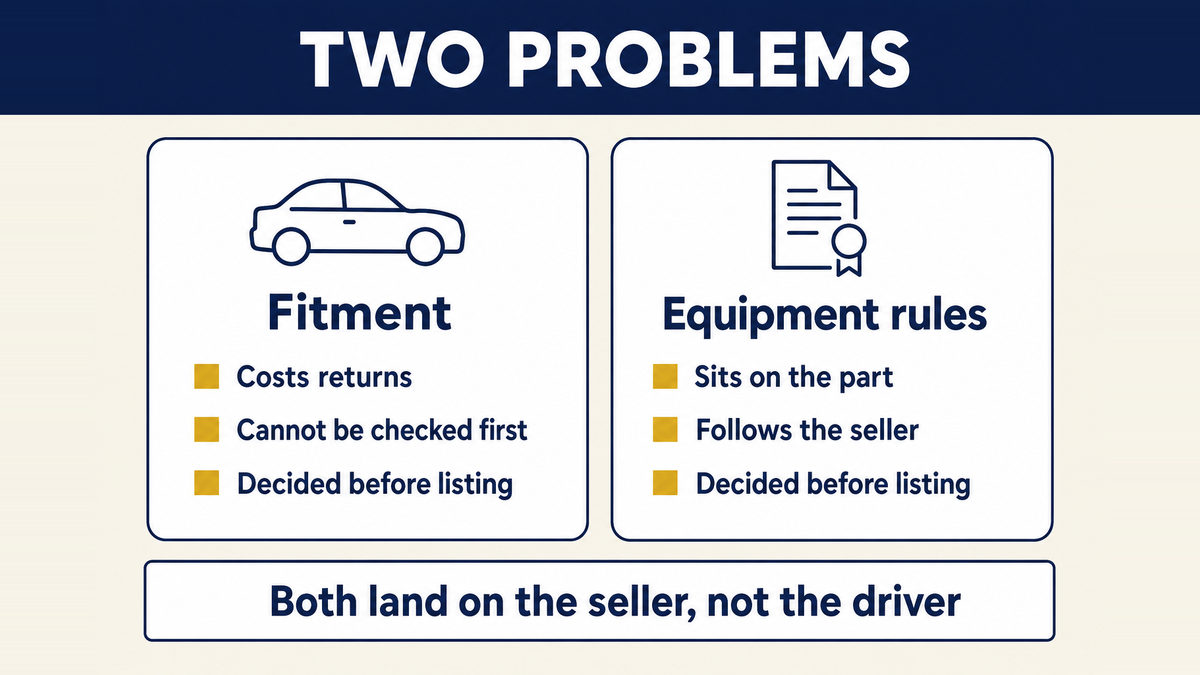
The first problem is that the buyer knows more about the product than the seller does. A customer looking for a floor mat or a set of bulbs knows the year, make, model and trim of their car. The store selling it often knows only what the supplier's listing said, and the supplier's listing was written for a wholesale catalogue rather than for a buyer standing beside a vehicle.
The second problem is quieter. A large part of this category is treated as motor vehicle equipment, and the duties that come with that classification sit on the party who sells the part, not on the party who bolts it on. A seller who assumes the rules belong to the driver is working from the wrong assumption, and the mistake only shows up when something goes wrong with a part that never met the rules in the first place.
There is a reason sellers keep arriving in this category anyway, and it is worth stating so the rest of this guide reads as a set of checks rather than as a warning. Parts stay relevant for years, so a listing written once keeps selling without the seasonal rewriting a fashion catalogue needs. The buyer is solving a specific problem rather than browsing, which makes them easier to convert than a shopper who is still deciding what to want. And the same customer tends to come back for the next accessory, because a vehicle does not stop needing things. None of that is disturbed by fitment or by the equipment rules. It is the reward for handling both. Which listings are allowed onto the store, and whether the fitment data on them is trustworthy enough to promise a fit.
| The question | Fitment | Equipment rules |
|---|---|---|
| What it costs | Returns and replacements | Exposure on the listing itself |
| Who can check it | Only if the fitment data is good | Only if the supplier has the documents |
| When it is decided | Before the listing goes live | Before the listing goes live |
| Who carries it | The store, through the return | The store, as the seller |
What this guide covers
2. Fitment Is the Return Engine
In most categories a return means the buyer changed their mind or the product disappointed them. In this one it usually means the part did not fit, and that is a different kind of return because nobody did anything wrong. The customer ordered what the listing described. The supplier shipped what the customer ordered. The two facts are correct and the outcome is still a parcel coming back.
A store with a warehouse can sometimes catch this before it ships, because somebody can compare the part against the vehicle in front of them. A store without one cannot. The only defence is the fitment data on the listing, and that data comes from the supplier, which means the store is promising a fit on the strength of somebody else's specification. Getting that promise wrong is the single largest avoidable return driver in the category.
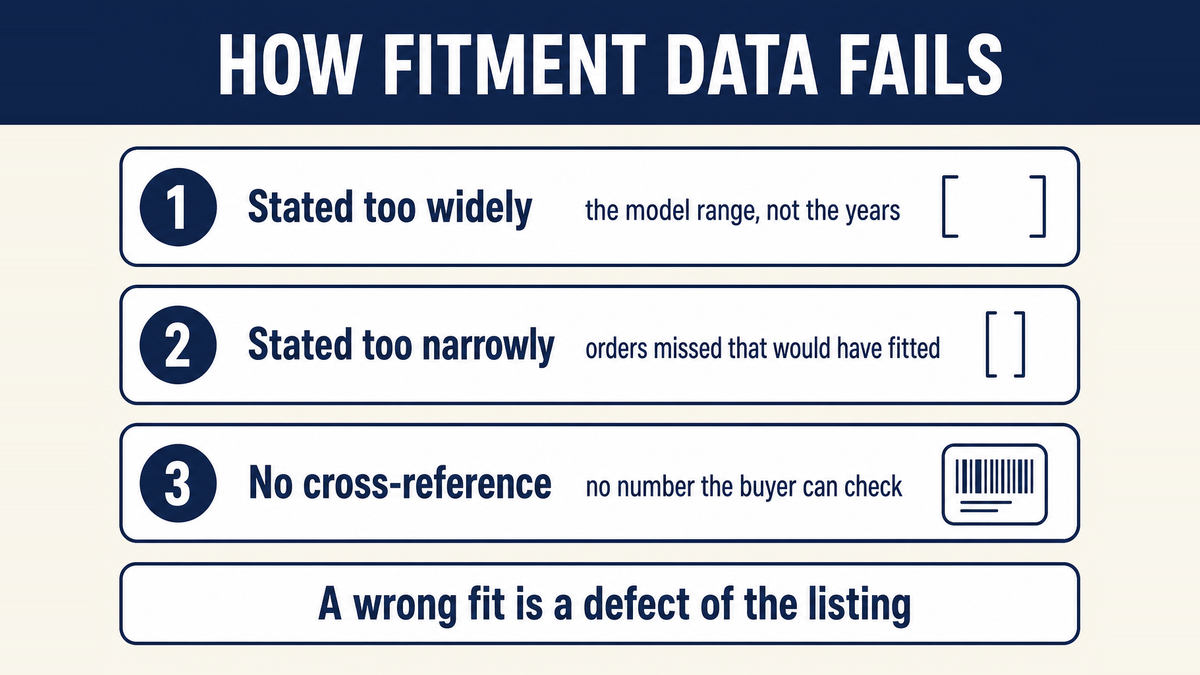
Fitment data fails in three recognisable ways, and each has a different fix.
The first is a genuine range that is stated too widely. A supplier writes that a part suits a model, when it suits most of that model's years and not the year after a mid-cycle change. The fix is to narrow the claim to the years the supplier will confirm in writing rather than the years the part will probably fit, and to accept that a narrower listing sells less.
The second is a genuine range that is stated too narrowly, which is less dangerous and more expensive than it sounds, because a listing that under-claims misses orders it could have served without any risk at all.
The third is the part number. Where a supplier can give a cross-reference against an original equipment number, that reference is worth more than a model list, because it can be checked against catalogues the buyer already trusts. A listing built on the reference converts better and returns less than a listing built on a written description of a shape.
The question that decides which of those three cases a listing falls into arrives after the sale rather than before it, which is the opposite of how it works in a shop. In a physical store the customer asks whether the part fits while the part is still on the shelf, and the answer costs nothing. Online the same question arrives by message after the parcel has shipped, at which point the only useful answers are a correct part and a return label. That is the reason fitment data is worth paying for with a narrower listing: it moves the question back to the point where answering it is free.
Whichever way the data arrives, it has to be priced in. A return is not a refund on the order; it is a cost carried by every delivered order, because the ones that come back are paid for by the ones that stay. What a return costs per delivered order and the rate to plan for are set out in what a return actually costs, and in this category the rate to plan for is higher than a general store's, because a wrong fit is a defect of the listing rather than of the buyer's taste.
3. The Part Carries the Duty, Not the Installer
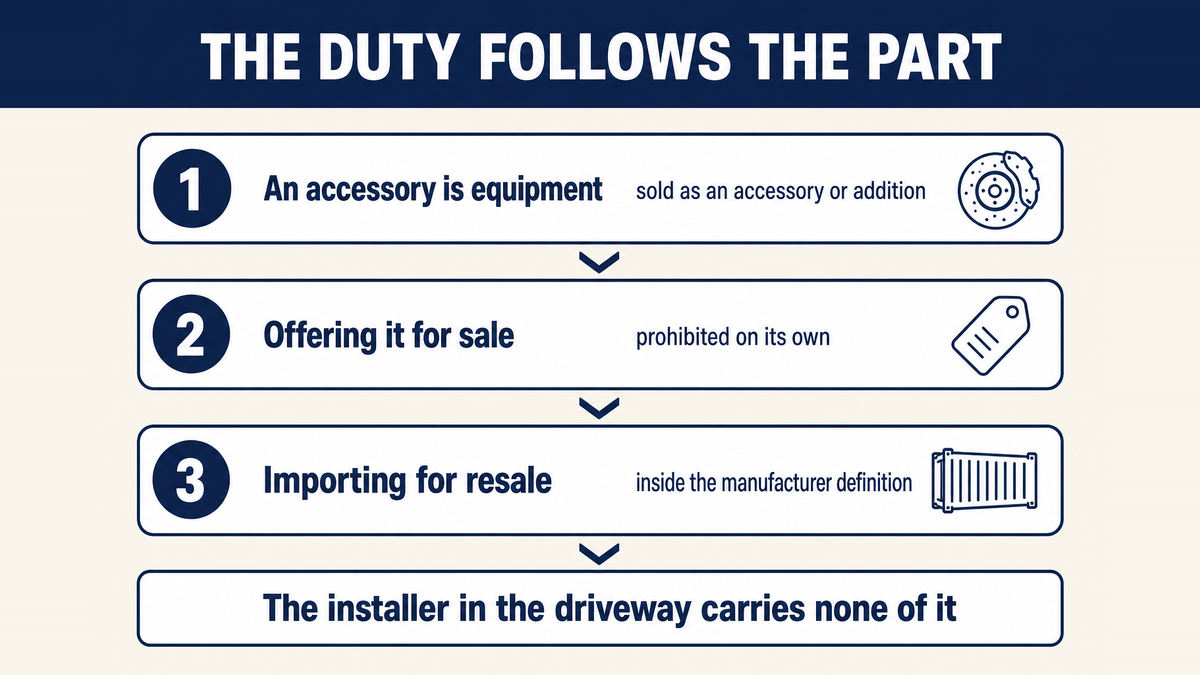
The second problem starts with a definition that is broader than most sellers expect. Motor vehicle equipment is not limited to parts that come on a car from the factory. It includes parts made or sold for replacement, for improvement, or as an accessory or addition to a vehicle.
“motor vehicle equipment” means—(A) any system, part, or component of a motor vehicle as originally manufactured; (B) any similar part or component manufactured or sold for replacement or improvement of such system, part, or component, or as an accessory or addition to a motor vehicle…
National Traffic and Motor Vehicle Safety Act, 49 U.S.C. 30102, Definitions (read 14 October 2026)
An accessory sold as an accessory is therefore inside the definition, not outside it. That matters because the next provision is not addressed to drivers, and it is not addressed to mechanics. It is addressed to anyone who puts the part into the market.
a person may not manufacture for sale, sell, offer for sale, introduce or deliver for introduction in interstate commerce, or import into the United States, any motor vehicle or motor vehicle equipment… if the vehicle or equipment does not comply with the applicable motor vehicle safety standard prescribed under this chapter…
National Traffic and Motor Vehicle Safety Act, 49 U.S.C. 30112, Prohibitions (read 14 October 2026)
The list of prohibited acts is worth reading twice, because it goes further upstream than most sellers assume. Selling is prohibited. Offering for sale is prohibited on its own, which means the listing is inside the rule before a single order arrives. And importing is prohibited, which brings the store into the provision long before it has a customer.
The phrase offering for sale repays a second reading, because it reaches further back than a completed transaction. A listing is an offer, and the prohibition covers the offer on its own rather than only the sale that follows it. Two consequences are worth writing down for a store. Publishing the page is the moment the duty begins rather than the moment the first order arrives, and a page left published while a supplier changes what they can prove carries the same exposure as a new one. Neither point changes what a seller has to do, and both change when the work has to be done.
Then comes the part that is least expected. In the same set of definitions, a manufacturer includes a person who imports motor vehicle equipment for resale. A store bringing these parts into the country is not merely a seller of somebody else’s product; the definitions put the importer into the manufacturer category for the purposes of the chapter. Duties that sellers assume belong to the factory can therefore arrive at the store’s own door, and they arrive because of what the store did rather than because of what the factory did.
The practical translation is short. An installer in a driveway does not carry these duties, because the installer is not selling or offering the part for sale. The party that does carry them is the one whose listing the buyer reads, which in a no-stock store is the store itself.
4. The Lighting Case: What a Replaceable Source Must Be
Lighting is where this stops being abstract, because it is the most common upgrade sold in the category and the one where the standard is most specific. The federal lighting standard does not simply require a lamp to produce light. It defines what may be used as a light source inside a replaceable-bulb headlamp, and the definition is a conformance requirement rather than a description.
Replaceable light source means an assembly of a capsule, base, and terminals that is designed to conform to the requirements of appendix A or appendix B of 49 CFR part 564 Replaceable Light Source Information of this Chapter.
National Highway Traffic Safety Administration, 49 CFR 571.108, Standard No. 108; Lamps, reflective devices, and associated equipment (read 14 October 2026)
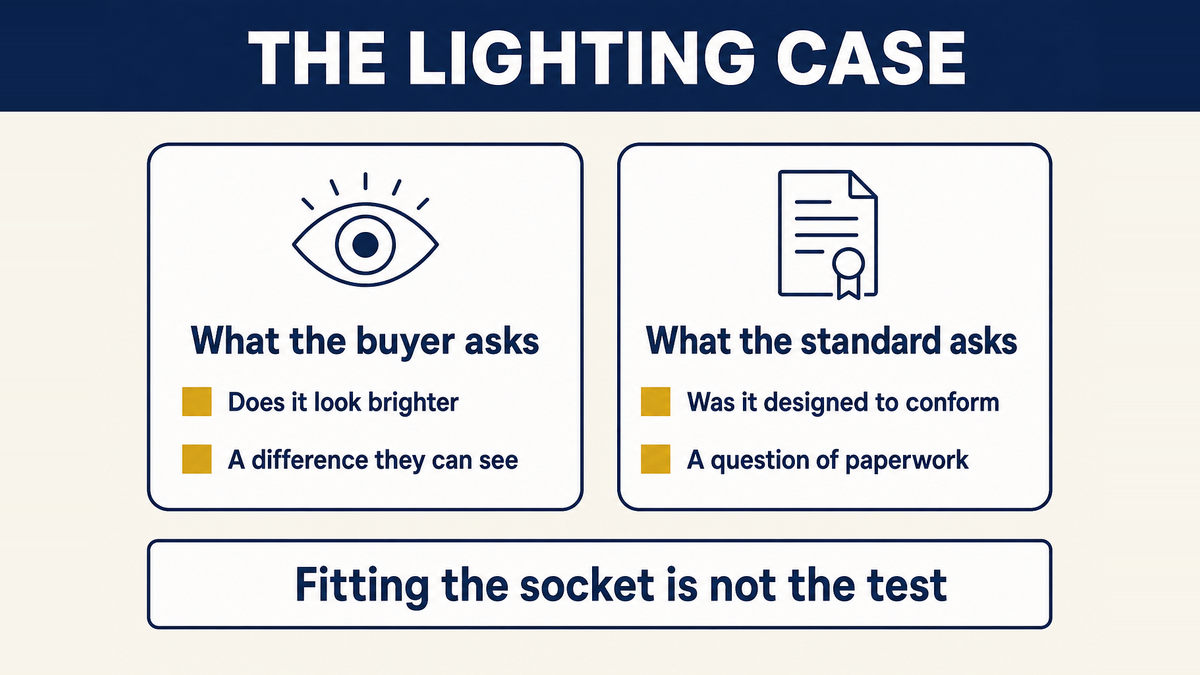
That sentence is doing a lot of work in very few words. A source is not covered because it fits the socket or because it produces a brighter beam. It is covered only if it is designed to conform to one of the two appendices of the separate replaceable light source information part of the rules. A bulb that lights up, fits, and looks correct is not automatically a conforming replaceable light source, and the standard does not treat brightness as a substitute for conformance.
The same standard also requires the lamp itself to say what it is designed to take. A replaceable bulb headlamp must carry permanent marking in front of each replaceable light source it is equipped with, stating either the type designation for a filament source or the bulb marking set out for a discharge source. That marking is the physical claim about which sources the lamp was built around, and it is the reason a listing that promises a lamp will run on any bulb is making a claim the hardware does not support.
There is a fourth consequence for a catalogue in this category, and it is a sourcing instruction rather than a warning. Because the standard works by conformance and by marking, the evidence a seller needs from a supplier is documentary: which standard the part was built to, what marking the lamp carries, and whether the light source is a conforming one. A supplier who cannot answer that is not necessarily selling something that fails the standard, but they have not shown that it meets the standard either, and a store that lists it has taken the question on.
It is worth naming the expectation that makes this hard to sell against, because it is the reason the unverified version of the product keeps turning up in catalogues. A buyer shopping for a lighting upgrade is looking for a difference they can see, and brightness is the difference they can see. The standard does not trade in that currency. It asks whether the source was designed to conform, which is a question about the part’s paperwork rather than about its beam, and a listing that answers the visible question while leaving the documentary one open is selling the half of the product the customer can judge by eye.
5. What This Does to the Numbers
Both problems feed into the same figure, which is the contribution left from a typical order after everything that varies with serving it. In this category that figure has three features that a general store's does not.
The return allowance is higher and it is harder to reduce. Where a general store can cut returns by describing the product better, a store selling parts can only cut them by narrowing the fitment claim, which trades orders for returns rather than removing the cost. That is a deliberate trade, and it should be made on the numbers rather than on the feeling that a narrower listing looks less impressive.
The parts that attract equipment rules cost more to source, because the supplier has to be able to show documents. That is a real cost in time and it is also a filter that removes competitors who cannot do the same, which is the useful side of it.
And the parcels are awkward in a way that is easy to miss. A pair of floor mats or a set of mud flaps is light but long, which means the parcel is priced on its dimensions rather than its weight, and the flat additions for length apply. How those charges are built is set out in how volume decides what a parcel is charged. How the contribution is assembled from the unit cost, the freight, the payment fee and the return allowance is covered in how a margin is actually built.
The scale of the store follows from the three of those together rather than sitting beside them. Because the return allowance is higher here than in a general store, contribution per order is thinner, and the number of orders needed to cover the fixed costs of the store moves up with it. A store in this category is therefore not a general store with a different product line; it is a store that has to reach a higher order count before its subscriptions stop being paid for out of the owner’s pocket. Running that figure at the general return rate instead of this category’s rate is one of the quiet ways a plan ends up short.
In this category the listing is the product decision, the return decision and the legal decision at the same time. What the listing claims about fit decides the returns, and what it offers for sale decides the exposure.
6. What to Check Before Listing
Five checks, in the order they save money.
- Narrow the fitment claim to what the supplier will confirm. State the years and trims in writing, not the model range the part will probably fit. A narrower listing returns less and is worth more than a wide one that comes back.
- Ask for the cross-reference. An original equipment part number is worth more to a buyer than a written description, because it can be checked against a catalogue they already use.
- Ask which standard the part was built to. For anything lighting-related, ask for the marking the lamp carries and whether the light source is a conforming replaceable one. If the supplier cannot answer, treat the listing as unverified rather than as approved.
- Check whether the store is importing. Where the parts are brought in from overseas for resale, the definitions put the importer inside the manufacturer category, which changes what the store is responsible for rather than only what it sells.
- Price the return allowance into the contribution. Do it at the rate this category actually produces rather than the general rate, and run the break-even on that figure.
The order matters as much as the checks themselves. Fitment and the part documents are both settled before a listing is written, because both decide what the listing is allowed to claim rather than the other way round. A store that writes the page first and then goes looking for the paperwork is choosing between rewriting the copy and leaving a claim it cannot support, and the second option is the one that tends to happen once the page is converting.
7. Frequently Asked Questions
Is dropshipping car accessories profitable?
It can be, and the return rate decides more of the outcome than the margin does. A wrong fit is a return that nobody caused on purpose, and its cost is carried by every order that stays. The stores that do well in this category narrow their fitment claims and treat the narrower listing as a feature, because a listing that promises less returns less.
Do aftermarket car parts have to meet safety standards?
A large part of the category is treated as motor vehicle equipment, and equipment made or sold as an accessory or addition to a vehicle is inside that definition. The rule prohibits selling or offering noncomplying equipment for sale, and offering it for sale is prohibited on its own, so the listing is inside the rule before an order arrives.
Can I be treated as the manufacturer if I only resell?
If you import the parts for resale, yes. The definitions in the same chapter treat a person who imports motor vehicle equipment for resale as a manufacturer. That does not make a store into a factory, but it does mean duties that sellers assume belong upstream can arrive at the store because of what the store did.
What is wrong with LED bulbs sold as headlight upgrades?
The lighting standard defines what may be used as a light source in a replaceable-bulb headlamp, and it defines that by conformance to one of two appendices of the replaceable light source information rules rather than by physical fit or brightness. A source that fits and lights up is not automatically covered, and the lamp is also required to carry permanent marking stating the source it was built around.
How do I reduce returns in this category?
By narrowing what the listing claims about fit. State the years and trims the supplier will confirm in writing, keep the model range off the page unless it is verified, and add an original equipment cross-reference where one exists. A listing that fits fewer cars but fits every one of them is worth more than a wide listing with a steady return rate.
Want Your Fitment Claims and Part Documents Checked?
Send us the accessories you are planning to list. We will tell you what the supplier can confirm in writing about fit, what the part was built to, and what the return allowance does to your contribution figure.
Check My Fitment
Questions & Comments
We read every one and reply within 24 hoursPlanning an accessories catalogue and unsure how wide a fitment claim your supplier will actually stand behind, or trying to work out what a part has to be built to before you can list it? Send us the accessories you are looking at, and our team will tell you what the supplier can confirm in writing about fit and what the part was built to.