
Drive Shaft Manufacturer: The Part No Document Names
 ·
Updated October 22, 2026
·
12 min read
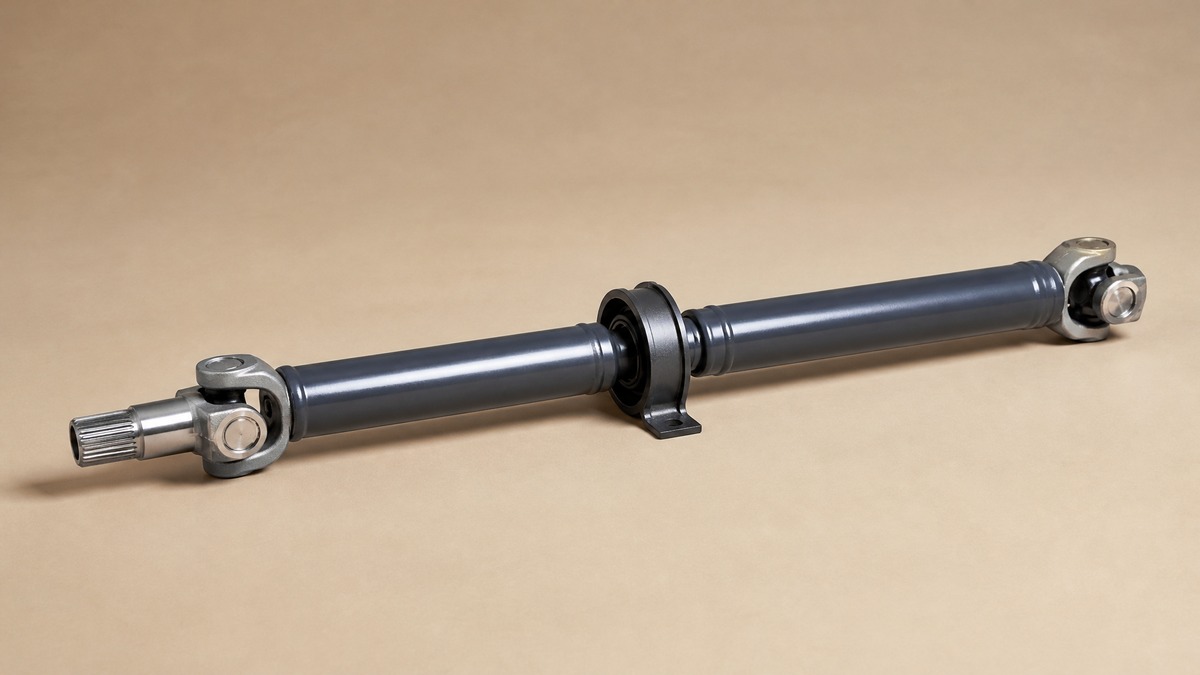
This is the first part in the series with its own line in the federal defect file. Not a mention inside a paragraph about something else: a component heading, POWER TRAIN:DRIVELINE:DRIVESHAFT, carrying 1,511 records. That is the opposite of the intercooler, which had sixteen.
And it is the first part the safety standards do not look at from either side. The vehicle standards never use the word. The inspection standards list brakes, steering, suspension, tyres and wheels, and stop. So the only written trace of this part is the record of what happened when it came apart.
1. A Heading, At Last
Method unchanged. The federal recall file holds 245,845 records across 15,305 campaigns, no header row, every field scanned. Controls: brake 28,639, air bag 16,162.
Read the whole file and the word appears in 1,911 records across 172 campaigns. Now restrict it to the component heading, which is the part of the file where the manufacturer had to pick a category rather than describe a symptom.
| Measure | Value | What it means |
|---|---|---|
Heading DRIVELINE:DRIVESHAFT | 1,511 records | a category of its own |
| Campaigns in that heading | 128 | not one recall, a pattern |
| Vehicles covered | 3,534,212 | the scale of the exposure |
| Largest single campaign | 427,407 | Kia Telluride, 2020–2024 |
yoke, whole file | 526 records, 40 campaigns | the joint end |
universal joint, whole file | 226 records, 23 campaigns | the joint itself |
So the archive knows this part exists. What it does not know is how the part is made, and the vocabulary shows it. Across the whole file, spline appears in 19 campaigns and balance in 13 — but inside the 128 driveshaft campaigns, where the summary text describes the failure, the word spline turns up in one and balance in one.
Two words with no home at all: shudder zero records, carrier bearing zero records. A driveline engineer says both of them in the first sentence of any diagnosis. The file, which holds a quarter of a million records, has never used either.
2. What the File Records Is Separation, Not Breakage
Read the summary text of those 128 campaigns and count the words that describe a failure. These are campaign counts, not record counts.
| Word in the summary | Campaigns of 128 | What it describes |
|---|---|---|
separat | 50 | the joint came apart |
break | 22 | something snapped |
fractur | 17 | a bolt, a yoke, a casting |
loose | 17 | the joint was never tight |
detach | 16 | the shaft left the vehicle |
yoke | 13 | named as the failed end |
weld | 10 | the tube-to-yoke joint |
universal joint | 7 | named as the failed part |
Fifty of a hundred and twenty-eight. Separation is four times more common than fracture, and the largest campaigns are all separation.
Kia, 427,407 vehicles. The intermediate shaft and right front driveshaft may not be fully engaged, and the consequence the file gives is not a vibration or a noise. It is that the vehicle can roll away while in PARK. The park load is held by a pawl inside the transmission, and the shaft is the only path from that pawl to the wheel.
Ford Transit, 372,991 and then 293,558. A flexible coupling between transmission and shaft may fail early. The consequence: the vehicle cannot move under its own power, and the disconnected shaft may hit the brake and fuel lines. The second campaign exists partly because the first remedy was a replacement coupling and only some vehicles received a mechanical universal joint instead. Read that twice: the factory fix for a rubber coupling was to fit a metal joint.
Ford Explorer, 252,936. A rear axle mounting bolt fractures, and the shaft disconnects. Acura, 248,358. A broken shaft causes a sudden loss of drive, and the vehicle can roll away if the parking brake is not applied.
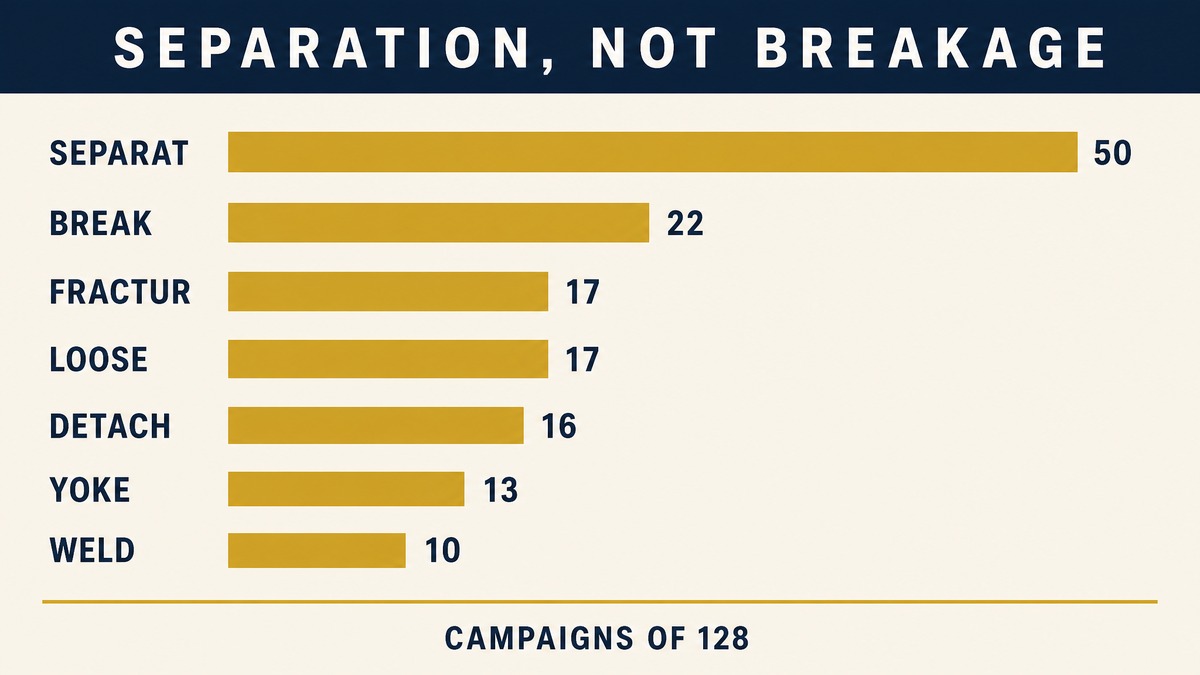
Four of the five largest campaigns end in either rollaway or loss of drive. Not one of them describes a shaft flailing at speed, which is the failure a buyer pictures. What the file records is quieter and harder to inspect: a joint that was never fully engaged, a coupling that cracked, a bolt that let go.
3. Three Documents That Never Say the Word
Now the other side. A part with 1,511 records and 3.5 million vehicles behind it should be named somewhere in the rules. It is not, and the way it is not is worth knowing precisely.
Part 571, all of it. The federal vehicle standards, fetched in full and searched as text: drive shaft zero occurrences, driveshaft zero, propeller shaft zero. There is no standard for this part. There is, however, a standard about the consequence. Standard No. 114 is titled Theft protection and rollaway prevention, and its scope sentence reads that it is intended to reduce crashes resulting from theft and accidental rollaway.
Then read what it asks for. The rollaway section requires that the transmission or gear selection control cannot move out of PARK unless the key is in the starting system. It regulates the selector, and the key, and the starting system. It does not regulate the shaft that carries the park load to the wheel. That is the gap the Kia recall fell through: every component the standard names can work, and the vehicle still moves.
Part 570, the light-vehicle inspection. Subpart A lists what an inspector checks: the brake system, the steering system, the suspension, the tyres, the wheel assemblies. There is no power train section, because the table of contents goes from wheel assemblies to the heavy-vehicle subpart.
Appendix A to Part 396, the commercial annual inspection. Fifteen numbered items, from brake system to rear impact guard, and no driveline item among them. The word driveline does appear exactly once, in item 1.b, and it is describing a parking brake: driveline hand controlled parking brakes. A part that holds the vehicle still, named in a rule about stopping it.
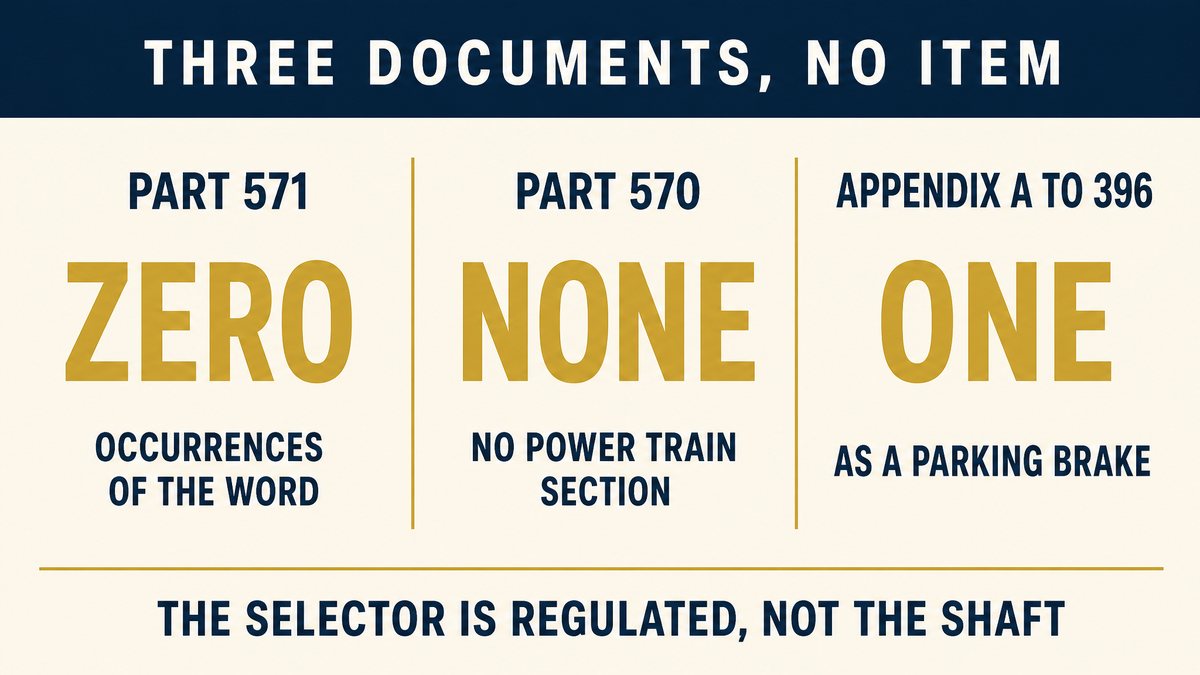
For a buyer this is not an academic point. It means no certificate, no marking and no test report will arrive with a driveshaft quotation, because there is nothing to certify against. Every property that decides whether the part works has to be written into the order by the person placing it, in words the factory can act on. The rest of this article is about which words.
4. The Angle Is the Specification
A single universal joint does not turn at constant speed. Its output accelerates and decelerates twice per revolution, and the size of that swing grows with the angle it is running at. This is not a defect; it is geometry, and the whole layout of a shaft follows from it.
Two joints cancel the swing, but only when two things are true. The angle at the front joint has to equal the angle at the rear joint, and the two yokes have to be in phase — aligned so the joint crosses sit in the same plane. Miss either one and the swing comes back, at twice the shaft speed, and it arrives at the gearbox tail and the differential nose as a vibration.
That is why the same part number can be smooth in one vehicle and rough in another. Change the ride height, change the engine mount, change the transmission mount, and the angles move. A shaft quoted for a stock vehicle and fitted to a lifted one is being asked to run outside the geometry it was phased for, and no inspection of the part will show it.
Practical consequence for an order: ask for the running angles the shaft was designed for, front and rear, and for the phasing of the yokes. Neither is visible in a photograph, and both decide whether the customer hears a rumble at 60 km/h.
5. Two Numbers That Decide a Long Shaft
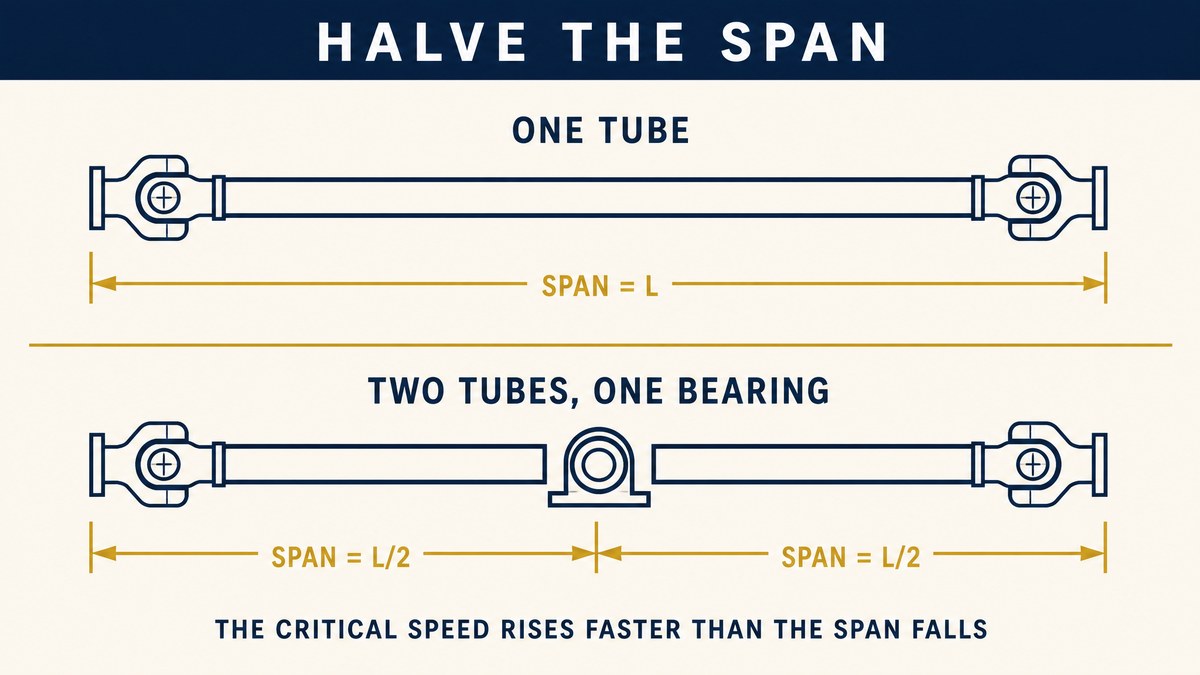
A shaft is a slender tube spinning at road speed times the final drive ratio, which is why it turns far faster than the wheels. Every tube has a speed at which it stops being straight: it bows, the bow rotates, and the whole assembly whirls. That speed falls as the shaft gets longer and rises as the tube gets fatter, so length is the enemy and diameter is the cure.
This is why a long wheelbase vehicle uses a two-piece shaft with a bearing in the middle: the support cuts the unsupported span roughly in half, and because the relation is not linear, halving the span raises the whirl speed by far more than a factor of two. It is also why a factory that quotes a single long tube for a long application is telling you something about how it thinks.
Balance is the other number. A shaft is balanced as an assembly — tube, both yokes, the slip spline, the flange — and balancing the bare tube first proves nothing, because welding a yoke on moves the mass. Ask at what speed the assembly was balanced and to what residual unbalance, and whether it was checked again after paint. Paint is mass, and on a part this long a few grams at one end is measurable.
The third check is runout: the assembly rotated and measured for how far it wanders from a true circle, at the tube ends and at the flange face. A shaft can be perfectly balanced and still have runout enough to load the bearing and the seal.
None of these three words — whirl, balance and runout — appears in the 128 campaign summaries, apart from a single mention of balance. The file records what came apart. It has nothing to say about the properties that keep it together.
6. Four Joints, Four Failure Modes
A driveshaft quotation is really a quotation for its joints. Everything else — the tube, the welds, the paint — is a price negotiation around them.
The cardan joint. Two yoke ears, a cross, four needle-bearing cups and a seal at each cup. It fails from the inside: the grease leaves or the seal lets water in, the needles spall, the cup develops play, and the play becomes a vibration long before anything breaks. Specify the bearing size, whether it is greasable or sealed for life, the seal type, and how the cups are retained — snap rings in grooves, or staked. Staking is cheaper and it is not serviceable.
The constant-velocity joint. Used where the angle is too large for a cardan joint, typically at the wheel end of a halfshaft. It runs smooth at high angle and it depends entirely on its boot. A torn boot is the failure: grease out, grit in, and the joint is gone within a few thousand kilometres. Specify the boot material and the clamp, because the clamp is what actually fails.
The flexible coupling. A rubber-and-fabric disc bolted between two flanges. It absorbs angle, isolates noise and needs no lubrication, which is why it appears on vans and hybrids. It also cracks, and when it cracks the shaft is free: this is the part behind the two Ford Transit campaigns totalling 666,549 vehicles, where the remedy on some vehicles was to replace it with a metal joint.
The slip spline. The joint that is not a joint: a splined sleeve that lets the shaft change length as the suspension moves. It fails by fretting — the grease is pushed out of the contact, the teeth wear, and the shaft either seizes or develops play. Seven campaigns in the heading mention seizure. Specify the coating on the spline, the grease, and the boot or seal that keeps the grease in place.
Two of these four are wear parts that will fail on a schedule and one is a rubber part with a shelf life. That is the honest answer to the question a distributor asks first: which one comes back.
7. Where the Price Difference Sits
Six places, in the order they change the invoice.
The tube. Wall thickness, straightness and whether it is welded or seamless. The tube is where the whirl speed comes from, so a thinner wall is not a saving; it is a shorter shaft that works. It also arrives in a long carton charged on the air inside it, which is why the CBM calculation belongs in the same negotiation.
The weld. Yoke to tube, welded on a fixture that controls phasing. Then straightened, then balanced. A factory that balances before it straightens has the order backwards. A weld fixture is a process, and a process is what a factory audit can look at.
The balance. Assembly balance at a stated speed, and a runout figure. This is a process, so it is auditable in a way a material certificate is not.
The joints. Bearing size, seal, grease, retention. This is most of the difference between two quotes that look identical in a photo.
The slip and the boot. Coating on the spline, and whether the boot is neoprene or a thermoplastic. One survives road salt and one does not.
The finish. Paint is mass. A shaft balanced, then painted heavily on one side, is no longer the shaft that was balanced.
8. Seven Questions, Six Lines
Ask these before the sample, because a sample cannot answer any of them. A sample is one shaft, balanced once, on a day when the fixture was freshly set.
- What running angles was this phased for, front and rear, and does the application stay inside them?
- One tube or two, and if one, what is the whirl speed of that span?
- Balance: as an assembly or as a tube, at what speed, and to what residual unbalance?
- Runout at the tube ends and the flange face.
- Joint specification: bearing size, seal, grease, retention method.
- Slip spline coating and boot material.
- Two prices: as quoted, and with the six lines below written into it.
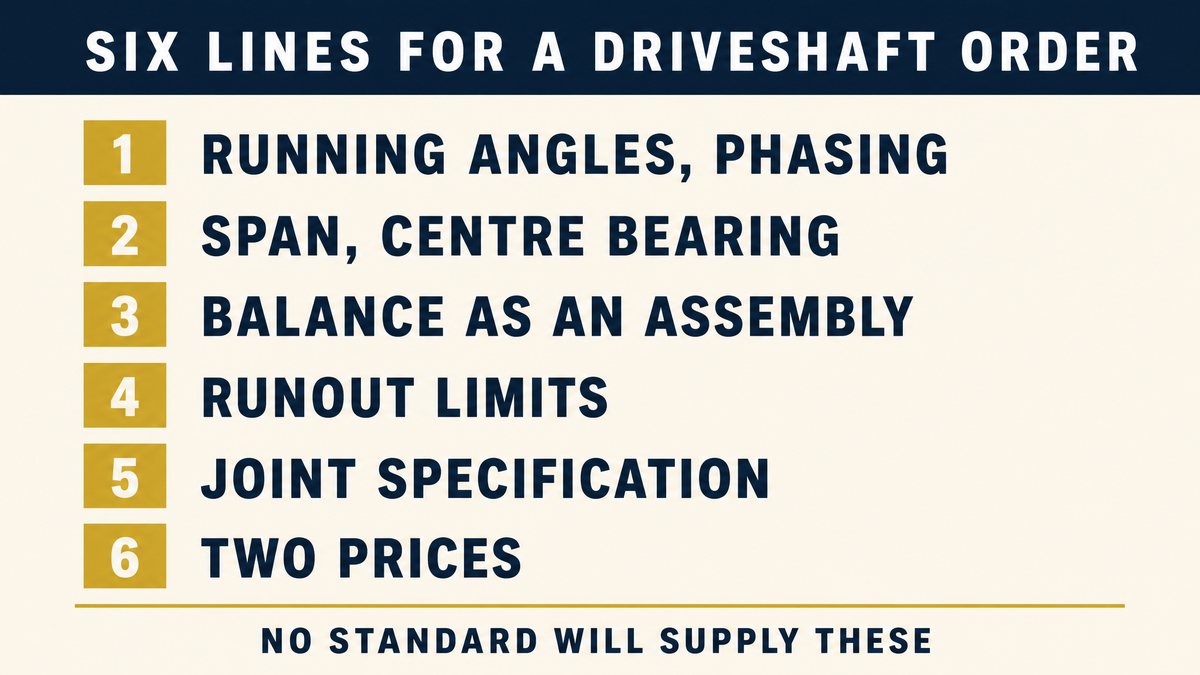
Then put six lines in the order. There is no standard to point at, so these six lines are the whole of the specification.
- Running angles and yoke phasing.
- Span, and centre bearing if the span needs one.
- Balance as an assembly, at a stated speed.
- Runout limits.
- Joint specification, all four points.
- Two prices: as quoted, and with the five items above written into it.
One thousand five hundred and eleven records sit under a component heading that ends in the part's own name, and eleven words in the entire federal standards corpus describe a shaft. The archive names it constantly; the rulebook never does.
The only federal sentence that reaches the consequence is about a gear selector, not a driveline. So the geometry has to be written by the buyer: equal joint angles, correct phasing, a span short enough for its critical speed, and a balance check done on the assembly.
A Certificate That Names the Speed
The balance speed achieved, the runout at each end, and the serial that ties the tube to its test stand record.
Issue My Balance CertificateFrequently Asked Questions
Is there a federal standard for drive shafts?
No. Part 571 does not contain the words drive shaft, driveshaft or propeller shaft anywhere in its text, and neither Part 570 nor the commercial inspection appendix has a driveline item.
Why does the recall file have so many records for this part?
Because it has a component heading of its own. 1,511 records sit under POWER TRAIN:DRIVELINE:DRIVESHAFT, across 128 campaigns and 3,534,212 vehicles.
What actually fails, the tube or the joint?
The joint. Fifty of 128 campaigns describe separation and 22 describe breaking; only 13 name a yoke and 7 name a universal joint, which is the vocabulary of a joint that came loose rather than a tube that snapped.
Why does a shaft vibrate after a suspension change?
Because the running angles changed. Two joints cancel each other only when the angles are equal and the yokes are in phase; move the ride height and both conditions can fail at once.
Why use two shafts instead of one long tube?
Whirl speed. A centre bearing halves the unsupported span, and the critical speed rises far faster than the span falls, so a two-piece shaft can run at speeds a single tube of the same diameter cannot.
What should a quotation state about balance?
That the assembly was balanced — not the bare tube — at a stated speed, with a residual unbalance figure, and that runout was measured after welding and after paint.
Questions & Comments
We read every one and reply within 24 hoursA drive shaft has a component heading full of records and no standard that names it. Send the layout, and we will write the angles, the phasing and the span.