
Brake Rotor Manufacturers: One Disc, Two Rule Books, Three Dates
 ·
Updated October 15, 2026
·
14 min read
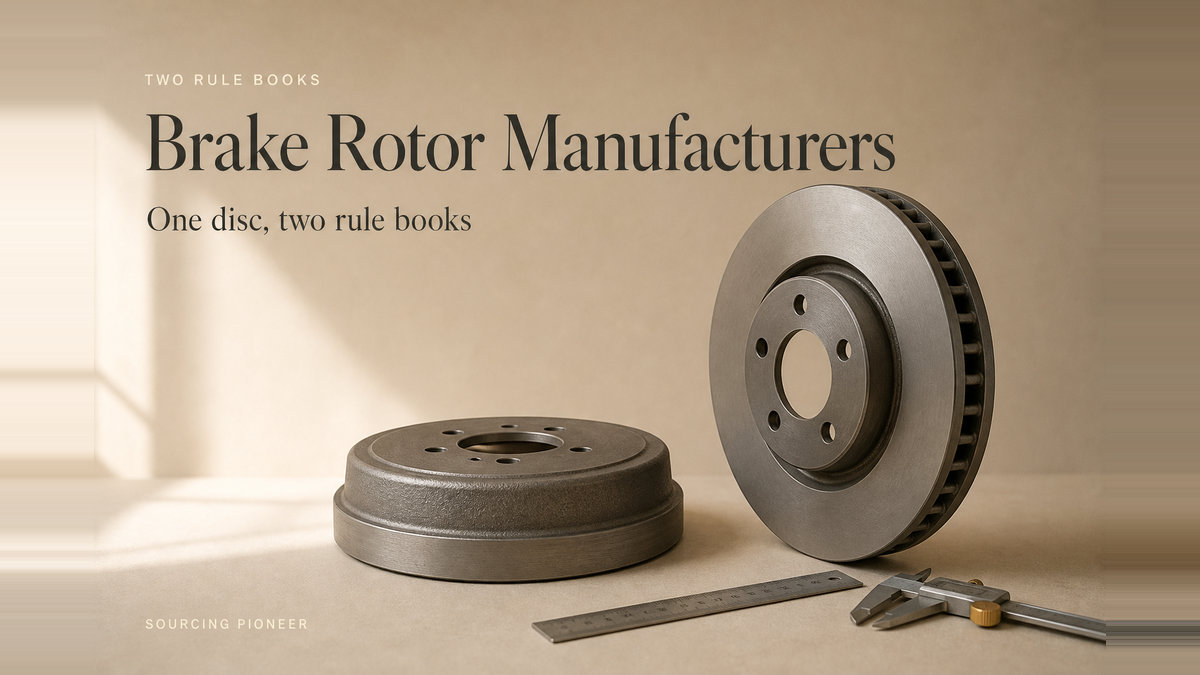
A brake rotor is the part in the braking system that has to absorb the energy of the vehicle. It looks like a disc of iron with two machined faces, and on a catalogue page it is the simplest thing you can buy. It is also the part whose legal standing flips when it crosses a border. In the United States no federal standard approves a replacement rotor as a product of its own. In Europe the same rotor cannot lawfully be placed on the market without a type-approval number — and the date that obligation starts is not one date. It depends on whether the part is a lining or a disc, and on which class of vehicle it serves.
1. What a Rotor Is, and the Three Numbers That Define It
A disc brake rotor — the part Europe calls a disc and America calls a rotor — is a casting with two machined friction faces. The brake pads press against those faces. Everything else on the rotor exists to hold the two faces in the right place and to move heat out of them.
The job is heat. When a vehicle slows, its motion becomes heat, and on a disc-braked axle most of that heat goes into the rotor. A rotor is a heat sink before it is anything else, and how well it holds and sheds heat decides whether braking stays steady on the tenth stop down a long descent. That is why rotors come in two shapes:
- Solid — one disc, two faces. Less iron, less weight, less cost, and enough for a light car driven gently.
- Vented — two faces separated by internal vanes that pull air through as the wheel turns. More iron, more heat capacity, more machining, more cost.
Choosing between them is not a quality question. A solid rotor is correct for some applications and wrong for others, and a supplier who quotes vented throughout is not being generous — they are changing a specification you never asked them to change.
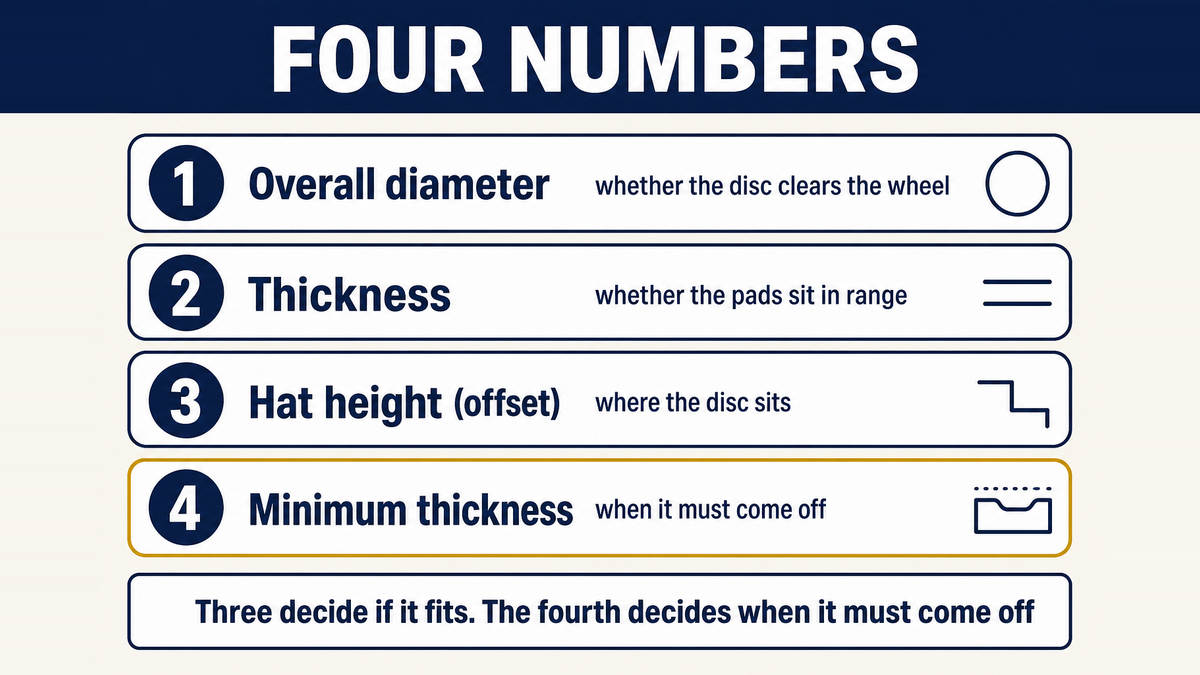
Three numbers decide whether a rotor fits; a fourth decides whether it is still safe to use. All four belong on the specification sheet, and none is captured by a car model alone.
| The number | What it decides | What a vague quote hides |
|---|---|---|
| Overall diameter | Whether the disc and caliper clear the wheel | Was it measured from the same reference |
| Thickness | Whether the pads and piston sit in range | New thickness, and its tolerance |
| Hat height (offset) | Whether the disc sits where the caliper expects | The datum used for the offset |
| Minimum thickness | How long the rotor may legally stay in use | Whether it is marked at all |
The fourth deserves the most attention, because it is a limit rather than a dimension. A rotor is machined to a starting thickness and wears thinner each time it is used or resurfaced. At a set figure it reaches the end of its service life and must be replaced: below that figure it cannot carry heat away as designed, and the caliper piston may travel further than it should. The limit is set by whoever designed the brake, and it is the one value on a rotor that a buyer cannot choose.
One structural choice sits on top of the four numbers. A rotor can be a single casting, or a two-piece unit with an aluminium hat carrying a separate iron ring. The two-piece design saves weight and lets the ring expand without distorting the hat, and it adds a joint a single casting does not have. That joint is a real place for a product to fail, so it belongs in the specification conversation rather than the brochure.
What this guide covers
- What a rotor is, and the three numbers that define it
- The number stamped into the disc
- America: what the manufacturing standard does not give you
- Europe: one regulation, and a date that depends on the part
- The scope is the words, not the code
- The rotors were cleared, the drums were not
- What a cheap rotor quote leaves out
- What to check on a sample
- Frequently asked questions
2. The Number Stamped Into the Disc
The minimum thickness is not a figure the buyer keeps in a folder. It is meant to be on the part. The federal rule that governs vehicle inspection in use says what a rotor has to carry, and what happens when it does not:
If the drum is embossed with a maximum safe diameter dimension or the rotor is embossed with a minimum safety thickness dimension, the drum or disc shall be within the appropriate specifications… If the drums and discs are not embossed, the drums and discs shall be within the manufacturer's specifications.
National Highway Traffic Safety Administration, 49 CFR 570.5, Service brake system (read 15 October 2026)
The same section dates the practice: those dimensions "will be found on motor vehicles manufactured since January 1, 1971". The embossed wear limit is not a new feature. It has been expected on vehicles for over fifty years, and a rotor that arrives without it is not modern — it is under-marked.
Two commercial readings follow. The first is that the marking is a liability you can measure. A rotor sold into a market where inspections are enforced will be measured against the figure cast into it. If a supplier casts a lower figure than the original design intended, they have lengthened the rotor's life on paper and shortened the distance from new to scrap in practice.
The second is that an under-marked rotor is not the same as an illegal one in every market. The rule quoted above governs vehicles in use. It is not a manufacturing approval for the part you are importing. That distinction — between what a part must carry and who approves the part — is where most of the confusion in this category lives.
3. America: What the Manufacturing Standard Does Not Give You
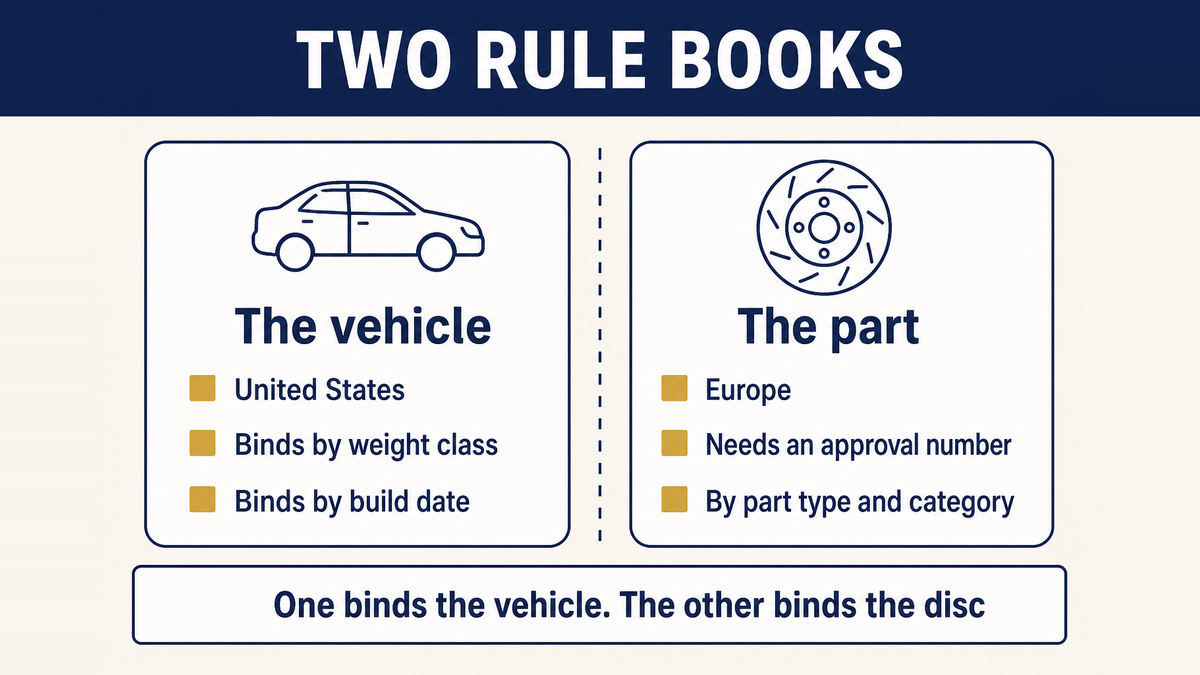
The United States does have a federal brake standard for new vehicles. It is written about the vehicle, its weight class and the date it was built, and it tests the braking system as a system. What it does not do is approve a replacement rotor as a product, and the test sequence shows why the standard is not a certificate for your part.
The road test is a fixed order of operations rather than a single stop. It begins with a burnish, and then the brakes are deliberately heated before they are measured:
The purpose of the snubs is to heat up the brakes in preparation for the hot performance test which follows immediately… Number of snubs: 15… The hot performance test is conducted immediately after completion of the 15th heating snub… Test speed: 100 km/h (62.1 mph).
National Highway Traffic Safety Administration, 49 CFR 571.135, Standard No. 135; Light vehicle brake systems (read 15 October 2026)
Read that as a buyer rather than an engineer and it says one thing: the performance the standard cares about is performance when hot. Fifteen snubs exist to put heat into the system, and the hot stop is measured immediately, with cooling and recovery stages later in the same sequence.
That is exactly the rotor's job. The pads create friction; the rotor receives the heat it produces and still has to be a sound surface for the next stop. So a replacement rotor does inherit a requirement from the standard — through the system it is fitted to — even though nothing in it names your part or issues a document for it.
This is why a factory's claim to be "FMVSS" something is not a certificate. The standard addresses whoever builds the vehicle. If a supplier offers it as proof about a loose rotor, ask plainly: which document, issued by whom, covering which part number? A real answer arrives as a test report with the part number on it. A vague answer is the answer.
4. Europe: One Regulation, and a Date That Depends on the Part
Europe works the other way round. The rotor — the disc — is itself the object of an approval. The European Commission states the position in one sentence any buyer shipping brake parts into the EU or the UK should read twice:
Compliance with UN Regulation No 90 is compulsory for replacement brake lining assemblies, drum-brake linings, discs and drums for power-driven vehicles and their trailers.
European Commission, amending Annexes I and II to Regulation (EU) 2019/2144 (read 15 October 2026)
The same document writes UN Regulation No 90 into the list of rules that apply under the general vehicle safety regulation, describing it as covering "replacement brake lining assemblies, drum-brake linings and discs and drums for power-driven vehicles and their trailers", at the 02 series of amendments, for vehicle categories M, N and O.
So on one side of the Atlantic the replacement disc is an unregulated commodity, and on the other it is a regulated product. A factory set up for one market may not be able to serve the other at all.
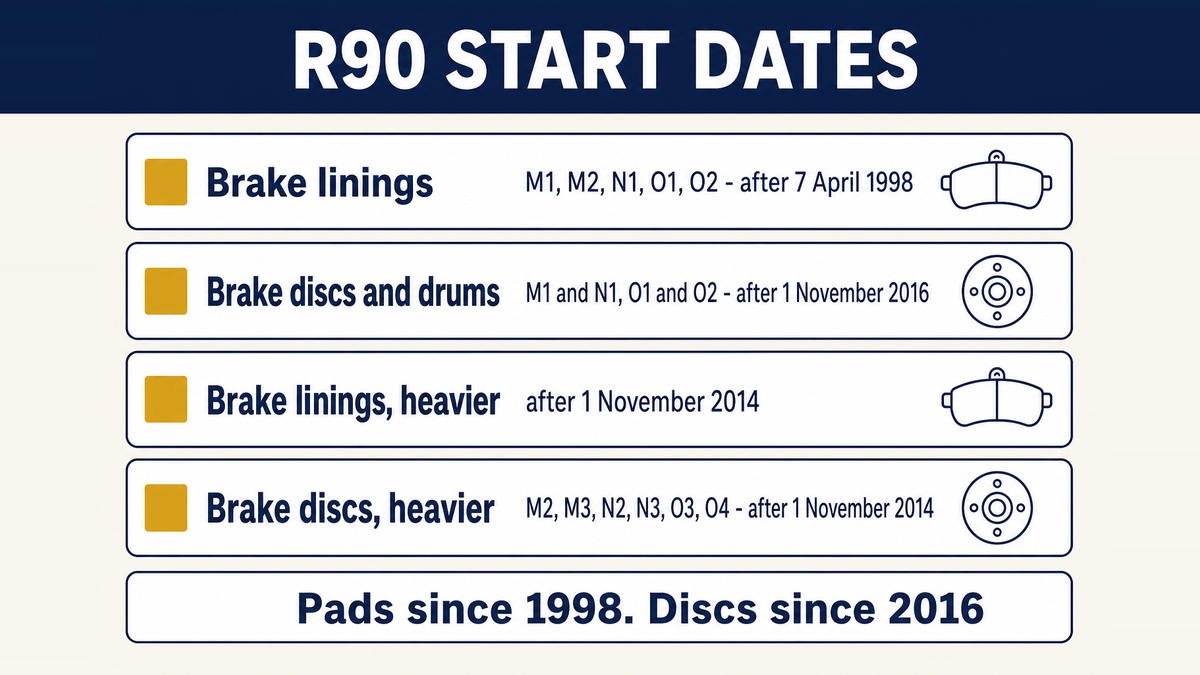
The part that catches people out is the timing: there is not one start date. The explanatory note to the same regulation splits by part type and by vehicle category:
- Replacement brake linings — for the small passenger and light commercial categories (M1 and M2 up to 3.5 tonnes, N1, O1 and O2), from vehicle type-approval granted after 7 April 1998; for the heavier categories, after 1 November 2014.
- Replacement brake discs and drums — for M1 and N1, and for O1 and O2, from vehicle type-approval granted after 1 November 2016.
- Replacement discs for the heavier categories (M2, M3, N2, N3, O3 and O4), from vehicle type-approval granted after 1 November 2014.
Three readings follow, and they are worth more than any price list.
Pads have been covered far longer than discs. Linings carry a 1998 date for passenger cars; discs carry 2016. A factory that shows you a lining approval has shown you nothing about their discs. They are separate approvals with separate histories.
The obligation follows the vehicle. The dates are written against the date the vehicle type-approval was granted, so the same disc can be in scope for one model year and out of scope for another. The buyer has to know which vehicles they are selling into, not just which box they are buying.
An approval is category-specific. A disc approved for a light passenger car is a different approval from one approved for a truck. So the useful question is not "do you have R90" but "which categories does this approval cover, and for which part number".
5. The Scope Is the Words, Not the Code
Everything above is a question of scope, and scope is worth learning once because it repeats. The clearest lesson comes from a United States trade notice on brake rotors, which described the products covered by an order and then said plainly which text governs.
The covered products were "brake rotors made of gray cast iron, whether finished, semifinished, or unfinished, ranging in diameter from 8 to 16 inches (20.32 to 40.64 centimeters) and in weight from 8 to 45 pounds (3.63 to 20.41 kilograms)". The notice then named the tariff subheadings those rotors fall under, and added that the subheadings are provided for convenience and customs purposes, and that the written description of the scope is the part that governs.
Read that as a buyer and it changes how you use a code. The number is a filing convenience; the words decide whether your shipment is inside the rule. A rotor outside that size band is not covered even if it files under the same digits, and a rotor inside the band is covered even if someone has told you the code is clear. The same logic runs through the European approval: the obligation attaches to a part type, a vehicle category and a date, and all three are written words.
Two habits follow. When a supplier or forwarder states a duty rate or an approval requirement, ask them to point at the words — the scope paragraph, the annex, the category list — rather than at a code. And keep that wording with the order: the classification your goods are entered under should follow from the description you agreed in writing, not the other way round. That description is the same one covered in how an HTS code is assigned.
The same notice also shows that scope gets argued. A ruling in 2007 removed one maker's rotors, certified by a car manufacturer, from the order. Scope is not only written down — it is decided, sometimes narrowly, and it can be contested.
6. The Rotors Were Cleared, the Drums Were Not
Buyers in this category often work from a short phrase — that brake parts from China carry anti-dumping duties — and treat it as a fact about a category. It is not. It is a fact about individual parts, orders and dates, and the rotor story proves it.
Brake rotors from China were covered by an anti-dumping order published in 1997. After a five-year review, the International Trade Commission decided that dropping the order was unlikely to lead to a return of material injury to the domestic industry, and the order was revoked. The revocation took effect on 14 August 2007, with the notice published in June 2008.
Now the neighbour. Brake drums — a different part, on the drum rather than the disc side of the brake — went the other way, and recently. Final determinations in the anti-dumping and countervailing duty cases on brake drums from China and Türkiye were announced on 16 June 2025, and orders were issued on 4 August 2025. The published rates are not small:
- A China-wide rate of 160.79 percent in the dumping case, with a cash deposit rate of 150.25 percent.
- 77.14 percent for the named Chinese producers and exporters in the dumping case.
- Subsidy rates of 446.83 percent for many named Chinese companies, with an "all others" rate of 11.94 percent.
- Türkiye: 15.22 percent for the named company and for all others, and up to 131.60 percent for companies that did not cooperate.
On top of that layer, a presidential proclamation of 17 October 2025 imposed a 25 percent duty on medium- and heavy-duty vehicles and on the medium- and heavy-duty vehicle parts named in the annex to the proclamation, applying to goods entered on or after 1 November 2025, and stating that these duties are additional to any others that apply.
So the phrase "brake parts from China" now covers a rotor with no anti-dumping order on it, a drum carrying a triple-digit rate, and a truck part inside a separate 25 percent action — three different landed costs inside one category name. Before a quote is compared, the buyer needs to know which of those their part is. That work sits with the importer of record, and how the entry is handled — including who files it — is the subject of our guide to using a customs broker. Where several parts arrive together and the duty treatment differs by part, planning for that is the same exercise as the one in how assembly method changes duty treatment.
7. What a Cheap Rotor Quote Leaves Out
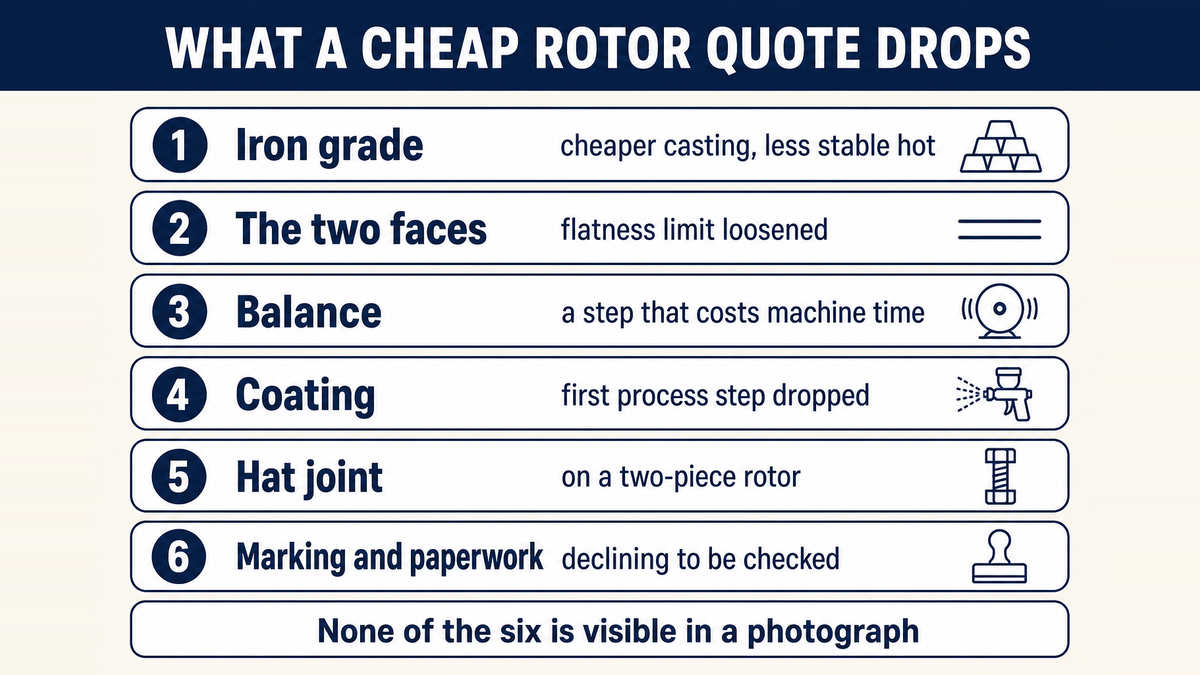
A rotor is a casting plus machining. Both halves can be made thinner, and neither shows in a photograph. Six places a low quote tends to come from:
The iron. The trade notice above describes the covered rotors as gray cast iron, which fixes the family but not the grade. Within that family, the carbon content and the alloying decide how the casting behaves under heat and how stable the friction surface stays. A cheaper rotor uses a cheaper iron, and the difference appears as a surface that changes after heavy use rather than in any measurement at the dock.
The two faces. The friction faces have to be flat and parallel to each other within a tight limit. Machining to a tighter limit takes longer and wears tooling faster, so the limit is a natural place to loosen. A rotor whose faces vary in thickness produces a pulsing pedal — the complaint a workshop cannot fix by changing pads.
The balance. A rotor turns with the wheel, so it is balanced after machining. Balancing is an operation with a machine and a cycle time attached, and skipping it returns a part that fits, stops, and vibrates.
The coating. An uncoated casting rusts on the shelf, on the hat and on the edges of the vanes, and a rotor that looks dirty before it is fitted is harder to sell — which is why coated lines exist. The coating is a process step and one of the first things dropped when a quote is cut, and a thin wash is not the same as a proper protective layer.
The hat joint, on a two-piece rotor. Where an aluminium hat carries an iron ring, the join between them is a load path. On a cheap two-piece rotor that join is where the product can fail, and it is invisible until it does.
The marking and the paperwork. The minimum thickness figure cast into the disc, the approval number if the market needs one, and the documents behind both. A supplier who is vague about all three is not being modest. They are declining to be checked.
Machining is a category the site covers in more depth for adjacent parts, in metal stamping and machined parts, and the same questions about who holds the drawing and who checks the first article apply here.
8. What to Check on a Sample
Because no certificate covers the part in the American market, and because in Europe the approval is the supplier's to hold, the sample stage is where the buying decision is actually made. Six checks cover most of the ground.
- The three fitment numbers against the drawing. Diameter, thickness and hat height, measured on more than one piece from the same carton. Variation inside a carton is more informative than the average of the batch.
- The embossed minimum thickness. Present, legible, and equal to the figure the vehicle application specifies — the number an inspector will one day measure against.
- Flatness and parallelism of the two faces. The measurement that predicts a pulsing pedal. Ask for the factory's own record across the face, not a single reading at one point.
- Balance. Whether the rotor is balanced after machining, on what equipment, and what the factory rejects at that station.
- The approval, if your market needs one. For Europe, the number, the part it covers, and the vehicle categories it names. For America, ask instead for the test report that carries the part number.
- The documents that travel with the part. The description of the goods that will define your scope and duty treatment, the origin paperwork, and the packaging specification.
On the supplier side, the checks that apply to any factory visit apply here: whether the foundry is theirs or bought in, whether machining is in-house, and who signs off the first article. The sequence we use is set out in the factory audit checklist, and the paperwork Customs asks for when the marking on the carton is questioned is covered in the certificate of origin guide.
9. Where the Unit Price Comes From
A rotor's price comes from four things, in roughly this order of influence: the iron and the melting, the machining, the coating and the packaging. The iron sets the material cost and, being iron, most of the weight. Machining sets the machine time per piece and is where volume changes the price fastest. The coating is the step most likely to be trimmed, and packaging is the smallest line.
Weight then decides how the goods move. Rotors are dense, so they are charged on what they weigh rather than on the space they take — the reverse of the calculation in how volume decides what a shipment is charged. That one fact changes the arithmetic of a cheap quote: a heavier rotor is cheaper to cast and more expensive to ship, and a buyer comparing free-on-board prices alone will not see it.
The practical consequence is that a rotor quote should name the iron specification, the machining tolerance on the two faces, whether the rotor is coated and with what, and the piece weight. Two factories quoting on "brake rotor, good quality" are not comparing the same object, and the cheaper is often cheaper because one of the six items in section 7 was never priced at all.
10. Frequently Asked Questions
Does a replacement brake rotor need a certificate?
It depends on the market. In the United States the federal brake standard is written about the vehicle, so a replacement rotor sold on its own is not approved as a product by it. In Europe and the UK the opposite is true: approval to UN Regulation No 90 is compulsory for replacement brake discs, and a disc cannot lawfully be placed on the market without it. The same casting is a regulated product in one market and an unregulated commodity in the other.
From when did brake discs need UN Regulation No 90 approval?
The start date depends on the part type and the vehicle category, not on one blanket date. For the small passenger and light commercial categories (M1 and N1), replacement discs and drums are covered from vehicle type-approval granted after 1 November 2016, while replacement linings have been covered since 7 April 1998 for the lightest categories. That gap matters commercially: a factory holding a lining approval has not shown you anything about their discs.
What does the number stamped into a brake rotor mean?
It is the minimum thickness, the wear limit at which the rotor must be replaced. The federal in-use inspection rule expects discs to be embossed with a minimum safety thickness dimension on vehicles built since 1 January 1971, and where a disc is not embossed it is checked against the vehicle maker's own specification. The figure is a design decision by whoever designed the brake, so a factory should not re-set it.
Do brake rotors from China carry anti-dumping duties?
Brake rotors from China were covered by an anti-dumping order published in 1997, and that order was revoked with effect from 14 August 2007. Brake drums — a different part — went the other way, with final determinations announced on 16 June 2025 and orders issued on 4 August 2025, including a China-wide rate of 160.79 percent and subsidy rates of 446.83 percent for many named companies. A separate proclamation added a 25 percent duty on medium- and heavy-duty vehicle parts listed in its annex. Duty treatment has to be settled part by part, not by category.
Does a tariff code decide whether my rotor is covered?
No. In the notice covering brake rotors the subheadings were named for convenience and customs purposes, with the written description of the scope stated to be what governs. The scope was defined by material and by size — rotors made of gray cast iron, finished or not, from 8 to 16 inches in diameter and 8 to 45 pounds. The words decide whether your shipment is inside the rule, and scope can also be ruled on case by case.
A Dossier Per Casting Batch
Casting number, heat treatment and four measurement points logged with initials, filed so a claim is answered in a day.
Open My Casting Dossier
Questions & Comments
We read every one and reply within 24 hoursSourcing brake rotors for Europe and America at the same time, checking whether a factory's UN Regulation No 90 approval covers the discs and the vehicle classes you sell into, or working out where your part sits inside a duty scope that is written in words rather than codes? Send us the application and the market, and our team will put the rotor specification in writing — iron grade, the fitment numbers, the minimum thickness, and whether an approval number is needed.