
Best Toys for Motor Skills Development: What Works, and What You Must Check Before You Import
 ·
Updated October 15, 2026
·
15 min read
A toy builds motor skills when it makes small hands do something exact. That is the whole test. Beads to thread, pegs to pinch, blocks to stack, tongs to squeeze. The toy itself matters less than what the child has to do with it. This guide covers which toy builds which skill. It also covers two United States rules that decide what you may label for which age. That label is a business decision you make before tooling.
The Short Answer: Two Different Skills, One Search Term
Motor skills split into two groups, and they use different toys. Parents search one phrase and mean either group. Importers have to pick one, because a single mould cannot serve both.
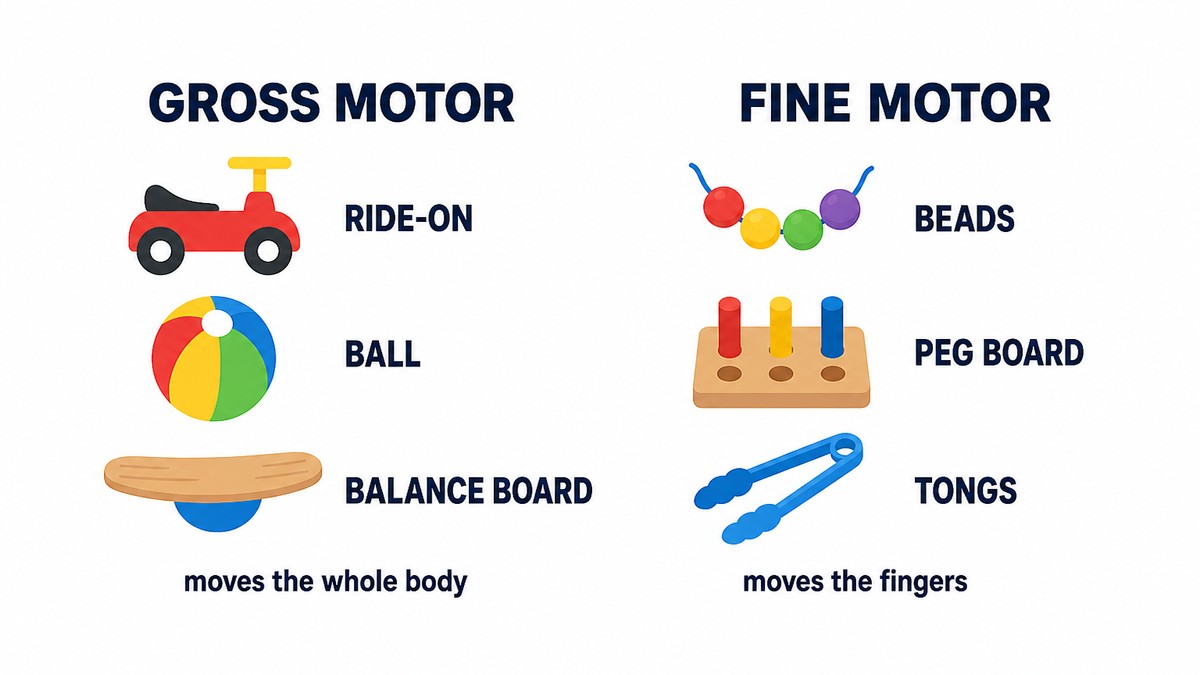
Gross motor skills move the whole body. Balance, walking, throwing and climbing all belong here. Ride-on toys, push-along walkers, balls and balance boards are the usual tools.
Fine motor skills control the hands and fingers. Pinching, threading, stacking and gripping belong here. Beads, lacing cards, peg boards, tongs, blocks and puzzles are the usual tools.
The difference matters commercially, and not for the reason most buyers expect. Fine motor toys are small by design. A bead has to fit a fingertip. A peg has to be pinched. That small size is the entire point of the product.
It is also the exact thing a United States rule watches. The feature that makes the toy work is the feature that decides which age it may be sold for. That collision is the subject of the rest of this guide.
| Family | What it trains | Toy types that do it | Common age |
|---|---|---|---|
| Gross motor | Whole-body balance, strength and coordination | Ride-on, push walker, ball, balance board, tunnel | 1 to 4 years |
| Fine motor | Fingers, grip and hand-eye control | Beads, lacing cards, peg board, tongs, blocks, puzzle | 2 to 6 years |
Which Toy Fits Which Age, and Why the Age Is a Legal Number
The skill builds in order. A child grips with the whole hand before it pinches with two fingers. A toy that arrives early teaches nothing, and a toy that arrives late gets ignored.
This is the practical order that toy buyers see in reorder data.
| Age band | Toy that fits | Skill it builds |
|---|---|---|
| 12 to 24 months | Chunky peg board, stacking cups, big-knob puzzle | Whole-hand grasp and release |
| 2 to 3 years | Large lacing beads, big blocks, tongs with pom-poms | Pinching and simple threading |
| 3 to 4 years | Smaller beads, child scissors, small-peg boards | Fingertip control and pressure |
| 4 to 6 years | Sewing cards, small puzzles, tweezers sorting | Finger strength, control and patience |
Now the part that surprises first-time importers. The age is not a suggestion. In the United States it decides which rule your product falls under, and the rules are not close to each other.
One number on your packaging moves the product between two complete sets of obligations. It also moves it between two kinds of testing cost. The next section explains how that switch works.
The Age Label Is the Legal Switch
The United States rule for small parts lives in 16 CFR Part 1501. Its first sentence sets the stakes. The rule covers a toy intended for children under 3 years of age. If small parts create a choking, aspiration or ingestion hazard, that toy is a banned hazardous substance.
Read that category carefully. A banned hazardous substance is not a product with a warning on it. It is a product that may not be sold at all. Aspiration means breathing a loose piece into the lungs, which is harder to treat than a swallow.
So the question becomes the important one. How does anyone decide what a toy is "intended for"? The rule answers that, and the answer is not about the toy.
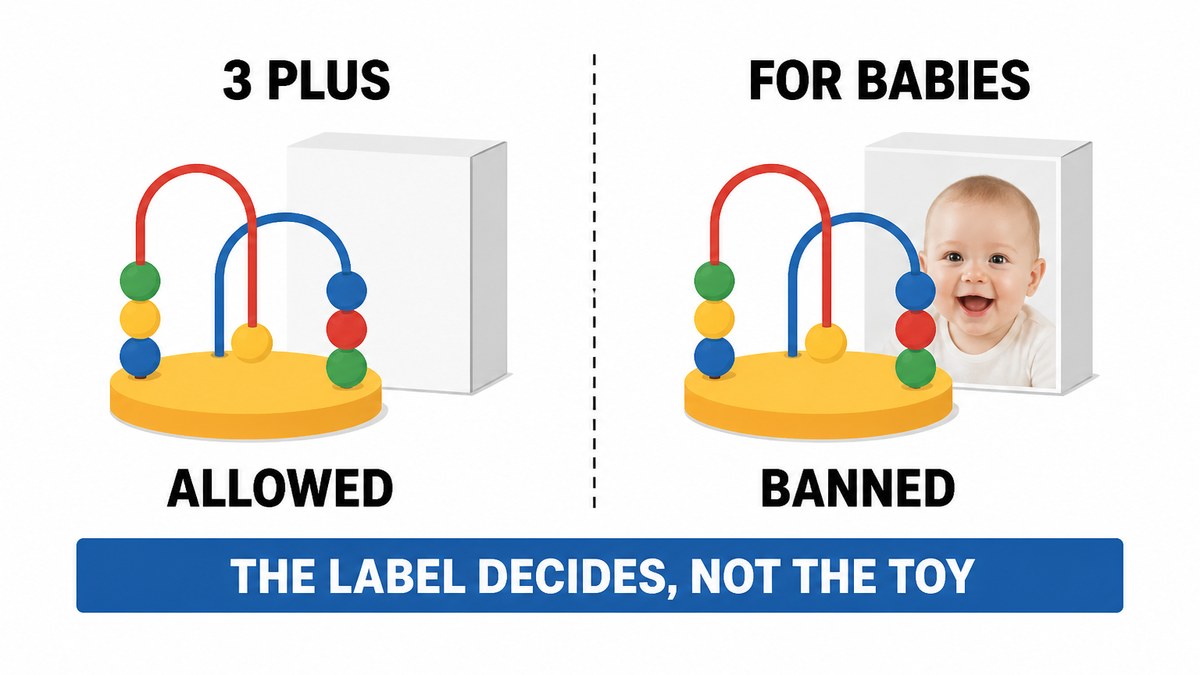
The scope section of Part 1501 lists three factors. They are your stated intent, which includes the label. They are the advertising, promotion and marketing. They are whether the article is commonly recognised as being for children under 3.
Two identical toys can sit on opposite sides of the law. One carries a 3+ label and neutral marketing. The other carries a baby photograph and the words "first beads". Only the second one is in scope.
Your label and your listing copy are the switch. That is why this decision belongs to the buyer, not to the supplier. A supplier will print whatever you ask for.
Part 1501 also names the product types it watches, and the list reads like a toy catalogue. It names squeeze toys, teethers, pull and push toys, pounding toys, and blocks and stacking sets. It names preschool toys, games and puzzles intended for children under 3.
Those are motor skills toys. The category this guide is about is named inside the rule.
One limit is worth knowing. The rule does not apply to toys meant only for children of 3 and older. It also does not cover every object a small child might reach at home. It covers toys and articles meant for that child.
The Two-Stage Test, and Why Stage Two Is the Costly One
The test itself is simple to describe and awkward to pass. It uses a small cylinder with fixed dimensions. The idea is simple. A piece that fits inside is small enough to block a young child's airway.
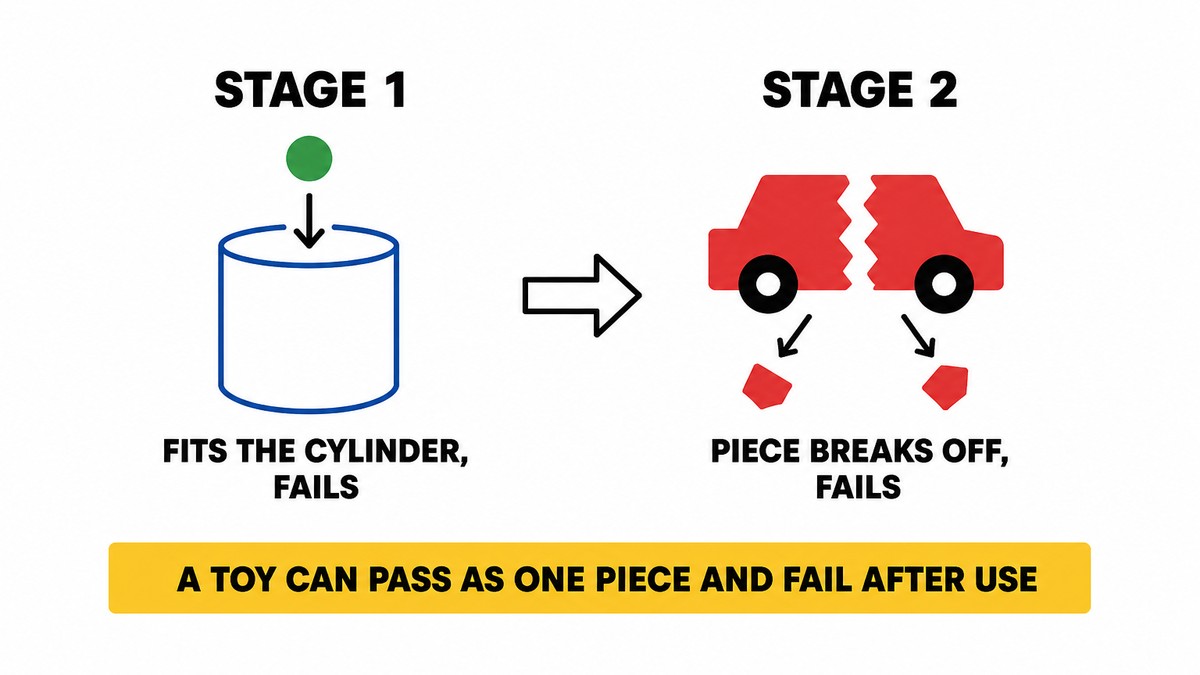
The first stage asks whether the toy fits. The test procedure in Part 1501 says to place the article, without compressing it, into the cylinder. If it fits entirely, in any orientation, it fails. Detached parts are tested the same way.
The second stage is the one that surprises people. If the toy does not fit as it arrives, the lab moves to stage two. It applies the "use and abuse" tests of 16 CFR 1500.51 and 1500.52, leaving out the bite tests.
Those tests drop the toy, pull it, twist it and bend it in the ways a real child would. Any piece that comes off is then placed into the cylinder on its own. If any piece fits, without being compressed, the toy fails.
So a product can pass inspection as a whole object and still fail. The question is not what the toy is. The question is what the toy becomes after a month of normal use.
This is where cheap material shows up in a lab report instead of a complaint. A bead that splits at the hole will shed a piece that fits the cylinder. A peg whose head snaps off leaves a stub that fits too.
| Stage | What the lab does | What makes it fail |
|---|---|---|
| Stage 1 | Places the toy, or any loose part, into the cylinder without squeezing it | It fits entirely, in any orientation |
| Stage 2 | Runs the drop, pull, twist and bend tests of 16 CFR 1500.51 and 1500.52, then tests every piece that broke off | Any broken piece fits the cylinder on its own |
Some products are outside this rule entirely, and the exemption list is oddly specific. The exemptions in Part 1501 cover balloons, books and other paper articles, and writing materials such as crayons, chalk and pencils.
The list also covers children's clothing and accessories. It covers grooming, feeding and hygiene products such as barrettes and toothbrushes. It covers records, modelling clay, and fingerpaint or watercolour sets. Rattles and pacifiers are exempt here only because they have their own separate rules.
Use that list when you plan a range. Modelling clay and crayons are exempt, so a fine motor kit built around them avoids this rule. A lacing bead set is not exempt. Beads are the moment you enter the rule.
What the Warning Must Say, and Where It Must Sit
Label a small-parts toy for 3 and older and a second rule starts. 16 CFR 1500.19 covers toys and games intended for children of at least 3 years but less than 6. If the toy includes a small part, it must carry a cautionary statement.
The rule calls a product without that statement misbranded. Misbranded is a legal failure in its own right, separate from any injury. The product can be stopped for the paperwork alone.
The statement has three parts. It needs the signal word WARNING, which the rule treats as the signal for a hazardous substance. It needs the hazard statement CHOKING HAZARD, which the rule names as the principal hazard here.
It also normally carries the age line the rule uses as its own example: not for children under 3 yrs. So the label does two jobs at once. It warns the parent, and it records the age you have claimed.
The formatting rules are stricter than most buyers expect, and they are the reason labels get rejected in review.
| Requirement | What it means in practice |
|---|---|
| English | The required statements must be in English. Other languages are extra, not a substitute |
| On at least two lines | The statements must be blocked together in a square or rectangular area, with or without a border. One long line does not comply |
| Solid background | The text must not sit over artwork, a vignette or a busy pattern. Design must not make it hard to read |
| Space or a border | It must be separated from other printed material by at least the height of its own type. If not, draw a border around it |
| Principal display panel | The statements belong on the panel a shopper sees first, not on the back or the base |
| Triangle | The alert triangle must be equilateral. Its height must match or beat the letter height of WARNING, and the mark inside must be centred |
There is one relief for small packaging. If the principal display panel is 15 square inches or less, the full statement may move to another panel. That is allowed only if the other panel shows it in three or more languages. The front must still carry a short statement with an arrow pointing to it.
One more point saves money later. State and local rules on small-parts labelling are preempted by federal law. You do not have to design a separate label for each state, and a supplier who claims otherwise is guessing.
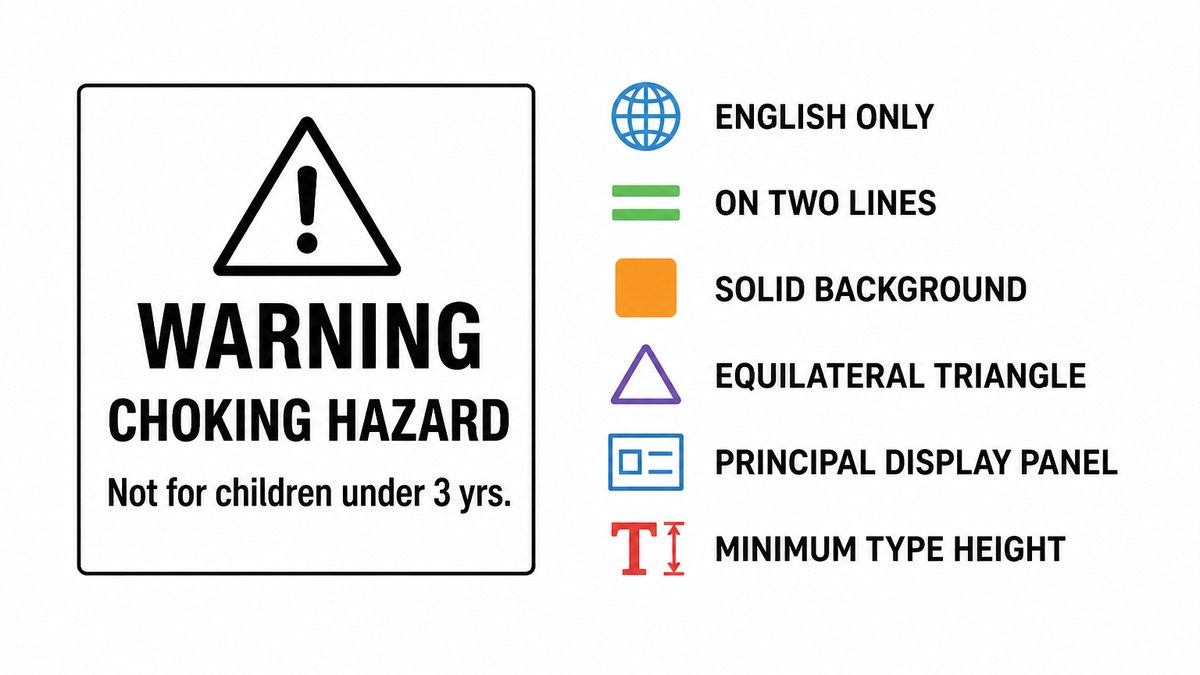
Treat this as a print file you sign off, not a detail you delegate. A label error found at the port is a shipment problem. The same error found in artwork is a ten-minute fix.
Two Newer Rules That Catch Sensory and Bath Toys
The small-parts rule is old and stable. Two newer additions to the same part of the code are less well known, and they land on products that motor-skills ranges often include.
The baseline first. the part that makes the toy standard mandatory turns that standard into law: each toy must comply with all applicable provisions of ASTM F963-23. That version was approved in August 2023.
Beyond that baseline, the same part now sets extra rules for two product families.
Water bead toys. The newer section sets performance and labelling requirements for water beads and toys that contain them. The stated aim is to cut the risk of children swallowing, inserting, breathing in or choking on a bead. It adds requirements beyond the general toy standard, and it defines a breathing-in hazard as a bead lodged in the airway.
Water beads turn up in sensory bins, sorting kits and calm-down sets. They are motor-skills products by any practical definition, and they now sit under a rule of their own.
Neck floats. The same part requires neck floats and their packaging to carry the safety alert symbol, a signal word and a word message. The wording must be in English at minimum. It must be conspicuous and permanent on the display area, in a colour that contrasts with the background, following the ANSI Z535.4-2023 layout standard.
Both rules point at the same habit. A range gets built around one core product, and then bath toys or sensory filler get added to fill a container. Each addition can bring its own rule with it.
| Rule | Product it covers | What it adds for you |
|---|---|---|
| 16 CFR 1250.2 | All toys | ASTM F963-23 becomes mandatory, so the test report is a requirement and not a sales extra |
| 16 CFR 1250.3 | Water bead toys and toys containing water beads | Extra performance and labelling duties beyond the standard, aimed at swallowing and breathing-in risks |
| 16 CFR 1250.5 | Neck floats | A set warning layout, permanent and contrasting, following ANSI Z535.4-2023 |
Sourcing This Category Without Redoing the Work
The certificate set for toys is already well covered, so this section stays on the part that these rules change. The full list of tests for the United States and Europe is in the guide to toy safety testing and certificates. Read that one for the paperwork.
What the small-parts rules change is the engineering conversation. Four questions do most of the work when you brief a supplier.
Ask what comes off. Do not ask whether the toy passed testing. Ask which pieces separated during the drop, pull and twist tests, and how big the largest of them was. A supplier who has run the test can answer that.
Design away the joints. Every glued or press-fitted joint is a future detachable part. A single moulded piece has nothing to break off, and it usually costs less than assembly labour. Material choice sets how the piece fails under load, so pick the material with the failure mode you want.
Specify the two weak points. On a bead, the hole is where it splits. On a peg, the head is where it snaps. Write a minimum wall thickness around the hole and a minimum neck diameter into the specification, not into the chat.
Match the label to the design. If the toy is small, you have two honest options. Make it bigger, or label it 3 and older and print the warning. Wishing it were both is the option that fails at the port.
Then treat the supplier the way you would treat any other. A factory audit before you pay a deposit tells you whether the plant can hold a tolerance at all. The ten screening steps before you approve a supplier come first, and the cluster question is settled in Yiwu versus Shantou for toy sourcing.
One habit is worth copying from buyers who do this well. They send every shortlisted factory the same drawing and the same label file, and they ask each one the same question about detachable parts. Comparing answers is only useful when the question was identical.
If you are new to the whole process, the wholesale toy sourcing playbook walks through cost, moulds and lead times in the order they happen.
Which toys are best for fine motor skills?
Beads, lacing cards, peg boards, tongs, blocks and puzzles do most of the work. They all ask the hand to pinch, thread or place something with control. Choose by the age band, not the picture. A chunky peg board is right at 18 months, and small beads are not.
At what age can a child use small beads?
Most bead sets are sold for 3 and older, and that number comes from the small-parts rule, not from child development. If a bead fits inside the test cylinder, the toy cannot be labelled for children under 3 in the United States.
Can I sell a bead toy for children under 3?
Only if it fails to fit the cylinder. That means making each piece larger, or removing the pieces altogether. The alternative is to label the product for 3 and older and carry the small-parts warning. A small bead toy sold for babies is a banned hazardous substance.
What warning does a small-parts toy need?
Three parts: the signal word WARNING, the hazard statement CHOKING HAZARD, and the age line. It must be in English, on at least two lines, on a solid background, on the principal display panel. The alert triangle must be equilateral and match the letter height.
Does the ASTM F963 test cover small parts?
Part of it does, and the two duties are separate. ASTM F963-23 is mandatory for toys through 16 CFR 1250. The cylinder test itself sits in 16 CFR Part 1501, and the warning rule sits in 16 CFR 1500.19. Ask the lab which clause each line of the report covers.
Do water beads need extra testing?
Yes. Water bead toys and toys containing water beads now have extra performance and labelling requirements beyond the general toy standard. The rule targets the risk of a child swallowing, inserting, breathing in or choking on a bead.
Check the Label Before You Buy the Mould
Send us the toy you want to make. We will tell you which pieces are likely to break loose in testing. We will say what size keeps the toy out of the small-parts rule. We will also say what the label has to carry for the age you want.
Ask Us to Check It
Questions & Comments
We read every one and reply within 24 hoursTell us what motor skills toy you are planning and which age you want to sell to. We will say which pieces are likely to break loose under testing, and how to keep the toy out of the small-parts rule.