
Best International Shipping Companies: Pick by Cargo, Not by Brand

There is no single best international shipping company, because the four cargo bands do not use the same kind of company. A 20 kg sample goes by courier. A 300 kg consignment goes by air freight. Two pallets go as LCL. A full container goes to a forwarder who books space on a liner. Pick the band first, then pick the company, and the shortlist becomes short.

Match the cargo, then the company.
| Cargo | Mode | Who you buy from |
|---|---|---|
| Under 30 kg | Courier express | A parcel carrier or a reseller account |
| 30 to 500 kg | Air freight | An air forwarder with a consolidation service |
| 1 to 15 cbm | Sea LCL | A co-loader or a forwarder that buys LCL space |
| 15 cbm and up | Sea FCL | A licensed forwarder or NVOCC that books with the liner |
Four cargo bands, four kinds of company
The first question is not “which company”. It is “which band is my cargo in”. The band decides the mode, and the mode decides who can sell to you.
A courier moves parcels through a hub network. It prices per parcel, and it handles the whole door-to-door trip including customs. It is excellent below 30 kg and costly above it.
An air forwarder buys space in the belly of a passenger plane or on a freighter. It prices per chargeable kilogram and consolidates several shippers into one air waybill. That is the right tool from about 30 kg to about 500 kg.
An LCL service fills one container from several shippers. You pay per cubic metre or per tonne, and the cargo shares a container with strangers. It works from one cubic metre up to about fifteen.
A full container is a booking, not a parcel. Above roughly fifteen cubic metres the ocean rate per unit drops enough that a whole container is cheaper. At that point you need a licensed intermediary, and the paperwork changes.
| Band | Typical trigger | Priced per | Main risk |
|---|---|---|---|
| Courier | Under 30 kg, parcel sized | Parcel, by zone | Volumetric weight doubles the bill |
| Air freight | 30 to 500 kg | Chargeable kg | Fuel and security surcharges move weekly |
| Sea LCL | 1 to 15 cbm | Cubic metre or tonne | Shared container, shared delays, co-loader cut-off |
| Sea FCL | 15 cbm and up | Container | Demurrage, detention, port choice |
The bands overlap on purpose. A 400 kg shipment can go by air or as LCL, and the choice depends on the deadline, not on the weight.
One order, two bands
Put 400 kg of cartons on the floor and two companies will both be right. An air forwarder can take it in four days. An LCL service can take it in five weeks for a fraction of the price.
The deciding question is what the cargo earns while it waits. If the stock sells at a margin that covers the air premium, air is cheaper in total. If it is going to a warehouse to sit for a season, the ocean price wins.
This is why a list of companies cannot answer the question. The same buyer, with the same cargo, should choose two different companies in two different months.
Write down three numbers before you call anyone. The weight, the volume, and the date the cargo has to be on a shelf. Those three decide the band, and the band decides who you should be talking to.
Where each mode stops working
Each mode has a point where the price per kilogram turns. Knowing the turn saves more money than any negotiation.
The courier turn is volumetric weight. A parcel that is light but bulky is billed on its size, not its mass. A carton one metre on each side is 167 kg of chargeable weight even if it weighs ten. That is the single most common surprise on a courier invoice.
The air turn is the 500 kg mark, roughly. Above it the per-kilogram rate flattens, and the fixed costs of an ocean booking start to look small next to the air premium.
The LCL turn is around half a container. Below that, paying for a whole container wastes money. Above it, LCL charges for space you do not need and adds handling at both ends.
These are planning boundaries, not published rules. Carriers price by lane and by season, so confirm the turn with a quote at both ends of the range before you commit.
One more boundary is inside each band: the chargeable weight divisor. Sea LCL compares cubic metres against tonnes. Air divides volume by 6,000. A courier divides by 5,000 or 6,000 depending on the carrier. Three separate divisors on one carton produce three separate bills.
Who is who
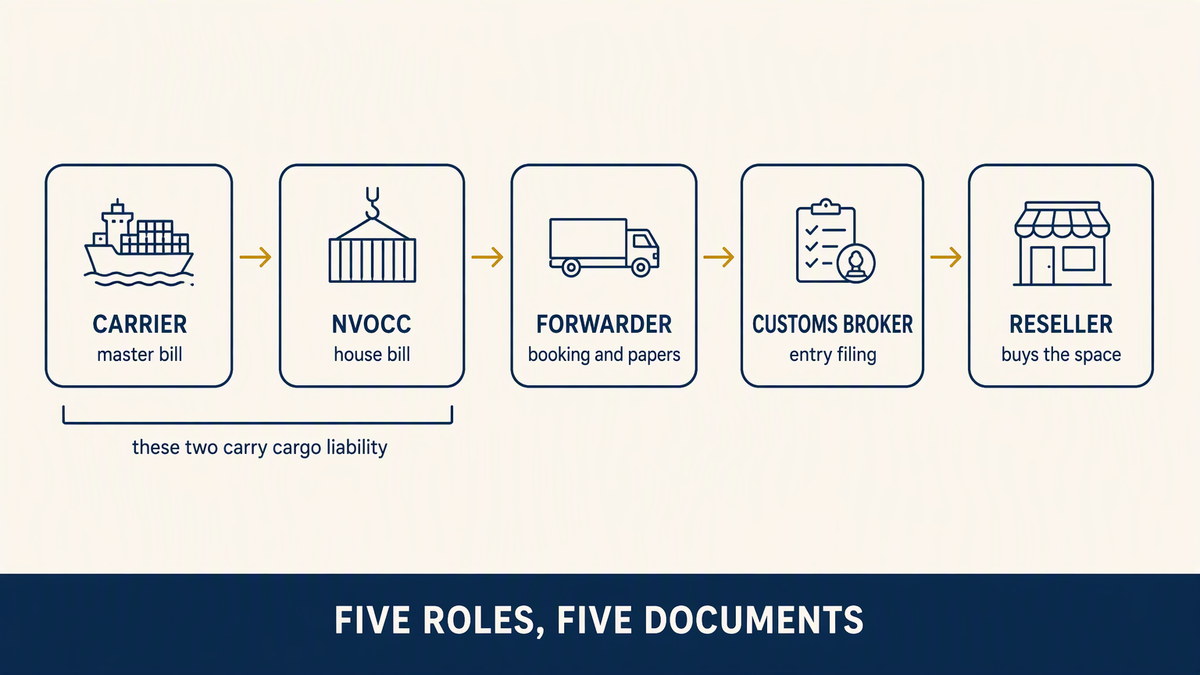
Most confusion on a shortlist comes from five words used as if they were one. They are not, and only two of them carry legal responsibility for your cargo.
| Role | What they own | Who they answer to |
|---|---|---|
| Carrier | The ship or the aircraft | Issues the master bill of lading |
| NVOCC | Contracted space on a carrier | Issues its own house bill of lading |
| Freight forwarder | The paperwork and the booking | Acts for you, the shipper |
| Customs broker | The entry filed with customs | Licensed to file, responsible for accuracy |
| Marketplace or reseller | A website and a rate card | Buys from one of the four above |
The distinction that matters in a claim is who issued the bill of lading. A forwarder that issues its own house bill is acting as an NVOCC and carries the cargo liability that goes with it. A forwarder that only arranges the booking passes you the carrier’s document.
A marketplace is not a bad choice. It is a reseller, and you should know whose space you are buying. Ask which company name appears on the bill of lading, then decide.
A two-minute test that works on any shortlist
You cannot check “experience” before you sign. You can check a licence, and in the United States that check is public.
An ocean transportation intermediary must be licensed by the Federal Maritime Commission and must show financial responsibility. The rule sits in the ocean intermediary licensing rules. Section 515.1 sets the penalty for operating without a licence at up to 9,000 dollars for each violation, and up to 45,000 dollars when the violation is wilful.
That number does two things. It tells you the licence is not decorative. And it gives you a question that a serious company answers in one line and a reseller dodges.
Four checks, in order
One: the licence number. Ask for it, then confirm the name on the licence matches the name on your quote. A trading name that differs from the licensed entity is common and not automatically wrong, but you should see both.
Two: financial responsibility. An NVOCC posts a bond or surety. Ask which form covers your booking. A company that cannot name it is not the licensed party.
Three: who issues the bill of lading. The answer decides who you claim against if the cargo is damaged or short.
Four: who files the ISF. For US ocean imports, an Importer Security Filing is due 24 hours before the cargo loads at the foreign port, under the ISF filing rules. Someone must own that deadline in writing. A late filing is a shipment that does not load.
None of these four checks costs money, and all four are answered before a deposit is paid. That is a better filter than a testimonial page.
What a rate card does not tell you
Two quotes for the same cargo can differ by a third, and the difference is usually in the lines that were left off. Each band hides another charge.
In courier, the hidden line is the surcharge stack. Fuel, remote area, address correction and oversize each add a percentage added to the base rate. A published rate card shows the base. Your invoice shows the stack.
In air freight, the hidden line is the security and fuel surcharge, which moves weekly. A quote that is three weeks old is a quote for another market. Ask for the surcharge as a separate number, and ask when it was last updated.
In LCL, the hidden lines are at both ends. Origin handling, documentation, destination terminal handling and a delivery order fee are billed by separate parties. The ocean rate is often the smallest of the five.
In a full container, the hidden lines are time. Free days at the terminal and free days on the container are two separate clocks. When either runs out, the bill is per day, and it is not small.
Ask for these lines in writing.
| Band | Line that gets left out | What it does to the bill |
|---|---|---|
| Courier | Fuel and remote-area surcharge | Adds a percentage to the base rate |
| Air freight | Security and fuel surcharge | Moves weekly with the market |
| Sea LCL | Origin and destination handling | Often larger than the ocean rate |
| Sea FCL | Free time, then demurrage | Per day, per container, after the clock |
None of this is dishonest. It is how the industry prices. The problem is weighing a quote that includes four lines with a quote that includes nine.
Score the shortlist instead of ranking it
Once you have three companies in the right band, stop looking for a winner. Score them on the things that will hurt you.
Five criteria cover most of the risk. The licence and the legal entity. The cut-off times in writing. The surcharge list. The claim route if cargo is damaged. And one named person who answers the phone.
Give each company a score out of two on each line, then add them up. A company that scores well on price but cannot name its cut-off times is not a lower-risk choice. It is an unmeasured one.
The scoring matters most when the two quotes are close. When one is much cheaper, the gap itself is the question. Ask which line the other quote includes that this one does not, and the answer usually names the missing service.
One question that separates the two
Ask each company for the name that will appear on the bill of lading. If the answer is the same company you are talking to, it is acting as an NVOCC and carries the cargo. If the answer is a carrier you have never heard of, the company is arranging, not carrying.
Neither answer is wrong. They are separate products, and they should be priced apart. A buyer who does not ask is comparing two things that only look alike.
The cut-off decides your week
In LCL, your deadline is not the carrier’s deadline. It is the co-loader’s deadline, and it comes earlier.
A co-loader takes cargo from several forwarders, builds the container, and hands it to the carrier. It needs your goods at its warehouse days before the vessel closes, because it has to stuff the container and weigh it.
So a forwarder who quotes “Thursday cut-off” may mean the carrier’s closing time. If the co-loader’s cut-off was Monday, your cargo misses the sailing by three days and nobody lied.
Ask for four times, not one. The warehouse receiving cut-off, the documentation cut-off, the co-loader’s build cut-off, and the carrier’s closing time. A company that can name all four is operating its own space. A company that can name one is passing you a rate card.
Who books: you or your supplier?
Most first orders are bought on terms where the supplier arranges the freight. That is convenient, and it removes your control over three things at once: the route, the arrival date, and the price you can audit.
When the supplier books, the freight is inside the unit price. You cannot see the ocean rate, the origin charges, or the margin. You also cannot change the port if the inland leg turns out to be costly.
Buying on terms where you choose the forwarder puts those decisions back in your hands. The trade-off is work: you need a forwarder, a broker, and a booking calendar.
The cut-off point is order size again. On a small trial order, letting the supplier handle it is fine, because your time costs more than the margin. From the second or third order, the freight line is large enough to be worth owning. Weighing CIF against FOB terms sets out what moves when you do.
Whoever books, one rule holds. The company that files the entry and the company that issues the bill of lading must both be named in writing before the goods leave. If those two names are missing, you do not have a shipping plan. You have a hope.
Send the shortlist you are considering
Send the two or three companies you are comparing, the cargo weight and the destination. We will name your band and check whether each company is licensed for it. We also list the questions to put in writing before you pay a deposit.
Check my shortlistA thirty-minute checklist
Set a timer. Thirty minutes is enough to move from a long list to one company, if you ask the same five questions in the same order.
Start with the band. Then ask for the licence number, the four cut-off times, the surcharge list and the name on the bill of lading. Write the answers side by side, in one file, and score them.
Companies that answer all five in one email are usually the ones that operate their own space. Companies that answer two and promise to revert are usually reselling. Both can be useful. Only one of them can be held to a schedule.
Questions about choosing a shipper
Who is the best international shipping company for small parcels?
For parcels under 30 kg, a courier network is the right tool. The company matters less than the account you buy through, because reseller rates are often below the counter rate. Compare on chargeable weight, not on the sticker price.
Is a freight forwarder cheaper than a courier?
Not below about 30 kg. A forwarder has fixed costs per shipment, so a small parcel pays for handling that a courier spreads across thousands of parcels. Above 100 kg the forwarder usually wins, and above 500 kg the gap is wide.
What is the difference between a forwarder and an NVOCC?
An NVOCC contracts space from a carrier and issues its own bill of lading, so it carries cargo liability. A forwarder arranges the booking and the documents, and may pass you the carrier’s bill instead. One company can act as both.
How do I check whether a shipping company is licensed?
Ask for the licence number and the legal entity name, then confirm they match the name on your quote. In the United States, ocean intermediaries are licensed and must show financial responsibility under 46 CFR Part 515.
Should my supplier book the freight?
On a first trial order, it is often fine. From the second order onward, booking it yourself gives you the route, the arrival date and an auditable cost. The freight line is usually large enough by then to be worth the work.
Why does LCL take longer than a full container?
Because the box waits for other cargo. Your goods arrive at the co-loader’s warehouse, then wait for the container to fill, then wait again at destination while the box is unpacked. Add a week or two to the sailing time.
If the order is still being costed, the same logic runs from the other end. The the full cost of an Alibaba order shows where freight sits next to unit price and duty.
Questions & Comments
Tell us the cargo weight, the volume and the destination country, and we will say which band you are in. If you already have a shortlist, paste the company names and we will tell you which one can legally issue the bill of lading.